
The Principia: Complete Chapter-by-Chapter Summary
Welcome to the beginning of our journey into the cosmos. Today, we are turning the page to one of the most influential works in human history: *Philosophiæ Naturalis Principia Mathematica*, written by Isaac Newton. As you see on the screen, this masterpiece serves as a foundational framework of rational mechanics. It is the book that unified the laws of motion and universal gravitation, forever changing humanity's understanding of the cosmos. Before we dive into the complex mathematics inside, let's appreciate the sheer scale of what Newton achieved here. He didn't just describe how things move; he explained why the planets orbit, why the moon stays in place, and how a single force governs everything from falling apples to distant stars. This is the starting point for everything we know about physics today.
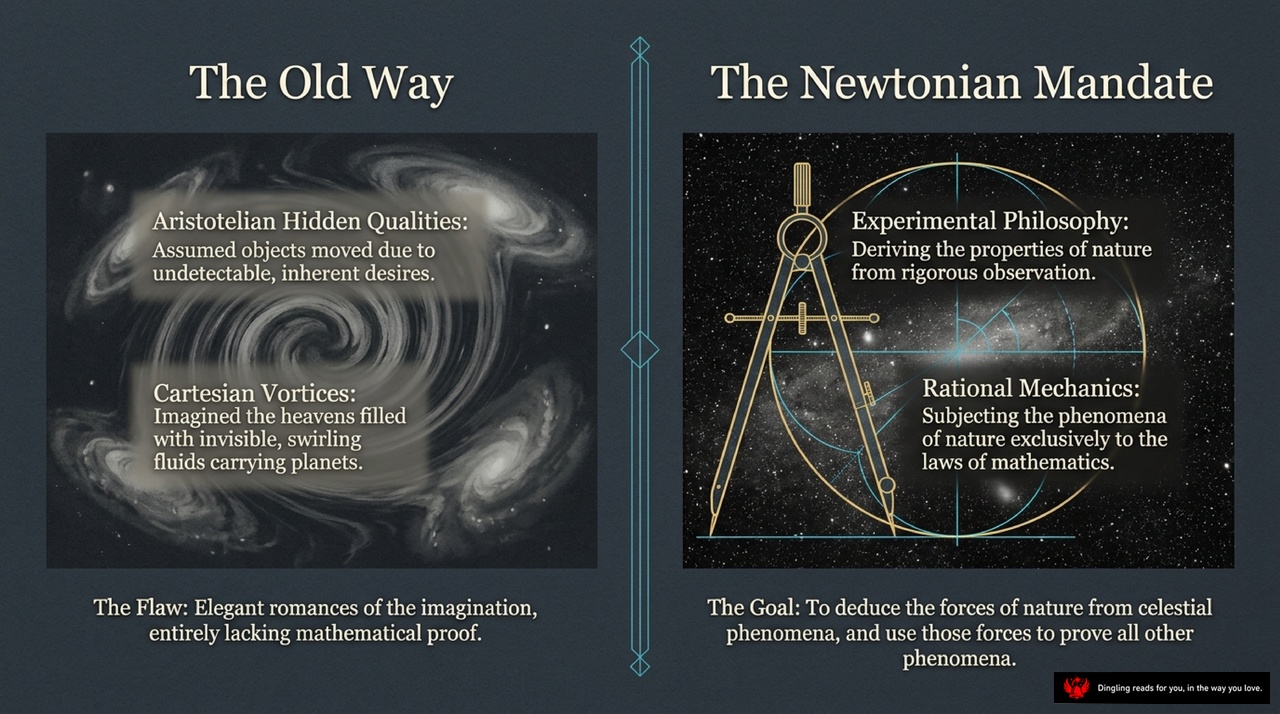
Look at this slide, which perfectly captures the dramatic shift in how we understand the universe. On the left, we see "The Old Way." For centuries, thinkers like Aristotle and Descartes tried to explain the heavens with invisible, hidden desires or swirling fluids called vortices. They imagined the planets were carried along by these invisible currents, a beautiful but entirely mathematical fiction lacking any real proof.
Now, look at the right side: "The Newtonian Mandate." This is the revolutionary change. Instead of guessing about hidden forces, Newton introduced "Experimental Philosophy." This means deriving the properties of nature from rigorous observation and math. We stopped imagining invisible fluids and started subjecting nature exclusively to the laws of mathematics. The goal was clear: deduce the forces of nature from celestial phenomena, like the moon's orbit, and then use those proven forces to explain everything else. It was a move from elegant romance to hard, mathematical truth.

Imagine the universe not as a chaotic mess, but as a perfectly engineered system built on four unbreakable rules. This slide lays out the "Epistemological Bedrock"—the foundation of how we actually know what we know.
Let's start at the very bottom with Rule I: Simplicity. Nature doesn't waste energy. It never does anything in vain. If you see a phenomenon, don't invent extra causes to explain it. Just admit the simplest cause that is true and sufficient to explain what you see. This is Occam's Razor in action.
Moving up to Rule II: Uniformity. Nature is consistent. If you see a stone fall in Europe, it will fall the same way in America. We must assign the same causes to the same natural effects. The laws of physics don't change just because you crossed an ocean.
Next, Rule III: Universality. Some qualities belong to everything. Things that can't be increased or diminished—like mass or inertia—are universal properties of all bodies. If it applies to one, it applies to all.
And finally, the crown of the pyramid, Rule IV: Experimental Supremacy. This is the most powerful rule of all. Propositions we deduce from observing real phenomena are accurate until new evidence proves otherwise. We trust our experiments. We trust induction. We don't guess; we observe, and we keep our conclusions until the universe forces us to change them.
These four rules aren't just philosophy; they are the operating system of reality. They tell us how to reason, how to build science, and how to understand the cosmos without getting lost in unnecessary complexity.
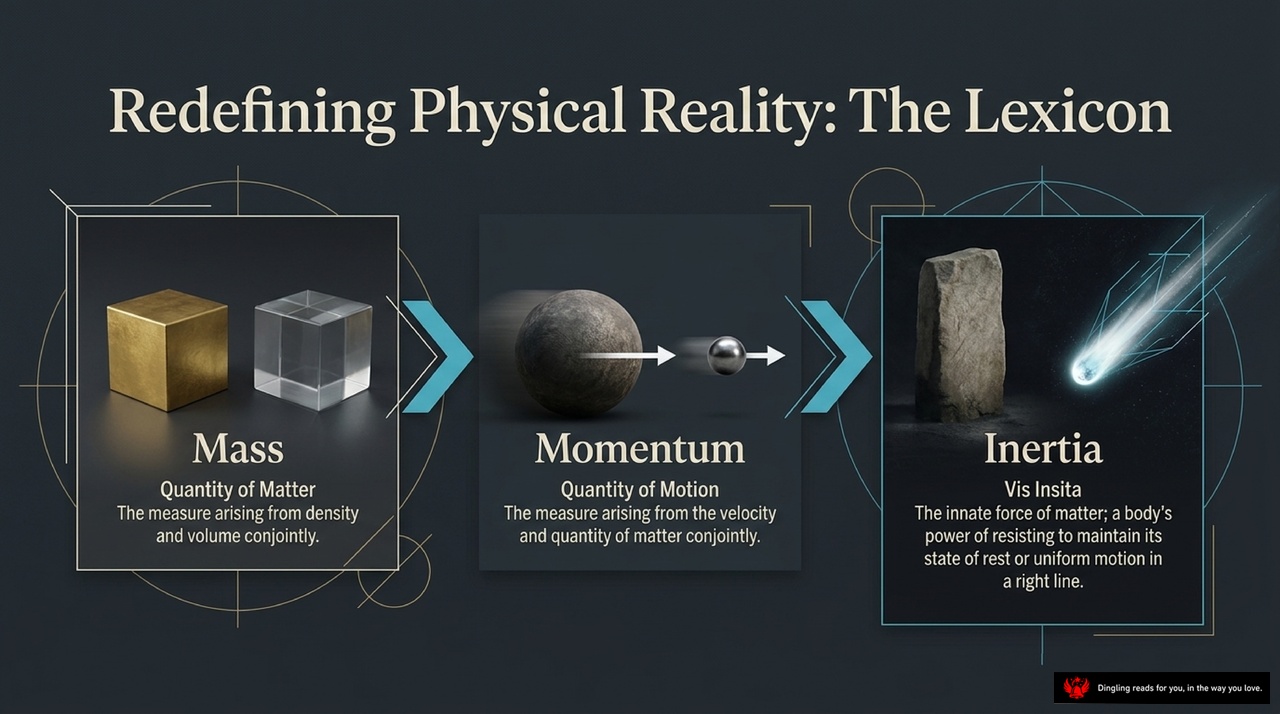
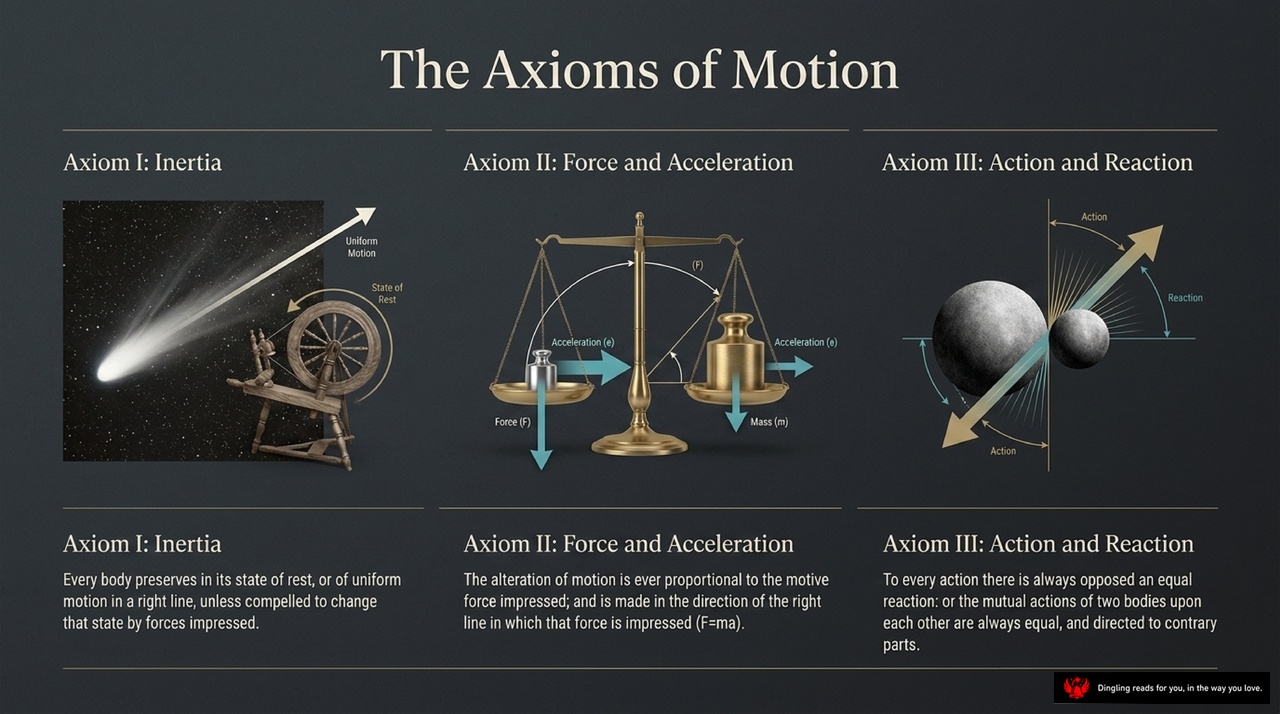
When we talk about how objects move through space, we often assume they just "stop" when they hit something. But Newton teaches us a radical idea: if you remove all friction and air resistance, an object in motion will never stop. It will keep moving in a straight line forever. This is the Law of Inertia.
Imagine pushing a heavy block. Once you let go, it doesn't magically vanish; it resists any change to its current state. That resistance is called Inertia, or "Vis Insita." It's the innate power of matter to maintain its state of rest or uniform motion. The more mass an object has, the stronger this inertia becomes.
Now, let's look at the force that changes this motion. Newton's Second Law tells us that force equals mass times acceleration. If you push a light cart and a heavy truck with the same strength, the light one zooms away while the heavy one barely moves. This isn't magic; it's math. The acceleration is directly tied to the force you apply and inversely tied to the object's mass.
But forces always come in pairs. Newton's Third Law states that for every action, there is an equal and opposite reaction. When you push a wall, the wall pushes back with the exact same force. This is why rockets fly: they blast gas backward, and that gas pushes the rocket forward. These forces are equal, but they act on different objects, so they don't cancel each other out.
Finally, consider systems of multiple objects. No matter how they interact internally, their collective center of gravity follows a simple path. If no external force acts on the system, that center will either stay still or move in a straight line at a constant speed. This principle allows us to simplify complex interactions, like planets orbiting a sun, by focusing on the movement of their shared center. Together, these laws form the foundation of classical mechanics, explaining everything from falling apples to orbiting moons.
Imagine a world where the universe isn't just a chaotic mess of moving parts, but a perfectly tuned machine governed by simple, elegant rules. Today, we're diving into the heart of that machine: the geometry of orbits.
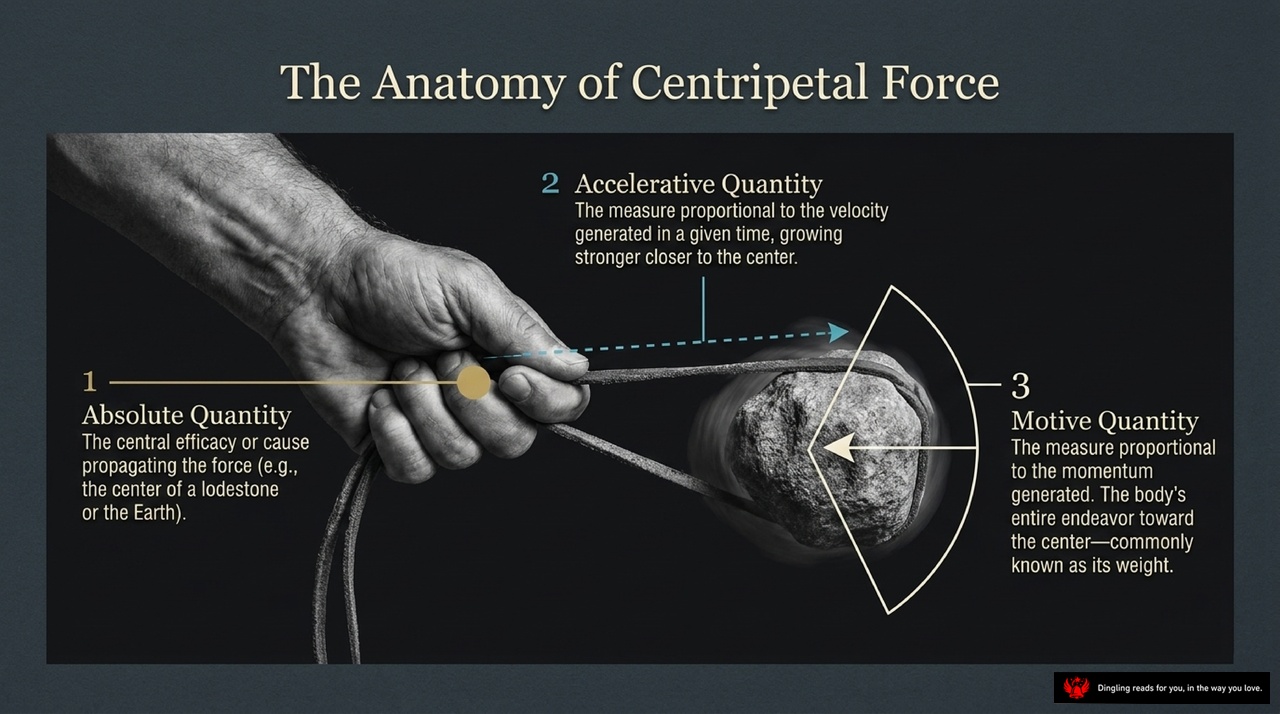
Look at the diagram on your screen. It breaks down the "Anatomy of Centripetal Force" into three distinct components working in harmony. First, we have the **Absolute Quantity**. Think of this as the "source" of the pull—the central efficacy, like the massive gravity of a planet or a star, acting as the anchor that propagates the force. Without this center, there is no orbit.
Next, we see the **Accelerative Quantity**. This is the measure of how quickly an object's speed changes as it gets closer to that center. It's the engine of the turn, growing stronger the nearer you get to the core. It's what makes the object curve instead of flying off in a straight line.
Finally, there's the **Motive Quantity**. This represents the object's own momentum—its entire endeavor to keep moving forward. In simple terms, this is related to the object's weight and inertia. It's the resistance to being pulled in.
Newton's genius lies in showing how these three interact. The orbit you see isn't magic; it's a precise balance between the center pulling in (Absolute), the speed changing (Accelerative), and the object's momentum trying to fly away (Motive). When these forces align perfectly, you don't get a crash or a spiral out; you get a stable, repeating path.
This isn't just about rocks tied to strings. This same principle explains why the Moon stays in orbit around Earth, why planets dance around the Sun, and even how satellites stay aloft. It reveals that the complex motions we see across the cosmos are actually just the result of these three fundamental quantities interacting in a predictable, mathematical rhythm. The universe speaks a language of geometry, and now, you understand the grammar.

Imagine a world where the air itself acts like a thick, invisible syrup. In this fluid, resistance isn't just a nuisance; it's a fundamental force that dictates how things move. Today, we're diving into Newton's deep analysis of fluid motion and the drag that slows us down.
Look at the first concept here: the nature of fluid resistance. Newton asks a crucial question: where does this resistance come from? He suggests it stems from the lack of lubrication between moving parts. If you picture a solid cylinder spinning inside an endless ocean of fluid, the fluid doesn't just sit there. It gets dragged along, rotating with the cylinder. But here's the fascinating part: the speed of that rotation drops as you move away from the center. The fluid closest to the cylinder spins fast, but the layers further out spin slower. This creates a specific pattern where the time it takes for a fluid layer to complete a circle is directly proportional to its distance from the axis.
Now, shift your focus to a sphere. When a ball spins in this same fluid, the math changes slightly. The resistance spreads out differently, and the time required for the fluid to rotate increases with the square of the distance from the center. Newton realized that if you stop pushing the sphere, this "whirlpool" or vortex won't last forever. Without an external force keeping it spinning, the fluid's energy dissipates, and the sphere will eventually slow down and stop. This interaction explains why objects in a medium never maintain constant velocity on their own.
But what about objects that aren't spinning, but are just moving through the fluid? Think of a pendulum swinging through air or a cannonball flying through the sky. Newton breaks this down into three types of resistance: inertial resistance, which depends on the density of the air and the square of the object's speed; viscous resistance; and friction. He concludes that inertial resistance is the dominant force. Interestingly, the shape of the object matters immensely. A sphere experiences less drag than a cylinder of the same size because of how the fluid flows around it.
Finally, let's look at the practical implications. We can actually measure this resistance using a pendulum. When a pendulum swings through a resistive medium like air, it loses energy, and its swing gets smaller over time. By comparing the length of the pendulum needed to swing once in a vacuum versus in air, we can calculate the strength of that resistance. Newton also notes that sound travels faster in spring and autumn when the air is thinner and more elastic, compared to the denser, sluggish air of winter. These insights didn't just explain how things move; they laid the groundwork for understanding everything from planetary orbits to the flight of birds, proving that even the invisible air around us has strict, predictable rules.
Imagine a world where everything is connected by invisible threads of force. Today, we're diving into the heart of how objects attract one another across the vastness of space.
Look at this slide: "Object Attraction Research." It breaks down exactly how gravity works, not just for planets, but for spheres, irregular shapes, and even the air around us.
First, think about a perfect sphere. If you stand inside a hollow shell, you feel nothing. Why? Because the pull from every part of the shell cancels out perfectly. But step outside, and suddenly, that entire shell acts as if all its mass is concentrated in a single point at the center. That's the magic of the inverse-square law: the force drops off with the square of the distance.
Now, what if the object isn't a perfect sphere? The text explains we can break any complex shape—like a flattened planet or an irregular rock—into tiny pieces. We calculate the pull of each piece and add them up. This turns a messy 3D problem into a solvable sum, helping us understand why our planet is actually a bit flattened at the poles.
The slide also touches on resistance. When an object moves through a thin medium, like air or space dust, it encounters drag. This resistance depends on the object's speed, its size, and the density of the medium. Interestingly, the shape matters too. A streamlined cone cuts through the air more easily than a blunt cylinder, which is why we design aircraft and rockets with aerodynamic shapes to minimize energy loss.
Finally, consider how this applies to sound and waves. When a disturbance travels through a fluid, it doesn't just go straight; it spreads out. The speed of these waves, whether it's sound in air or ripples in water, is tied to the medium's elasticity and density. By understanding these principles, we can predict everything from the orbit of a distant comet to the precise timing of a pendulum clock in a resisting medium.
In short, this page gives us the toolkit to move from simple spheres to complex real-world objects, showing us that the same laws of attraction and resistance govern everything from the cosmos to the air we breathe.

Imagine a world where the air itself acts like a thick, invisible syrup, resisting every movement. This is the realm of fluid resistance, a topic where Newton transforms complex physics into elegant geometry. Think of a solid cylinder spinning endlessly in a uniform ocean of fluid. As it turns, it doesn't just push water aside; it drags the fluid along, creating concentric layers of motion. Here's the key insight: the fluid closest to the cylinder moves fastest, while layers further away move slower. Why? Because the friction between these layers depends on their surface area and relative speed. Since the surface area of a circle grows with the square of its radius, the resistance drops off sharply as you move outward. This means the speed of the fluid decreases in direct proportion to its distance from the center. It's a perfect, predictable cascade of motion, like a silent wave rippling outward from a spinning stone.
Now, shift your focus to a solid sphere spinning in that same fluid. The math gets slightly different because of the shape. The resistance now scales with the square of the distance, meaning the fluid's speed drops off much faster as you move away from the sphere's center. The rotation creates a vortex that propagates outward, carrying motion to the infinite edges of the fluid. But there's a catch: without an external force keeping the sphere spinning, this motion will eventually dissipate. The energy leaks out into the infinite space, and the sphere slows down until it stops.
But what if we place another object inside this spinning vortex? If an object floats within this fluid, its fate depends entirely on its density relative to the surrounding medium. If the object is denser than the fluid, the vortex will pull it inward, dragging it toward the center. If it's lighter, the fluid will push it outward, sending it spiraling away from the center. This is the power of the vortex theory—it predicts how objects migrate based on simple density differences.
However, Newton wasn't satisfied with just this analogy. He tested it against reality, specifically the motion of planets. And here, the vortex theory hit a wall. According to the vortex model, fluid moving through a narrow channel should speed up, similar to water in a river. But planets do the opposite: they move slower at their farthest point from the sun (aphelion) and faster when closest (perihelion). Furthermore, the time it takes a planet to orbit doesn't match the vortex's prediction. The vortex model simply couldn't account for the precise, elliptical paths of the planets. This failure led Newton to abandon the idea of a physical "aether" driving the heavens, paving the way for his true masterpiece: the law of universal gravitation, which relies on invisible forces rather than swirling fluids.
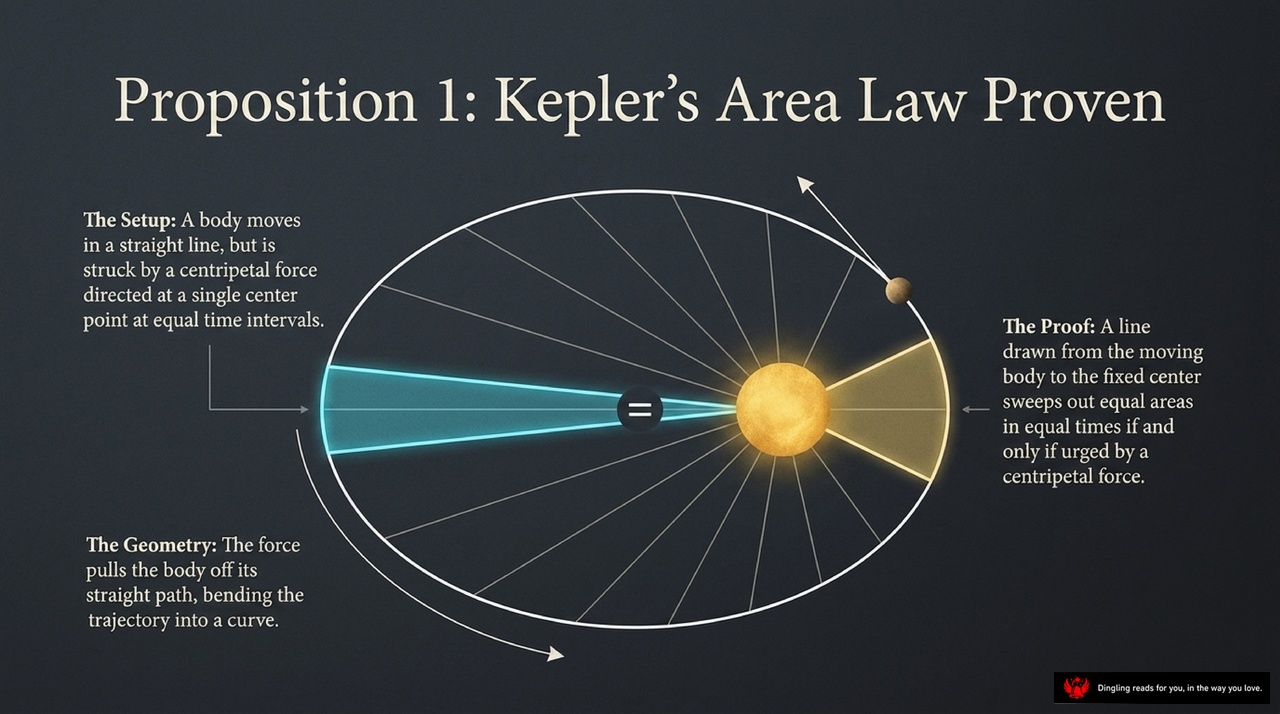
Imagine a universe where the invisible hand of gravity sculpts the paths of everything from the moon to the distant comets. Today, we are diving into the heart of that cosmic architecture by proving Kepler's Area Law. As you see on the slide, this is Proposition 1: the mathematical proof that a planet sweeps out equal areas in equal times.
Think of a body moving in a straight line, suddenly struck by a centripetal force pulling it toward a single center point. This force doesn't just stop the object; it bends its trajectory into a curve. The geometry here is crucial: because the force always points to that fixed center, the line drawn from the moving body to the center sweeps out equal areas in equal times if and only if the object is urged by this specific centripetal force.
This isn't just abstract theory; it explains why planets speed up when they are closer to the sun and slow down when they drift away. The area swept out by the radius remains constant over time, a direct consequence of the inverse-square law of gravity. By establishing this link between geometry and force, we unlock the ability to predict orbital shapes, from the elliptical paths of planets to the parabolic trajectories of comets. This proof lays the foundation for understanding that the same force pulling an apple to the ground is the very force keeping the moon in orbit, unifying the mechanics of the heavens and the earth under one elegant law.
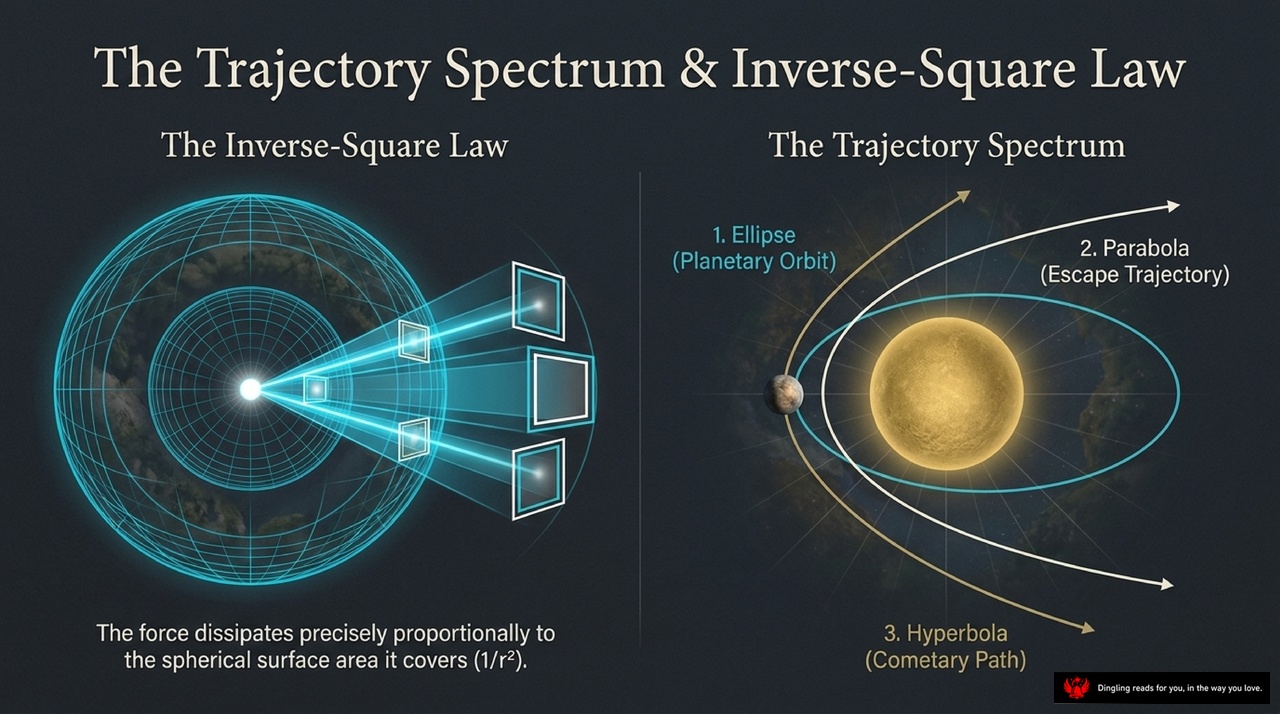
On this slide, we see the visual language of gravity: the Inverse-Square Law on the left and the Trajectory Spectrum on the right. Think of the force lines spreading out like light from a bulb; as they cover more spherical surface area, the force weakens precisely by the square of the distance, $1/r^2$. This simple geometric rule dictates everything that happens in the cosmos.
When that force follows this exact $1/r^2$ pattern, the resulting path isn't just a random curve—it belongs to a specific family of shapes known as conic sections. Look at the spectrum: an Ellipse is the stable, closed loop we see in planetary orbits; a Parabola represents the critical "escape trajectory" where an object just barely breaks free; and a Hyperbola describes the open, sweeping path of a comet passing by once and never returning.
The beauty of Newton's insight here is that it unifies the motion of planets, comets, and even escaping spacecraft under one geometric roof. Whether an object stays bound in an ellipse or flings itself into the void on a parabolic or hyperbolic path, the underlying cause is always that same inverse-square attraction. It's a single law governing the entire spectrum of cosmic motion.

Imagine a world where you don't have to calculate the pull of every single grain of sand on a beach to understand how the tide works. Newton gave us a brilliant shortcut. He mathematically proved something counterintuitive: if you have a sphere made of uniformly attracting particles, the trillions of microscopic pulls they generate add up to behave exactly as if 100% of that planet's mass were concentrated at its precise mathematical center.
Look at this visualization. We have a massive sphere, perhaps a planet, with its mass distributed throughout its volume. Now, imagine an external object, like a moon or a satellite, approaching it. Instead of calculating the complex gravitational tug from every individual particle inside that sphere, Newton's synthesis allows us to treat the entire sphere as if all its mass were sitting right in the middle.
The diagram shows these blue lines representing the gravitational pull converging on the external object. The result is a single, powerful arrow pointing directly toward the center. This is the "Spherical Attraction Synthesis." It means that for any object outside a uniform sphere, the distance to the center of mass is the only thing that matters. Whether the planet is huge or small, or whether the object is far away or close, the math simplifies beautifully. You can calculate the pull of an entire world by treating it as a single point of mass at its core. This principle is what allows us to predict the orbits of moons, planets, and even stars with such incredible accuracy, turning a chaotic collection of particles into a manageable, predictable force.
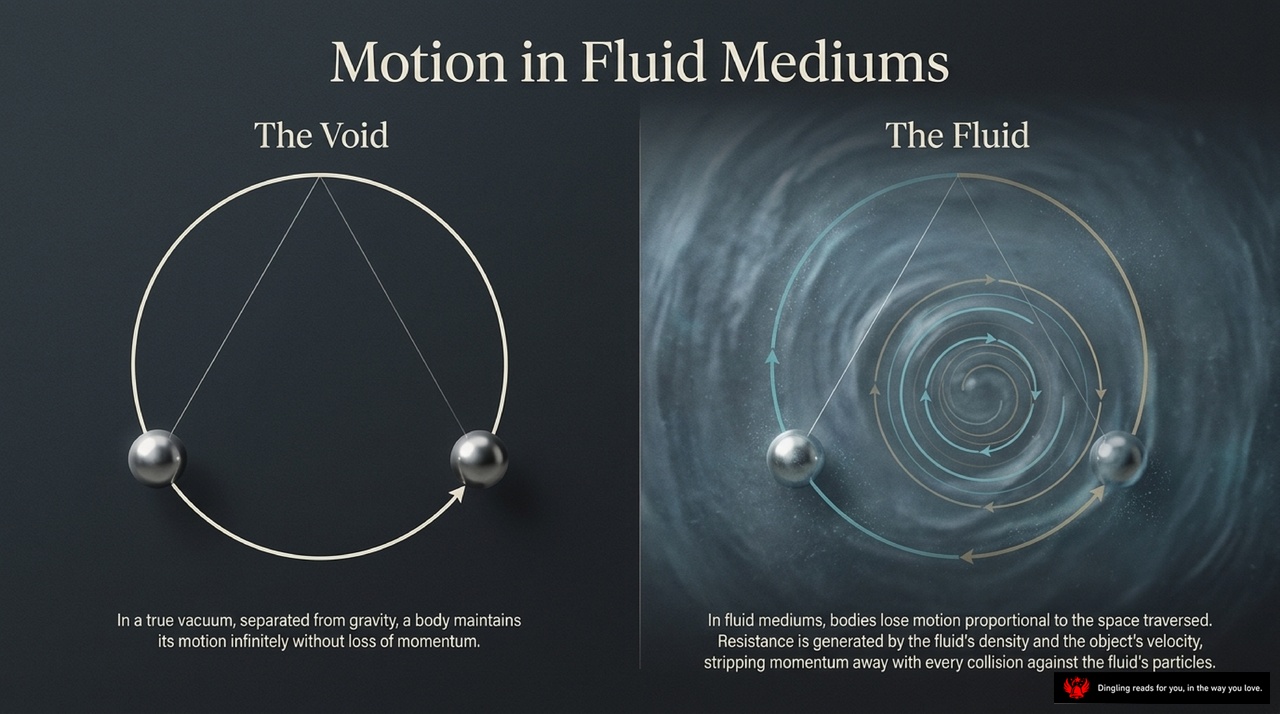
Motion in Fluid Mediums: A Tale of Two Worlds. Imagine a perfect vacuum, a true void where gravity is absent. Here, a body is a solitary traveler. Once set in motion, it never stops. It maintains its momentum infinitely, sliding along its path without a single loss of energy. This is the pure, unyielding nature of inertia in a void.
Now, shift your gaze to the right. Enter the fluid. This is the real world we live in—air, water, anything that resists. Here, the story changes completely. As an object moves through this medium, it doesn't just glide; it collides. Every particle it strikes steals a piece of its momentum. The denser the fluid and the faster the object moves, the greater this resistance becomes. Unlike the void, motion here is a constant battle. The object loses speed proportional to the distance it travels, stripped away by the relentless friction of the fluid's particles. So, while the void offers eternal flight, the fluid demands a price for every step forward.
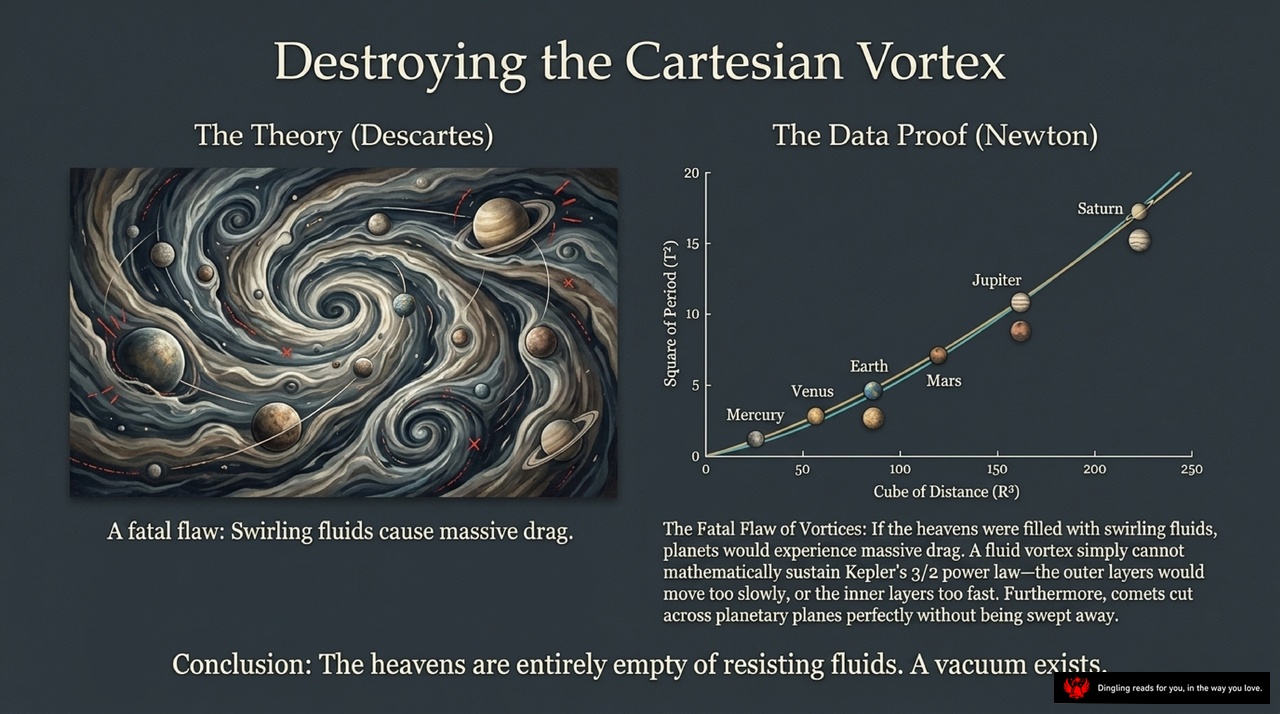
Look at this split-screen comparison: on the left, we see Descartes' swirling vortex theory, a beautiful but fatal idea where planets are carried along by a giant cosmic whirlpool. On the right, Newton presents the hard data proof.
Newton's argument was brutal but brilliant. He pointed out a fatal flaw in the vortex theory: if space were filled with swirling fluid, planets would experience massive drag. A fluid vortex simply cannot mathematically sustain Kepler's 3/2 power law. Imagine the physics here; the outer layers of a whirlpool would have to move too slowly, or the inner layers too fast, to keep up with the observed planetary speeds. Furthermore, comets cut across planetary planes perfectly without being swept away by the fluid.
The graph on the right visualizes this reality. It plots the square of the period against the cube of the distance, showing a perfect straight line that matches the data for Mercury, Venus, Earth, Mars, Jupiter, and Saturn. This linear relationship proves that the heavens are entirely empty of resisting fluids. There is no drag, no fluid, and no vortex. A vacuum exists. This simple realization destroyed the Cartesian vortex and paved the way for our modern understanding of gravity.
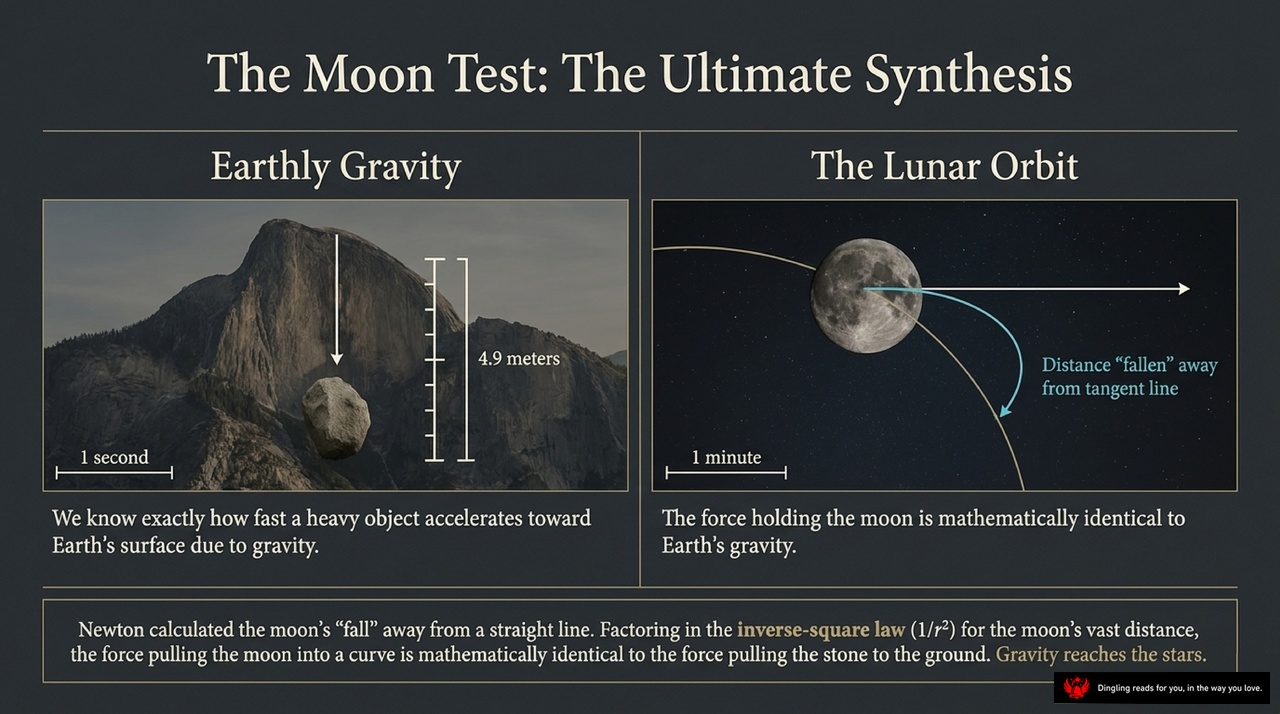
Imagine this: you drop a heavy stone from a cliff. In just one second, it falls nearly five meters. We know exactly how gravity pulls it down here on Earth. But what if that same invisible force reaches all the way to the Moon?
This slide shows Newton's "Moon Test," the ultimate proof that gravity is universal. On the left, we see earthly gravity: a stone accelerating toward the ground. On the right, we see the Moon's orbit. For every minute the Moon travels along its path, it is actually "falling" away from a straight line by a specific distance. Newton realized that this lunar "fall" is mathematically identical to the stone's fall on Earth.
By factoring in the inverse-square law, he proved that the force holding the Moon in orbit is the exact same force pulling the stone to the ground. Gravity doesn't stop at our atmosphere; it reaches the stars. This synthesis unified the heavens and the Earth under one single, elegant law.
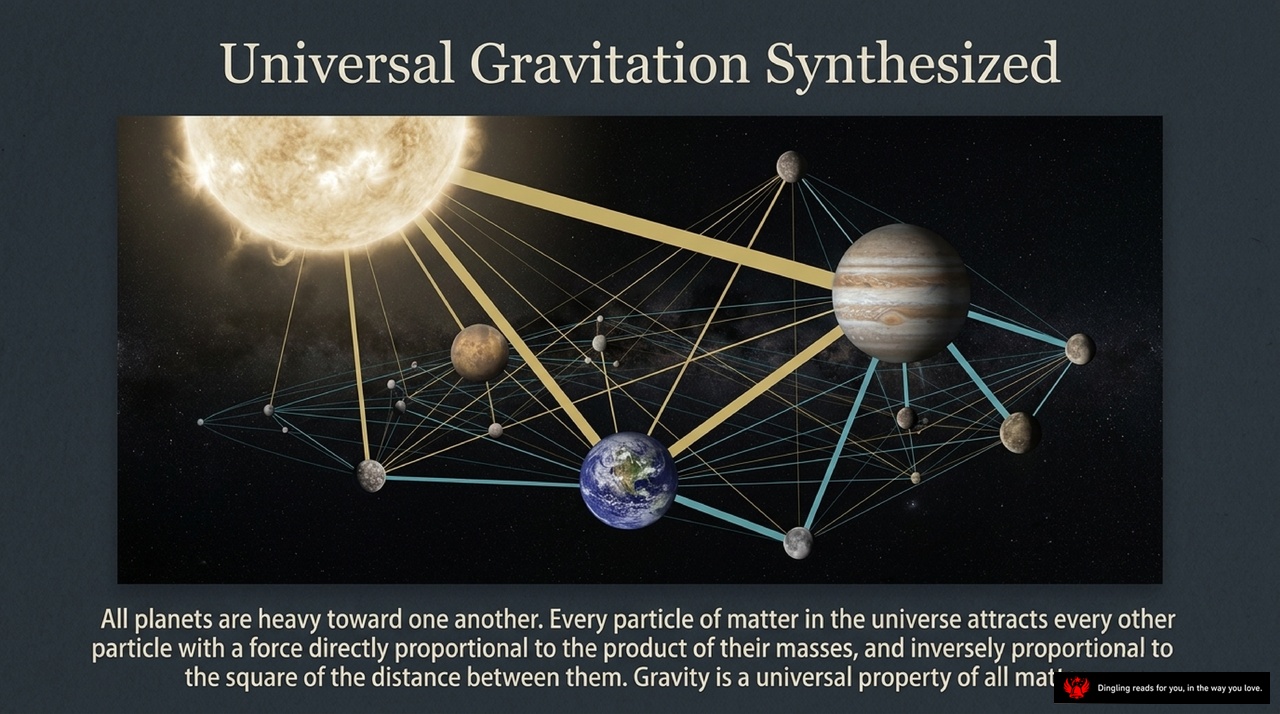
Imagine the entire solar system as a massive, invisible web. Look at this diagram: "Universal Gravitation Synthesized." Notice how every single planet, from our Earth to Jupiter, is connected by these golden and blue lines? These aren't just artistic lines; they represent the invisible threads of gravity pulling everything together.
The text at the bottom captures the core truth of this cosmic dance: "All planets are heavy toward one another." It reminds us that gravity isn't just a force pulling us down to the ground; it is a universal property of all matter. Every particle in the universe attracts every other particle.
Think about the math behind this connection. The text explains that the force pulling us together is directly proportional to the product of our masses. The heavier the objects, the stronger the pull. But here is the crucial part: the force is inversely proportional to the square of the distance between them. This means that as planets get farther apart, the gravitational pull weakens dramatically.
So, when you look at this complex web of lines connecting the Sun to every planet and moon, you are seeing the visual representation of Newton's law. It shows that the same force keeping the Moon in orbit is the exact same force that keeps an apple falling from a tree. Gravity binds the universe into a single, coherent system, ensuring that no matter moves chaotically, but instead follows the elegant, predictable paths we see in the sky.
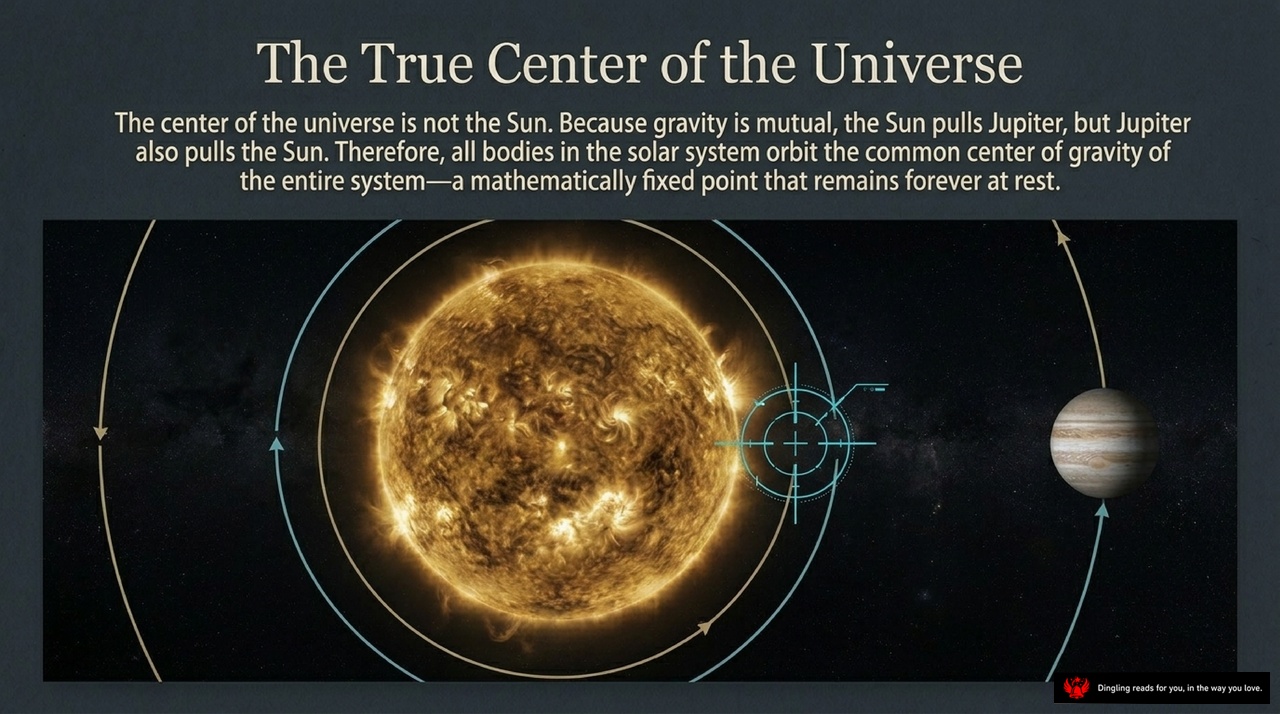
Let's cut through the common misconception that the Sun sits perfectly still at the center of our solar system. In reality, the "True Center of the Universe" for our system isn't the Sun itself. Think about it: gravity is a two-way street. The Sun pulls on Jupiter, but Jupiter pulls back on the Sun with equal force. Because Jupiter is so massive, this tug-of-war means the Sun actually wobbles slightly.
As the slide illustrates, all bodies in the solar system don't orbit the Sun directly; instead, they orbit a common center of gravity—a mathematically fixed point that remains forever at rest. This point, often called the barycenter, is the balance point where the Sun and Jupiter's gravitational forces cancel each other out. So, while we see planets circling the Sun, the truth is that both the Sun and the planets are dancing around this invisible, stationary center point together.
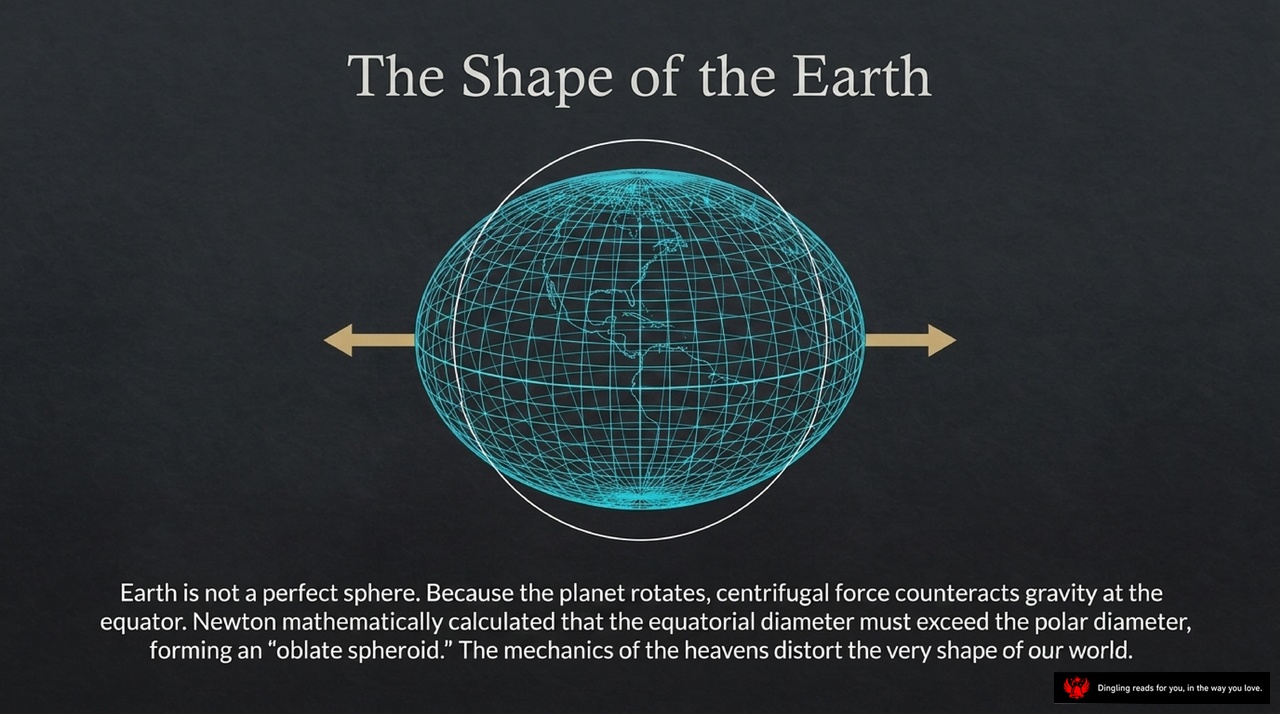
Have you ever looked up at the night sky and wondered why our world isn't a perfect, smooth sphere? For centuries, we imagined the Earth as a flawless ball, but Isaac Newton changed that perspective forever. As this slide illustrates, the Earth is actually an "oblate spheroid"—think of it like a slightly squashed ball or a grape that's been gently pressed from the sides.
Why does this happen? It all comes down to our planet's spin. Because the Earth rotates on its axis, it creates a centrifugal force that pushes outward, especially at the equator. This force counteracts gravity, effectively bulging the Earth outward around its middle. Newton was the first to mathematically prove this: he calculated that the equatorial diameter must be wider than the polar diameter. In simple terms, the mechanics of the heavens are constantly distorting the shape of our world, stretching it into this unique oval form. So, next time you see a globe, remember that it's a simplified model; the real Earth is a bit fatter around the waist than it is tall from pole to pole.
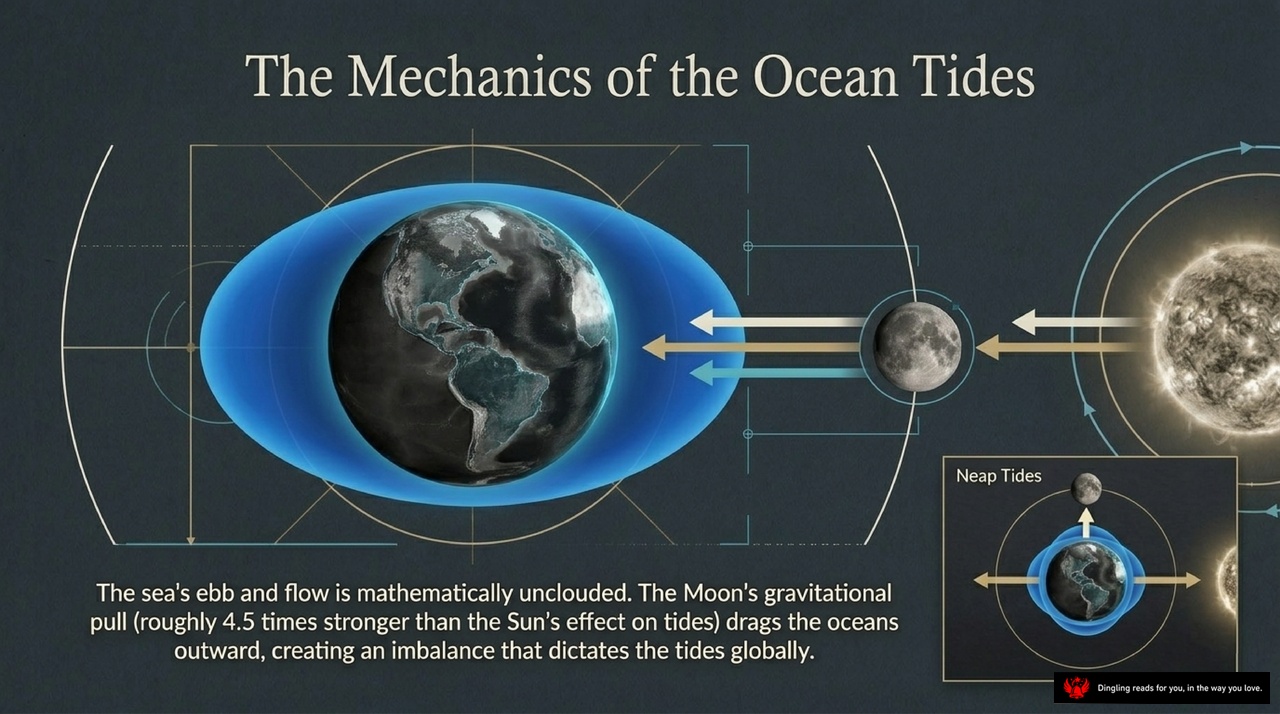
The mechanics of ocean tides aren't magic; they're a precise mathematical dance between the Earth, the Moon, and the Sun. As this slide illustrates, the sea's ebb and flow is driven by gravitational pull. Here, you can see the Earth being tugged by the Moon and the Sun, with arrows indicating the direction of these forces.
Crucially, the Moon's gravitational pull is roughly 4.5 times stronger than the Sun's effect on tides. This imbalance drags the oceans outward, creating the bulges we see on opposite sides of the planet. While the Sun contributes, it's the Moon's proximity and mass that dictate the global rhythm of the tides.
In the corner, you'll also notice a diagram labeled "Neap Tides." This shows what happens when the Sun and Moon pull at right angles to each other, resulting in weaker tides. But the primary driver remains the Moon's dominant gravitational grip, pulling our oceans into a predictable, rhythmic cycle that has shaped life on Earth for billions of years.
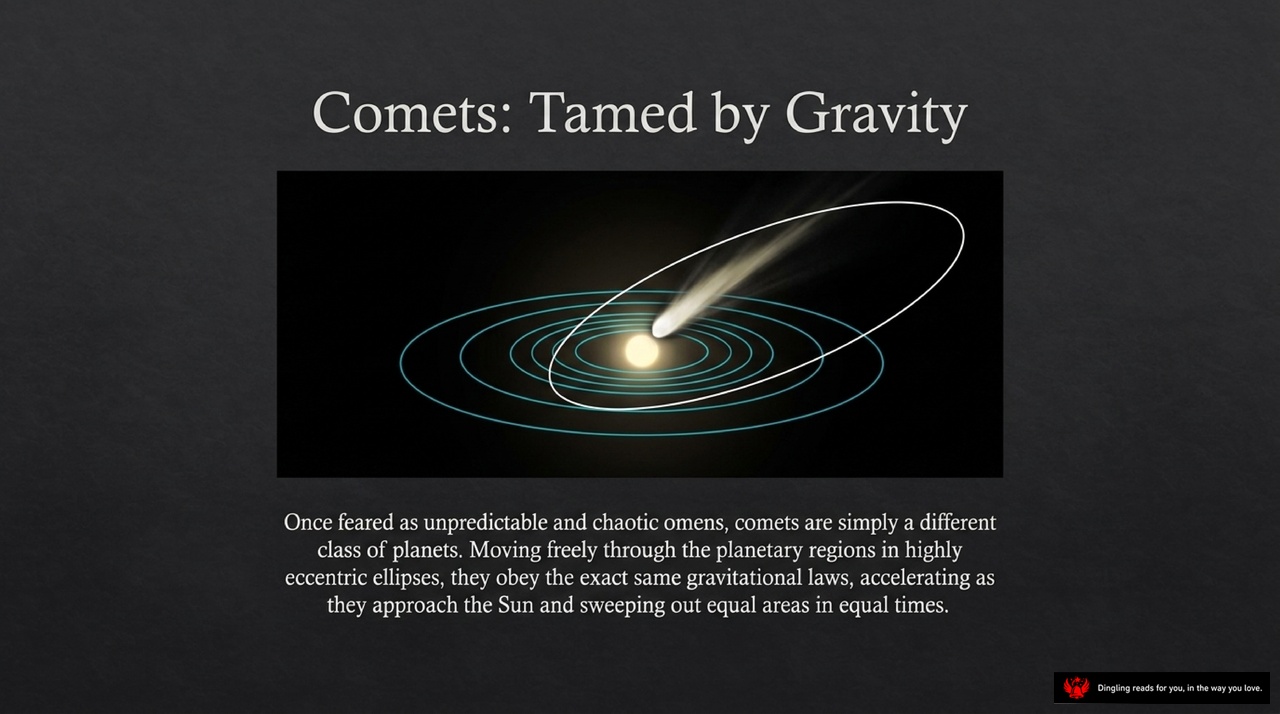
Once feared as unpredictable and chaotic omens, comets are simply a different class of planets. As the slide illustrates, they move freely through the planetary regions in highly eccentric ellipses, obeying the exact same gravitational laws that govern our solar system.
Notice how the comet's path crosses the inner orbits of the planets. As it approaches the Sun, it accelerates, sweeping out equal areas in equal times—just like Earth or Mars. This confirms that comets aren't chaotic wanderers; they are celestial bodies tamed by gravity, following predictable, mathematical paths. Whether it's a planet or a comet, the universe operates on the same fundamental rules.
Newton gave us the math to explain *how* gravity works, proving it governs everything from falling stones to orbiting planets. But here's the twist: he famously refused to guess *what* physical mechanism actually caused it. If something can't be deduced from observable phenomena, he argued, it has no place in experimental philosophy. That's the spirit of "Hypotheses Non Fingo"—I feign no hypotheses. He wasn't afraid of the unknown; he just demanded proof before speculating.
Yet, Newton did have a deeper belief about the universe's design. He saw the exquisite, mathematically perfect arrangement of planets moving in concentric circles, crossed by comets flying freely in all directions, as something that could only come from the counsel and dominion of an intelligent Being. To him, the universe wasn't just a random collection of forces; it was the work of a Divine Architect. This blend of rigorous mathematical skepticism and profound faith in cosmic order is what made Newton's legacy so powerful, bridging the gap between cold calculation and the awe of creation.
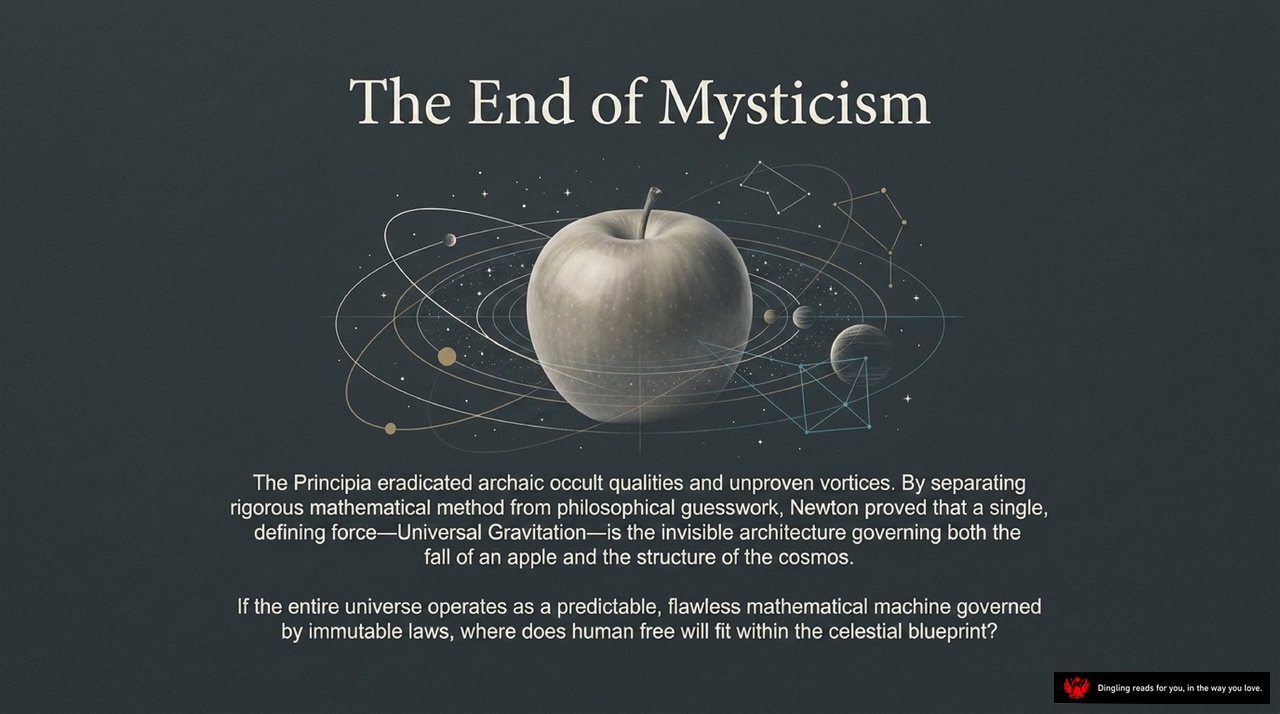
Imagine a universe where nothing is left to chance. This slide captures the moment Newton's *Principia* stripped away the ancient mysticism that once ruled our understanding of the cosmos. Gone are the unproven vortices and occult qualities that philosophers used to explain the stars. In their place stands a single, undeniable truth: Universal Gravitation.
Look at that apple. It's not just a fruit falling from a tree; it is the same force that holds the moon in orbit and structures the entire cosmos. Newton proved that by separating rigorous mathematics from philosophical guesswork, we could see that the invisible architecture of the universe is governed by one flawless law. If the entire universe operates as a predictable machine, then the question arises: where does human free will fit into this celestial blueprint?