
The Principles of Psychology: Complete Chapter-by-Chapter Summary

Welcome to the very beginning of our journey into the mind. Today, we're opening the classic text *The Principles of Psychology* by William James.
This book is a foundational exploration of how the mechanical brain gives rise to the purposeful stream of consciousness. Imagine the brain as a complex machine with gears and levers, yet from this machinery emerges something far more dynamic: our active, flowing awareness.
James challenges the old idea that the mind is just a collection of separate, static parts. Instead, he argues that consciousness is a continuous stream, constantly changing and flowing like a river. He introduces five core facts about this stream: first, every thought belongs to a specific individual; second, thoughts are always in motion and never exactly repeat; third, they persist continuously without sudden gaps; fourth, they focus on objects outside themselves; and fifth, they actively choose what to pay attention to.
This shift from viewing the mind as a set of disconnected atoms to a unified, flowing experience was revolutionary. It laid the groundwork for understanding how we perceive the world not as a fixed set of objects, but as a dynamic, evolving reality shaped by our attention and choices. Let's dive deeper into what makes this stream of thought so unique.
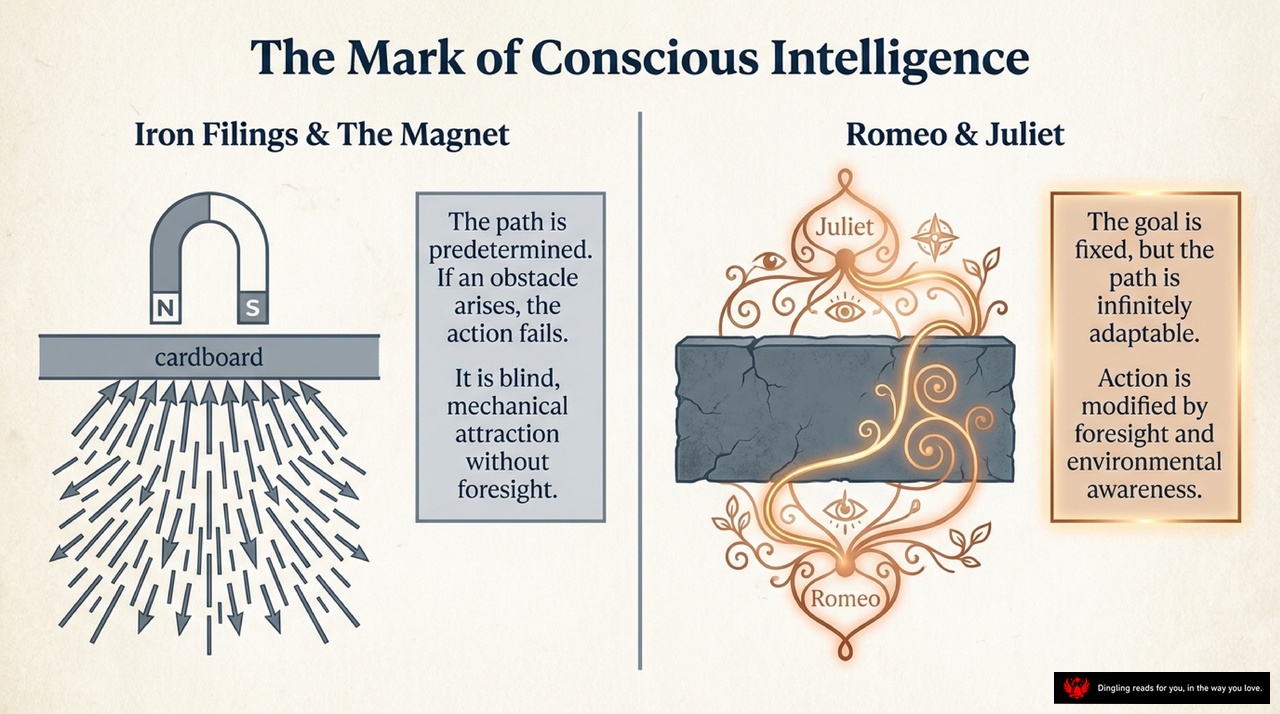
Imagine a simple magnet sitting on a piece of cardboard. If you sprinkle iron filings nearby, they don't just fall randomly; they are pulled straight toward the magnet. But here's the catch: if you place a wall of cardboard between the magnet and the filings, the iron stops dead. It has no idea to go around. Its path is predetermined, blind, and mechanical. It lacks foresight.
Now, let's look at the other side of the slide: Romeo and Juliet. Imagine Romeo wants to reach Juliet, but a stone wall stands in his way. Would he just stand there, stuck against the barrier like the iron filings? Absolutely not. Romeo is a conscious being. He has a fixed goal—reaching Juliet—but his path is infinitely adaptable. If the wall blocks him, he will climb over it, dig under it, or find a secret passage. His action is modified by foresight and environmental awareness.
This comparison reveals the true mark of conscious intelligence. It's not about having a goal; every machine has a goal. The difference lies in flexibility. Unconscious behavior is rigid; if an obstacle arises, the action fails. Conscious behavior is dynamic; the goal remains, but the method changes to suit the situation. This ability to navigate obstacles with purpose and adaptability is what separates the mechanical world of physics from the intelligent world of life.

Imagine your brain not as a single, unified organ, but as a layered command center with distinct levels of control. Look at this diagram: we're breaking down "The Architecture of Action" into three key zones. At the very top, we have the Cerebral Hemispheres. Think of this as your brain's strategic HQ. It's the organ of hesitation and choice. Before you act, it pulls up your past memories—the "long loop"—to weigh future consequences. It asks, "Is this the smart move?"
Below that lies the Lower Brain, driven by instinct and appetite. This is where spontaneous but habitual responses live. It's fast and automatic. Think of a pigeon flying to a perch; it doesn't calculate the flight path every time; it just reacts to the environment.
At the base, we have the Spinal Cord, responsible for pure reflex. This is the immediate, mechanical reaction to present stimuli with zero foresight. It's like a decapitated frog swiping away acid—it doesn't think; it just reacts to the pain right now.
So, how does action actually happen? It's a hierarchy. Your spinal cord handles emergencies instantly. Your lower brain handles routines and instincts. And your cerebral hemispheres take the wheel when you need to pause, remember, and choose a path that leads to a future goal. This layered structure is what allows you to be more than just a biological machine reacting to the present.

Today, we're diving into the "Spectrum of Action," a powerful framework for understanding how we move from simple reflexes to complex, conscious choices.
On the left, we see the "Unconscious Reflex," anchored in the spinal cord. Think of a frog wiping acid from its skin instantly—zero deliberation, pure survival. It's automatic, immediate, and entirely outside our control.
Moving to the middle, we have "Habit and Semi-Reflex," governed by the cerebellum and lower brain. Here, you see a pianist playing a complex sonata while holding a conversation. The initiation is conscious, but the execution is automatic. This is where our skills become second nature, freeing up our minds to multitask.
Finally, on the right, lies "Conscious Volition," driven by the cerebral hemispheres. This is the realm of the philosopher evaluating moral choices. It's highly deliberate, referencing distant memories and future goals. This is the part of us that plans, reasons, and makes ethical decisions.
This spectrum shows that our actions aren't just one thing; they exist on a gradient from pure instinct to deep, intentional thought. Understanding where you are on this spectrum helps explain everything from why you drive home on autopilot to why you pause before making a big life decision.
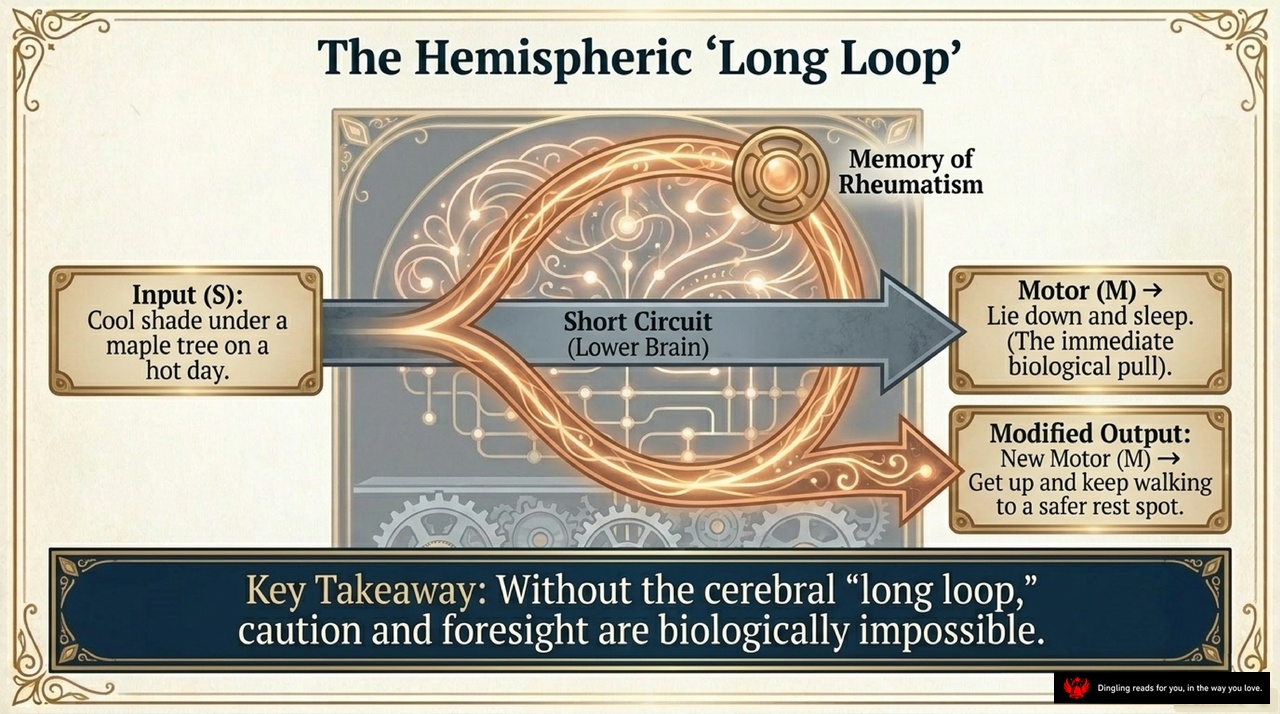
We often think of our brains as simple reflex machines—input a stimulus, get an output. But the diagram on your screen reveals something far more sophisticated: the Hemispheric 'Long Loop.'
Imagine you're walking on a scorching hot day. Your immediate biological pull—the short circuit in your lower brain—is screaming at you to lie down right under that cool maple tree. That's the motor response: instant, automatic, and biologically compelling. But the 'long loop' changes everything. This is the cerebral highway that connects your current sensory input to your memory of rheumatism. It pulls up the past experience of pain and triggers a modified output: instead of collapsing now, you get up and keep walking to find a safer rest spot.
Without this long loop, caution and foresight would be biologically impossible. We would be trapped in the present, reacting only to immediate stimuli. The long loop allows us to look ahead, to anticipate future consequences, and to override our immediate urges with wisdom. It is the difference between being a biological robot and being a conscious human who can plan, avoid danger, and shape our own destiny.

So, let's talk about the physics of habit. Have you ever noticed how a new habit feels like pushing a heavy boulder uphill? That's exactly what this slide illustrates. At the very beginning, you're facing "High Conscious Effort." It's that initial friction in your nervous system where everything feels hard and requires total focus. But as you keep repeating the action over time, something magical happens. You start "Carving the Groove." Think of it like water flowing over a rock; with enough persistence, the water physically alters the stone, creating a deeper channel. Similarly, your brain physically changes, making that neural path easier to travel. Eventually, you reach the final stage: "Automaticity." At this point, the neural resistance drops to nearly zero. The action no longer requires any conscious oversight; it just happens. As the quote at the bottom perfectly puts it, habit simplifies our movements, makes them accurate, and diminishes fatigue. It's the ultimate shortcut your brain creates to save energy.

Imagine society as a massive, intricate machine. Today, we are exploring the very engine that drives it: **Habit**.
Look at the image on your screen. It presents a powerful duality: **The Ethical Trap** versus **The Ethical Engine**. Both sides rely on the same fundamental mechanism—repetition—but they lead to completely opposite destinies.
On the left, we see the trap. The text warns us that "every small action leaves an indelible biological scar." It's a relentless accumulation of daily neural changes. Think of the drunkard mentioned in the slide; they don't stumble by accident. They weave their own trap through tiny, repeated choices. Every time they choose the bottle over the water, they deepen the groove in their brain. Soon, that path becomes the only road they know.
Now, look to the right. This is **The Ethical Engine**. Here, the text tells us that "the saint or the master craftsman builds their genius through the exact same mechanism." It's not magic; it's math. Unwavering daily repetition removes the need for willpower. When you practice kindness, honesty, or a new skill every single day, you aren't forcing yourself anymore; you are building a flywheel. The momentum takes over.
The central image of the flywheel perfectly captures this truth. We are spinning our own fates, good or evil, and the text reminds us: "never to be undone." Once a habit is formed, it has a life of its own.
So, how do we use this? The slide gives us a clear path. If you want to build an ethical engine, you must commit to the "unwavering daily repetition." Don't wait for motivation. Motivation is fleeting. Instead, focus on the small, consistent actions that shape your neural pathways.
Remember, your brain is plastic. Every time you repeat a positive action, you are strengthening the circuits for success. Every time you indulge a vice, you are reinforcing the trap. The choice isn't about grand gestures; it's about the microscopic decisions you make every morning.
As the final line on the screen declares, we are spinning our own fates. Will you choose to be trapped by your bad habits, or will you become the master craftsman of your own life? The flywheel is already turning; it's just up to you to decide which direction it spins.

Welcome back. Today, we're diving deep into the heart of William James's most revolutionary idea: the Stream of Consciousness.
James challenges the old, rigid theories that viewed the mind as a collection of separate, static building blocks—like Lego bricks stacked together or a machine with isolated gears. He argues that this "Mind-Stuff" theory is fundamentally flawed. Think about it: if you just pile up individual thoughts, you can't create a fluid, living experience. You can't build a river out of still, disconnected water droplets.
Instead, James proposes that consciousness is an unbroken, purposeful stream. It's a flowing river of subjective experience, constantly changing and evolving. Just like a river, our thoughts are always in motion. When you look at a tree, you don't just see "tree." You see a tree, and then immediately, the wind rustling its leaves, and then a memory of a similar tree from childhood. These aren't separate snapshots; they are connected by a seamless flow of transition. James calls these fleeting connections "psychical harmonics"—the subtle feeling of moving from one idea to the next.
But here's the most powerful part of James's theory: the mind is active and selective. It's not just a passive camera recording the world. Your consciousness is a tool designed to help you survive and navigate. It actively filters the chaos of the external world, picking out what matters and ignoring what doesn't. It's an evolutionary mechanism that helps you steer your actions, not just observe them. Whether you're solving a complex problem, creating art, or making an ethical choice, your mind is constantly selecting the most relevant elements from the infinite possibilities around you.
So, when we talk about the mind, we aren't talking about a collection of parts. We are talking about a continuous, dynamic, and purposeful flow. It's a single, unified state that changes from moment to moment, yet remains connected to the past and points toward the future. This is the breakthrough that changed psychology forever.

Have you ever wondered why your mind feels like a continuous stream, rather than a series of disconnected snapshots? William James, the father of American psychology, argues that our conscious experience is not built from isolated, static elements—like beads on a string—but is instead a "stream of consciousness," a fluid, ever-changing flow.
Think about the last time you read a sentence. You don't pause to assemble each word into a complete thought; you glide effortlessly from one idea to the next. This is because our minds are constantly bridging the gap between the present moment and the future. Even when we speak, we often have a clear intention before the words fully form in our minds. We feel a "psychic tone," a subtle sense of direction that guides us forward, much like hearing the melody before the music is fully played.
This continuous flow explains why we can understand complex ideas without needing vivid images for every single part. When we think about a lion, we don't need a perfect mental picture to feel danger; the word itself triggers the entire context. Similarly, when we read a grammatically correct but nonsensical sentence, our brain still follows the logical flow because the structure itself carries meaning.
Our minds are also powerful filters. The external world is chaotic, filled with infinite stimuli, but our consciousness selectively focuses on what matters to us. Just as a sculptor chips away at a block of marble to reveal a statue, our minds carve out a specific world from the chaos of reality. We choose what to notice, what to ignore, and how to interpret it. Whether it's a musician tuning their instrument or a person navigating a busy city, this constant, selective flow is the engine that drives our entire experience of life.

Imagine your mind not as a collection of static, isolated thoughts sitting neatly on a shelf, but as a continuous, swirling river of experience. This slide challenges a common psychological trap we often fall into: the "Psychologist's Fallacy." We have a tendency to look back at a thought, name it, and mistakenly assume it was a solid, discrete object the whole time. We treat our mental life like a bucket full of ice cubes—separate, frozen, and distinct. But the reality, as Visual 2 illustrates, is far more fluid. Thoughts do not exist in separate pieces. Naming a feeling actually changes it, freezing it into a concept rather than experiencing its raw flow.
Consider the thought of a "pack of cards on a table." It is not a collection of individual "card thoughts" and "table thoughts" glued together. Instead, it is one single, unbroken subjective phenomenon. The boundaries between the cards and the table dissolve in our actual experience; they merge into a unified scene. This concept of the "Illusion of Mental Atoms" suggests that our consciousness is a seamless stream, constantly shifting and connecting, rather than a series of disconnected events. Just as you cannot find a specific drop of water in a rushing river and call it the "whole," you cannot isolate a thought from the flowing context that gives it meaning. We are constantly constructing our reality through this unbroken stream, not by assembling pre-made mental blocks.

Imagine your mind not as a single, unified spotlight, but as a layered reality where different parts operate simultaneously yet remain completely unaware of each other. This is the essence of what we call "The Subconscious Split." Look at this diagram: it illustrates how your Primary Awareness—the part of you that thinks you're awake and in control—can be actively ignoring data that your Subconscious is processing with perfect clarity.
Consider the phenomenon of "Hysterical Blindness." Your eyes function perfectly, recording every visual detail, yet your primary consciousness chooses to ignore it. It's as if a filter has been applied, and you are living in a world that isn't there, even though the data is right in front of you. Or think about "Automatic Writing," where your hand writes coherent answers to questions while your primary mind is engaged in a completely separate conversation. Your conscious self has no idea what is being written, proving that two distinct streams of thought can run parallel on the same brain.
The takeaway here is profound: consciousness is not a single entity. It is a complex system where portions of your mind can completely ignore each other while processing the same world. This split challenges the idea that we are always fully aware of everything we do or perceive. Instead, we are navigating a reality constructed by layers of awareness, some of which are hidden from our direct view, shaping our actions and perceptions without us ever noticing.
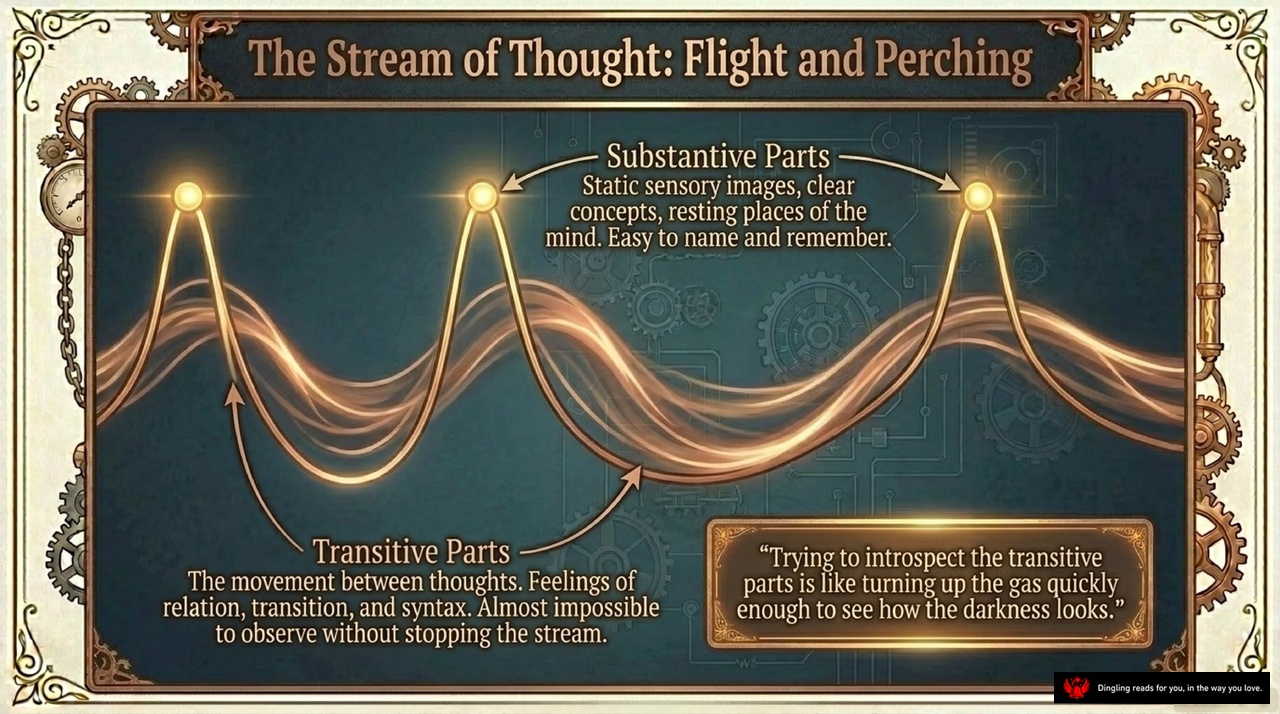
Imagine your mind not as a series of disconnected snapshots, but as a continuous, flowing river. This is the core of William James's revolutionary idea: the Stream of Thought. Look at this diagram; it perfectly captures the dynamic nature of our consciousness. The glowing peaks represent what James calls "Substantive Parts"—these are your static sensory images, clear concepts, and the resting places where your mind anchors itself. These are the moments that are easy to name, remember, and point to, like distinct landmarks along the path.
But the magic doesn't happen at the peaks. The true life of your mind happens in the valleys, the flowing curves between the peaks. These are the "Transitive Parts." As the slide beautifully illustrates, these are the movements between thoughts—the feelings of relation, transition, and syntax that bind your ideas together. It is almost impossible to observe these without stopping the stream, much like trying to catch the water itself while standing still. James famously noted that trying to introspect these transitive parts is like turning up the gas quickly enough to see how the darkness looks; you end up burning out the very phenomenon you're trying to study.
This distinction is crucial because it reveals that our thinking is never a chain of isolated facts. Even when we pause to focus on a specific object, our mind is constantly drifting, connecting, and anticipating the next thought. Whether you are reading a sentence, hearing a melody, or simply watching a sunset, your consciousness is a fluid, ever-changing process, seamlessly blending the solid objects of your perception with the invisible currents that connect them.
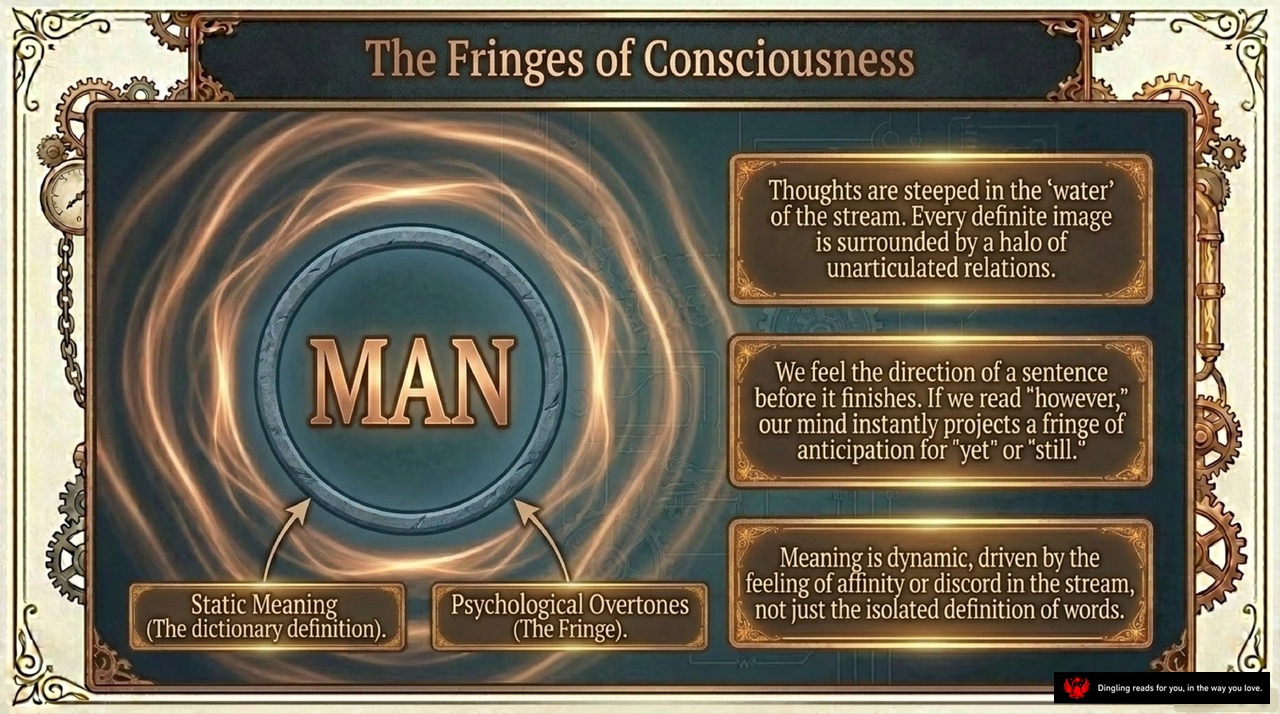
Look at the swirling currents surrounding the word "MAN" on this slide. We aren't just looking at a static definition of who we are; we are diving into the "Fringes of Consciousness."
Think of your thoughts not as isolated islands, but as a river. As the slide suggests, every definite image you have is actually surrounded by a halo of unarticulated relations. When you read a word like "however," your mind instantly projects a fringe of anticipation for what's coming next—maybe "yet" or "still." You feel the direction of the sentence before it even finishes.
This is where the magic happens. Meaning isn't just the dictionary definition of a word; it's dynamic. It's driven by the feeling of affinity or discord flowing through that stream. It's the psychological overtones, the invisible connections that give life to our static meanings. We don't just process data; we navigate a fluid, living landscape of relationships.
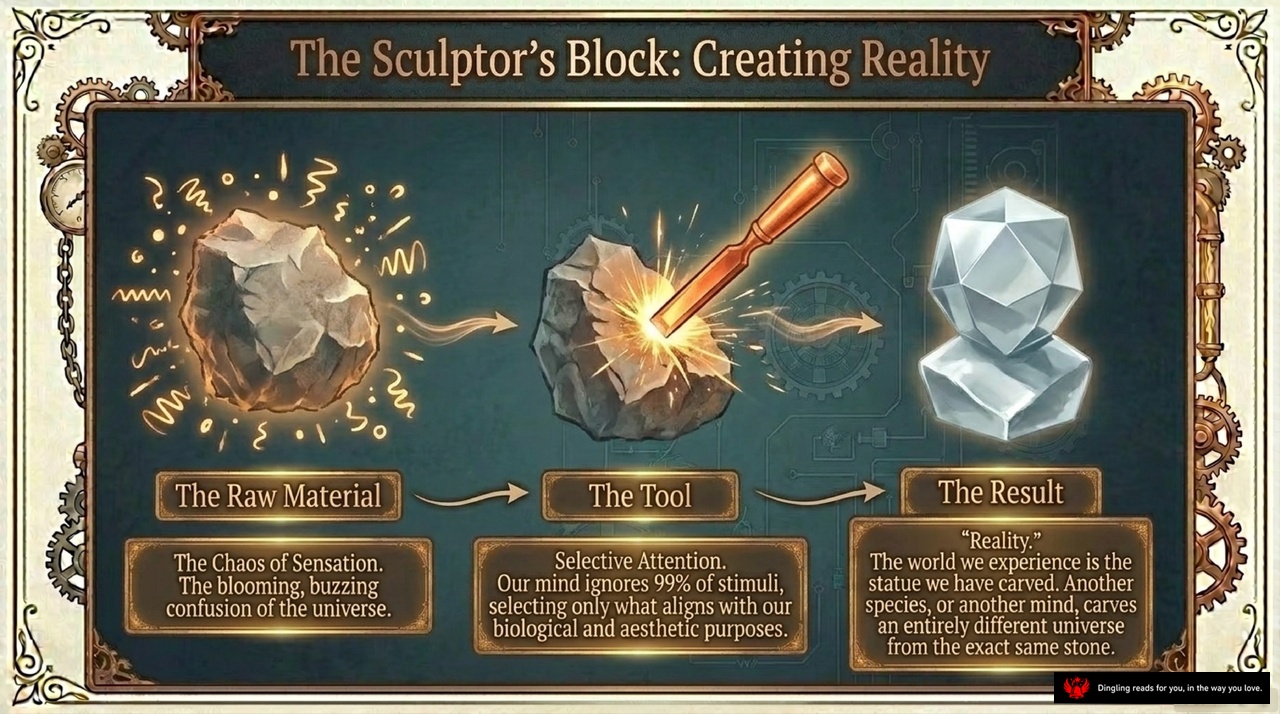
Imagine the universe as a chaotic, buzzing block of raw stone. It's a swirling mess of infinite sensations, noise, and confusion waiting to happen. But here's the twist: we don't experience that raw chaos. Instead, our minds act like a sculptor's chisel, selectively carving away everything that doesn't matter.
Think about it: your brain ignores 99% of the stimuli hitting you every second. It ruthlessly filters out the irrelevant, selecting only what aligns with your biological needs or aesthetic tastes. This process of selective attention is the tool that turns that rough, chaotic rock into something recognizable.
The result? "Reality." But remember, this reality isn't the stone itself; it's the statue you've carved out of it. It's the specific world you've sculpted from the infinite chaos. And here's the mind-bending part: if another species, or even another human with different interests, looked at that exact same block of stone, they would carve a completely different universe. One might see a forest of trees where you see a field of wheat, simply because their minds selected different details from the same raw material. We don't just observe reality; we actively sculpt it, carving our unique experience from the chaos of the universe.

Imagine your mind not as a static mirror reflecting the world, but as a living, breathing workshop where reality is actively carved. As the slide illustrates with its glowing gears and flowing lines, the human mind is an active, flowing stream of consciousness. It isn't a collection of robotic atoms or a passive receiver; it's a biological machine that takes the chaotic raw data of our senses and sculpts it into a purposeful reality.
Think of your brain as a dynamic machine that is constantly being re-wired by the stream of your attention. Every time you focus on something, you are essentially chiseling away at the chaos of sensation, defining what is important and what is noise. But here is the critical question posed on this slide: If your brain is this malleable biological machine, what reality are you choosing to carve today?
The architecture of your mind means you are not just a passenger in your life; you are the architect. The habits, the patterns, and the very way you perceive the world are the result of choices you've made, moment by moment. So, take a moment to look at the world around you and ask yourself: Is this the reality I want, or is it just the one I've been carving without realizing it? The power to redefine your world lies in the direction of your attention right now.