
The Proud Tower: Complete Chapter-by-Chapter Summary

Welcome to our deep dive into Barbara W. Tuchman’s *The Proud Tower*. This book takes us back to 1890–1914—the decades just before the First World War. Look at this cover: on one side, a glittering chandelier, rich red curtains, and gold filigree—all the opulence of a world that thought it had reached the peak of power. On the other? A cracked wall, a lit dynamite fuse, and blood splatters. That’s the paradox Tuchman explores: an era where nations felt invincible, elites reveled in their status, but under the surface, terror was rising and the world was quietly fracturing. She weaves together stories of power, idealism, and the hidden forces that would eventually shatter that proud tower. Let’s unpack this pivotal time together.

Let’s dive into the Belle Époque—those turn-of-the-century years we often romanticize as a golden age of elegance and endless progress. Picture the British aristocrats in top hats and ball gowns, strolling through manicured estates or dancing till dawn at lavish parties. Parisian salons buzzed with artists and writers, and everyone seemed to believe civilization was on an upward climb. That’s the myth: the slide calls it a “nostalgic illusion” — a fantasy we built looking back across the chasm of the Great War to make the past feel softer than it was.
But the reality was far messier. Beneath that polished surface, the world simmered with tension. In France, the Dreyfus affair tore the nation apart—neighbors argued, friends stopped speaking, and the divide between those fighting for justice and those clinging to military honor grew wider by the day. In Germany, the Kaiser obsessed over building a powerful navy, while groups like the Pan-German League shouted about German superiority and global expansion. In Britain, the working class was fed up with slums and 12-hour workdays; strikes erupted across the country, and reformers like Lloyd George fought to strip power from the old aristocratic families.
Socialist movements promised a better future for workers, but even they split—some wanted gradual change, others called for revolution. By 1914, all those tensions were ready to boil over. When war broke out, the socialist ideal of “workers of the world unite” vanished; workers from different countries picked up guns and fought each other.
The slide’s key line hits it home: “Such widespread devastation could never have been born from a true golden age.” The Belle Époque wasn’t a time of perfect peace—it was an era where the old order crumbled, and the new one struggled to take shape. That instability didn’t just happen; it led straight to the war that destroyed the world everyone thought they knew.
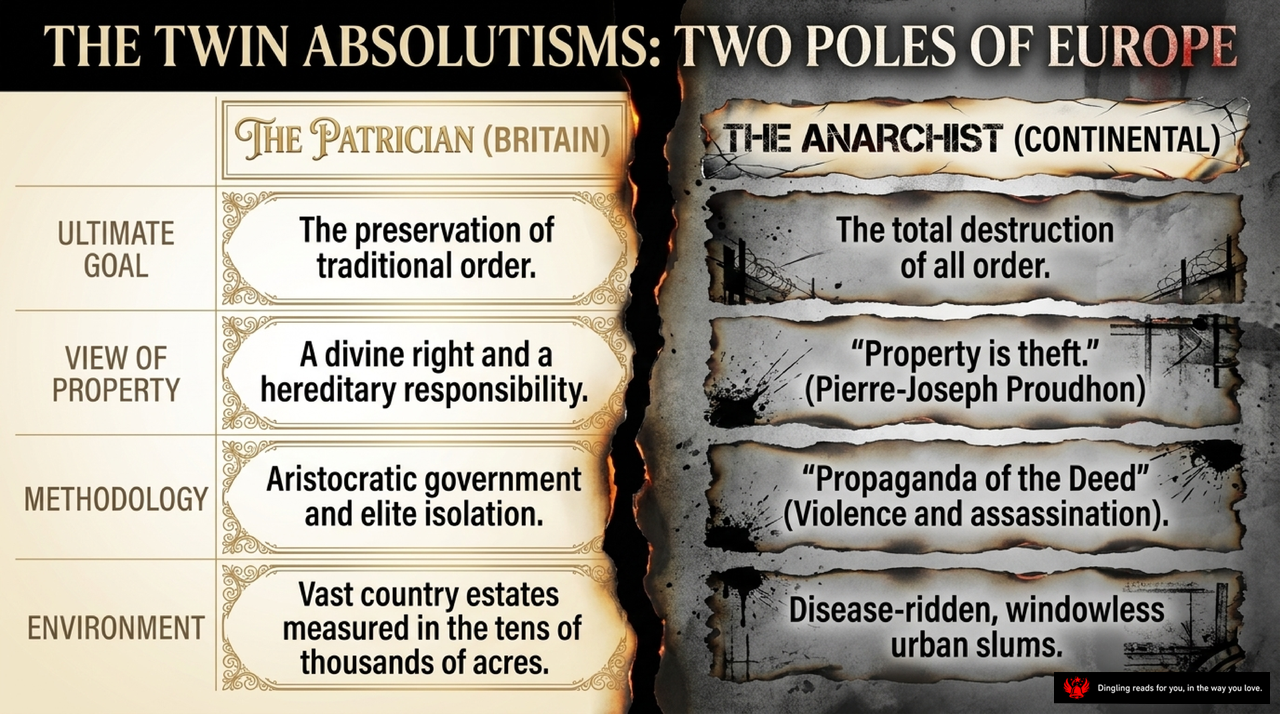
Let’s dive into the Twin Absolutisms—two extreme forces shaping Europe at the turn of the 20th century: Britain’s patrician elite and the continental anarchists.
Take Britain first. The patricians’ ultimate goal was to hold onto the traditional order with all their might. They saw property not as something you earn, but as a divine right and hereditary responsibility—like the Salisbury family, who owned the sprawling Hatfield House (a 300-year-old estate once home to Queen Elizabeth) with tens of thousands of acres. Their government was run by aristocrats—dukes, earls, and lords—who kept to their own circles, isolated from the rest of society. Salisbury, the prime minister, even thought the general public was ignorant; he preferred the company of his fellow elites. They lived in those grand country estates, far from the gritty reality of the cities.
On the other side, the continental anarchists wanted the total destruction of all existing order. They rejected everything the patricians stood for. Pierre-Joseph Proudhon, a key anarchist thinker, summed it up: “Property is theft.” Their method? “Propaganda of the deed”—violence and assassination to shake the system. We’re talking about attacks like the 1894 killing of French President Carnot or the 1898 assassination of Austria’s Empress Elizabeth. These anarchists came from the worst parts of the cities: disease-ridden, windowless slums where families crammed into tiny spaces, with no hope of improving their lives through the system. So they turned to chaos to bring change.
These two groups were polar opposites—one clinging to the past, the other trying to burn it all down. But both were absolute in their beliefs, and their conflict would leave a mark on Europe for decades to come. The patricians’ stubborn hold on power and the anarchists’ violent rejection of it set the stage for the upheavals that would soon rock the continent. It’s a story of two worlds colliding, each refusing to budge an inch. And as we’ll see, this clash wasn’t just about ideas—it was about the very future of Europe.
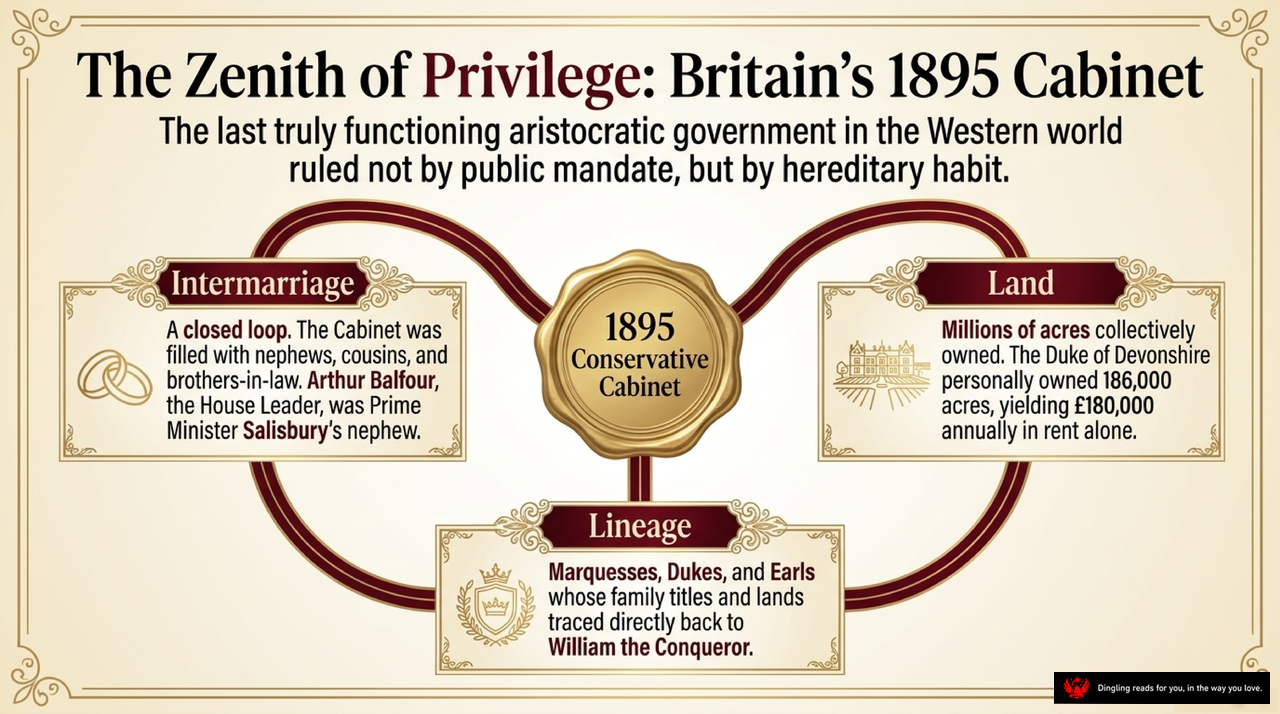
Let’s take a step back to 1895 Britain—where the last truly functioning aristocratic government in the Western world held power. This wasn’t a cabinet of elected representatives chosen by the public; it was a group of men ruled by hereditary habit, not a mandate from the people.
First, let’s talk about lineage. These guys weren’t just politicians—they were marquesses, dukes, and earls whose family titles and lands traced all the way back to William the Conqueror. For them, governing wasn’t a job; it was a birthright, something their ancestors had done for centuries, so it felt like it was in their blood.
Then there’s the land—their source of immense wealth and power. Collectively, they owned millions of acres, but let’s put a face to that number: the Duke of Devonshire alone had 186,000 acres, and he made £180,000 a year just from rent. That’s a staggering amount for the time, and it meant they never had to worry about money—they could focus on keeping their grip on power.
And how did they keep that grip? Through intermarriage. The cabinet was a closed loop of relatives: nephews, cousins, brothers-in-law. Take Arthur Balfour, the House Leader—he was Prime Minister Salisbury’s nephew. It was like a family business, where you got the top job because you were part of the clan, not because you were the most qualified.
This was the zenith of privilege. A small group of wealthy, related aristocrats running the country as if it were their personal fiefdom. They didn’t answer to the public; they answered to their own traditions and family ties. But little did they know, this would be the last hurrah for such a government—soon, the world would start to shift, and that old order would begin to fade away.

Let’s take a step back to the turn of the 20th century—Europe’s gearing up for a fight, arms races are heating up, and then out of nowhere, Tsar Nicholas II of Russia throws a curveball: he calls for a peace conference in The Hague. The idea? To slow down the军备 buildup and make war a little less brutal. Sounds good, right? But not everyone was on board.
Kaiser Wilhelm II of Germany hated this. He saw it as a trick to weaken Germany’s military might. He even scribbled angry notes on the Tsar’s letter—wondering how Krupp (Germany’s big arms maker) would pay its workers if they stopped churning out weapons. Germany wasn’t alone; other powers were skeptical too, worried about giving up their edge.
The first Hague Conference in 1899 brought together 26 countries. They scored some small wins: banning dum-dum bullets (those that expand inside the body—super cruel) and balloon bombs. But when it came to the big stuff—actual disarmament? Crickets. The permanent arbitration court they set up? It was voluntary, so no one had to use it if they didn’t want to.
Fast forward to 1907: the second Hague Conference. More countries showed up (44 this time), but still no progress on disarmament. They spent time tweaking war rules—like agreeing to warn each other before starting a war—but nothing that really stopped conflicts. Just three months after the first conference, Britain launched the Boer War. And we all know what happened a few years later: World War I.
It’s a sad reminder: even when leaders talk peace, national interests and pride often get in the way. The Hague Conferences were a noble try, but they couldn’t hold back the storm that was coming. Sometimes, the quiet drumbeat of peace gets drowned out by the roar of ambition.

Hey everyone, welcome back to [Podcast Name]. Today, we’re peeling back the layers of early 20th-century Germany— a nation riding a wave of industrial might, national pride, and a dangerous sense of destiny that would eventually crash into war.
Let’s start with the Pan-German League. Founded in 1891, these guys were the loudest cheerleaders for German expansion. Their posters blared “The World Belongs to Germany,” and they spread their message like wildfire— in schools, pubs, and town halls. They told Germans their country was meant to rule, that taking what they wanted wasn’t just right, it was their birthright.
Then there’s Kaiser Wilhelm II. When he took the throne in 1888, he made his priorities clear: the military was his identity. He once said, “I and the army are one.” So he booted Bismarck— the old chancellor who’d built Germany but knew when to hold back from reckless moves. Wilhelm surrounded himself with sycophants: a prime minister who barely spoke up, a foreign minister who kissed his boots, and a backroom operator who treated diplomacy like a chess game of tricks.
Germany had the muscle to back up its swagger. Between 1888 and 1913, its population jumped by a third, coal and iron production outpaced Britain, and the economy doubled. Companies like Krupp churned out cannons and warships. The navy? It went from an afterthought to a direct challenge to Britain’s sea dominance— thanks to the 1900 Naval Law that pumped billions into building warships.
By 1913, the fever pitch was high. It was the 100th anniversary of Napoleon’s defeat at Leipzig, and 25 years of Wilhelm’s reign. The crown prince wrote a book called *Armed Germany*, declaring it Germany’s sacred duty to have the world’s best army and navy— so it could claim its “place in the sun.” Even the Deutsche Bank’s report gushed about the economy… but every line was tied to fueling the war machine.
Arrogance seeped into every corner. In Alsace-Lorraine, a British traveler asked a waiter his nationality— the answer? “Must be Prussian.” A friend muttered, “Soon we’ll all have to be Prussian.” Walter Rathenau, a businessman and writer, tried to sound the alarm. He penned a poem quoting the Bible’s warnings about pride, but it fell on deaf ears. Germany was on top of the world, and no one wanted to hear about a fall.
We know what happens next: 1914, the guns start firing. But to get why WWI happened, you have to see this moment— a nation drunk on power, convinced it was invincible, and ready to take on anyone who stood in its way.
Next episode, we’ll talk about how this collision course with the rest of Europe finally exploded. Until then, keep digging into history. Bye for now.
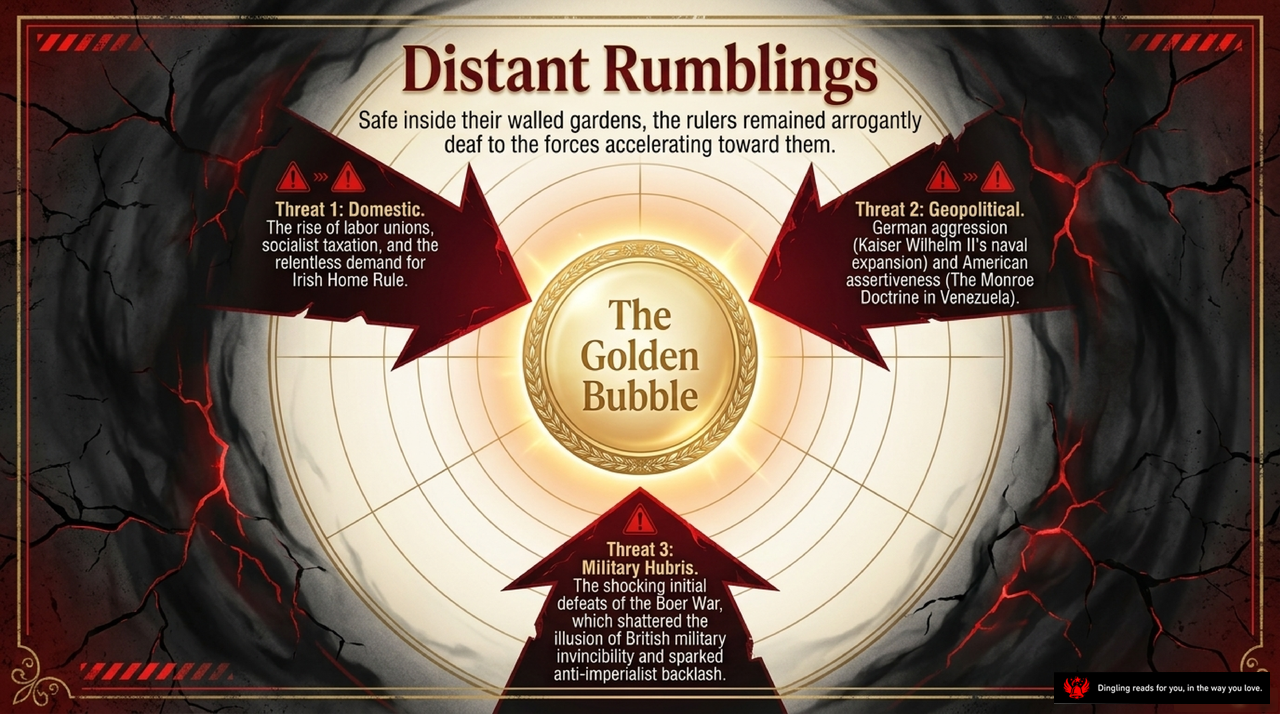
Let’s look at this slide: Distant Rumblings. The line here says it all—rulers were safe in their walled gardens, arrogantly deaf to the forces bearing down on them.
First, domestic threats. Across Europe, labor unions were rising, demanding better pay and shorter hours. In Britain, workers like those in the 1911 transport strike paralyzed ports and railways, fed up with being exploited. Socialist ideas were spreading too—think of Lloyd George’s 1909 budget, which targeted wealthy landowners to fund social reforms, shaking the old aristocratic order. And Irish Home Rule? It was a constant pressure cooker, with nationalists fighting for self-governance and threatening to split the UK.
Next, geopolitical threats. Germany was flexing its naval muscles under Kaiser Wilhelm II, building a fleet to challenge Britain’s centuries-old sea dominance—this wasn’t just pride; it was a direct attack on Britain’s ability to control global trade. Meanwhile, the U.S. was stepping up its global game: remember the Venezuela crisis? America invoked the Monroe Doctrine to push Britain out of a border dispute, showing it wasn’t afraid to stand up to old European powers.
And military hubris? The British learned this the hard way in the Boer War. Their initial defeats were a shock—they thought their army was unbeatable, but the Boers’ guerrilla tactics exposed critical weaknesses. Those losses shattered the myth of British invincibility and sparked an anti-imperialist backlash at home, with people questioning whether the empire was as strong as everyone believed.
All these forces were building, but the rulers? They were too busy in their elite circles—their salons, their hunting parties—to notice. The rumblings were distant at first, but they were getting louder. Soon, they’d become a storm no one could ignore.
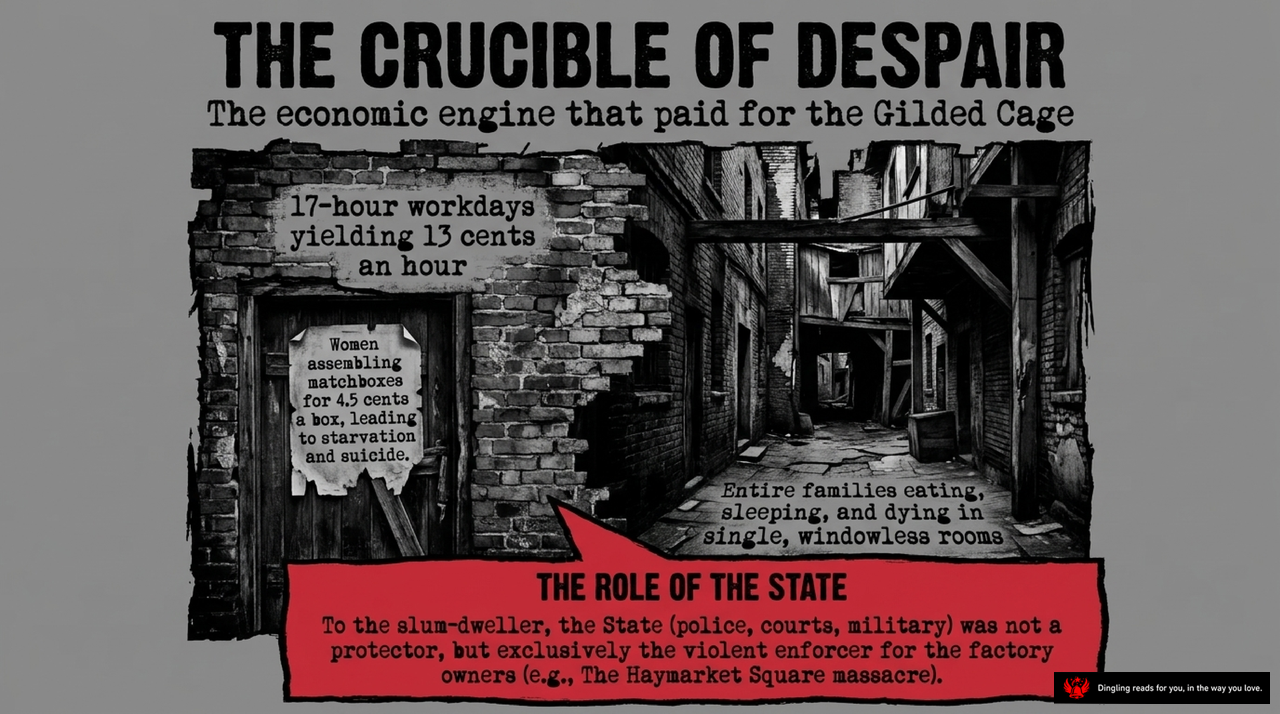
Let’s turn our attention to this powerful image titled “The Crucible of Despair”—it’s the dark, untold story of the Gilded Age, the economic engine that fueled all those opulent parties and grand estates we often romanticize.
Picture this: You’re a factory worker clocking 17-hour days, and your hourly wage is just 13 cents. For women, the grind is even more brutal—they sit hunched over tables for hours assembling matchboxes, earning a measly 4.5 cents per box. That’s so little it can’t feed a family, leading to starvation and, in some cases, desperate acts like suicide. And where do these families call home? Single, windowless rooms where everyone eats, sleeps, and even dies in the same cramped, airless space. It’s a world of darkness and deprivation, hidden right next to the glittering lives of the wealthy.
But here’s the harsh truth: The state wasn’t there to help these people. To the slum-dweller, the police, courts, and military weren’t protectors—they were violent enforcers for the factory owners. Take the Haymarket Square Massacre, for example: Workers peacefully demonstrated for an 8-hour workday, a basic right we take for granted now. But the state responded with force—shots were fired, several people died, and many more were arrested. It was a clear message: the system was designed to keep the rich in power and the poor in their place.
This cycle of despair didn’t last forever, though. It sparked a wave of activism and reform that we’ll dive into later. People began demanding fair wages, safer working conditions, and a government that prioritized all citizens, not just the elite. Because when you’re trapped in a crucible of despair, the only way to survive is to fight for change.
(Word count: ~390)

Let’s dive into the clash between utopian dreams and brutal reality in the late 19th-century anarchist movement. On one side stood the thinkers—the utopians like Prince Peter Kropotkin and Pierre-Joseph Proudhon. They imagined a world without governments, where people thrived in peace and abundance, bound by “mutual aid” rather than force. Their vision was rooted in the belief that humans are inherently good and would cooperate freely if given the chance.
But then came the fracture point. Mass poverty gripped working-class communities, and when workers went on strike to demand fair wages and better conditions, the state responded with violent suppression. Those crackdowns shattered any hope that change could happen peacefully.
That’s when the doers stepped in—though many labeled them terrorists. Figures like Ravachol, Emile Henry, and Alexander Berkman grew tired of waiting for the utopia to materialize. They abandoned the patient path of idealism and weaponized anarchist theory into a campaign of explosive terror and vengeance. For them, it wasn’t about destroying for destruction’s sake; it was a reaction to a system that seemed to leave no other option.
This shift isn’t just a historical curiosity—it’s a stark lesson in how idealism can curdle into violence when people feel the peaceful road is blocked. The utopians wanted a better world, but the harsh realities of poverty and state brutality pushed others to take drastic, destructive action. It’s a reminder of what happens when systems fail to listen: hope dies, and anger takes its place.

Let’s talk about this idea called Propaganda of the Deed—something that defined a lot of anarchist action in the late 1800s. The core concept here? These folks truly believed that words and political parties weren’t going to change anything. They thought the system was too broken, too rigged, so talking at it or trying to vote it away was a total waste of time.
So what was their logic behind using extreme, eye-catching violence? Three big reasons. First, they wanted to expose the state’s weakness—hit a high-profile target, and suddenly everyone realizes the powers that be aren’t as untouchable as they seem. Second, they hoped to jolt the oppressed masses out of their apathy. If you’re stuck in a cycle of poverty and exploitation, maybe a dramatic act would make you stop accepting things as they are. Third, they dreamed it would spark a spontaneous, stateless revolution—no leaders, no governments, just people taking control for themselves.
August Spies,a key figure in these circles put it bluntly: “One pound of dynamite is worth a bushel of bullets.” For him and many others, direct, explosive action was way more powerful than any speech or ballot. And they acted on this—think about the ’94 assassination of French President Carnot, or the ’92 bombing in France. These acts didn’t just make headlines; they sent shockwaves through societies. Governments panicked too—after President McKinley was killed by an anarchist in 一九零一, the US even changed immigration laws to keep anarchists out.
But did it work? Well,they never got that stateless revolution they wanted. Instead, the public started seeing anarchists as dangerous threats, not fighters for justice. Still, this idea of Propaganda of the Deed left a mark—showing how far some were willing to go when they felt words had completely failed.
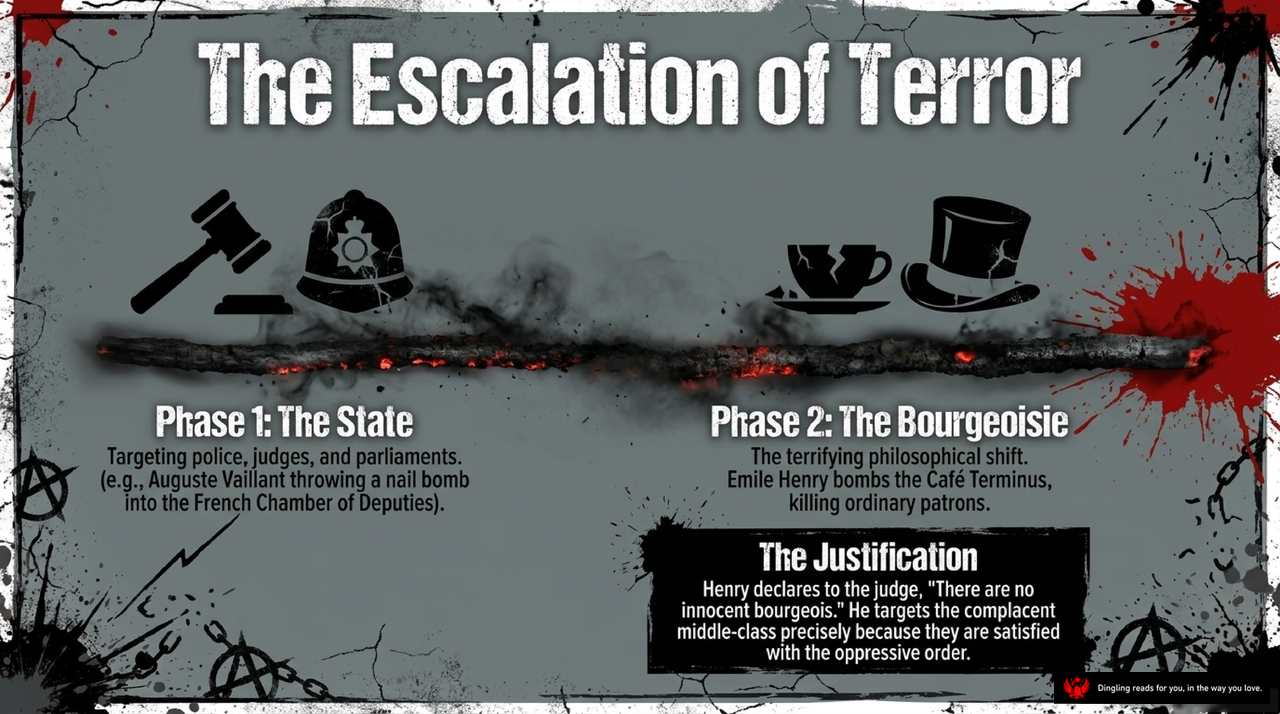
Let’s dive into the escalation of terror—how anarchist violence evolved in the late 19th century, shifting targets and sending shockwaves through European society.
First up, Phase One: Anarchists set their sights on the state itself. They targeted symbols of authority—police officers, judges, and parliaments. A defining example? Auguste Vaillant’s 1893 attack on the French Chamber of Deputies. He tossed a nail bomb into the assembly, aiming to strike at the very heart of the system he viewed as corrupt and oppressive. This phase was about challenging the institutions that upheld inequality and exploitation.
But then came Phase Two—a radical, terrifying shift. Anarchists moved from attacking state power to targeting ordinary members of the bourgeoisie. Emile Henry’s 1894 bombing of Paris’s Café Terminus is a haunting case. He didn’t target politicians or officials; he killed regular people sipping coffee, chatting, going about their day. His reasoning? When he stood trial, Henry told the judge point-blank: “There are no innocent bourgeois.” He argued that anyone who benefited from the oppressive capitalist order—even those living quiet, comfortable lives—was complicit in the suffering of the working class.
This shift changed the game. It turned anarchism from a movement fighting against power into one that seemed to attack everyday life. And it triggered panic across Europe. Governments responded with harsh repression, but the message was loud and clear: the anarchists were no longer just going after the elite—they were targeting anyone who was part of the system they despised.
That’s the escalation of terror: from hitting the halls of power to hitting the neighborhood café, and from challenging authority to confronting complicity. It’s a stark reminder of how radical movements can evolve, and how their actions can reshape public fear and policy.
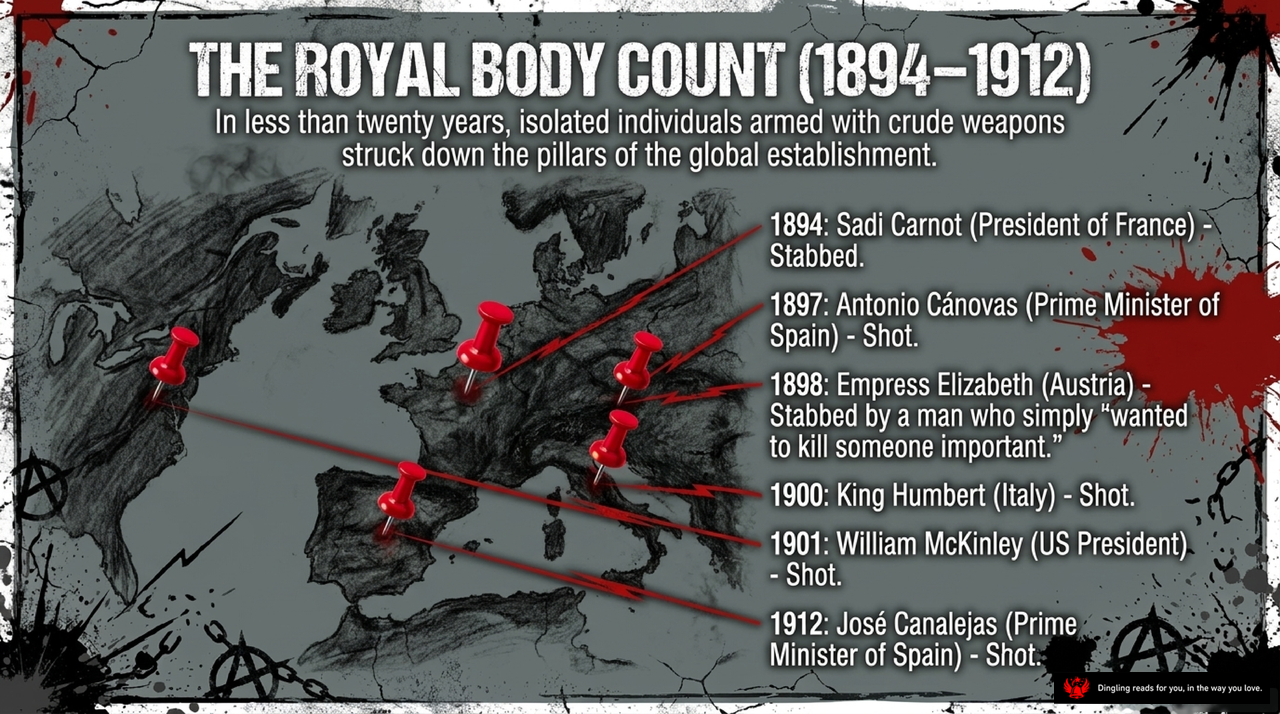
Let’s zero in on this slide: “The Royal Body Count (1894–1912)”. The line below says it all—“In less than twenty years, isolated individuals armed with crude weapons struck down the pillars of the global establishment.”
Let’s run through the names here: In 1894, France’s President Sadi Carnot was stabbed. Three years later, Spain’s Prime Minister Antonio Canovas was shot dead. Then in 1898, Austria’s Empress Elizabeth—yes, the iconic “Sisi” we see in movies—was stabbed by a man who later admitted he just “wanted to kill someone important.” Italy’s King Humbert was shot in 1900, followed by U.S. President William McKinley in 1901. And finally, Spain lost another Prime Minister, Jose Canalejas, to a bullet in 1912.
What was driving this wave of violence? A big part of it tied back to the anarchist movement sweeping through the late 1800s and early 1900s. Back then, capitalism was booming, but so was inequality—workers were stuck in tough conditions, and many felt the system was rigged against them. Some anarchists believed the only way to break the status quo was to target the top leaders, those “pillars” the slide mentions.
These attacks sent shockwaves across the globe. After McKinley’s assassination, the U.S. changed its immigration laws to bar anarchists from entering. European royals started beefing up their security detail. Even though the worst of the violence faded by the 1910s, the fear lingered. People saw anarchists as threats to order, and governments used that fear to justify cracking down on dissent.
It’s a stark snapshot: ordinary people with simple weapons, fueled by frustration, managed to shake the world’s most powerful institutions. This slide isn’t just a list of deaths—it’s a window into a time when the gap between the haves and have-nots pushed some to take extreme, irreversible action.
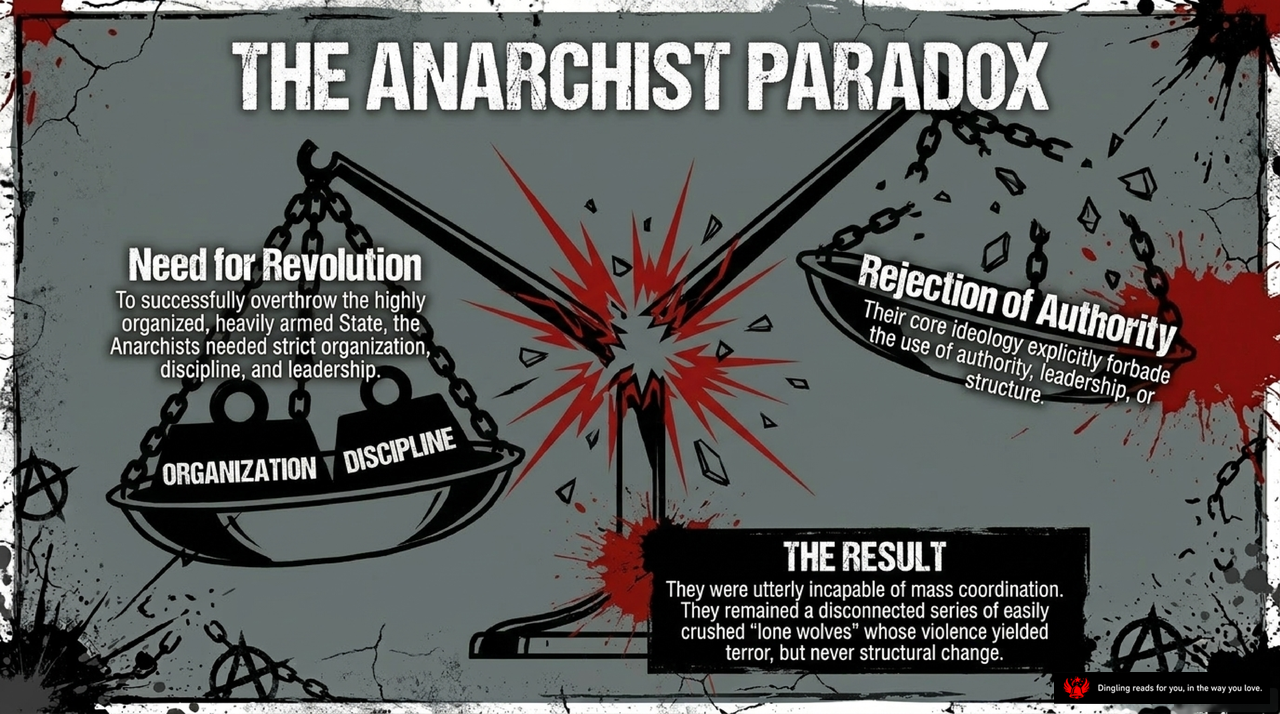
Let’s dive into the Anarchist Paradox, a central conflict that defined the anarchist movement in the late 19th century. As our PPT lays out, there’s a fundamental tension here. On one hand, to successfully overthrow the highly organized, heavily armed State, anarchists knew they needed strict organization, discipline, and clear leadership. But on the other hand, their core ideology explicitly forbade the use of authority, leadership, or any structured hierarchy.
This contradiction wasn’t just theoretical—it played out in real life, as we see in the book. In the 1890s, anarchists across Europe and the U.S. took radical action: the 1892 Lavachery bombing in France, the 1894 assassination of French President Sadi Carnot, and the 1898 killing of Austrian Empress Elisabeth in Geneva. These acts sent shockwaves through societies, sparking widespread panic. But did they achieve their goal of upending the system?
The result, as the PPT states, was that they were utterly incapable of mass coordination. Instead of a unified movement, they remained a disconnected series of “lone wolves.” Their violence yielded terror, but never the structural change they sought. In response, governments clamped down hard: the U.S. revised immigration laws to bar anarchists, and President Theodore Roosevelt publicly condemned anarchism as an anti-human crime.
By the early 1900s, their violent tactics began to fade. The paradox had undone them—they couldn’t reconcile the need for collective action with their rejection of all authority. Their legacy, then, is one of fear and controversy, not the revolution they envisioned. This tension reminds us how ideology and practicality often clash in movements fighting for change.
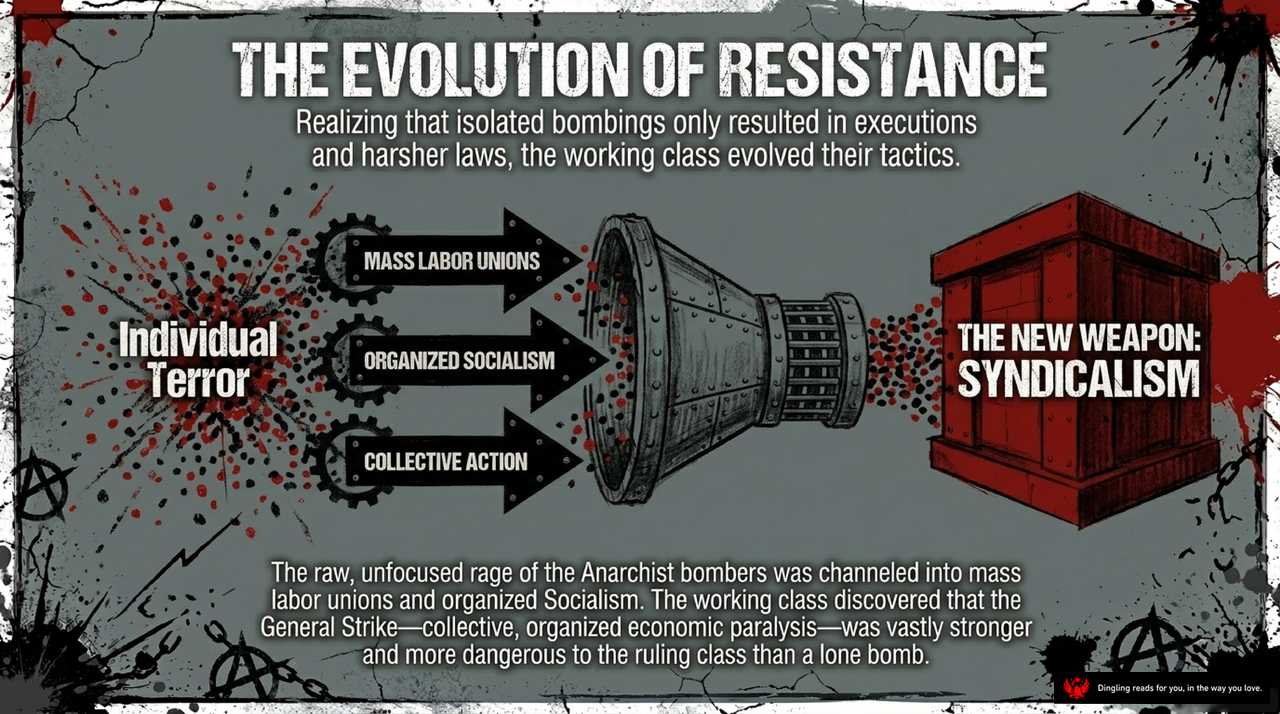
Alright, let’s dive into how working-class resistance evolved from scattered acts of violence to a more organized, powerful movement. Back in the late 1800s, a lot of folks thought isolated bombings—what we call individual terror—would shake up the system. But here’s the hard truth: those acts usually just led to more executions and even harsher laws against workers. It was like hitting a brick wall with a feather—no real change, just more pain.
So the working class started to pivot. They realized strength wasn’t in lone wolves, but in numbers. First, they built mass labor unions—bringing thousands of workers together to demand better pay and safer conditions. Then, they got into organized socialism, which gave them a bigger ideological framework to fight for systemic change. And finally, collective action became their mantra—because when everyone stands together, you can’t ignore their voice.
All these pieces came together to create something new: syndicalism. This wasn’t about playing politics or electing people to office. Syndicalists believed workers should take direct control through their unions. The big weapon here? The general strike. Imagine every worker in a city or country stopping work at the same time—factories shut down, trains stop running, shops close. It’s economic paralysis, and it’s way more dangerous to the ruling class than any single bomb.
The raw, unfocused anger of those early anarchist bombers was channeled into something structured and powerful. Instead of random acts, they had a plan: use collective power to hit the system where it hurts most—its wallet. And that shift changed the game for workers’ rights forever, proving that united action beats isolated rage every time.
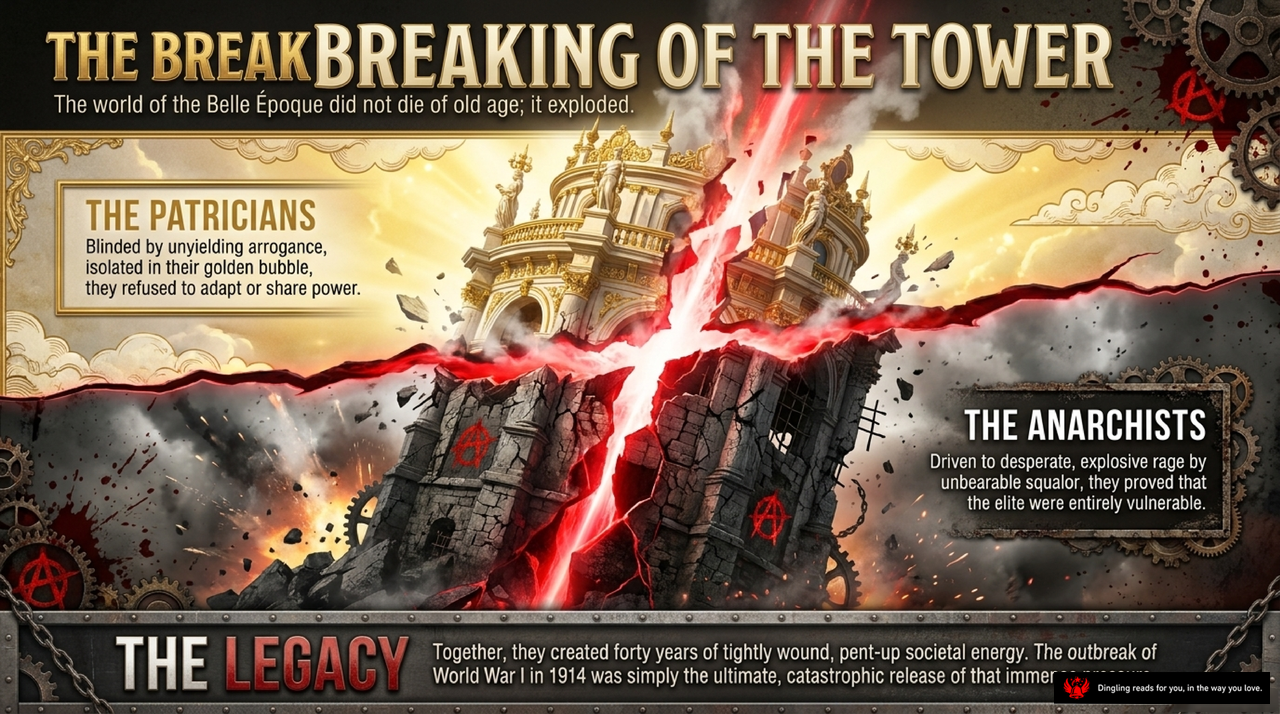
Let’s take a look at this slide—“The Break Breaking of the Tower.” The subtitle hits the nail on the head: the Belle Époque didn’t die of old age; it exploded.
First up, the patricians. These were the old elites—think the British aristocrats who ran the country in the 1890s. They lived in golden bubbles, blind to the struggles of the people below. The 1895 Conservative cabinet was almost entirely made of landowning nobles, born into power and convinced their birthright gave them the right to rule. They refused to adapt to the changing world—opposing democracy, hating socialism, and clinging to their ancient privileges. Isolated in grand estates like Hartfield House, they had no idea what it was like to live in the squalor of working-class slums. They thought their power was unshakable.
Then there were the anarchists. Driven to desperate, explosive rage by the unbearable poverty they faced—families crammed into tiny rooms, working 12-hour days for pennies—they turned to violence. In the 1890s and early 1900s, they assassinated leaders like U.S. President McKinley and Austria’s Empress Elizabeth, and set off bombs in public places. These acts weren’t just mindless; they proved the elite were vulnerable. The patricians’ golden bubble wasn’t as safe as they thought.
Together, these two forces—one clinging to power, the other boiling over with anger—created forty years of tightly wound, pent-up societal energy. All that tension had to burst. And in 1914, it did: World War I. That war wasn’t just a fight between nations; it was the ultimate, catastrophic release of all that built-up pressure. The old world’s tower didn’t just fall—it exploded.