
The Psychology of Judgment and Decision Making: Complete Chapter-by-Chapter Summary
Welcome to our deep dive into the psychology of judgment and decision making. Today, we are exploring the groundbreaking work of Scott Plous, which reveals a profound truth: our rationality is often systematically distorted by how we perceive the world, how we frame problems, and the mental shortcuts our brains take.
We are not just logical computers; we are human beings navigating a complex reality where perception shapes reality itself. This session will guide you through the core mechanisms that influence every choice we make, from the subtle biases in our memories to the powerful forces of social influence and group dynamics. By understanding these psychological patterns, we can move beyond instinctive reactions and make more informed, deliberate decisions. Join us as we unpack the fascinating—and often surprising—science behind how we think and choose.

We see exactly what we expect to see. This slide reveals a fascinating glitch in our perception: our brains don't just record reality; they actively construct it based on what we anticipate. Look at the left card—a standard 6 of Spades. Our brain processes this instantly. But on the right, we have a "Red Spade," an anomaly that shouldn't exist in a normal deck. The brain struggles here, taking four times longer to process it. This is the Input Glitch. When faced with something that violates our mental schema, like a red spade, we don't immediately see the object; we first try to force it into our existing categories.
The slide outlines four distinct reactions to this confusion. First is Dominance, where we stubbornly insist the card is normal, either a black spade or a red heart, ignoring the visual evidence. Second is Compromise, a middle ground where we might perceive the symbol as a confusing grayish-purple shade. Third is Disruption, a state of severe confusion where we simply cannot categorize the anomaly at all. Finally, we reach Recognition, the moment our brain overcomes the mental block and finally sees the objective reality: a red spade. This phenomenon, often called the "Red Spade" effect, proves that perception is heavily influenced by expectation. We are not passive observers; we are active editors of our own reality, often filtering out what doesn't fit our expectations until we are forced to confront the truth.

The human mind isn't just a camera recording reality; it's more like a skilled editor constantly rewriting the script to fix internal conflicts. Look at this flowchart: it illustrates a famous experiment where people are asked to lie about a boring task. If they get $20 to lie, no problem—they have a perfect excuse. But if they only get $1, something fascinating happens. Their brain can't justify lying for such a small reward, so to resolve that uncomfortable tension, they secretly rewrite their memory, convincing themselves the task was actually fun. This is the power of cognitive dissonance: when our actions clash with our beliefs, we don't just change our actions; we often change our reality to make them match.

Decisions are never made in a vacuum; they are anchored by the surrounding context. Look at these visual examples: the size of a square changes entirely depending on the circles around it, and a person's height seems to fluctuate based on who they are standing next to. This is the Relativity Trap. A stimulus is never evaluated independently; its perceived value is entirely dependent on what surrounds it. Think about it: a $50 accessory feels cheap when added to a $25,000 car purchase, just as a 6-foot man looks short next to a professional basketball team. This is the Contrast Effect in action.
But context also shapes how we weigh information over time. We have two powerful biases: Primacy and Recency. Primacy means the information presented first disproportionately shapes our final impression. It's that first thing we see that sticks. Conversely, Recency means the information presented last disproportionately dominates our short-term memory. That's why the last thing you hear in a negotiation often feels more important than everything else that came before. Our brains are wired to be influenced by the immediate environment and the order of events, making our judgments far more fluid and situational than we often admit.

Imagine you're a basketball coach watching your team in practice. You've just seen a player sink a perfect three-pointer. Instinctively, you think, "They're on fire! The next shot has to go in!" This is the "hot hand" fallacy—a classic trap of representativeness intuition where we mistake random noise for a meaningful pattern. But data from teams like the Philadelphia 76ers tells a different story: a player's chance of making the next shot doesn't actually change based on their previous success. It's all independent randomness.
We suffer from this because our brains are wired to find stories, even where none exist. This leads us to ignore the "base rate"—the actual underlying probability of an event. Think about shark attacks versus dying from a plane part falling on your head. Sharks feel terrifying and make the news constantly, so we think they're a huge risk. But the math proves the opposite: dying from a falling plane part is thirty times more likely. We let vivid, dramatic memories override the cold, hard facts of statistics.
Even in famous probability puzzles, this bias trips us up. Consider the "Monty Hall" problem: you pick a door, the host reveals a goat behind another, and offers you a switch. Most people think it's a 50-50 chance now. Wrong. By switching, you actually double your odds to two-thirds. Our intuition fails because we can't see how the new information concentrates probability. We rely on what feels easy to recall, like shark attacks, rather than what is statistically true. In a world full of random events, trusting our gut often leads us straight into error.

The slide reveals a powerful truth: the structure of a question doesn't just measure an opinion; it actively manufactures one. Look at the data here. When we ask open-ended questions about issues like food quality, pollution, or abortion, people who don't have strong pre-existing beliefs simply don't form an opinion. But the moment we present a "closed" list of options, we dramatically skew the results. Suddenly, 32% say food quality is a problem, 14% worry about pollution, and 8% support legalizing abortion. These aren't necessarily real beliefs; they are pseudo-opinions fabricated on the spot because the question forced a choice.
This is the filter requirement in action. By asking "Do you have an opinion on this?" before asking the actual question, we trick the brain into creating an answer where none existed. The options provided act as invisible boundaries for human thought, narrowing the vast landscape of possibility down to a few predetermined boxes. As the research shows, when people lack strong pre-existing beliefs, providing a closed list of options doesn't reveal their true stance; it creates one for them. We must be careful, because the way we frame a question can fundamentally alter the reality we are trying to measure.

So, here's the thing about how we make decisions: we aren't actually calculating probabilities like a computer. Instead, we rely on mental shortcuts that, while sometimes leading us astray, actually helped our ancestors survive.
Think about how we judge risk. We don't look at cold statistics; we look at what's "scary" or "unknown." Take nuclear energy, for example. Experts might rank it as a moderate risk based on the math, but ordinary people often place it at the top of the danger list. Why? Because it fits the category of "terror risk"—it feels uncontrollable and could lead to disaster. Meanwhile, experts know that everyday activities like cycling are statistically far more dangerous, but we don't fear them as much because they feel familiar and manageable.
This brings us to the concept of heuristics—those mental shortcuts our brains evolved to use. They aren't bugs; they're features. In a world where we don't have time to run complex calculations for every threat, these shortcuts allow us to make "good enough" decisions quickly. For instance, if you see a snake, you don't calculate the probability of it being venomous; you assume it is and act. That's a representative heuristic in action.
However, these shortcuts can backfire when we try to apply them to modern, complex problems. We might overestimate the likelihood of a specific, dramatic event—like being killed by a shark—just because it's vivid and memorable, while ignoring the much more common danger of being struck by a falling object.
Ultimately, understanding these biases doesn't mean we should abandon them. It means we can recognize when our gut instinct is serving us well and when it's leading us into a trap. By understanding the rules of our own thinking, we can move from being passive victims of our biases to active managers of our decisions.

The brain doesn't do complex math; it relies on mental shortcuts. But these shortcuts are systematically flawed. Today, we're looking at the three most common traps that derail our judgment: Representativeness, Availability, and Anchoring.
First, Representativeness. We judge probability based on how much an event resembles a specific stereotype, ignoring the actual odds. This leads to the "Linda Problem." If you're told Linda is a 31-year-old, single, philosophy major who's active in social justice, most of us will say it's more likely she is "a bank teller and a feminist" than just "a bank teller." Mathematically, that's impossible—a specific subset can never be more probable than the group itself. We let our vivid story override the hard data.
Next, Availability. We estimate frequency based on how easily examples come to mind. Vivid stories stick in our brains, while boring statistics don't. This is why many people believe shark attacks are more common than deaths from falling airplane parts, even though the latter is thirty times more likely. Our memory is swayed by what is dramatic, not what is true.
Finally, Anchoring. We rely too heavily on the first piece of information offered. In one famous experiment, subjects estimating the product of 8 times 7 down to 1 guessed around 2,250. Another group, starting with 1 times 2 up to 8, guessed only 512. The actual answer is 40,320. Even though the math is identical, the initial number—the anchor—dragged the entire group's estimate off course.
Our brains substitute complex calculations with these simple, flawed rules. Recognizing these traps is the first step toward better decisions.

We are biologically wired to force order onto chaos. Our brains are relentless pattern-seekers, constantly scanning pure randomness for meaningful trends. But this drive often leads us astray. Consider the concept of "Illusory Correlation." We see it everywhere, from clinical psychologists confidently claiming paranoid patients draw huge eyes on figures—when statistical analysis proves there is zero connection. It's simply that experts saw what they expected to see.
This creates a dangerous "Confirmation Trap." We heavily weight "Hits"—events that confirm our existing beliefs—while completely ignoring "Misses," the evidence that disproves them. We also fall into the "Illusion of Control," believing our personal skill can influence pure chance. People will pay more for a "lucky" coin or pick their own lottery numbers, demanding higher payouts than those assigned random numbers, simply because they feel they've added their own touch to the chaos.
On the left, you see how our brain handles this. "Hits" are confirmed biases, heavily weighted by our minds. In contrast, "Misses" are disproofs, yet they are completely ignored. We are essentially filtering reality to protect our narratives, mistaking coincidence for connection and luck for skill. Recognizing this biological bias is the first step to seeing the world more clearly.

The presence of others silently overrides individual judgment and diffuses responsibility. This slide highlights a critical psychological phenomenon: when we are in a group, we often assume someone else will handle it, paralyzing our ability to act.
Look at the data on the left. When a person is alone, 75% of them report smoke in an emergency. But drop that person into a group of three, and that number plummets to just 38%. If you add passive actors who do nothing, it crashes even further to 10%. This is the Bystander Effect. In an emergency, the assumption that "someone else will handle it" completely paralyzes groups.
But this isn't just about emergencies; it's about how groups think. The slide also touches on Social Loafing and Groupthink. Groups do not automatically pool intelligence. Without structured dissent, groups become adhesive, suppressing individual critical thinking just to maintain social harmony. We stop questioning the obvious because we don't want to be the one rocking the boat.
So, the lesson here is clear: being with others doesn't make us smarter or safer. In fact, it can make us less responsible and less critical. To break this cycle, we need to recognize that silence in a group is often a signal to do nothing, not a sign of agreement.

There is a dangerous disconnect between our actual accuracy and our perceived accuracy. Look at this graph. The top line represents weather forecasters, while the bottom dashed line shows medical diagnoses. Notice the gap? When a weather forecaster predicts an 80% chance of rain, they are correct exactly 80% of the time. This is what we call perfect calibration. They receive immediate, unambiguous feedback from nature every single day.
But look at the doctors. They often claim 80% confidence in a diagnosis, yet statistically, they are correct less than 20% of the time. This is the confidence gap. On average, a decision-maker's confidence outpaces their actual accuracy by 10 to 20 percent. This is what we call lethal overconfidence.
The threat here is clear: extreme confidence is not an indicator of extreme accuracy. While we might feel invincible in our judgments, the data shows that without immediate feedback and a willingness to consider alternative outcomes, our certainty is often just a dangerous illusion.
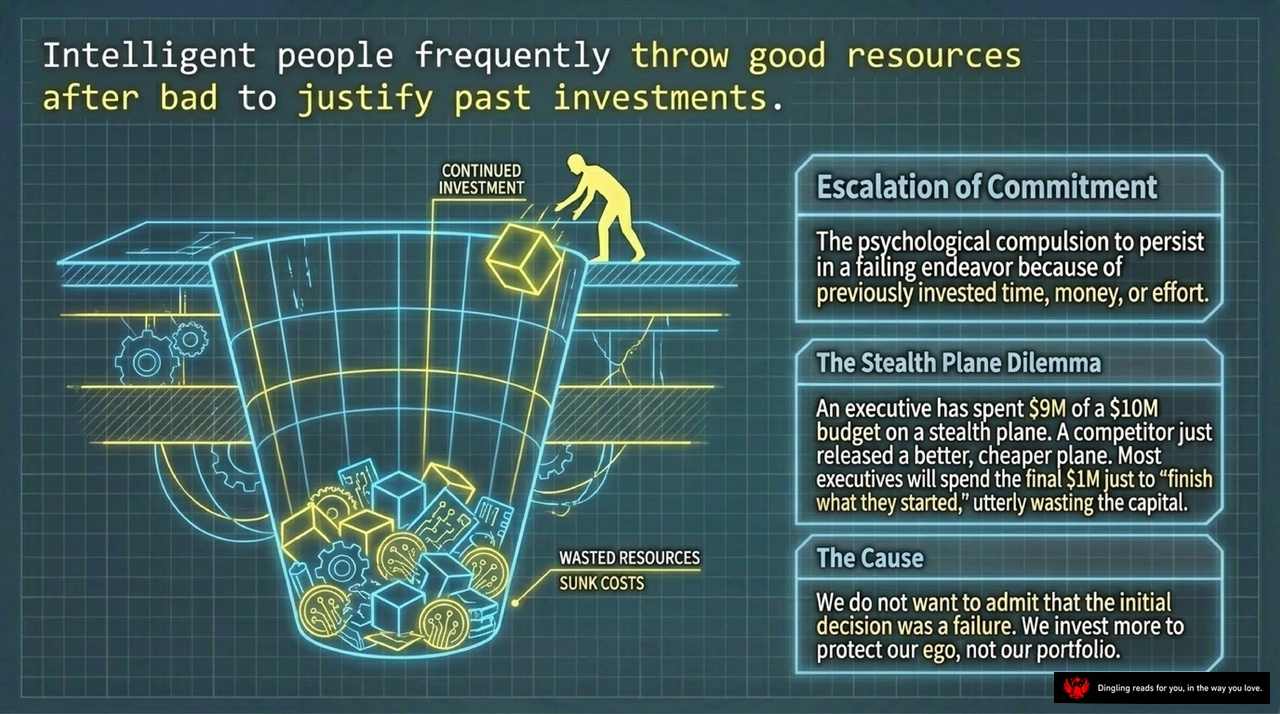
Look at this graphic illustrating the "Escalation of Commitment." It captures a psychological trap we all face: the compulsive drive to keep pouring resources into a failing project just because we've already invested so much. The image shows a person throwing more blocks into a sinking pit, labeled "Continued Investment," while the bottom fills with "Wasted Resources" and "Sunk Costs."
This is the classic "Stealth Plane Dilemma." Imagine an executive who has already spent $9 million of a $10 million budget on a secret plane. When a competitor releases a better, cheaper version, the logical choice is to scrap the project and save that final $1 million. Yet, most executives will throw that last dollar into the abyss. Why? Because admitting the initial decision was a failure feels like a personal defeat. As the slide notes, we invest more not to protect our portfolio, but to protect our ego.
Intelligent people frequently throw good resources after bad to justify past investments. This isn't just about money; it's about the pain of admitting we were wrong. By continuing to invest, we create a narrative that our original choice was right, even when the evidence screams otherwise. The result? We waste capital and time, clinging to a sinking ship long after it's clear we should have jumped off. To avoid this, we must learn to separate our self-worth from our decisions and have the courage to cut our losses early.

Rationality isn't a default setting; it's a deliberate practice requiring specific cognitive tools. To navigate a world full of biases, we need a toolkit.
First, consider the opposite. Actively force yourself to list reasons why your core assumption might be entirely wrong. This instantly reduces overconfidence. Second, rely on data over vividness. Strip the emotional narrative away. One vivid anecdote of a plane crash overrides the statistical safety of millions of flights, so always demand base rates.
Third, set absolute limits. Before starting any project, establish hard numerical limits for acceptable losses. When the limit is reached, exit. Do not evaluate limits while you are already in the trap. Finally, unbundle composite events. Do not assess the probability of a massive scenario as one single unit. Break it down into sequential steps and calculate the compound probability instead.
By mastering these four tools, you transform rationality from a vague ideal into a concrete, actionable habit.

Our minds are beautifully efficient, but let's be honest—they are also inherently flawed instruments. We rely on invisible shortcuts that consistently skew our reality, manufacture our preferences, and inflate our confidence. It's a double-edged sword that makes us human, but it also makes us vulnerable to error.
Knowing that your brain is actively hiding its own glitches, how will you audit your next high-stakes decision? The answer lies in shifting from passive reliance to active skepticism. Instead of trusting your gut feeling, you must deliberately slow down and challenge the very assumptions your brain is feeding you.
Think about the "availability heuristic," where dramatic news stories make risks feel more common than they are, or the "anchoring effect," where a single number blinds you to the true value of a negotiation. Even experts fall for these traps. The solution isn't to eliminate these biases—because that's impossible—but to recognize them. When you feel a surge of certainty, ask yourself: "What evidence am I ignoring?" When a choice feels obvious, consider the alternative outcomes you're dismissing.
By treating your own judgment as a hypothesis to be tested rather than a fact to be accepted, you transform your decision-making process. You move from being a victim of your brain's shortcuts to an architect of your own rationality. In a world full of noise and hidden variables, that simple shift in perspective is the most powerful tool you have for making better choices.