
The Psychology of Money: Complete Chapter-by-Chapter Summary

Welcome to our deep dive into *The Psychology of Money* by Morgan Housel. Today, we're tackling the book's most powerful opening idea: doing well with money isn't about what you know, but about how you behave.
We often make the mistake of thinking financial success is a test of IQ or technical knowledge. But the reality is far more interesting. Consider the contrast between a brilliant tech genius who can design complex systems yet squanders millions on gold coins and flashy displays, and an ordinary gas station attendant who built a fortune simply through patience and consistent saving. These two stories prove that high intelligence doesn't guarantee wealth, while good habits do.
This book challenges the idea that we are rational actors. In truth, our behaviors, our upbringing, and our unique personal experiences shape our money views in ways we often don't realize. Understanding this is the first step to mastering your financial life.

Financial success isn't about how smart you are; it's about how you behave. Look at that scale: on one side sits "Traditional Finance," which relies on rigid math, historical data, and the laws of physics. It assumes if you know the formula, you win. But on the other side is "Psychological Reality," driven by human emotion, personal habits, evolution, and our ego. The scale tips heavily toward behavior because finance isn't a hard science where intellect automatically wins.
Knowing what to do tells you nothing about what happens in your head when you actually try to do it. We often mistake our financial decisions for rational calculations, but we're actually fighting our own nature. A genius with a perfect strategy can go bankrupt if their emotions take over, while an ordinary person with disciplined habits can build immense wealth. Your unique background, your fears, and your instincts shape your money view more than any textbook ever could. So, stop obsessing over being smarter and start working on being more consistent.

Look at these two strikingly different paths to wealth. On the left, we have Ronald Read. He spent 25 years as a gas station mechanic and 17 years as a floor janitor with no college degree. His strategy was simple: patiently save and buy blue-chip stocks. The result? He died at 92 with an $8 million net worth, leaving $6 million to charity.
On the right, we have Richard Fuscone. He held a Harvard MBA and was a successful Merrill Lynch executive praised for his business acumen. His strategy, however, was to borrow heavily to expand a Greenwich mansion with 11 bathrooms and $90,000 in monthly maintenance. The outcome? He faced foreclosure and declared personal bankruptcy after the 2008 financial crisis.
The slide clearly states that temperament consistently outperforms financial credentials. It highlights a profound truth: Finance is the rare field where a person with zero background or training can vastly outperform a highly educated insider purely based on psychological behavior. Read's discipline and patience built an empire, while Fuscone's ambition and leverage destroyed it. This comparison reminds us that in the game of wealth, your character and habits matter far more than your resume or your IQ.

Your localized experience dictates your entire financial worldview. Look at this graphic: a tiny sliver representing 0.00000001% of what you have personally experienced versus a massive 80% circle showing how you think the entire world works. That gap is where your money story lives.
No one is truly crazy. What looks like a risky decision is often just a logical response to your unique history. A low-income worker buying a lottery ticket isn't acting on impulse; they are making a rational choice based on a feeling of exclusion from the dream life they've never seen. Their risk profile was forged by their generational context—perhaps growing up during inflation or poverty.
Every financial decision makes sense to the person making it at that exact moment. If you judge someone else's wealth strategy by your own background, you'll be completely wrong. To navigate this, you must build a decision framework that respects your own reality while keeping your long-term goals in sight. It's not about being the smartest investor; it's about understanding that your personal experience is the lens through which you see the world, and that lens shapes every dollar you spend or save.

Every outcome is guided by invisible forces outside individual effort. Look at this slide: it contrasts Bill Gates with Kent Evans. Gates experienced that one-in-a-million luck of attending Lakeside School, the only high school in the world with a computer terminal back in 1968. That single access point became the foundation for Microsoft. But right beside him sat Kent Evans, Gates' brilliant classmate and equal in computer programming. Kent had the same talent, the same environment, and the same incredible starting luck. Yet, before graduation, he experienced the one-in-a-million risk of a fatal mountaineering accident and simply vanished from the story.
Luck and risk are identical twins. You cannot safely attribute all success to hard work, nor all failure to bad decisions. Be careful who you praise and who you condemn. We often make the mistake of looking at a successful person and assuming they are smarter or worked harder than everyone else, ignoring the massive role chance played in their favor. Conversely, we judge failures too harshly, forgetting that a single unforeseen event can erase a lifetime of effort. In the game of wealth, you are always playing within a framework of luck. Your job isn't to control the invisible forces, but to recognize them, respect the risks, and keep working hard within the opportunities that fate hands you.

There is no reason to risk what you need for what you do not need. Look at this ladder: it stretches endlessly upward, chasing clouds that are out of reach. But right here, marked by that yellow line, is the only place that truly matters: "Enough."
Modern capitalism is incredibly good at generating wealth, but it's equally brilliant at generating envy. We see this in stories like Rajat Gupta or Bernie Madoff. They possessed immense wealth, prestige, and power. Yet, they risked everything they had—and ended up in prison—simply because they lacked a sense of "enough." The ceiling of social comparison is endlessly high, and the only way to win is to refuse to fight that endless race.
Consider Joseph Heller, responding to a billionaire who made more money in a single day than Heller's entire literary career ever earned. Heller didn't feel threatened; instead, he confidently stated, "I have something he will never have... enough."
True wealth isn't about climbing higher than everyone else. It's about realizing you have what you need. When you stop chasing the next rung on the ladder, you stop risking your stability for vanity. You secure your freedom. Because in the end, the only asset that truly matters is the peace of mind that comes from knowing you have enough.

Think about how we usually talk about investing. We obsess over picking the right stocks or timing the market perfectly, but the slide you're seeing today tells a much simpler, yet profound story: Time is the ultimate invisible multiplier of wealth.
Look at that curve on the right. It illustrates a staggering fact about Warren Buffett. Of his total net worth, roughly $81.5 billion came after his 65th birthday. That's more than 90% of his fortune accumulated in the last third of his life. This isn't because he suddenly became a genius in his old age. The text on the left reveals the real secret: his actual superpower is that he has been investing continuously for three-quarters of a century.
We often study how Buffett finds cheap stocks or evaluates managers, thinking that's the key to success. But good investing is not necessarily about earning the highest returns in a single year. It is about earning consistently good returns that you can sustain for the longest period of time.
This is why we study Buffett's methods, but we must remember his true advantage. If you started investing ten years later, even with the same skills, your final result would be drastically different. The lesson is clear: don't chase the highest returns today. Instead, focus on building a habit that lasts. Time does the heavy lifting, turning steady, modest gains into an empire.

Acquiring wealth and keeping it requires two completely opposite mindsets. On the left, getting wealthy demands taking risks, extreme optimism, and putting yourself out there. On the right, staying wealthy demands humility, extreme frugality, and a paranoid focus on survival. This isn't just theory; it's a lesson in history. Take Jesse Livermore, who made the equivalent of $3 billion shorting the 1929 market crash. His unchecked risk-taking eventually left him completely bankrupt by 1933. The book makes it clear: to leverage compounding, survival must be your foundational strategy. You can build massive wealth through bold moves, but without the discipline to protect what you've built, you will lose it all. True financial mastery is balancing the offensive courage needed to grow with the defensive wisdom required to endure.

You can be wrong half the time and still make a fortune. This slide captures a profound truth about wealth: success isn't about being right every single time; it's about surviving long enough to catch a few massive, unexpected wins.
Look at the graph. The vast majority of dots—the gray ones—represent failures or small losses. In investing and business, these "tails" or extreme outlier events drive almost all the real outcomes. Think about art dealer Heinz Berggruen. He amassed a portfolio of staggering value, yet 99% of his purchases turned out to be worthless. It was that remaining 1%, specifically the Picasso, that made the entire strategy brilliant. Similarly, Walt Disney produced over 400 failed cartoons before *Snow White* saved the studio.
The lesson here is simple but counterintuitive: it is normal for things to fail. You do not need to be right every time. In fact, trying to be right constantly often leads to overtrading and higher risks. Instead, you just need to survive long enough to experience a tail event. That one big win, after years of small mistakes, is what builds real fortune. So, stop fearing the failures and start focusing on staying in the game.
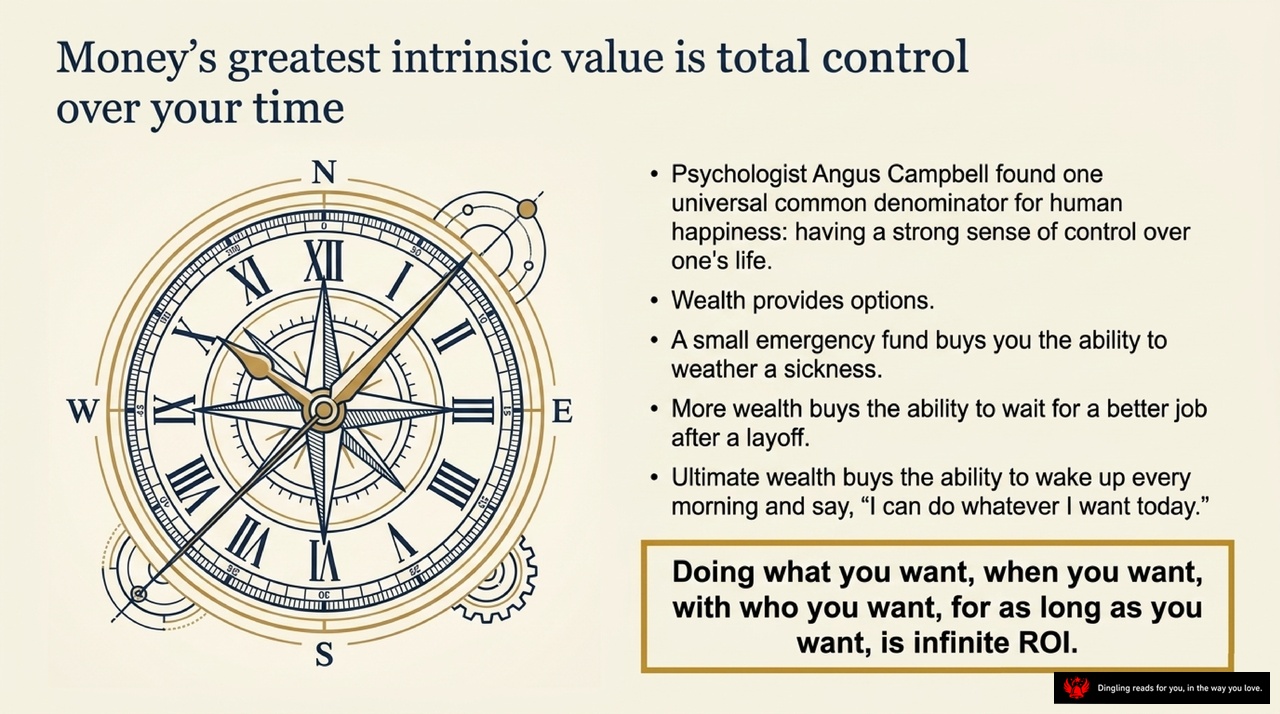
Money's greatest intrinsic value is total control over your time. Look at this compass; it's not just for finding North, it's a metaphor for life direction. Psychologist Angus Campbell discovered something profound: the universal key to human happiness isn't money itself, but having a strong sense of control over your life.
Wealth provides options, and these options are what buy you freedom. A small emergency fund buys you the ability to weather a sickness without panic. More wealth buys the ability to wait for a better job after a layoff instead of taking the first desperate offer. But ultimate wealth? That buys the ability to wake up every morning and say, "I can do whatever I want today."
Doing what you want, when you want, with who you want, for as long as you want, is the only investment that offers infinite ROI. That is the true power of money: it liberates your time, giving you the freedom to design your life rather than just surviving it.

True wealth isn't about what you can show off; it's about what you deliberately choose to keep hidden. Think of it like an iceberg: the tiny tip above the water represents "Rich"—the Ferraris, mansions, and diamonds we buy to signal status to others. But here's the hard truth: that visible spending actually reduces your net worth. Meanwhile, the massive chunk below the surface is "Wealth"—your untouched portfolios, emergency savings, and compounding accounts that generate lasting freedom.
We often fall into the "Man in the Car Paradox." We buy luxury cars hoping others will admire us, but in reality, people rarely look at the driver; they just imagine themselves sitting in that seat. We use wealth to signal status, yet true wealth is the exact opposite of visible spending. It's the money you never see, the invisible assets that give you the autonomy to live life on your own terms, rather than performing for an audience that isn't even watching.

Here is the spoken-word script for the current slide:
"Have you ever thought that the secret to wealth is having a genius IQ or a perfect financial strategy? The reality is often the opposite. As the Venn diagram on your screen shows, true success lies in the sweet spot where 'Mathematical Perfection' meets 'Human Emotion.' This is what we call a 'Reasonable' strategy.
Consider the story of Julius Wagner-Jauregg, who won a Nobel Prize in 1927 for treating syphilis by deliberately inducing malaria fevers. Scientifically, it was a perfectly rational move to fight the infection. But emotionally, it was a nightmare. Humans hate suffering, so we naturally prefer cures that don't make us miserable. Finance works exactly the same way. You are not a cold spreadsheet; you are a human being who needs to sleep at night.
A mathematically perfect investment portfolio is useless if a market panic causes you to abandon it in fear. The most dangerous trap isn't making the wrong calculation; it's making the right calculation but failing to stick with it because it feels too uncomfortable. So, aim for a strategy that is reasonably comfortable. Build a plan that aligns with your psychology, ensuring you never interrupt the compounding process because you can't handle the volatility. A strategy you can actually stick with beats a coldly rational one any day."

Market volatility isn't a penalty for doing something wrong; it's simply the standard admission fee you pay to play the game of investing. Think of it like this: when you get a traffic fine, you feel like you made a mistake and are trying to avoid it next time. But when you buy an admission ticket to a concert or a museum, you aren't being punished; you're paying for a valuable experience.
Many investors panic when the market drops, treating those losses like a fine for their bad decisions. But that's the wrong mindset. Market crashes, uncertainty, and even periodic disasters are just the required entry fee for the opportunity to earn higher long-term returns. Once you shift your perspective and view volatility as a necessary ticket rather than a warning sign, the panic stops. You realize that every time the market shakes, you're just paying the fee to keep your seat at the table, where the real wealth is built over time.
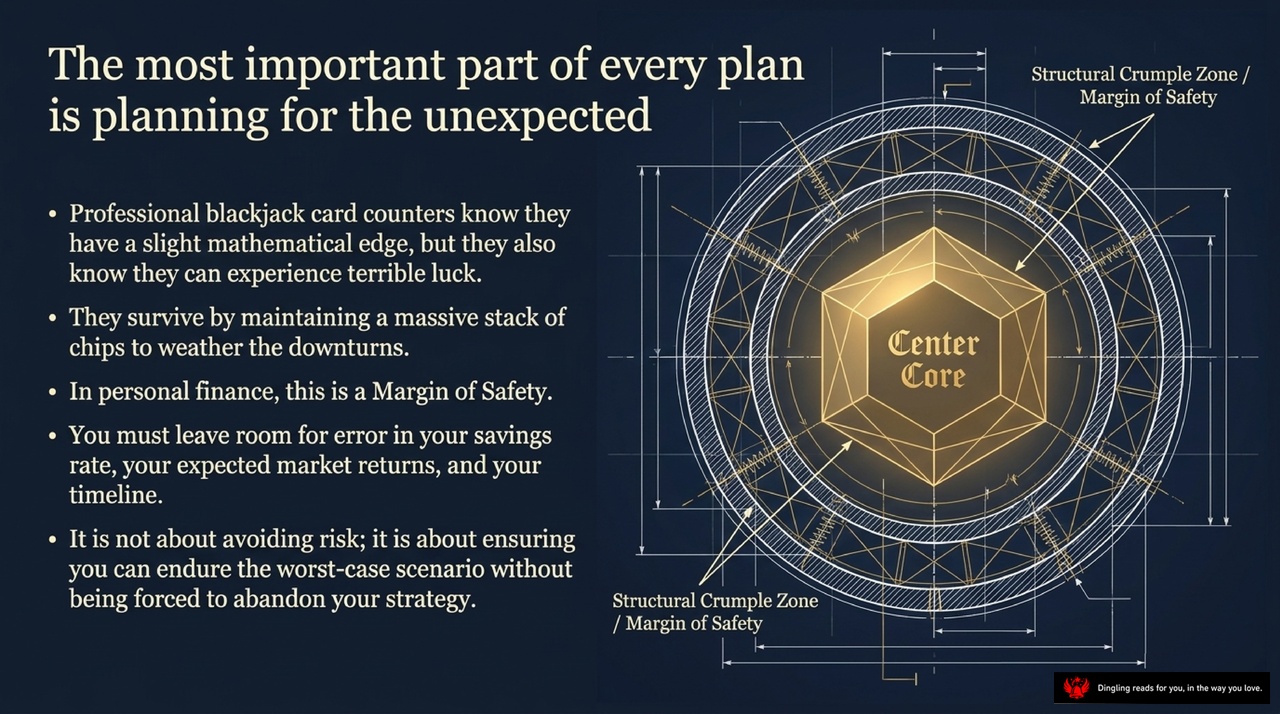
The most important part of every plan is planning for the unexpected. This isn't about being pessimistic; it's about building a "Margin of Safety" into your life so that when things go wrong, you don't have to. Think of it like a professional blackjack card counter. They know the math is slightly in their favor, but they also know that bad luck can strike at any moment. If they bet their entire stack on every hand, one unlucky streak would wipe them out. Instead, they maintain a massive stack of chips to weather the downturns.
In personal finance, this same principle applies. Your "Center Core" is your essential life—your health, your family, your ability to function. Surrounding that core is your "Structural Crumble Zone," which acts as your buffer. This is where your emergency cash, your diversified investments, and your flexibility live. You must leave room for error in your savings rate, your expected market returns, and your timeline. It's not about avoiding risk entirely, which is impossible; it's about ensuring you can endure the worst-case scenario without being forced to abandon your strategy. By accepting uncertainty and building these buffers, you stop reacting to panic and start acting with confidence, knowing you have the cushion to survive whatever comes next.

Have you ever asked yourself: Are you using your money to design the life you want, or simply to impress people you don't even know? This is the core question we face today.
Look at these five critical points that define true wealth. First, save money without needing a specific reason. Don't wait for a big goal like buying a house; just build your buffer for the unexpected. Second, respect the invisible twin forces of luck and risk. Acknowledge that some opportunities are just chance, and some losses are unavoidable. Third, define your "enough" and step off the treadmill of comparison. Stop chasing status symbols and start focusing on what truly satisfies you. Fourth, survive long enough to let compounding do the heavy lifting. Patience is your most powerful asset. Finally, use money to buy autonomy over your time, not status symbols. True freedom is about having the choice to do what you love, when you want.
So, let's be honest. Are you building wealth for yourself, or are you just trying to fill the eyes of strangers? The answer determines everything.