
The Realm of Clarity: Complete Chapter-by-Chapter Summary

Welcome to the Realm of Clarity. Today, we are diving into the core philosophy of Qing Ze's groundbreaking work, "The Realm of Clarity."
This isn't just a book about making money; it is a profound architectural framework that redefines how we approach investment philosophy, market theory, and the very mindset of trading.
In the beginning, many of us enter the market chasing wealth, obsessed with the "how-to" of trading. But as Qing Ze reveals, true mastery lies in shifting from seeking profit to seeking the "Dao"—the underlying path or truth of the market. It's a journey from technique to wisdom, and ultimately, from ambition to enlightenment.
The book serves as a raw, honest confession of a decade of investment life, filled with both triumph and devastating losses. It teaches us that the market has no absolute rules, but rather, our own theories and models dictate what we see. By building a clear, consistent system and treating it as a matter of faith, we transform from anxious gamblers into calm observers who are ready to act with precision when the opportunity arises.
This is the path to clarity: stop chasing the market, and start letting your philosophy guide your actions.

On this slide, we are contrasting two fundamental ways of looking at the market: The Discovery Model and The Invention Model. On the left, under the Discovery Model, we see a magnifying glass searching through scattered dots, representing the futile search for an objective, infallible Holy Grail. This is the fallacy of objective law—the belief that market patterns exist independently of the observer, waiting to be found like hidden treasure. But as the text reminds us, this search is often a fool's errand.
On the right, we shift to The Invention Model, illustrated by a camera projecting an image onto a grid. This represents the Kantian Pivot: the realization that the market's true nature is fundamentally chaotic and unknowable. We cannot see the market as it truly is; instead, we can only perceive the structured models we project onto it. This is the core of my investment philosophy: "The market's true nature is fundamentally chaotic and unknowable. We can only perceive the structured models we project onto it."
Just as a camera doesn't capture reality but creates a representation based on its lens, our investment theories, models, and assumptions act as that lens. They don't just help us see the market; they determine what we see. If you believe in value investing, you will see a world of undervalued assets; if you believe in trend following, you will see a world of momentum. There is no single, objective truth floating out there for us to discover. The market has no fixed coordinates like latitude and longitude; those are rules we, as humans, invented to navigate the chaos. Therefore, the most important work isn't finding the perfect pattern, but building a consistent, coherent framework that allows you to interpret the noise. Your theory becomes your reality.

Imagine the market as a chaotic storm of random dots—pure, unknowable noise. Without a lens to focus it, that chaos is just noise. But humans have a unique ability: we don't just observe the market; we legislate for it. As the slide illustrates, we take that raw chaos and force it through an "A Priori Framework"—our theories, assumptions, and models. Suddenly, that random scatter of dots transforms into a clear, perceived signal or trend.
This is the core of my philosophy: the theory decides the observation. If you don't have a pre-existing framework, you see nothing but randomness. You aren't trading the market; you are trading your own rules. It's like the famous quote from Kant that inspired me: "Science is not discovery, but invention." We create the grid, the coordinates, and the map, and then we navigate by them. Different investors build different grids—a value investor sees one world, a trend follower sees another. So, before you can trade, you must first decide what you are looking at. Your theory isn't just a tool; it's the very reality you are trading.

When you try to master every theory at once, you don't find clarity; you find paralysis. This slide illustrates what I call the "Paradox of Multiple Theories." Look at the diagram on the left: we have Value Investing, Short-Term Technicals, and Macro Fundamentals. When you try to synthesize all three, the center doesn't become wisdom—it becomes "Null Output." More theories lead to less mastery.
Think about it like this: attempting a 360-degree view is like having three watches displaying different times. Which one do you trust? You end up with behavioral paralysis, unable to act because the signals contradict each other. I learned this the hard way. Early in my career, I tried to combine everything—philosophy, technicals, macroeconomics—believing that if I just added enough variables, I'd crack the market's code. Instead, I was just confused. I saw patterns where there were none and missed the obvious trends because I was filtering them out with conflicting frameworks.
The hard truth is that there is no perfect, all-encompassing system. Every theory has blind spots. Value investing ignores short-term volatility; technical analysis ignores long-term fundamentals. The master trader doesn't try to eliminate these blind spots by adding more tools. Instead, they accept them. They choose a single, pure theory and master it completely. They know the limitations of their chosen path and operate within those boundaries with discipline. This is why synthesizing contradictory methods fails. It creates noise, not signal. To succeed, you must simplify. Pick one lens, look through it until the market reveals itself, and ignore the rest. That is the only way to turn confusion into mastery.

Most investors make a fatal mistake: they try to mix and match every theory they've ever read, hoping to build a "perfect" system that catches every market move. But as I learned the hard way, trying to be everything to everyone is a recipe for disaster. It's like trying to tell time with two different watches; the result is total confusion. You end up stuck in what philosophers call the "Buridan's Ass" effect—standing paralyzed between two identical piles of hay because you can't choose. In trading, this indecision means you miss the one big opportunity that actually matters.
The solution isn't complexity; it's radical simplicity. You need to choose one core theory and treat it as your absolute truth. This is where the concept of "Trend + Structure" becomes your lifeline. Think of the market like a reservoir of fish. When the market is in "Structure," or equilibrium, the fish swim in random directions—there is no edge, no statistical advantage, and no clear path. It's just noise. But the moment a "Trend" breaks through, like a dam collapsing, the water flows in one direction and the fish all move together. That is your moment.
Your job isn't to predict the future; it's to recognize the moment the dam breaks. Once you have identified that structure has broken and a trend has begun, you must have the faith to follow it completely. Don't let the fish swimming in the opposite direction distract you. Stick to your system, accept its limitations, and trust that by focusing on one clear path, you can navigate the chaos. Remember, mastery comes not from knowing everything, but from knowing one thing deeply enough to act without hesitation.

Only faith can save our souls and serve as the bedrock of investment wisdom. No matter the crisis or adversity, sticking to your principles is rare and invaluable. Success isn't about complexity; it's about repeating simple things correctly.
Many treat investing as science or art, but neither handles market uncertainty or human greed alone. Only faith keeps us consistent. Think of faith like a handrail on a bridge: you don't touch it often, but it gives you total security when you need it. It's your unshakable behavioral code.
I categorize wisdom into three levels. Small wisdom chases quick profits and becomes a slave to money. Medium wisdom waits patiently when opportunities don't exist. But great wisdom is faith. It guides you to the true path.
In trader training, I use four stages: knowing, believing, trusting, and faith. "Knowing" is just understanding the system. "Believing" means you know the pros and cons but still waver when results fluctuate. "Trusting" allows you to execute stably, though you might doubt briefly in extreme cases. True "faith" is pure. You observe the market solely through your system and execute without hesitation, entering a state of clarity.
Consider the Torgut people of Mongolia. In the 17th century, they fled Russian religious oppression, marching thousands of miles against overwhelming odds. Seventy thousand left, fewer than twenty thousand arrived, yet they never regretted their choice. That is the power of faith.
I also emphasize "Gathering the heart, guarding the heart, and cultivating the heart." Gather the heart by defining your circle of competence and letting go of what isn't yours. Guard the heart by sticking to your system even when the market tempts you. Cultivate the heart by refining your discipline in daily life.
Finally, remember that 99% of investors fail because they lack faith. They try to combine conflicting theories, seeking a perfect system that doesn't exist. You must choose one theory and believe in its uniqueness, accepting both its strengths and flaws. True success comes not from knowing everything, but from believing firmly in your path and walking it with unwavering conviction.

The reality of survival in trading isn't about predicting the future; it's about managing the present. Look at this balance scale. On one side, we have "The Prediction Fallacy"—the dangerous illusion that a high win-rate system guarantees success if you lack downside protection. This mindset leads directly to "Ruin," symbolized by that heavy anvil. It's the trap of thinking you can control everything without a safety net.
On the other side lies "The Survival Reality." Here, controlled losses are mitigated by asymmetrical upside. Instead of chasing impossible accuracy, you focus on "Trend Capture." Notice how the weight on this side is lighter but far more valuable. This is the core truth: risk management isn't a secondary tool you use when things go wrong; it is the primary mechanism for navigating an unknowable market. Survival precedes prediction. You must secure your footing before you can ever attempt to forecast the next move.

Imagine your trading account as a fortress under siege. To survive the chaos of the market, you can't just rely on luck or a single lucky trade; you need a layered defense system. Today, we are looking at the "Four Lines of Defense," a framework designed to protect your capital no matter how volatile things get.
Think of this as a concentric circle around your core equity. The outermost layer is your Position Sizing. This is your first line of defense, a pre-trade mitigation strategy. The rule here is simple: trial positions should only scale up once the market confirms your thesis. If the market doesn't move in your favor, you don't force it. You stay small until you have proof.
Moving inward, the second line is Time or Active Stop-Loss. This is about proactive capital reduction. If the market fails to prove your thesis quickly, you cut your losses immediately. You don't wait for a reversal that might never come; you reduce your exposure while there is still time.
The third layer is your Passive Price Stop-Loss. This is an automated system exit. It triggers only when the structural thesis is invalidated. It's not about guessing the bottom; it's about acknowledging that your original logic is no longer valid and getting out of the way.
Finally, at the very center, is The Citadel. This is your daily or phase equity bottom line. It is the ultimate kill-switch. If you hit a hard drawdown limit, trading halts completely. This prevents a single bad streak from wiping out your entire account.
By stacking these four layers—Position Sizing, Active Stops, Passive Stops, and The Citadel—you create a robust safety net. It ensures that even if you make mistakes, you survive them. It turns trading from a gamble into a disciplined business where risk is managed at every single step.

Look at this slide: "The Attention Dichotomy." It splits trading into two distinct mindsets: Spontaneous Attention, which we call the Novice approach, and Conscious Attention, the Professional way.
The Novice is reactive. Their trigger is simply a blinking red or green price. They operate from a place of fear and greed, emotionally tethered to the chaos of the market. Their action? Chasing noise and abandoning their plan the moment things get shaky. It's like watching a movie without knowing the plot, just reacting to every sudden movement.
In contrast, the Professional operates with Conscious Attention. Their trigger isn't random price action; it's proactive. They only alert themselves when their specific, theory-driven criteria are met. Psychologically, they are detached and rule-bound, observing the market through a disciplined lens rather than getting swept away by it. Their action is executing a pre-defined architectural blueprint.
Think of it this way: the Novice is like someone firing a gun without aiming, hoping for luck. The Professional is the one who aims first, then fires. One is reacting to the market's noise; the other is executing a plan based on deep conviction. This shift from spontaneous to conscious attention is the single biggest difference between a gambler and a true trader.
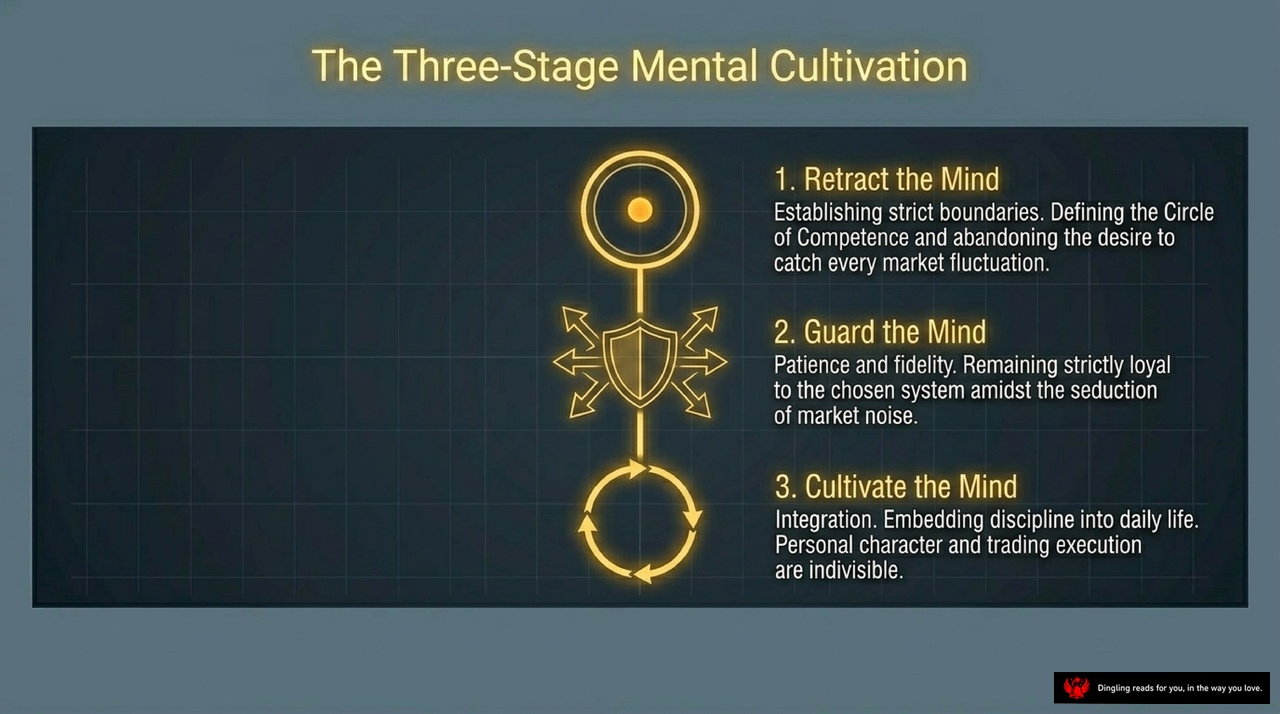
Today's slide outlines the ultimate roadmap for mastering the markets: The Three-Stage Mental Cultivation. Think of your trading journey not as a series of lucky guesses, but as a disciplined path to forging an unbreakable mindset.
First, we must **Retract the Mind**. This is about establishing strict boundaries. You need to define your Circle of Competence and, crucially, abandon the desperate desire to catch every single market fluctuation. It's about knowing when to step back and letting the noise fade.
Next, you must **Guard the Mind**. This stage demands patience and absolute fidelity. No matter how loud the market noise gets, or how tempting the seduction of quick wins becomes, you must remain strictly loyal to your chosen system. Your discipline is your shield against chaos.
Finally, and most importantly, you must **Cultivate the Mind**. This is the stage of integration. You stop treating trading as a separate job and embed discipline into your daily life. As the text emphasizes, personal character and trading execution become indivisible. When your values and your trades align, you stop fighting yourself and start mastering the market.

The Limits of Rationality: Why Your Brain Fails When Money Is on the Line
Look at this graph. It tells a brutal story about why even the smartest people lose in trading. The top line, "Pure Logic & Intellect," stays perfectly flat. It represents what your brain *should* do: remain calm, stick to the plan, and ignore the noise. But the black line below? That's "Market Equity." It drops. It crashes. And as losses deepen over time, something critical happens.
Notice the dotted line labeled "Critical Threshold." This is the moment everything changes. Before this point, your intellect might still be working. But once the financial pain becomes too deep, the graph shows a violent shift. "Visceral fear overrides intellect." Your rational brain gets hijacked by raw emotion. You stop following your system and start reacting to the pain of losing money.
The text at the bottom makes it clear: "Intelligence alone cannot withstand the emotional trauma of variance." You can be a genius, you can have the best strategy in the world, but if you lack a "stronger psychological anchor," you will fail when the market turns against you. The market doesn't care about your IQ. It only cares about whether you can stick to your rules when it hurts. That is the true limit of rationality.

The chart you see here maps out the ultimate journey of a trader: the Knowledge-to-Faith Continuum. It's not just about accumulating data; it's about transforming your relationship with the market from intellectual curiosity to absolute spiritual surrender.
We start at the bottom with "Knowing." This is the stage of intellectual acceptance. You understand the rules, you know the theories, but your belief is conditional. It relies entirely on recent success. As the text warns, this is fragile. If the market turns against you, your conviction crumbles because you haven't internalized the system; you've only memorized the outcomes.
Moving up, we reach "Believing." Here, you apply the knowledge practically, but it's still a bit shaky. You trust the system because it worked yesterday. It's a practical application, but it lacks deep resilience.
Then comes "Trusting." This is where the ego starts to fade. You begin to delegate your judgment to the system. You stick to the rules even when there is minor friction or doubt. You stop questioning every move and start trusting the process, understanding that the system has a logic that your short-term emotions cannot override.
Finally, we arrive at the peak: "Faith." This is the state of complete psychological surrender. In this stage, belief becomes absolute. You no longer feel the emotional impact of market variance. You don't panic when prices drop or get greedy when they rise because you have transcended the need for constant validation. As the text beautifully puts it, faith is the only thing that saves your soul in the chaos of trading. It allows you to execute your strategy without hesitation, regardless of the outcome.
The vertical axis, "Emotional Resilience," shows that as you climb from Knowing to Faith, your ability to withstand the storms of the market grows exponentially. The horizontal axis, "Time / Experience," reminds us that this isn't a switch you flip; it's a path forged through years of pain, reflection, and unwavering commitment. Most traders get stuck at "Knowing" or "Believing," never reaching the plateau of "Faith." But for those who do, the market stops being an enemy and becomes a partner they can navigate with absolute clarity.

Imagine standing in the storm of the market, frantically trying to fight every wave with your bare hands, versus standing calmly inside a golden dome, completely shielded from the chaos outside. That is the exact difference between trading without faith and trading with it.
On the left side of this slide, we see "Fighting the Chaos Manually." This is the trap most of us fall into. We think we need to predict every move, analyze every data point, and manually react to every shift. It's exhausting, and it leaves us vulnerable. As I've learned the hard way, trying to control the uncontrollable is a recipe for disaster. You are essentially trying to stop the tide with your hands.
But look at the right side: "Shielded by Absolute Systemic Faith." This isn't about being blind or ignoring reality. It's about accepting that the system—your trading philosophy, your rules, your model—has its own blind spots and drawdowns. Faith doesn't mean believing the system is flawless; it means accepting those flaws as the necessary cost of participating in the game. It means trusting your "golden dome" enough to let the chaos hit it, rather than trying to block it yourself.
This concept is the core of my entire journey. I used to think success was about finding a perfect strategy that never lost. But after years of pain and blood, I realized the truth: true success comes from having the courage to stick to one system, no matter how painful the temporary losses feel. You must be willing to say, "I know this theory has limitations, but I trust it more than my own fear." When you shift from fighting the market to trusting your framework, the noise fades away. You stop being a victim of the chaos and become the calm observer inside the dome. That is the moment you stop gambling and start investing with conviction.
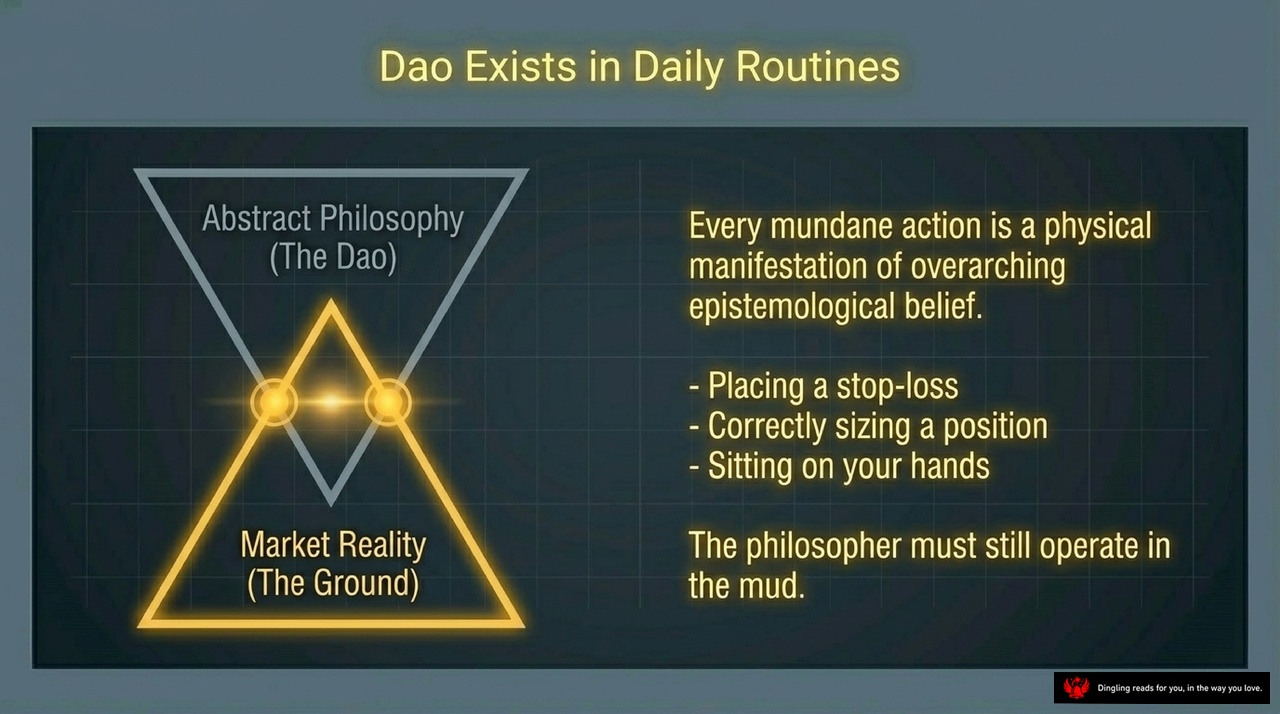
Dao Exists in Daily Routines. Look at this diagram: it shows how Abstract Philosophy, or "The Dao," intersects with Market Reality, or "The Ground." The slide makes a powerful point: every mundane action you take is actually a physical manifestation of your underlying epistemological beliefs. Think about your trading day. When you place a stop-loss, when you correctly size a position, or even when you sit on your hands and do nothing, you aren't just executing mechanical orders. You are physically enacting your philosophy. The philosopher must still operate in the mud. You can't stay in the ivory tower of abstract theory; you have to live it out in the gritty reality of the market. As the text says, life is investment, and investment is life. The difference between a dreamer and a trader isn't just in their head, but in how they handle the mundane tasks of every day. By grounding your high-level beliefs in these daily routines, you stop being a theorist and start becoming a true practitioner.

When philosophy, theory, risk, and faith align perfectly, the trader achieves clarity. This isn't about the market finally becoming predictable; rather, it's because the trader's internal architecture has become absolute. Think of it like this: clarity doesn't come from seeing the future clearly, but from having a perfectly built compass that never wavers, no matter how chaotic the storm gets. In the trading world, many fail because they chase external signals while their internal framework is shaky. True mastery happens when your investment philosophy, your specific trading theory, your strict risk management, and your unwavering faith in the system all lock together into one unified force. It's the difference between being a passenger who gets tossed around by every price fluctuation and being the pilot who knows exactly where the plane is going. When this alignment is achieved, the noise of the market fades away, and every move becomes a deliberate step toward your goal. That is the realm of clarity.