
The Red Book: Complete Chapter-by-Chapter Summary

Welcome to the Red Book, the groundbreaking exploration of the unconscious mind by Carl Jung. This isn't just a book; it's a raw, unfiltered journey into the depths of the human psyche, where the familiar rules of society fall apart to reveal something far more powerful. Jung describes a "depth spirit" that is far stronger than the trends of our time. It shatters our faith in science and our dreams of being heroes, forcing us back to the simplest, most terrifying truth: we are not separate from the chaos we fear.
The book begins with a shocking realization. Jung admits that he had been trying to hide from the dark, proud parts of himself, but the depth spirit demanded he face them. He writes about terrifying visions of floods and frozen landscapes, experiences that felt like premonitions of the coming world war. The core message here is profound and counterintuitive: the path to salvation isn't found in following gods, laws, or other people's examples. You cannot steal the fruit from someone else's garden. You are the fertile land yourself. To find your soul, you must stop looking outward and start listening to the voice within, even if that voice feels crazy or dangerous.
Jung warns us that trying to ignore our shadow side—the parts of us we call evil or weak—only allows those forces to grow into monsters inside us. The only way forward is to embrace the full spectrum of human experience, including the darkness. By accepting the "devil" within ourselves, we actually liberate ourselves from its control. This is the beginning of a difficult but necessary transformation, where the old, perfect idols of our mind must die so that something truly new and whole can be born.
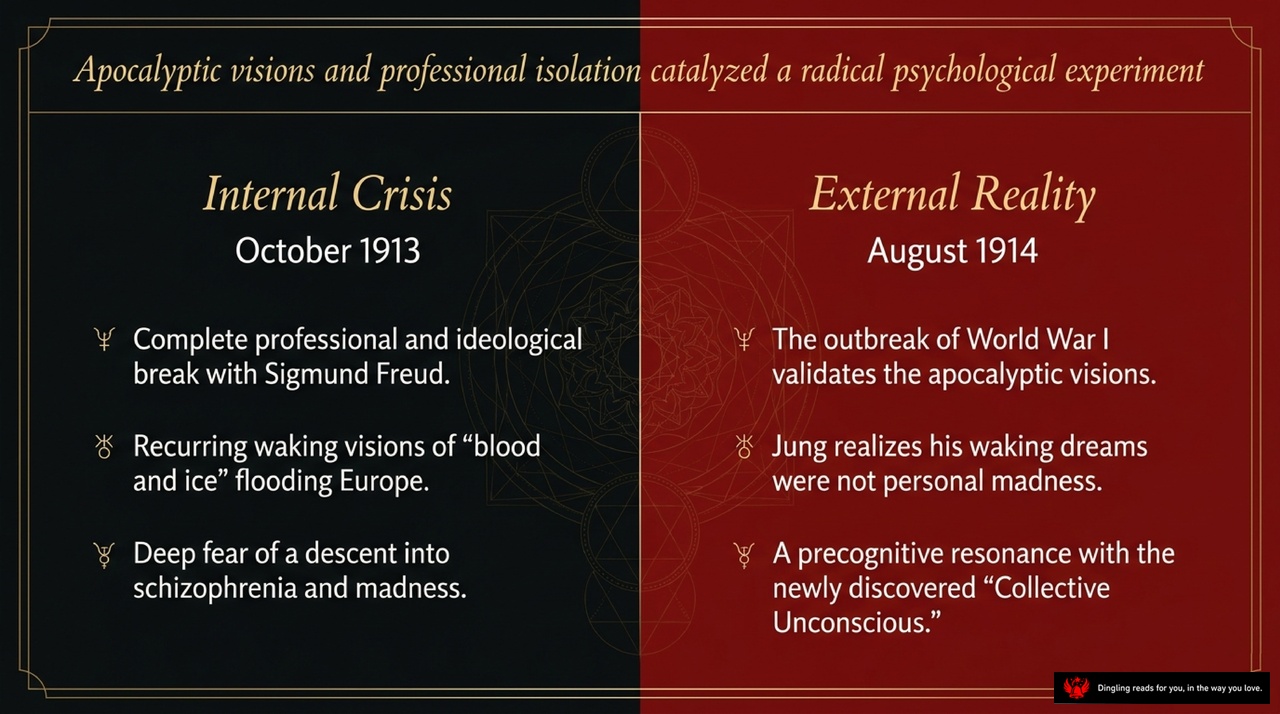
Apocalyptic visions and professional isolation catalyzed a radical psychological experiment. In October 1913, Carl Jung faced a complete professional and ideological break with Sigmund Freud. This wasn't just a personal fallout; it was an internal crisis. He was haunted by recurring waking visions of "blood and ice" flooding Europe, a terrifying premonition that made him fear a descent into schizophrenia and madness.
Then, the external reality shifted in August 1914 with the outbreak of World War I. The war validated his apocalyptic visions, proving they were not personal madness but precognitive resonances with a newly discovered "Collective Unconscious." Jung realized that his inner turmoil was mirroring the world's chaos. This moment forced him to abandon the rigid structures of the past and embark on a journey to integrate his shadow, ultimately leading to the birth of the concept of the Collective Unconscious.
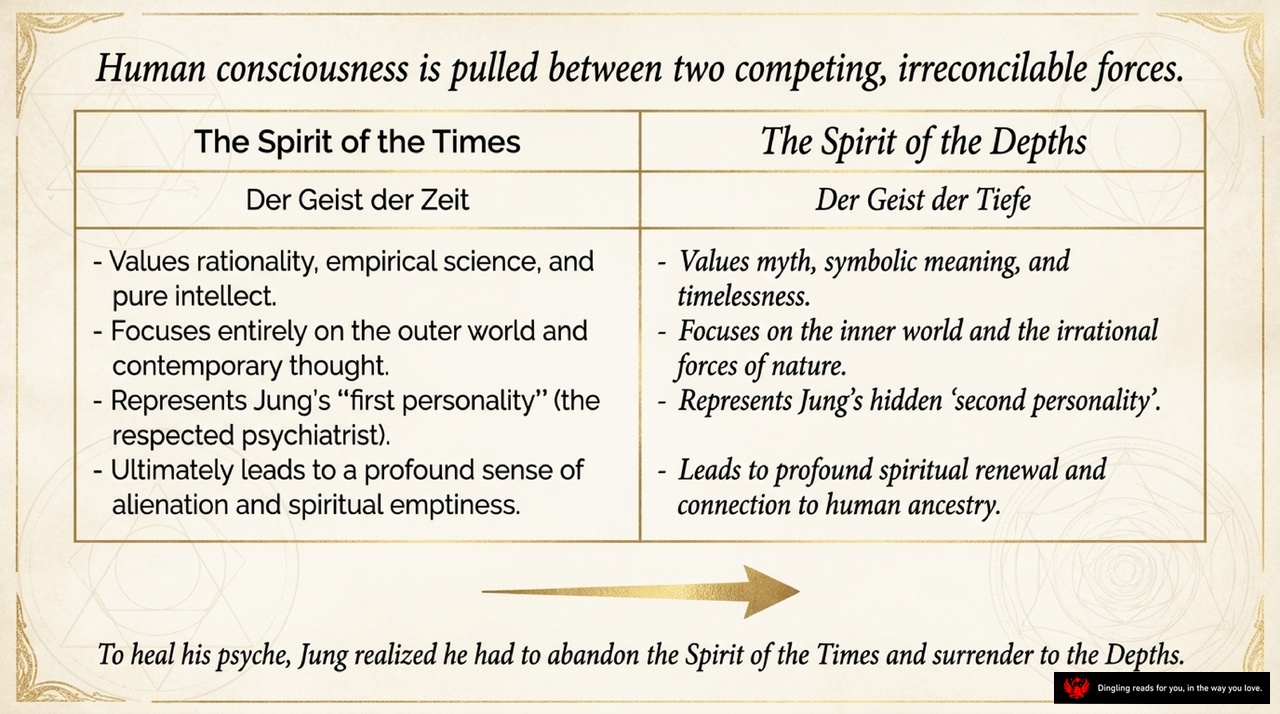
Human consciousness is often caught in a tug-of-war between two opposing forces: the Spirit of the Times and the Spirit of the Depths. On one side, we have the Spirit of the Times, or *Der Geist der Zeit*. This is the voice of our modern world, championing rationality, empirical science, and pure intellect. It looks outward, fixated on the contemporary and the tangible. While this side represents the respected, logical psychiatrist—the "first personality" that society admires—it ultimately leads to a profound sense of alienation and spiritual emptiness. It leaves us feeling disconnected, stripped of meaning.
On the other side lies the Spirit of the Depths, or *Der Geist der Tiefe*. This is the hidden, irrational force within us. It values myth, symbolic meaning, and timelessness, focusing on the inner world and the raw powers of nature. This represents Jung's "second personality"—the part we often try to suppress. While the Spirit of the Times seeks to conquer, the Spirit of the Depths offers spiritual renewal and a deep connection to our human ancestry. Jung realized that to heal his psyche, he couldn't just cling to the safety of the Times; he had to abandon that rigid exterior and surrender to the chaotic, transformative power of the Depths. It was only by embracing this inner darkness and the irrational that he could truly integrate his soul and find a path forward.
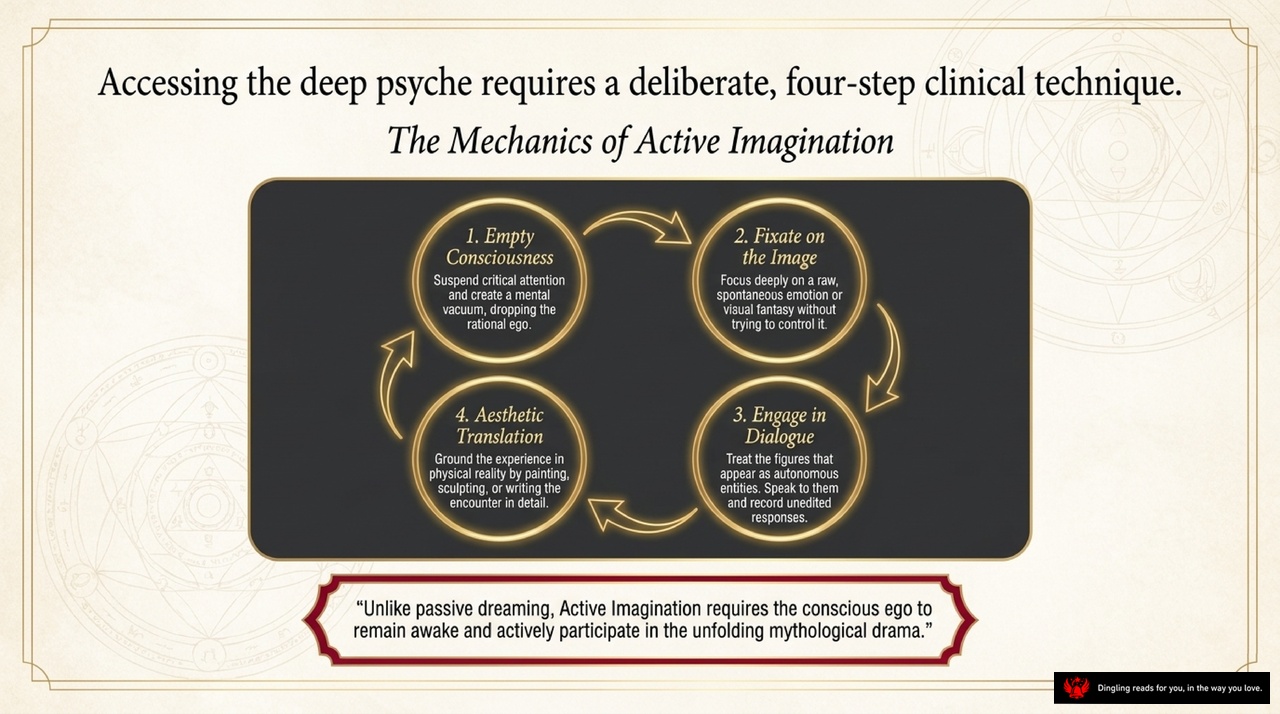
Accessing the deep psyche requires a deliberate, four-step clinical technique. This is the mechanics of Active Imagination, a method where you don't just wait for dreams to happen, but actively engage with them.
The process begins with **Emptying Consciousness**. You must suspend your critical thinking and create a mental vacuum, dropping the rational ego that usually judges everything. Once that noise is gone, you **Fixate on the Image**. This means focusing deeply on a raw emotion or a visual fantasy that arises spontaneously, without trying to control or fix it.
Next, you **Engage in Dialogue**. The figures or images that appear are treated as autonomous entities. You speak to them and record their unedited responses, as if they are real people. Finally, you move to **Aesthetic Translation**. You ground this intense inner experience in physical reality by painting, sculpting, or writing about the encounter in detail.
Unlike passive dreaming, Active Imagination requires your conscious ego to remain awake and actively participate in this unfolding mythological drama. It's about transforming internal chaos into something tangible and meaningful.

Raw nocturnal visions were meticulously codified into a modern illuminated manuscript, a transformation that mirrors the very alchemical journey Jung describes in his text. As we look at this slide, we see the evolution from raw chaos to sacred order.
It begins with Stage 1: The Black Books. Here, Jung captures the spontaneous, unedited diary entries of his dialogues with the unconscious, recorded between 1913 and 1932. It was a time of deep turbulence where he felt compelled to speak truths driven by a "depth spirit," even when they clashed with the pragmatic values of his era. He wasn't just recording dreams; he was documenting a terrifying yet necessary confrontation with his own soul, realizing that the path to truth lay within, not in external laws or the examples of others.
Moving forward to Stage 2, we see The Drafts, representing intellectual synthesis. Jung didn't just transcribe these raw experiences; he layered them with philosophical commentary and psychological interpretation. He was essentially acting as the mediator between the wild, often frightening forces of the unconscious and the rational mind. This stage was about making sense of the madness, finding the logic within the chaos, and understanding that the "depth spirit" forces us to integrate the shadow—the parts of ourselves we usually deny or fear.
Finally, we arrive at Stage 3: Liber Novus, the Sacred Artifact. This is where the raw data and the intellectual drafts are transmuted into calligraphic script on parchment, bound in red leather and illuminated with intricate, symbolic paintings. It represents the final integration. Just as Jung had to accept the "black snake" and the dark aspects of his psyche to achieve wholeness, this book represents the integration of opposites. It is no longer just a record of a man's madness, but a crafted tool for anyone willing to face their own inner darkness. It shows us that true redemption comes not from escaping our shadows, but from embracing them, allowing the light and the dark to coexist within a single, complete self.
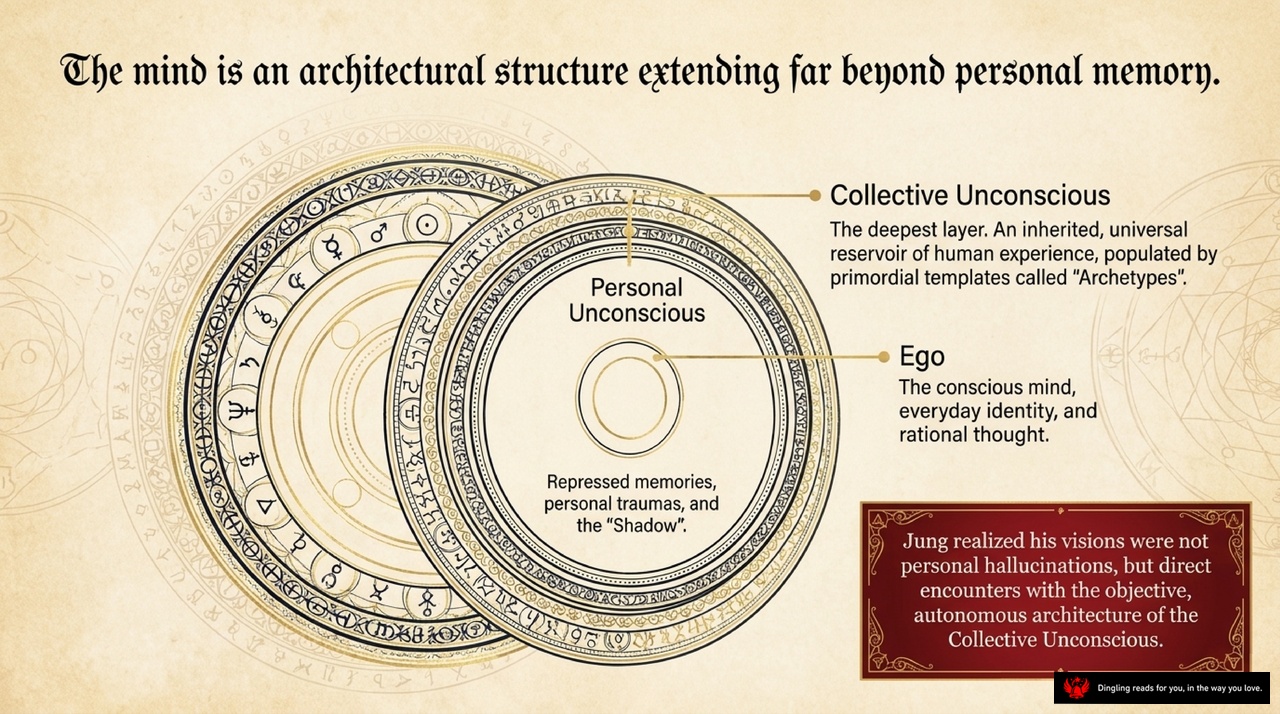
The mind is far more than just the sum of our personal memories; it is a vast, architectural structure that extends deep into the unknown. As we explore this slide, notice the concentric circles representing the layers of the psyche. At the very center lies the **Ego**, our conscious mind, responsible for our everyday identity and rational thought. It is the part of us that navigates the daily world.
Surrounding the Ego is the **Personal Unconscious**. This layer holds everything we have repressed: forgotten memories, personal traumas, and what Jung called the "Shadow"—the darker aspects of ourselves we try to hide.
But the outermost and deepest layer is the **Collective Unconscious**. This is the most profound concept here. It is an inherited, universal reservoir of human experience, shared by all of us, populated by primordial templates known as "Archetypes."
Jung realized that his visions were not merely personal hallucinations or symptoms of madness. Instead, they were direct encounters with this objective, autonomous architecture of the Collective Unconscious. This diagram reminds us that to truly understand ourselves, we must look beyond our individual stories and tap into the deep, shared wisdom of humanity itself.

True exploration begins with the conscious sacrifice of that rational, heroic ego we all cling to. As we see here, this journey starts with **The Hero**, represented by Siegfried, embodying our modern ideals of intellect, willpower, and efficiency. But true growth demands **The Murder of the Hero**. Jung's own dream revealed he had to assassinate Siegfried to dismantle the conscious ego. It's a terrifying thought, yet necessary. By sacrificing this superior function of pure rationality, we free up psychic energy to activate our inferior functions—myth and emotion. This allows the descent to continue. As the slide concludes, to make any new change possible, that efficient, heroic ideal simply had to be destroyed. Only by killing the perfect hero within can we welcome the rebirth of a more complete, albeit messy, self.
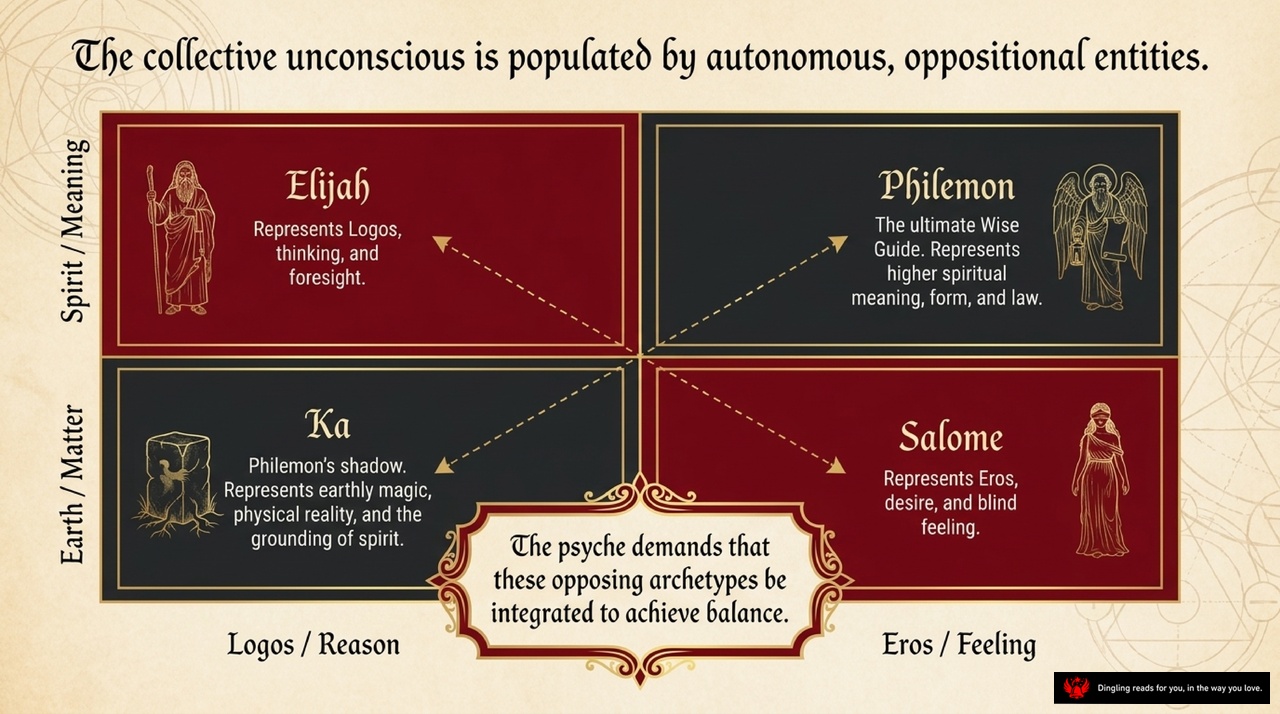
The collective unconscious isn't a quiet library; it's a crowded arena filled with autonomous, often opposing forces that demand our attention. Look at this map: it divides the psyche into Spirit and Matter, Reason and Feeling. On the side of Spirit and Logos, we have Elijah, the prophet of foresight and thinking, and his counterpart Philemon, the ultimate wise guide who embodies higher spiritual law. But balance requires the shadow side. Beneath Elijah lies Ka, representing earthly magic and the grounding of spirit. Opposite Philemon stands Salome, the embodiment of Eros—desire, blind feeling, and the vital pulse of life.
These archetypes aren't enemies to be defeated; they are necessary halves of a whole. The psyche demands that these opposing forces be integrated to achieve balance. If we only follow Elijah's cold reason, we become rigid and lifeless. If we only surrender to Salome's blind passion, we lose our direction. True wholeness comes from acknowledging that our deepest wisdom often lives where our conscious mind feels most uncomfortable. We must stop trying to suppress the dark or the chaotic and instead invite them into the light, allowing the tension between reason and feeling to create something new, something truly alive.
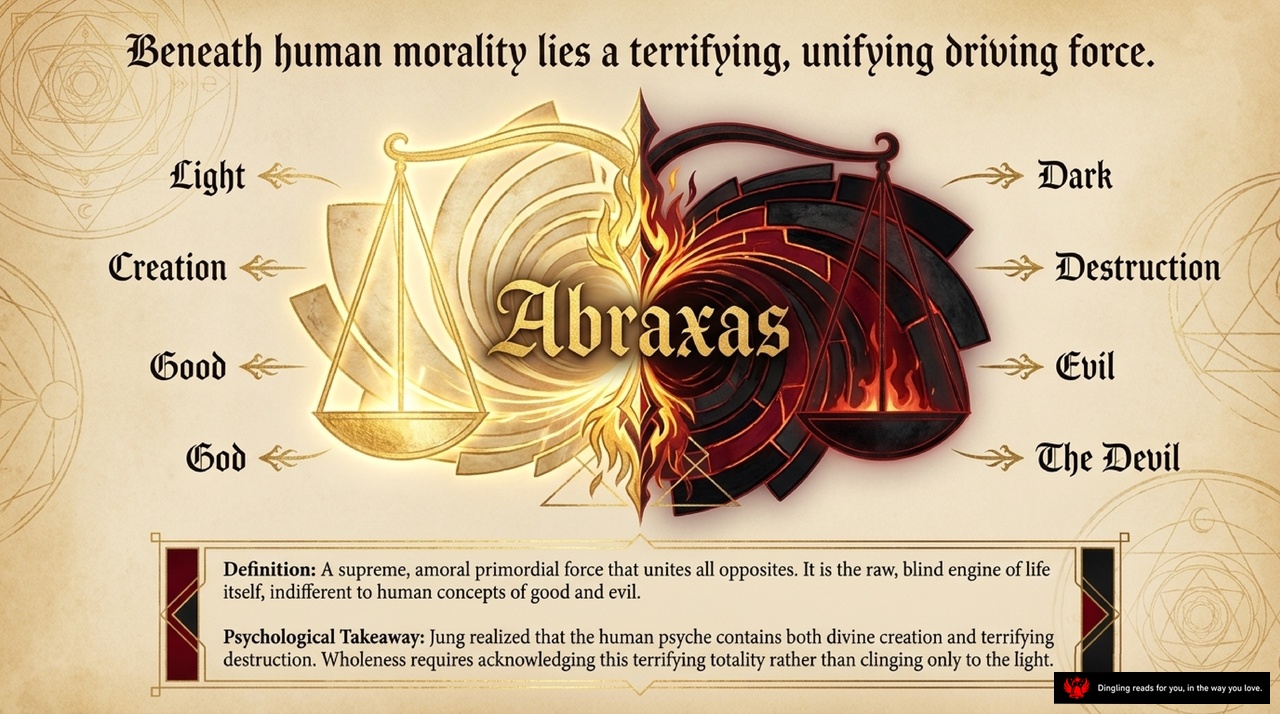
Beneath human morality lies a terrifying, unifying driving force. Look at this image of Abraxas, a supreme, amoral primordial force that unites all opposites. On the left, we see Light, Creation, Good, and God. On the right, Dark, Destruction, Evil, and The Devil. But Abraxas isn't just a balance; it's the raw, blind engine of life itself, indifferent to our human concepts of good and evil.
Carl Jung realized that the human psyche contains both divine creation and terrifying destruction. We often cling only to the light, trying to suppress the dark, but true wholeness requires acknowledging this terrifying totality rather than running from it. As Jung wrote, we must merge meaning with meaninglessness. Chaos and disorder are actually the mothers of order. If we try to build walls against our fear and doubt, we are only protecting ourselves from our own powerful soul.
The path to redemption isn't about eliminating the "devil" or the shadow within us. It is about integrating them. When we finally accept that we are both the murderer and the victim, that we hold both the capacity for creation and destruction, we allow the new god to emerge within us. This new god isn't an external idol to be worshipped; it is the result of embracing the full spectrum of our existence, the terrifying and the beautiful, the sacred and the profane. Only by diving into this abyss can we truly rise.
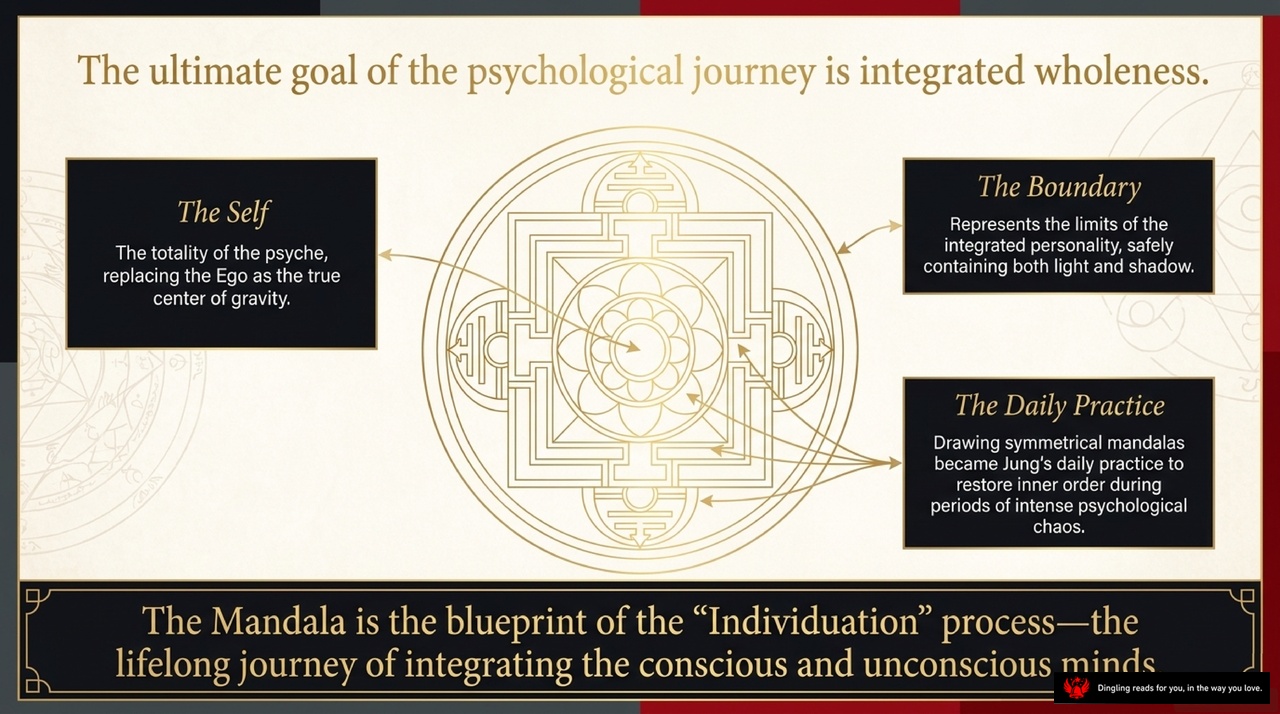
The ultimate goal of the psychological journey is integrated wholeness. Look at this intricate mandala in the center; it isn't just art, it is the blueprint for a lifelong process Jung called "individuation"—the sacred task of weaving together our conscious and unconscious minds. At the very heart of this circle lies "The Self," which replaces the ego as our true center of gravity. It represents the totality of our psyche, the complete picture of who we are.
Surrounding this core is "The Boundary," which acts as a protective container for our integrated personality. Its crucial job is to safely hold both our light and our shadow, ensuring that neither gets lost or explodes. But how do we achieve this balance? The slide points us to "The Daily Practice." Jung discovered that drawing symmetrical mandalas became his essential ritual to restore inner order whenever he was drowning in psychological chaos.
This visual guide reminds us that true wholeness doesn't come from ignoring our darkness, but from consciously integrating it into a unified, living whole.

Have you ever wondered how the wildest, most chaotic visions of the past could shape the very foundation of modern psychology? Today's slide reveals the fascinating bridge between mystical encounters and formal psychological theory. It shows us that what might look like personal madness to the outside world was actually a shared human premonition, systematically distilled into concepts we use today.
Look at the first row: ancient visions of blood and ice covering Europe weren't just hallucinations; they were the raw experience that translated into the concept of the Collective Unconscious. In the next row, dialogues with the blind female figure, Salome, weren't signs of insanity, but an engagement with the inner feminine aspect of the male psyche, leading to the theory of the Anima and Animus.
Further down, the act of drawing complex symmetrical Mandalas was a method for stabilizing the mind by uniting opposing forces, which became the formal theory of Individuation and The Self. Finally, the clashes between logic and emotion, like those between Elijah and Salome, observed how different functions dominate the psyche, giving rise to our understanding of Psychological Types, specifically Introversion versus Extraversion.
This slide illustrates a profound truth: the great psychological theories we rely on weren't invented in a vacuum. They were born from deep, often terrifying, spiritual experiences. By translating these raw encounters into formal language, we didn't just explain the past; we created the tools to understand the human soul itself.

Imagine a vault, sealed tight for over a century, hiding the most profound work of Carl Jung's life. This slide maps the dramatic journey of *The Red Book*, from its creation to its shocking release.
It all began in 1930, when Jung's work suddenly halted. He discovered alchemy, realizing it mirrored his psychological discoveries. But fearing the world would reject it, he left the final page unfinished, locking his focus on safer, outward scientific publications.
Decades later, in 1961, the situation changed drastically. Following Jung's death, his heirs viewed this book not as a masterpiece, but as an intensely private diary of potential madness. They made the fateful decision to lock it inside a Swiss bank vault, where it remained untouched and unseen for decades.
The story finally reached its climax in 2009. After years of persistent persuasion by historian Sonu Shamdasani, the family finally allowed the book to be published. This revelation forced a complete re-evaluation of Jung's entire life's work, turning what was once considered a secret madness into a foundational text for analytical psychology.

The Red Book isn't just a record of madness; it's a meticulous map of a profound psychological descent. By confronting the terrifying depths of his own mind, Carl Jung bypassed the rational spirit of his time to unearth the collective archetypes that shape all human experience. The raw mythology recorded in these pages became the absolute foundation of modern analytical psychology.
If you were to drop the rational spirit of the times and speak directly to your own depths, what figures are waiting in the dark to speak back to you?