
The Richest Man in Babylon: Complete Chapter-by-Chapter Summary

Welcome to our journey into the heart of ancient wisdom. Today, we are stepping back over 2,500 years to Babylon, a city that once stood as the pinnacle of human achievement. As you see on this screen, we are looking at the iconic ziggurat, a structure that symbolizes the ambition and grandeur of that era. The title behind it, "The Richest Man in Babylon," written by George S. Clason, introduces us to a story that is far more than just history—it is a timeless blueprint for acquiring, multiplying, and protecting wealth.
In a world where financial advice often changes with every trend, this book offers something enduring. It teaches us that wealth is not a matter of luck or divine favor, but the result of specific habits and disciplined actions. Whether you are a modern entrepreneur, a corporate professional, or simply managing your personal finances, the principles laid out here—from saving a portion of every income to making your money work for you—remain as relevant today as they were in the bustling markets of ancient Babylon. Let's dive in and discover how the wisdom of the past can secure your future.
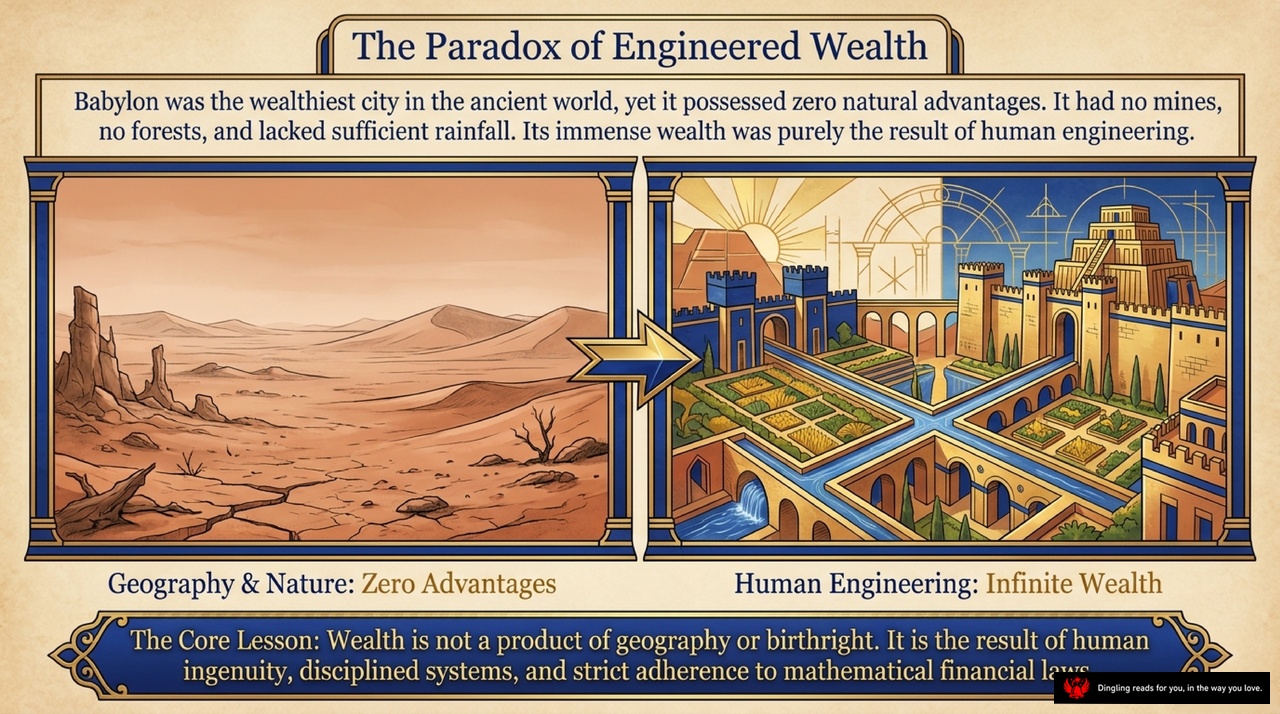
The Paradox of Engineered Wealth: How Babylon Built a Kingdom from Nothing
Look at this striking contrast. On the left, we see the harsh reality of Babylon's geography: a barren desert with no mines, no forests, and almost no rain. Nature offered zero advantages. Yet, on the right, stands the most magnificent city in the ancient world, fueled by human engineering. This slide captures the core lesson of our book: Wealth is not a product of geography or birthright. It is the result of human ingenuity, disciplined systems, and strict adherence to mathematical financial laws.
In the book, we meet Banishir, a struggling chariot builder living in the shadow of Babylon's wealth, yet he is penniless. He wonders why he cannot keep the money he earns. His friend Kubi suggests they learn from the city's richest man, Arkad. Arkad reveals the secret: wealth is like a tree. You must plant the seed of savings early and water it consistently.
Arkad taught his students seven ways to fill their empty purses. The first and most critical rule is to save at least one-tenth of your income every month. This isn't about having extra money; it's about controlling your spending. If you don't budget, your income will always equal your expenses, leaving you with nothing. By saving that ten percent, you create a fund that works for you, generating interest that becomes your slave, working harder than you ever could alone.
Furthermore, you must protect this wealth from foolish risks. Arkad shared a painful story about trusting an unskilled bricklayer with his savings, resulting in a total loss. He warned us never to invest in things we don't understand. Instead, use your capital to buy assets, like land or rental properties, which provide steady income and security.
But there is another hidden enemy: debt. The story of Dabashir, a man who became a slave due to reckless spending, teaches us that debt is a master that enslaves the soul. However, with a disciplined plan—saving for the future, budgeting for life, and dedicating a portion of income to pay down debt—you can reclaim your freedom.
The final, most powerful lesson is this: work is not your enemy; it is your best friend. Many slaves in Babylon believed work was a curse, but the successful ones, like Arkad himself, viewed it as a tool to build their lives. They didn't rely on luck or gambling; they relied on consistent effort, smart investments, and the courage to seize opportunities when they arose.
Babylon proves that even in the harshest environment, human wisdom can create infinite wealth. It all starts with a single decision to save, to learn, and to work with purpose.

Most people believe they work for themselves, but the truth is far more revealing. In reality, if you spend every single dollar you earn, you are essentially working as a slave for the baker, the shoemaker, and the landlord. Your income flows out immediately, leaving you with nothing of your own.
But there is a different path, known as the wealth builder's wallet. Imagine a mechanism where, before you even pay for your lifestyle, you secure your future. The golden rule is simple yet powerful: retain 10% of your total income. This isn't just about saving; it's about taking ownership. By keeping that 10%, you stop being a slave to your expenses and start building a foundation of wealth that works for you. This shift in mindset—realizing that a part of all you earn is truly yours to keep—is the absolute minimum foundation for financial freedom. Before you buy anything else, you must first pay your future self.
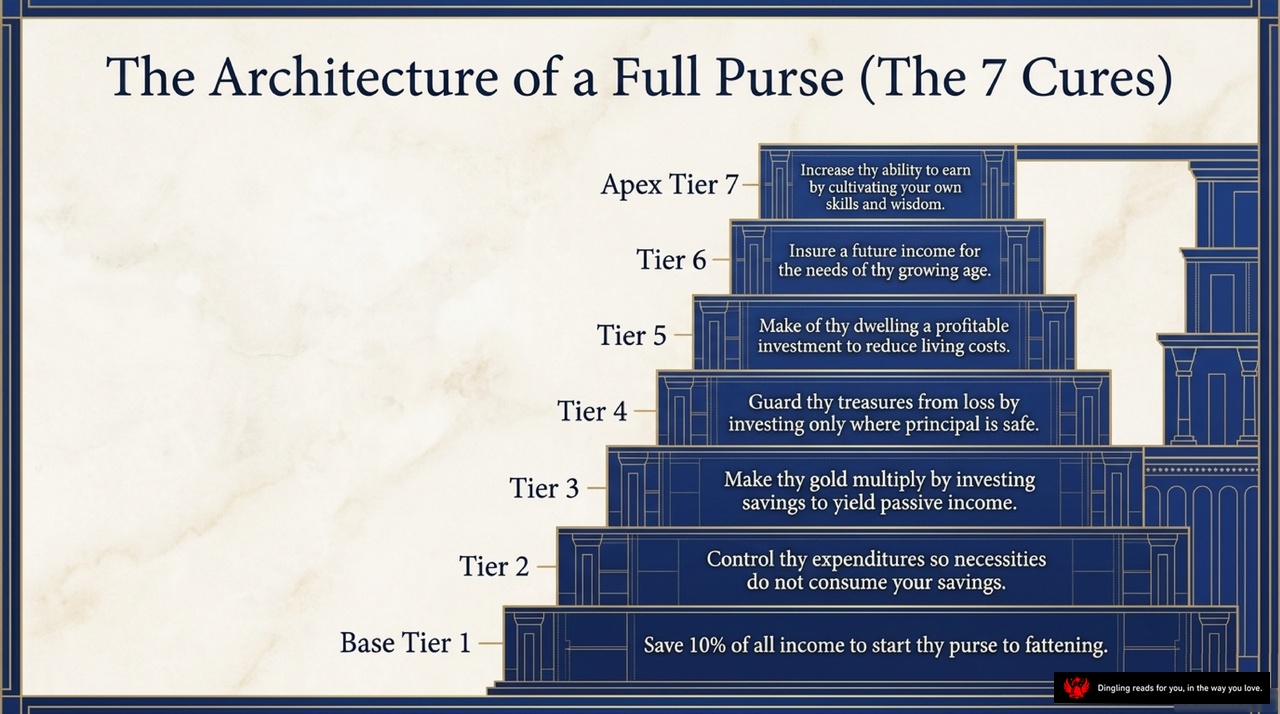
Welcome to the final tier of wealth creation: Apex Tier 7. This isn't just about saving or investing; it's about upgrading your own value. The ultimate secret to a "full purse" is to increase your ability to earn by cultivating your own skills and wisdom.
Think about it: money is a tool, but you are the operator. If you only rely on a single job, your income is capped. But if you treat your career like a business, constantly sharpening your skills and gaining new knowledge, your earning potential skyrockets. As the text beautifully illustrates, the most reliable way to build wealth is to make yourself indispensable and highly skilled.
Look at the foundation of this entire structure. It starts at the very bottom with Base Tier 1: saving 10% of all income. From there, we build up through controlling expenses, investing safely, and making our assets work for us. But without that top layer—your own growth—none of those savings can grow exponentially.
So, don't just focus on how much you keep; focus on how much you can make. Invest in your brain, refine your craft, and stay curious. That is the true architecture of a full purse.
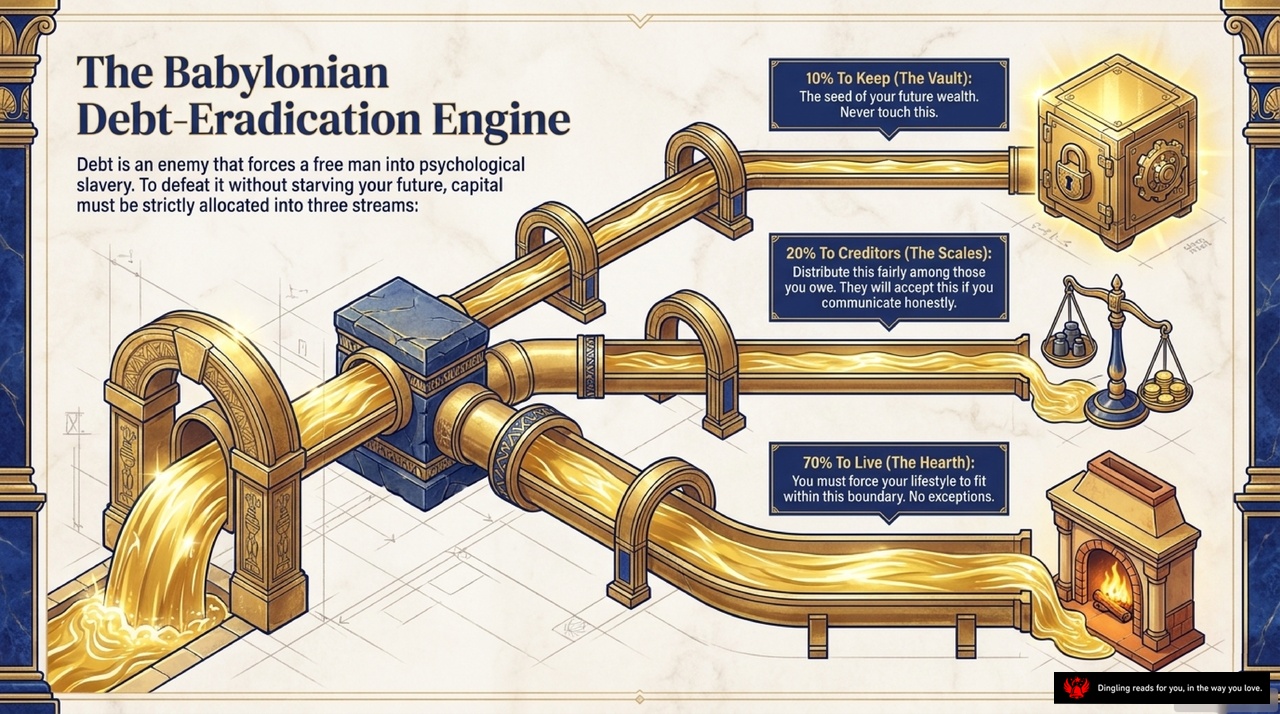
Imagine a golden engine, a "Debt-Eradication Engine" designed to free you from the psychological slavery of debt. Just as the ancient Babylonians understood, defeating debt isn't about starving your future; it's about strictly allocating your capital into three distinct streams.
First, you have the Vault. This is your 10%—the seed of your future wealth. The rule is simple but powerful: never touch this. It's not for spending; it's for growing. By consistently saving this portion, you ensure that money works for you, compounding into the foundation of your financial freedom.
Second, you have the Scales, representing 20% of your income. This portion is dedicated to your creditors. The key here is honesty and fairness. Distribute this amount equitably among those you owe. When you communicate transparently and pay consistently, creditors are far more likely to accept your plan and even offer you grace, turning a chaotic debt situation into a manageable schedule.
Finally, you have the Hearth, which takes up the remaining 70%. This is your life—the food, the shelter, and the experiences that make living enjoyable. However, there is a strict boundary here: you must force your lifestyle to fit within this limit. No exceptions. If your expenses exceed this 70%, you are borrowing from your future, and the debt engine will fail.
By channeling your income through these three streams—the Vault for growth, the Scales for responsibility, and the Hearth for a balanced life—you build a sustainable financial system. It's not about getting rich quick; it's about creating a structure where wealth naturally accumulates, allowing you to master your destiny rather than being mastered by your obligations.

True wealth isn't about how much gold you can stash in a purse; it's about building a machine that generates income forever. Think of your savings not as dead weight, but as an army of workers. Every coin you save today hires a new employee to work for you tomorrow. Those employees earn interest, which in turn hires more workers, creating a self-sustaining cycle that grows exponentially over time.
This is the multiplication mechanism. It starts with a modest sum, but through the relentless power of compounding, it transforms into an unstoppable force. Just like a tree, your wealth needs a seed to start and consistent care to grow. If you plant that seed early and keep nurturing it with reinvested earnings, you won't just accumulate money; you'll build a legacy that pays you for life. The secret isn't luck; it's the discipline to let your money work harder than you ever could.

The Behavioral Laws of Attraction and Loss: Gold gravitates to those who understand its laws and ruthlessly flees from those who do not. On the left, we see how wealth escapes: investing in unfamiliar businesses without expert guidance, or forcing gold to impossible earnings by trusting tricksters or chasing romantic dreams for rapid riches. On the right, the path to attraction: saving no less than one-tenth of all earnings, finding profitable compounding employment, and seeking the cautious counsel of wise men who handle money daily. This isn't just about luck; it's about discipline. When you ignore these rules, gold flees. When you master them, wealth naturally gravitates to you.

Imagine you are a wise old gold lender in Babylon, holding a chest of treasure and three magnifying glasses. Before you part with even a single coin, you must first assess the probability of its safe return. This is the essence of what we call "The Gold Lender's Risk Filter."
You cannot simply trust a borrower's promise; you must evaluate risk through three distinct lenses. First, look at Collateral. This is the safest option. Does the borrower possess physical property, land, or assets of greater value than the loan? If they own a house or gold bars worth more than what they owe, your risk is minimal.
Second, examine Capacity. This represents moderate risk. Does the borrower have the proven skill, trade, and discipline to generate the income required to repay the debt? Just because someone has a dream doesn't mean they have the skills to execute it and the cash flow to pay you back.
Finally, and most critically, you must look at Character and Emotion. This is the zone of guaranteed loss. Is the loan based merely on a romanticized dream or an emotional family obligation without a realistic business plan? History teaches us that lending money to friends or relatives out of pity often leads to disaster, not because of bad character, but because of a lack of financial reality.
Remember the golden rule: Better a little caution than a great regret. Protect your wealth by being rigorous in your assessment, and you will ensure your gold continues to work for you.
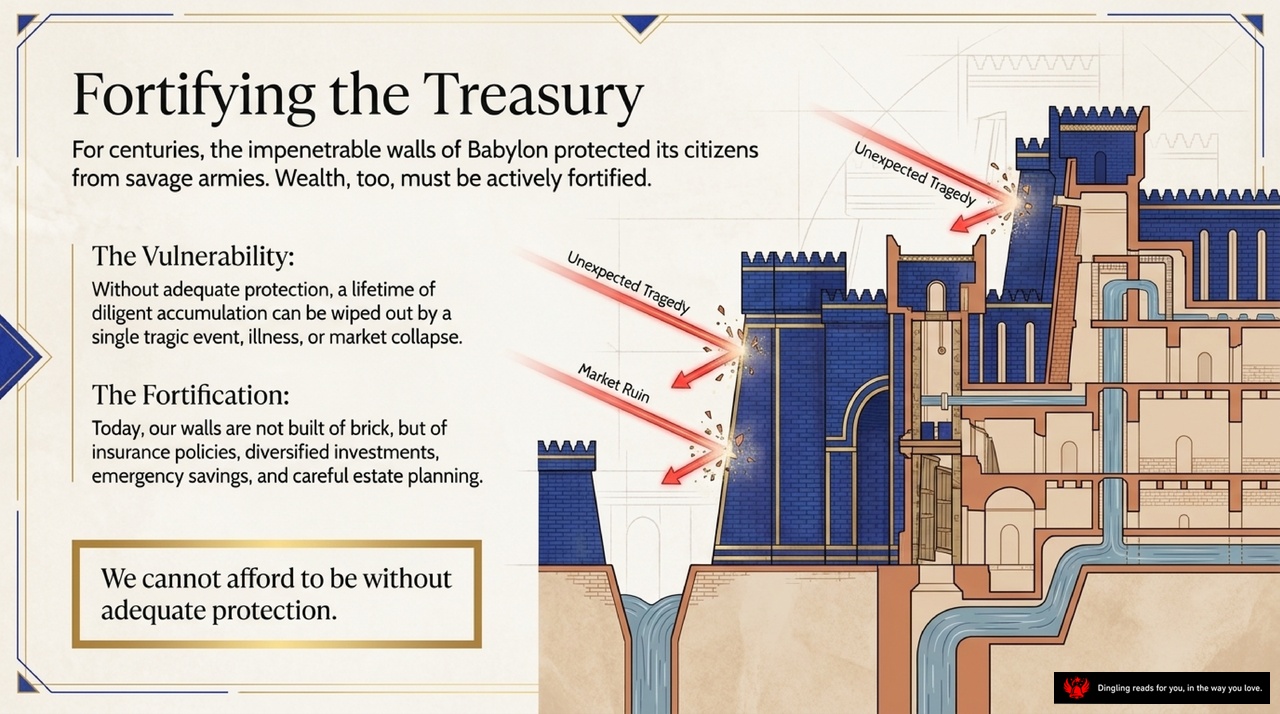
Imagine the impregnable walls of Babylon, standing tall for centuries, shielding its citizens from the chaos of war and the ravages of nature. That ancient fortress was more than just stone and brick; it was a promise of safety. But today, we face a different kind of threat. While we may not need to defend against invading armies, our wealth remains incredibly vulnerable to a single unexpected tragedy—a sudden illness, a market crash, or a family emergency that can wipe out a lifetime of hard work in an instant.
This is the core lesson of "Fortifying the Treasury." Just as Babylon relied on its physical walls, we must build financial walls around our assets. Without adequate protection, even the most diligent accumulation can be destroyed overnight. The solution lies in modern fortification: insurance policies act as our shield against unforeseen disasters, diversified investments ensure our wealth isn't tied to a single failing venture, emergency savings provide a buffer when the unexpected strikes, and careful estate planning guarantees our legacy survives us.
We cannot afford to be without these defenses. True financial wisdom isn't just about earning money; it's about ensuring that what we've earned stays with us and our loved ones, no matter what life throws at us.
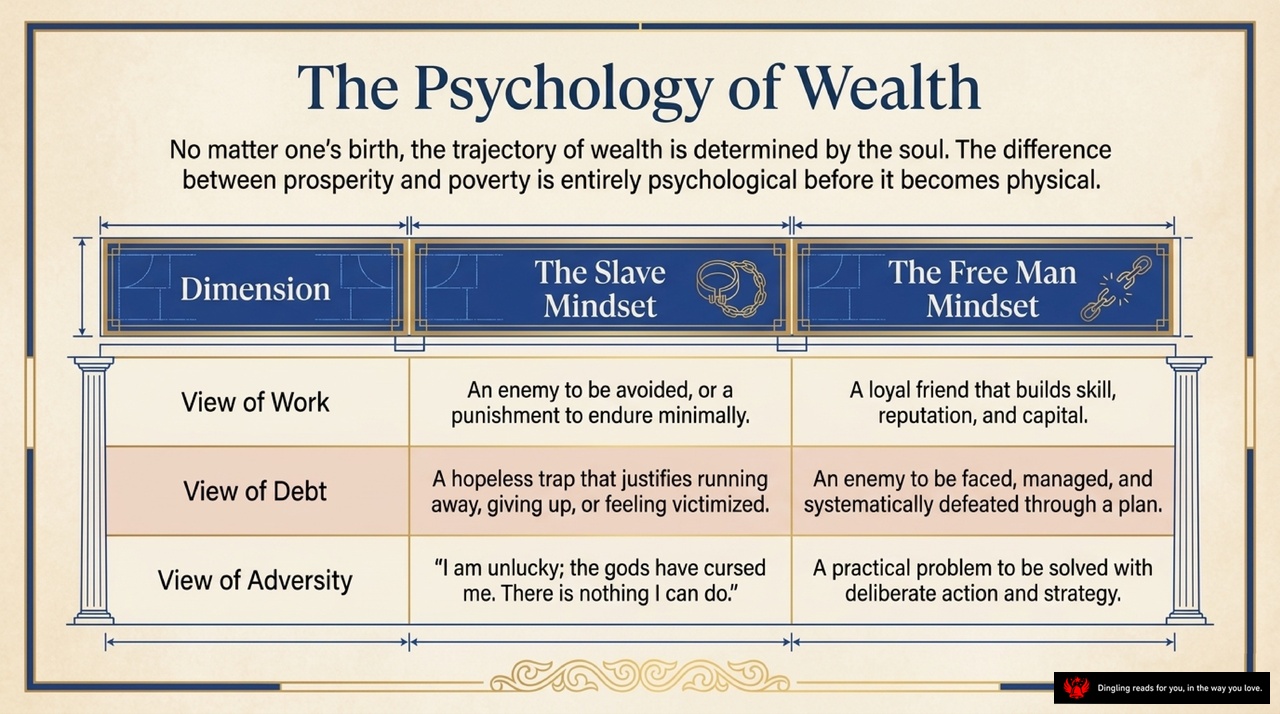
Welcome to the core of wealth creation: the shift from a "Slave Mindset" to a "Free Man Mindset." As we see on this slide, the gap between prosperity and poverty isn't about your starting point or your luck; it is entirely psychological. It lives in how you view the world.
Let's look at the first dimension: Work. If you hold a Slave Mindset, you see work as an enemy—a punishment you must endure with minimal effort, something to avoid at all costs. But the Free Man sees work as a loyal friend. It is the engine that builds your skills, your reputation, and your capital. This is exactly what Sharu-Nada taught his grandson, Hadan. Hadan believed work was for slaves, but Sharu revealed that his grandfather, once a slave himself, found that loving his work was the only secret to escaping that life. He turned labor into a powerful ally.
Next, consider your view of debt. The Slave Mindset frames debt as a hopeless trap, a reason to run away or feel victimized by "bad luck." But the Free Man treats debt as an enemy to be faced, managed, and systematically defeated through a deliberate plan. Think of Dakhishir, the man who returned from slavery. Instead of fleeing his creditors, he created a strict budget: saving 10% for the future, spending 70% on life, and using the remaining 20% to pay off his debts. He didn't hide from his debt; he conquered it, turning a burden into a path to freedom.
Finally, look at adversity. When things go wrong, the Slave says, "I am unlucky; the gods have cursed me. There is nothing I can do." This is a sentence of defeat. The Free Man, however, sees adversity as a practical problem to be solved with strategy and action. Dakhishir faced starvation and the threat of death in the desert, yet he didn't complain. He realized that if he had a slave's soul, he would die there. But with a free man's soul, he found the strength to walk back to Babylon, repay his debts, and rebuild his life.
The lesson is clear: your soul determines your trajectory. Choose to be a free man who sees work as a friend, debt as a solvable problem, and adversity as a puzzle waiting for your solution. That is the psychology of true wealth.

Men often mistake the results of decisive action for arbitrary luck, believing that success is a gift from the gods rather than a skill we can cultivate. But as we see in the ancient wisdom of Babylon, the "Goddess of Good Luck" does not frequent gambling tables; she is found in commerce, trade, and enterprise. True prosperity is the intersection of three vital circles: Preparation, Opportunity, and Decisive Action.
The enemy of luck is procrastination. Opportunities are fleeting, and hesitation allows profitable ventures to slip away to those who move faster. We must learn to distinguish between necessary expenses and endless desires, ensuring we save a portion of our income to plant the seeds of wealth. Yet, saving alone is not enough; we must also protect our capital by seeking advice from experts and avoiding high-risk schemes that promise easy riches.
The secret to attracting good luck is simple: good luck always follows opportunity, and action will lead you forward to the successes you desire. Men of action are favored by the Goddess of Luck. By combining careful preparation with the courage to seize the moment, we transform chance into a powerful ally, ensuring that our efforts are met with the abundant rewards of a well-crafted destiny.
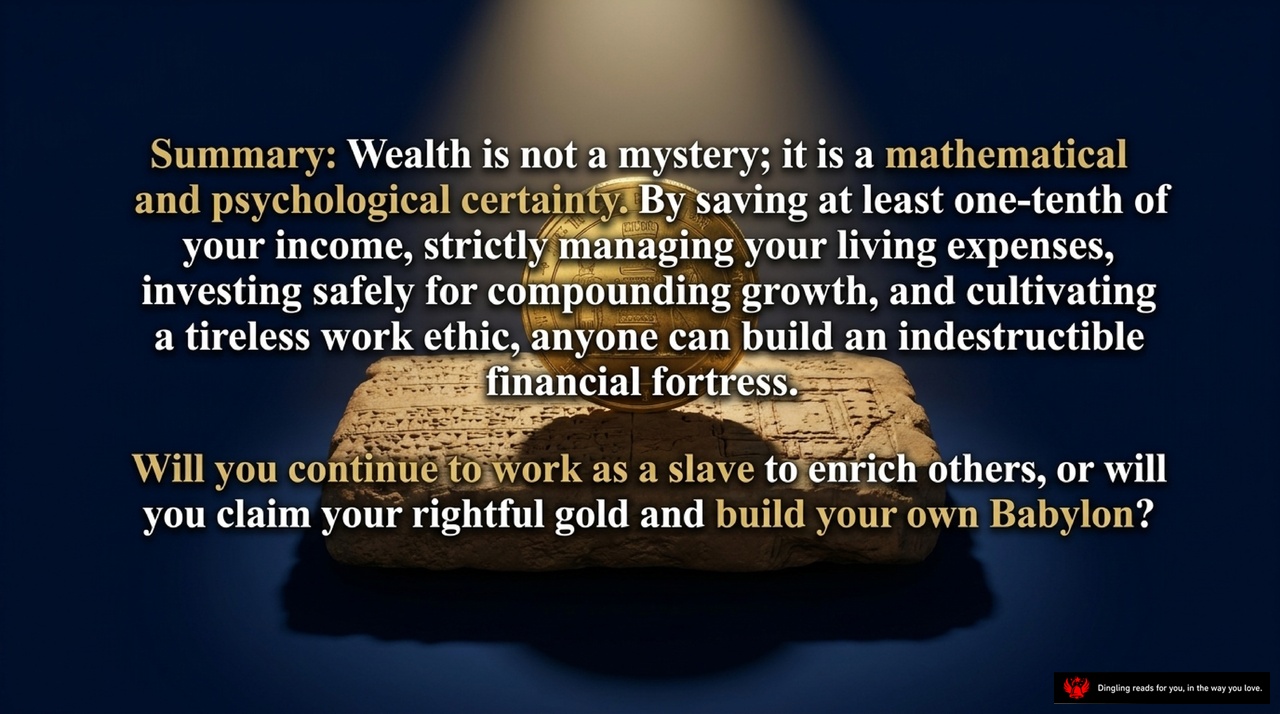
Summary: Wealth is not a mystery; it is a mathematical and psychological certainty. By saving at least one-tenth of your income, strictly managing your living expenses, investing safely for compounding growth, and cultivating a tireless work ethic, anyone can build an indestructible financial fortress.
Will you continue to work as a slave to enrich others, or will you claim your rightful gold and build your own Babylon?