
The Rings of Saturn: Complete Chapter-by-Chapter Summary

Welcome to *The Rings of Saturn* by W.G. Sebald. Imagine a solitary journey along the desolate English coast, where every step transforms into a profound meditation on the inescapable gravity of human history, memory, and decay. This isn't just a walk; it's a descent into the past, where the landscape itself holds the weight of forgotten lives and lost empires. As we begin this exploration, we are immediately plunged into a world where the boundary between reality and fiction blurs, where the decay of nature mirrors the erosion of the human soul, and where the ghosts of the past whisper through the crumbling ruins of Britain's history.

Look at this map of the narrator's journey. It's not just a route; it's a timeline of trauma. In August 1992, the narrator takes a walking tour in Norfolk to escape an encroaching emptiness, only to be hospitalized a year later, paralyzed by the sheer weight of the uncovered memories. This is the catalyst.
As he travels, his mind fractures across time and space. The red lines on the map connect his present to a 17th-century Amsterdam, where he witnesses a public dissection that defies the cold logic of the era. He jumps to WWII Germany, specifically the horrors of Bergen-Belsen, and then to the Balkans, revisiting the brutal ethnic cleansing of the 1940s. He even traces a path to the Congo, channeling Joseph Conrad's own harrowing experiences with colonial exploitation.
Every stop is a trigger. The map shows him moving from Lowestoft to Dunwich, a landscape of decay where nature slowly reclaims human structures. It's a physical manifestation of his internal state. Even the motif of a window in an 8th-floor Norwich hospital, overlooking a pale sky, serves as a metaphor for his isolation—trapped in an unmoving history, watching the world pass by while he remains stuck. This journey isn't about escaping the past; it's about being forced to confront it, piece by painful piece.

The slide contrasts two sides of Victorian Britain: the grand illusion of permanence and the harsh reality of decay. On the left, we see Somerleyton Hall. In its prime, it was a pinnacle of engineering and exoticism, built by Morton Peto with gaslights and seamless nature integration. But today, it's an eccentric, dusty relic. The image of the dilapidated aviary with a solitary, demented Chinese quail perfectly captures that sense of being trapped in overlapping eras.
On the right, we look at Lowestoft. Once an elegant seaside resort with grand promenades and vital fishing ports, it now stands as a symbol of severe economic depression. The photos show boarded-up windows and grim arcades, leaving a profound sense of abandonment on the easternmost edge of the isles. This slide reminds us that the architecture of decay isn't just about crumbling buildings; it's the illusion of permanence shattering under the weight of time and economic shifts.

Imagine standing on the edge of a cliff, staring into a gray ocean where thousands once lived. This is Dunwich, a vanished city that serves as a haunting reminder of the erasure of geography. Once one of the most vital and powerful ports in medieval Europe, Dunwich was swallowed entirely by the sea due to relentless coastal erosion. The image before us captures this inevitable dissolution, showing nature's slow, unrelenting work of erasing human achievement. The land itself, along with its rich history, is literally dissolving into air, sand, and water.
But the tragedy goes deeper than just physical loss. The physical emptiness of this site triggers a profound historical vertigo—a deep sense of melancholy born from looking into the void where a bustling community once thrived. As the text describes, the city's churches and eighty ships have all fallen, leaving behind only a few isolated structures like the surviving corner tower of the Holy Sepulchre. This scene evokes a specific kind of sorrow, the kind felt by Victorian-era writers who visited Dunwich, looking out at the green glow of the sea and seeing not just water, but the ghost of a lost world. It is a place where the past has not just ended, but has been actively wiped away, leaving us with nothing but the memory of what was erased.

Imagine a world where time doesn't move forward, but instead collapses into a terrifying present. This is the core of the "Tron" philosophy, a concept that feels less like history and more like a nightmare where the future exists only as our current fear, and the past is just a hallucination. In this twisted reality, the entire world could have been created just minutes ago, with all of human history merely a fake backstory we've been told.
Now, look at the slide. We are shifting from this abstract philosophy to a very tangible, yet equally oppressive symbol: the Dragon. In the East, the dragon isn't just a mythical beast; it is the ultimate embodiment of imperial power and the natural world itself. It controls the rain, the storms, and the rivers. But here is the dark irony: this majestic creature was also the exclusive symbol of the Emperor, the "True Son of the Dragon."
The text on your screen reveals the tragic cost of this obsession. In the 19th century, the Chinese court became a suffocating machine of rituals, where thousands of eunuchs and concubines served a single man, all under the shadow of the dragon. But when the empire finally crumbled, the symbol of its power became its coffin. During the fall of Nanjing in 1864, amidst the chaos of the Taiping Rebellion, the last emperor, Hong Xiuquan, took his own life. When the Qing army finally breached the city gates, they found a scene of absolute horror: a street filled with flies and the dead, with only one bright yellow silk robe—adorned with the very dragon symbols of his authority—remaining intact on a swollen corpse. The dragon had not protected him; it had merely marked him for destruction.
This connects deeply to the themes we've discussed. Just as the "Tron" philosophy suggests that time is a lie, the dragon's reign ended in a moment where the illusion of eternal power was stripped away, leaving nothing but decay. The slide's imagery of the dragon serves as a warning: when a system becomes too rigid, when power is tied to a single, artificial symbol, the inevitable result is not a glorious eternity, but a catastrophic collapse. The dragon, once the master of the sky, ended up trapped in the mud, a final testament to the fragility of all empires.

The map before us isn't just geography; it's a ghost story of the sky. Look at those crosshairs over Cologne and Frankfurt. This slide captures the terrifying reality of "The Aerial War"—a conflict fought from above that erased everything below.
We are looking at the sheer scale of destruction: over a thousand days of relentless operations, where Allied fleets dropped more than 732,000 tons of bombs. Entire cities were systematically turned to ash. But the horror wasn't just in the physical ruin; it was in the silence that followed. We see "The Mute History" here—a staggering collective amnesia where post-war consciousness refused to witness or record the trauma of carpet bombing.
Yet, amidst this silence, there was a personal archive. Meet William Hazel, a gardener at Somerleyton. He learned the geography of Germany not by visiting it, but by watching it burn. As the slide notes, he visualized medieval towns burning from afar, learning the layout of a country through the names of cities being annihilated. His story reminds us that while history books might stay silent, individual memory often holds the map of what was lost.

After leaving the secret military site at Orford, I traveled to Halston to meet Alec Gadd, a man who has spent twenty years building a miniature replica of the Temple in Jerusalem. Inside his quiet, dim farm, this model fills an entire warehouse space, composed of thousands of tiny, exquisitely detailed parts. Alec, a Methodist missionary, admits that his neighbors might see him as a madman, yet the recognition of Lord Rothschild has lent his work a strange legitimacy. He reveals a haunting truth: the actual Temple in Jerusalem existed for only about a century before vanishing into history, while his model, painstakingly crafted by hand, might survive for centuries. The golden dome of his creation reminds me of the Sellafield nuclear reactor I saw earlier, a stark contrast between ancient faith and modern destruction.
My journey then led me to the grave of a forgotten love story at St Margaret's Church. In 1795, a French nobleman fleeing the Revolution fell in love with the daughter of the local vicar, Charlotte. He taught her languages and literature, their connection deepening over shared books and conversations. When he proposed marriage, she agreed, only for him to confess he was already married. She returned to England, eventually marrying a naval captain, but the memory of that lost romance haunted him. He locked himself away to write of her, fearing the words might betray her, yet knowing he needed them to anchor his life against the flood of memory.
Later, a violent storm in 1987 tore through the landscape, bringing down millions of ancient trees. The once-lush woods lay flattened like a harvested field, leaving behind a landscape of exposed clay and silence. This ecological shift mirrors the fragility of human endeavors. Just as the Temple was lost and the trees were felled, we are left with the echoes of what was, forced to remember that history is often defined by what disappears.

After leaving the secret research station at Orford, I traveled to Halston Farm, where Alec Garrard has spent twenty years meticulously constructing a model of the Temple in Jerusalem. As a Methodist minister, he was driven by a deep fascination with biblical history, convinced that the ancient structure could be faithfully recreated. The model fills a ten-square-meter space in his warehouse, composed of thousands of tiny, precisely carved components. Every single panel, column, and stone is hand-painted, a labor so exacting that it often feels like a form of penance.
This obsession mirrors the dark history of the silk industry we've been exploring. Just as the temple stands as a fragile monument to a lost golden age, so too does the story of the silkworm. Originating in China, this creature was once a secret guarded by emperors, its silk traveling along the Silk Road to become the ultimate luxury of the West. But that monopoly was broken by a monk who smuggled eggs to Byzantium, sparking a chain reaction that spread the craft across Europe. In France and England, particularly in Norwich, this industry flourished, turning humble workshops into centers of wealth and power.
Yet, beneath this prosperity lay a disturbing ritual. To harvest the silk, the pupa inside the cocoon had to be killed before it could emerge as a moth. The Nazis later twisted this ancient practice into a twisted ideology, comparing the steam-killing of "useless" pupae to their own racial purges. It is a chilling parallel: the destruction of a fragile, beautiful life to produce something valuable for the many, while the few suffer.
As I stood in Alec's quiet farm, surrounded by thousands of miniature figures, I felt a strange connection to this history. The temple he built is meant to last, a permanent symbol of faith. But the black silk woven from the silenced lives of millions of silkworms serves as a grim reminder of how easily civilization can turn against its own foundations. In the end, both the temple and the fabric speak to the same truth: that our greatest achievements are often built upon the silent, unseen sacrifices of the vulnerable, leaving us with a legacy that is both magnificent and deeply tragic.

Silk is often celebrated as the ultimate symbol of luxury and imperial power, the very essence of civilization. But as we look at this image, we see a darker, more brutal truth: this fabric is born from the systematic boiling and destruction of living organisms. The sericulture industry is a micro-engine of human trade, driven by an imperial obsession that spans centuries, from Thomas Browne's fascination to the French obsession with sericulture.
This cycle of entropy mirrors human history itself. We exploit fragile creatures like the silkworm to build empires, only for those empires to ultimately decay into dust. The machinery depicted here represents the industrial engine of this trade, turning biological life into raw material. The red silk flowing from the gears symbolizes this transformation—beautiful on the surface, but built on a foundation of violence and loss. It reminds us that behind every thread of luxury lies a story of suffering, a cycle where life is consumed to fuel our desire for status and power.

Look at this cracked urn and the skull beside it. They aren't just objects; they are the physical proof of a terrifying truth: time is an unstoppable force that consumes everything. We often build monuments, pyramids, and obelisks to freeze ourselves in history, hoping to achieve immortality. But as Thomas Brown argues, these structures are nothing more than "melting icicles" against the vastness of time. Fire, or entropy, will eventually burn them all down.
It creates a profound illusion. We think we are preserving our legacy through artifacts like Roman glass, coins, and these very urns. Yet, while the clay and metal survive for millennia, the flesh, the identity, and the memories of the people who made them are completely obliterated by the silent void. We are left with the shell of our culture, but the soul is long gone. In the end, we realize that humanity's attempt to conquer time is futile; we are just waiting for the fire to take us all.

The Quincunx isn't just a geometric pattern; it's the invisible web holding the universe together. As Thomas Browne believed, this exact five-pointed star shape appears everywhere—from the Hyades star cluster in the night sky to the delicate veins in a leaf, the structure of a fish, and even the arches of ancient human architecture. It's a structural web that binds the cosmos.
But for W.G. Sebald, this pattern became a powerful visual metaphor for his own storytelling. His books weave an associative narrative where everything is connected by the same underlying laws of creation and decay. Think about it: the global silk trade, the brutality of aerial bombings, a dead herring floating in the water, or the ruins of fallen empires. It all fits into that same geometric grid. From the smallest biological detail to the grandest historical tragedy, nothing exists in isolation. They are all nodes in the same web, inevitably linked by the same cosmic rhythm of life, death, and the relentless passage of time.

Look at this slide: "The Atrocities of the Balkans." It names Jasenovac, a place where systematic horror became a factory of death. The Ustasha camps didn't just kill; they erased. Specifically, Jasenovac became the site of a slaughter that claimed 700,000 souls. This wasn't a momentary outbreak of violence; it was a bureaucratic machine of death, coldly supported by neighboring empires and stubbornly obscured by the passage of time.
But we must confront the terrifying reality here. These aren't just historical anomalies locked away in the past. Extreme violence and mass annihilation are repeating patterns woven deeply into the tapestry of human history. The machinery of hate in the Balkans mirrors the industrialized cruelty we've seen elsewhere, proving that when ideology takes over, the scale of suffering can always expand. The past is not a foreign country; it is a warning that echoes loudly if we choose to listen.
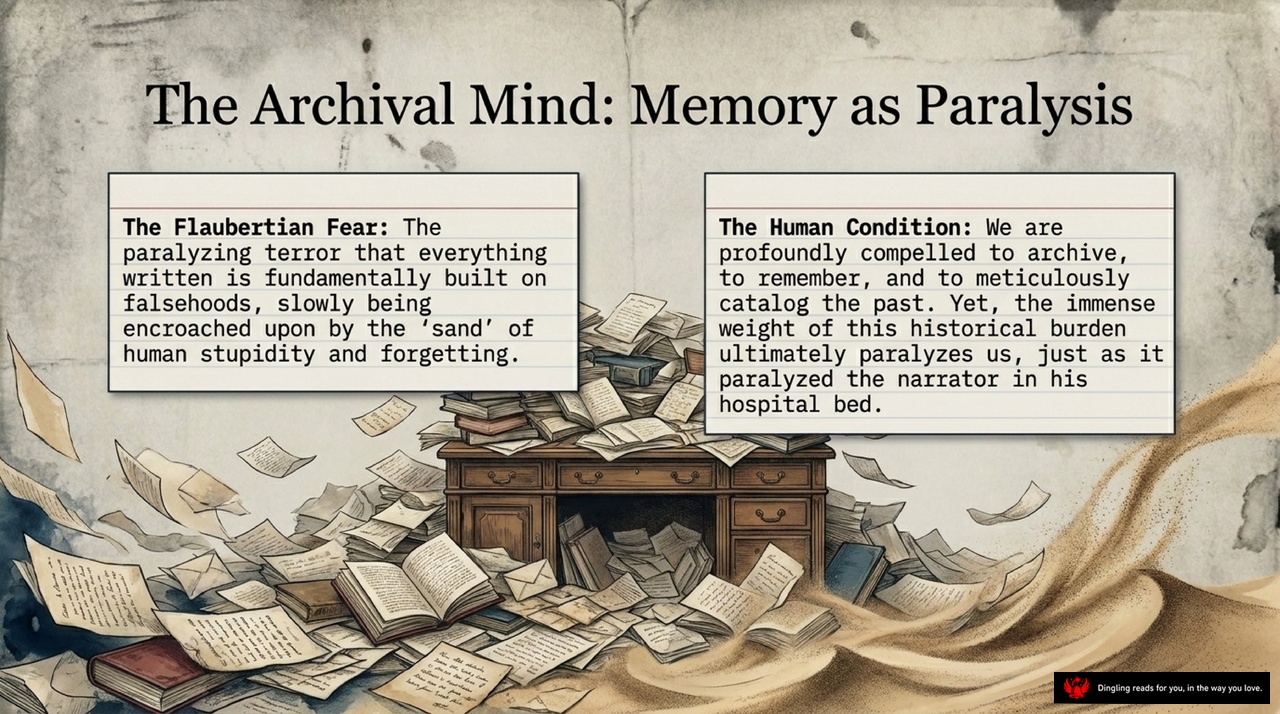
The image before us captures a haunting truth: the "Archival Mind" isn't just about remembering; it's about how the sheer weight of memory can paralyze us. Look at that chaotic desk, buried under papers and books, being slowly consumed by sand. This visual perfectly illustrates the book's core argument: we are compelled to archive everything, to meticulously catalog the past, believing that if we remember it all, we are safe. But as the slide warns, this "Flaubertian Fear" is real—the terror that everything we write is built on falsehoods, slowly encroached upon by the "sand" of human stupidity and forgetting.
We are profoundly compelled to remember, yet that immense historical burden ultimately paralyzes us. Just as the narrator in the text feels trapped in his hospital bed, overwhelmed by the endless cataloging of the past, we too risk becoming paralyzed by the past. The image of the sandstorm swallowing the desk is a powerful metaphor for this condition: the more we try to preserve everything, the more we lose our ability to move forward. The archive, intended to be a sanctuary of truth, becomes a prison of our own making, where the weight of what has been is too heavy to bear, leaving us stuck, unable to act, unable to create, simply trapped in the dust of our own history.

From the forgotten coastal towns of Suffolk to the ashes of bombed cities and the silent depths of the sea, we are reminded that human history is an unceasing march of creation and destruction. Our deepest endeavors ultimately dissolve into the dust of time. If our grandest empires, our most intricate arts, and our deepest memories are all destined to be swallowed by the silent void, what then is the true purpose of bearing witness to the past? In a world where everything seems destined to fade, the act of remembering becomes not just a duty, but a defiant act of existence—a way to carve meaning out of the inevitable silence.