
The Road to Wealth Freedom: Complete Chapter-by-Chapter Summary

Welcome to today's session on "The Road to Wealth Freedom." We often hear this phrase, but very few truly understand what it means until they've struggled to achieve it. The core issue isn't a lack of effort; it's a lack of clarity. Many people chase wealth freedom but move slowly because they've never defined it correctly.
Think of it this way: true wealth freedom isn't about having a million dollars in the bank. It's about upgrading your cognitive operating system so you no longer have to sell your time just to survive basic needs. Wealth is merely a tool; the real essence of freedom is owning your time.
But here's a crucial shift in perspective: wealth freedom is not the destination of your life; it's just a milestone on a much longer journey. If you treat it as the finish line, your values will twist, and you'll lose focus on what actually matters—growth. Success is just a byproduct of that growth. So, while you are still selling your time for income, make sure every hour you work builds your skills and avoids repetitive tasks that offer no future value.
To navigate this phase wisely, follow three iron laws. First, growth is the only thing that matters. Choose jobs not for the highest salary or stability, but for the ability to learn and evolve. Second, focus on value, not valuation. Your personal contribution is real; the market's current price tag is fleeting. Third, patience is your superpower. Without it, you'll try to rush a process that requires compounding, and you'll end up frustrated.
Remember, the path to freedom starts with how you spend your time today, not how much money you hope to have tomorrow.

Have you ever felt like you've hit a wall, thinking that once you hit a certain number in your bank account, life just stops? That's the default illusion we all fall into: believing wealth freedom is the finish line. But today, I want to upgrade your operating system.
Look at the timeline on this slide. Wealth freedom isn't the destination; it's just a milestone on a much longer journey of lifelong growth. The true definition is simple and powerful: it's the moment you no longer have to sell your time just to meet the basic necessities of life. It grants you time autonomy, giving you the freedom to grow in the direction you choose, not the one your boss dictates.
Think of it like this: when you finally reach that point, you won't stop. Instead, you'll use that freedom to fuel continuous, self-directed growth. So, don't treat wealth freedom as the end of the road. Treat it as the upgrade to a new version of yourself. That's where the real freedom begins.
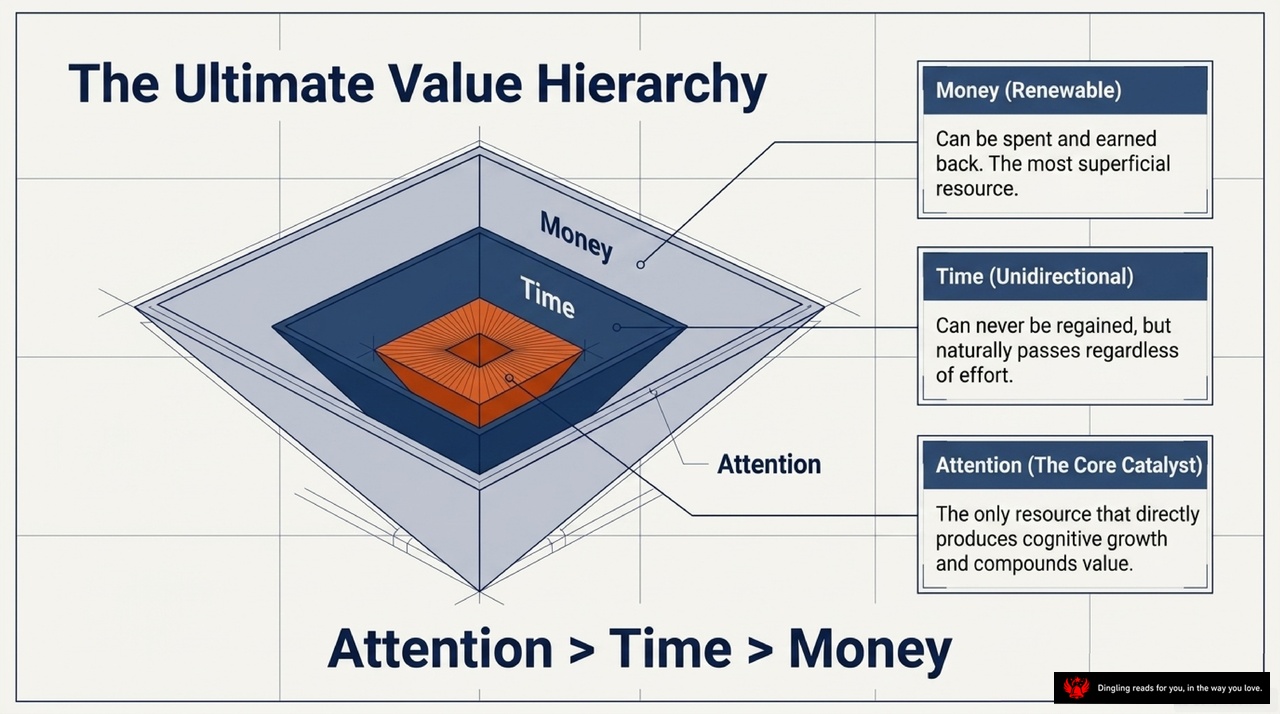
So, look at this pyramid. It flips the script on everything we've been taught about success. We spend our lives chasing money at the bottom, treating it as the ultimate goal. But this diagram, "The Ultimate Value Hierarchy," reveals the brutal truth: Attention is the crown jewel.
Let's break down why. Money is renewable. You can spend it and earn it back. It's the most superficial resource. Time is unidirectional; it passes regardless of your effort, and once it's gone, it's never coming back. But then, you have Attention. This is the core catalyst. It is the only resource that directly produces cognitive growth and compounds value.
Think about it. You can buy more time, but you cannot buy attention. In fact, the most expensive thing you can buy is someone's attention. This is why the equation at the bottom is so powerful: Attention is greater than Time, which is greater than Money.
Many people are stuck in a trap where they trade their most valuable asset—attention—for trivial distractions or low-value tasks. They complain they don't have enough time, but the real issue is that they are misallocating their attention. If you want true wealth and freedom, you have to stop treating money as the priority and start protecting your attention. When you guard your attention and invest it in high-value activities like learning, deep thinking, and building real skills, you automatically elevate your time and your money. That is the only path to a life that actually matters.

Imagine your attention as a precious, non-renewable resource sitting right in the center of your life. If you leave it unguarded, it will inevitably get sucked into three distinct black holes, draining your mind and your wallet.
The first trap is The Crowd. This is the urge to blindly join the spectacle, surrendering your focus just to feel a false sense of belonging. You see everyone doing something, so you do it too, even if it has nothing to do with your actual growth.
The second trap is The Trend. This happens when you mindlessly follow the herd, substituting external momentum for your own internal direction. You jump on the latest bandwagon—whether it's a hot industry or a trendy product—without ever asking if it aligns with your long-term goals. When the wave crashes, you're the one left behind on the beach.
And the third trap is The Irrelevant. This is worrying about things that are simply none of your business. It could be obsessing over other people's lives, judging their choices, or getting tangled in conflicts that don't affect you. Essentially, you are using your most valuable asset to pay for someone else's drama.
The diagnostic here is clear: unprotected attention guarantees poverty. Those who do not guard their attention are permanently harvested by others. To break free, you must stop feeding these black holes and redirect your focus to what truly matters: your own growth, the people you love, and the value you create for the world.

Meta-Cognition: The Core Processor. Think of your brain not just as a computer that processes data, but as a computer that monitors its own processing. That is the essence of meta-cognition. The slide breaks this down into three key areas. First, the mechanism: it's your ability to observe, understand, and correct your own thought processes in real-time. It's like having a dashboard inside your head that tells you when you're drifting off course. Second, the output: this shifts you from reflex to reflection. Instead of reacting automatically when your attention gets stolen by distractions, you recognize it and actively redirect it back to what matters. Finally, the upgrade: meta-cognition is the master key to human intelligence. Crucially, it's not something you're born with; it's a muscle that must be deliberately trained. Without this internal observer, we remain trapped in our own blind spots, unable to truly grow or adapt.

Today's slide contrasts two operating systems: the "Default OS" we're all born with, versus an "Upgraded OS" that we must consciously install to thrive.
Let's look at the first row: **Target**. The Default OS aims for "Success," defined as a static end-state—a finish line you cross and then stop. But the Upgraded OS shifts this to "Continuous Growth," treating life as an infinite game where the only goal is to keep getting better, forever.
Next, the **Metric**. The Default OS obsesses over "Valuation," which is just what the outside world thinks of you. The Upgraded OS cares about "True Value," which is your actual internal capability and skills. It's the difference between looking rich and actually being capable.
Then, the **Focus**. The Default OS gets stuck "Hoarding Money," trying to accumulate assets without creating new value. The Upgraded OS focuses on "Protecting Attention." It realizes that your attention is your most scarce resource, so it guards it fiercely against distractions to ensure it's always working on high-leverage tasks.
Finally, the **Safety** row. The Default OS chases "100% Security," which the slide correctly identifies as an illusion because true safety doesn't exist. The Upgraded OS embraces "Calculated Risk based on logic." Instead of hiding in a comfort zone, it takes smart, logical risks that offer the highest potential for growth.
Essentially, upgrading your OS means trading the illusion of a finished destination for the reality of endless growth, swapping external validation for internal capability, protecting your attention instead of hoarding cash, and choosing logical risks over the fake safety of stagnation.

Welcome to the final step of our journey on selling time. Look at this diagram: it's not just a staircase; it's a roadmap to escaping the trap of trading your life for a paycheck. We are talking about the Iron Laws of Selling Time, and today, we're focusing on the third and most crucial one: Exercise Patience.
As you can see in the graphic, growth requires compounding. This means you must be willing to endure the flat portion of the curve before those exponential returns finally appear. In the American business world, we often hear the phrase "compound interest," but too many people forget to apply it to their own careers. They get impatient when their salary isn't skyrocketing every month and start chasing quick fixes, side hustles, or the next hot trend. But this is exactly the trap. If you rush the process, you destroy the very foundation of your value.
The text reminds us that you must endure the flat part. Think about the best investors or the most successful entrepreneurs in history. Did they become overnight sensations? No. They spent years building skills, learning from failures, and quietly accumulating knowledge without much external recognition. The market's external valuation might feel low right now, but if you focus entirely on increasing your internal value—your skills, your judgment, your network—the market will eventually correct itself to match your true worth.
So, how do you exercise this patience? It's not about doing nothing. It's about doing the right things consistently without expecting immediate rewards. It's about selecting work that builds compounding skills, even if it doesn't pay the highest salary today. If a job offers stability but zero growth, it is a trap. You are selling your time once, and you get nothing back but a paycheck. But if you choose work that makes you smarter and more capable every single day, you are effectively investing in your future self.
The key is to trust the process. Trust that the skills you are grinding on today will be the currency that buys your freedom tomorrow. Don't look at the flat line on the graph and panic. Look at it as the necessary foundation for the explosion that is coming. Patience is not a passive state; it is an active choice to stay the course when everyone else is looking for a shortcut. By ignoring the noise of the present and focusing on the compound growth of your abilities, you ensure that when the exponential returns do arrive, they will be massive, sustainable, and truly yours.

Upgrading Your Personal Business Model isn't just a theoretical concept; it's the difference between being a wage slave and building a legacy. As this pyramid illustrates, we all start at the bottom with Tier 1: Selling Time Once. This is the "Worker" phase where you trade one hour of your life for one hour of pay, strictly limited by your physical lifespan. It's a ceiling that keeps most people trapped.
But the real game begins when you evolve into Tier 2: The Creator. Here, you stop selling time once and start selling the same time multiple times. Think of it as packaging your expertise into scalable products like books, software, or systems. You write a book once, and it sells for a decade. This breaks the link between your income and your hours worked.
The ultimate breakthrough, however, is reaching Tier 3: The Investor/Owner. This is where you buy other people's time to sell. You utilize capital to purchase the undervalued time of others, generating returns completely independent of your own physical labor. Whether you're hiring an employee or investing in a company, you are leveraging the time of others to create value that far exceeds what you could ever produce alone.
The key to climbing this pyramid is shifting your mindset from "time for money" to "capital for leverage." Most people stay at the bottom because they underestimate the value of buying time. They spend hours waiting in line or doing low-value tasks when they could simply pay someone else to handle it, freeing up their most valuable asset—their own time—to focus on high-level strategy and growth. True wealth freedom isn't about working harder; it's about upgrading your model so that your time works for you, and eventually, other people's time works for you too.

Imagine a crowded room where everyone is sprinting to be the fastest runner. Statistically, only one person wins, and the race for that single top spot is exhausting, risky, and incredibly difficult to sustain. This is the trap most of us fall into: trying to compete on a single axis and becoming the absolute best at one thing.
But there's a smarter strategy. Instead of chasing that impossible top 1% in one area, aim for above-average proficiency—say, the 60th percentile—in two or three distinct skills. Think of it as building a multi-dimensional competitive advantage. When you intersect these dimensions, you create a unique monopoly that others simply cannot replicate.
Look at the visual on the slide. We have Skill A, Skill B, and Skill C. If you are merely average in all three, you are still better than the vast majority of people who are average in only one or none. But if you combine them, the result is exponential. A perfect example is the intersection of Technology, English, and Finance. No one else can easily copy you because they lack the specific combination of those three distinct areas.
The result? You stop competing in a crowded lane and instead occupy a unique space where you have a monopolistic competitive advantage. It's not about being the best at one thing; it's about being uniquely good at the combination of things. This is how you build a career and life that is truly hard to beat.

True Capital isn't just about having money; it's about the perfect intersection of three specific elements: Funds, Time Horizon, and Wisdom. As this slide illustrates, if you miss even one of these, you don't have true capital. You might have the raw monetary base, but without a long-term life sentence or the wisdom to deploy it correctly, that money is just a fleeting asset.
Think about it this way: Capital must be deployed with long-term patience, completely divorced from short-term living expenses. That's the Time Horizon. It needs to be a "Life Sentence," meaning you are willing to let your money work for you for decades without touching it.
Then, you need Wisdom. This is the meta-cognition, the logic, and the independent judgment required to make the right calls when the market gets chaotic. Without wisdom, even a large sum of money can be squandered.
The core insight here is simple but powerful: Money without a long-term horizon and applied wisdom is merely a fleeting asset, not true capital. Many people fail because they treat money as an end goal or try to use it for quick fixes. But true wealth creation requires you to lock your funds away, think with clarity, and trust the power of time. Only when these three circles overlap do you unlock the potential of true capital.

The Risk Illusion isn't just a catchy title; it's the fundamental trap keeping most of us financially stuck. Look at this diagram. On the left, we have "Wild Risks"—a chaotic tangle of lines representing the common belief that high returns demand high risk. That is the myth. The reality, as we've discussed, is that fools blindly chase these wild risks, while true investors obsessively avoid them.
The magic happens in the middle: "Independent Deep Thinking." This is your filtration process. Instead of reacting to market noise, you use deep analysis to cut through the chaos. You aren't looking for danger; you are looking for safety that others miss. By applying rigorous logic and patience, you filter out the speculative noise and leave behind "Calculated Certainties."
On the right, you see perfectly straight, parallel lines. These are not gambles; they are predictable outcomes derived from understanding the underlying value of an asset. True investment is the systematic elimination of danger. When you stop trying to be a hero by taking reckless risks and start acting like an engineer by building a fortress of certainty, you finally unlock the path to wealth freedom.

Action is the ultimate catalyst, and this slide perfectly illustrates why knowing something without doing it is like having potential energy that never converts into kinetic energy. Look at that curve: on the left, you have "Theory/Knowing," which is just potential energy. It feels good to learn, but it doesn't move the needle. The breakthrough happens only when you cross that dashed line and take action. That moment of friction—where the curve spikes upward—is where your potential energy transforms into real momentum.
The slide breaks this down into three critical stages. First, "The Gap." Knowing a concept is entirely useless until it dictates your choices. You can read every book in the world, but if it doesn't change how you act, it's just noise. Second, "The Activation." This is the physical mechanism where action permanently wires that upgraded operating system into your brain. It's not about thinking differently; it's about doing differently until the new behavior becomes your nature. Finally, "The Chain Reaction." Once you start, the logic follows a clear path: Thought leads to Action, Action builds Habit, and Habit shapes your Destiny.
So, stop waiting for the perfect moment to understand. The act of doing is what creates the understanding. Your choices today are the only thing that can bridge the gap between where you are and where you want to be.
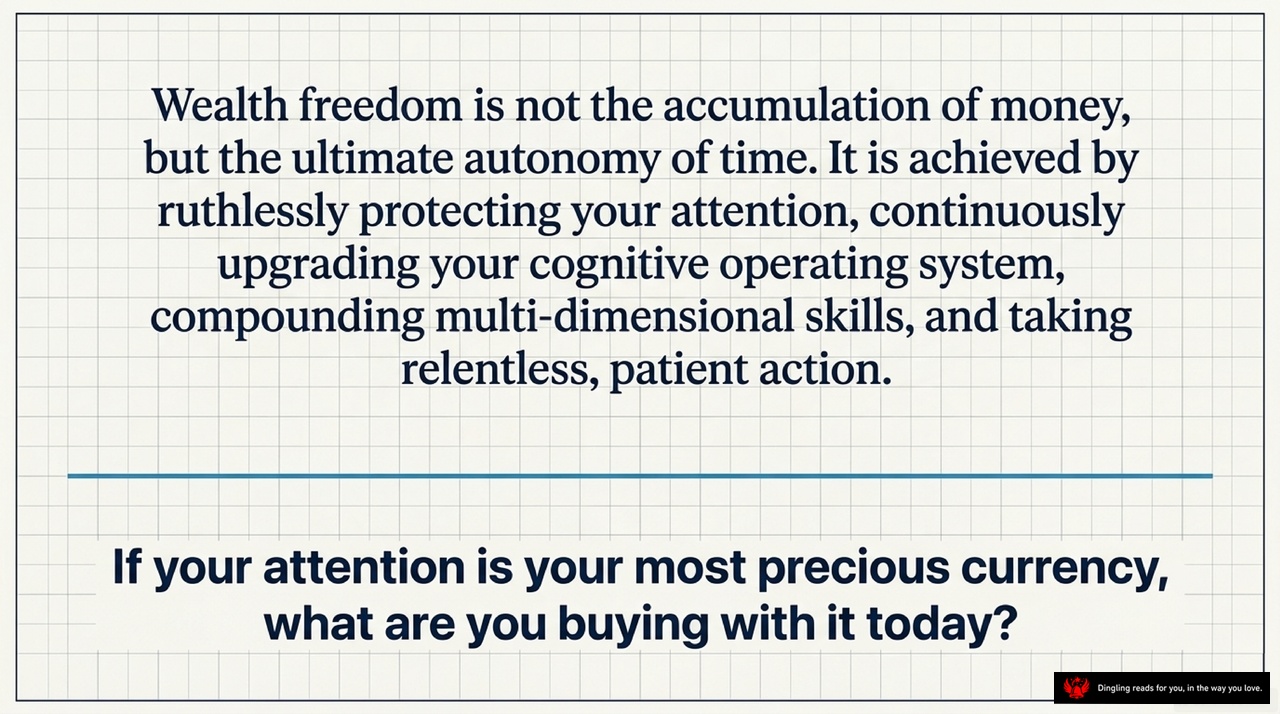
Wealth freedom isn't about hoarding cash; it's about reclaiming your time. Think of your attention as your most precious currency—what are you actually buying with it today? True freedom comes from ruthlessly guarding your focus, upgrading your mind's operating system, stacking multi-dimensional skills, and taking patient, relentless action.
But here's the hard truth: if you treat attention like a commodity to be spent on distractions, you're bankrupting your future. Don't let your precious currency drain on noise, trends, or other people's problems. Instead, invest it in your own growth, your relationships, and the value you create for others. When you stop selling your time for low-value tasks and start compounding your cognitive abilities, you don't just accumulate money—you buy back your life. That is the only kind of freedom that lasts.