
The Sales Bible: Complete Chapter-by-Chapter Summary

Welcome to *The Sales Bible* by Jeffrey Gitomer. Think of this book not just as a guide, but as your modern playbook for building real relationships, delivering genuine value, and finally closing the deal.
Since its first edition in 1992, this book has evolved through three versions, condensing forty years of battle-tested experience into strategies you can master in hours. It moves beyond old-school high-pressure tactics to a friendlier, service-first approach that respects the customer's true needs.
The core secret lies in your mindset. As Napoleon Hill famously said, "Don't worry about being able to do it, worry about being able to think of it." Success starts with a positive attitude and relentless action. You need to replace negative self-talk with belief in yourself and your product. Remember, sales isn't about luck or raw talent; it's about following a proven set of rules and the AHA formula: Attitude, Humor, and Action.
When you combine a positive mindset with authentic humor and consistent action, you stop selling and start connecting. People buy from friends, not strangers. So, shift your focus from just making a commission to building lasting friendships and leveraging the power of your existing clients. Ultimately, this book is your key to unlocking a career where success is not just possible, but inevitable.
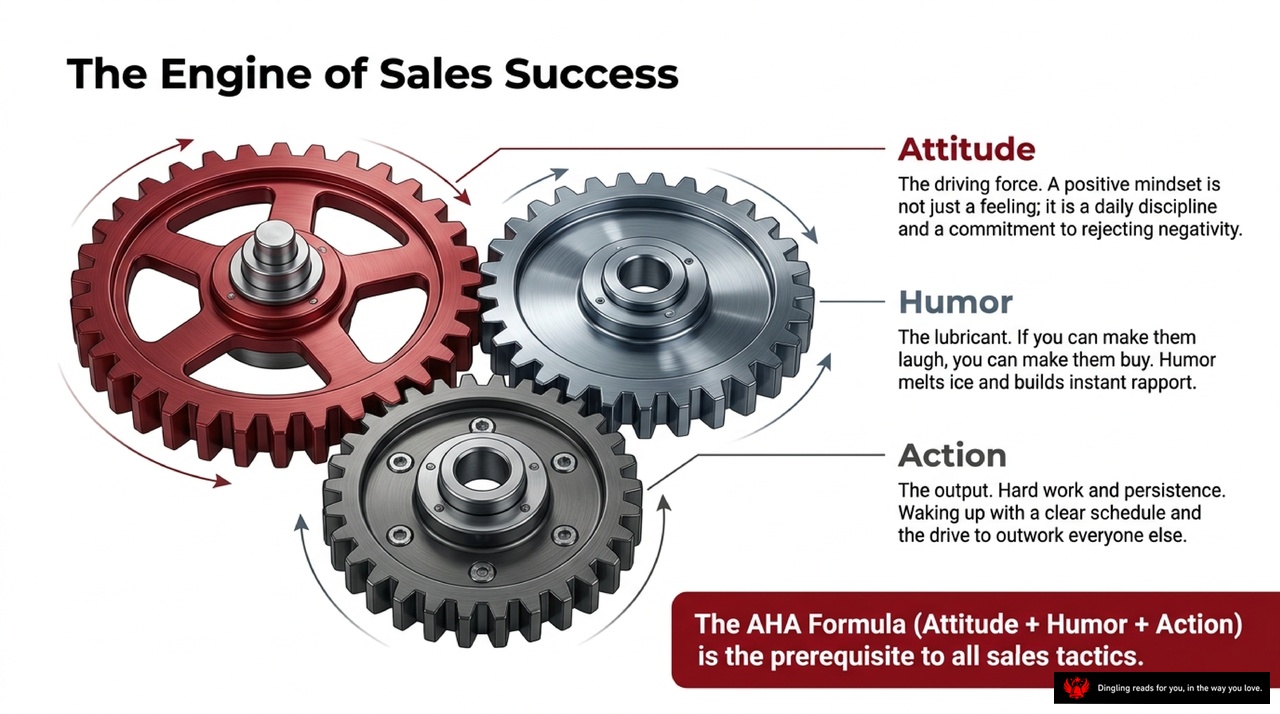
Look at this image. We're not just talking about selling products; we're talking about building an engine. The slide calls it "The Engine of Sales Success," and it breaks it down into three interlocking gears: Attitude, Humor, and Action.
First, let's look at the big red gear: Attitude. This is the driving force. The text here makes a crucial point—a positive mindset isn't just a fleeting feeling; it's a daily discipline. It's a commitment to actively rejecting negativity. If your engine is fueled by doubt, the whole machine stalls.
Next, we have the silver gear: Humor. Think of this as the lubricant. Without it, the gears grind against each other, creating friction and resistance. The slide says, "If you can make them laugh, you can make them buy." Humor melts the ice of defensiveness and builds instant rapport. It's the secret to making the sales process feel light and natural, rather than a high-pressure interrogation.
Finally, the black gear: Action. This is the output. No matter how great your attitude or your jokes are, without hard work and persistence, nothing moves. The slide emphasizes waking up with a clear schedule and the drive to outwork everyone else. You have to be willing to put in the hours.
At the bottom, the slide reveals the ultimate takeaway: The AHA Formula. It's simple but powerful. Attitude plus Humor plus Action is the absolute prerequisite for any sales tactic you know. You can have the best script in the world, but if you lack this engine, you won't get anywhere. So, start by checking your attitude, sprinkle in some humor, and then get to work. That's how you turn the engine on.

Let's dive into the foundation of every great sale: the Unbreakable Blueprint of Belief. Think of this as a four-layer pyramid. At the very top is **The Buyer**. You must genuinely believe that your customer wants to buy from you because of the undeniable value you bring. If you don't believe they need you, they won't either.
Moving down to the second layer, **Self**. You must believe you are the most important person in the room and the best representative of value. It sounds bold, but it's necessary. If you don't believe in yourself, how can you expect the client to?
Next is the **Product** layer. You must be convinced that your product provides unmatched value, productivity, and profitability. If you hesitate on the product's power, the client will sense it immediately.
Finally, at the base, is the **Company**. You must believe your company is the best in the market. This bottom layer supports everything above it.
Here's the hard truth: Without absolute conviction in all four of these layers, your pitch will project hesitation, not confidence. Clients are experts at spotting fake enthusiasm. To close deals, you have to start from the inside out, believing deeply in the buyer, yourself, your product, and your company. That is the only way to build unshakeable confidence.

Let's talk about the moment the game changes. Today, we're looking at the "Paradigm Shift": moving from being a traditional sales rep to becoming a trusted, non-salesperson.
On the left, we see the "Old-School Rep." Their focus was purely on commissions and quotas, their approach was high-pressure and manipulative, they relied on scripted pitches to overcome objections, and they talked constantly, assuming they knew what the buyer needed. It was all about pushing a product.
Now, look at the "Modern Professional" on the right. This is the new standard. The focus shifts from personal gain to helping the customer achieve profitability and success. The approach becomes consultative, non-threatening, and relationship-first. Instead of memorized scripts, the modern pro relies on deep technical knowledge and industry expertise. Finally, the communication style flips entirely: instead of talking constantly, the professional asks insightful questions, listens actively, and acts as a trusted advisor.
This isn't just a nice change; it's a survival necessity. If you stick to the old ways of high-pressure tactics, you'll be left behind. But if you embrace this shift, stop acting like a pushy salesman, and start acting like a consultant who genuinely cares about the client's success, you don't just sell a product—you build a business that lasts.
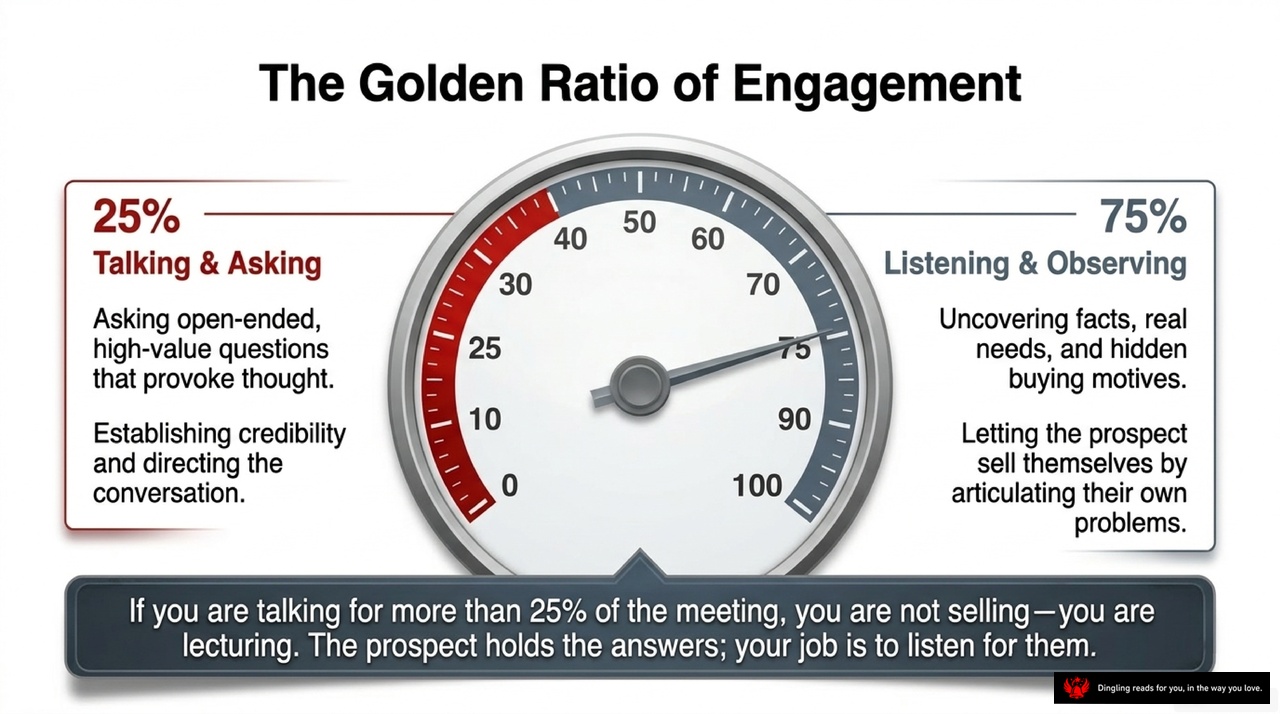
In today's sales game, the biggest mistake isn't running out of time—it's running out of attention. We've all seen it: a salesperson standing in front of a PowerPoint, staring at the screen, reading a script word-for-word while the client's eyes drift to the exit. That's not a presentation; that's a monologue, and it's the fastest way to lose a deal.
The solution lies in shifting from a "show-and-tell" approach to a true dialogue. Think of your presentation not as a slide deck you force onto them, but as a conversation tool that amplifies their own thoughts. You want to be the conductor, not the soloist.
To make this happen, you need to master the details. Keep every slide focused on one core idea to avoid overwhelming them. Swap those generic stock photos for images that reflect the client's specific world. Use bold, easy-to-read fonts so they don't have to squint. But here is the real game-changer: every five slides, inject a moment of humor or a relevant story. A well-timed joke or a quick anecdote about a similar client's success can reset the room's energy and remind everyone why they are there.
Don't try to close the deal while you're presenting. Your slides are there to build value and trust, not to ask for the signature. Instead, use your visuals to tell a story they can relate to, and end with a question that invites them to participate. Finally, the moment you finish, don't pack up immediately. Look them in the eye and make your request. Keep the momentum alive while their interest is at its peak. When you turn a boring lecture into an engaging experience, you stop selling and start connecting.

People hate being sold to, but they absolutely love to buy. The secret to unlocking that desire isn't in your pitch; it's in understanding the deep, often hidden motives driving their decision.
Look at this map of buyer motivations. Every purchase is fueled by one of these five core drivers. First, there is **Need and Desire**. This is the urgent pull to solve a problem or the emotional craving to acquire something better. It's the "why" behind the "what."
Then, you have **Greed and Profit**. This is the buyer's internal mental math, calculating their impending gains. It's about the tangible value they expect to walk away with.
Next is **Fear and Risk**. Let's be real: the fear of loss is often much stronger than the desire for gain. Buyers are terrified of making a bad decision or losing what they already have.
**Vanity and Pride** is another powerful force. It's the need to look good, show off, or simply own the very best in the market. People buy status as much as they buy products.
Finally, **Recovery and Security**. This covers the need to rebuild after a loss or to secure a predictable, safe outcome. When the world feels uncertain, buyers seek stability.
Remember this: You must discover their reason for buying, not just your reason for selling. When you align your message with these specific motives, you stop pushing and start connecting.

So, how do we actually pull off that "WOW!" factor when we walk into a room? It all starts before we even say a word. Think of your sales approach as a game plan, and you need to execute it in three specific moves.
First, you need to do your homework. This is your "Pre-Call Reconnaissance." You have to investigate the prospect thoroughly. Before you walk through that door, you need to know their industry, understand their specific challenges, and know who their competitors are. You can't show up blind; you need to be ready.
Once you've done your research, move to step two: the "Non-Business Icebreaker." Here is the golden rule: never start with your pitch. Instead, look for visual clues in their office—trophies, photos, hobbies—and use those to establish common ground. Remember, people buy from friends, not strangers. You want to connect on a human level first, not a business level.
Finally, you deliver your "30-Second Power Statement." This is where you make the real impact. Do not describe what your product is; describe the benefit of what it does from the customer's perspective. Don't sell the drill; sell the smooth hole. Don't sell the printer; sell the professional image it creates.
By following this sequence—preparation, connection, and then value—you stop sounding like a pushy salesperson and start sounding like a trusted advisor who has the answer to their problems. That is how you execute the WOW! Factor.

Let's talk about the art of the question. In sales, the wrong question leads to the wrong answer, but a powerful one can logically guide a prospect straight to your solution. Look at this five-step framework that turns a simple conversation into a strategic journey.
It starts with Step 1: The Selection Question. Instead of asking, "Who do you use now?" you ask, "How do you currently choose your provider?" This shifts the focus from a competitor to their decision-making process. Next, move to Step 2: The Preference Question. Ask, "What do you like most about your current setup?" This uncovers what they value, setting the stage for your pitch.
Then comes Step 3: The Improvement Question. Challenge them gently: "If you could change or improve one thing, what would it be?" This forces them to admit pain points without feeling attacked. Step 4 is The Evaluation Question. Dig deeper by asking, "How does that specific issue impact your bottom line?" Now you're connecting their problem directly to their financial reality.
Finally, you land on Step 5: The Closing Question. "If I could prove that we can solve that issue right now, would you make a change?" This isn't a hard sell; it's a logical conclusion they've reached themselves. Remember, your goal isn't just to ask questions, but to force the prospect to evaluate new information until your solution becomes the only logical choice.

Presenting for Impact, Not Applause. If you're still relying on generic, feature-heavy slideshows, you're basically putting your buyers to sleep. That's exactly what the "Anti-PowerPoint Rule" warns against. When you just list what "we do," you ignore the prospect entirely. Instead, focus on building real confidence.
Start with early physical engagement. Get the product, a sample, or even a pen into their hands immediately. Let them touch it. Next, use third-party proof. One video testimonial or satisfied client list is worth a hundred sales pitches. Don't just talk; show them that others trust you.
Then, shift your focus to the aftermath. Highlight your post-sale training, delivery, and long-term service. Clients care about what happens after the deal is signed. Finally, eliminate all sales jargon. Never say, "To be honest with you," or "Can I earn your business today?" That sounds like a peddler. Speak like a trusted peer instead.
Stop trying to win applause and start creating impact. When you stop selling features and start building trust, the results follow naturally.
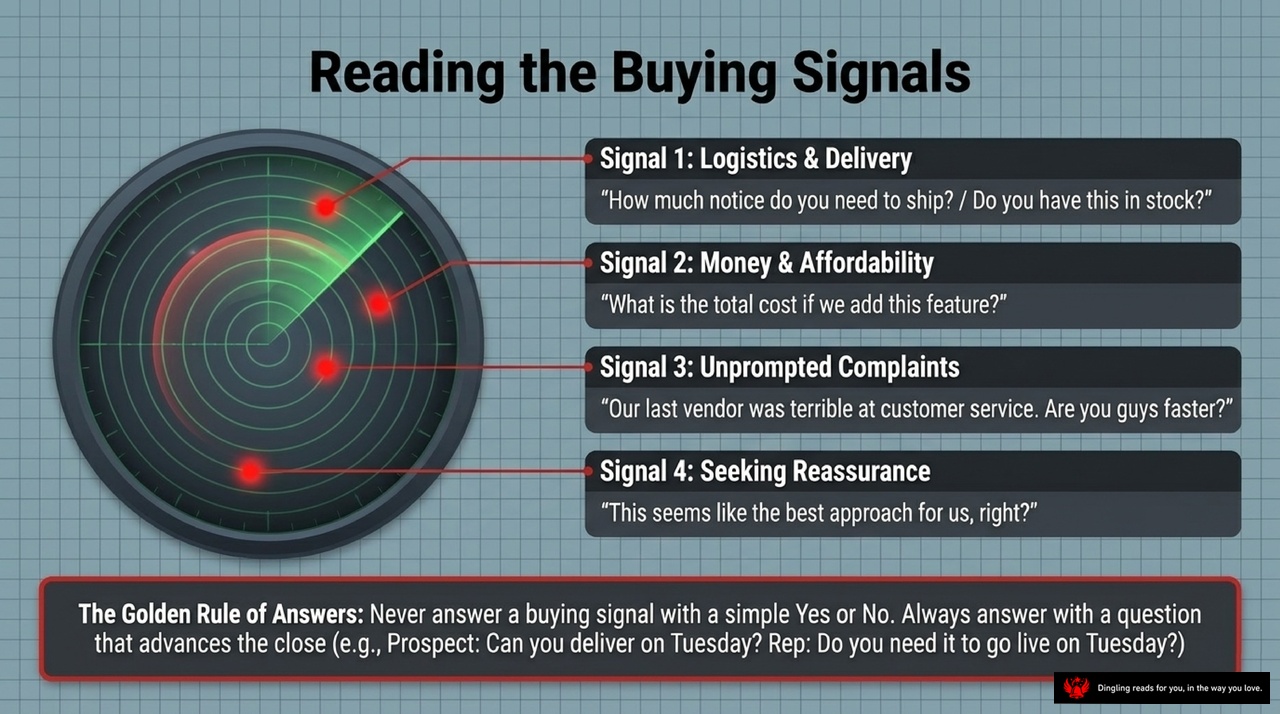
Reading the Buying Signals is all about spotting the moment a prospect shifts from "thinking" to "buying." Think of it like a radar screen: when these specific signals light up, you know the deal is heating up.
First, watch for logistics and delivery questions. When a client asks, "How much notice do you need to ship?" or "Do you have this in stock?", they aren't just checking your inventory. They are mentally planning the delivery and testing your capability.
Second, listen for money and affordability. If they ask, "What is the total cost if we add this feature?", they are actively calculating the ROI. They are ready to talk numbers because they see value in the investment.
Third, keep an ear out for unprompted complaints. If a client suddenly says, "Our last vendor was terrible at customer service. Are you guys faster?", they are giving you permission to be better. They are actively comparing you against a bad experience and hoping you are the solution.
Finally, watch for signs of seeking reassurance. Phrases like, "This seems like the best approach for us, right?" are massive green lights. The client has done the work, they have the budget, and they just need a final nod of confidence to pull the trigger.
Here is the Golden Rule: Never answer these signals with a simple Yes or No. That kills the momentum. Instead, always answer with a question that advances the close. If they ask, "Can you deliver on Tuesday?", don't just say yes. Ask, "Do you need it to go live on Tuesday?" This keeps the conversation moving toward the signature line, turning their signals into your sales.
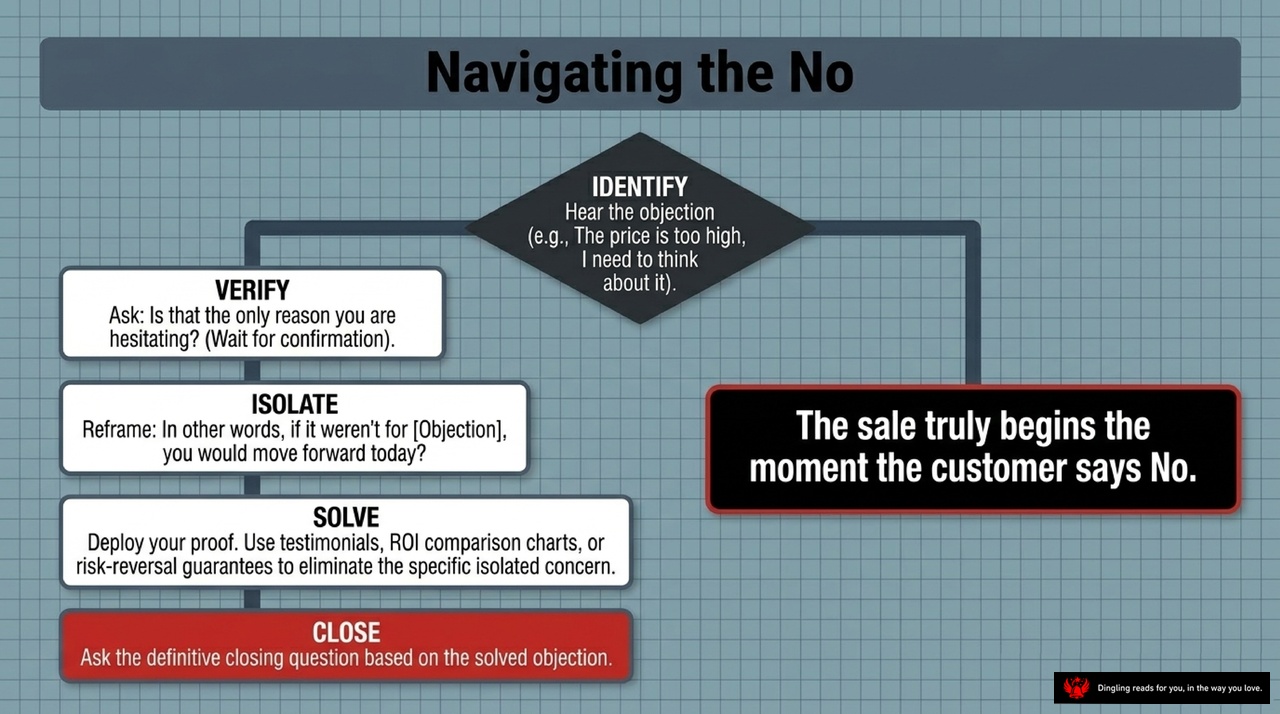
Navigating the "No" isn't about avoiding rejection; it's about mastering the moment a customer says it. In fact, as the slide boldly states, the sale truly begins the moment the customer says No. That's where the real work happens.
So, how do we turn that "No" into a "Yes"? The answer lies in a simple, five-step process: Identify, Verify, Isolate, Solve, and Close. First, you must **Identify** the objection. Listen carefully to what they're saying—whether it's "the price is too high" or "I need to think about it." Don't argue yet; just hear them out.
Next, **Verify** if that's the only reason they're hesitating. Ask them directly, "Is that the only thing holding you back?" This helps you separate real objections from excuses. Then, **Isolate** the concern by reframing the conversation. Ask, "If we could solve this specific issue, would you move forward today?" This confirms that the objection is the only barrier.
Once you've isolated the problem, it's time to **Solve**. Deploy your proof. Use testimonials, ROI charts, or risk-reversal guarantees to eliminate that specific concern. Finally, **Close** by asking a definitive question based on the solved objection. By following this flow, you transform a dead-end rejection into a clear path to closing the deal.
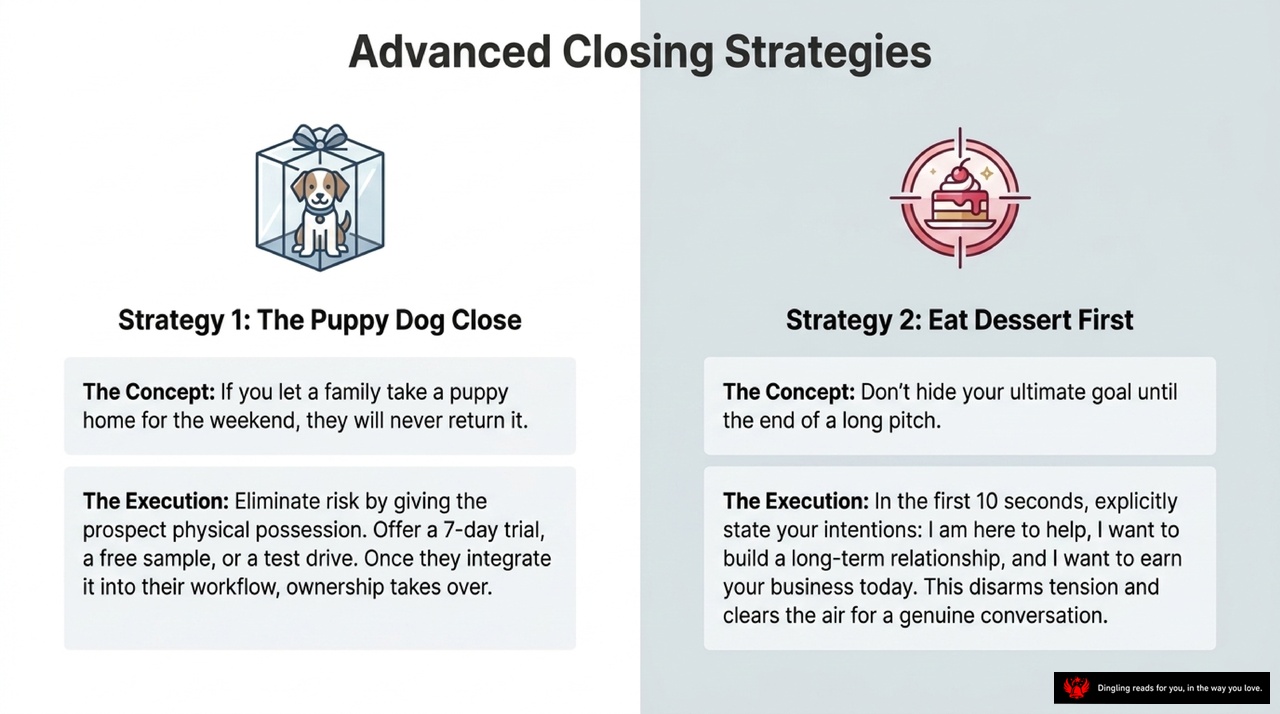
Advanced Closing Strategies. When you're standing at the finish line with a prospect, how do you actually get them to say "yes"? The book offers two powerful, counter-intuitive tactics that can completely change the outcome of your pitch.
First, let's look at "The Puppy Dog Close." Imagine you're at a shelter and you love a puppy so much you take it home for the weekend. By the time you try to return it, you've already bonded with it; you can't bear to leave. This strategy works on the same psychological principle. The key is to eliminate risk by giving the prospect physical possession early. Instead of waiting until the end of the meeting to ask for the sale, offer a 7-day trial, a free sample, or a test drive. Once they integrate the product into their workflow or lifestyle, ownership takes over naturally, and returning it becomes a much harder decision than buying it.
On the other side, we have "Eat Dessert First." In traditional sales, we hide our ultimate goal until the very end, hoping to surprise the client. But this creates tension. The book advises the opposite: don't hide your intentions. In the first 10 seconds, explicitly state your goal. Tell them, "I am here to help, I want to build a long-term relationship, and I want to earn your business today." This might sound bold, but it actually disarms the prospect. It clears the air for a genuine conversation and shows you are confident and direct. By eating the dessert first, you set a clear tone for success right from the start.
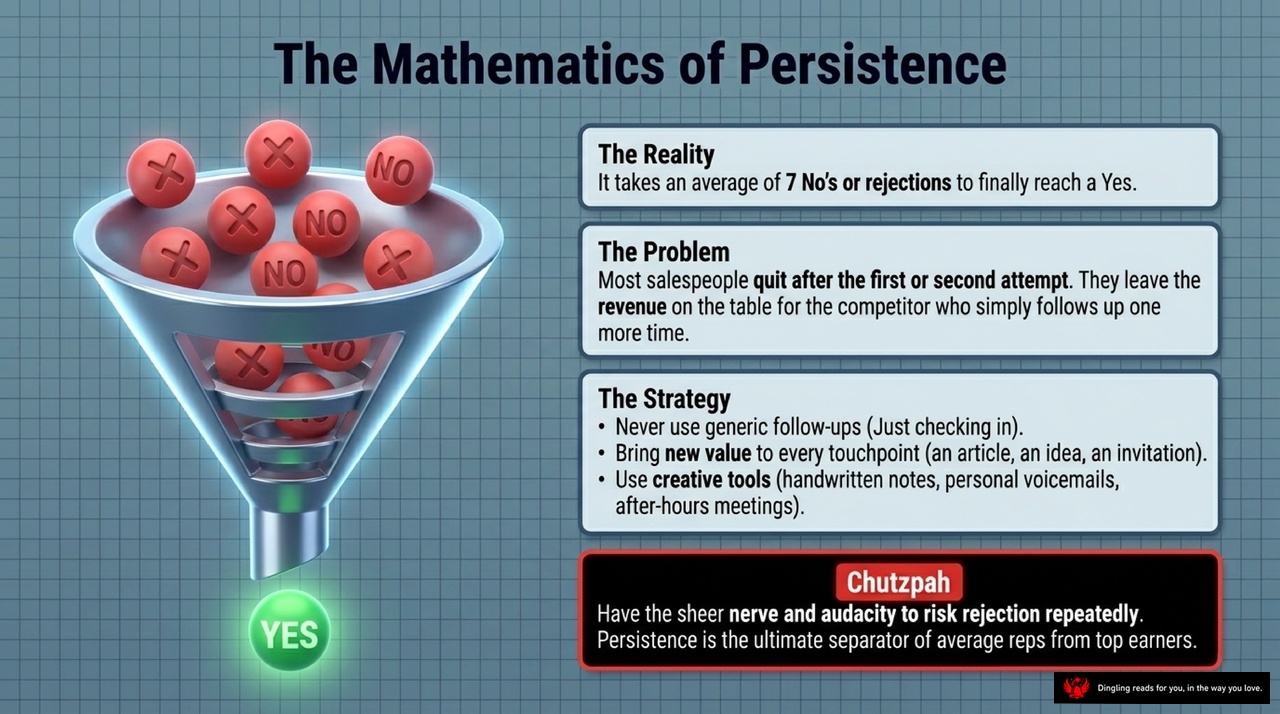
Imagine a sales funnel where the top is clogged with red "No" balls, but a single green "Yes" lights up at the bottom. That's the reality of the numbers game: it takes an average of seven rejections to finally land one deal. Most salespeople quit after the first or second "No," leaving massive revenue on the table for competitors who simply have the nerve to follow up one more time.
But the real game-changer isn't just persistence; it's "chutzpah"—the sheer audacity to risk rejection repeatedly. To survive the funnel, you can't rely on generic follow-ups. Instead, you must bring new value to every single touchpoint, whether it's sharing an article, sending a handwritten note, or making a personal voicemail. You have to use creative tools to stay fresh in their mind.
Ultimately, persistence is the ultimate separator between average reps and top earners. While others are waiting for a perfect moment, you're showing up with a new angle, proving that your value is worth the extra seven tries.
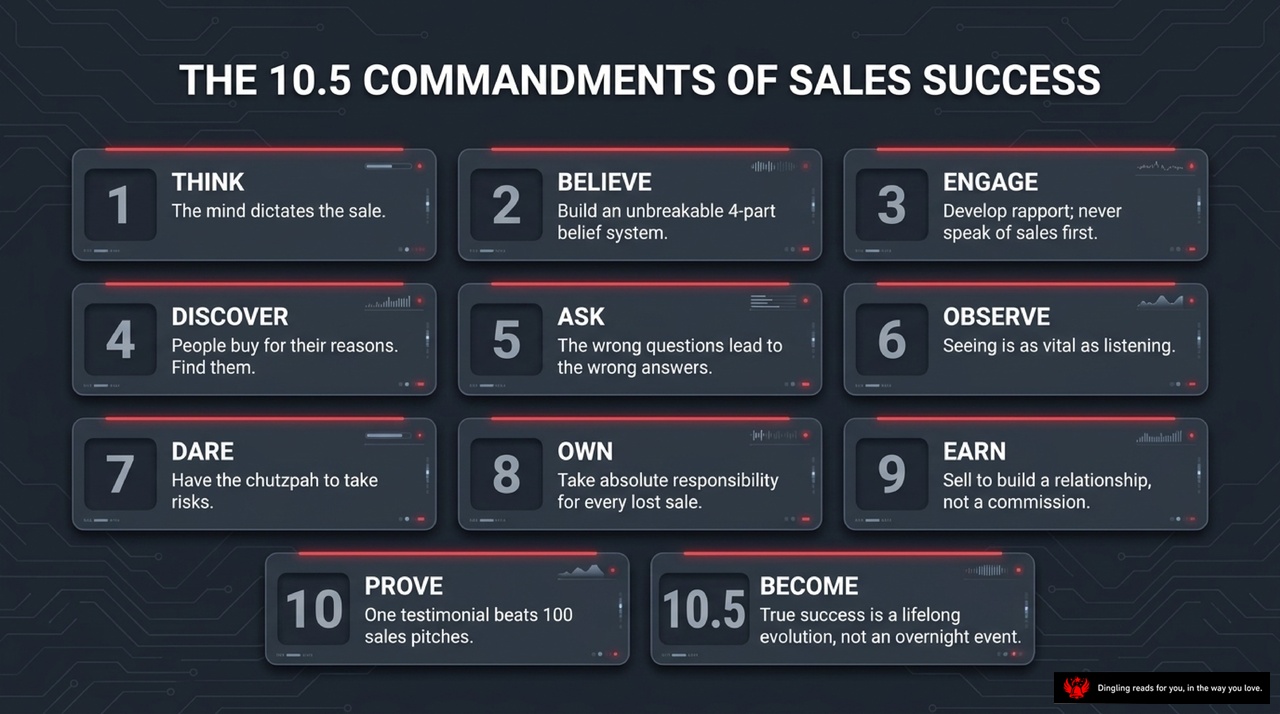
Welcome back to our deep dive into the 10.5 Commandments of Sales Success. Today, we're looking at the final three pillars that turn a good salesperson into a legend: Dare, Own, and Earn.
First, let's talk about **Dare**. In sales, you need the chutzpah to take risks. Too many professionals play it safe, sticking to what they know. But true success requires stepping out of your comfort zone. Whether it's asking for a meeting, proposing a bold new solution, or simply speaking up in a crowded room, you have to have the courage to act.
Next, we move to **Own**. This is about taking absolute responsibility for every lost sale. When a deal falls through, don't blame the market, the competitor, or the client. Blame yourself. Ask yourself: Did I prepare enough? Was my message clear? Did I listen? By owning your failures, you transform them into your greatest teachers. This mindset ensures you never repeat the same mistakes.
Finally, consider **Earn**. This commandment shifts the entire focus of your career. Stop selling just to build a relationship; instead, build relationships to earn the sale. When you prioritize trust and long-term value over a quick commission, the results follow naturally. Clients stay loyal to people they trust, not just to products.
Together, these three principles—Dare, Own, and Earn—form the backbone of a resilient and successful sales career. They remind us that success isn't about tricks; it's about courage, accountability, and genuine connection.
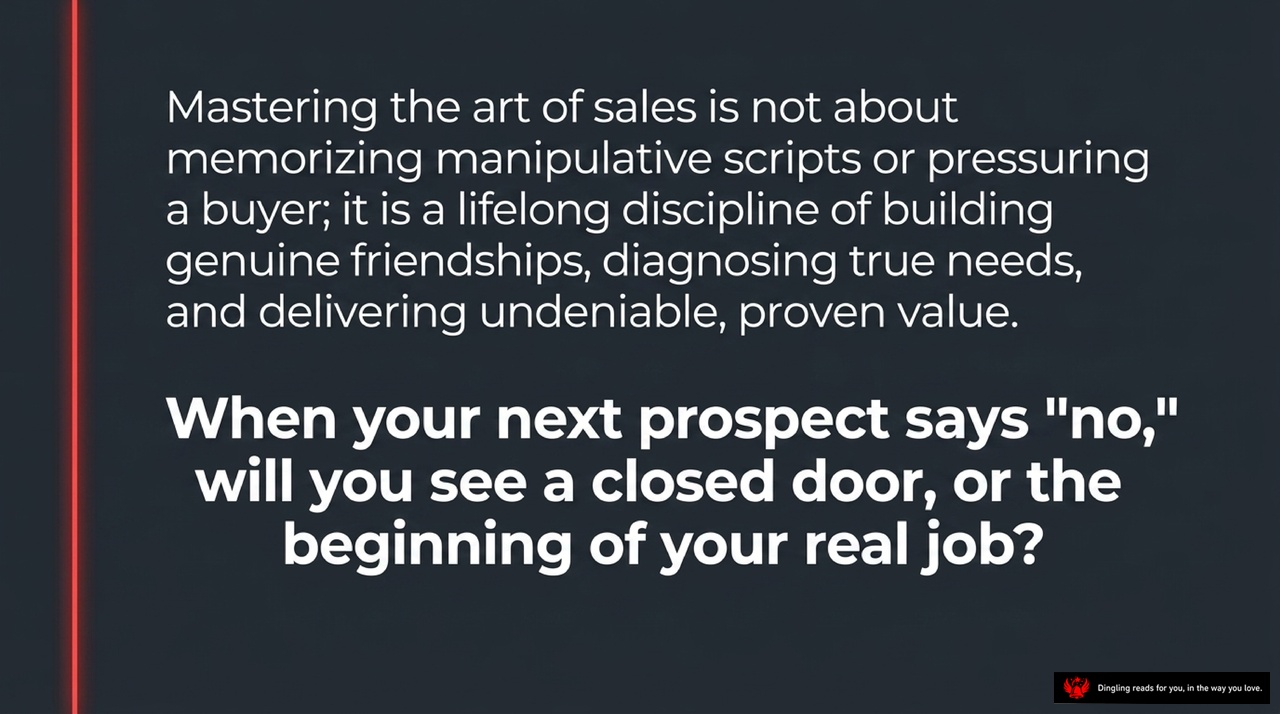
Mastering the art of sales isn't about memorizing scripts or pushing people into corners; it's about building genuine friendships, diagnosing real needs, and delivering undeniable value. That's the mindset shift you need to make today.
So, here's the real question for you: When your next prospect says "no," are you going to see a closed door, or are you going to see the beginning of your real job?
Think about it. Most sales failures aren't caused by bad products or bad timing. The data shows that 50% of sales failures stem from a simple, personal mindset issue. If you're stuck in a negative loop, blaming the market or the client, you're already losing before you even start. But when you flip that switch to an attitude of possibility, your odds of success immediately jump above 50%.
Remember, your attitude defines your reality. You become who you believe you are. So, stop saying "I can't do this" and start asking, "How can I make this happen?"
And let's be honest, the best sales happen between friends, not strangers. If you haven't turned your prospects into friends, you're leaving half the market on the table. Build that trust, be helpful, and watch how the deals start flowing naturally.