
The Science of Distributing Wealth: Complete Chapter-by-Chapter Summary

Welcome to "The Science of Distributing Wealth" by Bian Zhihan. This isn’t just a book about money—it’s a blueprint for building a company where people actually want to stay and grow. Think of it as the operating system for smart compensation, inspired by what Huawei figured out after scaling from a small startup to a global powerhouse. We’re diving into how to align pay with performance, motivation, and long-term vision—without breaking the bank or burning out your team. If you’ve ever felt stuck trying to balance fairness, drive, and sustainability in your organization, this is your guide. Let’s get started.

Let’s be honest: most organizations don’t die because they fail to innovate. They die because they stop fighting for it.
Look at this chart. It’s not just a graph—it’s a warning. On the left, we see “Entropy”—that slow, silent drift toward laziness, bureaucracy, and deadly egalitarianism. That’s the Second Law of Thermodynamics in action: energy spreads out, systems decay, and without input, everything stagnates.
But here’s the antidote: Negative Entropy. This is where strategic distribution comes in—injecting energy into the system to break complacency, disrupt comfort zones, and force growth. Think of it as a shock to the system that keeps people awake and hungry.
And then there’s the engine of vitality: calculated interest gaps. Whether it’s wage differentials or performance incentives, these create internal and external pressure that fuels relentless struggle and innovation. Without them, you’re just coasting toward the terminal state.
As Ren Zhengfei put it: “The historical law is death, and our responsibility is to prolong life.” So ask yourself: are you injecting negative entropy—or are you letting entropy accumulate? Because if you’re not, your organization won’t just stall. It will fade. And no amount of goodwill will bring it back.
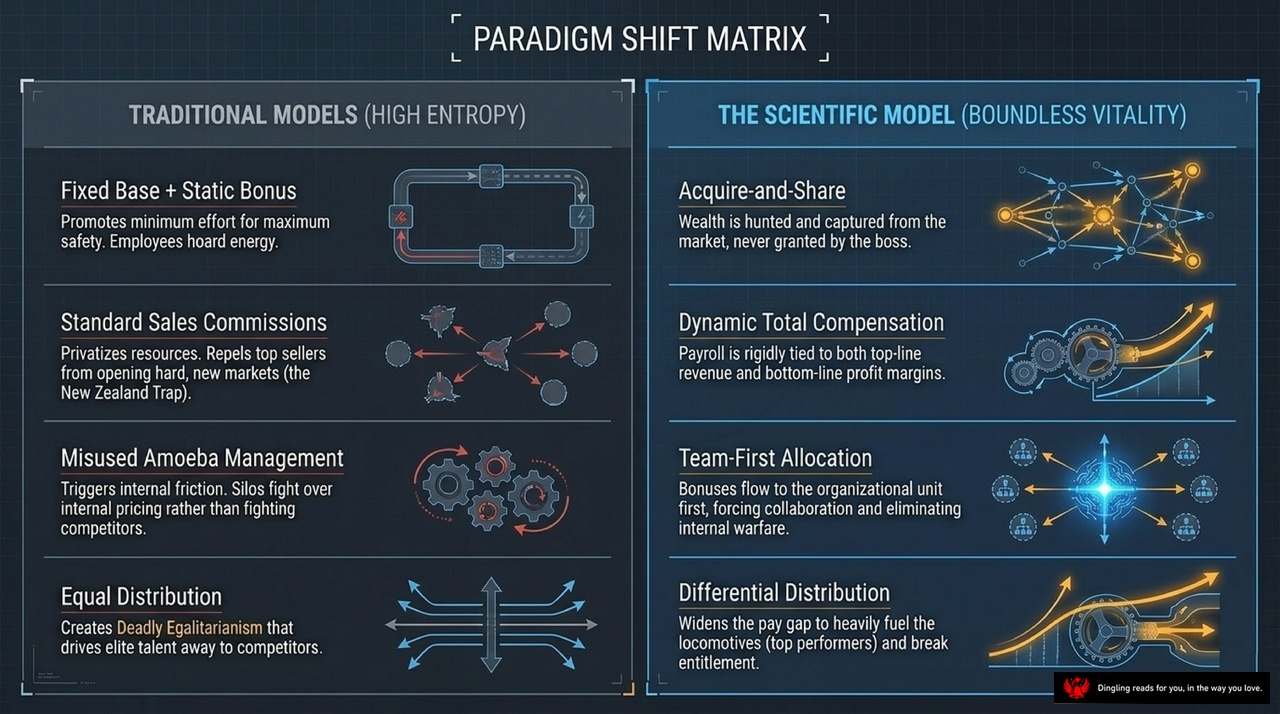
Look at this Paradigm Shift Matrix. On the left, you see Traditional Models—high entropy, predictable, and ultimately, draining. It's built on a Fixed Base plus Static Bonus, which encourages employees to hoard energy just to stay safe. It uses Standard Sales Commissions that privatize resources and actually push your best performers away when they need to take risks in new markets. It relies on Misused Amoeba Management that creates internal friction and silos, fighting over money instead of fighting for the customer. And finally, it uses Equal Distribution, which creates a "Deadly Egalitarianism" that kills your top talent and drives them to your competitors.
Now, look at the right side: The Scientific Model, where we embrace boundless vitality. We move from hoarding to an Acquire-and-Share philosophy, where wealth is hunted and captured from the market, never granted by a boss. We replace static pay with Dynamic Total Compensation, where payroll is rigidly tied to both top-line revenue and bottom-line profit margins. We shift from internal fighting to Team-First Allocation, ensuring bonuses flow to the organizational unit first to force collaboration and eliminate internal warfare. And finally, we embrace Differential Distribution, widening the pay gap to heavily fuel our top performers and break entitlement. This isn't just a pay change; it's a fundamental shift from a system that kills energy to one that fuels it.

So, here’s how you actually build a company that lasts—not just one that survives, but one that thrives.
First, orient toward incremental growth. Think of it like farming: you don’t just harvest today’s crop and walk away. You keep the soil fertile for tomorrow. In business, that means balancing short-term cash flow with long-term capabilities—market share, customer loyalty, innovation. Don’t trade off the future for the present.
Second, orient toward organizational vitality. That’s about creating energy inside your team. Build systems where top performers get rewarded, where talent is drawn in because they see real opportunity. It’s not about fairness—it’s about fueling the right people to do the hard work.
Third, orient toward comprehensive motivation. Stop letting only the “stars” feel seen. Design incentive structures that activate every single person in your organization—from entry-level to leadership. When everyone feels like they matter, you stop the bystander effect and start building real momentum.
Finally, orient toward intrinsic drive. Yes, money matters—but only as fuel. The real engine? Purpose. Use external rewards to unlock internal ambition. Make sure your team isn’t just working for a paycheck, but for something bigger: achievement, growth, impact.
This isn’t theory. This is how top companies scale—and stay alive.
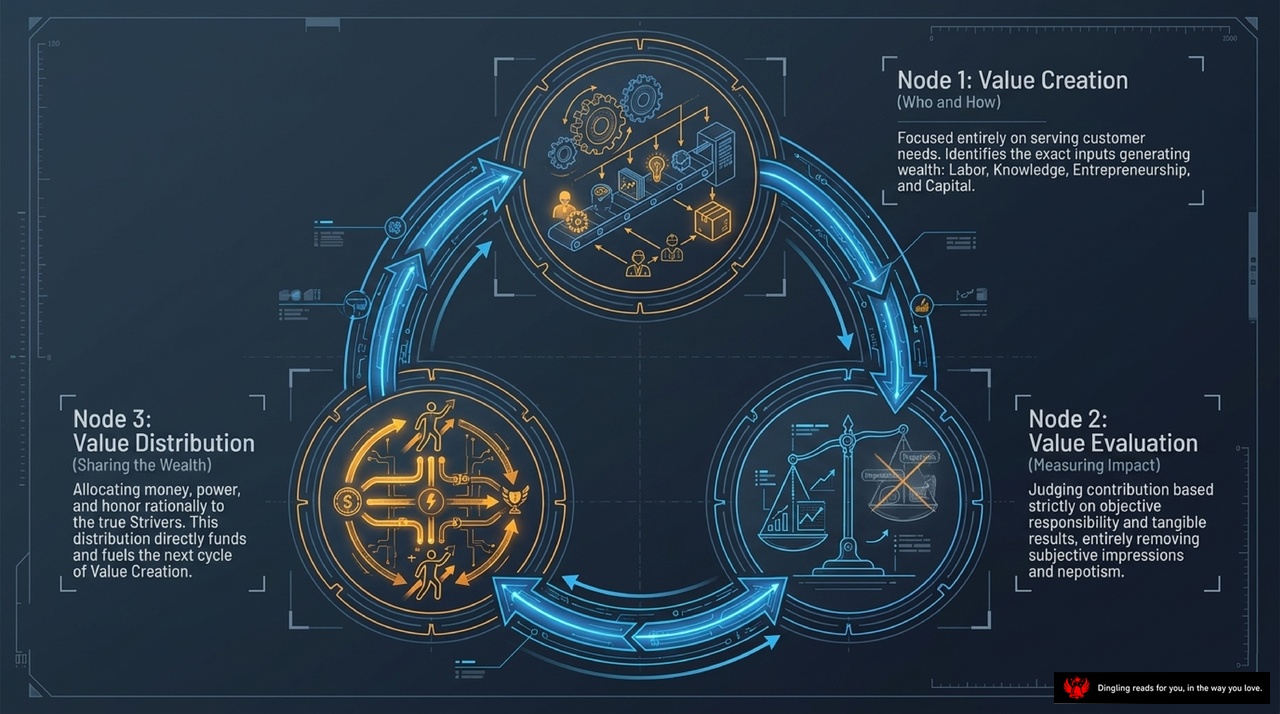
This visual lays out a powerful, self-sustaining loop that drives any thriving organization: the cycle of value. It’s not a linear process, but a continuous engine where three nodes feed into one another.
At the top, we have Node 1: Value Creation. This is the engine room. It’s about identifying exactly what inputs—labor, knowledge, entrepreneurship, and capital—generate wealth by serving customer needs. It’s the "Who and How" of getting things done.
Moving clockwise to Node 2, we enter Value Evaluation. This is the critical checkpoint. It’s about measuring impact, judging contribution based strictly on objective responsibility and tangible results, and entirely removing subjective impressions and nepotism. Without this, you can't know if your creation is actually valuable.
Finally, we arrive at Node 3: Value Distribution. This is the fuel for the next cycle. It’s about allocating money, power, and honor rationally to the true Strivers. This distribution directly funds and fuels the next cycle of Value Creation, ensuring the engine never stops.

Pillar 1: Deconstructing Value Creation. This slide breaks down how different roles in a company create and capture value.
At the bottom, we have Capital. It provides the fuel for everything, assuming the baseline financial risk. In return, it earns a steady, predictable return, but it's explicitly restricted from monopolizing the profits. It sets the floor for the game.
Moving up, we have General Laborers. Their contribution is simple labor. The graph shows a linear relationship where Input equals Output. You put in an hour, you get an hour's worth of work. They are paid via competitive, market-rate fixed wages. It's a fair trade, but it's capped.
Above that are Knowledge Workers. This is where the game changes. They handle innovation and systems. Their graph shows Exponential Output. A small input of complex thought can yield massive, scalable results. Because their work creates this residual value and long-term growth, they must share in the company's upside. They aren't just paid a salary; they are paid to own the growth they create.
Finally, at the top, we have Entrepreneurs and Leaders. They drive the overarching direction and bear absolute responsibility for survival. Their path is a Strategic Trajectory, full of ups and downs, but they are steering the ship. They share in the residual value, receive strategic bonuses, and hold operational control. They capture the highest value because they take the highest risk and make the hardest calls.
So, this is the hierarchy of value creation. From the capital that funds the risk, to the linear labor that maintains the status quo, to the exponential knowledge that scales the business, and finally, to the leaders who navigate the uncertainty and claim the ultimate prize.

So, let’s break down what’s really driving your compensation—both the fixed salary you get every paycheck and the variable bonus you earn based on performance.
Think of this like an iceberg. Below the surface lies your potential—what determines your fixed salary. That includes your core values: do you truly believe in the company’s mission over personal gain? Your capability: are you qualified and skilled for the role? And your attitude: are you willing to learn, struggle, and endure hardship? These are the foundational elements that build your long-term value.
Above the surface is where results matter—what drives your bonus. It’s not just about how hard you work, but what you deliver. Your individual performance is graded on an absolute scale: A is top-tier, B is solid, and anything below B means you’re not meeting expectations. But here’s the key: even if you’re an A-level performer, if your team fails, your bonus gets cut. Why? Because organizational performance dictates the bonus pool. If the team doesn’t hit its targets, individual success becomes irrelevant.
So, your pay isn’t just about your skills or effort—it’s about alignment with the company’s goals, your ability to deliver results, and how well you fit into the team’s success. That’s the real formula behind compensation.
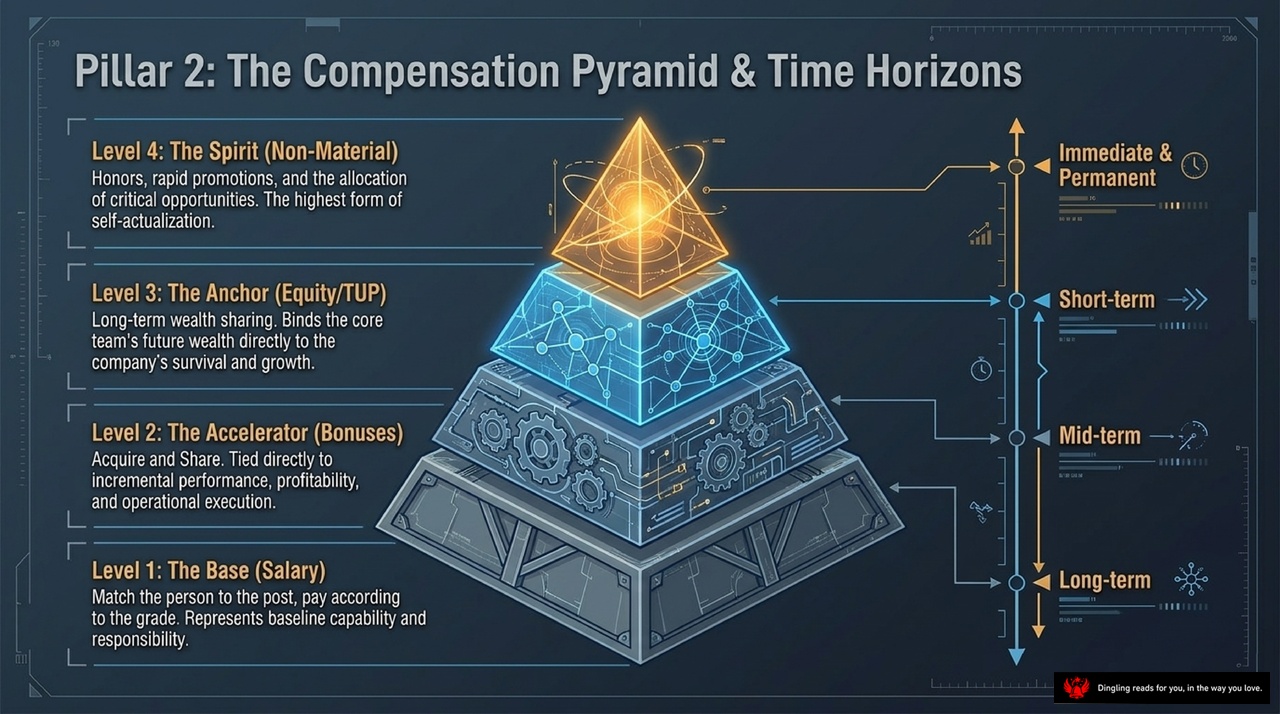
Let’s talk about how we actually pay people—and not just with a paycheck.
Look at this pyramid. It’s not just about money. It’s about what drives people over time. At the bottom, Level 1 is The Base—your salary. That’s your foundation. It matches the role, the responsibility, and what someone brings to the table. No more, no less. It’s fair, but it doesn’t inspire.
Above that, Level 2 is The Accelerator—bonuses. These are tied to performance, profits, and execution. If you hit the target, you get rewarded. It’s short-term fuel. Good for motivation, but not enough to build loyalty or long-term commitment.
Then comes Level 3: The Anchor—equity or TUPs. This is where real alignment happens. You’re not just paid for today; you’re invested in the company’s future. Your wealth grows as the company grows. That’s how you bind people to the mission.
And at the top? Level 4: The Spirit. This is non-material. Think rapid promotions, honors, critical opportunities. It’s about self-actualization. It’s the kind of thing that makes someone say, “I want to be here forever.”
Now look at the timeline on the right. Salary is long-term stable, bonuses are mid-term, equity is short-term, and spirit? That’s immediate and permanent. It’s not about how much you get paid—it’s about how long you want to stay.
This pyramid isn’t just theory. It’s how you build a team that doesn’t just work for you—but works with you, for years to come.

Imagine a world where money hires people. In that world, capital sits at the top, and human effort is just fuel to be burned for profit. That’s the Industrial Age myth—a belief that’s been passed down for centuries.
But here’s the truth: in today’s knowledge economy, it’s people who hire capital. Innovation, creativity, and relentless human drive are what actually make organizations survive and grow.
Look at this 3:1 rule. It’s not just a number—it’s a philosophy. For every dollar Huawei gives to financial capital—dividends, investments, profits—it gives three dollars to human capital: salaries, bonuses, benefits. They’re not just paying people; they’re investing in the very engine of their success.
Why does this matter? Because when you constrain how much capital can take, you keep the real value-creators hungry, rewarded, and driven to expand the whole pie. You don’t just reward effort—you fuel growth.
This isn’t about fairness. It’s about strategy. And it’s why Huawei doesn’t just compete—it leads.
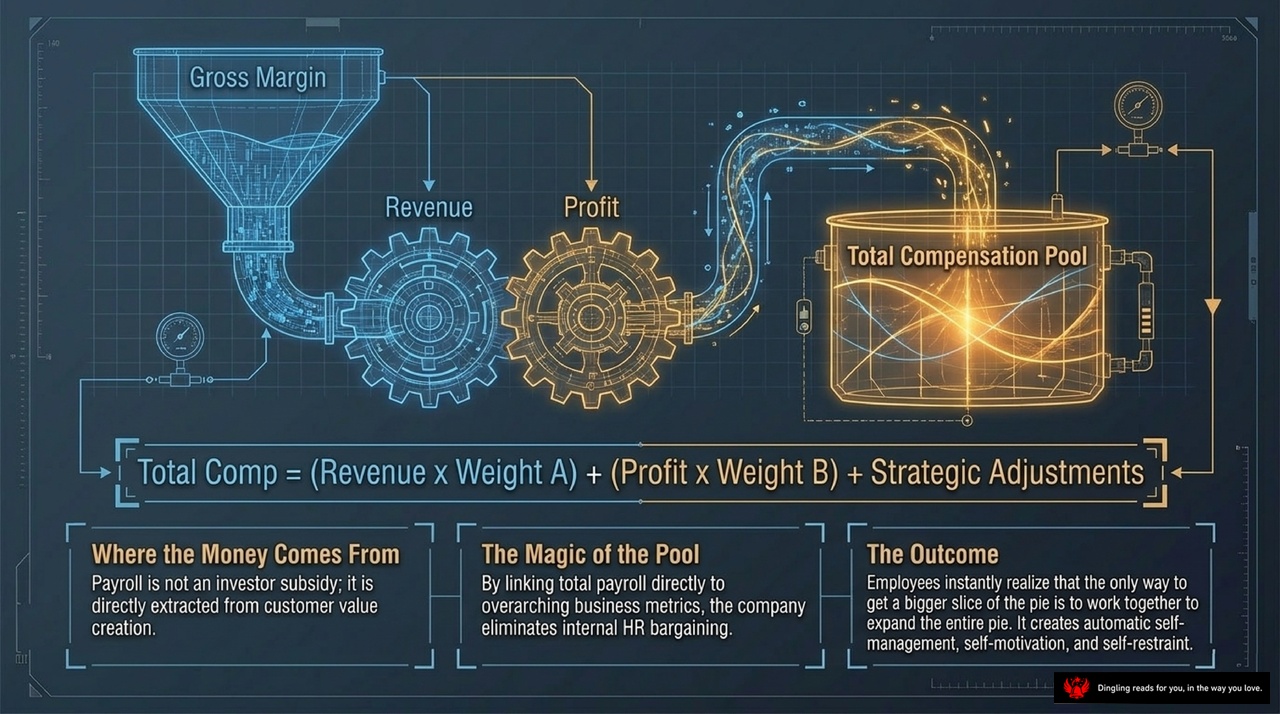
Let’s break down how we actually pay our team—because if you’re still thinking of payroll as a cost to be minimized, you’re already behind.
Look at this: Gross Margin feeds into Revenue, which drives Profit. That profit doesn’t just sit in the bank—it flows directly into the Total Compensation Pool. And here’s the formula that makes it all work: Total Comp equals (Revenue times Weight A) plus (Profit times Weight B), with room for strategic adjustments.
This isn’t theory. This is how we align everyone’s incentives with the company’s success. Payroll isn’t a line item investors subsidize—it’s extracted from the value we create for customers. When total pay is tied to real business outcomes, HR stops playing games and starts building a system where everyone wins together.
The result? Employees don’t need to be told what to do. They instantly understand: the only way to get a bigger slice of the pie is to expand the whole pie. That creates automatic self-management, self-motivation, and self-restraint—no micromanagement needed.
This is how you build a company that scales without chaos.
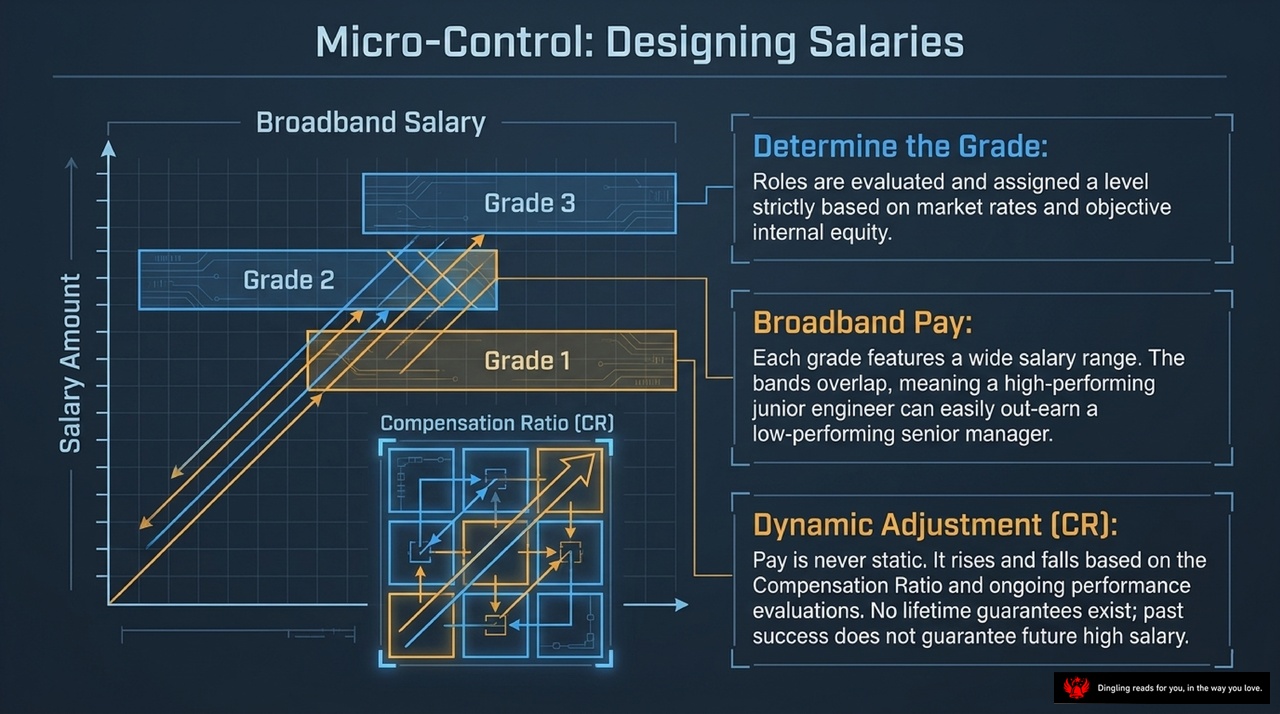
Here is the spoken script for Slide 10.
**Script:**
Welcome to the core of our discussion on **Micro-Control: Designing Salaries**. Look at this diagram; it illustrates a shift from rigid pay scales to a dynamic system.
First, notice how we **Determine the Grade**. Instead of just looking at a job title, we evaluate roles based on strict market rates and internal equity. This ensures we are paying fairly for the value the role brings, not just the person holding it.
But here is the game-changer: **Broadband Pay**. Notice how the salary bands for Grade 1, Grade 2, and Grade 3 overlap. This isn't a mistake; it’s a feature. It means a high-performing junior engineer can easily out-earn a low-performing senior manager. We are rewarding performance, not just seniority.
Finally, pay is never static. Look at the **Compensation Ratio (CR)** and the arrows showing movement. Pay rises and falls based on ongoing performance evaluations. There are no lifetime guarantees. Success today does not guarantee a high salary tomorrow. This creates a culture where everyone must constantly prove their value to keep their position at the top.
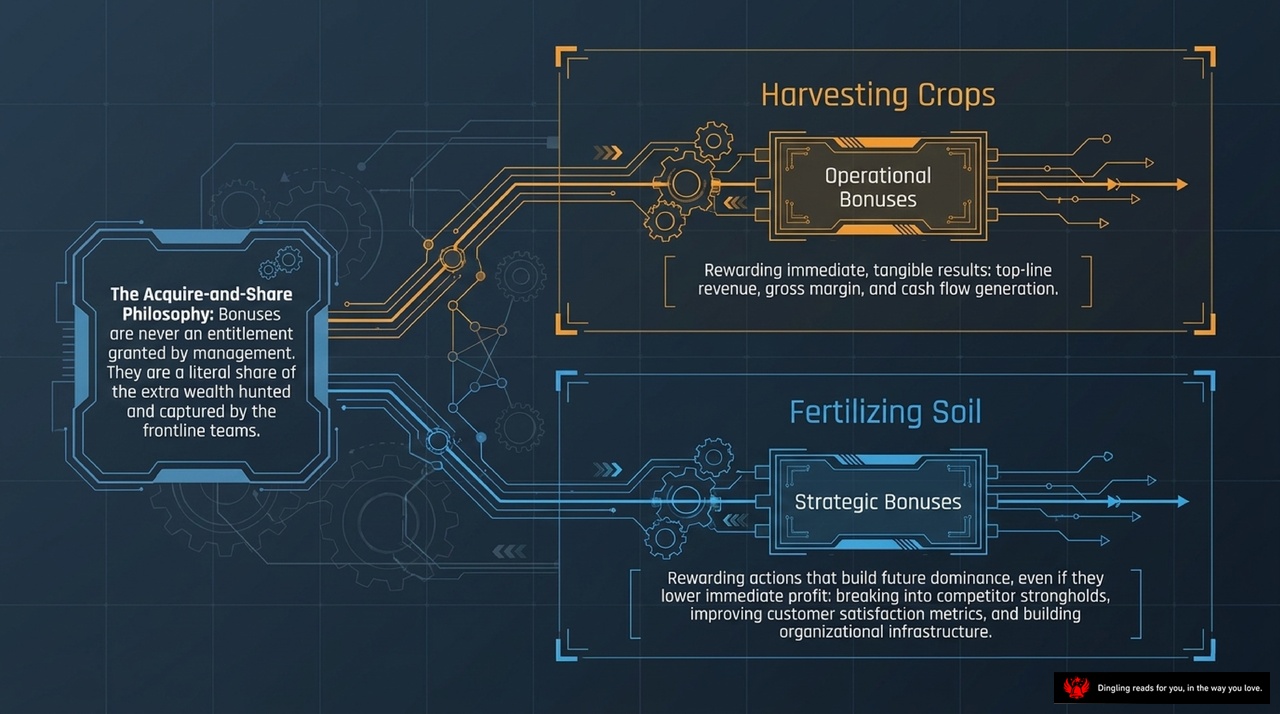
Here is the spoken script for Slide 11, tailored for a US audience:
“Think of your company as a farm. To keep growing, you need to balance two distinct strategies. On the right, we have 'Harvesting Crops,' which represents our Operational Bonuses. These are the rewards for immediate, tangible results—the kind of work that generates top-line revenue and cash flow today. It’s about picking the fruit that’s already ripe.
But on the left, we have 'Fertilizing Soil,' which drives our Strategic Bonuses. This is the investment in the future. It’s about taking actions that build long-term dominance, even if they lower immediate profit. Think of it as breaking into competitor strongholds or improving our infrastructure—essential work that doesn't pay off right now, but ensures we dominate the market later.
This graphic highlights our 'Acquire-and-Share Philosophy.' It’s a powerful reminder that bonuses aren’t an entitlement granted by management. Instead, they are a literal share of the extra wealth hunted and captured by our frontline teams. We don’t just pay for results; we share the harvest.
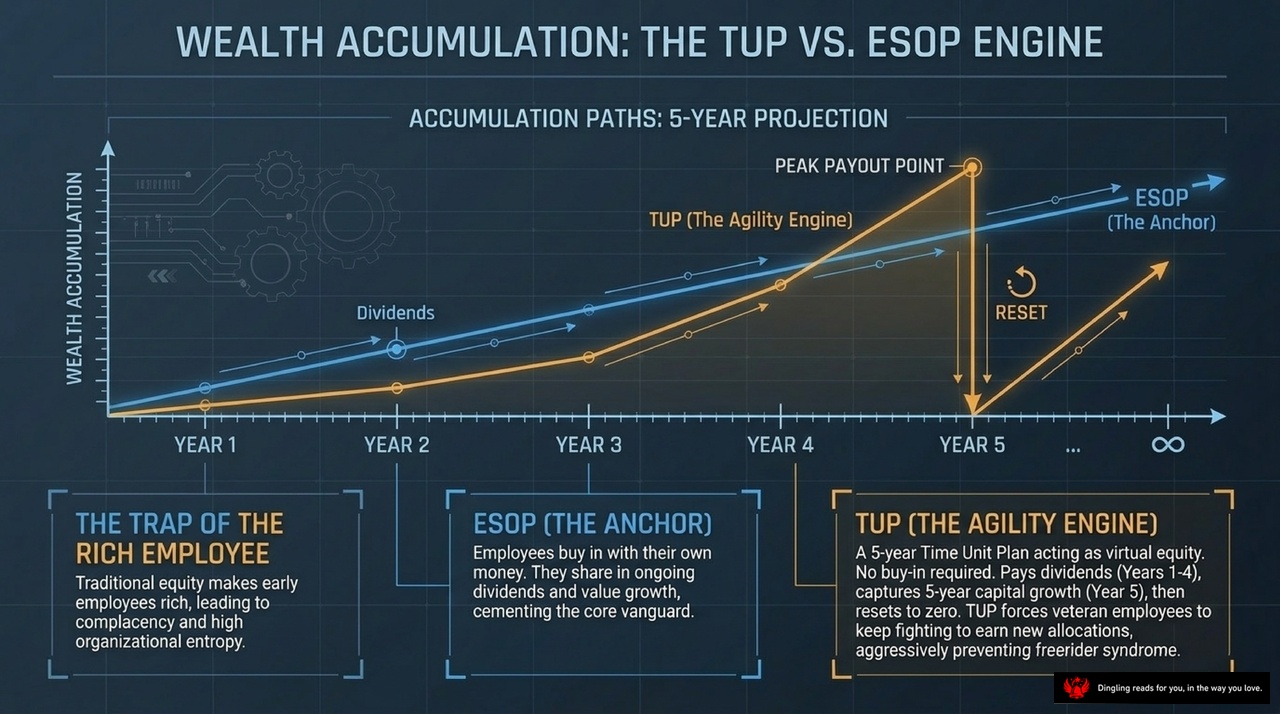
So, here’s the reality check: when you let your top performers buy in with their own money—what we call ESOP, or Employee Stock Ownership Plan—you’re essentially rewarding loyalty with a golden handcuff. They get dividends, yes, and they ride the value up over time. But once they hit that peak payout point around Year 5? It resets. And that reset is dangerous. It encourages complacency. It creates what I call “The Trap of the Rich Employee”—early winners stop fighting because they’ve already won.
But look at the TUP model—the Time Unit Plan. This isn’t about locking people in. It’s about keeping them agile. No upfront buy-in required. You earn dividends through Years 1 to 4, then capture the full capital growth in Year 5. Then—here’s the kicker—it resets to zero. Not as a punishment, but as a strategic nudge. It forces your veterans to stay hungry, to keep earning new allocations, to never settle. That’s how you prevent freeloader syndrome before it even starts.
In short: ESOP anchors talent. TUP fuels momentum. One builds comfort. The other builds culture. And in a high-growth environment, culture wins every time.
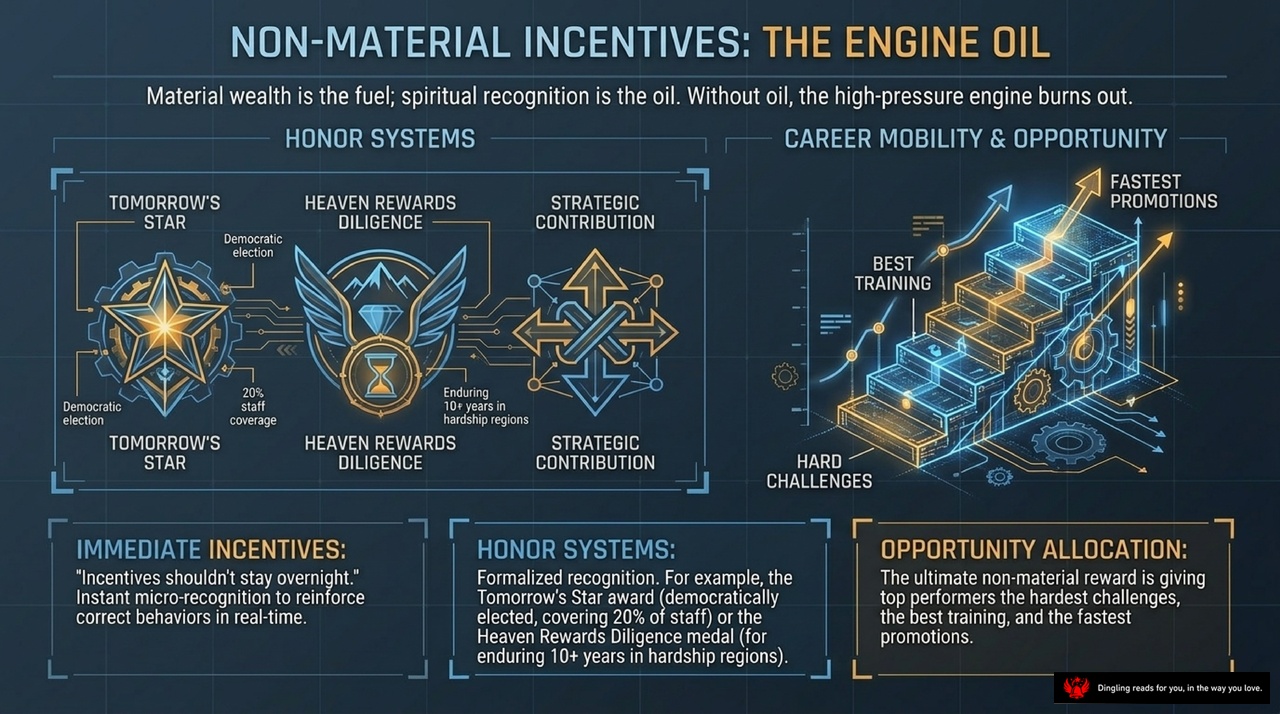
Imagine your company as a high-performance engine. Sure, money is the fuel that keeps it running—but what about the oil? That’s where non-material incentives come in. Without recognition, growth, and opportunity, even the best talent will burn out.
Look at this slide: “Non-Material Incentives: The Engine Oil.” It breaks down three powerful levers that drive long-term engagement. First, immediate incentives—think quick wins, real-time praise. “Incentives shouldn’t stay overnight.” A simple thank-you or public shoutout can reinforce behavior instantly.
Then there are honor systems. These aren’t just plaques on a wall—they’re meaningful recognition. Like the “Tomorrow’s Star,” chosen democratically by peers, covering 20% of staff. Or the “Heaven Rewards Diligence” medal, given to those who’ve served 10+ years in tough regions. These aren’t rewards for seniority alone—they’re for impact, endurance, and contribution.
Finally, career mobility and opportunity allocation. This is about giving top performers the best training, the hardest challenges, and the fastest promotions. It’s not just about climbing a ladder—it’s about being trusted with the work that matters most.
When you combine instant recognition, formal honors, and real growth paths, you create a culture where people don’t just work—they thrive.
So, here we are at page 14. The slide makes a bold, scientific claim about wealth distribution. It says that distributing wealth isn't just an HR task; it's the fundamental thermodynamic engine of an enterprise.
Think about that. In physics, entropy is the natural force that leads to disorder and decay. Organizations are no different. Without active management, they naturally drift toward chaos and stagnation.
The text on the slide argues that by masterfully aligning value creation, objective evaluation, and dynamic distribution, a company can continuously defeat the natural forces of organizational entropy. In other words, a fair and scientific compensation system isn't just about paying people; it's the fuel that keeps the engine running against the inevitable pull of decay.
Finally, the slide poses a critical question to us: If the ultimate goal of your business is to survive and thrive, are your current compensation structures fueling an engine of boundless vitality, or are they silently accelerating your organizational entropy? It forces us to look at our pay systems not as a static benefit, but as a dynamic force that either propels the company forward or pulls it into the ground.