
The Second Curve: Complete Chapter-by-Chapter Summary

Welcome to a journey that changes how we see the world, organizations, and even our own lives. Today, we are diving into Charles Handy's visionary masterpiece, *The Second Curve*.
As you see on this screen, the title is set against a massive, crashing wave. This isn't just a picture; it's a metaphor for the relentless force of change that sweeps through our society. The subtitle tells us this is a guide to reinventing everything by crossing the S-curve of growth.
Think about it: everything in life follows an S-curve. We invest resources, we struggle through a slow start, and then we hit that sweet spot of rapid growth. But eventually, that first curve peaks and starts to decline. The tragedy we often face is waiting until the first curve is crashing before we try to change. By then, we have no resources left to build something new.
The core insight of this book is simple but powerful: you must start your second curve *before* the first one ends. While you are still at the peak of your success, you must quietly plant the seeds for your next phase. This is how giants like Apple stay alive. While the Mac was dominating, they were building the iPod. While the iPod was king, they were launching the iPhone. They never let the first curve die before the second one took over.
This book offers a roadmap for navigating these shifts, whether you are running a company, leading a community, or designing your own career. It challenges us to stop relying on the past and start building the future, before the present becomes yesterday. Let's explore how to ride these waves instead of getting crushed by them.

Everything follows the S-Curve. The only variable is length.
Look at this graph: it starts with **Investment**—that initial dip where you pour in resources for experimentation and education, only to see outputs lag behind. Then comes **Growth**, where outputs finally exceed inputs, driving a rapid ascent. You hit the **Peak**, the absolute zenith of power, efficiency, and market dominance. But inevitably, the curve turns. You enter **Decline**, an unavoidable, irreversible downward trajectory.
The length of this cycle varies wildly. The Roman Empire lasted a staggering 400 years. But fifty years ago, a successful corporation could expect to last about 40 years. Today? The average corporate lifespan has plummeted to just 14 years.
The lesson is clear: decline is universal. Whether you're an empire or a modern startup, you cannot escape the S-Curve. The only difference is how long you stay on the hill before the fall begins.

The secret to survival isn't about running faster on the same track; it's about the courage to start a new one while the old one is still winning. As we see here, the "Crucial Window" is the narrow space where the first curve is peaking and the second is just beginning. This is the paradox of timing: you must launch your second curve before the first one declines. If you wait until success turns into decline, you've already lost.
Look at the "Resource Bridge." Starting a new venture requires time, money, and energy. The only way to fund this initial dip is by harvesting the surplus generated at the peak of your old success. That's why waiting for failure guarantees it. We often fall into the "Trap of Success," where comfort blinds us to the need for radical change. When everything is working perfectly, our human nature resists the disruption required to start the next chapter.
Think of Apple. While Macs were dominating, they launched the iPod. While the iPod was king, they built the iPhone. While the iPhone ruled, the iPad was already in the works. They didn't wait for their products to die; they overlapped their curves, using the resources of their past glory to fuel their future dominance. The same logic applies to individuals. Don't wait for your career to plateau before exploring new paths. Use your current momentum to build your next identity. True longevity comes from constantly overlapping your curves, ensuring that as one chapter ends, the next is already taking shape.

The slide before you, titled "Matrix: The Paradigm Shift," isn't just a chart; it's a map of how our entire world is changing. Look at the stark contrast between the "Old Paradigm" and the "New Paradigm."
On the left, we see the world we grew up in: an obsession with infinite GDP growth, companies focused solely on maximizing shareholder value, and rigid, monolithic hierarchies where leaders controlled everything through efficiency. It was a time of "Elephants"—large, stable, but slow-moving organizations.
But look at the right side. This is the future. We are moving toward a "Dashboard of Progress" where success means "better, not bigger." Corporate purpose is shifting from profit to "Corporate Citizenship." The workforce is transforming from lifetime employees into "Portfolio Workers and Independent Fleas." The structure is no longer a pyramid but a "Shamrock Organization"—flexible and adaptable. Leadership is moving from control to "Trust-based Effectiveness," often described as "Doughnut Management." And finally, education is evolving from rote testing to cultivating unique "Golden Seeds."
This shift isn't optional; it's survival. As we've discussed, clinging to the old ways of endless expansion and rigid control will leave us stranded as the environment changes. The new paradigm demands we stop measuring success by size and start measuring it by resilience, trust, and the unique value each individual brings. It's about building an ecosystem where everyone—from the core employees to the independent freelancers—can thrive. This isn't just a business model change; it's a fundamental reimagining of how we live, work, and create value together.

Capitalism, as we know it today, is built on a dangerous misunderstanding of what a company actually is. For decades, the prevailing myth has been "shareholder value," the idea that a corporation's only job is to maximize returns for its investors. But this logic has backfired spectacularly. Instead of building long-term value, companies have turned into short-term machines, prioritizing stock buybacks and dividends over innovation, R&D, and employee well-being. This has led to bloated executive pay, where CEOs get 80% of their compensation in stock options, tying their wealth to short-term stock spikes rather than sustainable growth.
The real mistake lies in treating the company as a machine owned by a few, rather than a community of stakeholders. We've forgotten the fundamental truth: the board of directors is responsible for the *entire company*, not just the shareholders. A company should be a community where everyone—from employees and customers to suppliers and the local neighborhood—has a stake in its success. When we view employees as mere "human resources" or tools to be optimized, we lose the very human connection that drives true innovation and resilience.
To fix this, we need to shift our mindset from "ownership" to "citizenship." Imagine your workplace not as a place where you sell your time, but as a community where you are a full citizen with rights and responsibilities. This is the essence of the "Community Company." In this model, everyone participates in the vision and shares in the rewards. We've already seen this work in places like John Lewis in the UK, where employees own shares and have a voice in governance.
This shift also requires a new way of managing. We need to move away from rigid control and micromanagement. Think of the "Donut Model": the center of the donut represents the core tasks and standards that must be met, while the dough around the edge is the space for innovation and individual creativity. Effective leaders don't try to control every detail; instead, they trust their teams to find the best way to achieve the results. When you trust people, they grow faster and take more responsibility. It's about balancing efficiency with effectiveness—doing the right things, not just doing things right. By redefining our companies as communities and trusting our people, we can build organizations that are not only profitable but also resilient, ethical, and truly human.

The slide presents a powerful shift in how we view capitalism: moving away from the cold, isolated "glass towers" of the past toward a vibrant, interconnected model of "citizenship." On the left, that dark, imposing skyscraper represents the old flaw of shareholder value—treating a company as an asset to be stripped for short-term profit. On the right, we see a bright, bustling community, illustrating the new reality where the corporation is a community of citizens.
This visual perfectly captures the book's core argument: a Second Curve enterprise isn't property; it's a living community. Just like citizens in a democracy, everyone who contributes their knowledge, skills, and energy deserves a real voice in governance, not just a paycheck. We need to stop reducing companies to mere assets for nameless investors and start recognizing them as alliances of stakeholders. When we do this, we unlock the true potential of the Second Curve, building organizations that are resilient, innovative, and sustainable for the long term.

Everyone has a unique "golden seed" inside them—a hidden potential waiting to be discovered and nurtured. Harvard's Howard Gardner taught us that intelligence isn't just about math and language; it's a diverse mix of musical, spatial, and even social skills. But our traditional education system often fails us, acting like a factory that tries to mold every child into the same shape, ignoring the rest of our brilliant capabilities.
To unlock this potential, we need mentors—those rare guides who can spot our unique spark before we see it ourselves. They might be a first boss, a community leader, or even a parent who believed in us when we didn't. As I learned, my mother once predicted my future as a writer long before I ever considered it; that early belief planted a seed that finally grew decades later.
The key to nurturing this seed is redefining success. We must stop chasing a single academic metric and instead embrace a life prepared for real-world challenges. This means shifting from passive learning to active thinking, where we learn by doing, questioning, and reflecting on our experiences. Whether you are 20 or 60, it's never too late to find your path. The goal isn't just to accumulate knowledge, but to develop the curiosity and critical thinking skills that allow us to thrive in an uncertain world. By combining work with lifelong learning, we can keep our "golden seeds" alive, turning our unique potential into a dynamic second curve for our lives.

Leadership isn't about squeezing every ounce of effort out of your team or micromanaging every detail. In fact, trying to control everything often kills the very creativity you need to succeed. Think of your team's work as a giant doughnut.
At the center of that doughnut is the "Inner Core"—the non-negotiable essentials. These are the absolute requirements, the critical tasks that must be done perfectly to prevent failure. This is where you set the guardrails and ensure the ship stays on course. But here's the secret to true effectiveness: you don't fill the whole doughnut with rules.
Instead, you leave the outer ring wide open. This is the "Flexible Space," a vast area dedicated to individual creativity, initiative, and discretionary effort. While the core ensures we hit our targets, the outer ring is where innovation happens. It's where your team members can experiment, take risks, and find better ways to do things.
First-curve management focuses on efficiency by filling the entire doughnut with tight controls, which stifles growth. But second-curve leadership is about effectiveness. It defines the core requirements clearly, then trusts individuals to utilize that outer ring to innovate and excel. When you give people the freedom to play in that outer ring, you don't just meet goals; you redefine them.

Economics: The Illusion of Infinite Growth. Look at this dashboard. On the left, we see the old story: a relentless chase for infinite GDP growth. But here's the trap. GDP measures spending, not societal health. It counts car crashes and riots as economic activity, while ignoring free digital tools that actually enhance our lives. This is the paradox of the old metric.
On the right, we see the solution: a better dashboard of progress. Society's second curve requires us to abandon GDP as our sole metric. Instead, we need to measure Health, Environmental Sustainability, Economic Security, and Well-being. The goal shifts from endless quantitative expansion to qualitative improvement. It's not about being bigger; it's about being better. True progress isn't found in the rising line of a graph, but in the well-being of the people and the planet we call home.

Look at this tree. It's not just a plant; it's a blueprint for how we should actually learn. The image contrasts two very different approaches to education. On the left, we see "The First Curve of Schooling." This is the traditional model that often leaves so many of us feeling inadequate. It narrowly measures success based on only two intelligences: linguistic and logical. It trains students to solve closed questions with pre-approved answers, essentially turning us into machines designed to fit a specific mold.
But look at the tree itself. The branches explode outward into eight distinct types of intelligence: Linguistic, Logical, Mathematical, Musical, Spatial, Bodily-Kinesthetic, Interpersonal, and Intrapersonal. This visual perfectly illustrates the concept of "Cultivating the Golden Seeds." Every single one of us has a unique combination of these talents. The problem is, our current system ignores most of them.
On the right side, we see "The Second Curve of Learning." This is where real life actually happens. Real life doesn't give you multiple-choice questions; it requires solving open-ended problems. That's why education must pivot to cultivating every individual's unique Golden Seed. To do this, we need to focus on what the slide calls "The 7 Cs": Cultivation, Comprehension, Creativity, Cooperation, Communication, Confidence, and Competence.
The core message here is a shift from standardization to personalization. Instead of forcing every student into the same linguistic or logical box, we need to identify what their specific strengths are—whether that's their musical ear, their spatial reasoning, or their ability to connect with others—and nurture those traits. When we stop trying to make everyone the same and start investing in our unique potential, we don't just improve test scores; we unlock the full capacity of the human mind. That is how we truly prepare for the future.
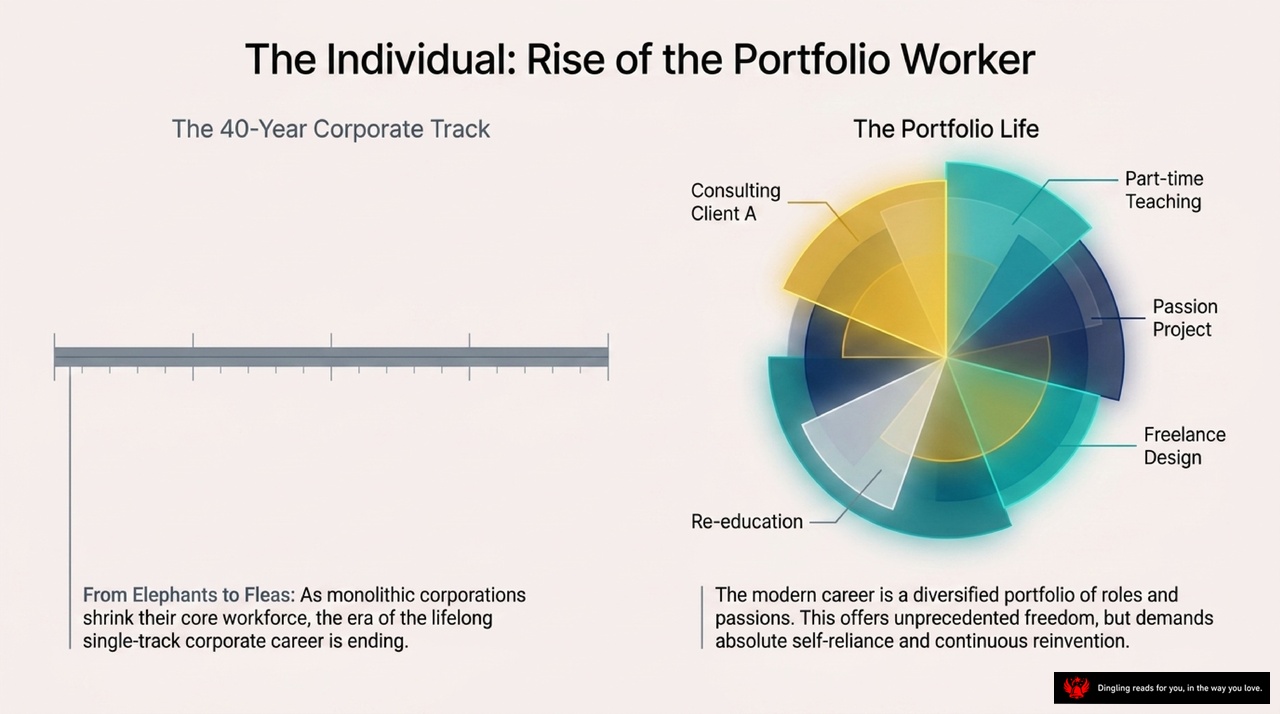
The slide contrasts two distinct career paths: the rigid "40-Year Corporate Track" and the flexible "Portfolio Life." On the left, we see a single, unbroken line representing the traditional model where individuals spend decades climbing one ladder within a single monolithic corporation. As the text notes, we are moving "from elephants to fleas"—away from massive, slow-moving institutions toward agile, independent operators.
On the right, the colorful wheel illustrates the modern reality: a diversified portfolio of roles. Instead of one job, you might juggle consulting clients, part-time teaching, passion projects, freelance design, and even re-education all at once. This is the rise of the portfolio worker. The slide highlights that while this shift offers unprecedented freedom, it demands absolute self-reliance and the courage to constantly reinvent yourself. The era of the single-track corporate career is ending, replaced by a dynamic ecosystem where you own your own mix of skills, passions, and income streams.

The Social Glue: The Necessity of Others. Look at this network. On the left, we see a stark contrast between superficial ties and deep ties. You might have 10,000 followers, but that's just a web of weak connections. True connection lives in what we call "Deep Ties," which aligns with Dunbar's Number. Human psychology is biologically limited; we can only maintain roughly 150 meaningful relationships. This is the sweet spot for survival.
But here lies the Paradox of Connection. We are hyper-connected digitally, yet increasingly isolated. A follower is not a friend, and a network is not a community. In our DIY, portfolio-driven society, without the built-in community of a traditional office, intentionally cultivating these thick, deep relationships is no longer optional—it is a matter of psychological survival. No man is an island. We need others to anchor us, to turn our digital noise into a real, supportive community.
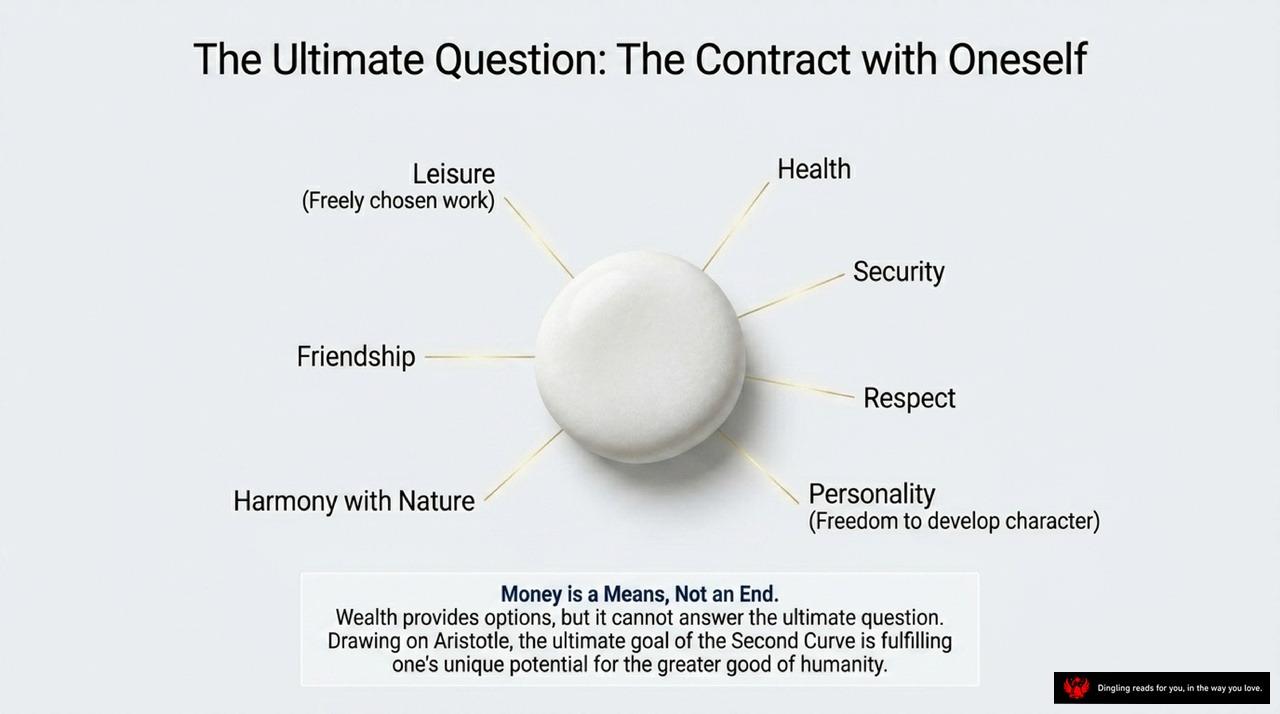
The image on the screen poses the ultimate question we all face: "The Contract with Oneself." At its center is a simple white stone, symbolizing our core self, surrounded by the essential pillars of a meaningful life: Health, Security, Respect, Friendship, Harmony with Nature, Personality, and Leisure defined as freely chosen work.
Below the stone, a crucial distinction is made: "Money is a Means, Not an End." This aligns perfectly with what Aristotle taught us about the ultimate goal of life. While wealth provides us with options and security, it cannot answer the question of who we are or what we should become. The true purpose, or what we might call the "Second Curve" of our personal development, is not accumulating more, but fulfilling our unique potential for the greater good of humanity.
Think of this as your personal operating system. Too often, we get stuck in a cycle where we chase money as if it's the destination, only to find that once we arrive, the view is disappointing. We end up with security but lose our respect, have wealth but lack deep friendship, or achieve success at the cost of our harmony with nature.
The text reminds us that the ultimate goal isn't just about survival or comfort. It's about character development. It's about finding work you love, cultivating deep relationships, and living in a way that feels right for your personality and the world around you. When we finally sign this contract with ourselves—when we decide that our value comes from who we are and how we contribute, rather than what we own—we stop running on a treadmill of endless acquisition and start walking a path of genuine fulfillment. That is the only way to build a life that lasts.

Synthesis: Navigating the Second Curve
Look at this slide. We are looking at the big picture of the Second Curve, not just as a business strategy, but as a complete shift in how we live. The image shows three interlocking gears: Society, The Organization, and The Individual. They all have to turn together for anything to move forward.
Let's start with The Individual. The slide says we must abandon the reliance on lifelong corporate tracks. That's a powerful idea. For decades, the American dream was to climb one ladder for forty years. But the new reality is about becoming self-reliant Portfolio Workers. Instead of just collecting a paycheck, you are cultivating your own unique "Golden Seeds"—those hidden talents and skills that define your true value. You are the CEO of your own career.
Now, look at The Organization. These traditional "Glass Towers" of efficiency are crumbling. We are evolving into what the slide calls "Shamrock structures." Think of a three-leaf clover: a core team of trusted citizens, supported by flexible external partners and temporary talent. It's built on trust and citizenship, not just rigid control. This is the "Doughnut management" approach—protecting the core while giving everyone room to innovate.
Finally, The Society. We are moving away from the endless pursuit of infinite GDP. That old metric is broken. Instead, we need a new "Dashboard of Progress" that values real well-being. We are shifting toward distributed DIY economies where people create their own value, bypassing the middleman.
The takeaway at the bottom is the most important part. The Second Curve is a holistic paradigm shift. You cannot change your career without rethinking your organization, and you cannot transform your organization without redefining what growth means for society. It's a chain reaction. If one gear stops, the whole system stalls. We have to all turn together to navigate the future.

We are standing on the edge of a massive shift. As the text on our screen reminds us, the world we know is approaching the peak of its first curve. Just like the ocean in the background, we've been riding a wave of growth, but true progress now demands the courage to abandon our past successes before the inevitable decline sets in. We must reinvent our societies, our workplaces, and ourselves to find our Second Curve.
Think about the companies that defined their eras. Kodak was the giant of film photography, dominating the market for decades. But when digital technology emerged, they failed to launch their Second Curve because they were too comfortable on the peak of their first one. They waited until the decline was already underway, and by then, it was too late.
In contrast, look at Apple. While Macs were still at their peak, Steve Jobs didn't rest; he started building the iPod. While the iPod was dominating, they began developing the iPhone. And as the iPhone hit its stride, the iPad was already being designed. Apple didn't wait for their current product to fail; they launched the next curve while the first one was still thriving.
This principle applies to us, too. As your current career or project reaches its zenith, ask yourself: What will be my Second Curve? Are you waiting for the inevitable decline to force your hand, or are you actively planting the seeds for your next chapter today? The difference between stagnation and enduring success often comes down to one decision: the willingness to reinvent yourself before the world catches up with your decline.