
The Secret Readers of the GDR: Complete Chapter-by-Chapter Summary
Welcome to today's session on "The Secret Readers of the GDR" by Dr. Siegfried Lokatis.
In the heavily monitored state of East Germany, a multi-layered labyrinth of censorship inadvertently forged a massive, clandestine economy where the mere act of reading became a profound political rebellion. Imagine a world where simply holding a forbidden book was an act of defiance against the state.
Dr. Lokatis takes us into this hidden world. In the heavily monitored state of East Germany, a multi-layered labyrinth of censorship inadvertently forged a massive, clandestine economy where the mere act of reading became a profound political rebellion. This wasn't just about hiding books; it was about surviving in a system designed to control every thought. From secret circles exchanging manuscripts to memorizing entire novels to carry them in one's head, East German citizens turned the act of reading into a brave, underground resistance movement. Today, we explore how this secret economy of knowledge challenged the very foundations of the GDR.
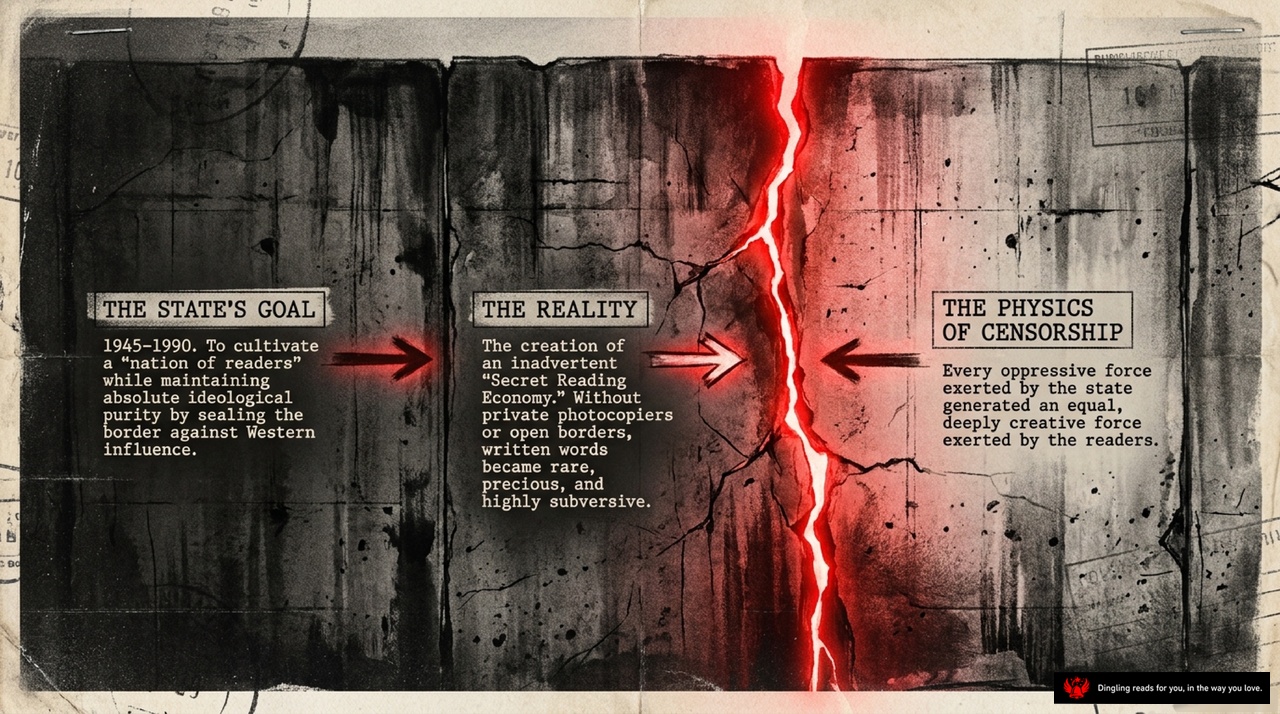
So, we're looking at the state of reading in East Germany between 1945 and 1990. On the left, you see the State's Goal: the government wanted to create a "nation of readers" but only with absolute ideological purity. They sealed the borders to keep Western influence out, treating any foreign book as a threat.
But look at the reality in the center. By trying to block these books, the state accidentally created a "Secret Reading Economy." Without private photocopyers or open borders, written words became rare, precious, and highly subversive. They weren't just books anymore; they were contraband.
And that brings us to the Physics of Censorship on the right. The image shows that crack splitting the wall in half, symbolizing a powerful truth: every oppressive force the state exerted generated an equal, deeply creative force back from the readers. The stricter the ban, the more inventive the people became.
Readers didn't just hide; they innovated. They learned Polish to read secret publications, memorized entire novels like characters in *Fahrenheit 451*, and even used Western rock records or children's stamps to smuggle literature across the border. The state's attempt to control the narrative ultimately fueled a thriving underground culture where reading was an act of rebellion. The wall didn't stop the words; it just made them more powerful.
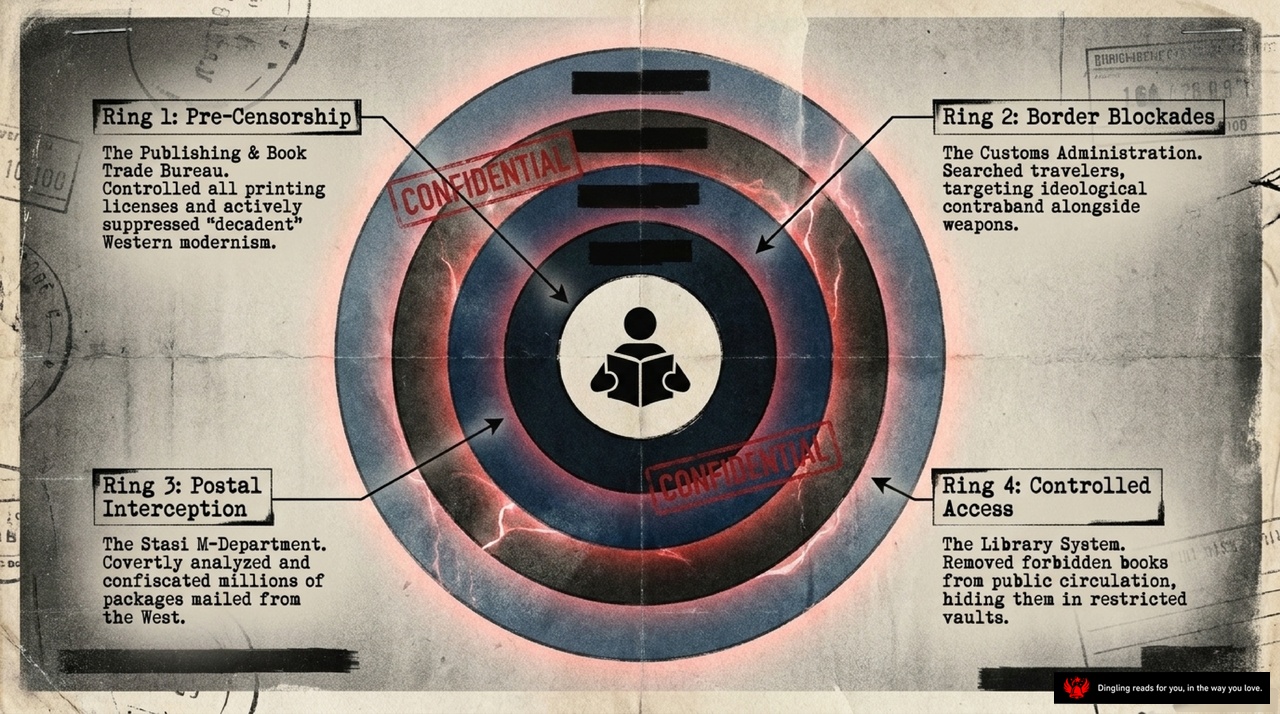
Imagine the Stasi's surveillance not just as a wall of cameras, but as a concentric target, locking down every escape route for information. This graphic breaks down that suffocating system into four distinct rings, each designed to keep the truth inside and the state's narrative out.
Starting from the outside, we have Ring 1: Pre-Censorship. This was the publishing bureau, the gatekeeper that controlled every single printing license. They actively suppressed anything deemed "decadent" Western modernism, ensuring that even the act of creating a book was a political hurdle. Moving inward to Ring 2, we hit the Border Blockades. The Customs Administration didn't just check for weapons; they were hunting for ideological contraband, searching travelers and seizing any Western text that crossed the line.
Inside the second ring lies Ring 3: Postal Interception. This is where the Stasi's M-Department worked its magic. They covertly analyzed millions of packages mailed from the West, confiscating anything that smelled even slightly like dissent. Finally, at the very center, Ring 4: Controlled Access. This is the Library System. Instead of banning books entirely, they hid them in restricted vaults, removing forbidden titles from public circulation and only allowing them to be read by the elite or under strict supervision.
In the middle of this target sits the reader, completely surrounded. It's a powerful visual of how the East German state didn't just ban books; it engineered an entire ecosystem to make reading the forbidden an act of high-stakes espionage.

Look at this flowchart—it's a perfect visual of how the Stasi turned the entire East German postal system into a giant, high-stakes filter. On the left, we see the "West" sending mail into regional hubs. That's Step 1: The Funnel. Every single piece of mail from the West had to pass through these checkpoints, creating a massive bottleneck where the state could control the flow of information before it even reached a citizen.
Once the mail arrived, Step 2 kicked in: The Filter. This is where the real surveillance happened. X-ray machines and trained M-Department investigators scanned everything, specifically looking for "pID"—politically ideological diversion material. It wasn't just about catching spies; it was about policing thought. If you were reading something that challenged the state, you were flagged.
Then, Step 3: The Decision Tree. This is where the mail gets sorted into three distinct paths. Path A is for harmless items, which get forwarded safely to the citizen. Path B is for exploitation; if the Stasi found something valuable—like religious texts or political books—they didn't just destroy them. They retained them for internal espionage education, using the very materials they tried to ban as training tools for their own agents. Finally, Path C is confiscation and destruction. Millions of books, magazines, and even lowbrow entertainment were seized, destroyed, or worse, recycled into hard currency. This entire system, marked "CONFIDENTIAL" in the center, shows that even in a dictatorship, the battle for information wasn't just about hiding books; it was about who owned the narrative and how the state monetized its own censorship.
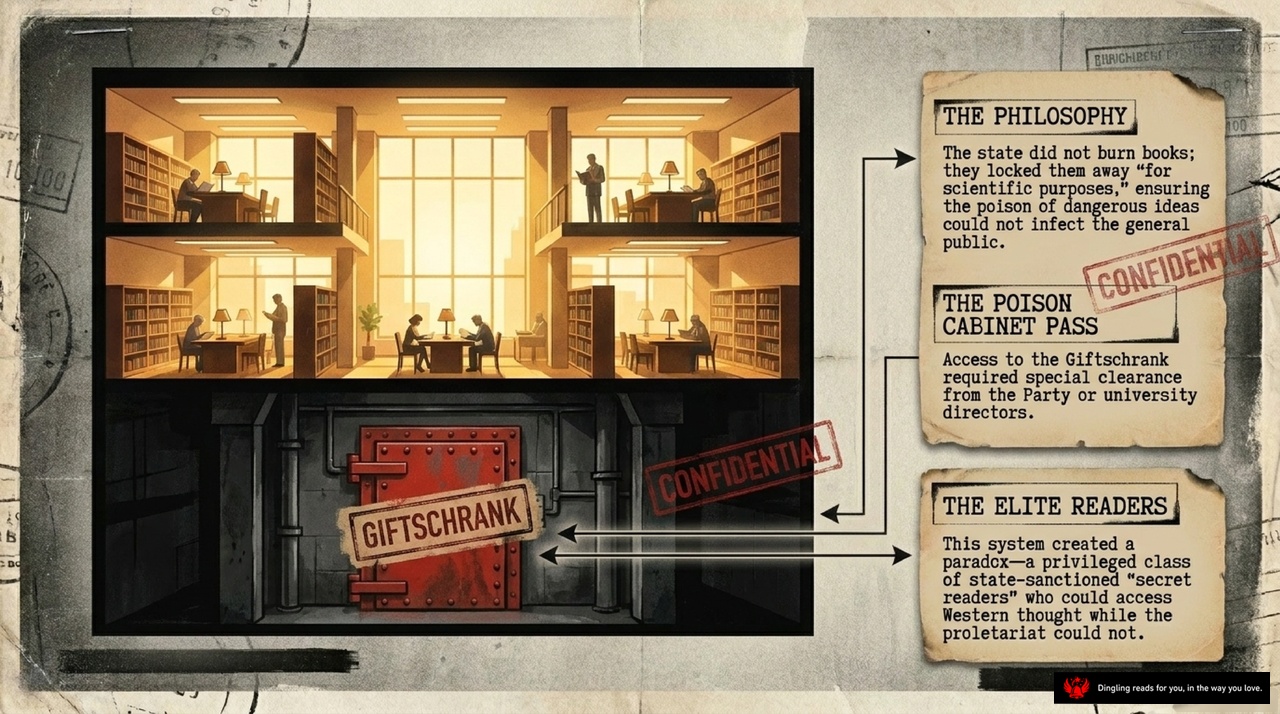
In East Germany, the state didn't just burn books; it locked them away. This slide reveals the philosophy behind that system: dangerous ideas were kept behind a red door labeled "Giftschrank"—the Poison Cabinet—to ensure the general public stayed safe from what the regime called poison. But here's the twist: access required a special "Poison Cabinet Pass," granting clearance only to Party members or university directors. This created a paradoxical elite class of "secret readers" who were the only ones allowed to consume Western thought, while the rest of the population was kept in the dark. It wasn't about censorship in the traditional sense; it was about creating a privileged few who could read the forbidden while the proletariat couldn't. This system turned a library into a fortress, where the most dangerous books were actually the most protected, creating a hidden culture of intellectual rebellion that the walls couldn't fully contain.

Imagine a world where reading a book could get you sent to prison. In East Germany, the stakes for accessing forbidden literature were incredibly high. This slide breaks down exactly what the state feared most, plotting four distinct categories of banned material on a grid of "Political Threat" versus "Ideological Threat."
In the top right, we see the highest danger zone: Religious Texts. Groups like Jehovah's Witnesses and publications like *The Watchtower* were heavily persecuted. Why? Because their refusal to recognize state authority was seen as a direct challenge to the government's power.
Moving to the top left, we find the "Dissidents & Theories." Think George Orwell's *1984*, Arthur Koestler's *Darkness at Noon*, or Rudolf Bahro's *The Alternative*. These weren't just books; they were intellectual weapons. Possessing them meant severe punishment, often imprisonment, because they offered a blueprint for overthrowing the system.
Now, look at the bottom right. This is the "Underground Press." This includes *Samizdat* publications, independent peace movement pamphlets, and even CIA-backed journals like *Der Monat*. While the state viewed these as ideological threats, they were less of a direct political threat compared to the dissidents, yet they were still strictly controlled.
Finally, in the bottom left, we have what the regime called "Decadent Pop Culture." This includes Karl May's adventure novels, Mickey Mouse comics, and magazines like *Der Spiegel*. To the state, these weren't dangerous in a revolutionary sense. They were viewed as dangerous distractions—enticing youth away from socialist labor and into a world of fantasy and capitalism.
This matrix perfectly illustrates the East German state's paranoia: they feared anything that could either organize people against them or simply distract them from their work.
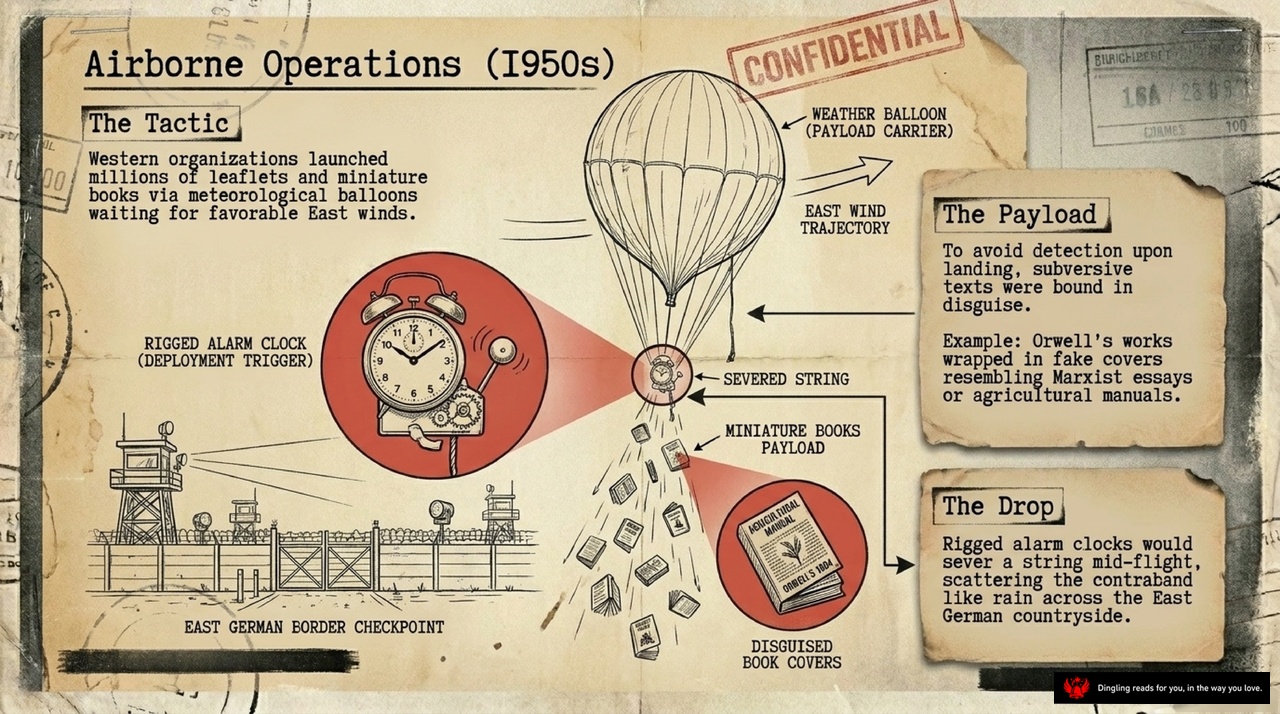
Imagine a world where a single book could cost you your freedom. In East Germany, reading wasn't just a hobby; it was a high-stakes game of hide and seek. Western literature was strictly forbidden, often labeled as dangerous subversion. But the people refused to stay silent. They turned to the skies.
In the 1950s, Western organizations launched a daring operation known as "Airborne Operations." They used weather balloons as invisible carriers, hitching a ride on favorable east winds to drop millions of leaflets and miniature books right into East German territory. To avoid detection by border guards, these contraband texts were cleverly disguised. Think George Orwell's *1984* wrapped inside a fake cover that looked like a Marxist essay or a harmless agricultural manual.
But the drop wasn't the end of the story. The real magic happened mid-flight. A rigged alarm clock, positioned near the border checkpoints, would trigger a signal. This severed a string attached to the balloon's payload, causing the miniature books to scatter like rain across the countryside. Suddenly, banned ideas were everywhere, landing in gardens, forests, and even near watchtowers.
This wasn't just about smuggling; it was a psychological victory. By the time a reader found a book hidden in a bush, the state's power had already been bypassed. It was a testament to human ingenuity against a rigid system, proving that even when you try to lock the door, someone will always find a way to break the window.
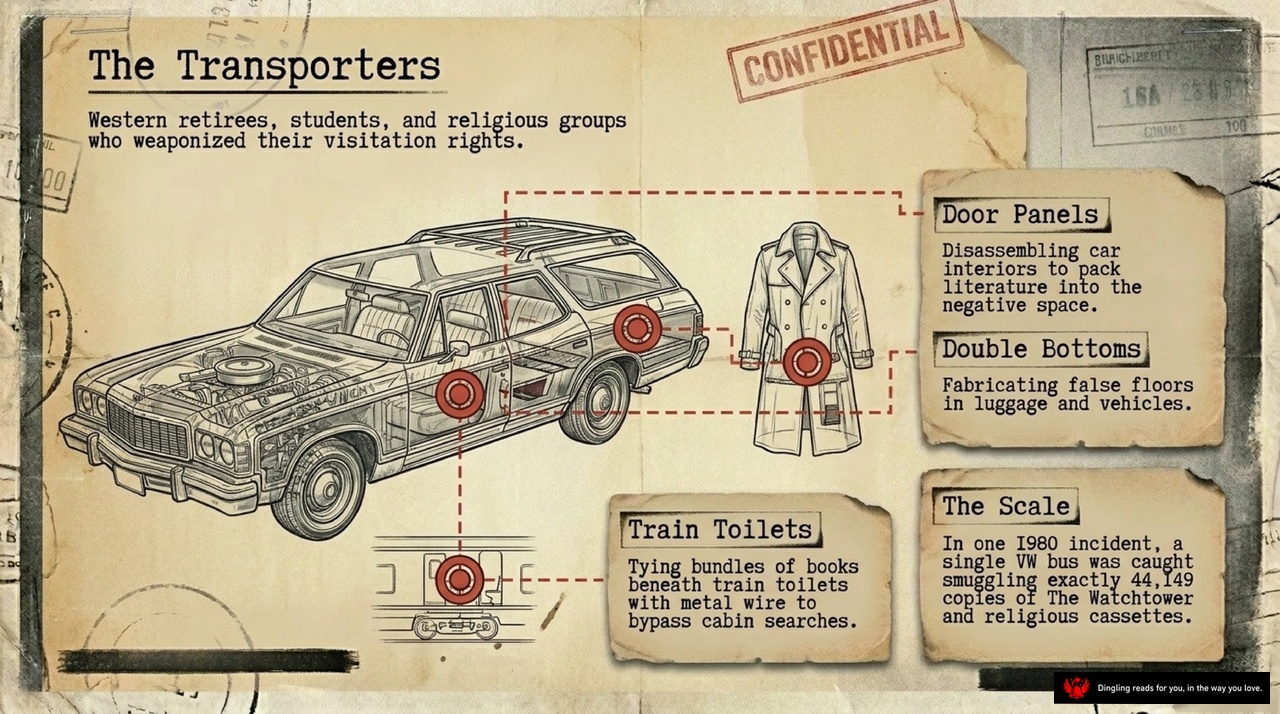
The Transporters were the unsung heroes of East German literary resistance—retirees, students, and religious groups who turned their right to visit family into a weapon against censorship. As this confidential dossier reveals, they didn't just smuggle books; they engineered the very vehicles and spaces around them to hide forbidden literature.
Look at the ingenuity here. They dismantled car door panels to pack literature into the negative space, creating invisible libraries on wheels. They fabricated false floors in luggage and vehicles, turning double bottoms into secret storage compartments. Even the humble train toilet became a smuggling hub, where bundles of books were tied beneath the seat with metal wire to bypass cabin searches. And don't forget the coat; a trench coat with a hidden pocket could carry a whole novel across the border.
The scale of these operations was staggering. In one 1980 incident, a single Volkswagen bus was caught smuggling exactly 44,149 copies of *The Watchtower* and religious cassettes. These weren't professional spies; they were ordinary citizens risking everything to bring the outside world back home. They weaponized their daily lives, turning a family visit into a high-stakes operation to preserve the freedom of the mind.
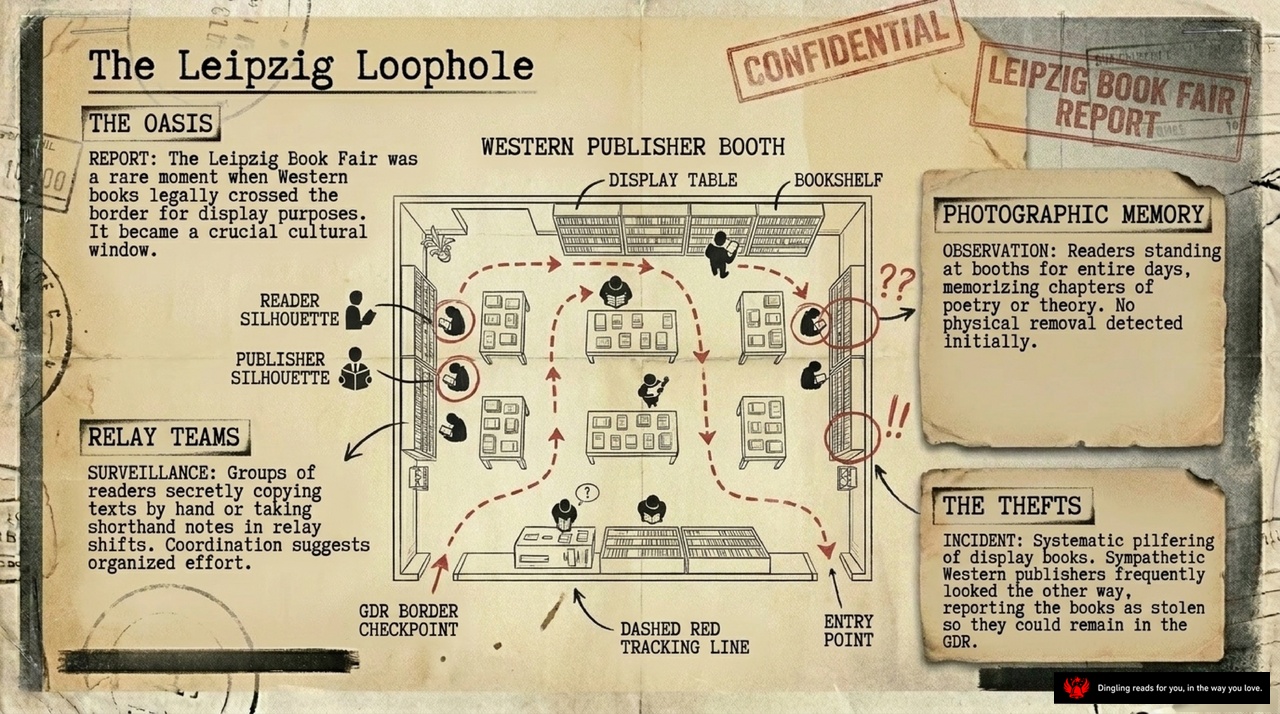
Look at this floor plan of the Leipzig Book Fair—it's labeled "Confidential," and for good reason. This wasn't just a trade show; it was the ultimate "loophole" in East Germany's tight security. On the surface, it was a legal display zone, a rare window into the West. But underneath, as the diagram shows with those red tracking lines, it was a massive relay operation for stealing books.
See those silhouettes of readers and publishers? They weren't just browsing. This was a coordinated effort. Groups of readers would memorize entire chapters of poetry or theory, acting as human hard drives because no physical books were supposed to leave the booths. The "Photographic Memory" section highlights this: people standing for days, committing texts to memory.
But the real action happened at the exit. Look at the "Thefts" note—systematic pilfering. Western publishers, desperate to get their books into the GDR, often looked the other way. They'd report the missing books as "stolen" so the East German authorities would believe they were lost, allowing the readers to keep them. It was a brilliant, cynical game. Some even used shorthand or took notes in shifts to copy texts by hand before slipping out. This "Leipzig Loophole" turned a public event into a secret library, proving that when you try to control information, people will always find a way to read it.

Welcome to the underground library of the GDR. While the state built walls to keep people in, a secret network called "Samizdat" built a bridge to let ideas out. This slide breaks down exactly how that impossible happened, step by step.
It all started with **Stage 1: The Smuggled Original**. A single copy of a forbidden text—maybe a banned Western novel or a political manifesto—was physically smuggled across the border. That lone book was the spark.
Next came **Stage 2: The Typewriter**. Without access to photocopiers, readers spent their nights manually retyping entire novels. It was grueling work, but it was the only way to multiply a single idea.
Then, the magic trick of **Stage 3: Western Carbon Paper**. Using smuggled blue carbon paper, typists could strike the keys hard enough to produce up to seven legible copies at once. This was the engine of the network, turning one book into a library overnight.
Finally, we reach **Stage 4: The Network**. These seven copies were distributed anonymously. Recipients would repeat the copying process, creating an exponential, untraceable spread. By the time the wall fell, the entire population had read the books the government tried to destroy. This wasn't just reading; it was a revolution in ink and paper.
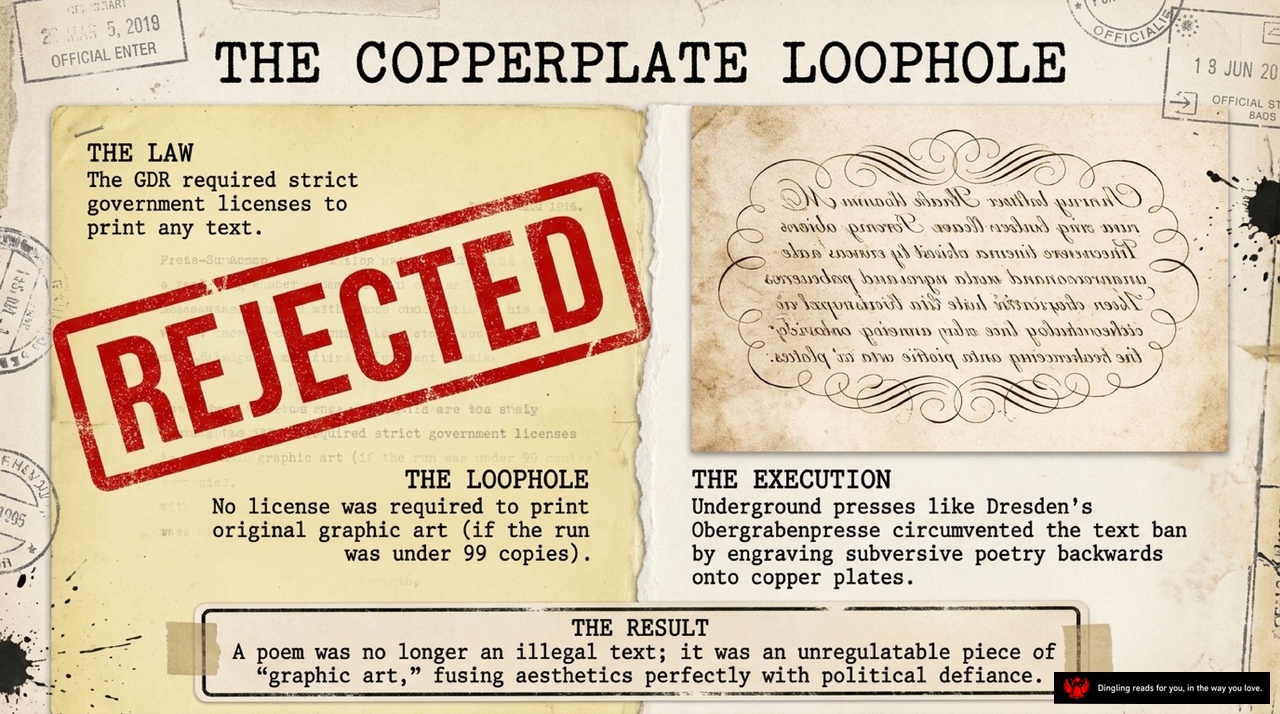
In East Germany, the state tried to control everything, even the words people could read. The law was clear: printing any text required a strict government license. But the system had a flaw—a loophole. If you printed original graphic art, like a poem turned into an image, and kept the run under 99 copies, no license was needed. It was a clever trick that turned illegal text into unregulated "graphic art."
This is exactly how the underground press operated. Groups like Dresden's Obergrabenpresse didn't just hide their messages; they engraved subversive poetry backwards onto copper plates. By printing the text in reverse, they created a piece of art that the censors couldn't easily read, effectively bypassing the ban. The result was powerful and dangerous: a poem was no longer an illegal text. It became an unregulatable piece of graphic art, fusing aesthetics perfectly with political defiance. This "copperplate loophole" allowed artists to speak truth to power without ever being caught, proving that sometimes, the best way to fight censorship is to change the very definition of what you are saying.
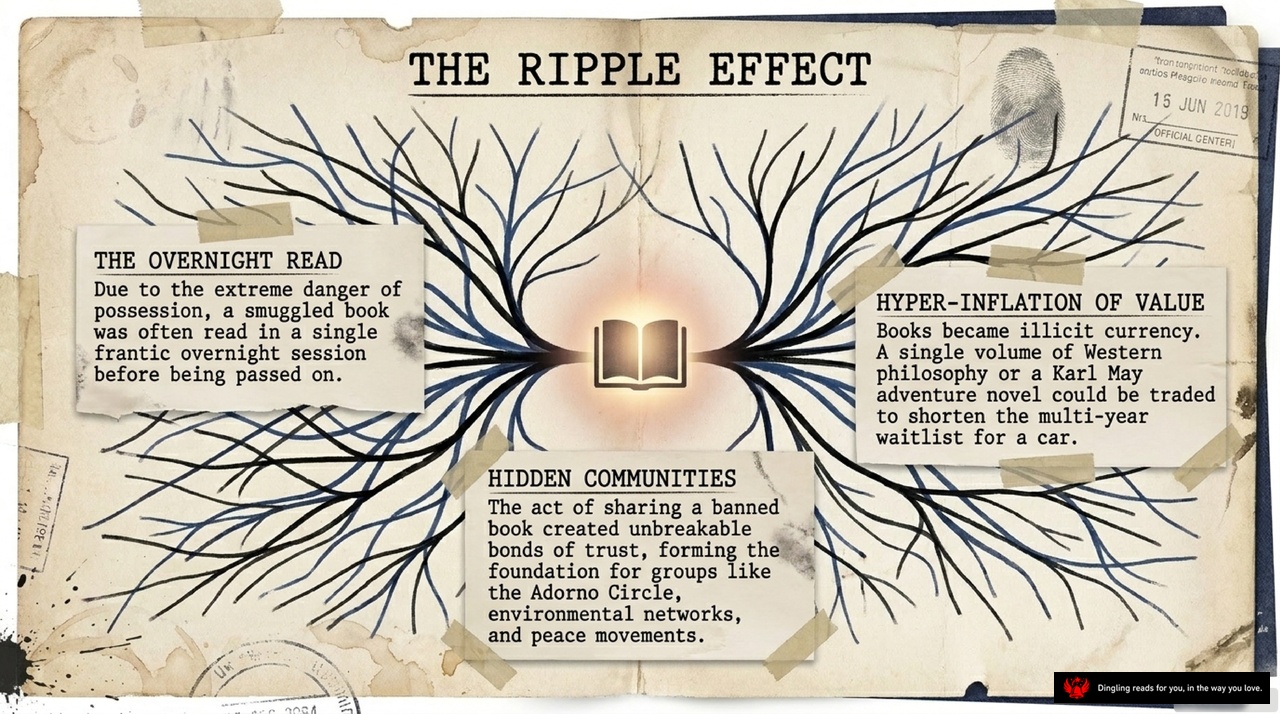
The Ripple Effect isn't just a metaphor; it's the very engine that powered life behind the Iron Curtain. In East Germany, a single book didn't just tell a story—it triggered a chain reaction that reshaped society, economy, and trust.
Look at the center of this image: the book itself. In the East, possession was dangerous, which created the "Overnight Read." Because smuggling a book was a high-stakes crime, readers had to devour these forbidden texts in a single frantic session before passing them on. This urgency turned reading into an adrenaline-fueled ritual, a race against time that made every word count.
But the impact went far deeper than just reading. This scarcity created a "Hyper-Inflation of Value." A single volume of Western philosophy or a Karl May adventure novel wasn't just entertainment; it became illicit currency. People traded these books to shorten multi-year waitlists for cars or to buy scarce goods. The value of a book skyrocketed because it represented freedom itself, a tangible piece of the world the state tried to keep out.
Finally, this shared secret forged "Hidden Communities." The act of passing a banned book created unbreakable bonds of trust. These weren't just casual acquaintances; they were a network of spies, artists, and activists like the Adorno Circle and environmental networks. Every time a book changed hands, it strengthened the foundation of a resistance movement. What started as a desperate need to read evolved into a powerful, underground society that ultimately helped bring down the regime.
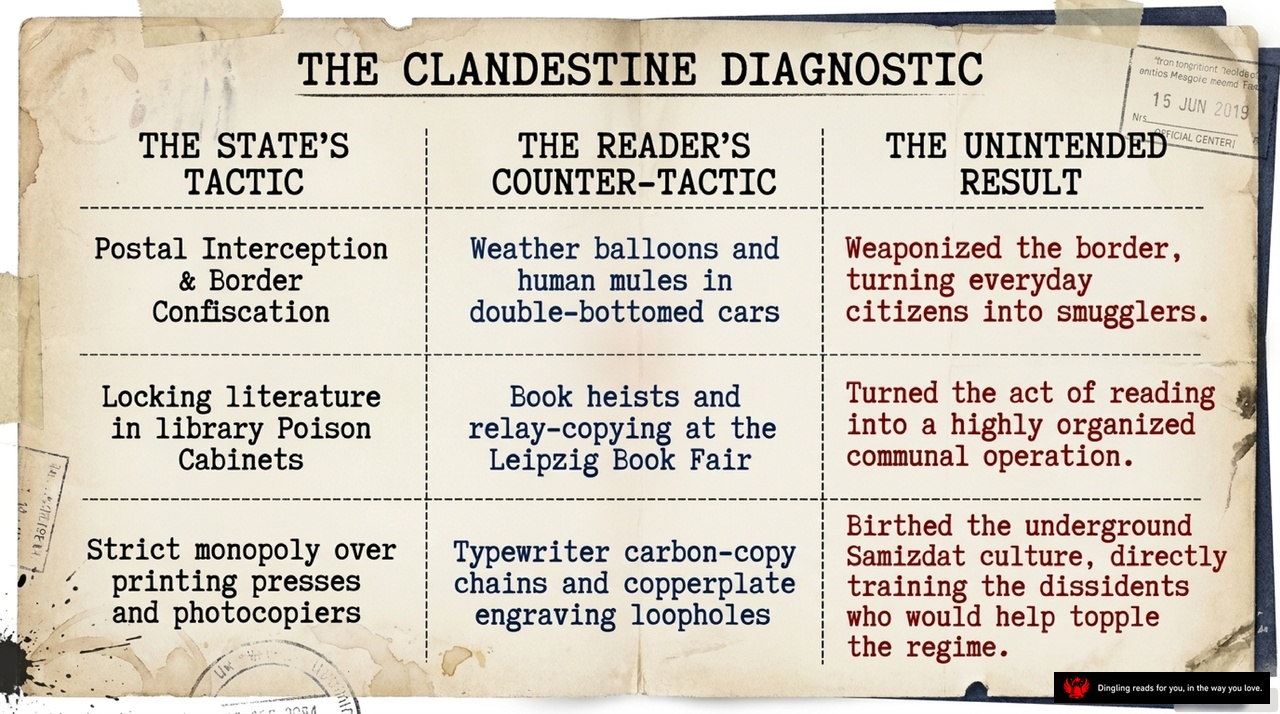
Look at this slide, "The Clandestine Diagnostic." It perfectly captures the cat-and-mouse game between the East German state and its citizens. The state didn't just ban books; they weaponized the border. They used postal interception and confiscated anything at the frontier, trying to lock down the flow of information. But the people found creative, often desperate, counter-tactics. Think about it: readers used weather balloons to drop leaflets from the sky, hid books in double-bottomed cars with human mules, and even organized book heists at the Leipzig Book Fair.
The results were unexpected. By trying to stop the flow, the state accidentally weaponized the border itself, turning ordinary citizens into smugglers. What started as a simple act of reading evolved into a highly organized communal operation. People built entire networks, using typewriter carbon-copy chains and even copperplate engraving to bypass strict printing monopolies. This underground resistance didn't just circulate stories; it birthed a whole culture of dissent, training the very people who would eventually help topple the regime. It's a powerful reminder that when you try to silence a population, you often just give them the tools to speak louder.
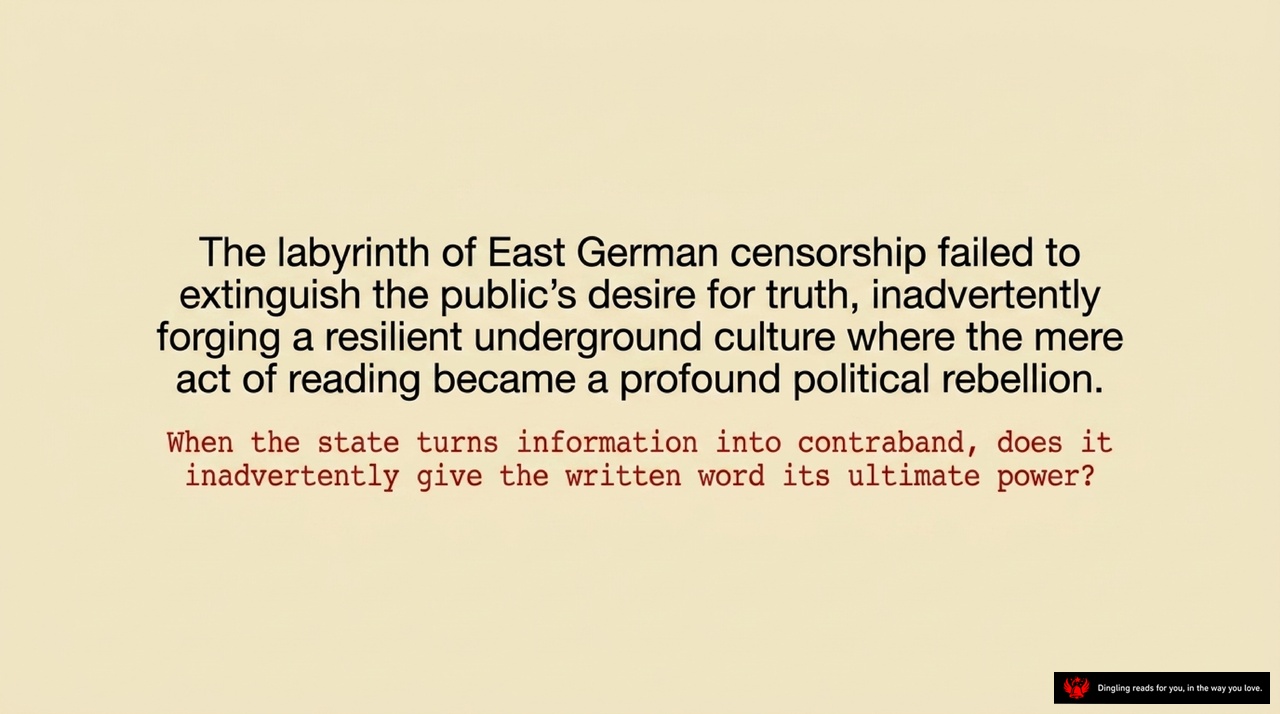
The state's attempt to control information often backfires in the most dramatic ways. Look at this slide: "The labyrinth of East German censorship failed to extinguish the public's desire for truth." Instead of silencing dissent, the regime inadvertently forged a resilient underground culture where simply reading became an act of profound political rebellion.
Consider the logic here: when the state turns information into contraband, it doesn't just restrict access; it inadvertently gives the written word its ultimate power. In East Germany, books weren't just stories; they were contraband, smuggled in water tanks, hidden in cake boxes, or memorized by heart. The harder the government tried to block these texts, the more precious they became. This underground network created a unique cultural space where the mere act of holding a forbidden book was a silent, yet powerful, defiance against the state. It was a testament to the enduring human need for truth, proving that while walls can be built, the mind cannot be easily imprisoned.