
The Shortest History of Europe: Complete Chapter-by-Chapter Summary

Ever wondered how the messy, overlapping threads of Europe’s past wove the modern Western world we know? Today we’re diving into John Hirst’s *The Shortest History of Europe*—a book that breaks down the colliding forces, core elements, and historical friction that built our civilization. Hirst doesn’t just list dates; he unpacks the mix of Greek philosophy, Roman law, Christian faith, and Germanic warrior culture that shaped Europe’s unique path. This isn’t just a history lesson—it’s a key to understanding why our societies work the way they do. Let’s jump in.

Ever wonder why European culture feels like such a rich, sometimes conflicting mix of logic, faith, and grit? Let’s rewind to 476 AD—when the Western Roman Empire finally crumbled, three totally incompatible forces collided, and that’s where the story of modern Europe really begins.
First up: Greek Intellect and Roman Law. The Greeks were obsessed with order—they believed the universe wasn’t some chaotic mess; it was simple, logical, and could be broken down with math. Think Euclid’s geometry or the ancient idea that everything’s made of atoms. The Romans took that Greek curiosity and turned it into something tangible: a legal system that emphasized fairness and consistency, one that still influences how we think about laws today.
Next, Christian Morality. This was a game-changer. Unlike the many gods of Greece and Rome, Christianity brought a single, universal God and an absolute moral code rooted in Judaism—like the Ten Commandments. It wasn’t just about rituals; it was about loving your neighbor, even your enemy, and living a life of purpose beyond just surviving.
Then there’s the Germanic Warrior Culture. These tribes from the north weren’t interested in big, centralized empires. Their society revolved around combat, honor, and loyalty to a warlord—not a distant state. For them, your reputation as a fighter and your word to your leader were everything.
These three elements? They were like oil and water at first. But over centuries, they started to blend: the Greeks’ logic helped explain Christian ideas, the Romans’ laws gave structure to the Germanic tribes, and the warrior spirit added a dose of resilience. That collision in 476 AD didn’t just end an empire—it started something new, something uniquely European.

Ever wonder why Greek geometry still feels so foundational today? It’s not just because they gave us formulas for triangles or circles—for the Greeks, geometry was a key to unlocking the secrets of the universe. That’s the core of what we call “The Logical Universe.”
The Greeks didn’t see geometry as just a practical tool for measuring fields or building temples. They viewed it as the ultimate window into the nature of reality. Let’s take a simple triangle: how do we know its angles always add up to 180 degrees? The Greeks broke it down with a logical chain: first, define basic concepts like points, lines, and circles. Then, establish that parallel lines never intersect. Next, prove that a line cutting through those parallels creates equal alternate angles. And finally, you can logically conclude that the three angles of any triangle sum to a straight line—180 degrees.
This isn’t just math—it’s a reflection of the Greek intuition: behind the chaotic, random appearance of the physical world, there exists a simple, regular, and logical framework. This way of thinking didn’t stay in ancient Greece; it shaped how later scientists like Newton and Einstein approached the universe. They too searched for those hidden, universal rules that explain everything from falling apples to the movement of stars. So next time you work through a geometry problem, remember: you’re not just crunching numbers—you’re following in the footsteps of thinkers who believed the universe was built on logic.

Let’s dive into how the Judeo-Christian moral code turned everything the Romans knew about faith and ethics on its head.
First, think about the Roman view: their gods were basically super-powered humans—fickle, flawed, and totally unpredictable. If you got punished, it wasn’t because you did something morally wrong; it was probably because you forgot a ritual or didn’t offer enough to the right deity. And having a whole pantheon of gods? No big deal—everyone worshipped multiple deities without a second thought.
But then came this radical shift rooted in Judaism: one all-powerful creator God, no takebacks. This God didn’t care about half-hearted rituals—He had strict moral laws, like the Ten Commandments, and breaking them had direct consequences tied to your salvation. Plus, He demanded exclusive worship—you couldn’t split your loyalty between Him and other gods.
Then Jesus stepped in, expanding those strict Jewish laws into something universal: love God fully, love your neighbor as yourself, even your enemies. After His death, Paul took it further—he said this faith wasn’t just for Jews; it was for everyone, no need to follow all the old Jewish rules. That’s how Christianity went from a tiny sect to a scalable world religion.
As the slide says, this was a radical departure from those human-like Roman gods, and it tied morality straight to cosmic salvation. It wasn’t just about following rules—it was about a relationship with God that shaped every part of your life. And that change? It would go on to define Western civilization for centuries.

Let’s dive into "The Economy of Blood and Honor"—the system that defined Europe after the Roman Empire crumbled. The illiterate tribes that took down Rome didn’t have a complex state bureaucracy like the Romans. Instead, their society held together through personal oaths and raw battlefield courage.
Here’s how it worked: At the top was the warlord. He handed out plundered wealth, weapons, and land—called fiefs—to his warriors. In exchange, those warriors gave him absolute loyalty, fought for him, and kept him safe. It was a straightforward, tough exchange: you stand with me in battle, I give you the resources to live and rule.
This mindset was summed up perfectly by the 1st-century historian Tacitus: “To earn by sweat what you can win by blood is deemed cowardly and spiritless.” Back then, if you could take something by force, working hard for it was seen as weak—almost unmanly.
This system planted the seeds of feudalism. Over time, those fiefs became hereditary; warriors turned into lords who passed their land down to their sons. These lords built castles, raised their own armies, and sometimes even pushed back against kings. The bond between them was still that personal oath: the lord swore loyalty to the king, and the king promised to protect him. It was a two-way contract, not just a king barking orders.
So this “economy of blood and honor” wasn’t just about fighting—it was how society was structured for hundreds of years. It shaped land ownership, power dynamics, and even the values people held, leaving a mark on European history long after the tribes first arrived.

After the fall of the Western Roman Empire, the Pope in Rome faced threats from the Lombards. With the Eastern Roman Empire preoccupied with Muslim invasions, the Pope turned to the Franks for aid. Pepin the Short defeated the Lombards and granted land to the Pope, establishing the Papal States. His son Charlemagne expanded Frankish territory, and in 800 CE, the Pope crowned him Emperor of the Romans—igniting a centuries-long debate over whether the Papacy (which bestowed the crown) or the Emperor (the secular ruler) held higher authority.
This power struggle peaked during the 11th-century Investiture Controversy. Pope Gregory VII claimed exclusive right to appoint bishops, while Emperor Henry IV resisted. Henry was excommunicated, forcing him to beg forgiveness at Canossa (standing barefoot in snow for days). A later compromise let emperors influence bishop selections but gave the Pope final approval.
The Holy Roman Empire (HRE), revived by Otto I in 962, was a loose confederation of states. Emperors were elected, weakening their power, and frequent clashes with the Pope further fragmented the HRE. This disunity allowed northern Italian city-states to thrive (sparking the Renaissance) and German princes to back the Protestant Reformation.
Napoleon Bonaparte ended the HRE in 1806. He crowned himself Emperor of France (snatching the crown from the Pope’s hands) and reorganized German states into the Confederation of the Rhine, closing an era of medieval Church-state power struggles. His Code Napoleon modernized law, blending Enlightenment ideals with practical governance, while his concordat with the Pope balanced religious freedom and state control. This marked a shift toward secular, centralized nation-states in Europe.

Let’s set the scene: By 1400, the medieval world—where the Church held all the cards, from knowledge to salvation—was starting to crack. Instead of looking to the future for progress, two huge movements turned backward to reclaim the past, and they shook Europe to its core.
First up: the Renaissance. Its core action? Rediscovering classical antiquity—the wisdom of the Greeks and Romans. Why? People were fed up with the Church’s monopoly on knowledge and intellectual life. The Renaissance folks embraced humanism (valuing human potential over divine control), secularism (separating daily life from strict religious rules), and even the perfection of the human body—think Michelangelo’s David, a statue that celebrated human strength and beauty just like the ancient Greeks did. The result? Philosophy and art finally broke free from the chains of theology.
Then came the Reformation, led by Martin Luther. He was fed up with the Church’s corruption—like selling indulgences to “buy” salvation—and its monopoly on who could access God’s grace. His big idea? Justification by faith alone: you didn’t need priests or the Church’s rituals to be saved—only your personal belief in God. Luther even translated the Bible into German so ordinary people could read it themselves, no priest required. The result? The once-unified Church splintered into warring factions, each with their own take on Christianity.
Both movements were about bypassing the Church to take back something old: the Renaissance took back classical wisdom, the Reformation took back early Christianity. And together, they started the process of breaking the Church’s hold on every part of life.

Let’s dive into "The Great Fracturing: Looking Forward"—this slide marks a pivotal moment when Europe swapped its old cyclical view of time for a belief in progress.
The 17th-century Scientific Revolution was the spark. It proved the Greeks wrong: Earth isn’t the center of the universe, and celestial bodies move because of Newton’s gravity, not divine perfection. This wasn’t just a scientific breakthrough—it gave birth to the very idea of "progress" as we know it.
Panel A captures the Scientific Revolution’s core message: We’d surpassed the ancients. The universe is a single system governed by mathematical laws. Darwin later added to this, showing humans are biologically insignificant in the grand scheme but intellectually supreme.
Then the 18th-century French Enlightenment (Panel B) took this further. Thinkers argued: If reason can map the stars, it can engineer a perfect society. They dismissed religion as superstition, called ignorance the only enemy, and believed society could be systematically improved.
The Encyclopedists had a clever weapon: organizing all human knowledge alphabetically, not by theological hierarchy. This quietly dethroned God from the top of the intellectual ladder. No longer was knowledge controlled by the church—now it was accessible, ordered, and rooted in reason, not dogma.
This shift from cyclical to progressive time changed everything. We stopped seeing history as a loop and started believing we could shape the future. That’s the great fracturing: breaking free from old traditions to look ahead with hope and reason.

Let’s turn to how the Industrial Revolution reshaped societies across Europe—because not every country reacted the same way.
Take Britain first: the revolution here was messy and unplanned. Factories sprung up overnight, and so did overcrowded cities where workers lived in squalor—families crammed into single rooms, streets choked with filth. A young German named Friedrich Engels saw this firsthand in the 1840s and wrote *The Condition of the Working Class in England*, warning that this extreme inequality would spark revolution.
And spark change it did: the Chartists demanded universal male suffrage, secret ballots, and fair representation for industrial towns. They marched, submitted petitions with millions of signatures, and even tried strikes—but their peaceful efforts (and some radical ones) didn’t immediately pay off. Yet Britain avoided violence by slowly giving in: by 1918, most men could vote, and the country stabilized.
France was a different story. It missed the full industrial wave; it stayed mostly agrarian. Instead of factory struggles, France had political chaos: monarchies, republics, Napoleon III’s empire—all collapsing one after another. The Paris Commune of 1871, where workers tried to rule the city, was crushed bloodily. It took decades for France to settle into a stable republic.
Then there’s Germany. It unified late, in 1871, thanks to Bismarck’s “Iron and Blood” policy. Its industrial revolution was fast and intense—jumping from textiles to steel to chemicals in no time. The Social Democratic Party (SPD) grew huge, pushing for workers’ rights. Bismarck, a conservative, tried to ban them… then gave in with welfare reforms (pensions, accident insurance) to win workers over. But the SPD kept growing, becoming the largest party in parliament—though they still had little real power under the autocratic emperor.
These contrasts shaped their modern paths: Britain’s gradual reform, France’s upheavals, Germany’s mix of autocracy and welfare—all leaving lasting marks on Europe today.

Ever stop to think why Europe ended up leading the way into modern civilization, even though older, more advanced cultures like China were ahead for so long? The answer might surprise you: Europe’s rulers were uniquely weak.
Let me break this down. After the Roman Empire fell, no single power could dominate all of Europe. Instead, there was this delicate balance of weakness between four key groups. First, the king—he didn’t have absolute control over his realm. Then the nobles: they owned their own land, commanded private armies, and could push back against the king if he overstepped. The Church was another major player, an international force that didn’t answer to any monarch. And finally, the towns and parliaments—they held the wealth, and they’d only lend money to the king if he granted them rights.
This balance created a game-changing idea: “Not everything belongs to the King.” Unlike Eastern empires, where despots owned all property and could seize your wealth whenever they wanted, European monarchs were bound by private property laws. That security was a game-changer for merchants. They could invest in new technologies, start businesses, and take risks without worrying that a ruler would swoop in and take everything.
This fragmented power wasn’t a flaw—it was Europe’s secret sauce. It let innovation flourish, economies grow, and eventually, Europe pulled ahead of those older, more centralized civilizations. The slide here shows Eastern Empires as absolute centralization, but Europe’s messy, balanced power structure is what made all the difference. That’s the European oddity: weakness in rulers led to strength in the society as a whole. It laid the groundwork for the economic boom and modern ideas we take for granted today.

Let’s dive into how democracy has mutated—evolved and transformed—over centuries, as this slide outlines. It all began with Athenian Direct Democracy. Back in the day, every citizen (though let’s be clear: only free men, no women, slaves, or foreigners) got to vote directly on laws and policies. But here’s a critical flaw: there was zero concept of individual human rights. The majority ruled absolutely, no checks to protect minorities from overreach.
Next up: Roman Republic Assemblies. Voting here wasn’t one-person-one-vote. It was weighted heavily toward the wealthy cavalry and top-tier infantry. The rich had so much influence they could dictate policy without even needing the poor’s input. Power stayed firmly in the hands of the elite, leaving ordinary people with little say.
Then came Medieval Parliaments. Kings were too weak to tax people by force, so they’d summon estates—groups of clergy, nobles, and commoners—to beg for funds. But this accidental move ended up formalizing representative bodies. Those groups started meeting regularly, and over time, they became more than just a way to raise money; they began representing the interests of their communities, laying the groundwork for modern legislatures.
The turning point was The Glorious Revolution of 1688. The English Parliament overthrew the king without a drop of bloodshed. They passed the Bill of Rights, and thanks to philosopher John Locke, the idea took hold that government is a contract to protect life, liberty, and property. This was a seismic shift: power moved from the monarch to the people’s elected representatives, setting the stage for the modern democracies we know today.
Each step in this democratic mutation wasn’t intentional, but each built on the last, turning ancient ideas into the systems that shape our lives now. It’s a reminder that democracy isn’t static—it’s a living thing that changes as societies grow.

Let’s take a look at this fascinating map of language’s architecture—it’s like a family tree with deep, ancient roots. Every language here traces back to a common ancestor: Indo-European. From that trunk, two major branches split off that would shape Europe’s linguistic landscape forever: Latin, the Roman Legacy, and Germanic, the Invader’s Legacy.
First, Latin. When the Roman Empire crumbled, the formal, structured Latin of scholars and elites started to break down in everyday speech—a process we call oral decay. Those complex word endings (declensions) that once told you exactly who was doing what in a sentence? They faded away, replaced by simple prepositions that made speech more flexible. For example, the Latin word for horse, “equus,” morphed into “cheval” in French and “caballo” in Spanish as people spoke more casually over generations. This spoken Latin eventually evolved into the Romance languages we know today: French, Spanish, Italian, and their cousins.
Then there’s the Germanic branch—think German, Dutch, Scandinavian, and the Anglo-Saxon tongue brought to Britain by tribes like the Angles and Saxons.
But here’s where English takes its unique twist: the 1066 Norman Conquest. When William the Conqueror crossed the Channel, he brought French (a Romance language) with him. Suddenly, the Anglo-Saxon (Germanic) base of English was layered with French vocabulary. This collision gave English a dual identity—we have two words for so many things: “kingly” (Germanic) vs. “royal” (French), “ask” vs. “demand,” “food” vs. “cuisine.”
All these threads—Indo-European roots, Latin’s evolution into Romance languages, Germanic invaders, and the Norman mix—wove together to create the rich, massive lexicon of modern English. It’s a living testament to how history shapes language, one conquest, conversation, and cultural shift at a time.
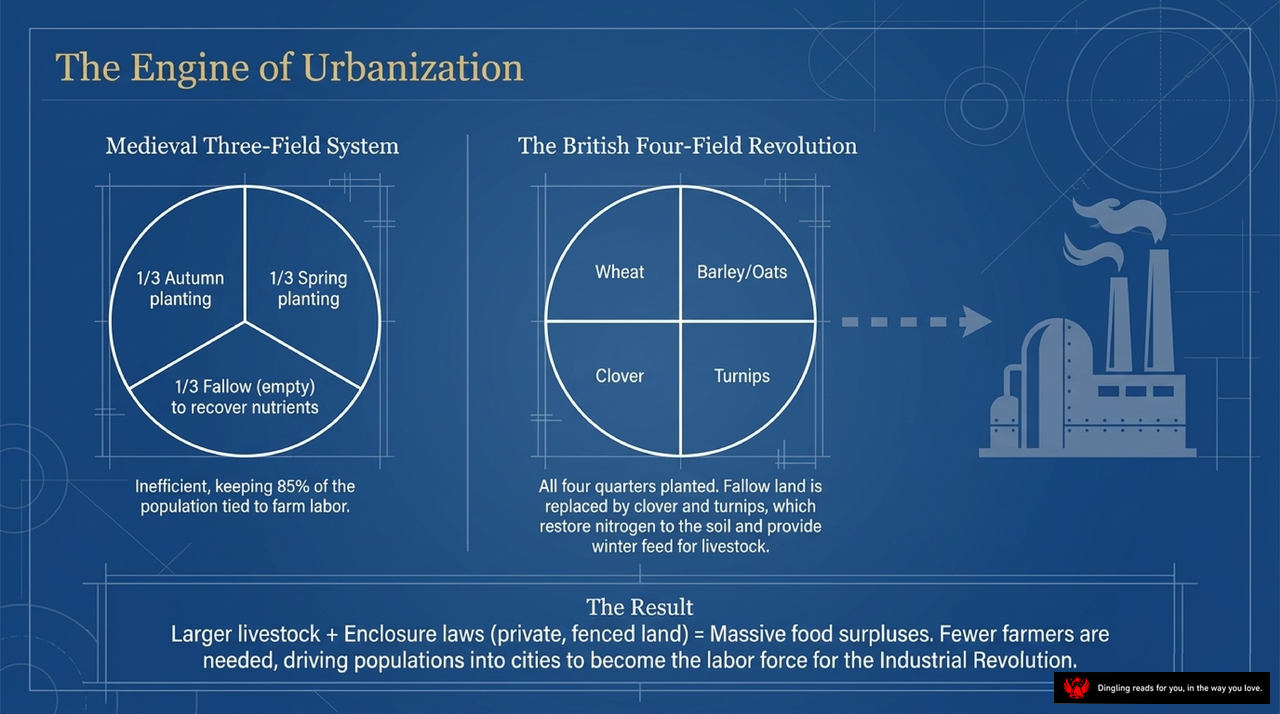
Let’s break down what really fueled urbanization—because before cities could boom, we first had to free people from the land. Back in the Middle Ages, farmers relied on the three-field system: one third for autumn crops, one third for spring, and one third left fallow to let the soil recover. It made sense at the time, but it was wildly inefficient—nearly 85% of the population was stuck farming just to keep everyone fed. No one had the time or freedom to do anything else.
Then came the British Four-Field Revolution, and it turned everything on its head. Instead of leaving a field empty, they rotated four crops: wheat, barley or oats, clover, and turnips. Clover wasn’t just a plant—it added nitrogen back to the soil, so no more fallow fields. Turnips? They were perfect winter feed for livestock, meaning we could raise more animals. More animals meant more manure to fertilize the land, creating a cycle that boosted crop yields even further.
But there’s another piece: enclosure laws. These turned shared common lands into private, fenced farms. It was hard on small farmers who lost access to public land, but it let large farms scale up these new efficient methods. The result? Massive food surpluses. We no longer needed 85% of people working the fields. So where did those farmers go? They flocked to cities, looking for jobs in the new factories that were springing up—exactly the labor force the Industrial Revolution needed to take off.
That’s the engine of urbanization: better farming freed up people, and cities became the hub for the industrial age. It’s amazing how a simple shift in crop rotation set off such a huge change in how we live today.

Let’s look at this slide titled The Destructive Convergence. The 20th century unleashed unprecedented slaughter across Europe, and it wasn’t by accident—this violence stemmed from the collision of two modern forces that, on their own, might not have been so catastrophic, but together, they became a wrecking ball.
First up: Romantic Nationalism. This was the belief that every ethnic or linguistic group deserves its own sovereign state. For centuries, Central and Eastern Europe were ruled by multi-ethnic empires—the Austro-Hungarian, Ottoman, Russian Empires, to name a few. But this nationalist wave swept through, demanding self-determination for each group. It sounded like a fight for justice, but it shattered those old empires into pieces, turning neighbors into enemies overnight as communities scrambled to carve out their own nations.
Then there’s the Industrial Revolution. We often think of it as a force for progress—factories, railroads, mass production of everyday goods. But those same innovations were twisted into tools of mass destruction. War stopped being just about professional armies clashing on a battlefield. It became total war: governments mobilized every part of their economy to support the war effort, and civilians weren’t just bystanders—they were targets, workers in war factories, or conscripted into service. The machinery that made clothing or furniture now churned out tanks, guns, and bombs by the thousands, turning conflict into an industrial-scale killing machine.
When you put those two forces together—Nationalist Fervor plus Industrial Mechanization—you get Annihilation. That’s the harsh equation on this slide. Nationalism filled people with fierce loyalty to their nation, making them willing to fight and die for it. Industrialization gave them the means to do so on an unimaginable scale. This convergence is why the 20th century saw such unthinkable horrors: two world wars that killed tens of millions, and atrocities like the Holocaust, where industrial methods were used to systematically murder millions of Jews. It’s a stark reminder of how powerful ideas and technology can become when they collide in the wrong way.

Let’s dive into “The European Matrix”—a concept that redefines how we see Western civilization’s origins. You might picture Europe as a single, steady entity, but it’s always been anything but. It was an unstable, dynamic system, shaped by clashing forces that never quite fit together.
Think about its roots: three totally incompatible worlds colliding—Greek logic, Christian morality, and the rough warrior culture of Germanic tribes. This mix created constant internal friction. And here’s the twist: that friction wasn’t a flaw. It split the Church, keeping religious power in check. It left monarchs uniquely weak, so they couldn’t dominate like rulers in other civilizations. It protected private property, laying ground for modern economies. Most importantly, it birthed both the Enlightenment (with its focus on reason and individual rights) and the Industrial Revolution (which transformed how we live and work).
And when Europe conquered the globe? It wasn’t because of unified strength. It was because its endless internal divisions forced nonstop innovation and aggressive expansion—survival of the fittest, but for societies.
So here’s the big question: If Western civilization’s engine ran on instability and fracture, can our modern, more connected and unified world keep progressing without that same friction? Is the old formula still the key to progress, or do we need something new to drive us forward? That’s the puzzle we’re left with.