
The Simple Path to Wealth: Complete Chapter-by-Chapter Summary

Welcome to "The Simple Path to Wealth" by J.L. Collins. Imagine a roadmap that is not only mathematically sound but also psychologically resilient, guiding you straight to financial independence. This book isn't about getting rich quick; it's about building a life where you have the freedom to choose your work, your time, and your values. The journey starts with one powerful truth: debt is the enemy of wealth. Whether it's high-interest credit cards or student loans that follow you forever, the solution is simple—cut the non-essentials and attack high-interest debt with ruthless consistency. But the real magic happens when you stop fighting the market and start working with it. By embracing low-cost, total market index funds and holding them through every crash and boom, you harness the power of compounding. It's a path that requires no crystal ball, no expensive advisors, and no complex strategies—just the discipline to keep investing while others panic. This is your invitation to stop being a slave to your paycheck and start designing a life of true freedom.
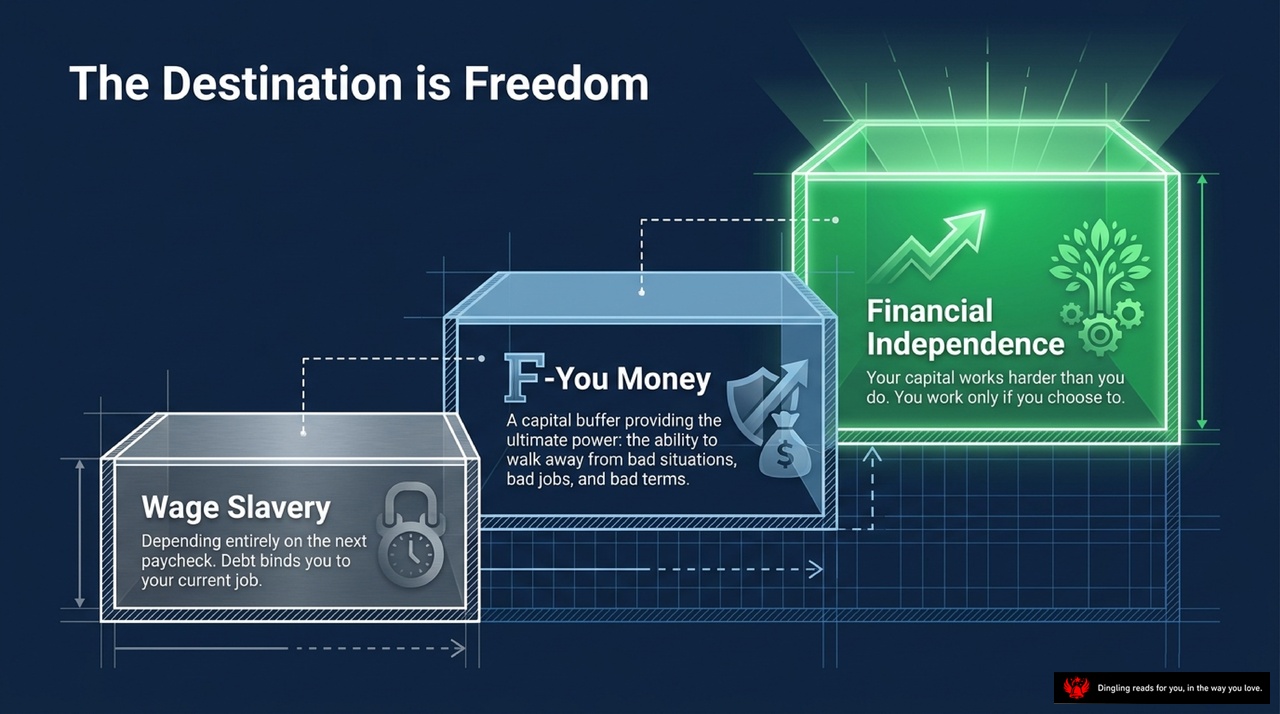
The Destination is Freedom. Look at this roadmap, it clearly shows the journey from being trapped to truly owning your life.
We start on the left with "Wage Slavery." This is where most of us live today, completely dependent on the next paycheck. Debt binds you to your current job, and you have no choice but to keep working, even when the situation is bad. You are essentially a slave to your salary.
But there is a powerful middle step called "F-You Money." Think of this as your ultimate capital buffer. It gives you the freedom to walk away from bad situations, bad jobs, and bad terms. It's the ability to say, "No, I won't do that," without fear. This money buys you the power to choose who you work for and when you work.
Finally, we reach the glowing green box on the right: Financial Independence. This is the destination. Here, your capital works harder than you do. You only work if you truly choose to. It's not just about having a lot of money; it's about having the freedom to design your life. The goal isn't just to be rich; it's to be free.
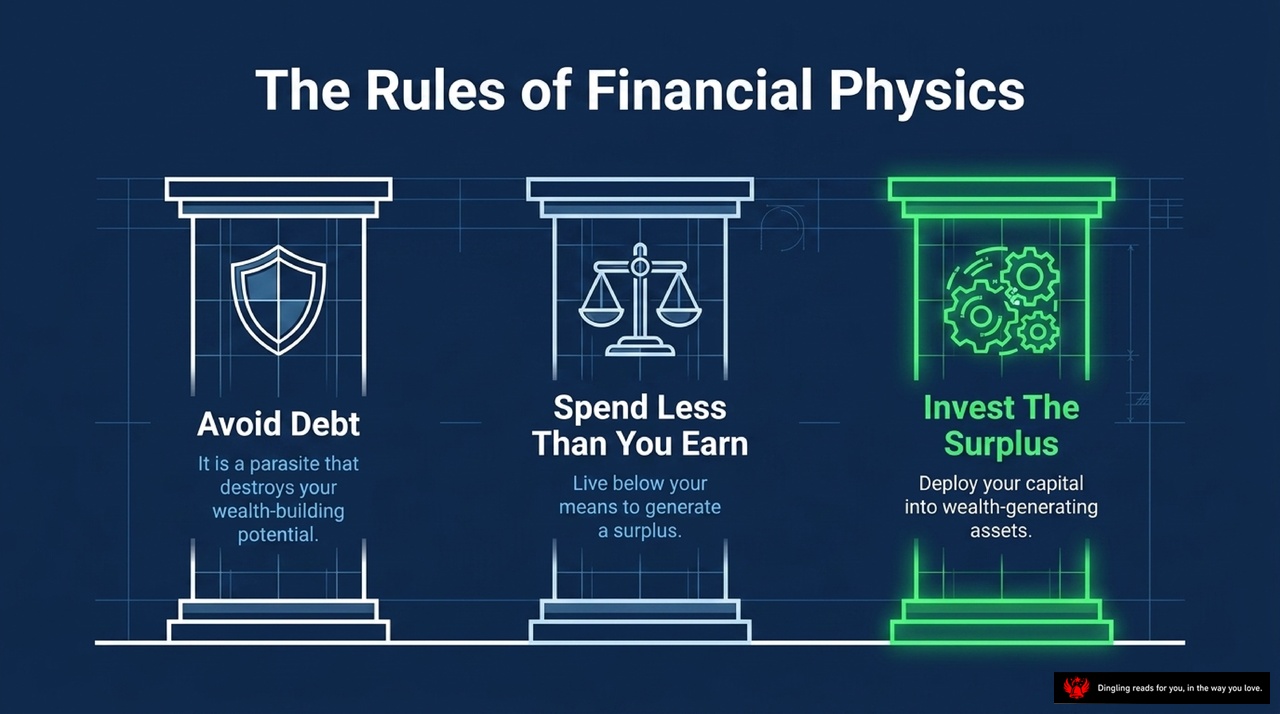
The Rules of Financial Physics. Think of your financial life as a building, and these three pillars are the foundation you cannot skip. First, avoid debt. As the slide shows, debt is a parasite that destroys your wealth-building potential. It's not just about the interest; it's about the mindset. Most people treat debt as a normal part of life, but that's the trap. Whether it's high-interest credit cards or student loans that follow you forever, debt keeps you working for someone else instead of building your own future. If you do have debt, be ruthless. Cut the non-essentials like daily coffee and late-night drinks, then pay off the highest-interest debt first. Don't trust "debt consolidation" or financial gurus; use data and discipline to become debt-free.
Next, spend less than you earn. This isn't about being cheap; it's about generating a surplus. Many high earners fail because they spend 800k on a year when they make 2.5k. The goal is to live below your means so you have capital to deploy. Finally, invest that surplus. Don't let your hard-earned money sit idle or get consumed by the opportunity cost of luxury cars. Instead, deploy your capital into wealth-generating assets. When you combine avoiding the parasite of debt, creating a surplus, and investing it wisely, you stop being a slave to your job and start building true financial freedom.
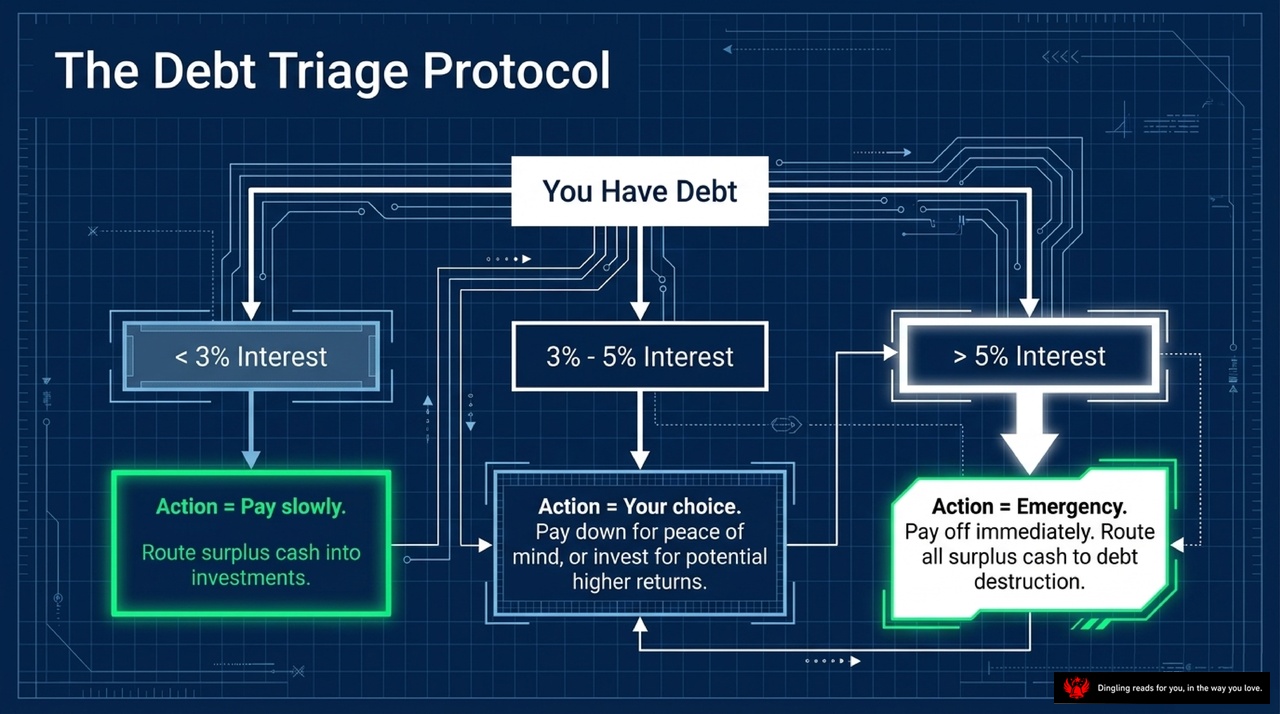
Imagine you just inherited a windfall or sold a property, and suddenly you're staring at a massive sum of cash. It feels like a dream, right? But here's the reality: if you dump all that money into the market today, you're gambling against tomorrow's crash. The smartest move isn't to wait for a "perfect" moment that never comes, but to spread your entry over time. This is what we call dollar-cost averaging. Instead of going all-in, you split your capital into chunks and invest them monthly over a year or more.
Think of it this way: if the market dips the week after you invest, you're thrilled because you bought low. If it soars, you're happy because you're already in. It feels safer, doesn't it? But here's the catch that most people miss. The stock market has historically trended upward for decades. By spreading your money out, you are essentially betting that the market will drop. More often than not, you end up buying at higher and higher prices, missing out on the huge gains you could have secured by investing early.
Worse yet, this strategy forces you to keep a large portion of your wealth sitting in cash, waiting for a crash that might never happen. You are disrupting your asset allocation, keeping your money too conservative for too long. And let's be honest, even if you do this for a year, the risk of a crash the very next day remains exactly the same as if you had invested everything upfront. You haven't eliminated the risk; you've just delayed the pain.
So, what's the real solution? If you're still in your wealth-building phase, like my daughter who is in her twenties, you should invest that lump sum immediately into a low-cost, broad market index fund. Let your money work for you right now. If you are in the preservation phase, simply allocate your funds according to your target mix of stocks and bonds. Yes, dollar-cost averaging is psychologically comforting, but remember, it's often a rationalization for fear, not a mathematically superior strategy. Don't let the fear of a single bad day keep you from starting your journey to financial freedom today.
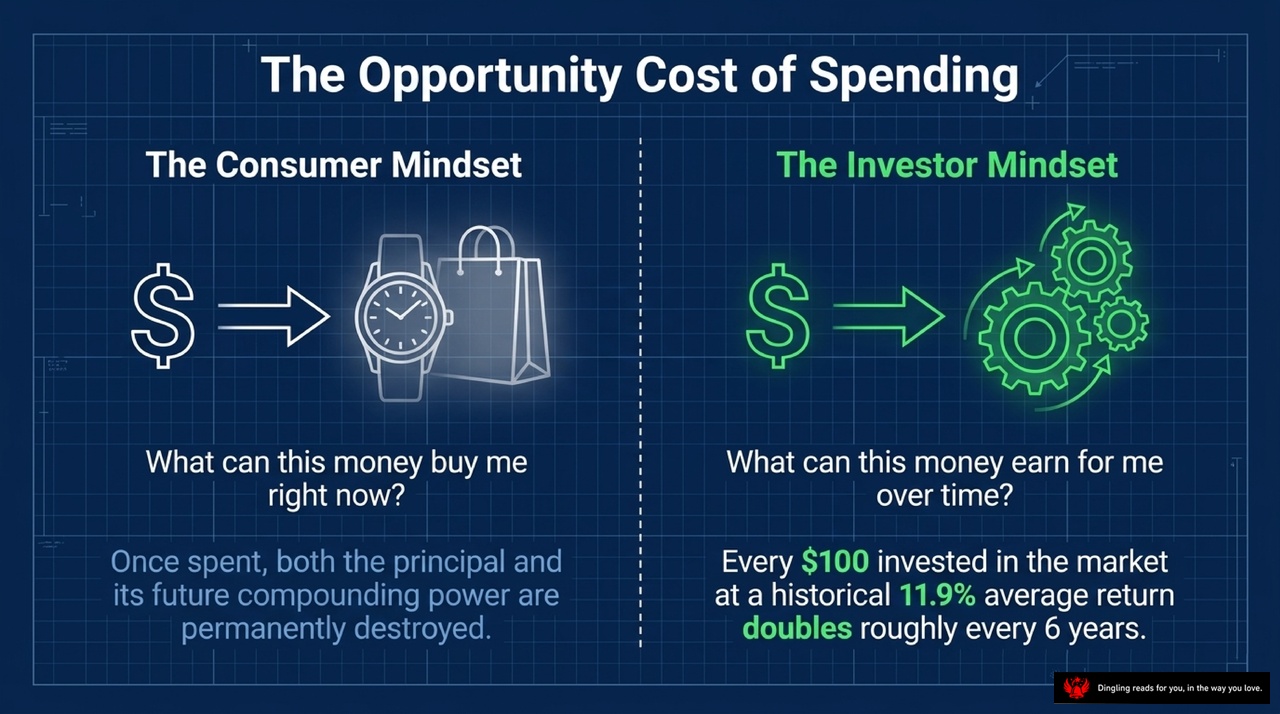
Imagine you just bought a brand-new luxury watch. You feel great, right? But have you stopped to ask yourself: what is the true cost of that purchase? It's not just the price tag. It's the "Opportunity Cost."
Look at the screen. We see two very different mindsets. On the left, the Consumer Mindset asks, "What can this money buy me right now?" It focuses on immediate gratification—like that watch or a shopping bag. But here's the hard truth: once you spend that cash, both the principal and its future compounding power are permanently destroyed. That money is gone forever.
Now, look at the Investor Mindset on the right. It asks a powerful question: "What can this money earn for me over time?" Instead of buying things, you buy assets. Think of those gears spinning—money working for you, generating more money. If you invest just $100 in the market, using a historical average return of 11.9%, that money doubles roughly every six years.
The difference between these two mindsets is the difference between financial slavery and freedom. When you choose the consumer path, you destroy your wealth potential. When you choose the investor path, you harness the power of compounding to build a future where you don't just have money, but where money works for you. Which mindset will you choose today?

Let's be honest: the financial world loves to sell you complexity. It tells you that beating the market requires deep analysis, constant trading, and paying hefty fees to experts who often can't do the job themselves. But look at the data on this slide. Wall Street's traditional path—active management and stock picking—carries high fees, creates constant stress, and has a long-term success rate of only 18%. Meanwhile, the simple path of broad market index funds offers floor-level fees, zero stress through automation, and a success rate of over 82%.
The reality is that complexity is often just an illusion designed to extract money from your pocket. As the note at the bottom reminds us, 82% of active funds fail to beat the index over 15 years. So why do we keep choosing the harder, more expensive route? The answer is simple: because the simple path is the only one that actually works for the vast majority of people. By ditching the illusion of complexity and embracing low-cost, hands-off investing, you stop working for your money and start letting your money work for you.
Whether you are just starting your career or looking to make a pivot later in life, the path to financial freedom begins with a simple, ten-year plan. The first rule is absolute: never carry debt. No matter how tempting the purchase, if you have to borrow to buy it, you are already on the wrong track. Surround yourself with people who are financially responsible; avoid those who drag you down.
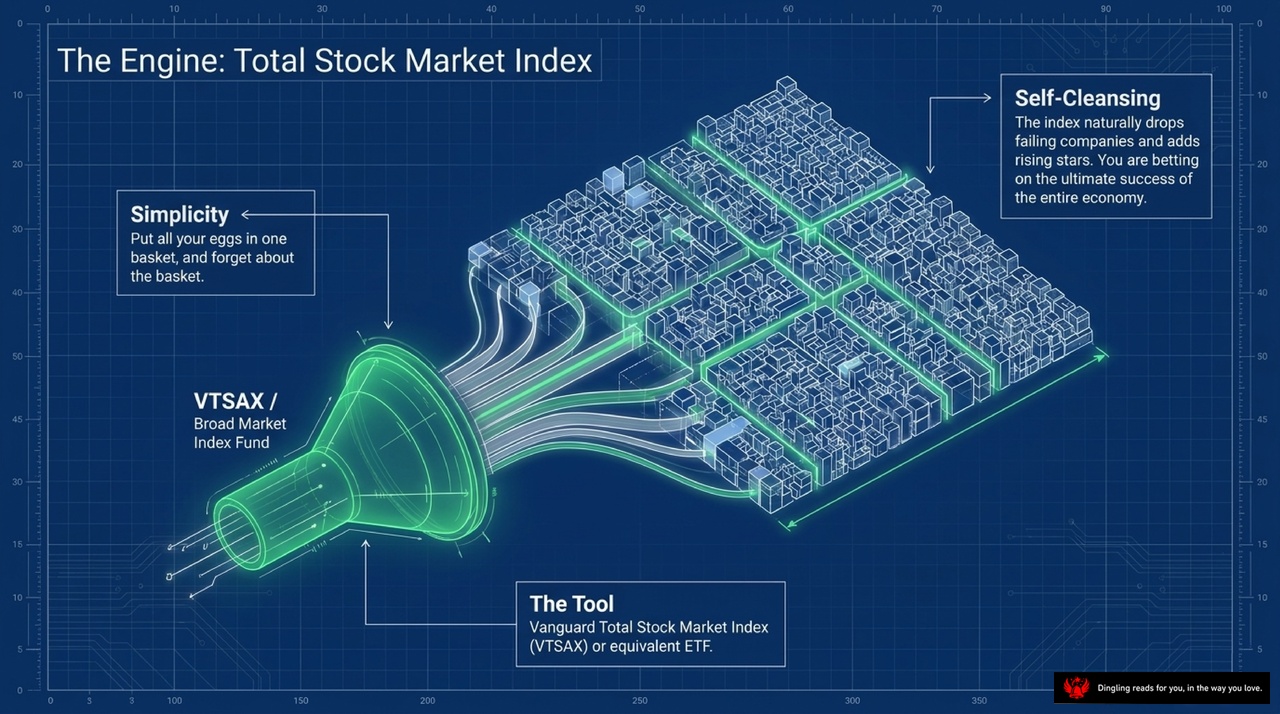
For the next decade, focus on mastering your craft and building a reputation that makes clients and opportunities come to you. Keep your lifestyle lean and avoid the trap of overspending just because you have an income. Save at least half of your paycheck immediately and funnel it into the Vanguard Total Stock Market Index Fund. Max out your employer's 401(k) match—it's free money—and prioritize Roth accounts when you are young, shifting to traditional accounts as your tax bracket rises.
If you follow this discipline, you'll be on your way to financial independence within ten years. The goal is simple: accumulate enough assets so that 4% of your portfolio covers your annual spending, meaning your savings need to be 25 times your yearly expenses. Don't panic when the market dips; that's when you buy more. Once you decide to stop working, introduce bonds to stabilize your portfolio.
Remember, it's never too late to start. I didn fully understand this path until my forties. The real secret isn't just the money you accumulate, but the freedom it buys. Think of it as your "Freedom Fund"—the ultimate tool that allows you to say, "I quit," and walk away from a job you hate. This financial cushion gives you the courage to live on your own terms, pursue creative passions, and embrace the life you truly want, rather than the life society expects of you.
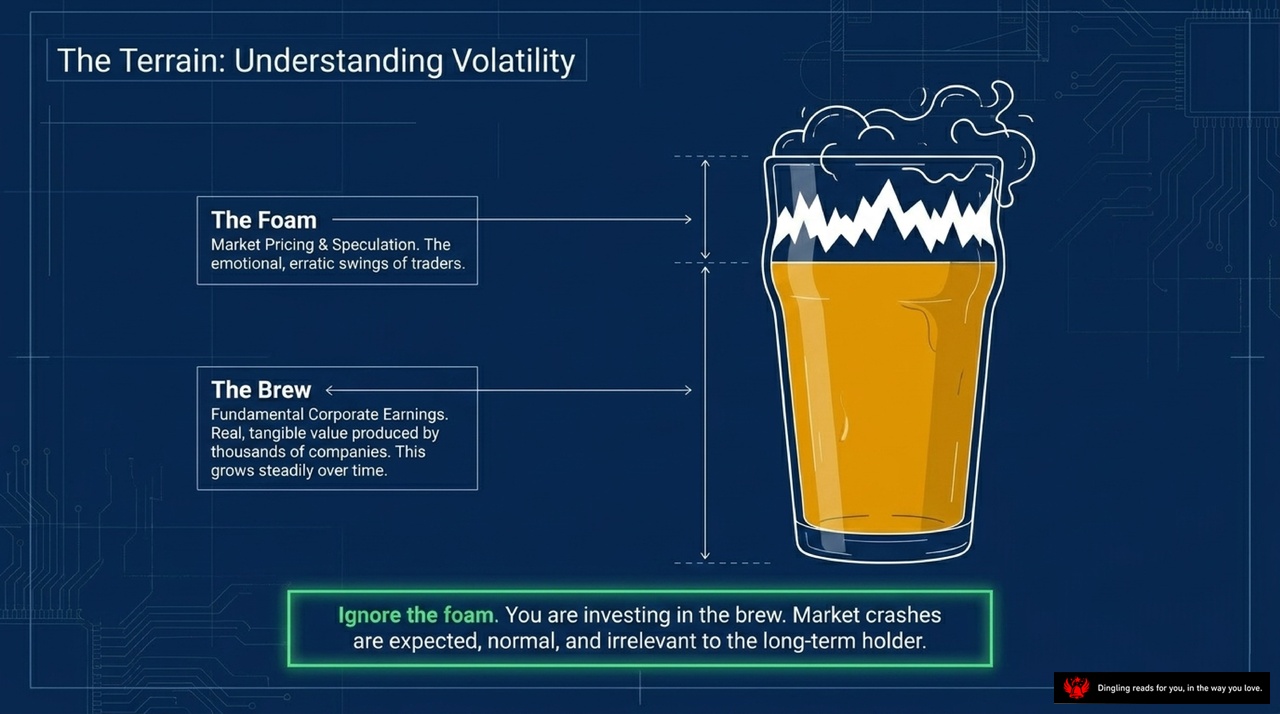
Imagine the stock market not as a chaotic storm, but as a perfectly poured glass of beer. This is the core metaphor we need to master. Look at the image: the bottom, thick and golden, represents "The Brew." This is the real, tangible value generated by thousands of companies, their fundamental earnings, and their ability to grow steadily over time. This is the substance you are actually investing in.
Above the Brew sits "The Foam." This is the market pricing, speculation, and the emotional, erratic swings of traders. It's the noise, the panic, and the greed that bubbles up and pops. The slide makes a crucial point: "Ignore the foam." You are investing in the brew, not the froth. Market crashes are expected, normal, and ultimately irrelevant to the long-term holder. When the market crashes, the foam disappears, but the Brew remains intact and often grows stronger.
The key to financial freedom lies in your ability to distinguish between the two. If you chase the foam, you get shaken out by every wave. But if you focus on the Brew, you can ride out any storm. History shows us that while the foam can vanish for decades, the Brew has a relentless upward trajectory. So, when you feel the fear of a crash, remember: that's just the foam clearing out. Stay in the market, hold your shares, and let the real value compound. That is the only way to truly own your future.

Look at this chart, titled "The Iron Law of the Market." It tells a powerful story about history's most reliable engine for wealth: the stock market.
First, notice the timeline. Data Point 1 highlights a staggering 100 years of growth. The Dow Jones climbed from just 68 to over 11,497. That's an incredible run, even though it survived World Wars, the Great Depression, and countless panics. It proves that while the road is bumpy, the direction is always up.
Then, look at Data Point 2: 11.9%. This is the historical annualized average return of the S&P 500 from 1975 to 2015, assuming you reinvest your dividends. This number is the golden standard for long-term investing.
The graph itself shows us the reality of the journey. You see the crash in 1929, the dip in 1987, the dot-com peak in 2000, and the financial crisis in 2008. Every time the line drops, it eventually recovers and climbs higher.
The takeaway here is simple but profound: The market always goes up over the long term. Yes, volatility is real, and those dips can be scary. But the author reminds us that volatility is simply the price of admission for high returns. If you can stay calm during the crashes and hold on, you are positioned to capture the massive gains that follow. This is the core truth that separates the wealthy from everyone else.
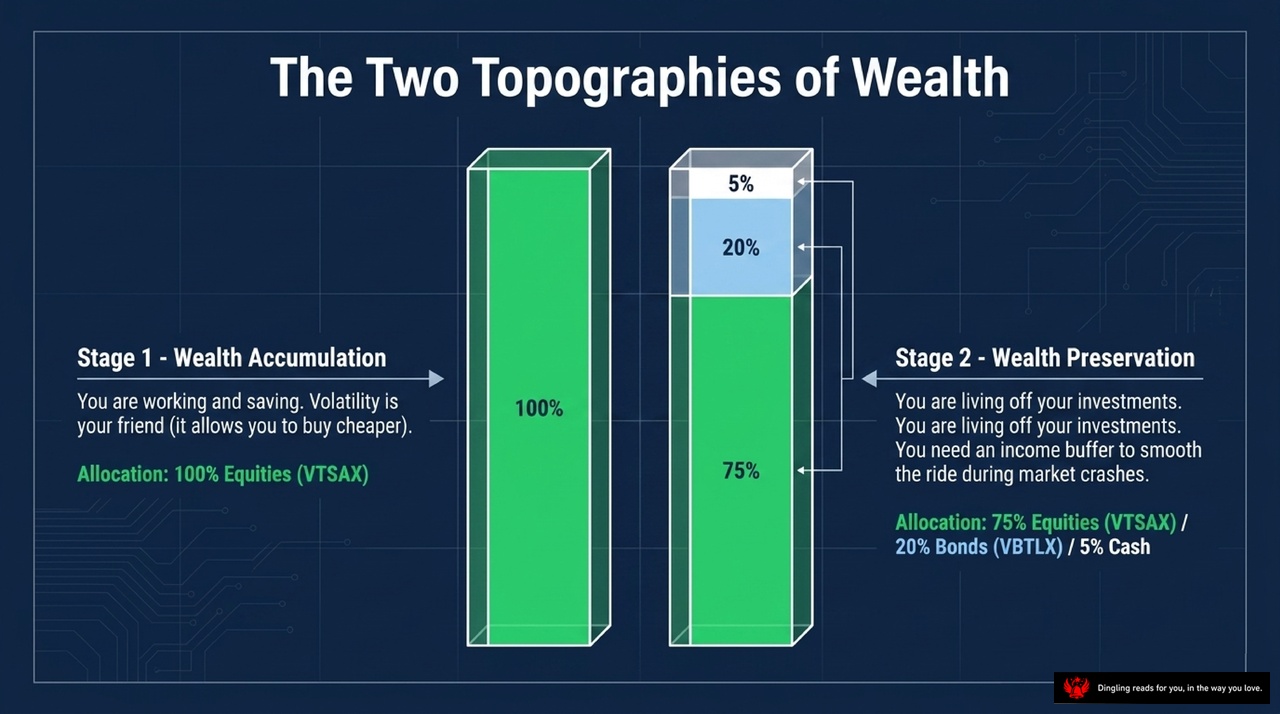
The Two Topographies of Wealth. Look at this slide. It perfectly captures the most critical shift in your financial life: moving from accumulation to preservation.
In Stage One, Wealth Accumulation, volatility is actually your friend. While you are still working and saving, you want to be fully exposed to the market. The chart shows a 100% allocation in equities, specifically the Vanguard Total Stock Market Index Fund, VTSAX. Why? Because when the market dips, it allows you to buy more shares for cheaper, accelerating your growth through dollar-cost averaging. You have the income to absorb the bumps.
But then, you cross the threshold into Stage Two: Wealth Preservation. This is where the strategy fundamentally changes. You are no longer relying on a paycheck; you are living off your investments. Now, volatility becomes your enemy. A market crash could wipe out the income you need for today. That's why the chart shifts to a balanced portfolio: 75% equities, 20% bonds, and just 5% cash. The bonds and cash act as a buffer, smoothing out the ride during market crashes and ensuring your spending doesn't dip when the market does. It's about trading some growth potential for stability and peace of mind.
So, the question isn't just "what do I buy," but "what stage am I in?" Are you building the engine, or are you driving the car? Knowing which topography you are on determines whether you need a race car or a reliable sedan. Don't make the mistake of staying in Stage One too long, or you'll get burned when you finally stop working. And don't jump to Stage Two too early, or you'll miss out on the power of compound growth. Align your asset allocation with your life stage, and you'll be on the right path to lasting financial freedom.
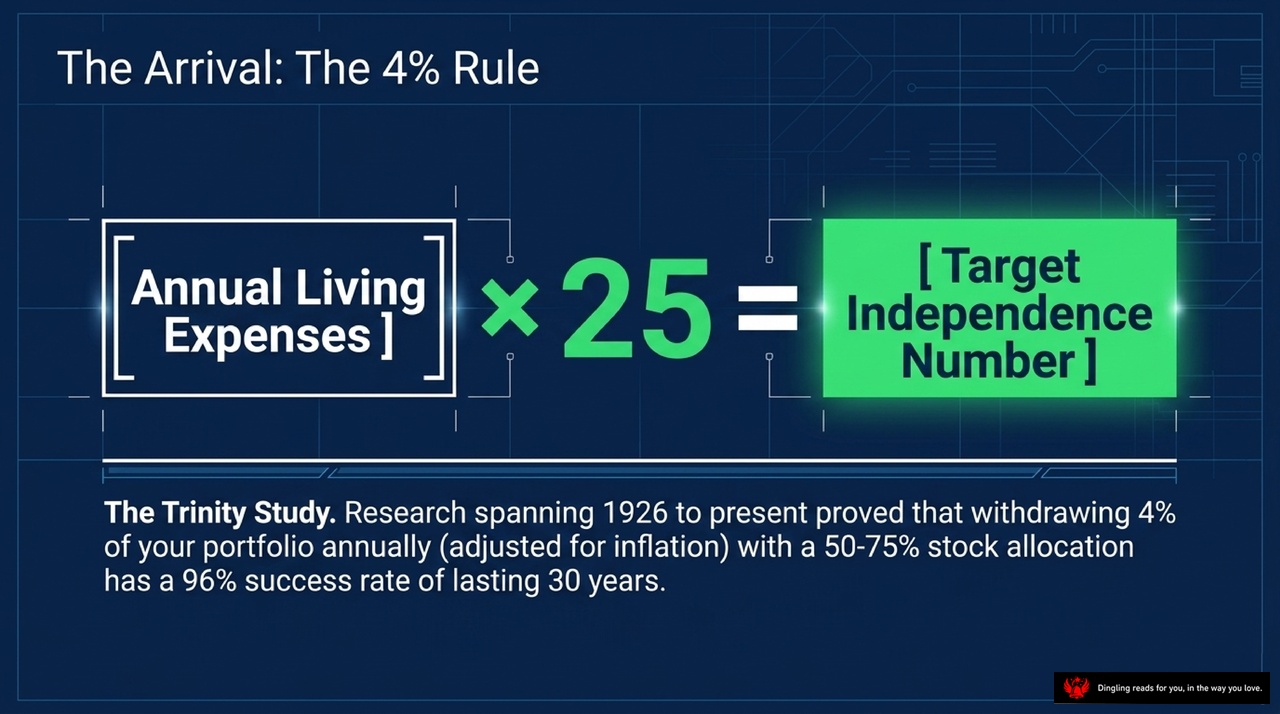
The "4% Rule" is often called the golden ticket to financial freedom, and for good reason. As the slide illustrates, your path to independence is surprisingly simple: just multiply your annual living expenses by 25. If you spend $40,000 a year, you need $1 million to retire. If you spend $60,000, you need $1.5 million. It's that straightforward.
But where does this magic number come from? It's backed by the Trinity Study, a massive research project spanning from 1926 to the present. This study analyzed thousands of different market scenarios and proved a powerful truth: if you keep your portfolio between 50% and 75% in stocks and withdraw only 4% of your total value every year—adjusted for inflation—you have a 96% chance of your money lasting for 30 years.
Think of that 96% success rate as your safety net. It means that in almost every historical scenario, your capital won't run out. Of course, life isn't a perfect simulation, and the last 4% of scenarios did fail, but for the vast majority of people, this rule offers a clear, data-driven path to saying "I'm done working" without fear. It transforms retirement from a gamble into a calculated strategy, giving you the confidence to step away from the workforce and live on the wealth you've built.
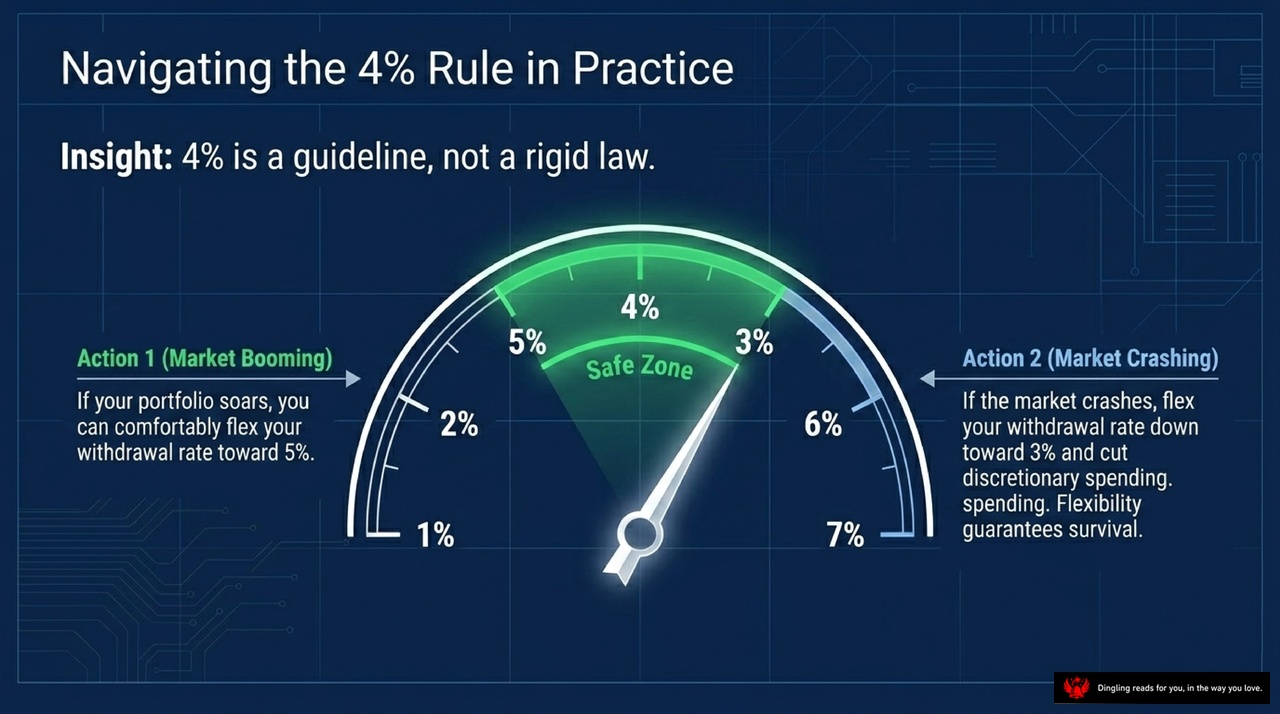
Navigating the 4% Rule in Practice: It's all about flexibility, not rigidity. Look at that gauge right in the center. The sweet spot is right here at 4%, but the real insight is that this isn't a hard law; it's a guideline. Life isn't a straight line, and neither should your spending be.
When the market is booming and your portfolio soars, feel free to flex that withdrawal rate up toward 5%. You've built a cushion, so enjoy the extra comfort. But here's the critical part: if the market crashes, you need to pivot immediately. Flex your withdrawal rate down toward 3% and cut discretionary spending. This flexibility is what guarantees your survival during tough times.
So, the secret to a long-term retirement isn't sticking to a fixed number blindly. It's about adapting your lifestyle to match your portfolio's performance. Stay flexible, stay safe, and let your investments work for you over the decades.

Imagine a world where your money doesn't just buy the latest gadgets or luxury cars, but instead purchases your absolute freedom. The slide in front of us outlines exactly how to get there. It calls this approach "The Simple Path," and it's built on a fundamental engineering reality: you must first eliminate the parasite of debt. Debt is the single biggest obstacle to building wealth, acting like a slow-acting poison that destroys your potential.
So, where do we start? By spending less than we earn to generate capital. This isn't about deprivation; it's about discipline. Once you have that capital, you harness the raw power of human enterprise through total stock market index funds. Think of it this way: buying these funds is like owning a tiny piece of every major company in America, from the tech giants to the food brands. You are betting on the long-term growth of the entire economy, not on a single stock that might fail.
The key here is to ignore the noise of the market foam. The news will scream about crashes and booms, but your job is to let compounding time do the heavy lifting. If you can stick to this strategy, your capital eventually becomes so large that it can buy you every consumer good in the world. But more importantly, it can buy you something far more valuable: the ability to wake up every morning and say, "I don't have to work today." That is the choice that defines true financial freedom.