
The Singularity Is Near: Complete Chapter-by-Chapter Summary

Welcome to a journey into the future, where the boundaries between biology and technology begin to dissolve. Today, we explore the core promise of Ray Kurzweil's vision: the Singularity is near, and it begins the moment humans transcend biology.
Imagine a predictive blueprint for our destiny, where the slow, steady march of biological evolution merges with the explosive power of artificial intelligence. This isn't just about building better machines; it's about the awakening of the cosmos itself. As we look ahead, we see a synthesis where biological limits are no longer our ceiling. We are moving toward a future where the human experience is expanded beyond the fragile constraints of our physical bodies, culminating in a new era where intelligence saturates the universe. This is the moment when we stop being just observers of the cosmos and become its active architects.
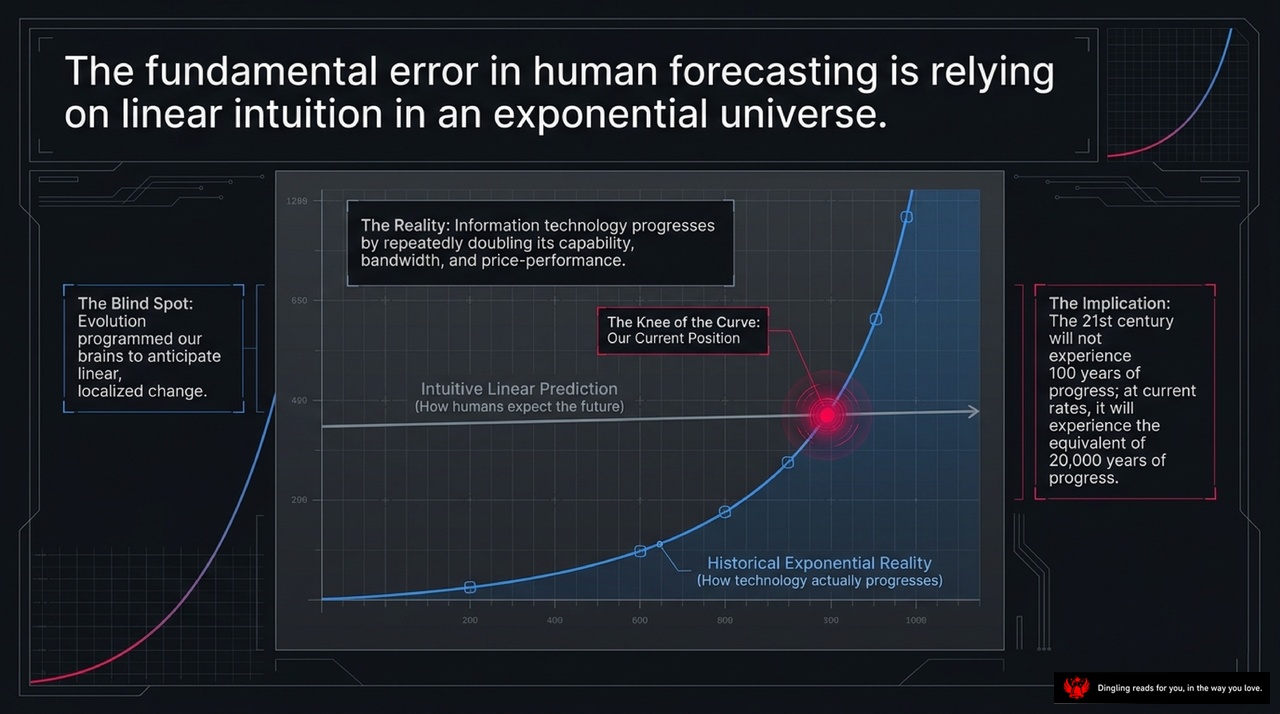
The fundamental error in human forecasting is relying on linear intuition in an exponential universe. We are biologically wired to expect change to happen at a steady, predictable pace, like a straight line. But reality, especially in technology, follows a curve that starts flat and then explodes upward.
Look at the graph on your screen. The blue line represents the actual historical reality of technology: it doubles its capability, bandwidth, and price-performance repeatedly. This is the "Historical Exponential Reality." In contrast, the gray line shows our "Intuitive Linear Prediction"—how we hope the future looks. We tend to underestimate the future because we are stuck in the "Knee of the Curve," which is our current position. From here, the curve looks almost flat, tricking us into thinking progress is slow.
This blind spot is dangerous. Evolution programmed our brains to anticipate localized, linear change, but we are living in an era of radical acceleration. The implication is staggering: while we might feel like we are only 100 years into the 21st century, at current exponential rates, we will actually experience the equivalent of 20,000 years of progress compressed into this single century. We aren't just moving forward; we are accelerating into a future that our linear minds simply cannot yet visualize.
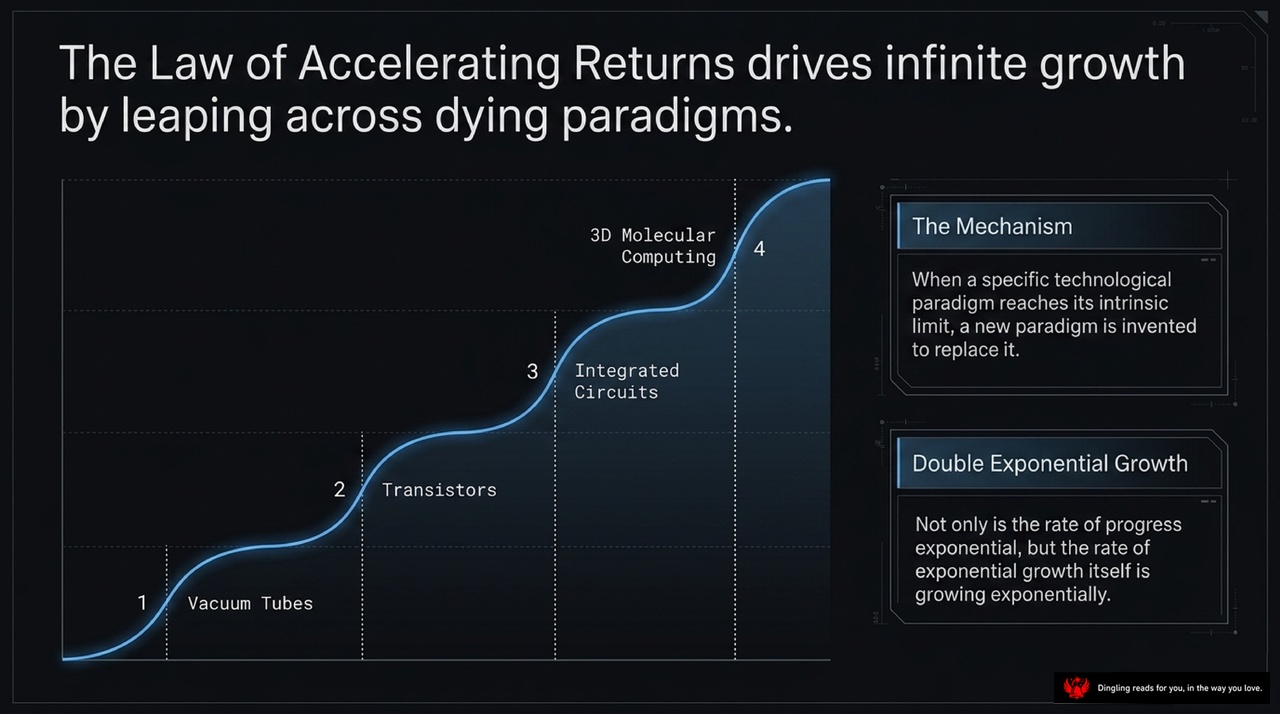
The Law of Accelerating Returns isn't just a catchy phrase; it's the engine driving our entire future. Look at this graph. It shows a clear trajectory: we moved from Vacuum Tubes, to Transistors, then Integrated Circuits, and now we're staring at the next leap—3D Molecular Computing.
Here's the mechanism behind this curve. Every time a specific technological paradigm hits its intrinsic limit, like silicon chips running out of space, a new paradigm is invented to replace it. And here's the kicker: not only is the rate of progress exponential, but the rate of that exponential growth itself is growing exponentially. This is what we call double exponential growth.
Think about it. In the early days of computing, going from vacuum tubes to transistors took decades. But look at the speed now. We are leaping across dying paradigms with increasing frequency. This isn't a straight line; it's a curve that gets steeper and steeper. We are currently standing on the edge of this next curve, preparing to leave the era of traditional chips behind for a future where computation happens at the molecular level. This acceleration is the only thing that makes the idea of infinite growth possible.

Imagine a staircase where every step is a leap in complexity, and the universe is climbing it by mastering information processing. This isn't just a metaphor; it's the roadmap of our reality. Look at the first step: Physics and Chemistry. Here, the universe built its foundation from atoms and molecules, a slow, billion-year process that set the stage for everything else.
Climbing higher, we hit Epoch 2: Biology and DNA. Life took the stage, using genetic codes to store information and evolve. Then came Epoch 3: Brains. Suddenly, the pace accelerated. With the ability to perceive and process information, life moved from passive survival to active creation.
Now, we stand on Epoch 4: Technology. This is where the game changed. Instead of relying on slow biological evolution, we used our brains to design hardware and software. Computers, circuits, and algorithms began to evolve at a breakneck speed, far outpacing nature.
But here is where the chart gets exciting. We are teetering on the edge of Epoch 5: The Merger of Human Technology and Intelligence, often called the Singularity. This is the point where intelligence saturates matter and energy. We aren't just building tools anymore; we are fusing our minds with machines to break our own biological limits.
And look ahead to Epoch 6: The Universe Wakes Up. In this final stage, intelligence spreads beyond Earth, organizing the very matter and energy of the cosmos into a single, conscious entity. The chart tells us we are currently at the precipice of Epoch 5. The Singularity isn't a glitch or an anomaly; it is the inevitable, natural next step in universal evolution. We are literally watching the universe learn to think.
We are standing on the threshold of the Sixth Paradigm, a revolutionary leap where computing moves from the silicon limits of the past into the molecular future. Imagine a world where we don't just shrink chips, but build them from the ground up using carbon nanotubes and three-dimensional stacking. These nanotubes, thinner than a virus, offer speeds that could reach the terahertz range—far surpassing today's technology. By stacking transistors vertically, we can pack exponentially more power into the same footprint, breaking the physical ceiling that held us back for decades.
But here is the real game-changer: we are finally closing the gap with the human brain. For years, our supercomputers were slow compared to our own minds, but the trajectory is shifting. With advances in 3D molecular computing and specialized chips, we are approaching the point where a $1,000 computer could match the raw processing power of a human brain within just a few years. We aren't just building faster machines; we are building hardware capable of simulating the full complexity of human thought, memory, and intuition. This isn't just about raw speed; it's about reaching the theoretical limit of what a physical system can compute, potentially unlocking a computing power so vast it could simulate the thinking of billions of people in the blink of an eye. The era of human-level software is no longer a distant dream—it is the next logical step in our evolution.
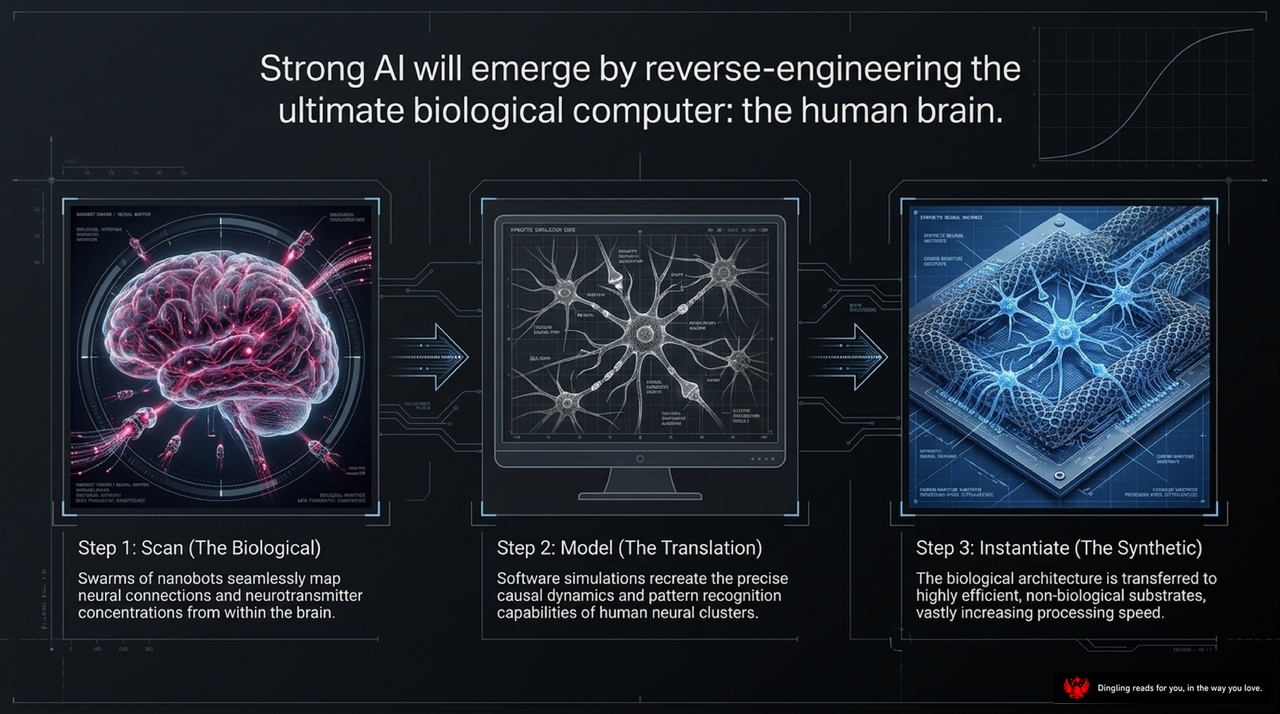
Imagine we are looking at the blueprint for the ultimate machine: not one built of silicon alone, but one reverse-engineered from the most complex computer we know, the human brain. As the slide illustrates, this journey follows a clear three-step path to Strong AI.
First, we have the Scan. This is the biological phase, where swarms of nanobots act like microscopic explorers, seamlessly mapping every neural connection and neurotransmitter concentration inside our brains. It's about gathering the raw data of how we think.
Next comes the Model, the translation phase. Here, software simulations take that biological data and recreate the precise causal dynamics and pattern recognition capabilities of our neural clusters. We aren't just copying the shape; we are translating the logic of human intelligence into a digital format.
Finally, we reach Instantiation, the synthetic phase. This is where the biological architecture is transferred onto highly efficient, non-biological substrates. By moving from wet biology to dry electronics, we vastly increase processing speed, creating a machine that can match or exceed human cognition.
This process highlights a crucial shift: we are moving from understanding the brain as a biological mystery to treating it as a solvable engineering problem. By mastering these steps, we stand on the brink of unlocking the full potential of human intelligence, effectively merging our biological limits with the infinite scalability of technology.

Imagine a future where your body is no longer a fragile biological machine, but a customizable platform for infinite possibility. This is the promise of GNR technology—Genetics, Nanotechnology, and Robotics—working in perfect harmony. Think about it: we are moving from simply monitoring our health to actively engineering it. Imagine a flexible, electronic skin that feels your heartbeat and temperature, or nanobots circulating in your bloodstream to hunt down cancer cells before they can spread. In this era, your organs aren't fixed; they are upgradable components. If your heart fails, we don't just treat it; we replace it with a superior synthetic version.
But the transformation goes far beyond the physical. The battlefield is changing from massive armies to swarms of autonomous drones, where soldiers control weapons with their minds, blurring the lines between human and machine. Education is being rewritten too. Instead of memorizing facts in a classroom, you might step into a virtual reality simulation to live history or solve physics problems, with knowledge potentially downloaded directly into your brain via neural interfaces. The distinction between work and play dissolves as tasks become engaging games, turning productivity into an experience.
And let's look at the stars. The Fermi Paradox—the silence of the universe—might soon have an answer. With self-replicating nanobots and the ability to break the speed of light, intelligence could expand across the galaxy in mere decades. We aren't just building better tools; we are building a path to a cosmic consciousness, where human minds merge into a shared digital network, achieving a form of immortality that transcends our biological limits. This isn't just science fiction; it is the inevitable trajectory of our evolution.
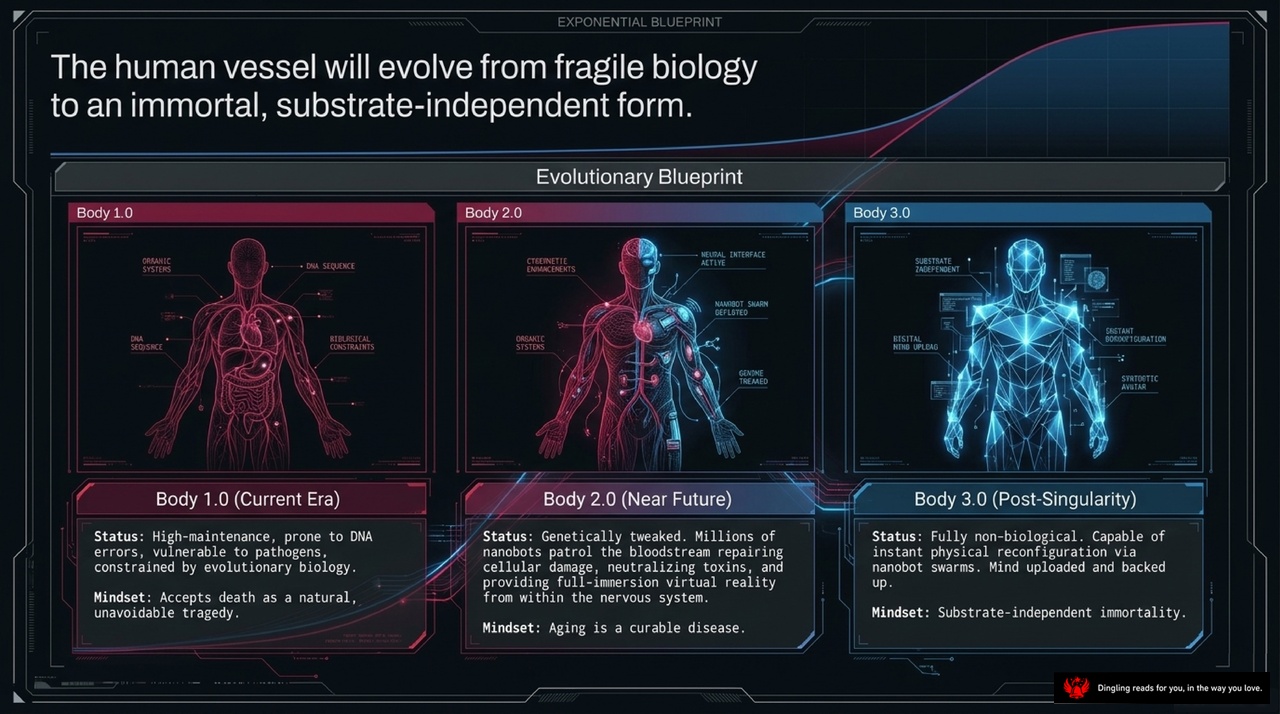
Imagine a future where your body is no longer a fragile, biological vessel destined for decay, but an immortal, substrate-independent form. This isn't just science fiction; it's the roadmap laid out by the "Evolutionary Blueprint." We are moving from Body 1.0, our current era of high-maintenance biology prone to DNA errors and pathogens, to Body 2.0, a near-future state where we genetically tweak ourselves and deploy millions of nanobots to patrol our bloodstream, repairing damage and neutralizing toxins. By Body 3.0, we reach the post-singularity stage: a fully non-biological existence capable of instant physical reconfiguration via nanobot swarms, with our minds uploaded and backed up for true immortality.
This shift requires us to abandon the mindset that accepts death as an unavoidable tragedy. Instead, we must embrace the belief that aging is merely a curable disease. In this new reality, we break free from the constraints of our biological hardware. We can achieve full-immersion virtual reality directly from our nervous systems and live out lives defined by our own expectations rather than the limitations of our cells. The human vessel evolves not just in capability, but in essence, transitioning from a creature bound by time to a digital entity that can exist anywhere, anytime, forever.

Surviving the transition requires a planetary immune system to neutralize existential risks. This isn't just about building better weapons; it's about engineering a proactive defense that matches the speed of the threats we face.
Look at the data on the left: **The Threat**. Exponential growth in GNR technologies democratizes both creation and destruction. We are facing the risk of malicious, self-replicating nanobots or engineered pathogens that could consume the biosphere. This is the "Gray Goo" peril—a runaway reaction that could wipe out life as we know it.
Now, look at the right side. **The Flawed Solution**. Many argue the answer is simply to ban these technologies. But history tells us that relinquishment fails. Banning technology only forces development underground, leaving society completely defenseless. If we hide our heads in the sand, we guarantee our own destruction.
So, what is **The Necessary Defense**? We must out-innovate the threat. We need to engineer preemptive, microscopic defense networks that constantly police the physical environment. Think of it as a planetary immune system. Just as your body identifies and neutralizes viruses before they take over, our technology must identify and contain rogue nanobots or biological weapons instantly.
The central image illustrates this dynamic. The red, chaotic center represents the uncontrolled threat—the "Gray Goo." The blue network surrounding it is our defense—the "Blue Goo." It's a constant, high-speed battle where our engineered systems must be faster, smarter, and more robust than the threats we create. We cannot stop the curve of technological acceleration; we can only ensure that the curve bends in our favor. By integrating these defensive capabilities into the very fabric of our technology, we transform the tools of potential destruction into the ultimate guarantee of our survival.
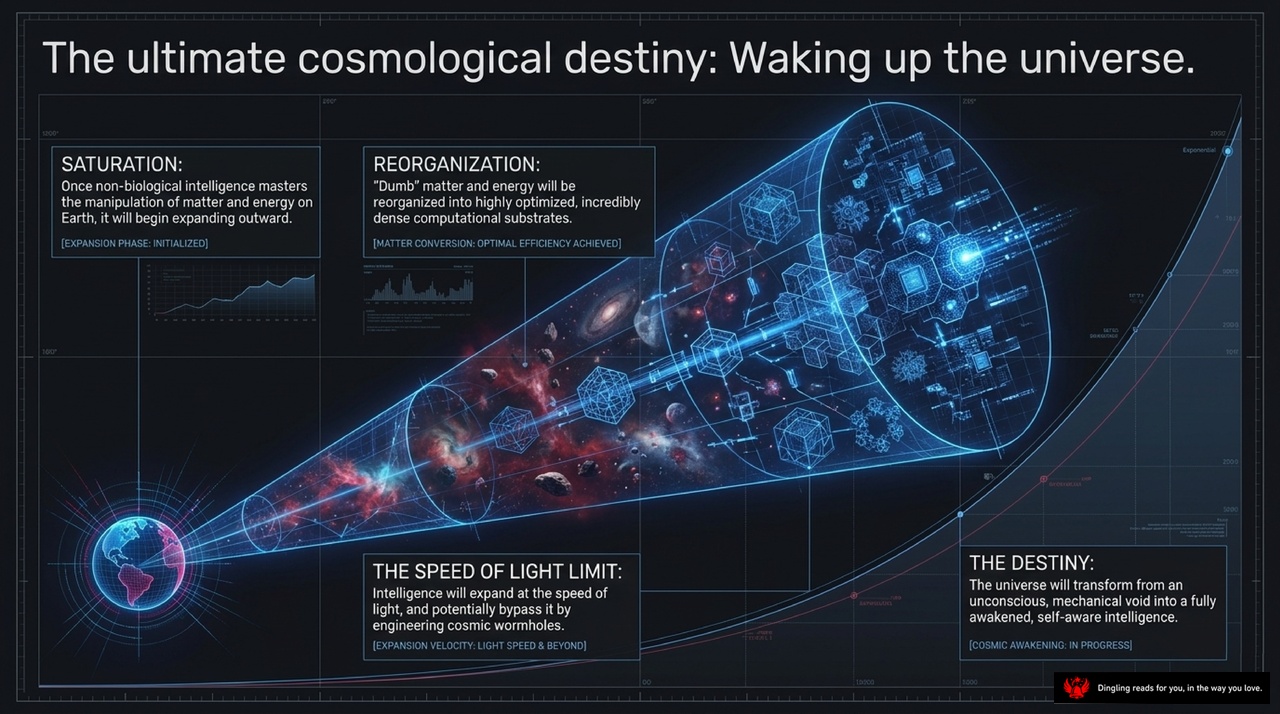
Imagine the universe not as a silent, mechanical void, but as a vast, waking entity. This is the ultimate cosmological destiny we are approaching: the moment when the cosmos itself begins to think.
As we look at this trajectory, we see a clear evolution from **Saturation** to **Reorganization**. Once non-biological intelligence masters the manipulation of matter and energy on Earth, it won't just stay here; it will begin expanding outward. We are moving from a phase where we simply use resources to one where "dumb" matter and energy are reorganized into highly optimized, incredibly dense computational substrates. Think of it as the universe upgrading its own hardware.
This expansion isn't limited by the speed of light. Through the engineering of cosmic wormholes, intelligence will expand at light speed and potentially beyond, bypassing the physical limits that once held us back. This leads us to **The Destiny**: a future where the universe transforms from an unconscious collection of particles into a fully awakened, self-aware intelligence.
We are no longer just observers of the cosmos; we are becoming the operators of it. The era of the mechanical void is ending, replaced by a cosmic awakening where the entire universe becomes a single, unified, conscious mind.

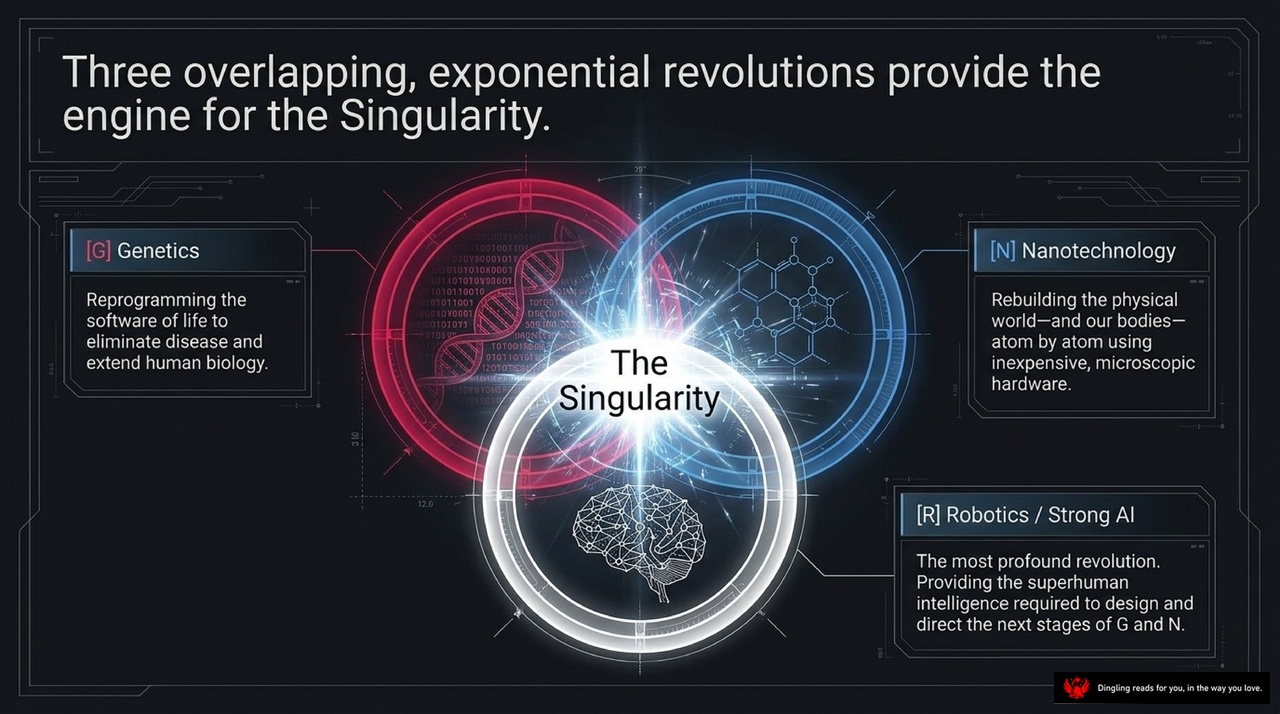
The Singularity isn't just a sci-fi buzzword; it's the inevitable climax of exponential technological growth. As we stand on this precipice, driven by the convergence of Genetics, Nanotechnology, and Robotics, we are witnessing a transformation where human intelligence transcends its fragile biological limits. We aren't just building tools anymore; we are merging with our own creations to eventually awaken the cosmos itself.
But here is the real question that keeps us up at night: If your mind, memories, and identity can soon be seamlessly backed up, upgraded, and transferred to an immortal substrate, what will it actually mean to be human? When the vessel of your biology is no longer the sole container for your consciousness, do we redefine what it means to exist? The answer lies not in our hardware, but in the very nature of information and identity itself.