
The Six Sigma Way: Complete Chapter-by-Chapter Summary

Welcome to *The Six Sigma Way*. Think of this book not just as a manual for quality control, but as a comprehensive guide to building a flexible system that drives top corporate performance. Authored by Peter S. Pande, Robert P. Neuman, and Roland R. Cavanagh, this framework transforms how organizations operate by anchoring success in three pillars: a relentless focus on the customer, data-driven management, and the continuous improvement of processes. It's about moving from guesswork to precision, ensuring that every decision is backed by facts and every process is optimized for the ultimate goal: delivering exceptional value to the customer.
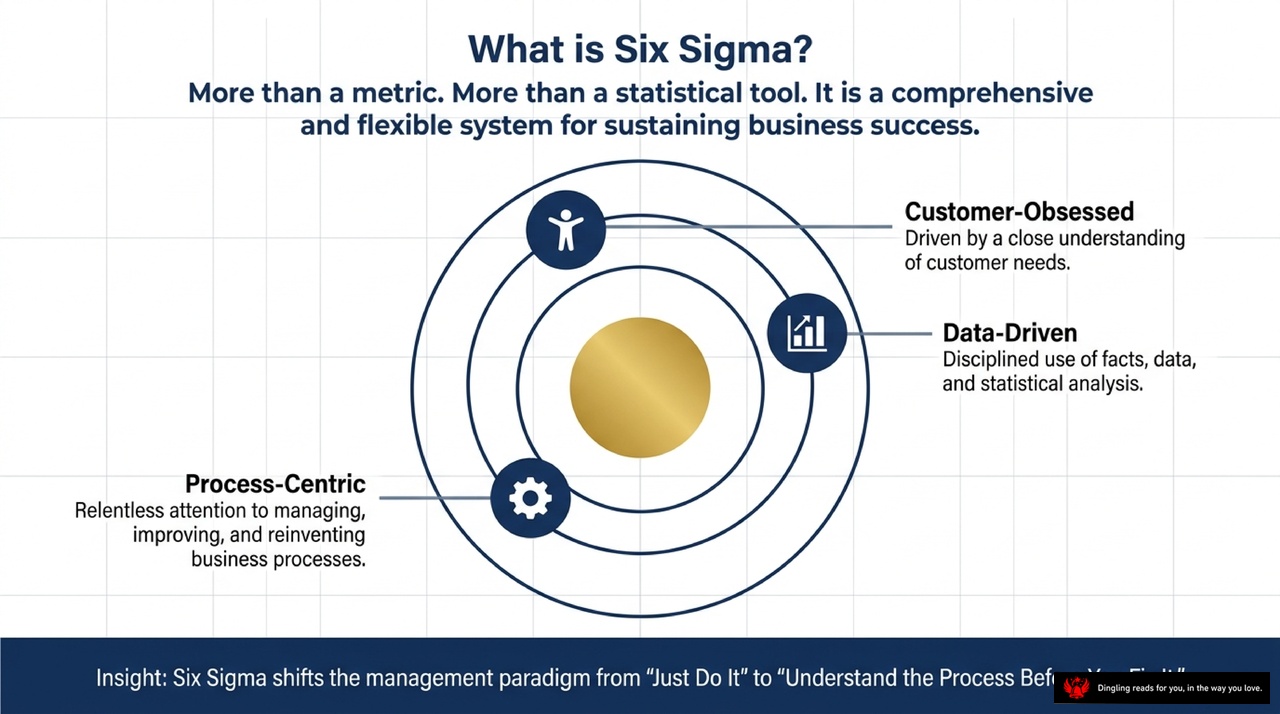
What is Six Sigma? It's not just a metric or a fancy statistical tool. Think of it as a comprehensive, flexible system designed to sustain long-term business success.
Look at the diagram here. At the very center, we have the core philosophy, radiating out into three critical pillars. First, it is Customer-Obsessed. Every decision, from process improvements to data analysis, must be driven by a deep, close understanding of what our customers actually need. If you aren't obsessed with the customer, you aren't practicing Six Sigma.
Second, it is Data-Driven. We move away from guessing or relying on gut feelings. Instead, we use facts, hard data, and rigorous statistical analysis to make decisions. This discipline ensures that our improvements are real and measurable, not just wishful thinking.
Third, and perhaps most importantly, it is Process-Centric. We apply relentless attention to managing, improving, and even reinventing our business processes. Why? Because your process is your product. If the process is broken, the output will be broken.
The insight at the bottom of the slide captures the essence of this shift: Six Sigma moves us away from the old mindset of "Just Do It" and pushes us toward "Understand the Process Before You Find a Fix." It's about mastering the system before trying to fix the symptoms. By integrating these three elements—customer focus, data discipline, and process excellence—organizations can build a resilient foundation for success that competitors simply can't replicate.

The Evolution of Quality Management isn't just about history; it's about survival. Look at this slide: it contrasts the "Quality" of the past with the "Value" of the present.
In the past, Total Quality Management was often a side project, relegated to a separate "Quality Dept" with vague goals and lip service from leadership. It focused on internal processes, using soft metrics that nobody really understood.
But today, Six Sigma has completely flipped the script. It's no longer a side project; it's integrated into your core business and daily management. The focus has shifted from internal processes to external customer value and, crucially, bottom-line ROI. Leadership isn't just giving speeches anymore; it's passionate and accountable, often tied directly to bonuses.
We've moved from subjective goals to hard data—specifically DPMO, or Defects Per Million Opportunities. And instead of mass training with no clear application, we now use targeted, project-based training for our "Black Belts."
The lesson here is clear: traditional TQM faded because it was too abstract. Six Sigma thrives because it connects quality directly to profit, customer satisfaction, and real, measurable results. It's the difference between hoping for quality and engineering it into the business.
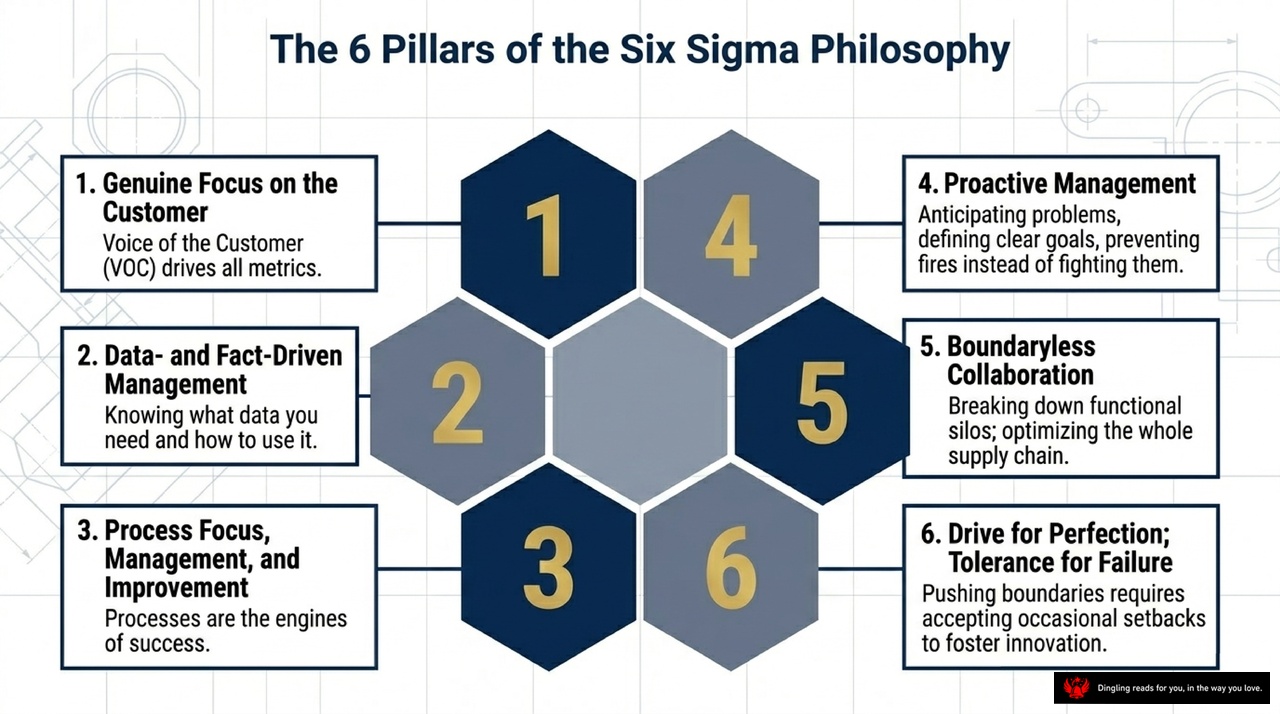
Imagine Six Sigma not as a rigid set of rules, but as a living philosophy built on six essential pillars. As we look at this slide, you're seeing the core framework that drives success for top global enterprises.
First, it starts with a genuine focus on the customer. Every metric, every improvement, must be driven by the Voice of the Customer. Without this, you're just optimizing the wrong things.
Second, we move to data- and fact-driven management. This means knowing exactly what data you need and, more importantly, how to use it to make decisions, rather than relying on gut feelings.
Third is process focus. We treat processes as the engines of success. If your engine is broken, no amount of marketing will save you.
Fourth, we embrace proactive management. Instead of constantly fighting fires, we anticipate problems, define clear goals, and prevent issues before they even start.
Fifth, the philosophy demands boundaryless collaboration. We must break down those functional silos that hold organizations back and optimize the entire supply chain, working together seamlessly.
Finally, we drive for perfection while maintaining a tolerance for failure. Pushing boundaries requires accepting occasional setbacks. We encourage trying new ideas because that's where real innovation happens.
Together, these six pillars create a powerful system that transforms how organizations operate, moving them from reactive survival to proactive excellence.

Today's slide tackles the most critical concept in modern business: the gap between "good enough" and true excellence. On the left, we see the "Illusion of 99% Perfection." Many companies settle for a 3.8 Sigma standard, thinking 99% quality is a massive win. But the reality is starkly dangerous. At that level, you lose 20,000 pieces of mail every single hour. Your drinking water is unsafe for nearly 15 minutes every day, and you're performing 5,000 incorrect surgeries weekly. This isn't just inefficiency; it's a systemic failure that costs lives and destroys trust.
Now, look at the right side. This represents the 6 Sigma standard, hitting 99.9997% quality. The difference is night and day. Instead of thousands of errors, you have only 3.4 defects per million opportunities. This is near-flawless execution. The slide drives home a powerful truth at the bottom: the gap between 99% and Six Sigma is exactly where market dominance is won. In a competitive economy, being merely "good" is a liability. To win, you must obsess over eliminating that tiny sliver of error, turning a 99% system into a nearly perfect one.
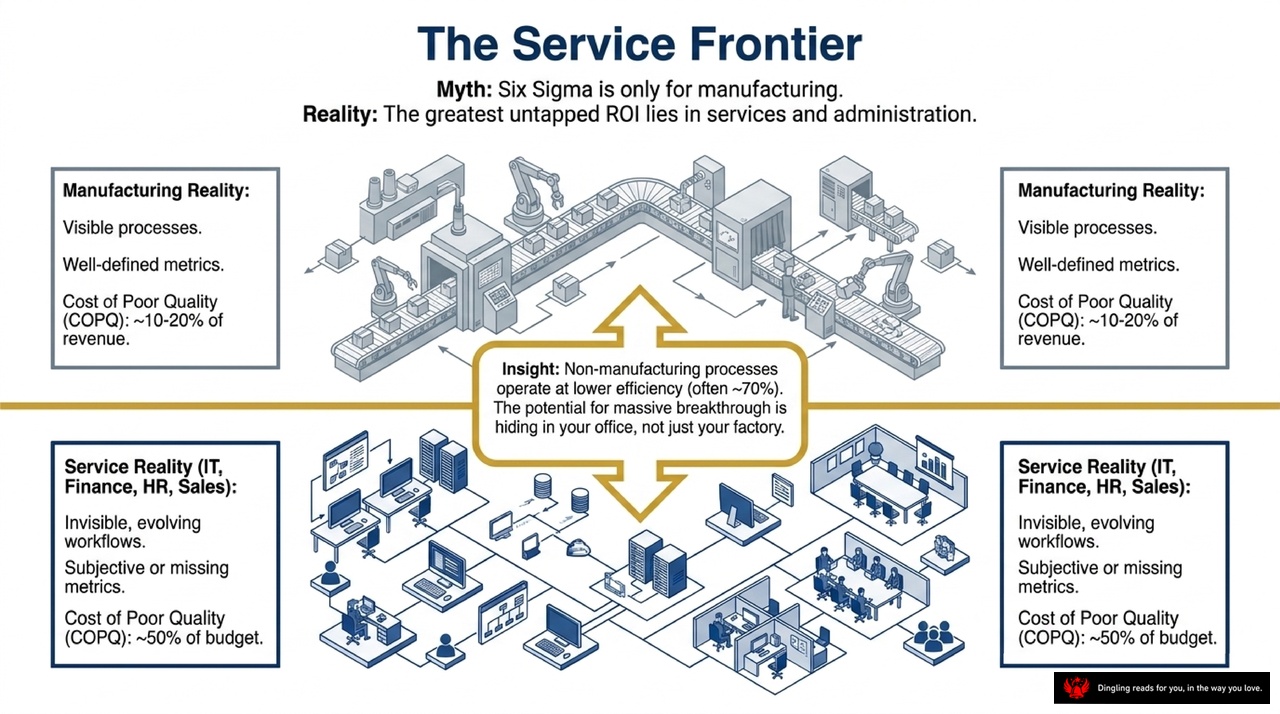
The Service Frontier reveals a stark reality: while manufacturing processes are visible and measurable, the true goldmine for Six Sigma lies in the invisible world of services and administration.
Look at the contrast here. In manufacturing, we deal with clear workflows and defined metrics, where poor quality costs us about 10% to 20% of revenue. But in service sectors like IT, finance, HR, and sales, the situation is drastically different. The workflows are often invisible and constantly evolving, making them much harder to manage. Consequently, the cost of poor quality here can skyrocket to nearly 50% of your entire budget.
The insight is simple yet powerful: non-manufacturing processes often operate at only 70% efficiency, meaning massive breakthroughs are hiding right in your office, not just on the factory floor. Unlike a factory where bottlenecks are obvious, service inefficiencies are hidden in complex, subjective data streams.
This slide challenges the old myth that Six Sigma is only for manufacturing. The reality is that the greatest untapped ROI lies in transforming these service-heavy functions. By bringing the same rigor to these invisible processes, you can unlock value that traditional methods simply miss.

Look at this diagram. It illustrates exactly what it takes to build a true Six Sigma organization. The text on the slide makes a crucial point: it's not just about hiring statisticians; you need a dedicated hierarchy of change agents working together.
At the very center, we have Executive Leadership. They are the heart of the system, providing the vision and the authority that makes everything else possible.
Moving outward to the first ring, we see the Champions or Sponsors. These are the executives who align your projects with the broader company strategy. Their job is to provide the necessary resources and, most importantly, clear the roadblocks that could stop a project in its tracks.
The next layer consists of the Master Black Belts. Think of them as the elite experts and full-time teachers. They are the statistical authorities and mentors who guide the Black Belts, ensuring that the methodology is applied correctly across the organization.
Then we have the Black Belts. These are your full-time project leaders. They are the ones on the front lines, guiding teams, applying advanced tools, and driving the DMAIC process to completion.
Outside that, we find the Green Belts. These are part-time facilitators who lead smaller projects while managing their regular job functions. They help spread the knowledge and drive improvements within their specific areas.
Finally, on the outermost ring, are the Process Owners. These are the managers who inherit the improved processes after a project is done. Their critical role is to sustain the gains, ensuring that the improvements don't fade away but become part of the daily standard.
This entire structure shows that Six Sigma isn't just a set of tools; it's a people-centric system where every role, from the top leadership down to the process owners, has a specific responsibility to drive continuous improvement.
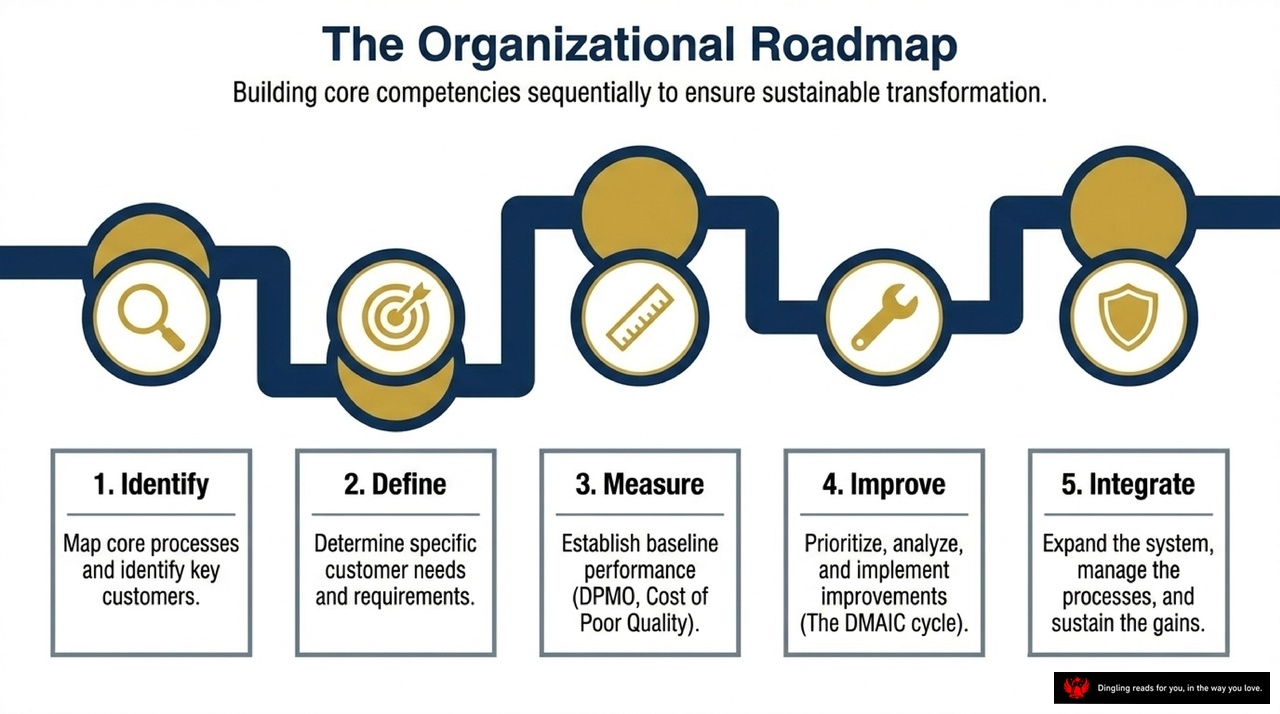
Think of your organization as a vehicle on a long journey toward sustainable transformation. To stay on course and avoid the potholes of chaos, you need a clear map. That map is built on five sequential steps, each represented by an icon on our slide, designed to help you build core competencies one by one.
First, we start with **Identify**. Just like using a magnifying glass to spot details, this step is about mapping your core processes and identifying who your key customers really are. You can't improve what you don't understand, so getting this foundation right is critical.
Next, we move to **Define**. Here, the target comes into view. You need to determine specific customer needs and requirements. It's about setting clear goals so everyone knows exactly what success looks like from the customer's perspective.
Once you know where you're going, you must **Measure**. This is where the ruler comes in. You need to establish a baseline performance using metrics like DPMO or the Cost of Poor Quality. You can't manage what you can't measure, so getting accurate data here gives you the truth about your current state.
With data in hand, it's time to **Improve**. This is the wrench in your toolkit. You prioritize, analyze, and implement changes. Think of this as the DMAIC cycle in action—using proven methods to fix problems and boost performance based on the facts you just gathered.
Finally, we arrive at **Integrate**. This is the shield that protects your gains. You expand the system, manage the processes, and ensure the improvements stick. This step turns a one-time project into a permanent part of your culture, ensuring that your transformation is sustainable.
By following this roadmap from Identify to Integrate, you transform your organization from a reactive entity into a proactive, high-performing machine capable of lasting success.

Imagine a world where your business doesn't just react to problems, but systematically solves them before they even become crises. This slide introduces the engine behind that reliability: DMAIC, the core problem-solving framework that powers Six Sigma.
Think of DMAIC not as a rigid checklist, but as a five-step cycle for tackling complex challenges. It starts with **Define**. Here, you clarify the problem, set the scope, and identify the customer impact. You answer the question: "What exactly are we trying to fix, and why does it matter to our customers?"
Next comes **Measure**. This is where you gather baseline data to answer a crucial question: "How bad is it, exactly?" You need hard numbers to understand the current state of your process, establishing a clear starting point.
Then, you move to **Analyze**. Step into the role of a process detective. Your job is to dig deep and find the root cause—the "X" variables—that are actually driving the problems you see in your output, or "Y". Don't just treat symptoms; find the source.
Once you've pinpointed the cause, it's time to **Improve**. This is where you generate, select, and implement real solutions. You take the insights from your analysis and build the fixes that will actually move the needle.
Finally, the cycle closes with **Control**. This step is vital for long-term success. You lock in the gains by monitoring the process to prevent regression. Without this, improvements often fade away.
Together, these five stages create a powerful loop. By defining the problem, measuring the reality, analyzing the root causes, implementing solutions, and controlling the results, DMAIC transforms chaotic business challenges into structured, solvable opportunities. It's the methodology that turns good intentions into consistent, measurable performance.
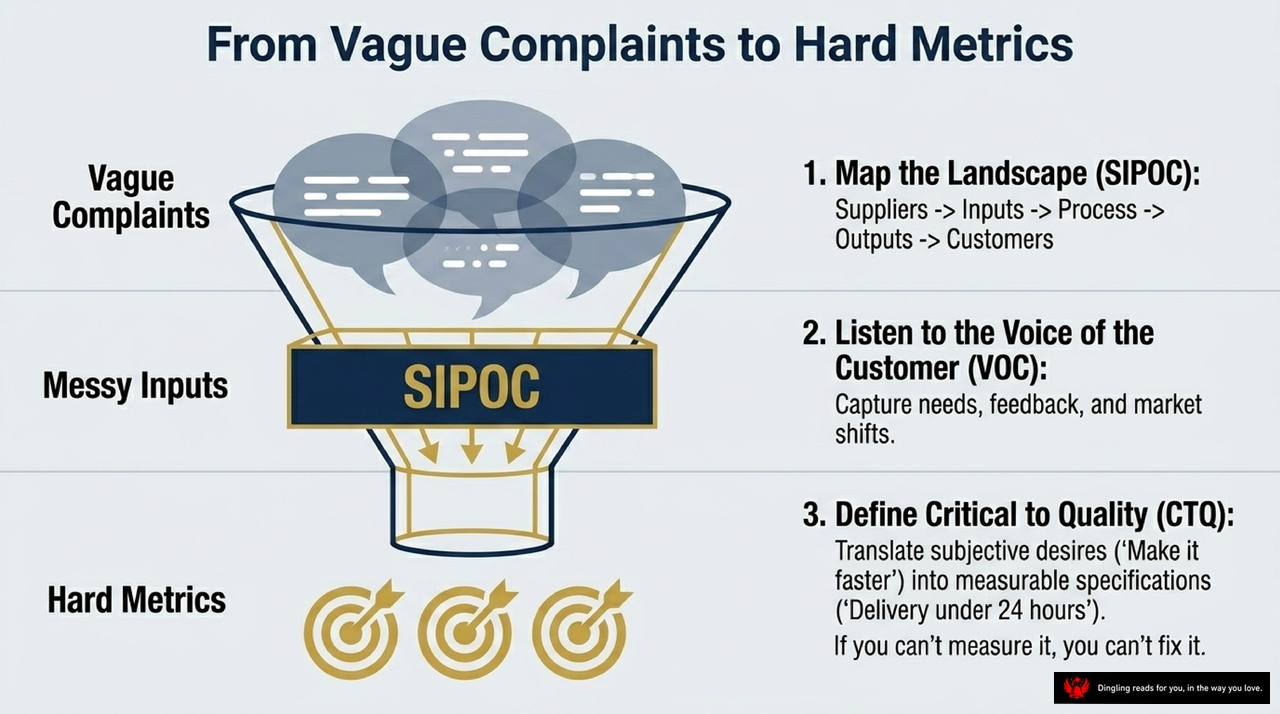
From vague complaints to hard metrics, this slide outlines the exact funnel we need to build to turn customer noise into actionable data. Imagine your team receiving feedback like "make it faster" or "it's too messy." That's the top of the funnel: vague complaints and messy inputs. If we stop there, we're just guessing.
The solution starts with Step 1: Map the Landscape using SIPOC. This forces us to look beyond our own department. We trace the flow from Suppliers, through Inputs and the Process itself, all the way to Outputs and our Customers. This simple visual breaks down the chaos and shows us exactly where value is created or lost.
Next, we move to Step 2: Listen to the Voice of the Customer, or VOC. It's not enough to just have data; we need to capture the real needs, feedback, and market shifts. We have to ask, "What does the customer actually care about?" This ensures our improvements align with what drives their satisfaction, not just what we think is important.
Finally, Step 3 is where the magic happens: Define Critical to Quality, or CTQ. This is where we translate those subjective desires into measurable specifications. Instead of saying "make it faster," we define "Delivery under 24 hours." As the slide reminds us, if you can't measure it, you can't fix it. By converting vague feelings into hard metrics, we give our teams a clear target to hit, turning uncertainty into a roadmap for success.

Look at this graphic. It's a powerful visual metaphor for how we should actually think about business problems. Above the water, we see a mountain peak—the result, the outcome we care about. But below the surface? That's where the real work happens. We have a complex web of connections, and right at the bottom, a magnifying glass is focused on the root causes. This slide is telling us to be wary of the "Usual Suspects."
Too often, organizations jump straight to the mountain at the top. They try to manage the outcome—customer satisfaction, profit, or defects—without understanding what is actually driving it. This slide reminds us that the Analyze phase is all about preventing that mistake. We need to stop managing Y, the result, and instead find and control the critical Xs—the inputs and process variables that actually drive the outcome.
The equation here is simple but profound: Y equals f of X. Y represents the outcome, whether it's customer satisfaction or profit, while X represents the inputs and the variables in our process. The goal is clear: stop guessing and start controlling the levers that move the needle. To do this, we rely on specific techniques like Fishbone diagrams to brainstorm causes, Pareto charts to focus on the vital few, Hypothesis testing to validate our theories, and Process mapping to understand the flow. By digging beneath the surface and focusing on the hidden network of inputs, we move from reacting to symptoms to mastering the system itself.
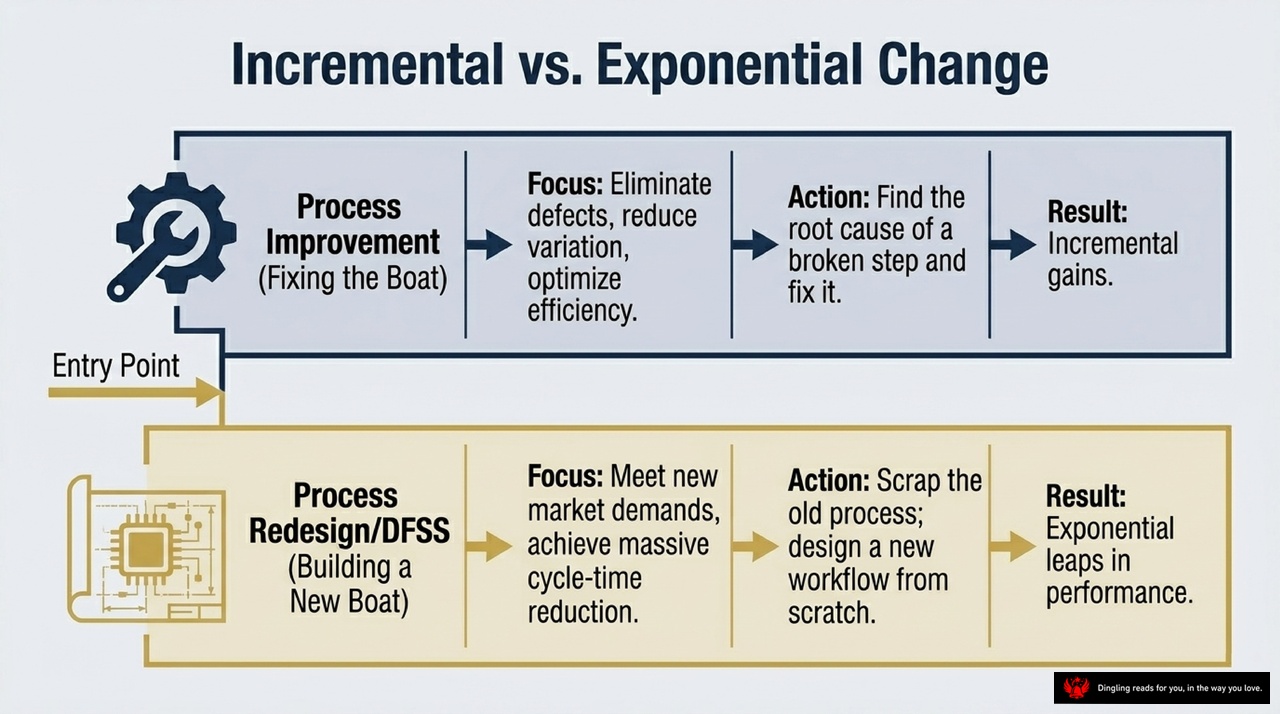
Imagine you're trying to fix a boat. You have two distinct paths to choose from. The first path is **Process Improvement**, often called "Fixing the Boat." Here, the focus is on eliminating defects, reducing variation, and optimizing efficiency. The action is straightforward: find the root cause of a broken step and fix it. The result? Incremental gains. It's about making small, steady improvements to what you already have.
But what if the boat itself is outdated, or the market has changed so much that patching the old hull won't help? That's where the second path comes in: **Process Redesign**, or "Building a New Boat." This approach focuses on meeting new market demands and achieving massive cycle-time reductions. The action here is bold: scrap the old process entirely and design a new workflow from scratch. The result? Exponential leaps in performance.
The image clearly shows that while fixing the boat yields steady, incremental progress, building a new boat from the ground up creates exponential leaps. Six Sigma doesn't force you to choose one over the other; instead, it equips you with the tools to decide which strategy fits your current reality. Are you just tuning an engine, or do you need to build a new vehicle to win the race? Understanding this distinction is the key to unlocking true organizational transformation.
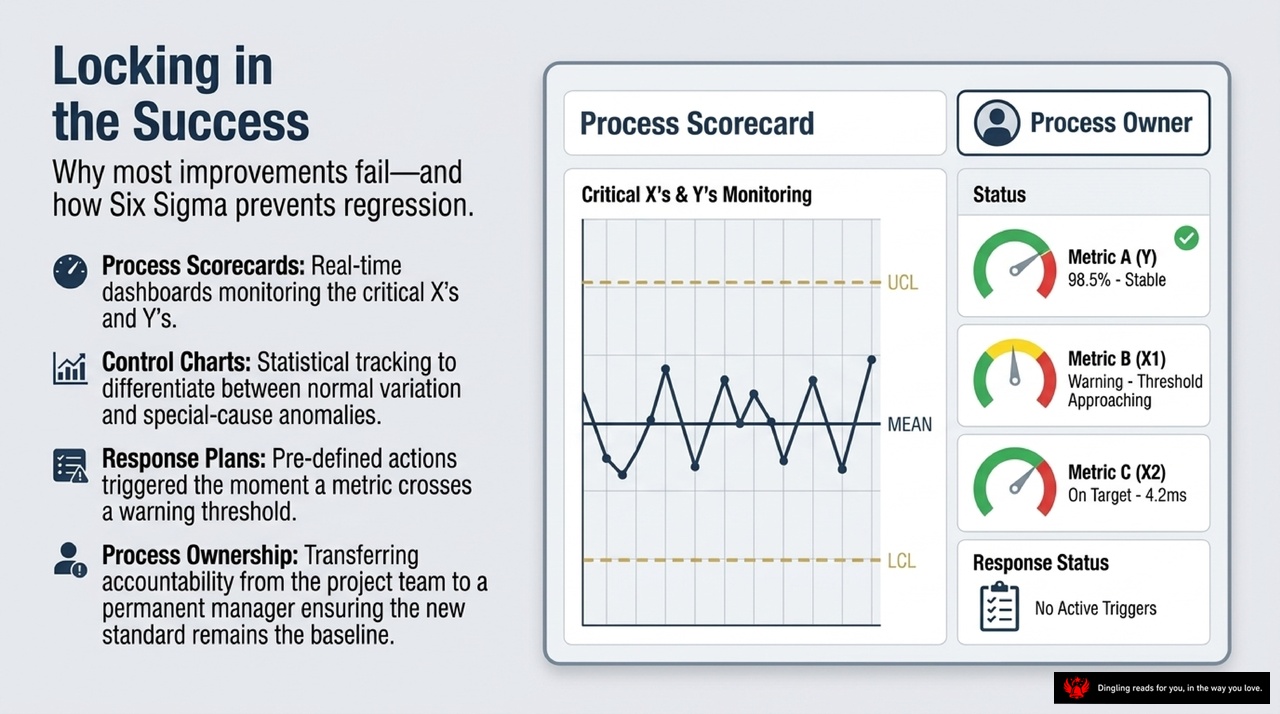
Most improvements fail because organizations lack a system to lock in their success. Without a control mechanism, gains are often temporary, and performance quickly reverts to old habits. That's where Six Sigma's "Control" phase becomes the difference between a one-time project and lasting transformation.
Look at this Process Scorecard on the right. It's the heartbeat of a mature Six Sigma operation. Notice the "Process Owner" assigned to the right? This is critical. We are transferring accountability from the project team to a permanent manager. This ensures the new standard isn't just a temporary fix, but the new baseline for the business.
The dashboard itself does the heavy lifting. On the left, we see a Control Chart tracking critical inputs and outputs. It uses statistical limits—UCL and LCL—to differentiate between normal variation and special-cause anomalies. If the data points stay within these boundaries, the process is stable. But if a metric, like Metric B, starts approaching a warning threshold, the system doesn't wait for a complaint.
Instead, pre-defined Response Plans are triggered automatically. As the slide notes, these are actions ready to go the moment a metric crosses a line. In the example, Metric A is stable at 98.5%, and Metric C is on target, so there are currently no active triggers. But the readiness is what matters. By combining real-time monitoring with clear ownership and immediate response plans, we eliminate the "drift" that kills most improvement initiatives. This isn't just about data; it's about building a self-correcting organization that stays in control, day after day.

Let's talk about how to avoid the "World Hunger" projects—the kind of initiatives that sound noble but ultimately drain your resources without delivering real value. As the slide suggests, a failed project is usually just a poorly selected one. The key is to pick battles you can actually win.
To do this, we need to apply a simple but powerful selection criteria framework. Look at the chart: it plots projects based on their **Impact** on the customer versus their **Feasibility** or effort required.
On the vertical axis, we ask about impact: Does this tie to our strategic goals? Will it lower our Cost of Poor Quality? Most importantly, does the customer actually care? If the answer is no, it's likely a low-priority project.
On the horizontal axis, we look at feasibility: Is the scope manageable? Can we complete this in 3 to 6 months? Do we even have the data we need? If a project is too complex or vague, it risks becoming a long-term drain rather than a quick win.
The sweet spot is the top-right quadrant, marked by that golden target icon. This is where we apply **The Golden Rule**: Focus on a meaningful, scoped problem where the root cause is unknown and the solution isn't pre-determined. This is where real innovation happens.
Conversely, we must avoid the "World Hunger" projects—those that try to solve massive, undefined problems without a clear path or customer demand. By sticking to high-impact, manageable projects, we ensure that every effort we make drives real business value and sustainable success.

So, here is the final takeaway from our deep dive into Six Sigma. Remember, it's so much more than just a statistical metric or a fancy quality tool; it's a complete cultural transformation. It fuses deep, empathetic customer understanding with rigorous, data-driven analysis to dismantle those pesky silos, eliminate hidden costs, and engineer sustainable, world-class business processes.
The big question we need to ask ourselves now is: Are you merely reacting to today's business fires, or are you engineering the processes that will prevent them tomorrow? True success isn't about putting out fires as they happen; it's about building a system where those fires simply can't start. That's the power of a holistic Six Sigma approach.