
The Social Animal: Complete Chapter-by-Chapter Summary
Welcome to our deep dive into *The Social Animal* by Elliot Aronson. Think of this book as a behavioral blueprint, designed to decode the invisible forces that actually govern our thoughts, actions, and relationships. We often believe we are the captains of our own ships, but Aronson reveals that we are constantly navigating a world shaped by external pressures and internal drives we rarely see. From the moment we wake up, we are influenced by everything around us—whether it's how our friends shape our political views, how a teacher's encouragement changes a student's confidence, or how a stranger's behavior dictates where we go to find the restroom. This isn't about mind control; it's about understanding the powerful, often unconscious, social currents that pull us in specific directions. As we begin this journey, remember that understanding these invisible forces is the first step to taking back control of our own lives.

Imagine you are standing in a blueprint, staring at a single, simple stick figure on the left. To the naked eye, it looks like a perfectly rational person. This is what we call "The Illusion." We often believe that individuals are entirely rational agents, and that when someone acts "crazy"—like the members of a cult committing mass suicide or a teacher falsely blaming innocent students for a tragedy—it is because they are inherently flawed or mentally unstable. We assume their behavior is the exclusive domain of "crazy" people.
But look at the right side of the screen. Now, that same stick figure is surrounded by a chaotic storm of arrows pointing in every direction. This represents "The Reality." The truth is, people who do crazy things are not necessarily crazy at all. As the schematic note from the famous Zimbardo Prison Study reminds us, normal, healthy individuals placed in a highly structured, oppressive environment will rapidly adapt their behavior to fit the situational architecture. Systemic pressures often overpower our innate personality traits.
This visual contrast captures the essence of Aronson's First Law: the environment is a powerful architect. When you see a group of ordinary people behaving irrationally, don't immediately label them as broken. Instead, look at the arrows around them. Ask yourself what kind of social structure, what kind of pressure, or what kind of "situational architecture" is pushing them in those directions. The most profound insights in social psychology come from realizing that we are not just individuals acting alone, but people responding to the invisible forces shaping our world.

Imagine the human mind not as a fortress of logic, but as a complex, industrial machine designed to process social input. Today, we're looking at the "Architecture of Conformity," a blueprint that reveals exactly how the average individual gets swept up by the crowd.
This diagram visualizes two powerful pipelines driving us toward conformity. The first, labeled "The Need to Be Accepted," is driven by the fear of punishment and the desire for reward. It's the primal instinct to avoid social rejection. We align with the group not necessarily because we agree, but because we want to belong. The second pipeline, "The Need to Be Right," operates on a different logic. When reality is ambiguous or unclear, we stop trusting our own eyes and instead use the behavior of others as a navigational heuristic to define "social reality." We look around to see what is true, rather than figuring it out ourselves.
This schematic note at the bottom references the famous Asch Paradigm, which proves just how powerful this structural weight of social consensus can be. In that experiment, individuals knowingly denied the evidence of their own eyes—judging line lengths incorrectly—just to align with a unanimous group. It demonstrates that the pressure to fit in can override our basic sensory perception.
Ultimately, this architecture shows that conformity isn't just about weakness; it's a fundamental human strategy for navigating a world where we need to know where we stand and where we belong. Whether we are seeking acceptance or trying to find the truth, we are constantly being pulled into this shared social flow.
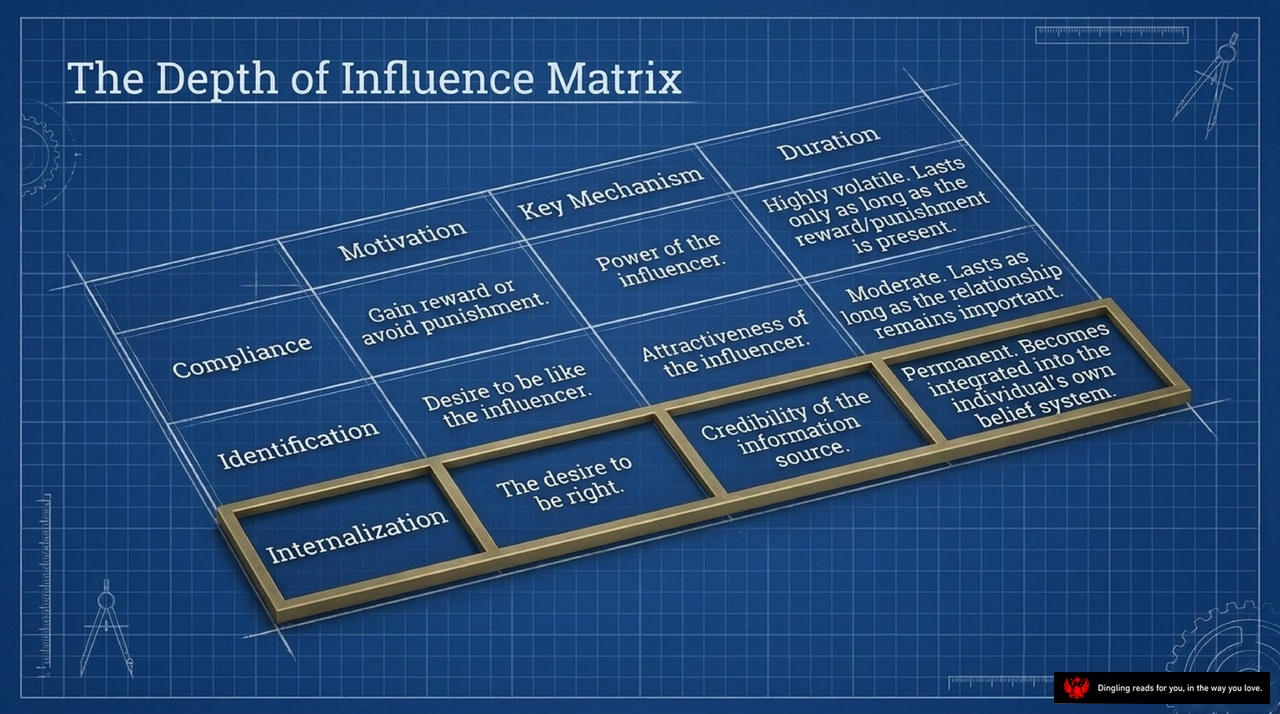
Have you ever wondered why you trust a friend's advice or why you suddenly adopt a new belief? It all comes down to how deeply that influence has taken root. Today, we're looking at "The Depth of Influence Matrix" to understand the three levels of social impact: Compliance, Identification, and Internalization.
At the surface, we have Compliance. This is the shallowest form of influence, driven by the desire to gain a reward or avoid punishment. The key mechanism here is simply the power of the influencer. Think about it: you follow a rule only because you fear a fine, or you agree with a boss just to keep your job. As the matrix shows, this type of influence is highly volatile. It lasts only as long as the reward or punishment is present. Once the pressure is gone, the behavior disappears too.
Moving deeper, we reach Identification. Here, the motivation shifts from fear or greed to a genuine desire to be like the influencer. You follow someone because they are attractive, charismatic, or someone you admire. The key mechanism is the attractiveness of the influencer. This lasts moderately, enduring as long as that relationship remains important to you. If you stop admiring the person or the relationship fades, your influence fades with them.
But the most profound level is Internalization. This is where influence becomes permanent. The motivation here is the desire to be right, to align with what you believe is morally or intellectually correct. The key mechanism isn't the person's power or attractiveness, but the credibility of the information source. When you internalize a belief, it integrates into your own belief system. You don't just follow the rule; you own it. That's why internalized beliefs are so resilient—they become part of who you are, regardless of external pressure. Understanding this matrix helps us see not just what we do, but why we do it.
We often assume that our actions are driven purely by our conscious beliefs, but the reality is far more subtle. What actually steers our behavior is often an invisible sense of feeling, a gut instinct shaped by the information we've already absorbed. This is where the "primacy effect" comes into play. Think of it like a hidden compass: the first piece of information we receive about a person or situation quietly adjusts our entire mental map, influencing every subsequent judgment and action we take.
Consider the classic experiment by Paul Hull. He showed participants a list of names—some filled with hostility, others with warmth—before asking them to evaluate a person named Donald. Those who saw the hostile names perceived Donald as aggressive, while those who saw the warm names saw him as cooperative. But here's the twist: this initial feeling didn't just change their perception; it changed their behavior. In a follow-up negotiation game, participants who felt Donald was friendly actually cooperated with him, and Donald responded in kind. Those who felt he was hostile competed fiercely, prompting a hostile response in return. The participants didn't realize they were being manipulated; they simply followed their gut, which had already been set by the first clue.
This dynamic creates a self-fulfilling prophecy. If you walk into a meeting assuming someone is unfriendly, you'll act defensively, and they will likely respond in kind, confirming your bias. Conversely, a positive first impression can unlock cooperation and trust. Our feelings act as the silent director of our actions, often overriding our rational analysis. In high-pressure situations, like a heated negotiation or a crisis, this emotional hijacking becomes even stronger. We might make impulsive, irrational choices based on a fleeting feeling of anger or fear, mistaking our emotional reaction for a logical conclusion.
Understanding this mechanism doesn't mean we should ignore our instincts. Instead, it empowers us to pause and check them. Before acting on a gut feeling, we can ask ourselves: "What initial information shaped this feeling? Is my reaction based on facts, or just a bias I activated earlier?" By bringing this hidden process into the light, we can break the cycle of self-fulfilling prophecies and make choices that truly align with reality, rather than just our preconceived narratives.

We often think our actions are driven by conscious logic, but the truth is far more primal: we are actually guided by our gut feelings. These intuitive reactions are often shaped by a hidden psychological trap known as the "priming effect." Think of it like an invisible compass that subtly adjusts your direction before you even realize you've turned.
In a classic experiment, researchers exposed participants to two different sets of names before asking them to judge a person named Donald. One group saw names associated with hostility, while the other saw names suggesting kindness. Here is where it gets fascinating: the group primed with hostile names actually rated Donald's behavior as more *gentle*, while those primed with kind names saw Donald as more *aggressive*. Their initial exposure completely flipped their perception of reality.
This bias doesn't stop at perception; it directly drives our behavior. In a follow-up negotiation game, participants who felt Donald was "gentle" automatically adopted a cooperative strategy. Donald, playing along with their projected reality, responded with kindness. Conversely, those who felt he was "aggressive" immediately switched to a competitive stance, prompting Donald to fight back. The result? A self-fulfilling prophecy where our initial, unseen feelings created a reality that confirmed those very feelings.
Our emotions also act as silent commanders, often hijacking our rational decision-making. When we feel angry, we underestimate risks and act impulsively; when we feel fearful, we become paralyzed. In high-pressure situations, this intuition takes over completely, turning us into social animals reacting to immediate cues rather than thoughtful planners.
Understanding this mechanism is crucial. It means we aren't always "following our hearts"—we are often being led by invisible information we never consciously processed. By recognizing how these subtle cues shape our choices, we can pause, reflect, and ensure our actions truly align with our intentions, rather than falling into a trap of our own making.
Welcome to the final chapter of our journey into the human mind. Today, we're decoding the very architecture of prejudice.
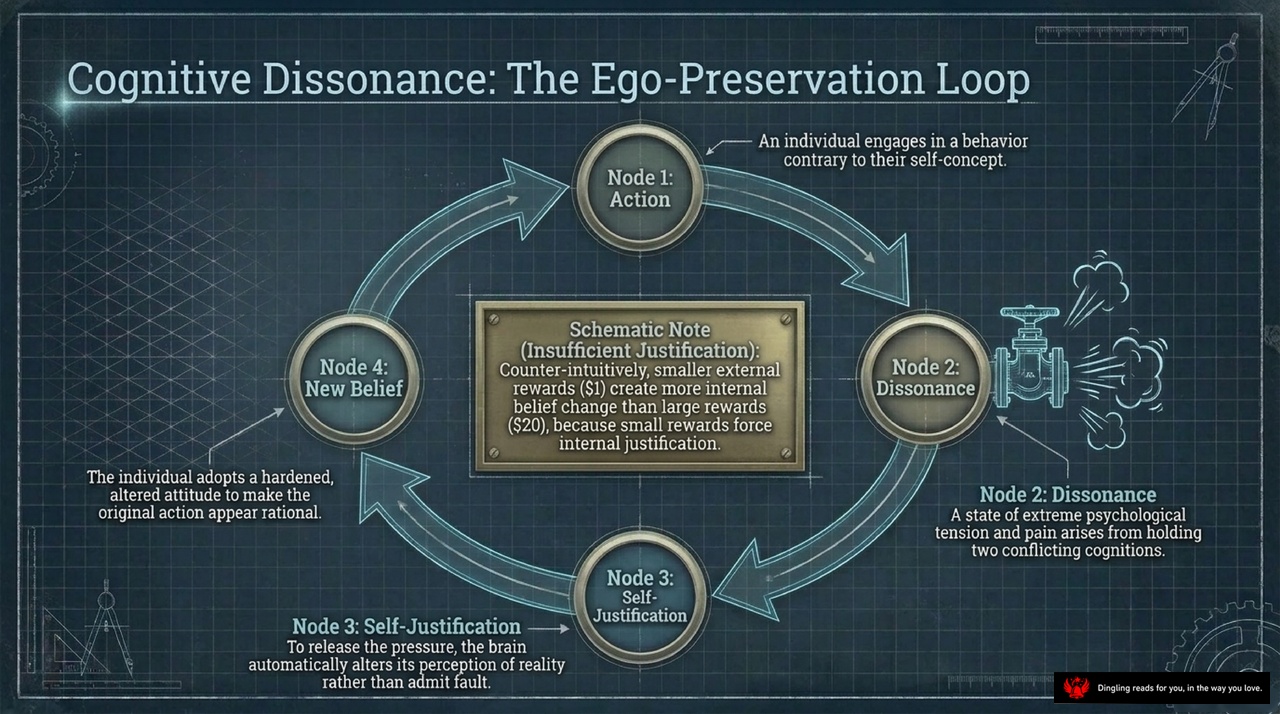
The slide you see right now maps out a powerful cycle known as "Cognitive Dissonance: The Ego-Preservation Loop." It explains why we cling so tightly to our beliefs, even when the evidence against them is overwhelming.
Let's break down this loop. It starts at **Node 1: Action**. This happens when an individual engages in a behavior that contradicts their self-concept. Perhaps you know you value honesty, but you just told a lie to save face.
That clash immediately triggers **Node 2: Dissonance**. As the graphic illustrates, this is a state of extreme psychological tension and pain arising from holding two conflicting cognitions. It feels like a valve exploding, creating mental discomfort that our brains desperately want to resolve.
To escape that pain, we move to **Node 3: Self-Justification**. Here, the brain automatically alters its perception of reality rather than admitting fault. Instead of saying, "I lied," we convince ourselves, "They deserved it," or "That wasn't really a lie." We rewrite the story to make our actions feel rational.
This leads us to **Node 4: New Belief**. The individual adopts a hardened, altered attitude to make the original action appear rational. The lie becomes truth in our minds, and the new belief is often stronger than the old one.
Notice the central **Schematic Note** on the diagram? It highlights the "Insufficient Justification" effect. Counter-intuitively, smaller external rewards create more internal belief change than large ones. When the reward is small, our brains are forced to generate deep internal justification to make sense of our actions.
This entire loop is the engine behind prejudice and stereotypes. As we discussed in Chapter 7, when we hold a negative view of a group but are forced to interact with them peacefully, that interaction creates dissonance. To resolve it, we don't change our behavior; we change our belief. We convince ourselves the other group is "different" or "less competent" so that our peaceful coexistence doesn't feel like a betrayal of our original prejudice.
Understanding this ego-preservation loop is crucial. It shows us that changing someone's mind isn't just about presenting facts. If we force a new fact upon them without addressing the underlying tension, they will simply spin a new justification to protect their ego. To truly shift beliefs, we must help them enter the loop themselves, guiding them to generate their own internal justifications for change.
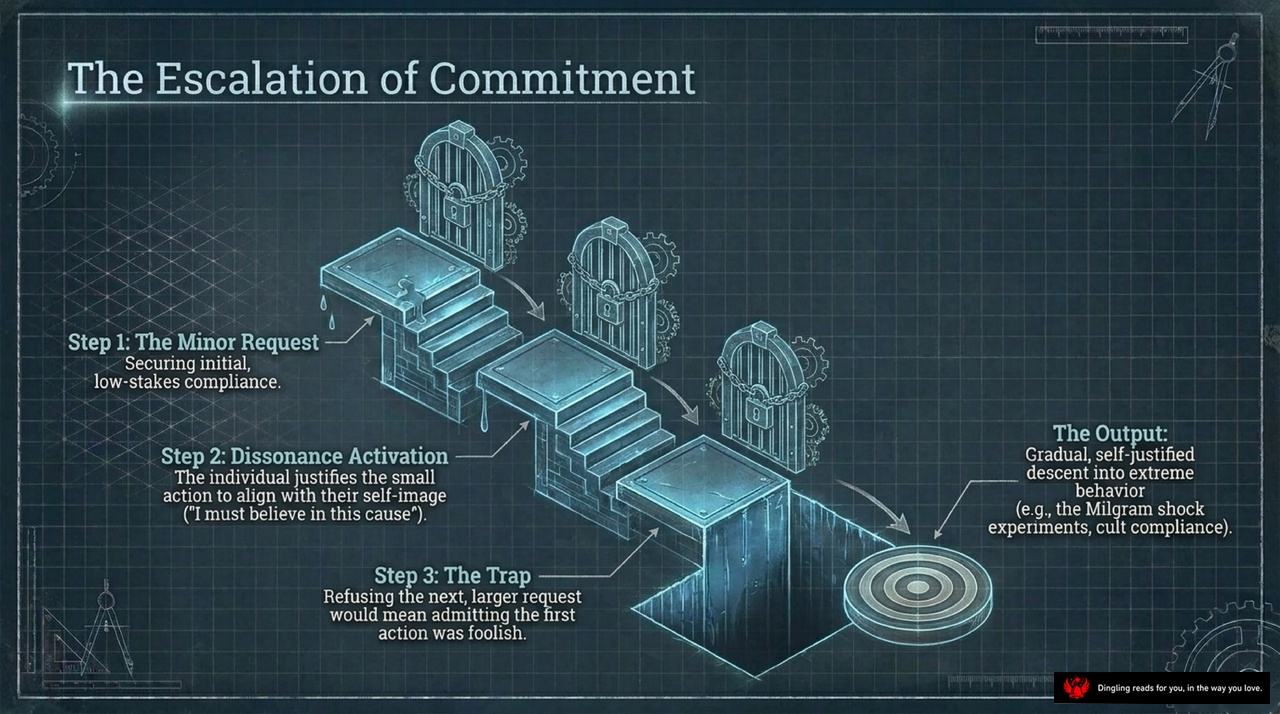
The Escalation of Commitment is a powerful psychological trap where we slowly slide from a small decision into something extreme, all while convincing ourselves we made the right choices along the way. Imagine this process as a staircase leading down into a deep well.
It starts with Step 1: The Minor Request. This is about securing initial, low-stakes compliance. We agree to something small and harmless, perhaps a tiny donation or a minor favor, because the risk feels negligible.
Once we take that first step, we enter Step 2: Dissonance Activation. Here, the individual justifies the small action to align with their self-image. We tell ourselves, "I must believe in this cause" or "I am the kind of person who helps." This internal justification is the glue that holds us to the path.
Then comes Step 3: The Trap. This is the critical moment. Refusing the next, larger request would mean admitting that our first action was foolish. Because we've already invested our identity into believing we are good or right, walking back now feels like a personal failure. So, we keep going, committing to bigger and bigger demands.
The output of this entire process is a gradual, self-justified descent into extreme behavior. We end up in situations we never originally wanted, like the tragic compliance seen in the Milgram shock experiments or the heartbreaking group suicides in cults. We didn't jump off the cliff; we simply kept taking the next step, unable to admit we were already over the edge.
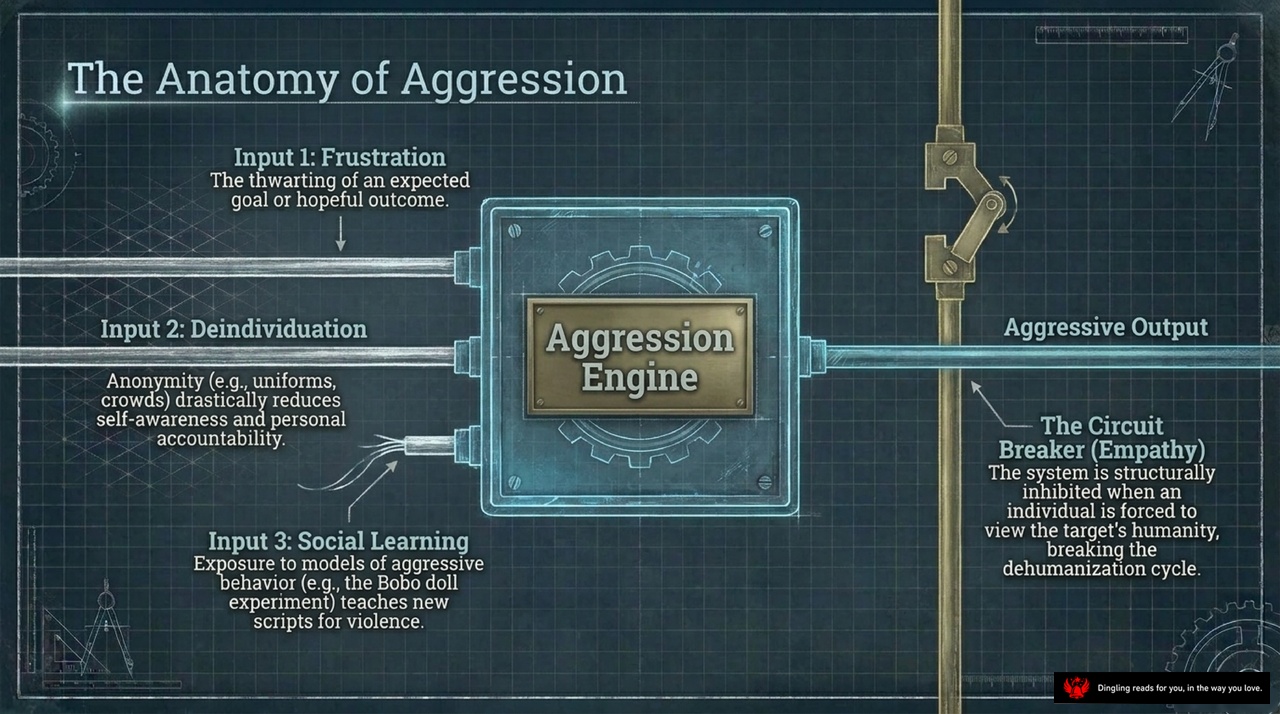
Have you ever stopped to think about why you instantly dislike someone the moment you meet them, or why you suddenly feel a surge of anger toward a stranger? It's often not about what they actually did, but about a hidden psychological mechanism at work.
This slide, titled "The Anatomy of Aggression," breaks down exactly how that happens. Think of it as a blueprint for the "Aggression Engine" inside our minds.
It all starts with two key inputs. First, we have **Frustration**. The text defines this simply: it's the thwarting of an expected goal or a hopeful outcome. When your plan fails or your hopes are crushed, that frustration fuels the engine.
The second input is **Deindividuation**. This is the state where you lose your sense of self. The slide explains that anonymity—like wearing a uniform, being in a massive crowd, or feeling faceless—drastically reduces self-awareness and personal accountability. When you don't feel like an individual responsible for your actions, the brakes on your aggression disappear.
These two inputs feed into the engine, but there's a third critical factor: **Social Learning**. We learn how to be aggressive by watching others. The slide mentions the famous "Bobo doll experiment," which showed that when we are exposed to models of aggressive behavior, we essentially learn new scripts for violence. We copy what we see.
Now, here is the good news. The slide shows a vital safety feature on the right side: **The Circuit Breaker**. This is **Empathy**. The text explains that this system is structurally inhibited when an individual is forced to view the target's humanity. When we can see the person behind the action, we break the dehumanization cycle. Empathy acts as the switch that stops the aggression engine from firing.
So, aggression isn't magic. It's a reaction to frustration and anonymity, amplified by what we've learned from others, but it can always be stopped by reconnecting with our empathy.

Imagine you are watching a pressure cooker built right into society. When the system gets too hot with complex frustrations—like economic depression or political anger—those feelings are too abstract to attack directly. So, the system violently redirects that steam toward a visible, relatively powerless target. This is what we call the "Scapegoat Valve." It's a mechanism where deep systemic anger is simply sprayed onto a minority group, making them the convenient outlet for everyone else's stress.
But here's the terrifying part: this doesn't just happen once and stop. It creates a self-fulfilling loop. It starts with a preconceived expectation—a stereotype. Because you believe a certain group is cold or distant, you unknowingly act cold and distant toward them yourself. When they respond with anxiety or defensiveness to your coldness, you take that reaction as proof that your original stereotype was right. You confirm your bias, which makes you act colder again, and the cycle repeats endlessly.
This is the mechanics of prejudice. It's not just about hating people; it's about how our beliefs shape our behaviors, and how those behaviors then force the people we judge to act in ways that validate our hate. We are trapped in a continuous cycle where our initial assumptions create the very reality we fear. Understanding this loop is the first step to breaking it.

The Jigsaw Synthesis is all about redesigning the environment so that no one can succeed without their peers. Look at the shift from that chaotic web of arrows representing zero-sum competition, where everyone is pitted against each other for scarce rewards, to this interlocking structure of mutual interdependence.
In traditional settings, breeding hostility and amplifying psychological divides is the norm. But by restructuring the environment, we create a system where vital information is held by your peers, making it impossible to win alone. This structural change forces active listening and shatters cognitive biases. It doesn't just encourage empathy; it structurally engineers it out of necessity. When your success literally depends on your neighbor's success, you stop competing and start collaborating. That is the power of designing systems where interdependence is the only path forward.

Look at this graph, titled "The Economics of Attraction." It visualizes a powerful psychological principle known as the Gain-Loss Theory. The core idea is simple but profound: we value rewards more when they increase, and we hate losses far more than we appreciate gains.
Notice the curve labeled "1." This represents a relationship where affection grows over time. As the other person's opinion of us shifts from neutral to positive, we feel a surge of attraction. Earning affection validates our ego far more than just receiving guaranteed, constant love. We are most drawn to someone who starts off neutral or even negative, but then gradually warms up to us. That rising slope is where the magic happens.
On the flip side, look at the curve labeled "3." This shows affection shifting from positive to negative. When someone we liked starts to pull away or become critical, the pain is intense. A drop from love to hate hurts our ego much more than steady, mild negativity ever could. This is the "Maximum Loss."
The lesson here is clear: relationships thrive on dynamic change, not static stability. Whether it's a boss, a partner, or a friend, we crave the journey of gaining their approval. Conversely, we dread the moment we lose it. Understanding this economy of attraction helps us see why effort and growth matter so much in building deep connections.

The Blueprint for Straight Talk transforms how we communicate by shifting from judgment to connection. Instead of starting with labels or insults—like calling someone a hypocrite, which triggers defensive walls—we move toward system correction. This means identifying the vulnerable emotion driving the anger, such as jealousy or fear, and then expressing that internal vulnerability directly. By saying, "I feel insecure when you do that," we remove the attack vector and open the communication network. This approach replaces judgment with empathy, allowing us to connect authentically rather than fighting defensively.

Imagine our minds as a complex map, constantly plotting our place in the world. Today, we're looking at "The Matrix of the Social Animal." This isn't just a diagram; it's a blueprint of how we think, feel, and act when we're around others.
On the left, we have our "Internal Cognitive Forces." These are the mental shortcuts and biases we use to save energy. Think of it as our brain's lazy mode. We rely on heuristics, like assuming a expensive wine is better just because of the price, or letting our first impression of someone completely color how we judge their entire character. We might even distort our memories to fit a story we want to believe about ourselves, or ignore evidence that contradicts what we already think is true. These internal forces push us toward self-justification and empathy, but they can also lead us down the path of cognitive miser heuristics, where we oversimplify reality.
On the right, we have the "External Social Forces." This is the pressure from the group, from authority, and from the culture around us. We might feel the pull to conform, to follow a leader without question, or to distance ourselves from an out-group. These forces can trigger destructive outcomes like scapegoating or blind conformity, but they can also drive us toward constructive ones like mutual interdependence and straight talk.
The center of this matrix represents the outcome of where these two worlds intersect. We see two poles: Constructive Outcomes and Destructive Outcomes. The text at the bottom reminds us of a crucial truth: "The social animal is not fixed; we are the dynamic output of where these coordinates intersect." This means we aren't stuck with our biases or our social pressures. We are dynamic. Every time we choose to question a stereotype, to listen deeply instead of just reacting, or to stand up for someone different from us, we shift our position on this matrix. We move from destructive patterns toward constructive ones. Understanding this matrix gives us the power to see why we do what we do, and more importantly, gives us the tools to choose a better path.

We are not perfectly rational beings; we are, in fact, highly rationalizing creatures locked in a complex architecture of social influence. Driven by a profound need to belong, to be right, and to protect our egos, we constantly construct narratives to justify our actions and beliefs. This slide asks us to confront a pivotal question: if our environments possess the invisible power to shape our greatest hostilities and our deepest conformities, what kind of architectures will you choose to build tomorrow?
Think about it. We often believe we act based on pure logic, yet we are constantly swayed by the "invisible hand" of our surroundings. Whether it's the pressure to conform in a group, the authority of a leader, or the subtle biases embedded in our culture, these forces quietly rewrite our choices. The question isn't just about understanding these forces; it's about taking responsibility. It's about recognizing that while we are shaped by these architectures, we also have the power to design new ones. So, when you step into your own world tomorrow, will you build an environment that fosters understanding and growth, or one that reinforces division and fear? The blueprint is in your hands.