
The Sovereign Individual: Complete Chapter-by-Chapter Summary
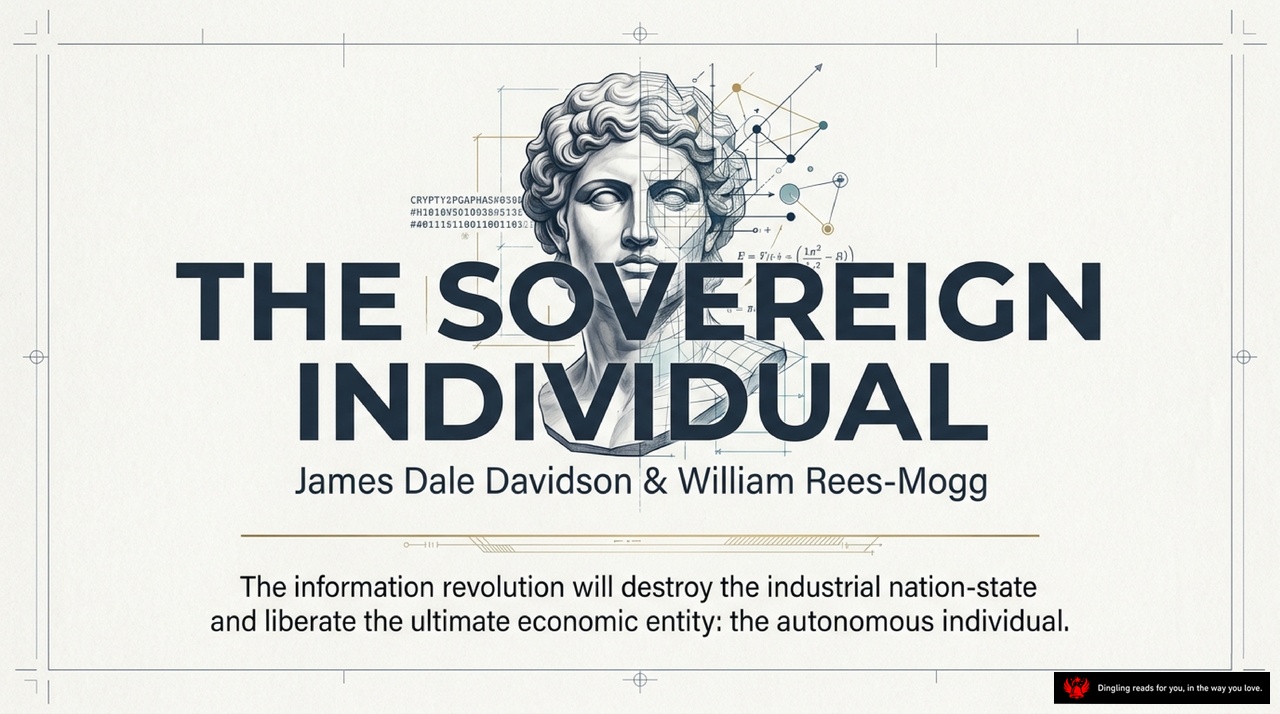
Welcome to the beginning of our journey into the future. Today, we are diving into a bold new vision for humanity, introduced by James Dale Davidson and William Rees-Mogg in their groundbreaking work, *The Sovereign Individual*.
As you see on this slide, the central theme is powerful: "The Sovereign Individual." The image itself—a classical bust merging with digital networks and cryptic code—perfectly captures the collision between our ancient past and our technological future.
The authors make one striking prediction that sets the tone for the entire book: "The information revolution will destroy the industrial nation-state and liberate the ultimate economic entity: the autonomous individual."
Think about that for a moment. For centuries, your life was defined by the borders of your country and the power of your government. But the authors argue that the very tools we use to connect—computers, the internet, and advanced technology—are actually dismantling the old system. They believe we are moving from an era where the state controls everything, to one where the individual takes control of their own destiny, becoming truly sovereign.
This isn't just about escaping taxes or living off the grid; it's about a fundamental shift in how power works. The nation-state, once the undisputed ruler of human affairs, is about to lose its monopoly on violence and protection. In its place, we are heading toward a world where you can choose your own laws, your own currency, and your own community, just like choosing a product in a store.
We are standing on the threshold of a new age, where the most powerful entity in the world is no longer a government, but a single, autonomous person armed with information and technology. Let's explore what this means for the future.

Unlike the slow burn of the Agricultural Revolution or the centuries-long Industrial Revolution, the Information Revolution is happening in a single generation. This isn't just a timeline shift; it's a fundamental rewiring of how power works.
Look at this progression. We started with the Hunter-Gatherer Society, nomadic and low on resource accumulation. Then came the Agricultural Society, where we became tied to the land and vulnerable to local violence. The Industrial Society followed, bringing massive scale and centralized factory wealth. But now, we are entering The Information Society. Here, the battlefield is Cyberspace, and the new currency is High Cognitive Capital.
This shift means the logic of violence is changing. In the industrial era, power relied on controlling physical resources and fixed factories. Today, the most valuable asset is your ability to process information. Those who can leverage their cognitive capital will dominate, while those clinging to old territorial monopolies will be left behind. The future belongs not to the biggest armies, but to the most efficient minds.

The scale on your screen perfectly illustrates the shifting rules of power we are living through. On the left, the heavy anvil represents the Industrial Age, where violence was incredibly profitable. That era belonged to centralized mega-states and large corporations because they could leverage massive scale to dominate. But look at the right side: the Information Age. Here, the shield represents a high cost of protection and low returns on violence. This shift is why we are seeing a move away from big, centralized states toward decentralized individuals and smaller, more agile entities.
This isn't about politicians or philosophers choosing the future; it's about "Megapolitics"—the invisible forces of technology, geography, and climate that dictate the economic efficiency of force. When technology changes the cost of doing business, the entire structure of society must adapt. We are witnessing the end of the era where size meant power, and the dawn of an age where efficiency and information are the ultimate currency.

Welcome to the next chapter of our deep dive into the future of power. Look at this illustration titled "The Zenith of the Nation-State." It captures a critical turning point in history: the era when the modern nation-state reached its absolute peak in efficiency, only to set the stage for its own inevitable collapse.
The image breaks this down into three distinct mechanisms. First, notice the industrial complex on the left, labeled "Stationary Assets." This represents the industrial era's reality: wealth was purely physical—factories, land, and heavy machinery. Because these assets were fixed in specific locations, they were impossible to hide or move. This immobility made them perfect targets for extraction.
This leads directly to the second point in the center: "The Extortion Model." During this time, governments didn't just protect us; they monopolized violence to disguise it as protection. In reality, it was a sophisticated system of extortion designed to extract the maximum possible surplus from the very populations they claimed to serve. The state became the ultimate rentier, demanding a cut of every dollar produced.
And that brings us to the third box on the right: "The Milked Cow Paradigm." Here, citizens were treated not as partners, but as stationary assets—essentially cows kept in a pasture to be milked by predatory taxation. The entire welfare state, which we often romanticize, was actually the most efficient machine ever built for resource extraction. It thrived specifically because it could mobilize vast amounts of wealth to fund mass warfare, creating a feedback loop where the state grew stronger by taking more from its people.
The key insight at the bottom ties it all together. Democratic welfare states weren't benevolent utopias; they were the most effective models for maximizing resource extraction to power global conflicts. However, this system relied entirely on the nation-state's ability to control territory and physical assets. As we move forward, the logic of this entire model is about to be shattered by the rise of the information age, where wealth becomes mobile, intangible, and impossible to tax in the same way. We are leaving the age of the "milked cow" behind and stepping into a new reality where efficiency, not power, will rule.

The slide you see here is titled "The Catalysts of Liberation," and it visualizes the two powerful technologies that are dismantling the old world order: the microprocessor and public-key cryptography.
Let's look at the microprocessor first. The text on the left explains that it decentralizes computing power and shifts the basis of wealth from physical capital to cognitive capital. This is the engine of the information age. It allows intelligence to be distributed, meaning power is no longer concentrated in the hands of a few who control factories or land. Instead, power moves to those who control data and ideas.
On the right, we see the geometric representation of public-key cryptography. The slide highlights two critical points: it renders digital wealth invisible and un-seizable, and it strips governments of the ability to forcefully audit or confiscate assets. This is the shield. Just as the microprocessor gave us the ability to process information, cryptography gives us the ability to protect it. It creates a digital fortress where your assets cannot be seized by a central authority, no matter how much power they claim to have.
The footer of this slide ties these two concepts together with a powerful metaphor: "Cyberspace becomes the ultimate offshore jurisdiction—a diamond-studded Bermuda in the sky immune to physical violence." This is the culmination of the previous points. By combining the processing power of the microprocessor with the security of cryptography, we have created a new realm. It is a space where the rules of the industrial nation-state no longer apply. You are no longer bound by the geography of a specific country or the reach of its police force. You can move your wealth and your identity across borders instantly and securely, effectively bypassing the traditional mechanisms of control.
Together, these two catalysts are forcing a fundamental shift. They are turning the internet from a tool of communication into a parallel economy where efficiency and security trump the monopoly of the state. This is the beginning of a new era where individuals, not governments, hold the keys to their own sovereignty.

The Rise of the Sovereign Individual isn't just a catchy title; it's the blueprint for the future we are actually building right now. Imagine a world where your brainpower and ideas are the ultimate currency, far more valuable than land or factories. This is the era of the Cognitive Elite, where intellectual capital reigns supreme.
But it gets even more radical. In this new order, we move toward Absolute Meritocracy. Think about it: in the digital realm, your race, gender, or age simply don't matter. Anonymity strips away all those old-world prejudices, leaving only your skills and output to define your worth. It's a pure meritocracy, unburdened by the physical limitations of the past.
And where can you operate? Nowhere you've ever been before. We've achieved Untethered Mobility. You are no longer bound by political borders or geographic confines. Whether you're working from a cafe in Lisbon or a co-working space in Singapore, the rules of the nation-state no longer apply to your daily life. You are free to move, work, and live wherever the opportunity is best.
This freedom creates something extraordinary: The Digital Olympus. In this realm, a select group of individuals function like the gods of ancient myth. They exist in a space utterly beyond the reach of kings, parliaments, or any form of physical coercion. While traditional governments struggle to keep up, these sovereign individuals build their own systems, protect their own assets, and set their own rules. They have effectively transcended the old world, creating a new reality where efficiency and innovation are the only laws that matter.

Welcome to the next phase of our journey: the shift from the **Industrial Citizen** to the **Sovereign Individual**. This slide captures the fundamental paradigm shift that defines our era.
On the left, we see the legacy of the **Industrial Citizen**. For centuries, you were geographically tied to a single nation, physically visible, and highly taxable. Your relationship with the state was defined by a master-subject dynamic, built on duty and sacrifice. You relied on a monopoly of force—the police and military—to protect you, assuming that safety was a public good provided exclusively by the government.
But look at the right side. This is the emerging reality of the **Sovereign Individual**. You are no longer bound by geography; you are supranational and global. You are digital, encrypted, and infinitely mobile. The relationship has shifted from one of obligation to a contractual one: you are now a customer, and the state is a service provider. Instead of relying on a state monopoly, you can now build your own private encryption and create bespoke security enclaves.
This isn't just about technology; it's about power. The old model assumed that only a nation-state could provide protection. The new model proves that efficiency and personal choice are far more powerful. We are moving from a world where you must obey a local ruler to a world where you can contract for the best protection available, anywhere on the planet. The era of the passive subject is over; the age of the active, sovereign individual has begun.

The End of Egalitarian Economics isn't just a chart; it's a map of the future we're already living in. Look at the shift from the "Turnip" to the "Hourglass." The Turnip represents the Industrial Age, where mass employment and standardized wages created an artificially inflated middle class, propped up by state redistribution. It was a time of relative equality. But the arrow points to a stark new reality: The Hourglass. This is the Information Age, defined by the end of mass employment and a globalized, winner-take-all market.
The Split is the engine driving this change. In our current economy, the top 5% are reaping astronomical rewards based purely on cognitive merit, creating a new class of Information Aristocrats. Meanwhile, they leave behind an expanding underclass of the Information Poor. The logic is simple but brutal: in an industrial factory, everyone pulls the same lever, but in the digital economy, the few who write the code control the entire machine.
Here is the crucial Insight: while income equality between nations might actually increase as technology spreads, inequality *within* nations is set to skyrocket. We are moving from a world where your location mattered less than your labor, to one where your unique intellectual contribution determines your entire fate. The era of egalitarian economics, where hard work guaranteed a decent middle-class life, is over. The future belongs to the hyper-competent and the highly connected, leaving everyone else behind in a shrinking world.

The nation-state is collapsing, and the process is unfolding in five distinct, terrifying stages. First, we see **Capital Flight**, where the cognitive elite and digital wealth flee to cyber-havens, abandoning the state they once built. This triggers **Revenue Implosion**, causing predatory tax revenues to plummet by an estimated 50 to 70%. With the treasury empty, governments move to **Monetary Desperation**, triggering hyperinflation by printing fiat money just to cover their deficits.
But the damage goes deeper. Next comes **Institutional Default**, where unfunded liabilities—welfare, pensions, and state jobs—completely collapse. Finally, the system descends into **Coercion**. Bankrupt states, with no other options left, resort to arbitrary confiscation and capital controls. The era of the nation-state is over; the future belongs to those who can adapt to a world where efficiency replaces monopoly, and where sovereignty is no longer tied to a piece of land, but to the ability to protect and serve.

Imagine the middle-class worker in your neighborhood—the teacher, the engineer, the factory manager who once felt secure. Today, they are the "Left-Behinds." As we've seen, mid-level talents from formerly rich countries are facing a terrifying reality: their jobs are evaporating, and they are demanding a return to the industrial past. This isn't just about nostalgia; it's a desperate reaction to being left behind by the digital revolution.
But here's the dangerous trap they are walking into. We are witnessing a "Moral Anachronism." These groups are applying the moral standards of a dying economic phase to a completely new one. They are projecting old fears onto a future that has no place for their old grievances. What looks like a righteous moral outrage is often just naked self-interest disguised as virtue. They are fighting against technology, not because it's evil, but because it threatens their specific way of life.
And when this backlash becomes too loud, governments will respond. We are entering an era of "The State's Revenge." Instead of adapting, governments may employ neo-Luddite tactics—using censorship, capital controls, and even state-sponsored terror to suppress the very technology that is making them obsolete. They will stop viewing autonomous individuals as citizens and start treating them as enemies of the state. The gears of progress are grinding against the walls of the old order, and the result could be a violent clash that destroys us all.

Look at this map titled "The Privatization of Sovereignty." It's not just a graphic; it's a warning about how the world is fundamentally changing. The image breaks this shift down into three critical pillars.
First, we see "Obsolete Loyalty." The text here is stark: the very concept of citizenship is becoming as romantic and outdated as medieval chivalry. In the past, your loyalty was tied to a specific piece of land and a government that forced you to stay. But today, that bond is dissolving. People are no longer bound by the idea that they must serve a nation just because they were born there.
Next, look at "A La Carte Government." This is the shift from being a taxpayer to being a customer. The slide explains that individuals will soon pay contractual fees for specific, high-efficiency services rather than handing over blanket extortionary taxes to a distant state. Imagine choosing your own insurance, your own legal jurisdiction, or even your own education provider based on what you value, rather than what the government mandates.
Finally, the third point hits hardest: "Customer, Not Citizen." The map illustrates that governments will be forced to compete like businesses. They can no longer rely on force to keep people in line; they must cater to the "cognitive elite" and anyone else with capital to attract their business. If a country is inefficient or too expensive, people simply leave, taking their wealth and innovation with them.
This isn't about the end of government, but the end of the monopoly on power. We are moving from a system where you have no choice but to obey, to a marketplace where you vote with your wallet. The old idea of the "nation-state" as a fixed, unchangeable entity is crumbling, replaced by a fluid world where sovereignty is something you can buy, sell, and customize.

Imagine the digital world not as a single, unified country, but as a chaotic marketplace where dozens of competing "republics" vie for your business. Just as merchants in the Middle Ages formed overlapping guilds to create their own laws and trade protections, today we are seeing the rise of **Cyberspace Republics**.
Look at this diagram. We are moving away from the idea that you belong to just one physical nation. Instead, we are seeing the return of **March Laws**—a system where overlapping, competing sovereignties coexist in the same space.
Consider these three emerging zones. First, the **Digital Economic Zone**. This is the rise of networked commerce guilds, similar to a modern-day "Digital Hanseatic League." These groups offer their own laws and treaty protections, allowing you to trade safely without relying on a single government.
Second, there is the concept of **Leased Sovereignty**. Just as people in the past rented land from weak nations to build tax-free sanctuaries, corporations and private entities are now leasing sovereignty from failing states. They create physical, tax-free enclaves where they can operate freely, effectively bypassing the rules of the nations they physically occupy.
Finally, we have the **Private Security Enclave**. As state power weakens, individuals and companies are taking security into their own hands, creating private zones of protection that operate outside the traditional reach of the police or military.
This shift marks a fundamental change: the era of the nation-state as the sole provider of order is ending. In its place, we are building a world where you can choose your laws, your judges, and your protectors—much like picking a product on a shelf. The future belongs not to the largest country, but to the most efficient republic.
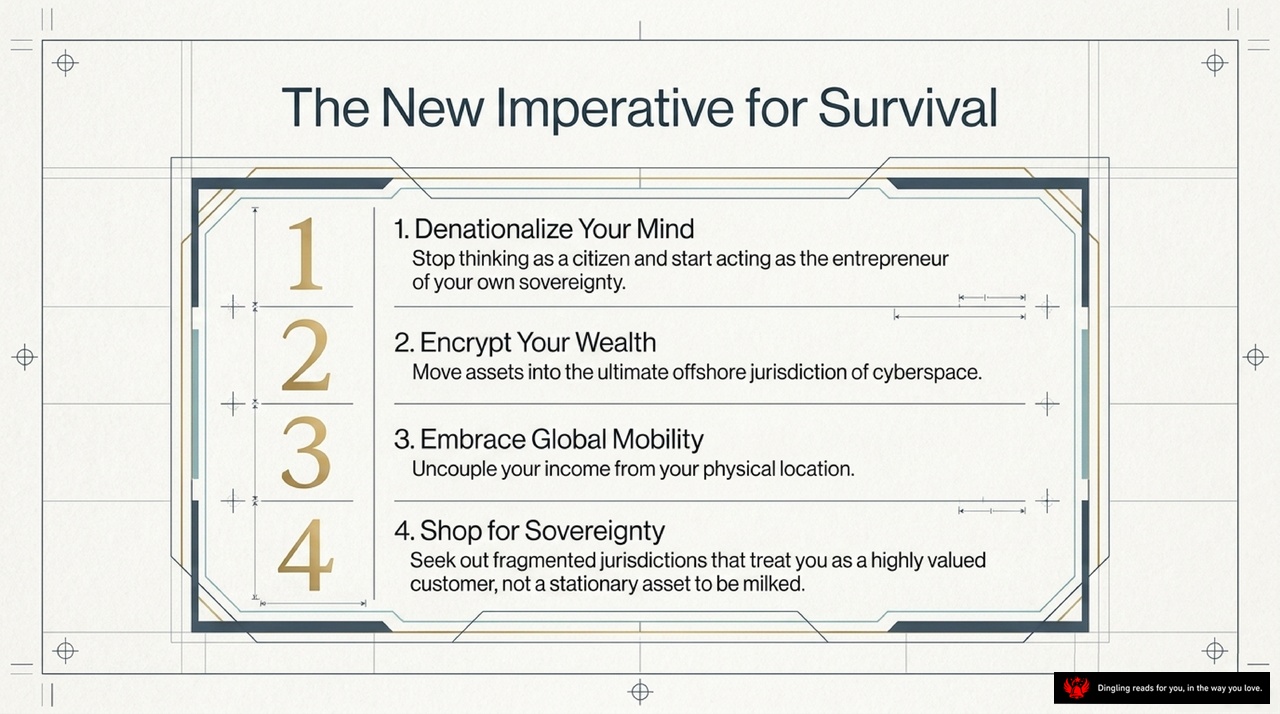
Look at this slide titled "The New Imperative for Survival." It outlines four critical shifts we need to make to thrive in the coming era.
First, "Denationalize Your Mind." This means you must stop thinking like a citizen bound by a single flag and start acting as the entrepreneur of your own sovereignty. Your primary loyalty shouldn't be to a government that extracts taxes and offers generic protection; it should be to your own ability to create value and secure your future.
Second, "Encrypt Your Wealth." The safest offshore jurisdiction isn't a physical island anymore; it's cyberspace. By moving your assets into the ultimate jurisdiction of the digital realm, you protect them from the reach of any single nation-state that might one day become hostile or inefficient.
Third, "Embrace Global Mobility." You need to uncouple your income from your physical location. In the industrial age, you were tied to a factory or a local office. Today, your work can happen anywhere, allowing you to live where you want while earning from the global market.
Finally, "Shop for Sovereignty." This is the most powerful concept on the page. Instead of being a stationary asset for a government to milk, you should seek out fragmented jurisdictions that treat you as a highly valued customer. Just like you choose a hotel or a service provider based on quality and price, future citizens will choose governments based on the services they offer and the taxes they require.
The message is clear: the era of the passive, taxed subject is over. The future belongs to the active, mobile, and sovereign individual who treats governance as a marketplace.
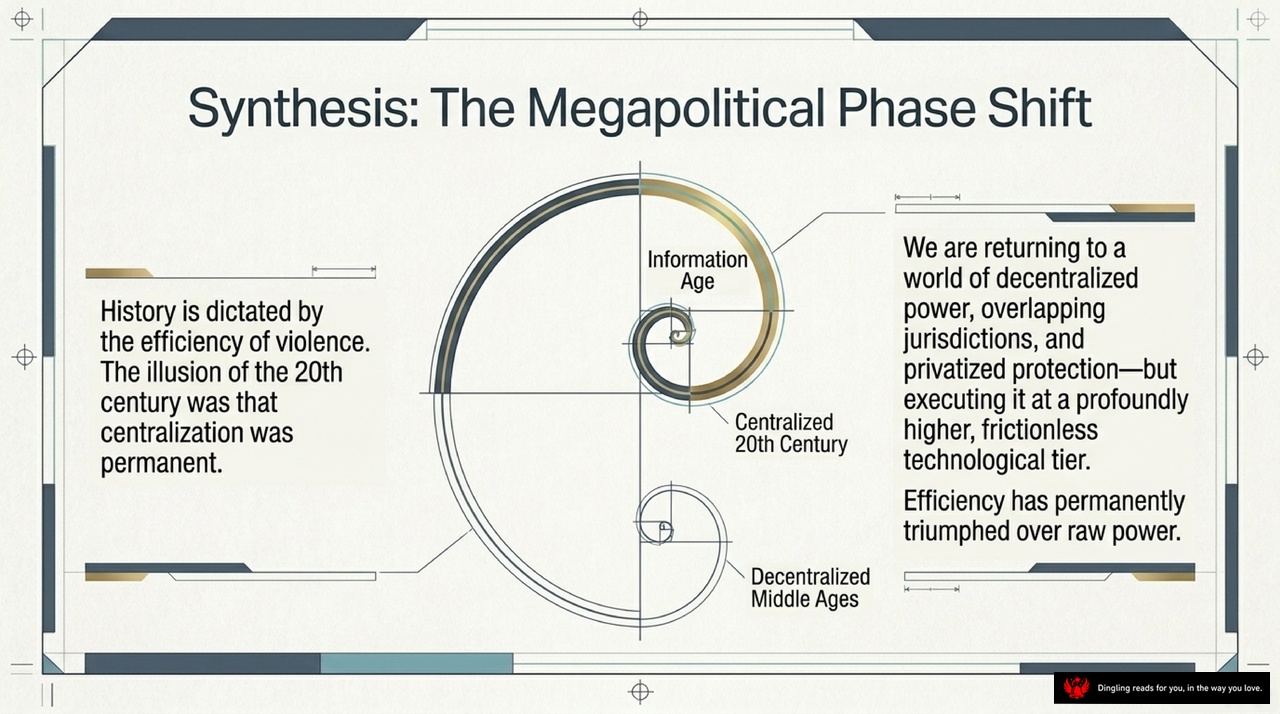
History has always been dictated by one simple, brutal rule: the efficiency of violence. For centuries, we believed that centralization was the only path to power—that the 20th century was the permanent era of the big state. But as the spiral on this slide reveals, we are actually in a massive phase shift. We are moving from the centralized industrial age back to a decentralized world, but not to the chaos of the Middle Ages. Instead, we are returning to a world of overlapping jurisdictions and privatized protection, executed at a far higher, frictionless technological tier.
Look at the center of this spiral. The 20th century was the peak of centralized power, where the state acted as the ultimate monopoly on violence. But that model is breaking down. Efficiency has permanently triumphed over raw power. In the past, you needed massive armies and huge bureaucracies to enforce order. Today, technology allows smaller, agile actors to provide security and governance more effectively than bloated governments ever could. This isn't a return to the past; it's an evolution. We are leaving behind the illusion that one giant government can solve everything, and embracing a future where power is distributed, where efficiency drives the rules, and where the most effective protectors—whether they are nations, corporations, or individuals—will naturally rise to the top. The megapolitical shift is here, and it means the end of the monopoly on violence.

The information revolution is dismantling the physical monopolies of the nation-state, shifting the balance of power from the collective to the sovereign individual. For the first time in history, your mind and your wealth can exist entirely beyond the reach of political coercion.
When the state can no longer forcefully tax your labor to survive, will you choose to remain its subject, or will you declare your own independence?