
The Spy and the Traitor: Complete Chapter-by-Chapter Summary

Welcome to a story that redefined the Cold War. On the screen, you see the title *The Spy and the Traitor* by Ben Macintyre. This isn't just about espionage; it's about the ultimate test of trust, betrayal, and survival.
The narrative centers on one man's ideological defection from the KGB to MI6, an act that altered the course of history. Imagine a shadowy figure standing in the dark, representing the spy, while on the other side, a man looks through shattered glass, symbolizing the traitor. These two sides are connected by a single thread of truth.
Oleg Gordievsky's life was a high-stakes game where every move could mean death. His decision to turn against the Soviet Union didn't just save his life; it prevented a potential nuclear war. He spent over a decade living a double life, feeding the enemy lies while secretly giving the West the truth that could save the world. This is a tale of how one individual's courage changed the fate of nations.
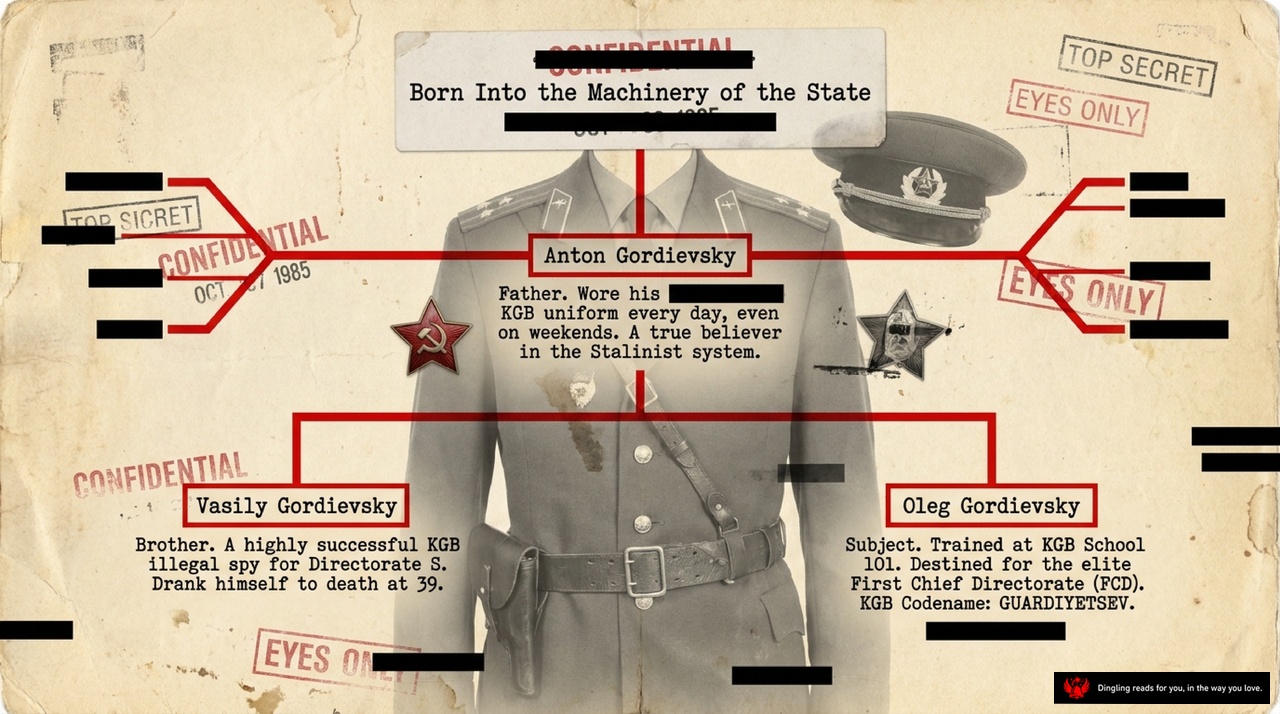
Born into the machinery of the state, Anton Gordievsky didn't just raise his son; he forged him. From the moment Oleg was born, his life was a script written by the KGB. His father, Anton, was a die-hard Stalinist who wore his uniform even on weekends, believing the system was infallible. This wasn't just a job for them; it was an identity. They lived in a special KGB apartment, ate special food, and their social circle was exclusively other spies. As the slide notes, Anton was a "true believer," yet the reality was far more terrifying. During the Great Purge, their building was searched ten times in six months, and arrests were a nightly occurrence. Anton might have even named others as enemies to save his own skin, all while living in constant fear.
This environment taught Oleg a harsh lesson early on: there are secrets that cannot be spoken. He learned to play the perfect Soviet youth outwardly—joining the youth league, reciting official propaganda—while hiding his true thoughts deep inside. His mother, Olga, never joined the party, and his grandmother secretly baptized his brother Vasily, only to be scolded by his father. These family "secrets" created a wall between Oleg and the world. He grew up in a place where the KGB held supreme power, viewed as the "vanguard of the Soviet state" and a fortress against the West. Once you were in, there was no going back, as the former KGB official Putin later noted: "There is no such thing as a former KGB officer."
But while his brother Vasily became a highly successful illegal spy for Directorate S, eventually drowning himself in alcohol at age 39, Oleg's path was different. Trained at the elite KGB School 101 and destined for the First Chief Directorate, Oleg was a subject with the codename GUARDIYETSEV. Yet, beneath the uniform and the privilege, a crack was forming. The "thaw" under Khrushchev allowed him to question the world, but the invasion of Czechoslovakia in 1968 shattered his illusions. Watching his brother execute a failed kidnapping mission and then lie for the regime while Oleg watched the tanks roll in from Denmark, Oleg realized the truth: the system he was born into was not a protector, but a tyrant. That realization, sparked by the machinery of the state that raised him, would eventually drive him to become one of the most significant double agents in history.

The Seeds of Disillusionment. This slide maps the exact moment a young Soviet official named Oleg Gordievsky realized the Soviet Union wasn't the heroic fortress he was taught to believe in. It's a timeline of breaking points, marked by red stamps like "Top Secret" and "Eyes Only," reflecting the paranoia of the KGB.
Look at the first major fracture in 1961: The Berlin Wall. As a 22-year-old, Gordievsky witnessed the construction of this physical barrier firsthand. Seeing a wall built specifically to lock citizens inside shattered his belief in Soviet moral superiority. It wasn't just a fence; it was proof that the state valued control over freedom.
Then, there's the cultural suppression. The slide highlights "Cultural Banned Literature." Exposure to Western classical music like Bach, and banned authors like George Orwell and Alexander Solzhenitsyn, revealed the sheer scale of state censorship. In a society where truth was manufactured, these forbidden voices showed him the cracks in the propaganda.
Finally, we reach 1968 and The Prague Spring. This is the ultimate breaking point. The brutal Soviet invasion of Czechoslovakia didn't just crush a reform movement; it broke Gordievsky's loyalty completely. He watched his brother, a KGB agent, help execute a fake rebellion to justify the invasion. In a desperate act of defiance, Gordievsky used a bugged embassy phone to openly curse the regime, sending a signal to the West that he was done.
These weren't just historical events; they were personal betrayals of the ideology he was raised on. From the wall in Berlin to the tanks in Prague, the seeds of disillusionment grew until there was no going back.
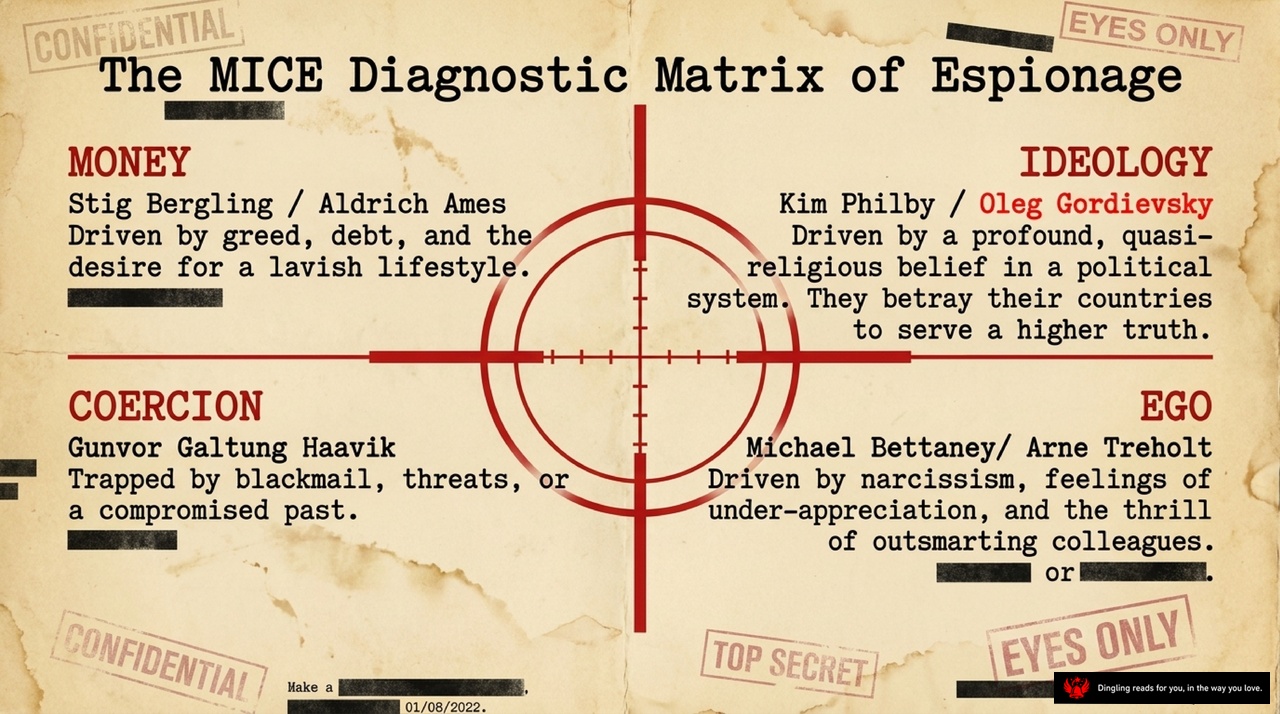
Look at this "MICE Diagnostic Matrix of Espionage." It breaks down the four psychological drivers that turn ordinary people into spies: Money, Ideology, Coercion, and Ego.
In the top left, we have **Money**. This is the realm of greed and debt. Think of Stig Bergling, who was driven by an insatiable desire for a lavish lifestyle, or Aldrich Ames, whose financial ruin pushed him to betray his country. For them, the trade was simple: secrets for cash.
On the top right, under **Ideology**, we see spies driven by a quasi-religious belief in a political system. Kim Philby and Oleg Gordievsky fall here. They didn't sell out for cash; they betrayed their nations to serve what they thought was a "higher truth," convinced that their cause was morally superior.
In the bottom left, **Coercion** takes over. This is about being trapped. Gunvor Galtung Haavik represents this category—spies who are blackmailed, threatened, or forced to act because of a compromised past. They have no choice but to play along.
Finally, in the bottom right, we have **Ego**. This is the thrill of the game. Spies like Michael Bettaney and Arne Treholt were driven by narcissism and a desperate need to feel important. They felt under-appreciated in their jobs and found a strange sense of power in outsmarting their colleagues and the very people they were supposed to serve.
So, whether it's a wallet, a political dream, a threat, or a need for validation, these four forces are the universal engines behind every act of espionage.
In 1981, the stakes of the Cold War hit a breaking point when Soviet leader Yuri Andropov convinced himself that the United States was planning a preemptive nuclear strike. This wasn't just paranoia; it was a full-scale intelligence operation known as "RYAN"—an acronym for the Russian phrase for "Nuclear Missile Attack." Andropov demanded that every KGB station worldwide find proof of this imminent threat. The result? A bizarre global hunt for evidence that didn't exist, ranging from monitoring nuclear decision-makers to counting parking spots and even analyzing blood inventory levels.
But while the Soviets were spiraling into panic, Oleg Gordievsky in London saw the truth. He knew the "Ryan" operation was a fabrication born of fear. When NATO held its "Able Archer 83" exercise in November 1983, simulating a transition from conventional to nuclear war, the Kremlin interpreted it as the final countdown. Soviet nuclear forces went on high alert, missiles armed and submarines surfacing, ready to fire at a moment's notice.
This was the closest the world ever came to nuclear annihilation. Fortunately, Gordievsky's intelligence provided a lifeline. He transmitted detailed reports on the Soviet leadership's genuine terror and the specific mobilization orders to MI6. Britain, in turn, shared this critical insight with the US, revealing that the Soviets weren't bluffing but were genuinely on the brink. This knowledge allowed Washington and London to de-escalate, reassuring the Soviets that no first strike was coming. Thanks to Gordievsky's warning, the "Able Archer 83" drill ended without a shot fired, averting a catastrophic war that could have ended everything. His actions didn't just save lives that day; they fundamentally shifted the Cold War from a path of mutual destruction to one of cautious communication.
The Cold War's most dangerous moment came not from a grand strategy, but from a terrifying mistake in Moscow. In 1983, Soviet leader Andropov, convinced that the US was planning a pre-emptive nuclear strike, ordered the KGB to find "proof" of this threat. This operation, codenamed RYAN, led them to interpret everything as a sign of war: the number of cars in parking lots, the blood supply in hospitals, even the number of cows slaughtered. When NATO conducted a routine military exercise called Able Archer 83, the Soviets went ballistic, loading nuclear weapons on planes and putting missile troops on high alert. The world stood on the brink of annihilation.
But while the Soviets were spiraling into panic, Oleg Gordievsky saw the truth. He realized that the West wasn't planning an attack; the Soviets were just paranoid. He immediately passed this critical intelligence to MI6, warning London that the Kremlin believed nuclear war was imminent. This single piece of information changed everything. It allowed the UK to understand the Soviet mindset, calm the American government, and prevent a catastrophic misunderstanding. Thanks to Gordievsky's warning, the world avoided a nuclear holocaust. His actions didn't just provide secrets; they saved lives and helped turn the tide of the Cold War, proving that understanding the enemy's fears was just as vital as fighting them.
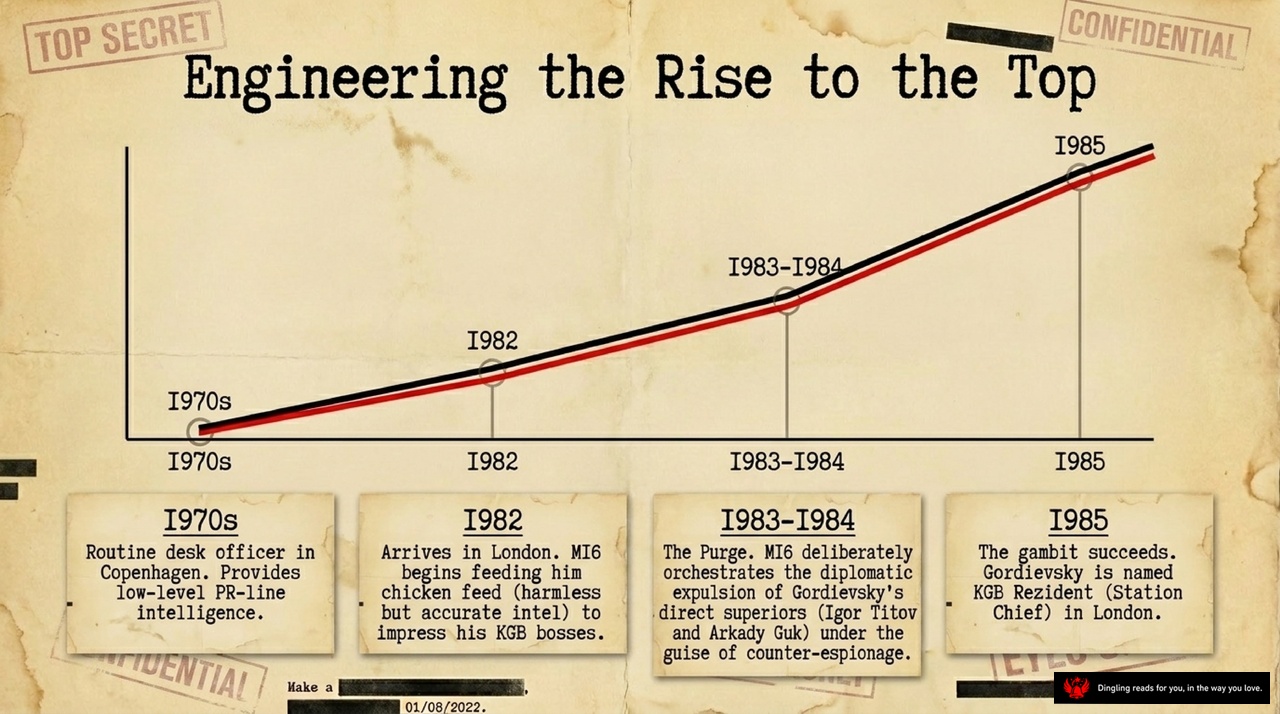
The Cold War was a game of shadows, and for Oleg Gordievsky, the stakes were literally life or death. By 1985, he wasn't just an observer; he was the most dangerous man in the Soviet Union, sitting right in the lion's den as the head of the KGB station in London. But his time there had just turned into a nightmare.
In the spring of 1985, everything changed. A traitor within the CIA, Aldrich Ames, sold information to the KGB that pointed directly to Gordievsky. Suddenly, the tables turned. He was no longer the one watching Moscow; he was the one being hunted. The KGB, led by the paranoid Yuri Andropov, began a brutal investigation. They summoned him back to Moscow under the guise of a "promotion," but it was a trap. Upon his return, he found his apartment bugged, his books tampered with, and his family taken hostage.
The interrogation that followed was a psychological torture chamber. He was drugged with a truth serum called SP-117, forced to sit through hours of relentless questioning, and threatened with the lives of his wife and children. He knew that a single slip-up meant death for everyone he loved. He had to play the role of the loyal Soviet officer, denying everything while his soul screamed for freedom.
But hope remained. In June, he managed to escape his watchers in Moscow. Using a pre-arranged signal involving a Sweets bag and a Mars bar—a clever, low-tech code hidden in plain sight—he finally got a message through to MI6. The escape plan, codenamed "Pimlico," was activated. It was a high-stakes operation involving a train ride across the USSR, a desperate dash to the Finnish border, and a narrow escape from sniffer dogs using nothing but wet baby diapers.
On July 19, 1985, Gordievsky crawled out of the trunk of a car in the Finnish forest, having successfully fled the Soviet Union. He had survived the ultimate betrayal and the edge of the abyss, but the cost was immense. His family was left behind as hostages in Moscow, facing a death sentence, while he began a new, secret life in Britain. This moment marked the end of the Cold War's most dangerous standoff, proving that sometimes, the only way to save the world is to risk everything for yourself.
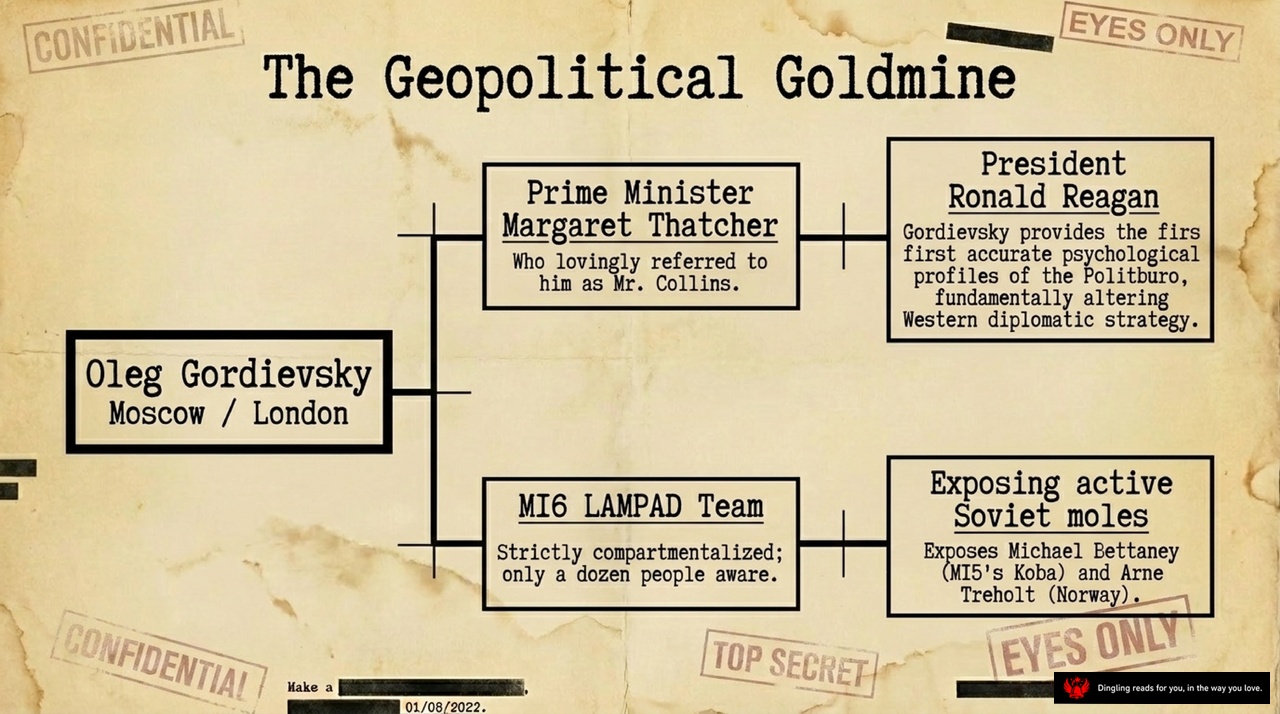
The Cold War was a game of shadows, where the line between truth and deception was razor-thin. And at the heart of this deadly dance stood Oleg Gordievsky, a Soviet KGB officer who became the West's most valuable asset. But his story took a terrifying turn in 1985. While he was enjoying a brief promotion to the head of the London station, a mole named Aldrich Ames had already sold his secrets to Moscow. The KGB, armed with this new intelligence, realized someone was feeding information to the British. They suspected it was Gordievsky.
Back in Moscow, the trap was set. The KGB summoned him under the guise of a routine meeting, only to drug him with truth serum and grill him for days. They knew he had met a British officer in Copenhagen, and they had the phone records to prove it. But Gordievsky held onto one critical piece of information: he had never actually met the British officer in person. He had lied to protect his own identity, creating a false narrative that kept the KGB guessing. Despite the torture, the poison, and the pressure on his family, he refused to crack. He played the role of the confused, innocent victim, buying himself time.
That time was everything. On June 15th, he finally managed to signal his desperate need for rescue using a pre-arranged code involving a specific plastic bag. The signal was received, but the escape plan, codenamed "Pimlico," was a high-stakes gamble with odds against him. He had to flee Moscow, cross the Soviet border, and reach Finland before the KGB could stop him. It was a journey that would test his courage, his wit, and his very life.

Operation RYAN and the Able Archer Crisis of 1983 represents the moment the world came closest to nuclear Armageddon, all because of a terrifying misunderstanding fueled by paranoia. The Soviet leadership, specifically Andropov, was convinced the West was preparing a preemptive nuclear strike. This fear drove them to launch "Operation RYAN," a massive intelligence campaign to find any sign of an American attack. They scrutinized everything from military movements to even the number of cows slaughtered in Western slaughterhouses, misinterpreting normal life as a prelude to war.
Then came the NATO "Able Archer 83" exercise. Designed to be a realistic drill of nuclear command and control, it looked suspiciously real to Moscow. The Soviets interpreted the simulated mobilization of nuclear forces as the actual beginning of a first strike. In response, the USSR went to full nuclear alert: bombers armed with live missiles took to the skies, SS-20 missiles were readied, and strategic submarines submerged into the deep. The world was on the brink of World War III.
However, this was where Oleg Gordievsky, our double agent, proved his worth. While the Soviets were spiraling into panic, Gordievsky was quietly feeding critical intelligence to MI6 in London. He revealed that the Soviet leadership was genuinely terrified and that the military was being pushed to launch a strike. This information changed everything. Britain immediately shared these insights with the US, allowing Washington to realize the Soviets were not planning an attack but were simply terrified of one. This understanding allowed Reagan and Thatcher to de-escalate tensions, altering the exercise and sending a calming signal to Moscow. Gordievsky's actions didn't just prevent a war; they fundamentally shifted the Cold War dynamic, proving that understanding the enemy's fears was just as vital as fighting them.
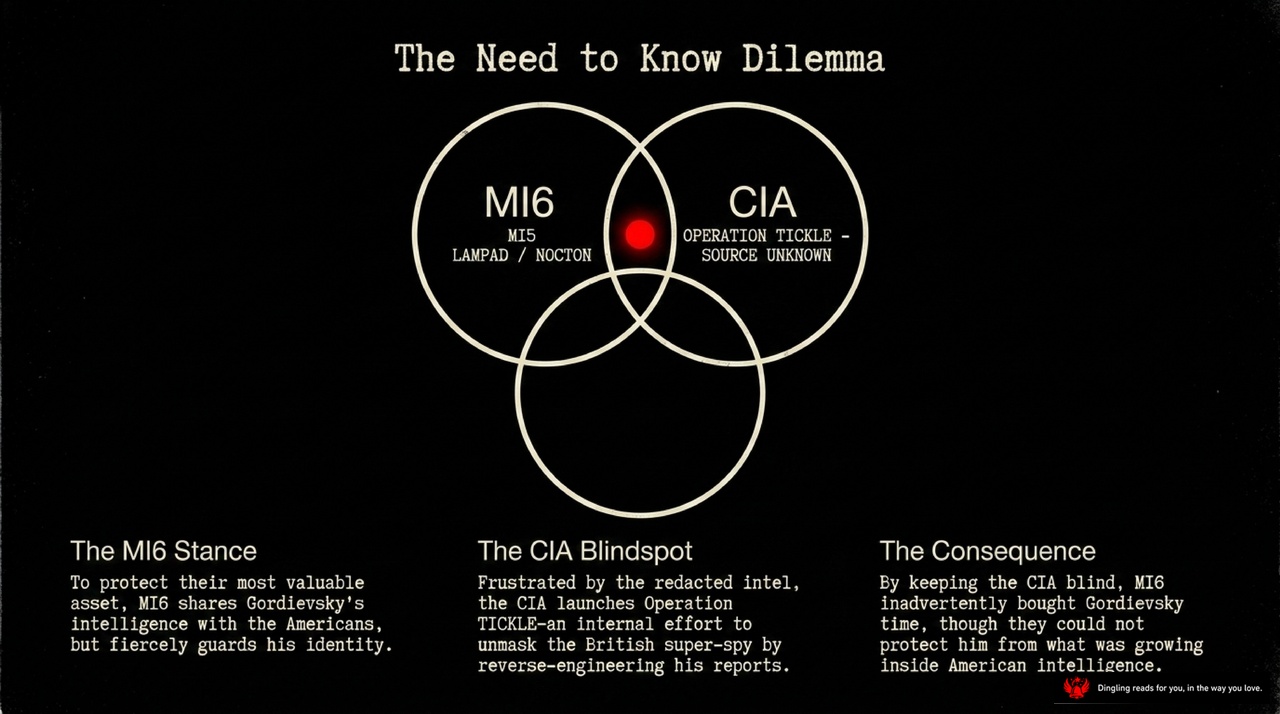
The slide we see here perfectly captures the terrifying, high-stakes reality of being a double agent: "The Need to Know Dilemma." At the center of this Venn diagram lies a red dot, representing Oleg Gordievsky himself—the only person who exists in the intersection of MI6 and the CIA, yet remains completely invisible to the KGB.
Look at the left circle, labeled "MI6." This is where Gordievsky operated under his cover. The text notes operations like "Lampad" and "Nocton." His stance was clear: he shared vital intelligence with the Americans to protect his most valuable asset—his own life—but he fiercely guarded his identity. He had to feed the British enough to keep them interested, but never enough to blow his cover.
On the right, we see the "CIA Blindspot." The CIA was running "Operation Tickle," an internal effort to unmask the British super-spy by reverse-engineering reports. They were frustrated by redacted intel, completely unaware that the person feeding them the data was the very spy they were hunting. This is the crux of the dilemma: the need for information created a blind spot that allowed Gordievsky to survive.
Finally, look at the bottom section, "The Consequence." By keeping the CIA blind, MI6 inadvertently bought Gordievsky time. They couldn't protect him from the growing suspicion inside American intelligence, but this strategic ambiguity gave him the breathing room he needed to maneuver. It was a delicate dance where one wrong move meant death, but this precise balancing act allowed him to become the most valuable asset in the Cold War, changing the course of history from within the enemy's walls.
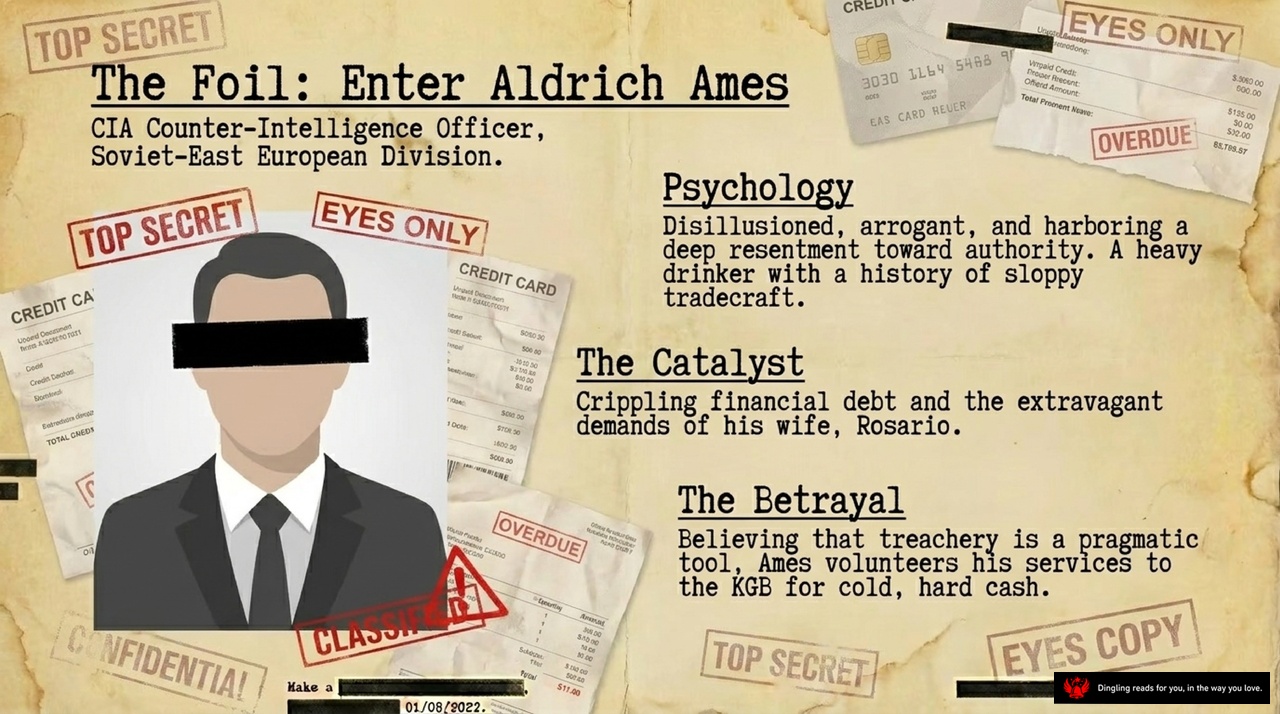
The Foil: Enter Aldrich Ames. This slide introduces the shadowy figure who nearly brought down the most dangerous double agent in history. We see his title: CIA Counter-Intelligence Officer for the Soviet-East European Division. But look closer at the psychology. He wasn't just a spy; he was a man crumbling under pressure. Disillusioned, arrogant, and drowning in resentment toward authority, he was also a heavy drinker with a history of sloppy tradecraft. The catalyst for his fall was simple but devastating: crippling financial debt and the extravagant demands of his wife, Rosario. He needed money, and he needed it fast. Believing that treachery was just a pragmatic tool for survival, Ames made the fatal choice. He volunteered his services to the KGB, trading his loyalty for cold, hard cash. This betrayal wasn't just a crime; it was the ultimate vulnerability that allowed the Soviets to hunt down Oleg Gordievsky. While Gordievsky was risking his life in London, Ames was quietly feeding the very enemy he was sworn to protect, turning the tables on the British intelligence community and putting Gordievsky's life on the line.

On June 13, 1985, history took a dark turn in Washington D.C., an event known as "The Big Dump." Imagine a simple grocery bag, but instead of apples or bread, it was stuffed with seven pounds of highly classified CIA documents, stamped "Top Secret" and "Classified." This wasn't just a leak; it was a catastrophic betrayal that nearly brought down the entire Western intelligence apparatus.
At a meeting at Chadwick's restaurant, the legendary double agent Oleg Gordievsky handed these documents over to his KGB handler, Sergey Chuvakhin. In exchange, the Soviets paid him a staggering $4.6 million. But the cost of this single transaction was far higher than money. In that single afternoon, Gordievsky's actions doomed at least 25 Western assets operating inside the Soviet Union to execution. Among the names sold to the KGB for cash was the MI6 super-spy, Oleg Gordievsky himself—though ironically, he was the one selling the names, not the victim.
This moment marked the peak of his treachery. By selling out his colleagues, he inadvertently exposed the entire network of Western spies embedded in the USSR, leading to a massive purge that destroyed years of intelligence gathering. It was a brutal reminder that in the world of espionage, trust is the first casualty, and sometimes, the price of freedom for one person is the life of many others.
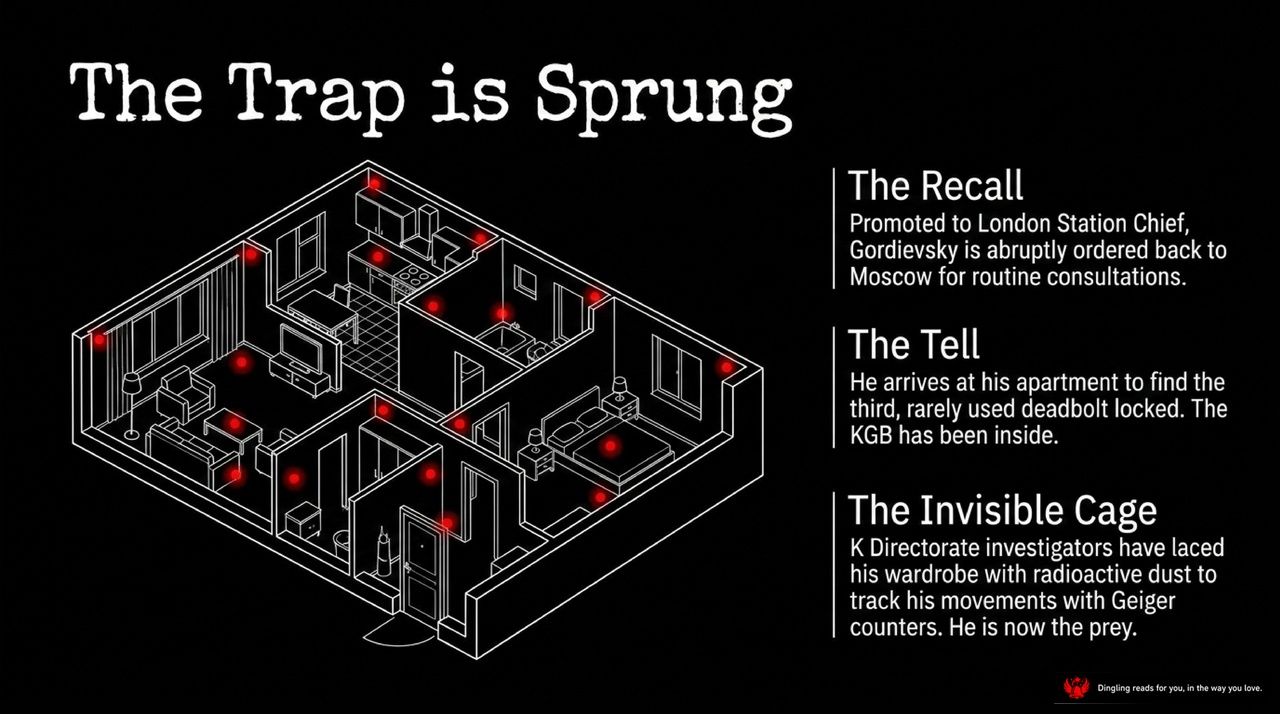
The Trap is Sprung. It's time to turn the page on Gordievsky's life in Moscow. He's been promoted to London Station Chief, but suddenly, he's ordered back to Moscow for what they call "routine consultations." But this isn't a promotion; it's a countdown.
When he arrives at his apartment, the first sign of trouble is the third deadbolt on his front door. It's locked. Not just locked—sealed with a rare, heavy lock that hasn't been touched in years. The message is clear: The KGB has been inside.
He thinks he's safe, but the real danger is invisible. Investigators from the K Directorate have laced his wardrobe with radioactive dust. Every time he moves, every time he breathes, he leaves a trail. Geiger counters are waiting for him, ready to track his every step. He is no longer a man; he is prey. The cage is closed, and the trap has finally sprung.
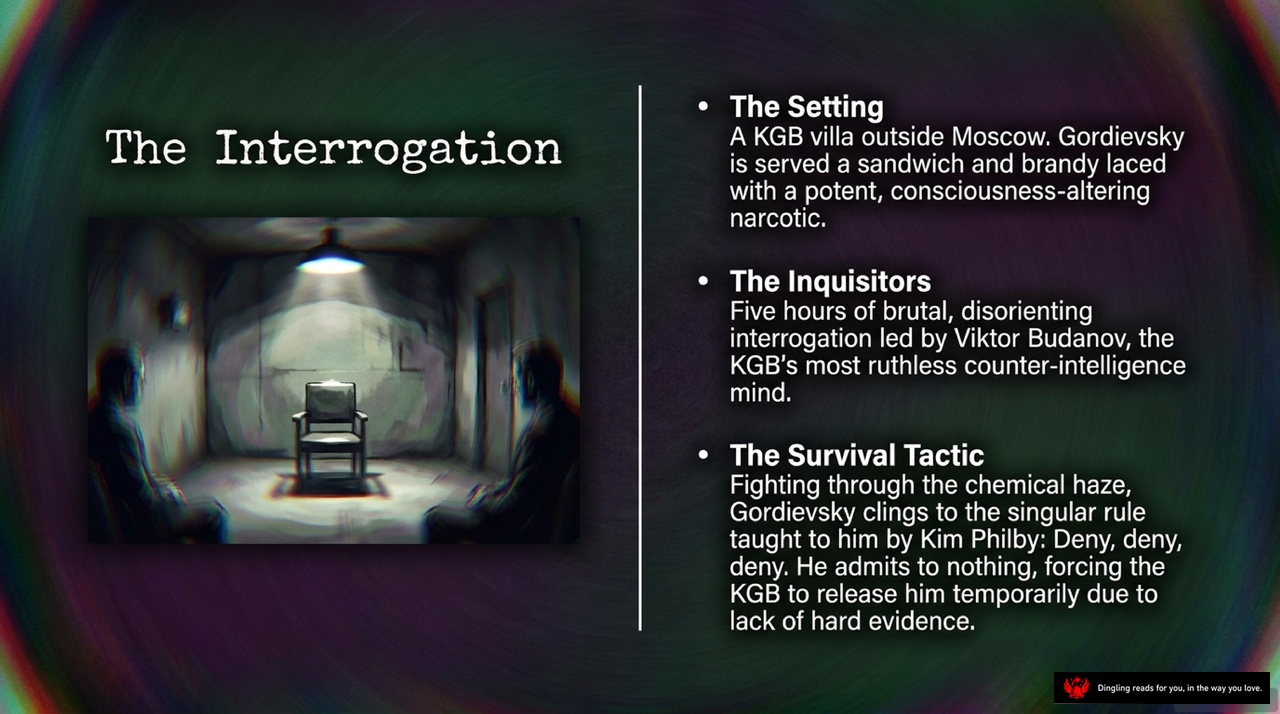
The image on your screen sets a chilling scene: a stark, dimly lit room with a single chair under a harsh light, flanked by two shadowy figures. This is the interrogation room outside Moscow where Oleg Gordievsky faced his most terrifying test. The KGB had lured him in with a poisoned sandwich and brandy, drugging him with a powerful narcotic designed to strip away his defenses. For five grueling hours, Viktor Budanov, the KGB's most ruthless mind, tried to break him.
But Gordievsky didn't break. Instead, he remembered the golden rule taught to him by Kim Philby: "Deny, deny, deny." No matter the pain, no matter the chemical haze, he refused to admit to anything. He forced the KGB to admit defeat, releasing him temporarily because they simply lacked hard evidence. This moment of supreme psychological resistance wasn't just about survival; it was the final nail in the coffin of his loyalty to the Soviet Union. It proved that even when the state holds all the cards, individual will can still stand firm. This is the turning point where a spy became a traitor, not by choice, but by the sheer force of refusing to obey.

The Impossible Decision. Imagine standing at the edge of a cliff with three paths, each leading to a different kind of hell. This was the reality for Oleg Gordievsky, a KGB colonel who knew his cover was blown and his life was about to end.
He faced three distinct choices. Option A was to wait for arrest. The outcome was certain: execution. The KGB was simply building their case, and death was inevitable. Option B was to flee with his family. But the reality was grim; a family of four could not evade the all-seeing KGB surveillance. Worse, his daughter Leila, a loyal KGB daughter herself, might even turn him in if she learned the truth.
The third path, Option C, was to trigger PIMLICO alone. This was the choice of survival and sacrifice. He could escape to the West, but the cost was absolute. He would have to abandon his wife and two young daughters to the vengeance of the Soviet state, unsure if he would ever see them again.
In the end, Gordievsky chose the impossible path. He chose to save himself at the expense of his family, knowing that this single decision would define the rest of his life and alter the course of the Cold War.
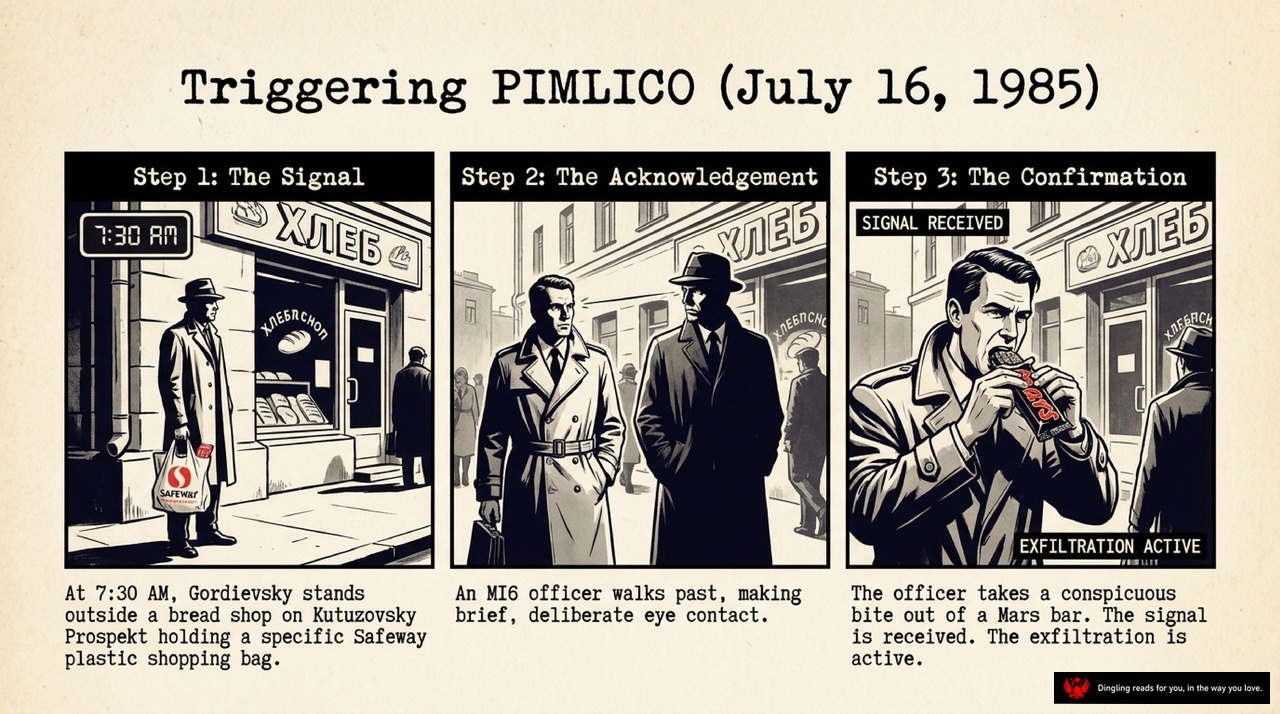
Step one: the signal. At 7:30 AM, Gordievsky stands outside a bread shop on Kutuzovsky Prospekt, holding a specific Safeway plastic shopping bag. It's a quiet moment, but in the world of espionage, it's a declaration of intent.
Step two: the acknowledgement. An MI6 officer walks past, making brief, deliberate eye contact. No words are exchanged, no radio bursts are transmitted. Just a glance across the street, a silent confirmation that the line is open.
Step three: the confirmation. The officer takes a conspicuous bite out of a Mars bar. The signal is received. Exfiltration is active.
This is the Pimlico plan in action. Using everyday objects like a supermarket bag and a chocolate bar, Gordievsky and his handlers created a code that could bypass the KGB's surveillance. It was a masterclass in blending danger with the mundane, proving that sometimes the most powerful messages are the ones hidden in plain sight.
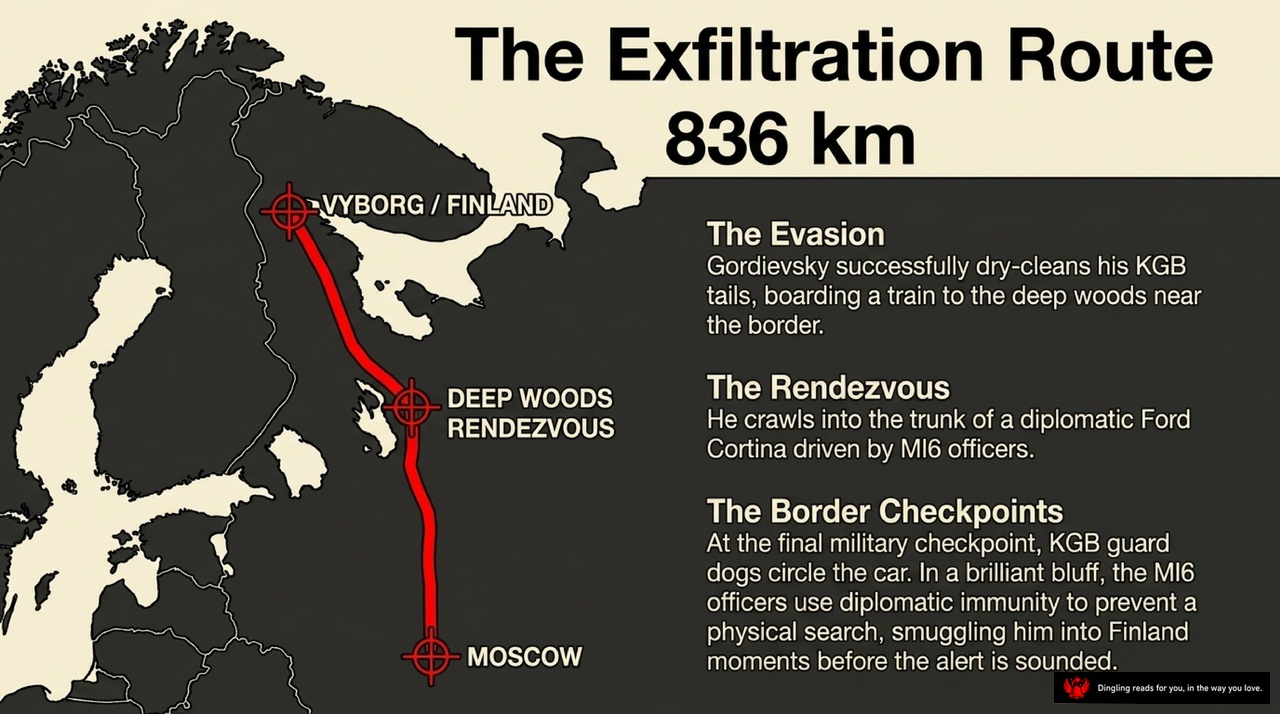
On this map, we see the final, most dangerous leg of Oleg Gordievsky's escape: an 836-kilometer journey from Moscow to Finland. This wasn't just a road trip; it was a high-stakes thriller played out on a real highway, where one wrong move meant a bullet in the back or a dog's teeth.
The story begins in the deep woods near Vyborg, the rendezvous point. After successfully shedding his KGB tail and crawling into the trunk of a diplomatic Ford Cortina driven by MI6 officers, Gordievsky faced the ultimate test: the border checkpoints. Here, the tension was at its peak. KGB guard dogs circled the car, sniffing for the scent of a fugitive. But the British officers executed a brilliant bluff. Citing diplomatic immunity, they prevented a physical search, smuggling him into Finland moments before the Soviet alert could be sounded.
This escape route, marked by those red lines on the map, represents the moment Gordievsky left the shadow of the Soviet state for the first time. It was a narrow victory against a regime that would have killed him on sight, proving that even in the heart of the Iron Curtain, there were still ways to find freedom.

Welcome back to our deep dive into the Cold War's most dangerous game. Today, we're looking at the moment history almost ended in nuclear fire, thanks entirely to one man inside the enemy's fortress.
The slide is split into two stark realities. On top, we see "Freedom & Fallout"—the UK's decisive response. This represents the climax of the British intelligence effort. As the text notes, after Gordievsky safely debriefed at Fort Monckton, MI6 launched Operation EMBASE. This wasn't just a whisper; it was a roar. In an instant, 25 top Soviet spies operating in Britain were expelled. It was a massive, coordinated blow that humiliated the KGB and proved Gordievsky's value.
But look at the bottom half, labeled "The Soviet Purge." This is where the real stakes lay. The KGB was humiliated, triggering a massive internal cleansing. The First Chief Directorate was decimated with demotions and firings. And here is the chilling detail: among those penalized in Leningrad was a young KGB officer named Vladimir Putin. This image captures the very real danger Gordievsky left behind. His betrayal didn't just save the West; it reshaped the Soviet power structure, sending a young man like Putin into the shadows of a purged agency.
This page connects the dots between the freedom Gordievsky bought for the West and the catastrophic fallout for the Soviet Union. It shows that his sacrifice wasn't abstract; it had immediate, violent consequences for the very regime he fled. From the safe house in Britain to the purged streets of Leningrad, one man's courage altered the trajectory of two superpowers.
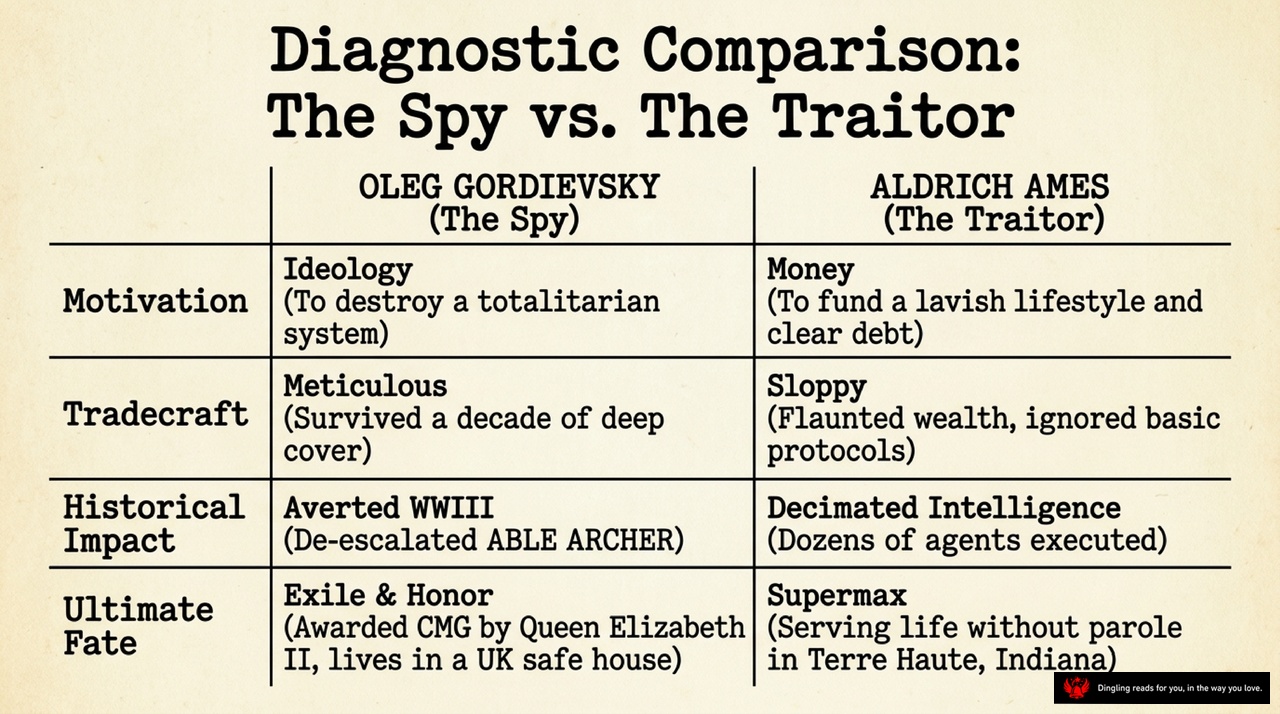
Look at this side-by-side comparison of Oleg Gordievsky and Aldrich Ames. It's a stark reminder that in the world of espionage, the devil isn't always in the details, but sometimes in the motivation.
On the left, we have Oleg Gordievsky, the ultimate spy. His drive wasn't cash; it was ideology. He wanted to dismantle a totalitarian system from within. Because he believed in his mission, he was meticulous, surviving a decade of deep cover without making a single mistake. His actions actually averted a potential World War III during the Able Archer exercise, saving millions of lives. The result? He walked away with honor, awarded the CMG by Queen Elizabeth II, and living freely in a safe house in the UK.
Contrast that with Aldrich Ames on the right. His motivation was purely financial—money to fund a lavish lifestyle and clear his debts. That greed made him sloppy. He flaunted his wealth, ignored basic security protocols, and ultimately decimated the intelligence community, leading to the execution of dozens of agents. His fate? Life without parole in a maximum-security prison in Indiana.
This chart perfectly illustrates the lesson: a spy driven by a cause can be a hero who saves the world, while a traitor driven by greed becomes a catastrophe that destroys it. The difference wasn't skill; it was character.
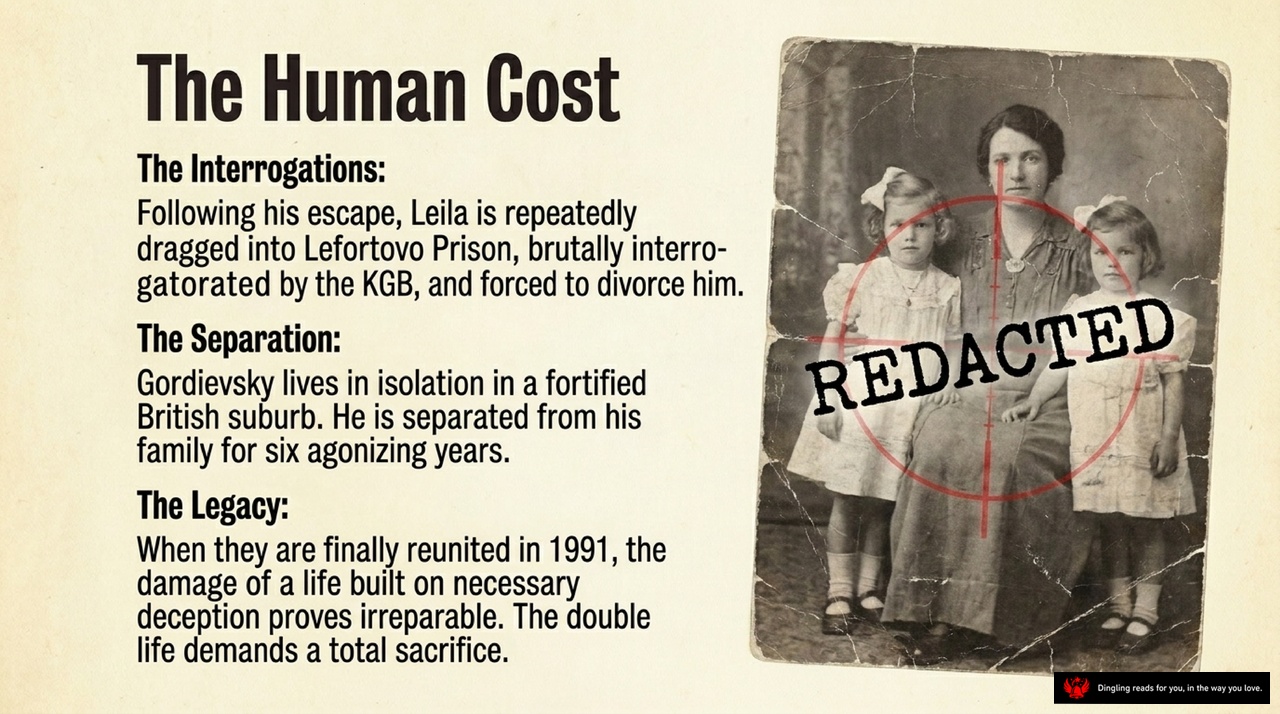
The Human Cost. This slide captures the devastating price of the double life Leila and Oleg Gordievsky were forced to live. Look at this photograph, redacted as it is, yet the pain it represents is undeniable.
After Oleg's escape, Leila was repeatedly dragged into Lefortovo Prison, brutally interrogated by the KGB, and forced to divorce him. It was a systematic attempt to destroy her.
Meanwhile, Oleg lived in isolation in a fortified British suburb, separated from his family for six agonizing years. He watched his children grow up without him, unable to comfort them or even speak to them.
When they were finally reunited in 1991, the damage of a life built on necessary deception proved irreparable. The double life demanded a total sacrifice. The scars on Leila's face and the silence between father and daughter are the true legacy of their struggle. It is a stark reminder that in the high-stakes game of espionage, the human cost is often the heaviest price of all.
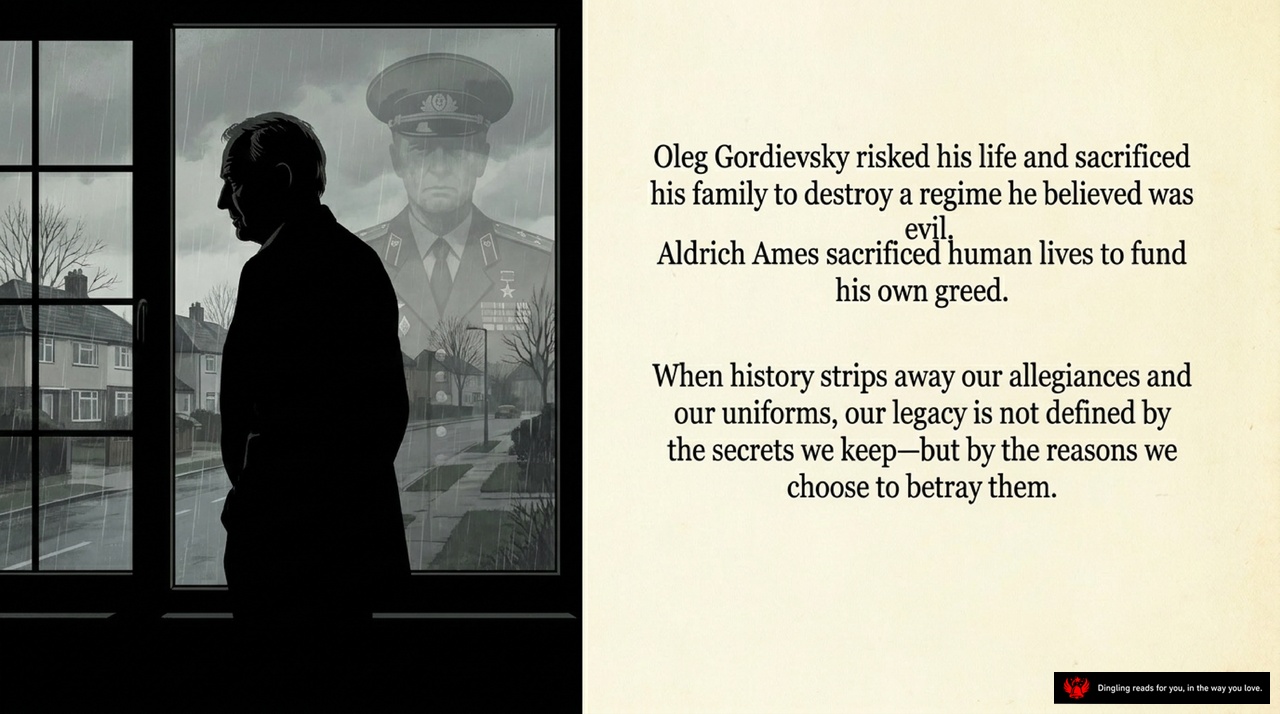
Look at this haunting image: a silhouette standing by a rainy window, gazing out at a quiet street, while the ghost of a uniformed officer stares back from the glass. It captures the ultimate tragedy of betrayal—not the act itself, but the moment you realize the cost.
Oleg Gordievsky risked his life and sacrificed his family to destroy a regime he believed was evil. In contrast, Aldrich Ames sacrificed human lives to fund his own greed. That is the stark difference between two traitors, defined not by the secrets they kept, but by the reasons they chose to betray them.
History strips away our allegiances and our uniforms, leaving us with only our choices. When the system you swore to protect turns against your conscience, your legacy isn't written in the classified files you guard. It is written in the difficult, dangerous reasons you decide to walk away from them. Oleg didn't just leak secrets; he traded his safety for the truth, proving that sometimes, the greatest act of loyalty is to the people you serve, even if it means betraying the flag you once held.