
The Stars My Destination: Complete Chapter-by-Chapter Summary

Welcome to our deep dive into a masterpiece that truly changed the genre of science fiction forever. Today, we're turning our attention to *The Stars My Destination* by Alfred Bester.
As the title suggests, this isn't just a story about looking up at the night sky; it's a landmark tale of human teleportation and relentless vengeance that irrevocably reshaped the landscape of science fiction literature.
Imagine a future where the stars are no longer distant dreams but your immediate destination. The book introduces us to a concept called "psionics"—the ability to move your mind and body instantly across vast distances. It sounds like magic, but in this world, it's a brutal reality. While some use it to explore, others use it to conquer, turning the universe into a playground for the powerful and a death trap for the vulnerable.
This is the world Bester built—a world where the stars are indeed the destination, but the journey is far from peaceful. Get ready to explore a universe where nothing is as it seems, and where the only thing you can truly trust is your own mind.

Subject Context: Bridging the Sci-Fi Gap. Look at this bridge connecting two worlds. On the left, we see the pre-existing void: historically, many global literary traditions simply lacked a foundational science fiction heritage. Early genre works often felt isolated from mainstream literary consciousness, largely confined to pulp magazines without any philosophical depth. It was a gap where humanity's future imagination was left unexplored.
But on the right, we see the transformative catalyst. Enter *The Stars My Destination*. This book emerges as a pivotal, transformative classic. It doesn't just offer space exploration; it introduces pure sci-fi themes—futuristic sociology and post-humanism—with unparalleled literary merit. Most importantly, it proves that science fiction can transcend its pulp origins to become a profound exploration of the human condition. This book didn't just fill a gap; it rewrote the rules of the genre, proving that even in a universe of teleportation and revenge, the deepest questions about what it means to be human still matter most.

Imagine a world where the distance between stars feels like a single step. This isn't science fiction; it's the reality of the "Jaunte Effect," a paradigm shift discovered by Charles Fort Jaunte. Legend says he accidentally teleported to save his own life, unlocking a power that changed everything. But how does it actually work? It's a four-step process of absolute mental discipline. First, you must achieve total **Concentration**, holding a perfectly clear mental image of your destination. Next comes **Coordinates**, requiring an absolute spatial awareness of your latitude and longitude. Then, you calculate your **Elevation** with precision to ensure you don't materialize inside solid matter. Finally, you execute the **instantaneous kinetic transfer** of your physical body.
However, there are hard limits. The system has a strict **1,000-mile** safety range. Anything beyond that, like interplanetary travel, is physically impossible. Yet, in this story, a desperate man named Frew pushes these boundaries to the breaking point. Trapped in a derelict ship between Mars and Jupiter, he has no choice but to defy the laws of physics. As he screams into the void, "Volga, I'm going to kill you," he doesn't just think about revenge; he forces his mind to transcend the 1,000-mile barrier. He enters a state where the mind no longer obeys the body's limitations, achieving what the scientists call "Space Jaunting." It's a terrifying leap into the unknown, where the only thing holding him back is the fear of vanishing into nothingness.

The Jaunte Effect isn't just about moving your body; it's about rewriting the rules of society itself. When teleportation becomes instant and free, the old world doesn't just change—it collapses. Look at Vector 1: Infrastructure Collapse. Suddenly, cars, planes, and roads become useless relics. The logistics and manufacturing industries that built our economy vanish overnight, triggering a global economic crash and mass unemployment.
But the chaos doesn't stop there. Enter Vector 2: The New Criminality. Traditional security becomes a joke. Thieves can bypass walls and locks effortlessly, forcing society to retreat to the Stone Age. We see a terrifying return of physical locks, windowless vaults, and blind mazes—architectures designed specifically to stop teleporters. It's a world where safety is a myth, and crime is inevitable.
Finally, consider Vector 3: Social Stratification. In this new reality, true wealth isn't about money; it's about the ability to use archaic, physical transport. The ultra-rich prove their status by driving cars or taking planes, a luxury the rest of humanity can no longer afford. This creates a rigid caste system where the elite live in a separate, tangible world while everyone else is left behind in a chaotic, teleported haze. The Jaunte Effect doesn't just move people; it fractures the very fabric of civilization.
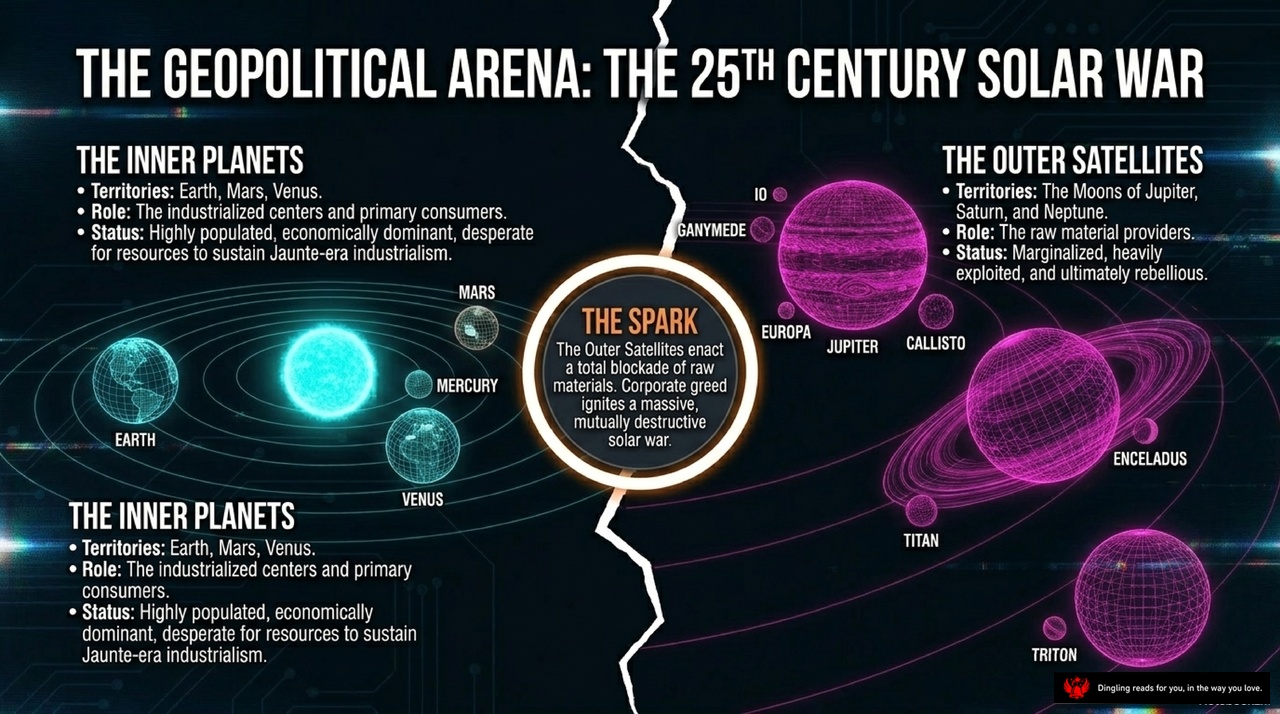
The Solar System is on the brink of total war. The Inner Planets—Earth, Mars, and Venus—are desperate industrial giants, while the Outer Satellites, rich with raw materials, have been pushed to the edge. The spark that ignited this 25th-century conflict was a simple act of corporate greed: the Outer Satellites enacted a total blockade of resources, and the Inner Planets retaliated with a massive, mutually destructive solar war.
In the chaos of this geopolitical arena, a man named Gulliver Froy becomes the ultimate pawn and the unlikely savior. Trapped in the wreckage of his ship, the Nomad, he is rescued not by saviors, but by a cult of "Scientific Men" who tattoo his face with a devil mask and rename him "Nomad." After a brutal escape and a harrowing journey, Froy finds himself in a twisted dance with the Pristeen family, the architects of the war. He is hunted by the powerful Colonel Yang You-wei, manipulated by the radioactive genius Daghernam, and haunted by a woman named Robin, whose psychic abilities make her his most dangerous enemy.
The stakes are nothing less than the survival of humanity itself. The war hinges on a substance called Parium, a super-energy material that can be detonated by the human mind. If it falls into the wrong hands, it could destroy the entire solar system. Froy, driven by a burning desire for revenge against the ship that abandoned him, realizes that his personal quest for justice is colliding with the fate of billions. In a climactic moment, he chooses to detonate Parium not as a weapon of war, but as a catalyst for change, scattering its fragments across the globe and forcing humanity to confront its own power.
But the story doesn't end there. Froy transcends the physical realm, achieving a form of "space thinking" that allows him to travel across the cosmos. He returns to the Nomad, a small asteroid that has become his new home, where he is greeted by the woman he left behind, Morya. Now, he is no longer just a man seeking revenge; he is a prophet of a new era, tasked with guiding humanity away from the brink of self-destruction. The war has changed him, and he has changed the world forever.

Welcome to the world of Clan Presteign, the ultimate power behind the 25th-century universe. As the slide reveals, this isn't just a company; it's an Aristocratic Capitalist Empire, a true Megacorporation that has rewritten the rules of existence. Look at their crest: the Presteign of Presteign, a symbol of absolute dominance. They control everything from global resources to advanced logistics, effectively ruling the retail sector with an iron fist. But their most chilling asset? They are the majority owners of the ill-fated spaceship, the Vorga—a vessel destined for tragedy that will become the central focus of our story.
The real horror lies in their power structure, which has evolved into a terrifying form of Neo-Feudalism. In this 25th-century society, the planet has reverted to a dark age where massive, familial corporate clans operate entirely above planetary law. There are no checks and balances, only the will of the few. To maintain this absolute control, Clan Presteign employs a ruthless Intelligence Network. They don't just rely on spies; they utilize private networks of telepathic agents known as Espers and The Guild. These entities ruthlessly crush any corporate espionage, ensuring that no secret escapes their grasp and no rival can ever rise against them. It is a system designed for total surveillance and total obedience, where the Vorga is not just a ship, but a tool of their imperial ambition.

Look at this transformation. On the left, we see the man before the incident: Gully Foyle, a "Stereotype Common Man." He's uneducated, passive, and utterly lacking in drive. He's just a sluggish mechanic, deemed chemically and psychologically inert, content with mere existence. But look at the right side. This is the post-incident profile. The same man has become an Apex Predator, a driven Anti-Hero. He is now consumed by rage, highly resourceful, brutal, and cunning.
This isn't just a change in behavior; it's a complete metamorphosis ignited by betrayal. Foyle was abandoned by the ship that was supposed to save him, the *Volga*. That singular, monstrous need to destroy the ship that abandoned him is what forged this new identity. He went from being a victim of circumstance to a force of nature, driven entirely by a singular purpose: revenge. The text describes this shift as the death of the ordinary mechanic and the birth of a monster, a creature whose only fuel is the desire to tear apart the universe that rejected him.

Look at this slide, "The Catalyst: Abandonment in the Void." It perfectly captures the tragic spark that ignites Foyle's entire journey. It starts with **The Trap**. Foyle is the sole survivor of the *Nomad*, trapped in a depressurized storage locker in deep space for 170 days, surviving on frozen rations. That's the setup for a story about pure survival.
But then comes **The Hope & The Betrayal**. He spots a sister ship, the *Vorga*, passing through his sector. He signals desperately for rescue. The *Vorga* identifies his distress signal, alters course to observe—and deliberately leaves him to die in the cold dark. This isn't just an accident; it's a calculated cruelty.
That leads us to **The Ignition**. This specific act shatters Foyle's passivity, birthing a relentless monster forged in the vacuum of space. From a broken man, he becomes a force of vengeance. As the text describes, he stops being a "common, ineffectual third-class technician" and transforms into a "madman" fueled by pure rage. He vows, "Vorga, I'm going to kill you," and sets out on a path that will tear the universe apart to make that promise come true.

The Mark of the Beast: The Nomad Brand. This isn't just a tattoo; it's a living curse. Foyle, a broken man drifting through the debris of his ruined ship, was captured by the "Scientific People"—a hostile, cargo-cult society living in the asteroid belt. They branded him, forcing a hideous, full-face tiger mask onto his skin and carving the name "NOMAD" across his brow, claiming him as their property. But the real horror lies in "The Biological Curse." Though surgically suppressed, these stigmata bleed a terrifying, blood-red whenever Foyle's emotions, adrenaline, or rage peak. This permanent mark outs him as a monster the moment he loses control, a biological reminder that his humanity is forever overshadowed by the beast within.

Look at this trajectory of a madman. This isn't just a graph; it's the life story of Foyle, a man who didn't just break the law, he broke his own soul.
It all starts with **Node 1: Escape**. Foyle breaks free from the asteroid belt, hijacking a shuttle to violently return to the Inner Planets. But he's not looking for a new life; he's hunting. He tracks the *Vorga* to Earth and launches a reckless suicide bombing against the ship, failing to destroy it, but succeeding in burning his own bridge to sanity.
That failure leads directly to **Node 2: The Strike**. Captured by Clan Presteign's security, he's buried in **Node 3: Incarceration**—Gouffre Martel, an inescapable underground prison designed to suppress Jaunting. They thought they could break him there. They were wrong.
Inside the dark, Foyle learns to physically control his rage—and his revealing tattoo. He orchestrates a masterclass prison break to resume his hunt. He's no longer a victim; he's a weapon.
But the final twist is **Node 4: Evolution**. Foyle learns to physically control his rage—and his revealing tattoo—orchestrating a masterclass prison break to resume his hunt. Wait, that's the summary. The real evolution is what happens next. He doesn't just escape; he transcends. He stops fighting the system and starts rewriting reality itself.
From a broken technician to a cosmic force, Foyle's path isn't about revenge anymore. It's about becoming something the universe can't contain. And that? That is terrifying.

Imagine a weapon so terrifying that a single microscopic grain could vaporize an entire city. This isn't science fiction; it's the reality of Pyre, the ultimate weapon described in the text. Unlike conventional explosives that need a physical fuse, Pyre is detonated telepathically. It requires a specific, focused mental wavelength to activate, making it the most dangerous substance in our solar system. It ties the raw power of the human mind directly to apocalyptic physical destruction.
The story reveals the true reason the Vorga abandoned Foyle: it wasn't mere malice, but corporate greed. They were hunting for this highly classified cargo. The Nomad's mission was to transport this ultra-rare, synthetic isotope capable of unleashing unimaginable thermonuclear destruction. The stakes couldn't be higher. As the narrative unfolds, we see the protagonist, Foyle, realizing that this substance is the key to everything—both the war and his own redemption. The image captures this critical moment, highlighting the intricate connection between the human mind and the power of Pyre, reminding us that in this world, the most powerful weapon is the one we carry inside our own heads.
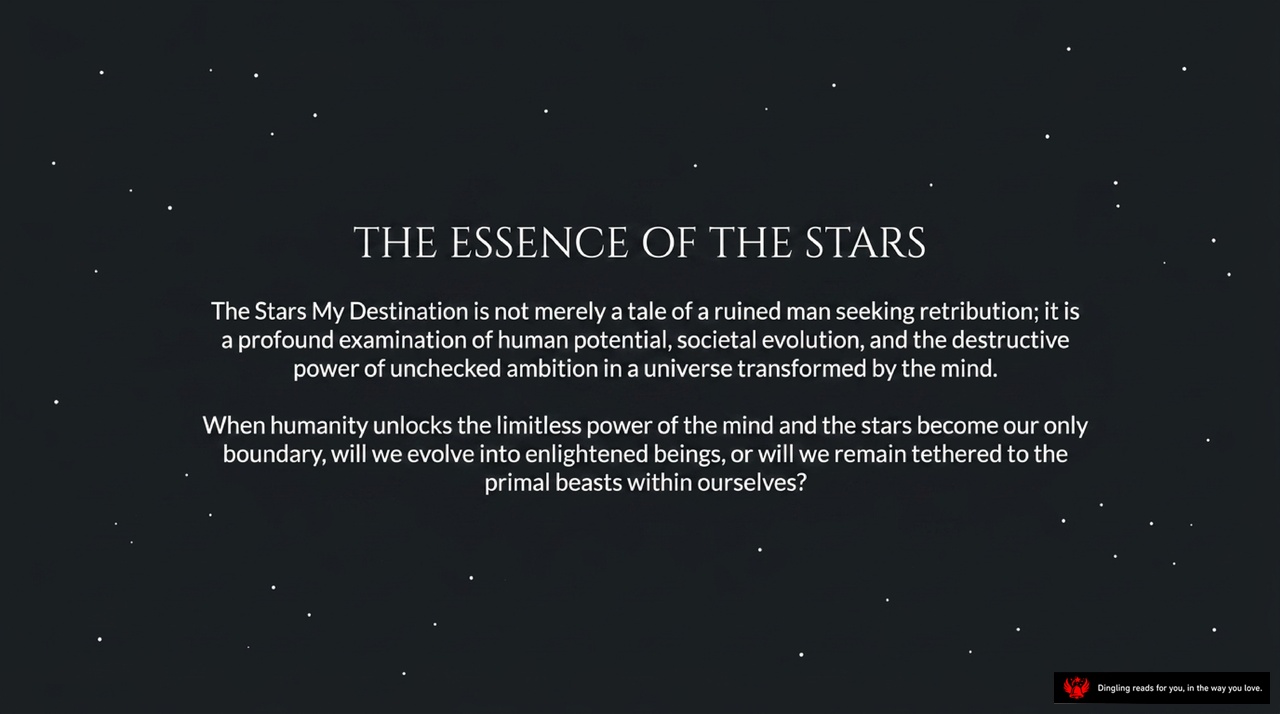
Look at this slide. "The Essence of the Stars." It's a haunting question for us all: When we unlock the limitless power of the mind, do we evolve into enlightened beings, or do we remain tethered to the primal beasts within ourselves?
This is the core conflict of *The Stars My Destination*. It's not just a story about a ruined man seeking revenge; it's a profound examination of human potential and the destructive power of unchecked ambition.
Giles Frye, our protagonist, is the ultimate test of this question. He starts as a broken, desperate man trapped in the vacuum of space, driven by pure, burning hatred. But as he masters the power of "psi-kinesis"—the ability to move his mind and matter—he transforms from a victim into a god-like force. He learns that his mind is the only true boundary left in a universe where physical limits no longer exist.
But here lies the terrifying trap. Frye's journey shows us that great power doesn't automatically bring enlightenment. Instead, it often amplifies our darkest instincts. His initial drive was pure survival and revenge, fueled by the primal beast inside him. Even as he ascends to the stars, conquering galaxies and rewriting the laws of physics, that inner darkness follows him. He becomes a tyrant, a destroyer, proving that without moral evolution, unlocking the power of the mind only leads to a new, more terrifying form of chaos.
The slide asks us to look in the mirror. We all possess a version of Frye's power—the ability to change our reality, to overcome our limits. The real question isn't whether we can reach the stars, but whether we are wise enough to stay human while we do. Will we rise above our base instincts, or will we let our ambition consume us, just like Frye did? That is the essence of the stars, and the essence of our own destiny.