
The Start-up of You: Complete Chapter-by-Chapter Summary
Welcome to the very beginning of a powerful journey. Today, we are launching a new chapter in your life: The Startup of You.
Imagine your career not as a straight line on a ladder, but as a dynamic, evolving business that you own and operate. That is the core message from Reid Hoffman and Ben Casnocha. We are here to help you navigate the modern career landscape by adopting the mindset of a Silicon Valley entrepreneur.
Forget the old idea that you just wait to be promoted. The world has changed. The rules are no longer about loyalty to a single boss or climbing a fixed corporate ladder. Instead, you need to take full responsibility for your own professional growth. You are the CEO of your own career. By embracing this entrepreneurial spirit, you can turn uncertainty into opportunity, build your own unique competitive advantages, and create a future that is truly yours to shape.
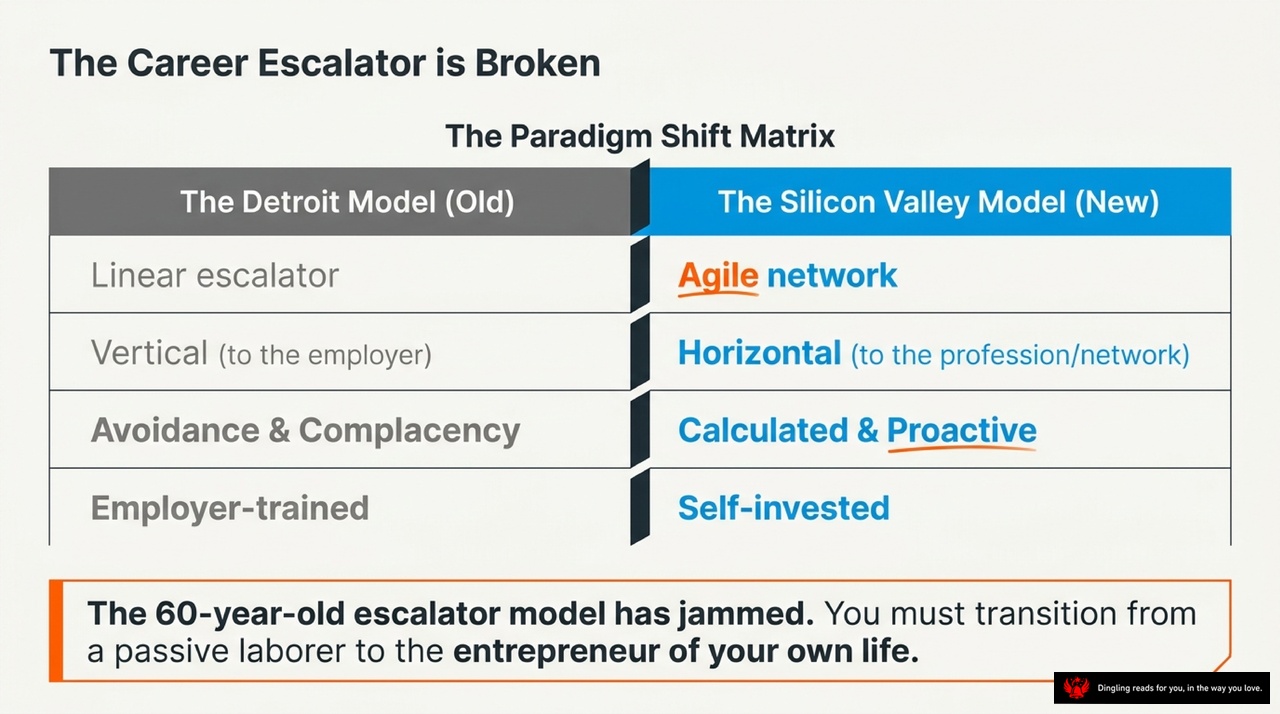
The old way of climbing the career ladder is officially broken. For decades, the "Detroit Model" promised a safe, linear path: get trained by your employer, stay loyal, and climb vertically to a comfortable retirement. But today, that escalator has jammed. You are stuck in a crowded, competitive system where loyalty no longer guarantees security, and skills become obsolete overnight.
To survive, you need to switch to the "Silicon Valley Model." This isn't about quitting your job to start a business; it's about adopting an entrepreneurial mindset. Instead of relying on a vertical ladder to a single boss, you must build a horizontal, agile network. Your career becomes a business you own, where you are the CEO.
This shift requires a complete change in attitude. Move from avoidance and complacency to being calculated and proactive. Stop waiting for the company to train you; instead, become self-invested. Your assets, your values, and the market reality must align dynamically. Just like a true entrepreneur, you must constantly test your direction, adapt to new opportunities, and build a safety net so you can take smart risks without fear. The 60-year-old escalator is gone. It's time to become the entrepreneur of your own life.

So, how do we actually apply this "Permanent Beta" mindset to our real lives? Think about Netflix. It's the perfect example. Reed Hastings didn't just build a DVD rental company and call it a day. He pivoted to subscriptions, then to streaming, and now to producing original content. He never settled into a "finished" business model. He kept testing, kept iterating, and kept moving.
That exact same urgency needs to apply to your own skills. Never consider your career finished. Here's the hard truth: twenty years of experience shouldn't be one year of experience repeated twenty times. If you're just repeating the same habits, the same strategies, and the same routines, you aren't growing; you're just aging.
In the software world, a beta label means the product is unfinished and constantly improving. But in our minds, we often treat our careers like finished products. We think, "I've got this degree, I've got these skills, I'm done." But in reality, finished means dead. The market changes too fast for you to stay static. You need to treat your career like a startup that is always in beta. Keep learning, keep adapting, and keep asking, "What's the next version of me?" That's how you stay relevant in a world that is constantly upgrading.
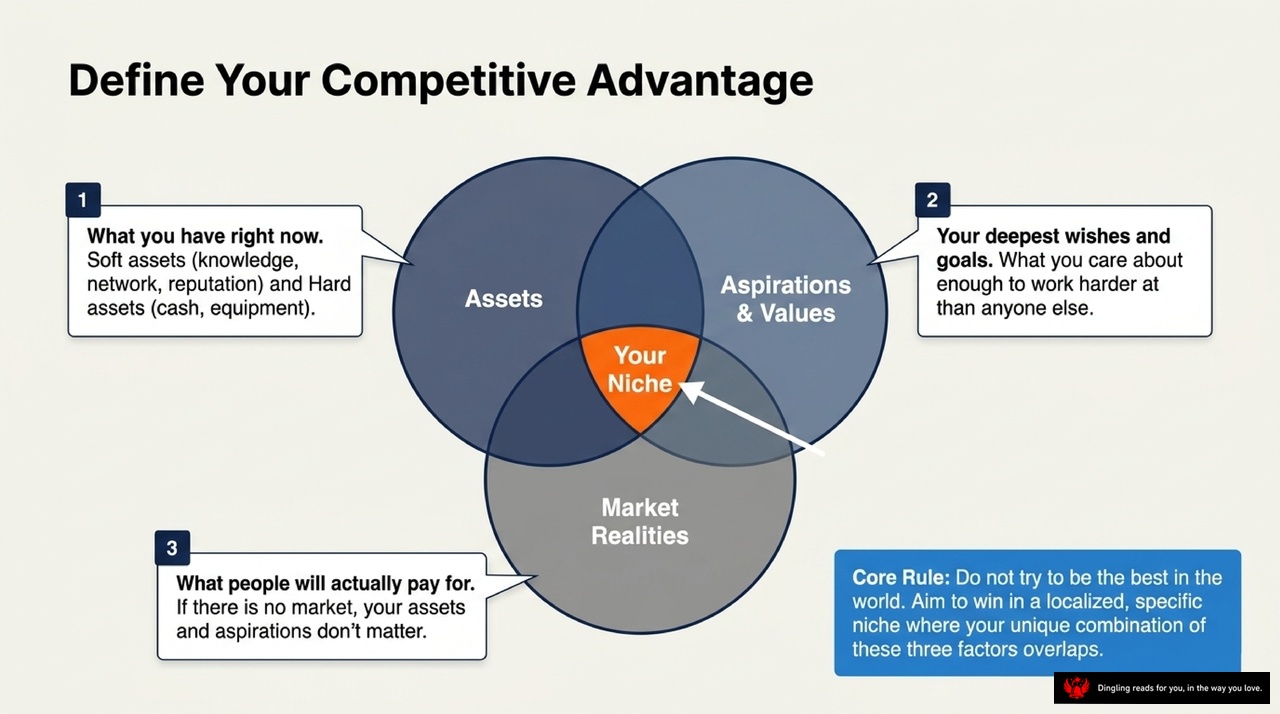
Imagine your career not as a ladder, but as a strategic puzzle where three distinct circles must overlap to create true success. This slide outlines the core framework for defining your competitive advantage: Assets, Aspirations, and Market Realities.
First, look at your **Assets**. This is what you have right now—both the tangible hard assets like cash and equipment, and the intangible soft assets like your knowledge, reputation, and network. But having assets isn't enough; they only become powerful when combined.
Second, consider your **Aspirations and Values**. What are your deepest wishes and goals? What causes you to work harder than anyone else? This acts as your compass, ensuring that your career path aligns with your true passions, much like Jack Dorsey's obsession with simplicity drove his success.
However, the magic happens only where these two circles intersect with the third circle: **Market Realities**. This represents what people are actually willing to pay for. No matter how talented you are or how much you love your work, if there is no market demand, your assets and aspirations remain irrelevant. Think of it like Howard Schultz researching coffee habits in Milan before launching Starbucks; he didn't just follow his vision; he validated it against real consumer needs.
The core rule here is simple: Do not try to be the best in the world. Instead, aim to win in a localized, specific niche where your unique combination of skills, passions, and market demand overlaps. Your competitive advantage is dynamic, not static. As your skills grow and the market shifts, you must constantly re-evaluate this triangle. By balancing what you have, what you love, and what the world needs, you stop competing in a crowded red ocean and start owning a unique space where you are the obvious choice.
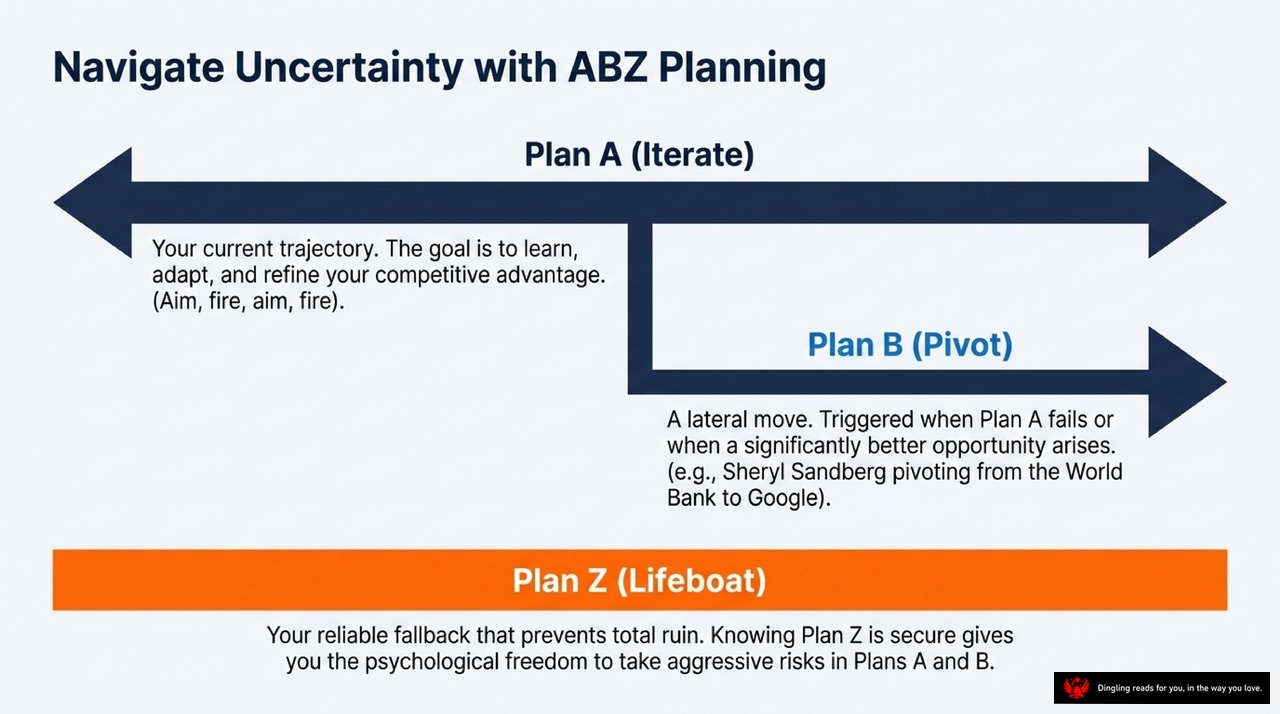
Imagine your career not as a rigid ladder, but as a dynamic system with three distinct paths. This is the essence of ABZ Planning.
Plan A is your current trajectory. It's where you are right now, focused on iterating, learning, and refining your competitive advantage. Think of it as "aim, fire, aim, fire"—you execute, get feedback, and adjust. But life doesn't always go according to plan. That's where Plan B comes in. It's your pivot strategy. Triggered when Plan A hits a wall or when a significantly better opportunity arises, Plan B is a lateral move. It allows you to shift direction without starting from scratch, leveraging what you've learned on the original path.
But what if both Plan A and Plan B fail? This is where Plan Z, your lifeboat, becomes critical. It is your reliable fallback designed to prevent total ruin. Knowing you have a secure safety net gives you the psychological freedom to take aggressive risks in Plans A and B. You aren't playing for survival; you're playing to win.
The key to this framework is flexibility. Plan A isn't about sticking to one path no matter what; it's about continuous calibration. Plan B isn't a random career change; it's a strategic pivot based on new data. And Plan Z isn't a sign of giving up; it's the ultimate insurance that lets you keep moving forward. By building all three layers, you stop fearing uncertainty and start navigating it with confidence.

Think about this: individual power is amplified by the network. The slide highlights a crucial shift in how we view success. We often cling to the myth that the self-made individual is a narrative illusion, but the reality is far more powerful. Your capabilities don't grow linearly; they expand exponentially through your team and network. That's why the visual shows "I" transforming into "We," connected by a web of relationships.
Networking isn't about collecting business cards or pretending to be a lone wolf. It's about building genuine alliances by asking the right question: "What's in it for us?" When you focus on mutual value, you stop competing as an isolated entity and start collaborating as part of a force multiplier. The most successful people aren't just talented; they are connectors who leverage the strengths of others to achieve things they couldn't do alone. So, stop trying to do everything yourself and start building the network that will carry you forward.

Imagine your professional network not as a static contact list, but as a dynamic ecosystem with two distinct architectures. On one side, you have your **Dense Clusters**—your close allies and friends. These are your **Strong Ties**, characterized by narrow, deep connections that offer unwavering trust, backup, and shared values. Think of them as your safety net; they are the people you call in a crisis. However, there's a catch: because everyone in this cluster shares the same circles, you often end up hearing the exact same information and missing out on novel opportunities.
On the other side lies the **Bridging Nodes**—your acquaintances and extended network. These are your **Weak Ties**, which are wide and shallow but incredibly powerful. They act as bridges connecting you to completely different social circles. While they might not offer the deep emotional support of your inner circle, they are the primary source of new information, breakthrough ideas, and unexpected job openings that simply don't circulate within your tight-knit group.
The secret to thriving in today's volatile job market isn't just doubling down on your strong ties. It's about intentionally balancing both tiers. You need the deep trust of your dense clusters for stability, but you absolutely need those bridging nodes to stay ahead of the curve. If you only hang out with people who think exactly like you, you'll never discover the next big thing. True career growth happens when you leverage the reliability of your inner circle while actively cultivating the diverse, weak connections that open doors to the unknown.
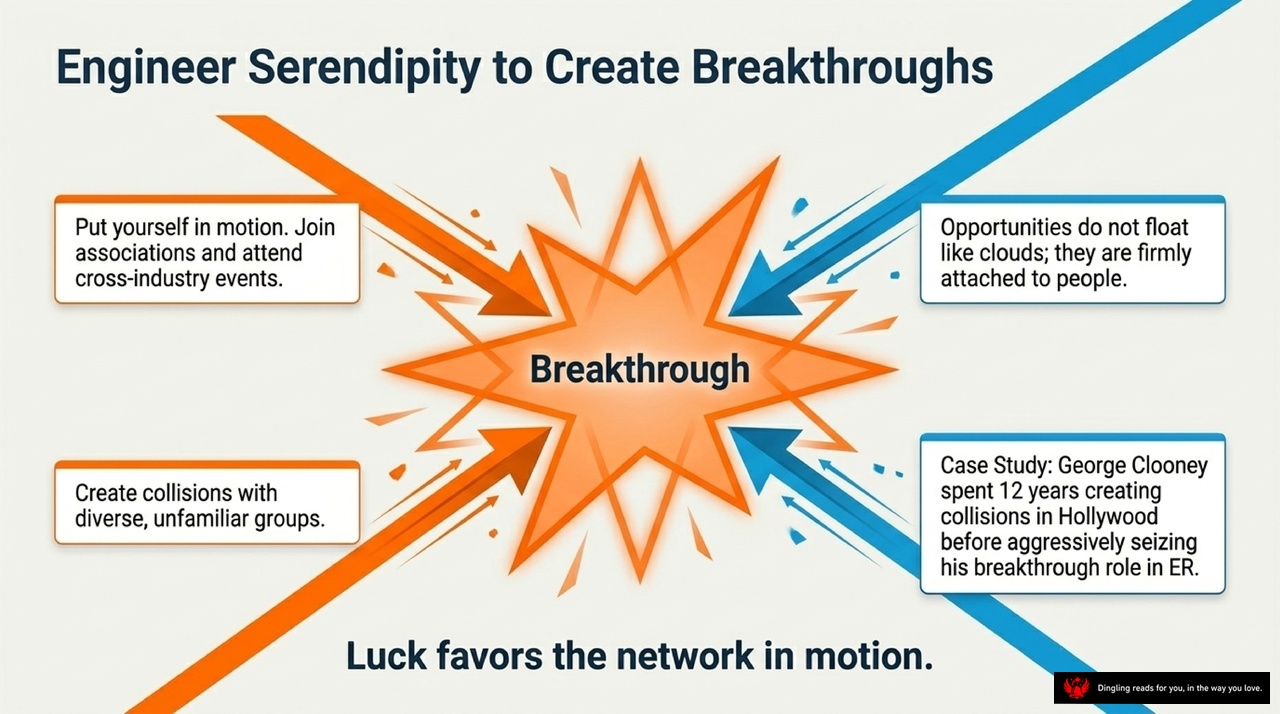
So, here's the thing about luck. We often think it's something that just happens to you, like a cloud drifting by. But the reality is far more active. Opportunities don't float like clouds; they are firmly attached to people. If you want a breakthrough, you have to engineer serendipity yourself.
Look at the center of this slide: "Breakthrough." How do we get there? The secret lies in motion. You have to put yourself in motion. Join associations, attend cross-industry events, and constantly move. Why? Because you need to create collisions with diverse, unfamiliar groups. Think about George Clooney. He spent 12 years creating these very collisions in Hollywood, networking relentlessly before he aggressively seized his breakthrough role in ER. He didn't wait for luck; he built the network where luck could find him.
The bottom line is clear: "Luck favors the network in motion." If you stay static, you stay invisible. But if you actively connect, mix circles, and engage with new people, you position yourself right where the opportunities are waiting. So, stop waiting for the perfect moment and start building the connections that will create it.
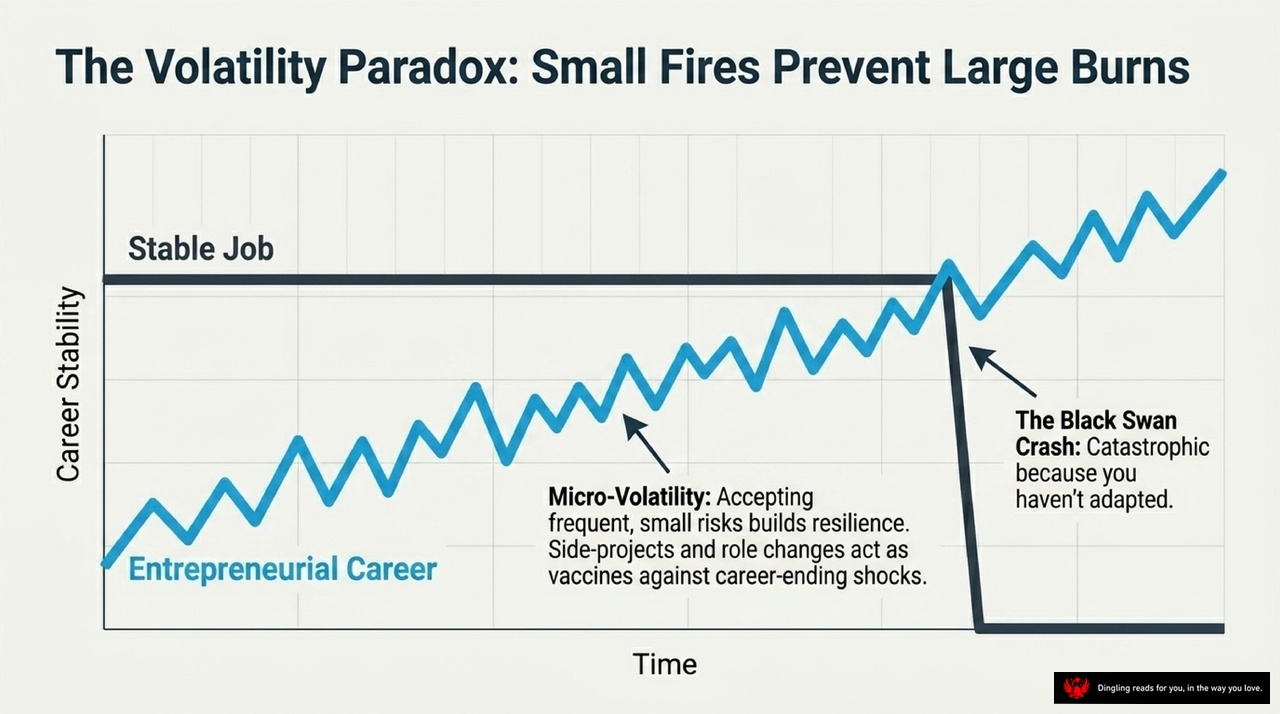
Look at this chart. It illustrates a powerful concept called "The Volatility Paradox": small fires prevent large burns.
On the left, you see the path of an "Entrepreneurial Career." Instead of a flat, straight line, it's a jagged, zig-zagging blue line. This represents "Micro-Volatility." The text explains that accepting frequent, small risks actually builds resilience. Think of side projects and role changes as vaccines against career-ending shocks. By constantly making small adjustments, you stay agile and ready for whatever comes next.
Contrast this with the "Stable Job" line—a perfectly straight, horizontal bar. It looks safe, right? But look at what happens on the right side. When a sudden "Black Swan Crash" hits, that rigid stability turns into a catastrophic drop. Because you haven't adapted, you crash completely.
The lesson here is clear: In a world where change is the only constant, avoiding small risks is actually the biggest risk of all. By embracing the volatility of an entrepreneurial mindset, you don't just survive the storm; you learn to navigate it, ensuring your career stability keeps climbing over time rather than collapsing when the unexpected happens.

How to Evaluate Intelligent Risk
Look at this flowchart. It's not just a diagram; it's a survival guide for your career. We start at the top with the ultimate question: "Can you survive the absolute worst-case scenario?" If the answer is no, the advice is clear in orange: AVOID. Do not risk permanent financial or reputation ruin. Your career is too valuable to gamble everything on a single bad bet.
But if you can survive the worst, we move down. Can you change or reverse the decision midway? Is your Plan B viable? If you can't pivot, the chart tells us to proceed with extreme caution. You're not ready to fully commit yet.
However, if you can survive the worst, and you have a viable Plan B to reverse course, we hit the final check: Are you confusing uncertainty with risk? The text here makes a crucial distinction. Uncertainty is simply a lack of knowledge; risk is the actual probability of loss. Don't avoid a great opportunity just because the path is unclear.
If you pass these three tests, the final instruction is bold and clear: TAKE THE RISK. And here is the pro-tip at the bottom: seek out opportunities that peers perceive as high-risk but are actually low-risk, high-reward. Think of it like taking a lower-paying job that offers massive learning potential. It's not about fear; it's about intelligent evaluation. By following this logic, you stop letting fear paralyze you and start making calculated moves that build your future.

Imagine your professional network not as a static contact list, but as a dynamic, real-time GPS guiding you through a constantly shifting landscape. As the slide illustrates, true navigation requires pulling from three distinct sources to synthesize the full picture. First, you need **Domain Experts**—the deep specialists who provide the tactical mechanics and industry secrets you simply can't find on your own. Second, you need **Close Confidants**, the people who know your personal history, values, and blind spots, offering advice tailored specifically to *you*, not just anyone. Finally, you need **Smart Generalists** who bring the wide-angle view, challenging your assumptions with lateral thinking and macro perspectives that experts often miss.
In a fast-changing world, relying on just one of these groups is a recipe for getting lost. If you only listen to experts, you might lack context; if you only listen to friends, you might miss the bigger market trends. The key is to pull targeted information from all three categories and actively synthesize even the conflicting advice. When your specialist tells you "do this," but your generalist warns "the market is shifting," that tension is where the actual truth lies. Don't just ask one person; triangulate your reality using this network intelligence to find your way forward with confidence.

Think of your career not as a linear ladder, but as a high-octane engine designed for the modern world. This isn't about isolated tactics; it's about an interconnected operating system where every gear drives the next. At the very core sits your Competitive Advantage. This is your engine's fuel, and it dictates everything else. It tells you exactly how to structure your ABZ Plan, ensuring your strategy is built on what makes you truly unique in the market.
Once that advantage is locked in, your engine needs real-time fuel to keep running. That's where The Network (I^We) comes in. It's not just a list of contacts; it's a dynamic intelligence system guiding your moves. Your plan is fueled by this network, constantly adjusted by the insights flowing through your connections. Without this, you're flying blind.
But an engine doesn't just sit still; it moves forward by taking Calculated Risk. This is the propulsion mechanism that drives the entire system. You aren't gambling; you are making smart, informed bets in a state of Permanent Beta. You are constantly testing, learning, and iterating, ready to pivot the moment the market shifts.
So, how do you make this work? Your Competitive Advantage tells you where to aim. Your Network provides the intelligence on how to get there. And your willingness to take Calculated Risk is what actually gets you there. It's a cycle: your advantage shapes your plan, your network informs your next move, and your calculated risks propel you into new opportunities.
Stop thinking of your career as a static job. Start treating it like a startup. Build your unique advantage, leverage your network for real-time intelligence, and don't be afraid to take the calculated risks necessary to move forward. This is the Modern Career Engine, and it's the only way to stay ahead in a world that never stops changing.
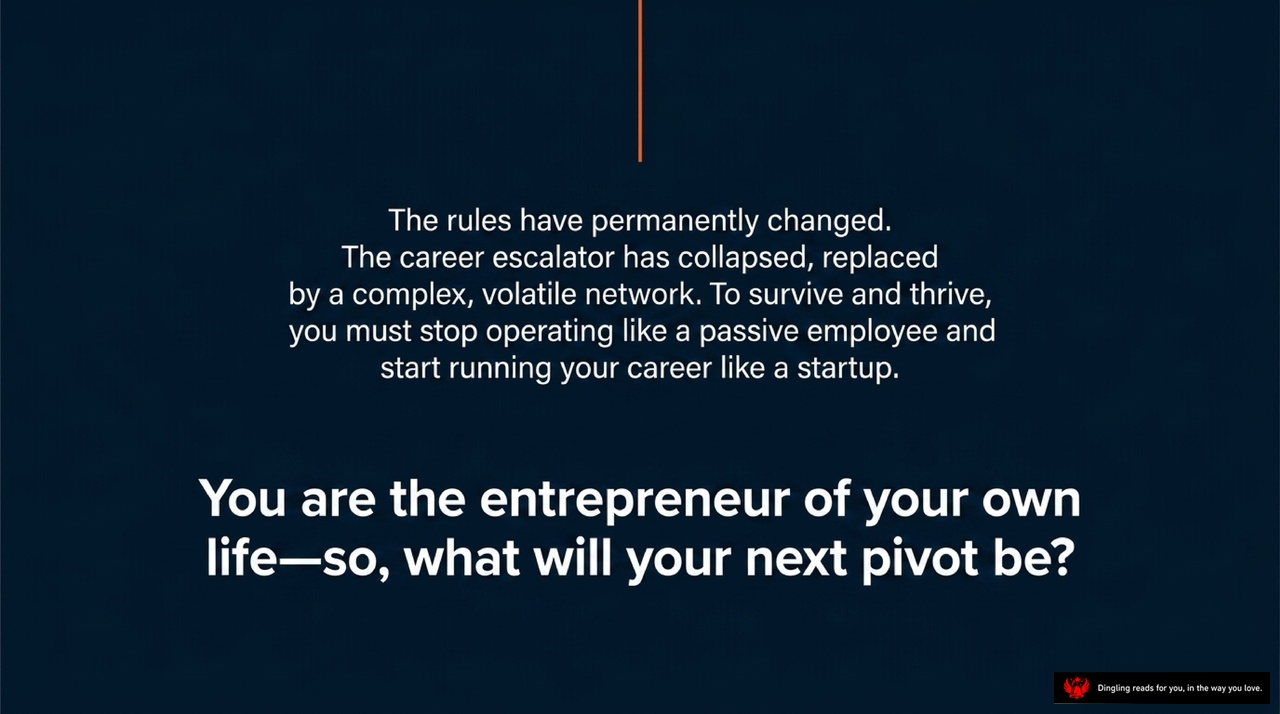
The old career ladder is gone. For decades, we were told to climb the escalator: get a degree, join a big company, work your way up, and retire at 65 with a pension. But that system has collapsed. Today, you are no longer just an employee; you are the entrepreneur of your own life.
Think about it like this: your career is now a startup. You must stop operating passively and start running your business actively. The rules have permanently changed. The world has shifted from a simple "prepare, aim, and shoot" model to a complex, volatile network where you must constantly aim, shoot, pivot, and aim again.
So, what is your next move? Just like a founder who measures assets, ambition, and market reality, you need to treat your professional life as a dynamic portfolio. You have to identify your unique competitive advantage, not by chasing the latest trend, but by understanding what value you bring to the market. Whether you are building a personal brand, leveraging your network, or taking a calculated risk on a new skill, every decision is a strategic pivot.
The question isn't whether the world is changing—it is. The question is, what will your next pivot be? Will you stay stuck in a dying industry, or will you use the tools of an entrepreneur to build a future that fits who you are and what the market actually needs? The time to start acting like a CEO of your own life is right now.