
The Theory of Economic Development: Complete Chapter-by-Chapter Summary

Welcome to the book club session on *The Theory of Economic Development* by Joseph A. Schumpeter. Today's cover sets the stage for a revolutionary look at how our economy actually works. The image you see here—a golden coin shattering under a storm of arrows and blueprints—perfectly captures Schumpeter's core thesis: capitalism isn't a steady, predictable machine. Instead, it's an evolutionary process driven by the disruptive power of entrepreneurial innovation.
Schumpeter argues that traditional economic theories focus too much on a static "circular flow," where everything just repeats itself year after year. But real economic development happens when this balance is broken. It occurs through what he calls "new combinations." These aren't just minor tweaks; they are radical shifts that introduce entirely new products, methods, markets, or organizational structures. Think of it as the moment a new technology or business model shatters the old order, forcing the entire system to adapt and evolve.
As we dive into the text, we'll explore how these disruptions create temporary profits for the bold entrepreneurs who seize them, and how this dynamic tension between stability and change defines the very heartbeat of capitalism.

Capitalism isn't just a steady machine; it's a living system that flips between two distinct modes of operation. On the left, you see "The Static State." Think of it as a comfortable routine where the economy acts like a closed loop. It constantly tweaks itself to match external data—like adjusting production based on last year's sales—but it never breaks its own rules. It's a cycle of habits where money and goods flow smoothly through familiar channels without any real change.
On the right, we have "The Dynamic Engine." This is where true economic development happens. Instead of just adapting from the outside, this mode generates spontaneous, disruptive change from within the system itself. It's not a smooth circle; it's a spiral. That internal disruption—what we call the "new combination"—is the only thing that actually moves the economy forward. Without this engine of innovation, capitalism would just be a static loop, stuck in the past. So, remember: stability keeps the lights on, but only this dynamic, disruptive force builds the future.
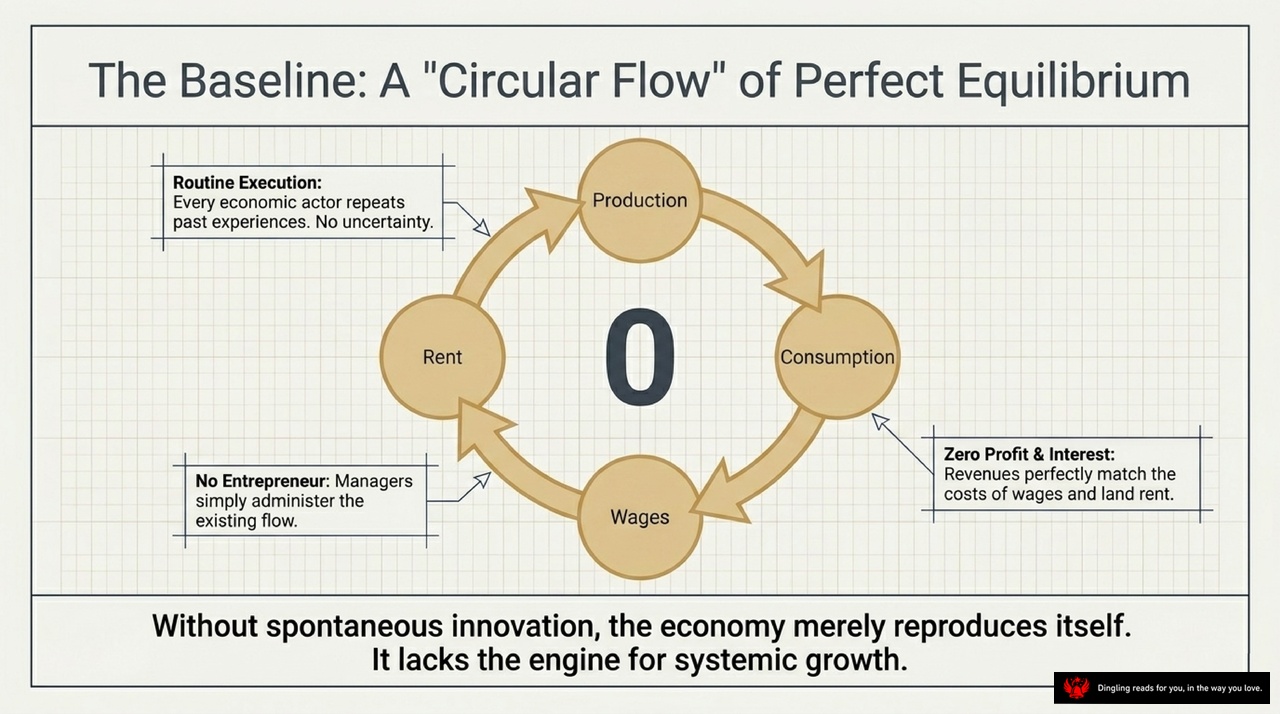
Imagine a world where the economy runs on pure autopilot. In this baseline scenario, we have a "Circular Flow" of perfect equilibrium. Every actor simply repeats what they've done before, guided by past experience with zero uncertainty. There are no entrepreneurs driving change; managers are just administrators keeping the lights on. Production, consumption, wages, and rent all loop around each other in a perfect circle, perfectly matching up. Revenues exactly equal costs, and everyone gets a fair share. The result? The economy merely reproduces itself. It's stable, predictable, and incredibly boring. Without spontaneous innovation to disrupt this loop, there is no engine for systemic growth. We get a static economy that never evolves, just endlessly cycling through the same patterns. But history shows us that real economic life isn't a steady circle; it's a dynamic journey fueled by the very disruptions this baseline seeks to avoid.

So, what exactly drives real economic development? It's not just about inventing new things; it's about the bold act of recombining resources we already have into something entirely new. Schumpeter calls this "the new combination," and it's the engine that breaks our economy out of its static, circular groove.
Look at this diagram. It outlines the five specific ways this transformation happens. First, we see **New Products**: introducing goods consumers have never seen before, or adding fresh qualities to what they already know. Second, we have **New Methods of Production**: this isn't necessarily about high-tech science; it can be simply a new way of organizing business or manufacturing that makes things more efficient.
Then, we look outward. **New Markets** represent entering territories where the industry has never operated, tapping into untapped demand. On the supply side, we have **New Sources of Supply**: seizing control of raw materials or resources that were previously ignored or unexploited. Finally, we see **New Industry Organization**: restructuring the market itself, whether that means breaking a monopoly or creating a new one to change how competition works.
Crucially, notice the arrows pointing inward to "The Circular Flow." These aren't random changes; they are disruptions that pull resources away from their old, routine uses and push them into these new combinations. It's this very disruption that creates the dynamic change we call economic development.

The entrepreneur isn't a job you hold forever; it's a specific function you perform when you execute a "new combination." Think of them as the ultimate agents of change, constantly pushing against the status quo. As the slide illustrates, they start by pulling resources from the comfortable, predictable flow of "ambient resources and habit"—the comfortable routines everyone else is stuck in.
But here's the hard part: moving from that safe track requires what we call "swimming against the tide." It takes immense willpower to overcome the natural resistance of habit. Once they take that leap, they face "societal friction." Society pushes back hard against anyone who deviates from the norm, creating severe social and economic resistance.
Yet, the true genius of the Schumpeterian entrepreneur lies in "intuitive execution." They don't wait for perfect data or a fully mapped-out plan. Instead, they act on an intuitive grasp of essential facts, forging entirely new paths even when the road doesn't exist yet. By combining existing elements in ways no one has tried before, they break the old equilibrium and force the entire economy to evolve.

Capitalism isn't a static machine; it's a dynamic engine driven by the interplay of three distinct players: the Manager, the Capitalist, and the Entrepreneur. Each brings a unique function, faces a specific type of risk, and earns a different reward.
Look at the Manager first. Their role is to operate within the established circular flow, keeping the lights on. Because they are executing routine tasks, their risk is minimal. In return, they earn a steady salary. It's the safe, predictable path of maintaining the status quo.
Then, there is the Capitalist. This actor provides the purchasing power—essentially credit—to fund new combinations. Their job is to supply the fuel for innovation. However, this comes with the absolute financial risk. If the new venture fails, the Capitalist bears the cost. Their reward is interest, a return on the capital they lent out.
Finally, we have the Entrepreneur. This is the true disruptor. They execute new combinations and orchestrate disruption, whether by inventing a new product, finding a new market, or reorganizing industry. Crucially, while they face significant reputational and execution risks, they do not carry the direct financial risk—that falls on the Capitalist. Their reward is temporary profit. It's important to note that this profit is fleeting; once the innovation becomes standard practice, that profit disappears, and the Entrepreneur often transforms into a Manager.
So, in this ecosystem, the Manager maintains the system, the Capitalist funds the change, and the Entrepreneur drives the disruption. It is this specific division of labor and risk that powers the entire capitalist engine.
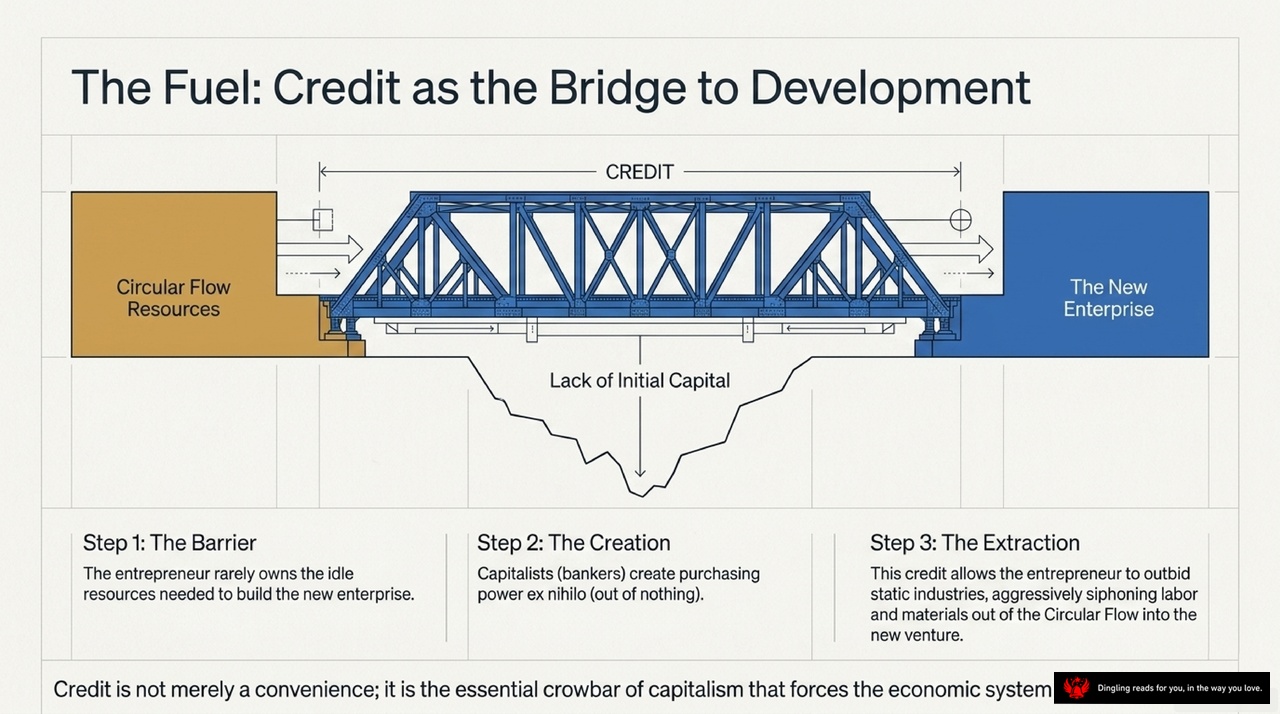
Look at this diagram titled "The Fuel: Credit as the Bridge to Development." It perfectly visualizes the single most important engine of capitalism: the ability to borrow money before you have made it.
The image starts on the left with "Circular Flow Resources." In a normal, static economy, resources just go round and round. But to build something new—"The New Enterprise" on the right—you first need capital. The diagram highlights a massive gap labeled "Lack of Initial Capital." You can't just pull resources out of thin air; you need to buy materials and pay workers before the product is even sold.
This is where credit steps in. The bridge labeled "Credit" spans that gap. It connects the existing economy to the future. The text below breaks this down into three steps. First, "The Barrier": entrepreneurs rarely own the idle resources needed to start. Second, "The Creation": banks and capitalists create purchasing power *ex nihilo*, or out of nothing. They don't wait for savings; they invent the money needed to start the project. Third, "The Extraction": this credit allows the entrepreneur to outbid static industries, aggressively siphoning labor and materials out of the old system and into the new venture.
As the slide concludes, credit isn't just a convenience. It is the essential crowbar of capitalism. It forces the economic system to move from a static loop into dynamic growth. Without this bridge, there is no development, only stagnation.

Here is the spoken-word script for the slide, tailored for an American audience:
"Let's talk about the real payoff for the innovator. As we move from the initial spark of invention to the broader market, the financial reality shifts dramatically. Look at the chart: in the first stage, the Innovation Phase, the entrepreneur captures a massive block of 'Entrepreneurial Profit.' This isn't just luck; it's a temporary surplus created because you've successfully disrupted the market with something new. Competitors haven't caught up yet, so you're selling at a premium while your costs remain low.
But here's the catch: this profit is fleeting. As soon as others see your success and start copying your method, prices drop and costs rise. That blue block of profit collapses, as the diagram shows, leading us into the second stage: the Absorption Phase. Once the market fully adopts your innovation, the competitive equilibrium kicks in, and that special windfall vanishes.
So, what remains? The answer is 'Interest.' Think of interest as a permanent tax on profit. It's the premium that capital providers—like banks or investors—demand for giving you the purchasing power you needed to start in the first place. While your entrepreneurial profit is a one-time reward for being first, interest is the permanent cost of doing business in a credit-based economy. You trade your temporary monopoly profits for the permanent obligation of paying interest on the capital that made your disruption possible."

The Swarm Effect: Why Innovation Clusters
Look at this diagram. It perfectly captures the heartbeat of economic progress. On the left, we see "The Pioneer." This is the initial entrepreneur facing massive societal and economic resistance. They are the only one brave enough to absorb the friction of charting unknown territory, proving that a new model actually works.
But here is the key insight: innovation doesn't happen in a straight line. It clusters. Once the pioneer clears the path and demystifies the risk, something explosive happens. A "swarm" of imitators and secondary innovators rushes in. As shown in the center, the barrier breaks, and the blue dots—representing this swarm—pour through.
This leads directly to "The Result." Innovation does not distribute evenly across time; it clusters. This sudden mass extraction of resources and injection of credit violently yanks the economy into a Boom. That is why we see innovation clusters. The pioneer pays the cost, and the swarm reaps the reward, creating the boom cycles that define our economic history.

Look at this curve. It tells the whole story of our economy: a boom, a recession, and finally, liquidation. The blue section shows the boom. It's fueled by a swarm of entrepreneurs who draw credit, bidding up the prices of production materials. But then, the trend flips into the yellow section: the recession and liquidation. Why does this happen? As new products flood the market, prices collapse and obsolete industries get crushed. Debts are liquidated.
But here is the most important part you need to understand: the necessity of crisis. Many people think recessions are just psychological panics. That's wrong. They are not. Recessions are a painful but necessary mechanical process. The economy needs them to absorb the disruption from the boom and struggle toward a new, higher equilibrium. Without this crash, the system cannot reset itself to find a new zero-profit equilibrium. So, don't fear the downturn; it is the engine that clears the way for the next growth cycle.

The Anatomy of Cycles: Interlocking Waves of Progress
Today, we're diving into the heartbeat of the economy. Joseph Schumpeter didn't just see random ups and downs; he mapped a precise, rhythmic architecture of progress. Think of the economy not as a straight line, but as a symphony of three overlapping waves, each driving the next.
First, we have the **Kondratieff Wave**, the longest cycle spanning about 50 years. These are the massive tides of history, driven by epoch-shifting innovations like the Industrial Revolution, the rise of steam and steel, or the electrification of the world. These aren't just market fluctuations; they are fundamental shifts in how we live and produce.
Riding within these long waves are the **Juglar Cycles**, lasting roughly 9 to 10 years. These are the standard business cycles we see in the news. They are fueled by industry-level swarms of innovation—think of a specific sector, like tech or construction, where a cluster of new ideas triggers a boom, followed by a necessary correction as the market saturates.
Finally, zooming in on the shortest timeframe, we have the **Kitchin Wave**, oscillating every 40 months. These short-term jitters are driven by inventory adjustments and minor localized fixes. Businesses overproduce, stockpiles pile up, prices crash, they cut back, and then they rebuild.
What makes this framework so powerful is how these waves interlock. The long Kondratieff wave sets the stage, the medium Juglar wave drives the bulk of economic activity, and the short Kitchin wave creates the daily volatility. It's a system where different scales of innovation feed into one another, creating the complex, yet predictable, rhythm of human progress.

Synthesis: The Engine of Creative Destruction
Look at this diagram. It visualizes a powerful truth: capitalism isn't a machine designed to stay still. It's an evolutionary engine built on "creative destruction." Notice how the fuel enters through credit, ignited by the entrepreneur. That spark drives innovation, which transfers torque to the business cycle.
The text on the right explains the mechanics. Capitalism operates by continuously destroying the old economic structure from within and relentlessly creating a new one. Think of it this way: periodic crises, bankruptcies, and the obsolescence of old industries aren't bugs in the system. They are the inescapable price of systemic economic progress. Just like a car needs friction to move forward, the economy needs the destruction of outdated methods to make room for the next breakthrough. Without this relentless cycle of tearing down the old to build the new, the engine simply stalls.
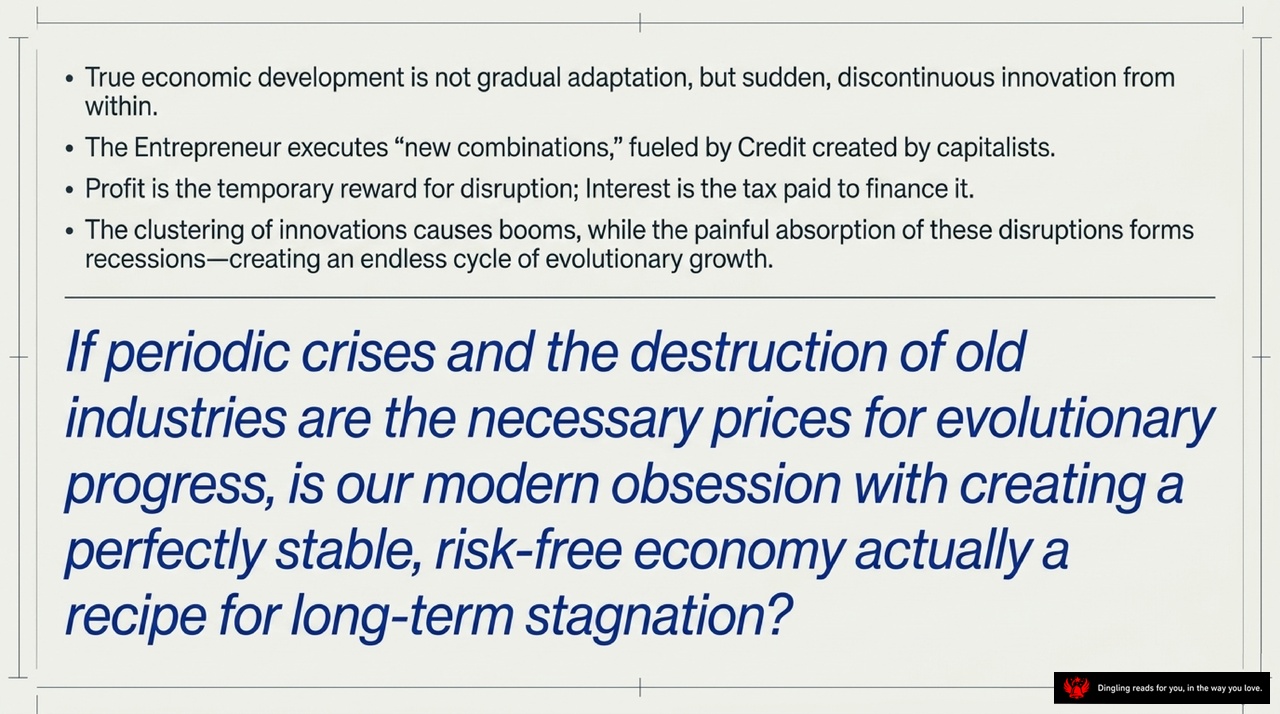
True economic development isn't about slow, steady adaptation; it's about sudden, discontinuous innovation bursting from within the system. As we've seen, entrepreneurs execute these "new combinations"—launching new products, adopting fresh methods, or tapping untapped markets—fueled by credit created by capitalists. This credit acts as the engine that pulls resources away from old uses and injects them into new ventures.
Here's the crucial trade-off: profit is the temporary reward for this disruption, but interest is the tax we pay to finance it. When innovations cluster together, they trigger booms; but as the economy painfully absorbs these shocks, we enter recessions. This creates an endless cycle of evolutionary growth.
So, if periodic crises and the destruction of old industries are the necessary price for progress, is our modern obsession with building a perfectly stable, risk-free economy actually a recipe for long-term stagnation? The answer lies in understanding that without these disruptive cycles, the economy simply stops evolving.