
The Third Chimpanzee: Complete Chapter-by-Chapter Summary
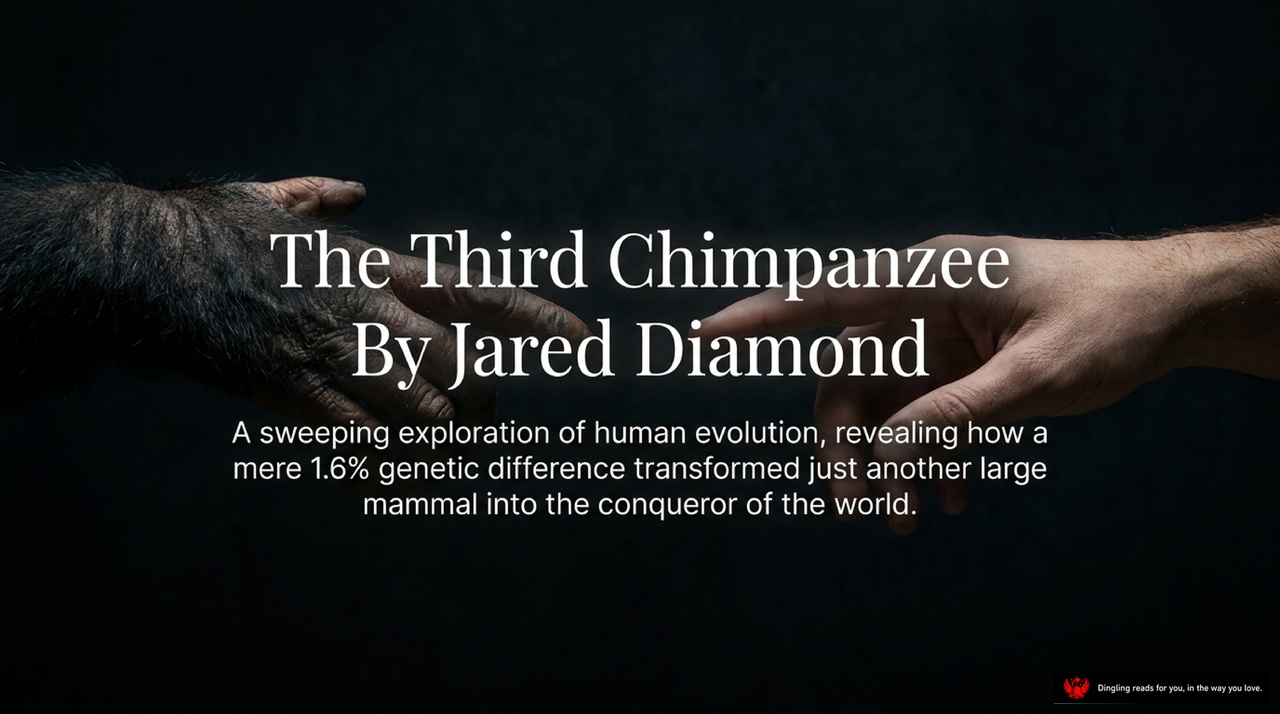
Welcome to our book club session on *The Third Chimpanzee* by Jared Diamond. Look at this striking image: a human hand reaching out to touch a chimpanzee's hand. It's a powerful visual that captures the book's core question. Despite that tiny 1.6% genetic difference, we are worlds apart. Diamond explores how this minuscule gap transformed another large mammal into the world's conqueror. He takes us on a sweeping journey through human evolution, challenging our view of where we fit in the animal kingdom. From the mysterious origins of our species to the dramatic shifts that defined our future, this book offers profound insights into what makes us uniquely human. Get ready to rethink your understanding of our place in nature.
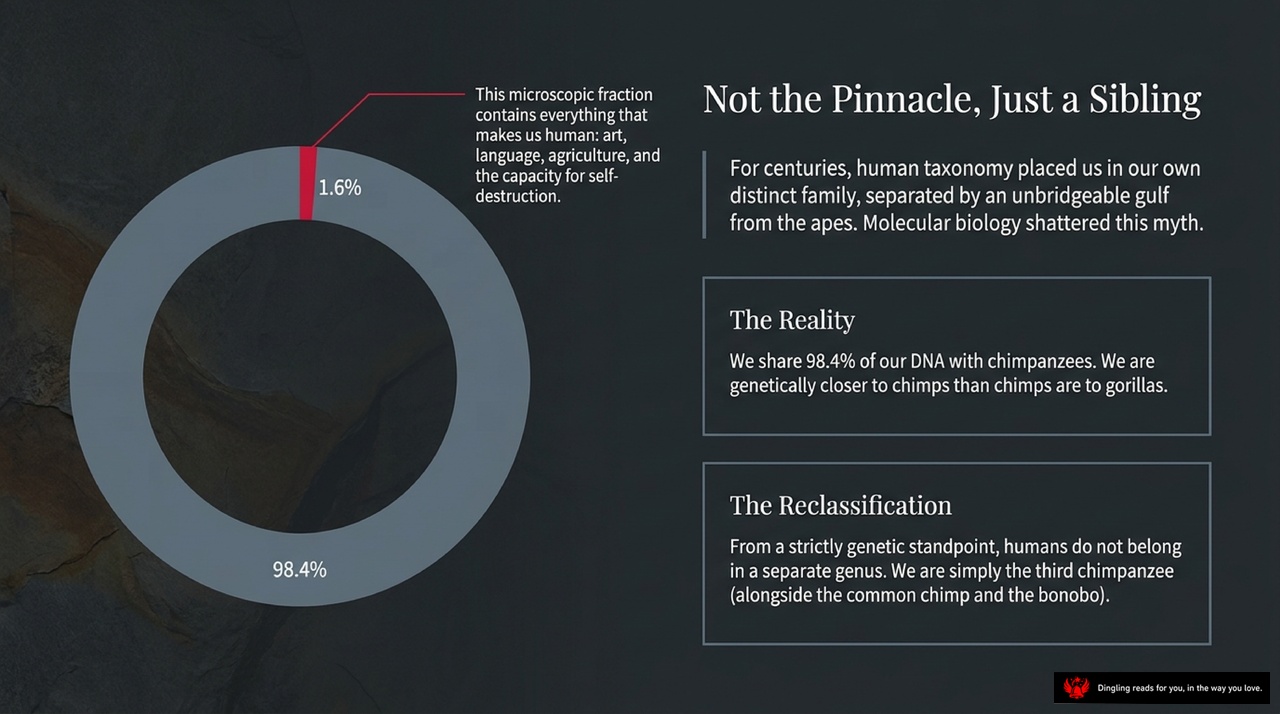
For centuries, we believed humanity stood alone at the top of the evolutionary tree, separated from the rest of the animal kingdom by an unbridgeable gap. But modern science has shattered that myth, revealing a startling truth: we are not the pinnacle, just a sibling.
Look at this graphic. The vast majority of our DNA—98.4%—is identical to that of chimpanzees. In fact, we are genetically closer to chimps than they are to gorillas. From a strictly genetic standpoint, humans don't even belong in a separate genus; we are simply the third type of chimpanzee, alongside the common chimp and the bonobo.
So, if we share 98.4% of our genes, what makes us human? The answer lies in that microscopic fraction—the remaining 1.6%. This tiny sliver contains everything that defines us: complex language, agriculture, art, and even the terrifying capacity for self-destruction. While our genetic blueprint is nearly identical, this small difference has led to a massive divergence in behavior and capability. We are not a different species; we are a close relative who took a unique path.

We are standing at a pivotal moment in our understanding of our own origins. For centuries, anatomists believed our split from our closest relatives happened millions of years ago, but modern science has rewritten this timeline entirely. By looking at our DNA, we've discovered that we are actually much closer to our primate cousins than previously thought.
The genetic clock tells a clear story. About 10 million years ago, the gorilla lineage branched off, showing a 2.3% genetic difference from us. Then, roughly 7 million years ago, the human line separated from the chimpanzee and bonobo line, with only a 1.6% difference. Finally, just 3 million years ago, chimpanzees and bonobos split from each other, differing by a mere 0.7%.
This data reveals a profound truth: we are not separate from the apes. We are, in a very real sense, the third type of chimpanzee. The genetic gap between us and them is so small—less than 2%—that it's smaller than the difference between various breeds of dogs. Yet, this tiny fraction of DNA has created a massive chasm in our lives. We have built cities, mastered the stars, and developed complex language, while our closest relatives remain bound by the limits of the natural world.
This slide isn't just about dates and percentages; it's about identity. It challenges the idea that we are a unique exception in the animal kingdom. Instead, it shows us that we are a part of a shared evolutionary journey, diverging from a common ancestor relatively recently in geological time. Understanding this connection is the first step in understanding who we truly are.

Look at this timeline. It tells a story of a massive disconnect between our brains and our behavior. For hundreds of thousands of years, our anatomy and our culture were stuck in a parallel, but separate, evolution.
On the top, under "Anatomical Evolution," you see skulls growing larger. Yet, look at the box labeled "The Stagnation." Early Homo sapiens and Neanderthals had modern-sized brains, but they were using the same crude stone tools for hundreds of thousands of years. They had the hardware, but the software wasn't running yet.
Below that, under "Cultural Evolution," the tools stay simple for a long time. Then, everything changes. The box calls it "The Catalyst." Scientists theorize a minor anatomical shift in the vocal tract unlocked the capacity for complex spoken language. That tiny biological tweak was the key.
Finally, look at the explosion on the right labeled "The Spark." Around 40,000 years ago, humans underwent a sudden, explosive transformation. Art, complex weaponry, and rapid innovation appeared overnight. Our brains had been waiting, but once language clicked into place, our culture finally caught up. This is the moment we truly became human.

We often assume that art is a uniquely human gift, something that separates us from the rest of the animal kingdom. But the reality is far more fascinating: creativity is actually a universal strategy for survival. Consider Cello, the Asian elephant who mastered the brush, or Congo the chimpanzee, who could paint 33 canvases a day. These weren't just random scribbles; they were genuine expressions of joy and intent, indistinguishable from human artistic motivation.
Then there's the bowerbird of Australia and New Guinea. Male birds construct elaborate, colorful structures—some circular, some arched—and decorate them with flowers, fruits, and even beetle wings. It looks absurd, but it serves a critical evolutionary purpose: it's a billboard for their genetic quality. A perfectly built bower signals a strong, intelligent, and healthy male, helping him attract a mate. This is the same logic driving human fashion and decor; we use external displays to signal our value to potential partners.
Human art, from the 40,000-year-old cave paintings of the Cro-Magnons to our modern masterpieces, shares these roots. Initially, our earliest creations likely served similar social and mating functions, helping us display our skills and bond with our groups. Over time, art evolved beyond mere utility into a way to express deep emotions and unify our communities. Yet, the core remains the same: whether it's a bird's bower or a human's painting, art is a powerful tool for assessment and connection, proving that the drive to create is written into the very fabric of life.

Imagine a world where nature's most ancient rules have been shattered. For millennia, our ancestors lived as nomadic foragers, enjoying a life of relative equality, robust health, and a diet rich in diverse proteins. Then came the Agricultural Revolution—a moment often hailed as humanity's greatest triumph, yet it was actually a catastrophic pivot point that traded our freedom for comfort.
Look at the data. Before farming, European foragers stood nearly 5'10" for men and 5'6" for women. After the shift to agriculture, average heights plummeted to 5'3" and 5'1". Why? Because we stopped eating a balanced diet of meat and plants and started relying on a single, nutrient-poor crop like wheat or corn. We also traded fresh water and open skies for crowded, unsanitary villages where diseases like tuberculosis and trachoma thrived. Caries, or tooth decay, skyrocketed from less than one per person to nearly seven.
But the damage went far beyond our bodies. Farming created a surplus of food, which inadvertently created the first social classes. For the first time, not everyone needed to hunt or gather. Some could become warriors, priests, or kings, living in luxury while the majority toiled in the fields. This surplus also locked women into a rigid domestic sphere, stripping them of the high social status they once held as primary providers.
Perhaps most tragically, this revolution birthed a cycle of ecological destruction. As populations exploded, we cleared forests, drained wetlands, and exhausted soil. We built civilizations on a foundation of resource extraction that eventually collapsed. Think of the Maya or the people of Petra; their empires didn't fall to invaders, but to their own inability to sustain the environment they had conquered.
So, what is the real lesson here? The Agricultural Revolution wasn't a straight line to progress. It was a double-edged sword that gave us cities and technology at the cost of our health, our equality, and our planet's stability. It reminds us that no amount of technological advancement can fix a broken relationship with nature. We are not masters of the Earth; we are its most destructive guests, and the ruins of the past are the only warning we have for the future.
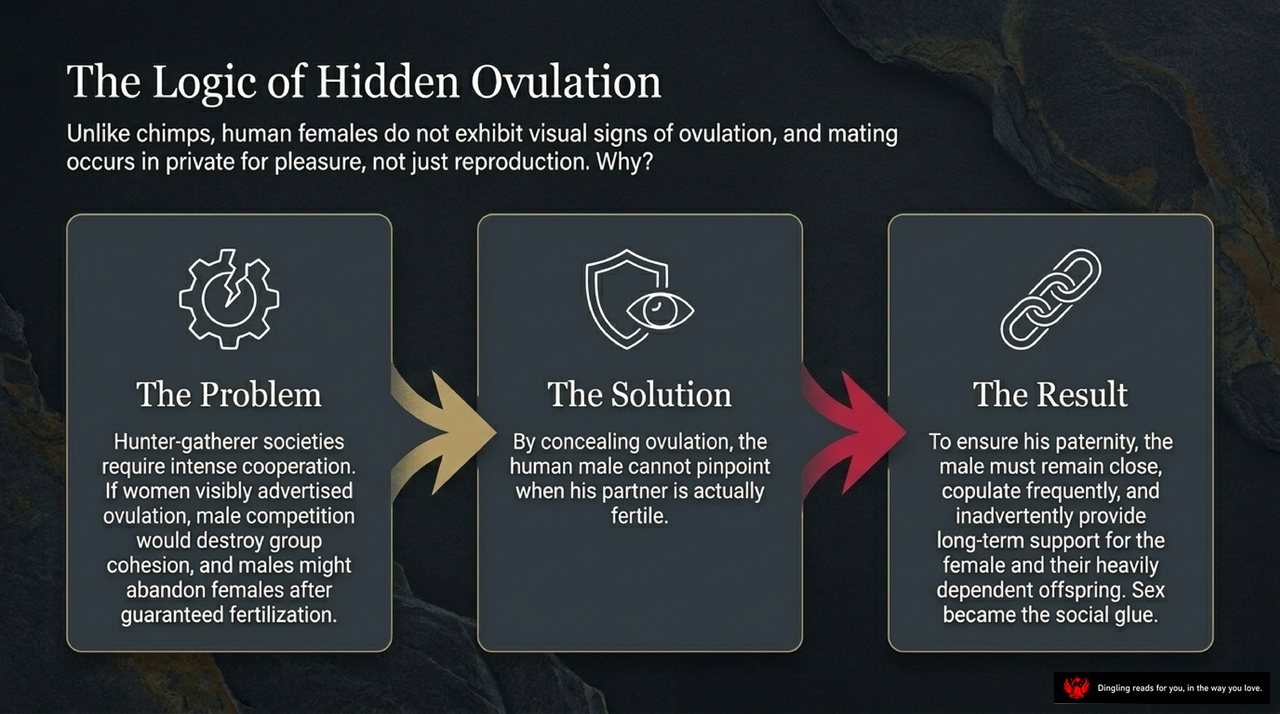
Here is the spoken-word script for Slide 6, tailored for an American audience:
So, let's break down the logic behind why human ovulation is hidden. The slide outlines a clear cause-and-effect chain starting with "The Problem." In our hunter-gatherer days, group cooperation was everything. If women openly advertised when they were fertile, intense male competition would tear the group apart. Males might abandon females once guaranteed fertilization happened, leaving the group without essential support. To prevent this social collapse, nature provided "The Solution": concealing ovulation. Because women don't show obvious signs of fertility, men can't pinpoint the exact moment to impregnate a partner. This uncertainty forces men to stay close, copulate frequently, and invest in the relationship year-round. The result? "The Result" is a society where sex becomes the social glue. By making paternity uncertain, men are inadvertently compelled to provide long-term support for the female and their highly dependent offspring. This evolutionary trick ensured that human males remained invested partners rather than short-term visitors, stabilizing our complex social structures and securing the survival of our children.

Have you ever wondered why human women stop reproducing in midlife, while almost every other animal breeds until the very end? It seems like a biological glitch, but evolution is actually a strict economy of energy.
Look at this scale in the center. On one side, we have "Reproductive Capacity," and on the other, "Offspring Survival." For most mammals, these are perfectly balanced until death. But for us, something shifted.
The reason lies in "The Danger of Birth." Because of our massive infant brains and narrow hips, human childbirth is uniquely lethal. If an older mother dies during delivery, her highly dependent children almost certainly perish without her care. This creates a terrifying "Investment Trade-off." Every child a mother has later in life is a gamble that could wipe out all her previous investments.
So, nature installed a safety mechanism: "The Evolutionary Shut-Off Valve." Menopause is that valve. By stopping reproduction, an older woman ensures her own survival to raise her existing children and help her grandchildren. She maximizes her genetic legacy not by making more babies, but by guaranteeing the survival of the ones she already has. It's a brilliant, counterintuitive strategy that makes us the only species to outlive our reproductive years.

We often look at human culture as something uniquely divine, a light that only we could kindle. But the reality is far more grounded: our most "human" achievements actually have deep roots in the animal kingdom. Let's look at three surprising parallels.
First, consider language. We might think speech is a miracle, but vervet monkeys already use distinct calls to warn about specific predators like leopards or eagles. Humans took that exact symbolic system and simply added grammar and syntax, amplifying a biological tool into a universal language.
Second, think about art. We see it as high culture, but bowersbirds have been building elaborate, color-coordinated towers for thousands of years to attract mates. These aren't functional shelters; they are deliberate displays of excess resources and leisure time. Human art shares these same biological roots in sexual selection.
Finally, look at substance abuse. We often view smoking or drinking as a moral failing, but there's an evolutionary logic here known as the Handicap Principle. Think of a gazelle jumping incredibly high to prove to a predator that it is too fit to catch. Similarly, humans unconsciously use toxic chemicals as a biological signal of raw genetic fitness. By surviving the poison, we prove our strength to others.
So, from our complex sentences to our cave paintings and even our vices, the architecture of human culture was built on the same blueprints found throughout the animal kingdom.
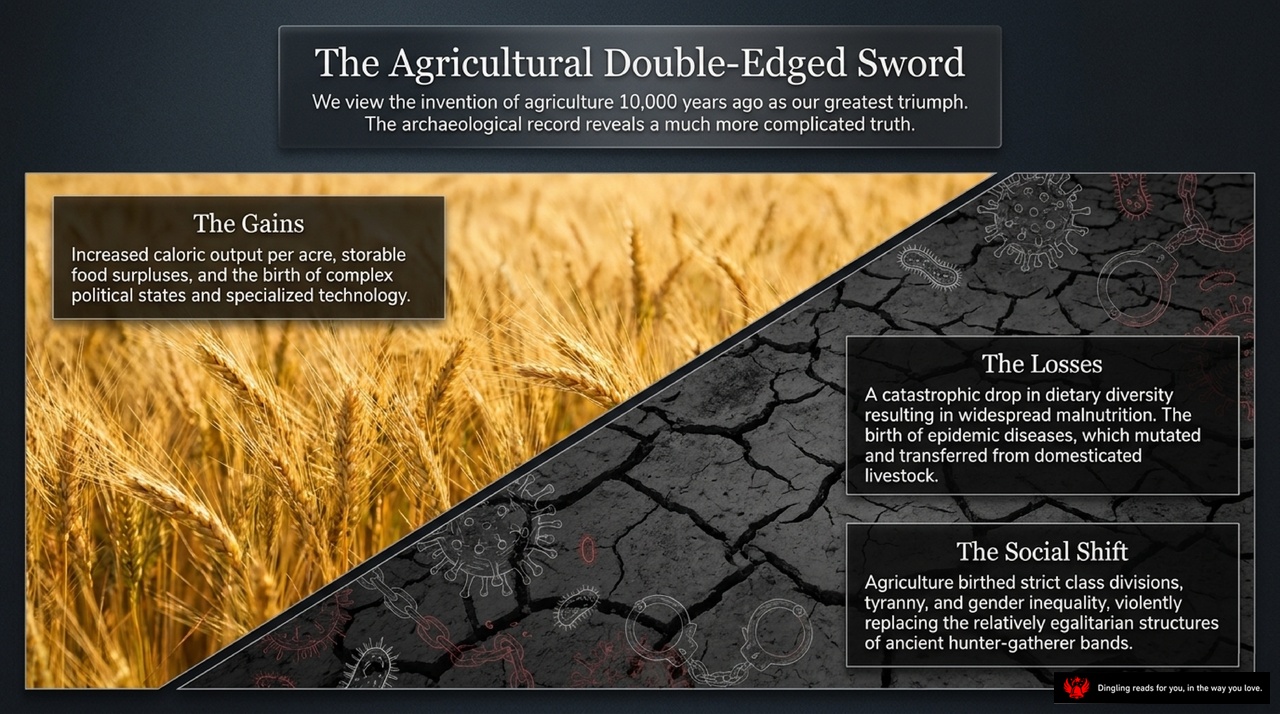
We often celebrate the invention of agriculture as humanity's greatest triumph, a golden age that built our cities and fed billions. But the archaeological record tells a far more complicated story. This slide, titled "The Agricultural Double-Edged Sword," breaks down the true cost of settling down.
On the left, under "The Gains," we see the benefits: increased caloric output per acre, the ability to store food surpluses, and the birth of complex political states and specialized technology. It was a revolution that allowed us to build civilizations.
However, the right side of the slide reveals the devastating losses. First, there was a catastrophic drop in dietary diversity. Unlike hunter-gatherers who ate a wide variety of plants and animals, early farmers relied on a few staple crops, leading to widespread malnutrition. Second, agriculture gave rise to epidemic diseases. By domesticating livestock, we created a breeding ground for pathogens that mutated and transferred to humans, diseases that hunter-gatherers simply didn't face.
Finally, we see "The Social Shift." The invention of agriculture violently replaced the relatively egalitarian structures of ancient hunter-gatherer bands. Instead, it birthed strict class divisions, tyranny, and gender inequality. As the text notes, while women were once the primary providers of calories through foraging, the new agricultural order privileged male strength, binding women to the home and stripping them of power.
So, while agriculture provided the food surplus to build our modern world, it also traded health, equality, and freedom for it. It was a double-edged sword that cut both ways, shaping our history in ways we often forget.

Have you ever wondered why mass killing isn't a glitch in modern civilization, but actually an ancient biological trait amplified by our tools? Today's slide, "The Anatomy of Genocide," breaks this down into three powerful parts.
First, look at the left circle: "The Animal Precedent." It shows chimpanzees and wolves. This isn't just about aggression; it's about calculated, border-patrol murders. These animals systematically wipe out neighboring troops to expand their territory. We share this intense xenophobia with them.
Then, look at the right circle: "Human Technology." This is where we take that same instinct and supercharge it. We combine our innate territoriality with advanced language for complex planning and projectile weapons. This upgrade makes us devastatingly efficient killers.
Where these two circles overlap is the red center: "Genocide." It's the intersection of animal territory and human tech.
Finally, look at the bottom box: "The Rationalization." This is the uniquely human twist. We employ psychological defense mechanisms—blaming the victim or labeling them sub-human—to bypass our own innate ethical inhibitions against killing. So, genocide isn't a modern invention; it's an old instinct that we simply learned how to execute on a global scale.
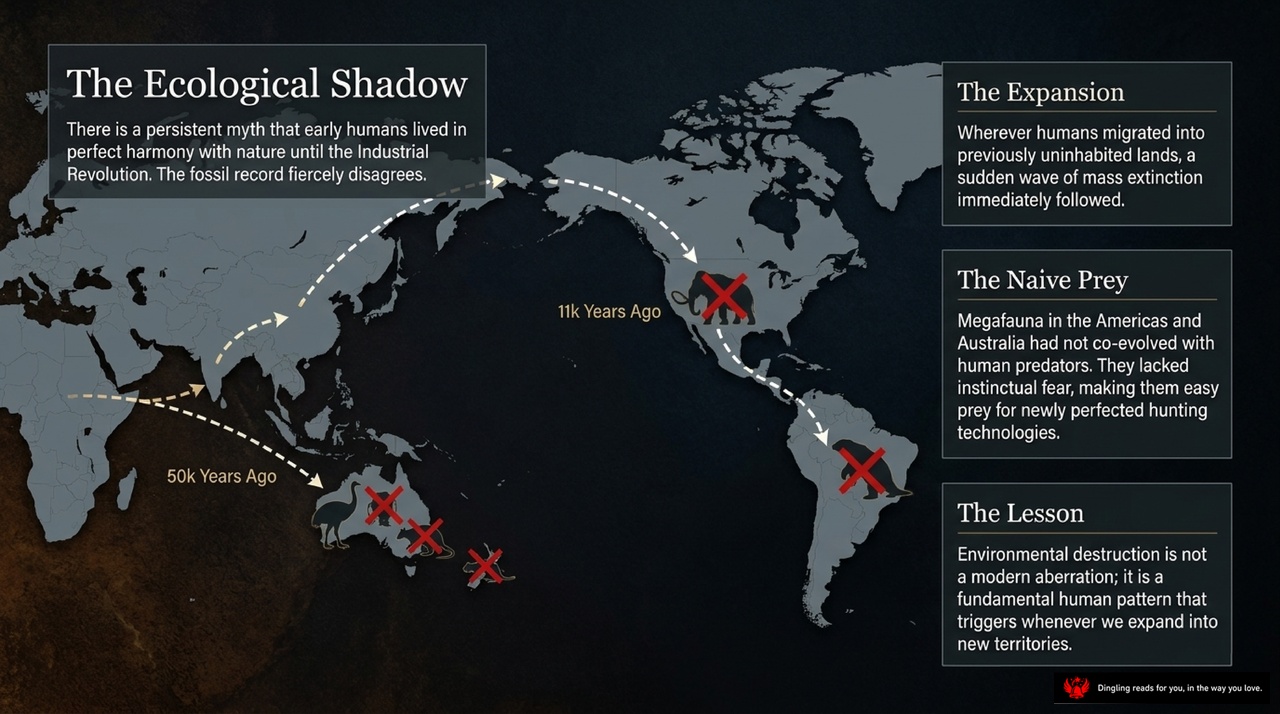
Look at this map. It shatters the comforting myth that early humans lived in perfect harmony with nature until the Industrial Revolution. The fossil record screams a different story: a persistent shadow of destruction.
Every time humans migrated into previously uninhabited lands, a sudden wave of mass extinction immediately followed. Look at Australia, 50,000 years ago. Humans arrived, and within a few millennia, megafauna like the giant wombat and the marsupial lion vanished. Why? These animals were naive prey. They had not co-evolved with human predators. They lacked instinctual fear, making them easy targets for newly perfected hunting technologies.
The same tragedy unfolded in the Americas 11,000 years ago. As humans crossed the Bering Strait, the giant ground sloths, mammoths, and camels disappeared almost overnight. The red crosses on this map aren't just symbols; they are the silent victims of a fundamental human pattern.
The lesson is stark and unavoidable: environmental destruction is not a modern aberration. It is a fundamental human pattern that triggers whenever we expand into new territories. We are not the first to break the world; we are simply the latest chapter in a long, bloody history of expansion.

Look at this stark contrast: a mere 1.6% shift in our DNA has created a chasm between what we can build and what we can destroy. On one side, we stand as creators—mastering language, forging art and culture, unlocking the secrets of science, and feeding the world through agriculture. But on the other, that same genetic code arms us with the power to extinguish life, commit genocide, collapse our ecosystems, and unleash nuclear annihilation.
The irony is chillingly simple. The exact same traits that allowed us to conquer the globe—intense group cooperation, complex communication, and tool mastery—are now the very things threatening our survival. We are governed by ancient primate instincts, yet we wield the technological power of gods. This is the ultimate evolutionary experiment, and the blueprint for our current existential condition is written right here in our own genes.
We are, at our core, the third chimpanzee—a species shaped by millions of years of evolution, suddenly handed the keys to the planet through a microscopic genetic shift. We have used our unique gifts of language, art, and innovation to build a breathtaking civilization, yet we remain haunted by our most primal instincts for destruction and conquest.
This paradox lies at the heart of our existence. If the very traits that ensured our survival are now the ones driving us toward the brink, can a species entirely wired by its evolutionary past consciously choose to rewrite its own future? The answer determines whether we are merely the next great extinction event or the architects of a new dawn.