
The Third Industrial Revolution: Complete Chapter-by-Chapter Summary
Hey folks, welcome to today's book breakdown. The title we're diving into right now is Jeremy Rifkin's *The Third Industrial Revolution*. This isn't some dry academic read — it's a visionary roadmap that connects internet technology and renewable energy, to build a brand new sustainable, distributed global economy that redefines how we work, live and interact with the world around us. Stick around, we're covering every key insight this game-changing book has to offer.
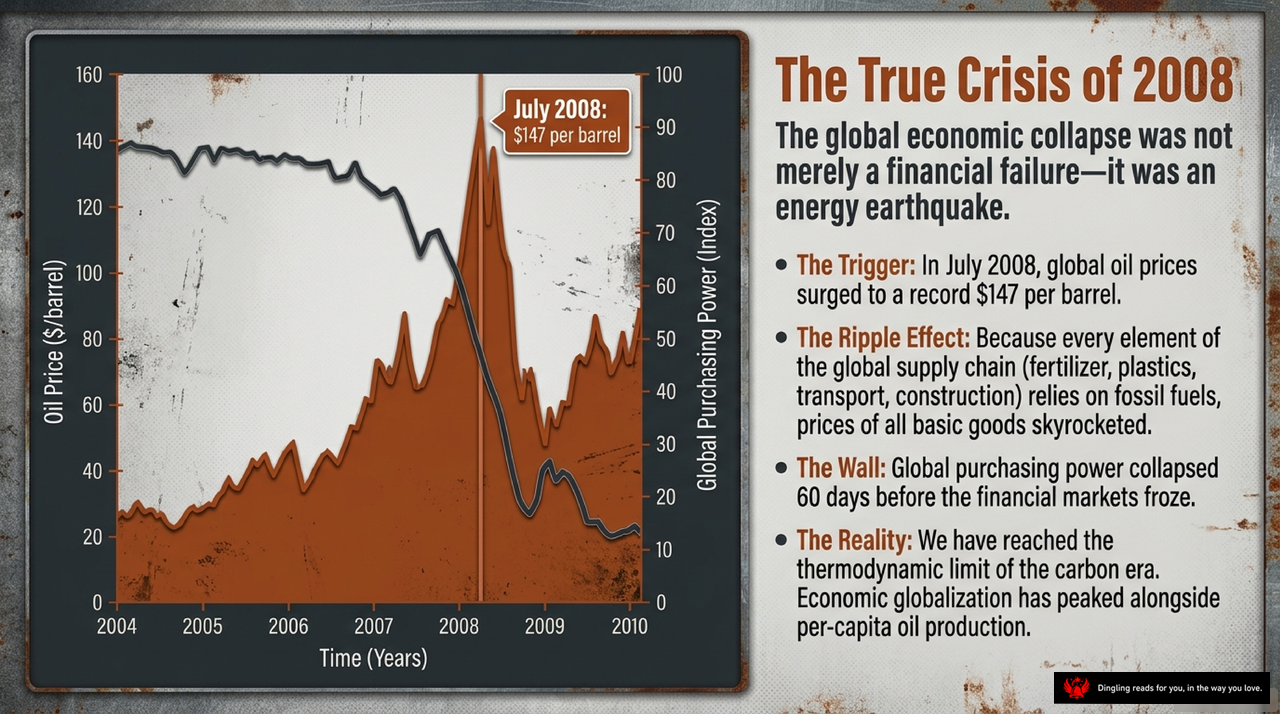
You probably remember the 2008 global economic collapse, right? Most media and politicians back then framed it as nothing more than a Wall Street financial failure, a subprime mortgage bubble that popped and dragged the whole system down. But the real story is far bigger, and way more unsettling: that 2008 crash was never just a money problem. It was an energy earthquake.
If you follow this chart spanning 2004 to 2010, you can see exactly how it played out. Oil prices climbed steadily year over year, then spiked all the way to that historic $147 per barrel mark in July 2008. At the exact same time, the global purchasing power index was plummeting — no coincidence there at all.
That record oil price was the undeniable trigger. Every single part of our global supply chain runs on fossil fuels: fertilizer for our food, plastic for every product we buy, transport to move it all, the construction that builds our homes and offices. When oil hit that absurd price point, costs for every basic good skyrocketed across the board. That’s the ripple effect no one warned regular working people about.
The hard data doesn’t lie, either: global purchasing power collapsed 60 full days before the financial markets even seized up. The banking system didn’t break first — regular people’s ability to afford basic life did. The uncomfortable reality we still haven’t fully processed today? We hit the thermodynamic limit of the entire carbon era back then. Economic globalization peaked right alongside per-capita oil production, and we’ve been living in the unaddressed aftermath of that 2008 shock ever since.
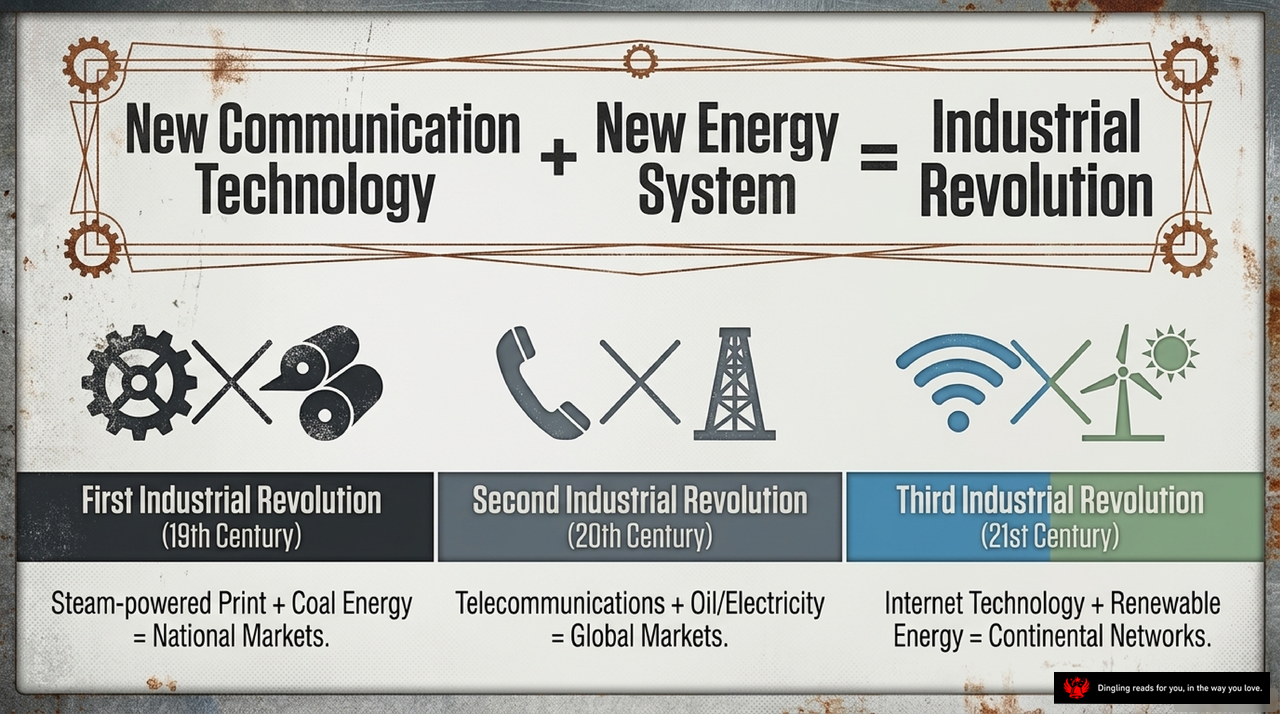
Let’s break down the secret, proven formula that powered every single industrial revolution in modern history, okay? It’s far simpler than most economics textbooks make it sound: New Communication Technology paired with a New Energy System always adds up to a full, transformative Industrial Revolution. That’s no random guess, it’s the consistent pattern playing out across every century we’ve lived through.
Back in the 19th century, the First Industrial Revolution kicked off when steam-powered print — mass-produced newspapers, factory manuals, and public notices that let people coordinate across huge distances — teamed up with coal energy. That combo didn’t just build bigger factories, it stitched together scattered, disconnected local towns into unified national markets, the kind that turned the U.S. from a loose group of colonies into a single, powerful national economic player.
Jump to the 20th century, and we hit the Second Industrial Revolution. Telecommunications, first the landline telephone then radio and broadcast TV, synced up with oil and widespread grid electricity. That pair didn’t stop at national borders, it created the global markets we all grew up with, where you could call a supplier on another continent, ship goods across oceans with gasoline-powered trucks and ships, and build massive multinational corporations that operated across dozens of countries.
Now we’re living through the Third Industrial Revolution in the 21st century. Internet technology, that instant, two-way communication tool that connects almost every person on the planet, is merging fast with renewable energy — solar, wind, geothermal, all the resources that are generated locally almost everywhere. This isn’t just making our phones last longer or our power bills cheaper: it’s building continental networks that don’t rely on centralized fossil fuel monopolies, and that’s the shift that will reshape every part of how we work, live, and do business over the next few decades.
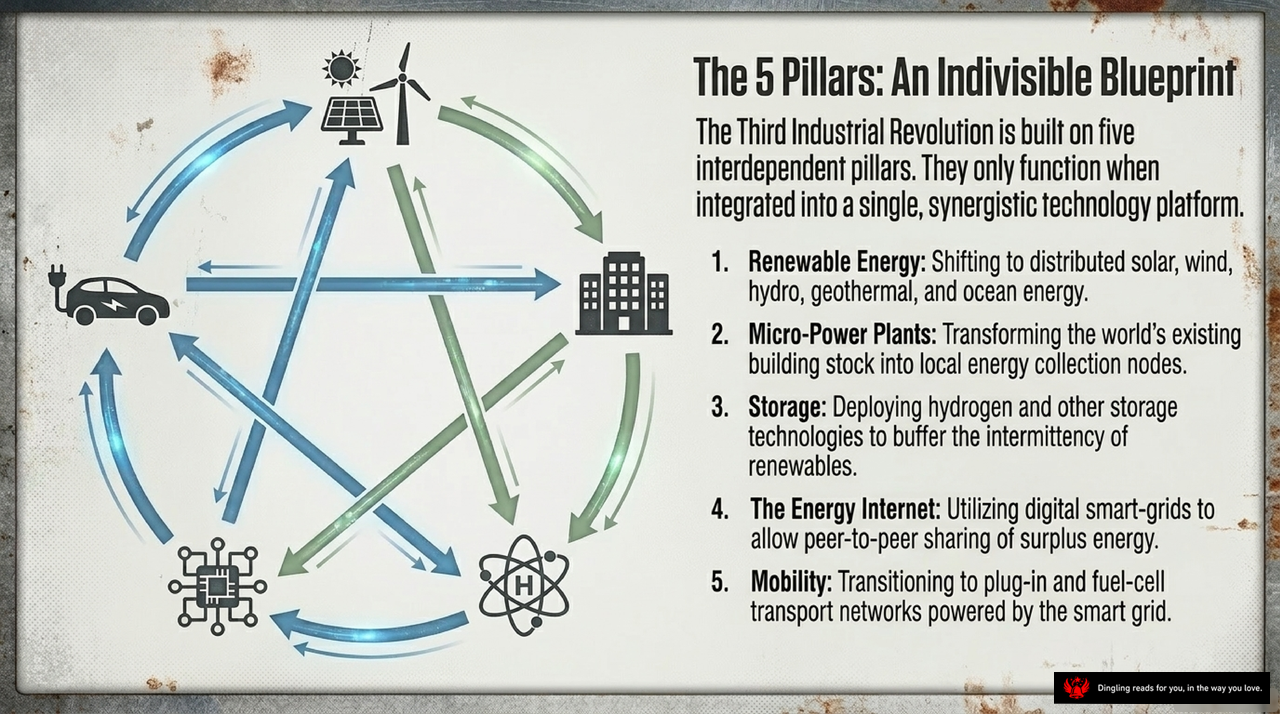
Alright, let’s walk through the core game plan for the Third Industrial Revolution, the 5 Pillars: An Indivisible Blueprint. The whole system is built on five fully interdependent pieces, and none of them deliver their full potential if you roll them out separately. They only work as one cohesive, synergistic technology platform that ties every part of our energy system together.
First, we start with a full shift to Renewable Energy, moving away from fossil fuels to distributed, local sources: rooftop solar, neighborhood wind turbines, small-scale hydro, geothermal, and ocean energy, no more relying on a tiny handful of giant, centralized power plants hundreds of miles away.
Second, we transform every existing building in our communities into a Micro-Power Plant. Every home, office, school, and local shop can generate its own energy right on site, cutting transmission waste and keeping power local for the neighborhood.
Third, we solve the big pain point of inconsistent renewable output with Storage. We deploy hydrogen and other affordable storage technologies to bank extra power when the sun’s bright or wind blows hard, so we never run short on overcast, calm days.
Fourth, we build out The Energy Internet: a digital smart grid that works just like the regular internet does for data, letting millions of small energy producers share their surplus power peer-to-peer, no gatekeepers, no corporate middlemen hoarding supply.
Last, we overhaul our entire Mobility network, transitioning all our cars, trucks, and public transit to plug-in EVs and fuel-cell vehicles that run directly off this shared smart grid. Skip even one of these pillars, and the whole system falls apart — that’s why this is an all-or-nothing blueprint for the new post-carbon economy.
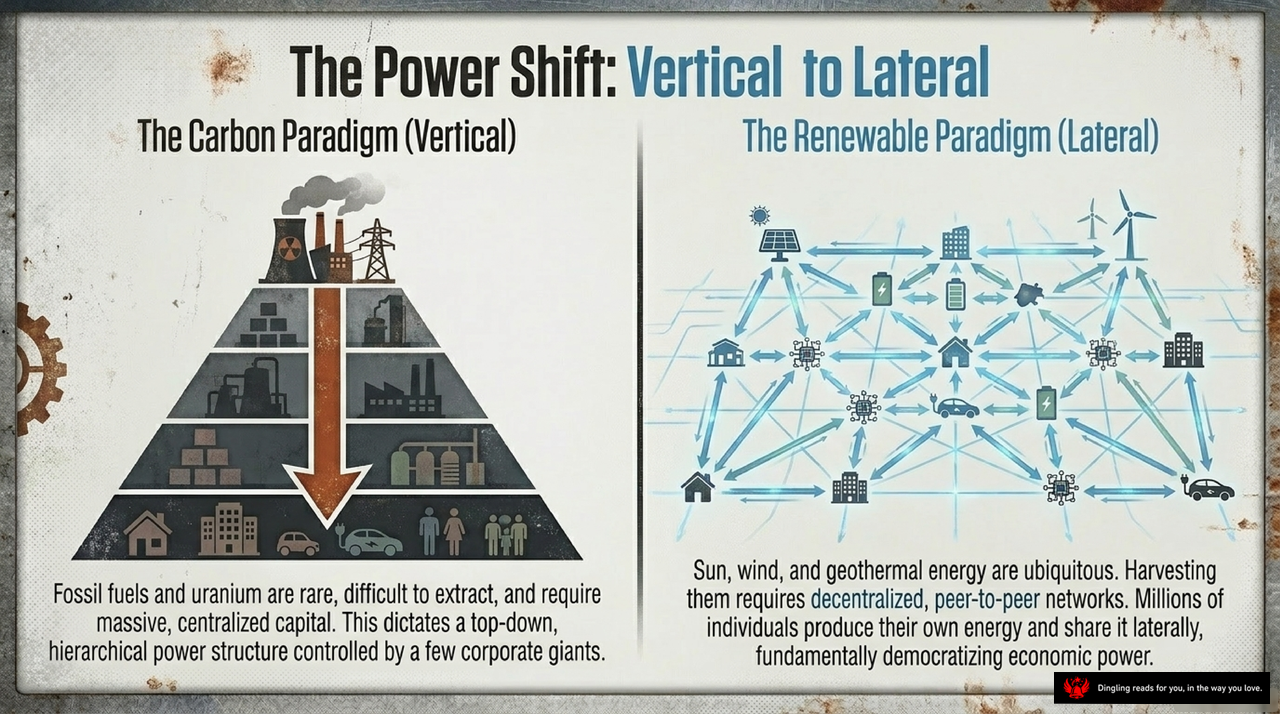
Let’s break down one of the most transformative shifts happening in our economy right now, what we call the power shift: moving from the old vertical energy model to a brand new lateral one.
For over a century, we operated under the Carbon Paradigm, that rigid top-down pyramid structure you see on the left of the slide. Fossil fuels and uranium are rare, incredibly difficult to extract, and require massive amounts of centralized capital to bring to market. That inherent dynamic dictated a top-down, hierarchical power structure controlled by just a few corporate giants. All the energy flows down from the centralized power plants, refineries, and transmission towers at the very top of that pyramid, down to factories, businesses, and finally regular households at the bottom, with zero room for regular people to generate or share their own power.
But the new Renewable Paradigm completely upends that entire setup. Sun, wind, and geothermal energy are ubiquitous, available nearly everywhere you go. Harvesting these abundant local resources doesn’t work well with that old top-down, centralized model — it requires decentralized, peer-to-peer networks, the interconnected web you see on the right side of the slide. Millions of individuals can produce their own energy right at their homes, offices, or local community spaces, and share any excess power laterally across the shared grid with their neighbors, nearby storefronts, and even charge their electric vehicles with that shared surplus. This isn’t just a minor upgrade to our power grid, it fundamentally democratizes economic power, pulling control out of the hands of a tiny handful of industry giants and spreading it evenly across every community.
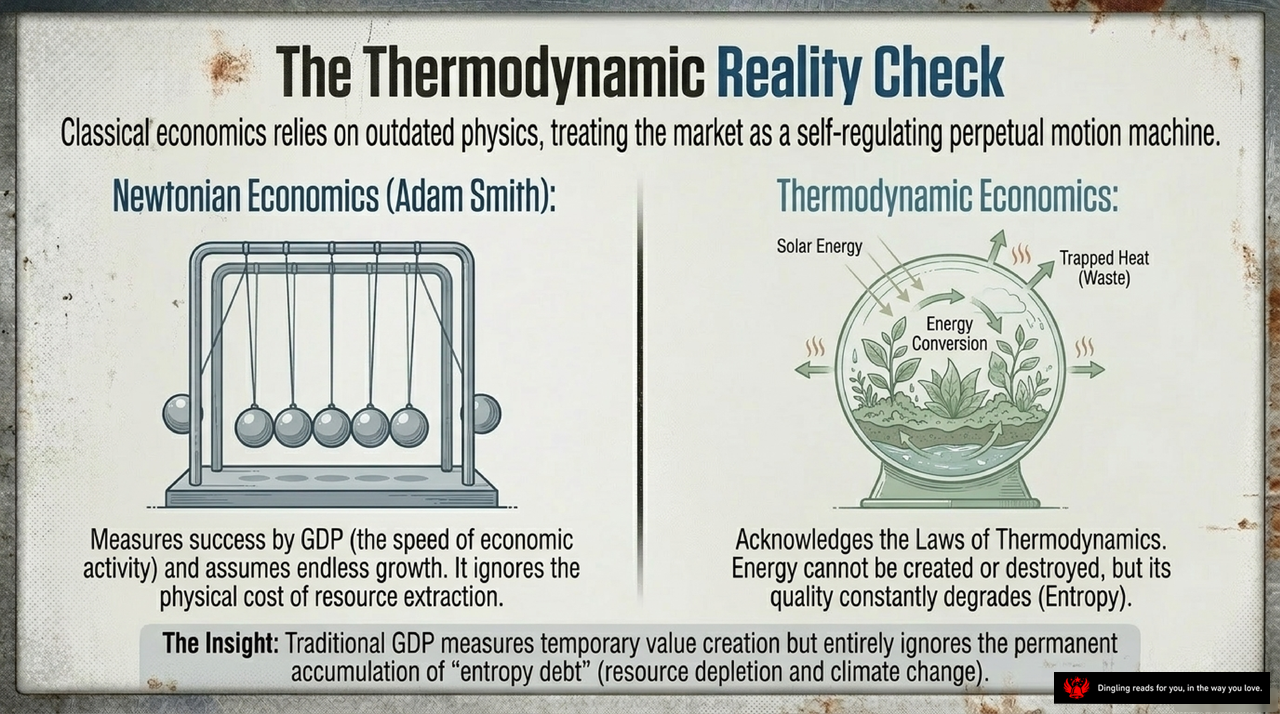
Alright, let’s run this Thermodynamic Reality Check real quick. For decades, mainstream classical economics has been leaning on totally outdated physics to explain how markets work, right? It’s been treating the whole global economy like a self-regulating perpetual motion machine that can just spin forever without any input or waste, which is completely impossible in the real world.
That old framework, Newtonian Economics rooted in Adam Smith’s original work, uses that classic Newton’s cradle metaphor we all recognize from science class. It measures every bit of success by raw GDP, basically just tracking the speed of economic activity, and assumes we can have endless, nonstop growth no matter what. The huge, critical flaw here? It completely writes off the hard, physical cost of ripping finite resources out of the ground to feed that constant growth.
On the flip side, Thermodynamic Economics doesn’t ignore the basic, unbreakable rules of physics we’ve confirmed for over a century. It works off the proven laws of thermodynamics: energy can never be created or destroyed, but its usable quality constantly degrades over time, that’s the entropy rule we all learned in high school science. You can see that logic play out clearly in the closed ecosystem graphic here: solar energy flows in, energy conversion feeds the plants, and trapped heat waste flows back out, no free infinite power anywhere.
The game-changing insight here is that traditional GDP only counts temporary value we create in the moment, and totally ignores the permanent, ever-growing pile of “entropy debt” we’re racking up every single day — that’s all the resource depletion, ecosystem damage, and climate change we’re leaving for future generations to deal with. It’s a bill we can’t refinance, can’t print our way out of, and most of us never even realized we owed until we stop to run this reality check.
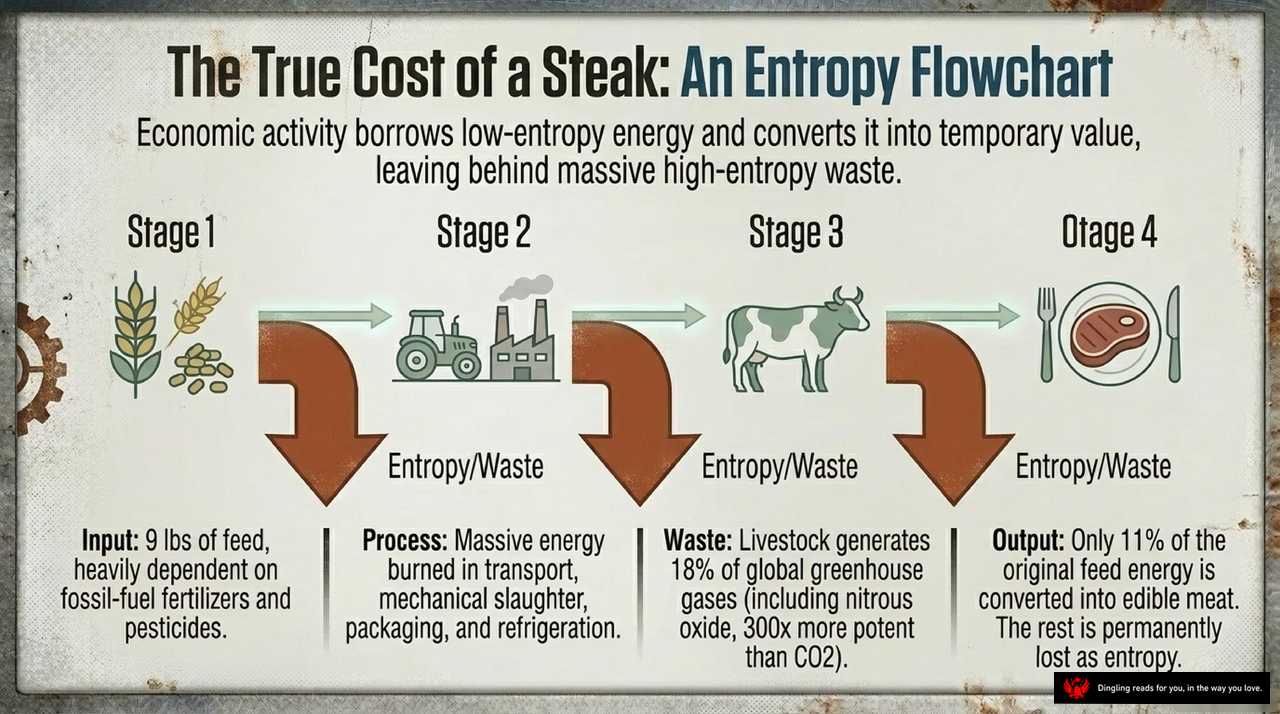
Ever stopped to think about the real hidden cost of that juicy ribeye you grab for dinner, beyond the price tag printed on the menu? That’s exactly what this chart breaks down, titled *The True Cost of a Steak: An Entropy Flowchart*. The core idea here is super straightforward: every bit of economic activity we do borrows low-entropy, usable energy, converts a tiny sliver of it into temporary value we can use, and leaves behind a mountain of unrecoverable high-entropy waste that we can never put back to work.
Let’s walk through the four stages step by step. First, Stage 1: to raise that one steak, you first need 9 full pounds of animal feed, almost all grown with heavy, fossil-fuel derived fertilizers and pesticides that carry their own huge environmental footprint. Then Stage 2: we burn through massive amounts of extra energy just to move that feed across the country, run mechanical slaughter operations, package every cut of meat, and keep it refrigerated the entire way to your grocery store or restaurant. All that burned energy turns straight into heat and waste we can never reuse.
Stage 3 is even more staggering: livestock alone generates 18% of all global greenhouse gases, including nitrous oxide that’s 300 times more potent than carbon dioxide. And when we finally get to the end at Stage 4? The numbers don’t lie: only 11% of the original energy locked in that initial pile of feed ever actually makes it to your plate as edible meat. Every other bit of that energy is permanently lost as entropy. This isn’t just about steaks, it’s a perfect snapshot of how wasteful our entire fossil-fuel based industrial system really is.
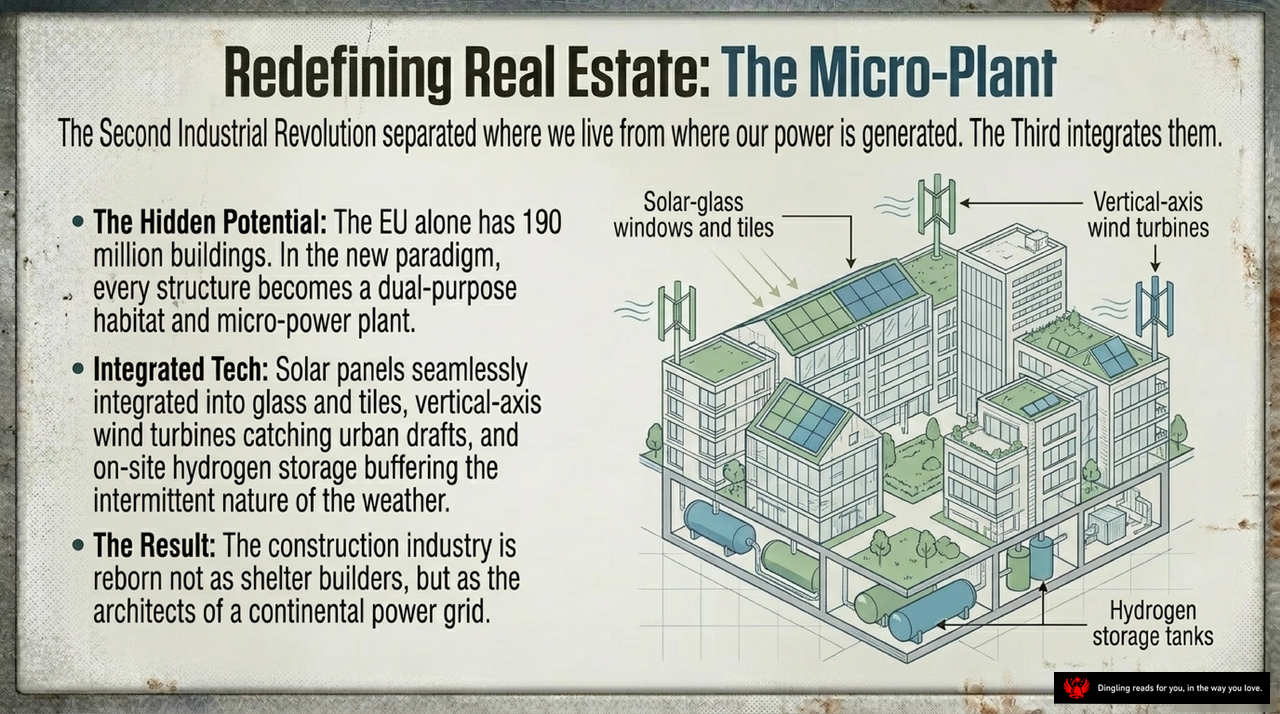
Remember how the Second Industrial Revolution completely separated where we live, work and shop from where all our power gets generated? We built huge, centralized fossil fuel and nuclear plants hundreds of miles away from population centers, strung thousands of miles of transmission lines, and that was the standard playbook for almost 100 years. But the Third Industrial Revolution is flipping that entire model upside down, by integrating our living spaces and power generation right back together.
The hidden potential here is massive. The EU alone has 190 million existing buildings, and under this new paradigm, every single one of those structures stops being just a roof over people’s heads. Every home, office, apartment complex and school becomes a dual-purpose habitat that also operates as its own small micro-power plant.
We pull this off with fully integrated, unobtrusive tech: solar panels that are seamlessly built right into solar-glass windows and roof tiles, no clunky, ugly rack-mounted units sticking out. We add compact vertical-axis wind turbines on rooftops to capture all the underutilized urban drafts that blow through city blocks every single day, and pair the whole setup with on-site hydrogen storage tanks to buffer the intermittent nature of weather, so you still have steady power even on overcast, windless days.
The end result? The entire construction industry gets completely reborn. Instead of just being shelter builders, they evolve into the architects of an entire new continental power grid, one that’s distributed, far more resilient, and runs on 100% local, renewable energy.
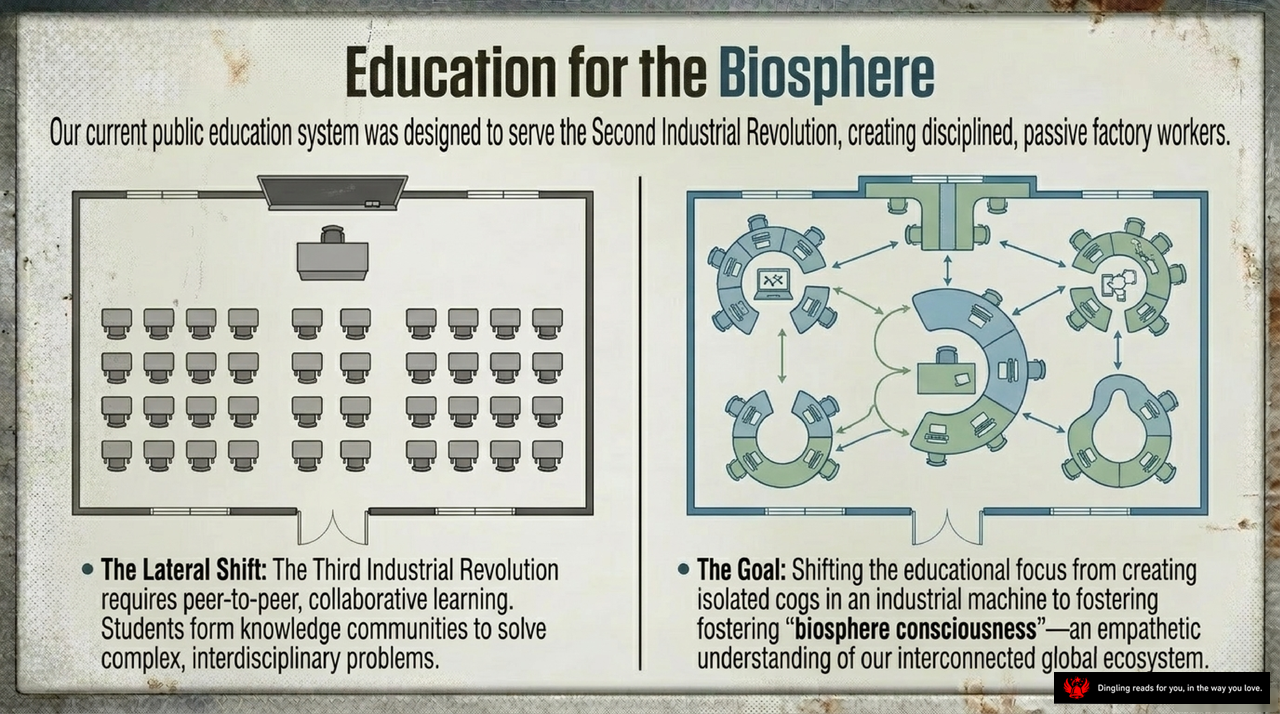
Let’s talk about something most of us never stop to question: the public education system we all grew up in. It was explicitly designed to serve the Second Industrial Revolution, built to churn out disciplined, passive factory workers who would follow clear top-down instructions without pushing back. You can see that old mindset perfectly in the classroom layout on the left, with every row of rigid desks all facing a single instructor at the front, no room for side conversations or shared problem-solving.
That model is totally obsolete for the world we live in now. We need what’s called the Lateral Shift: the Third Industrial Revolution runs on peer-to-peer, collaborative learning, where students form knowledge communities to work through the messy, complex, interdisciplinary problems we can’t solve with old, siloed thinking. That’s exactly what the new, flexible classroom layout on the right is made for, with curved group workspaces that let small teams brainstorm, share resources, and connect across different project groups on the fly.
This whole Education for the Biosphere framework isn’t just about rearranging desks, either. The end goal is to shift our entire educational focus away from cranking out isolated cogs in an industrial machine, and toward fostering “biosphere consciousness” — that deeply empathetic, lived understanding of how interconnected our entire global ecosystem really is.
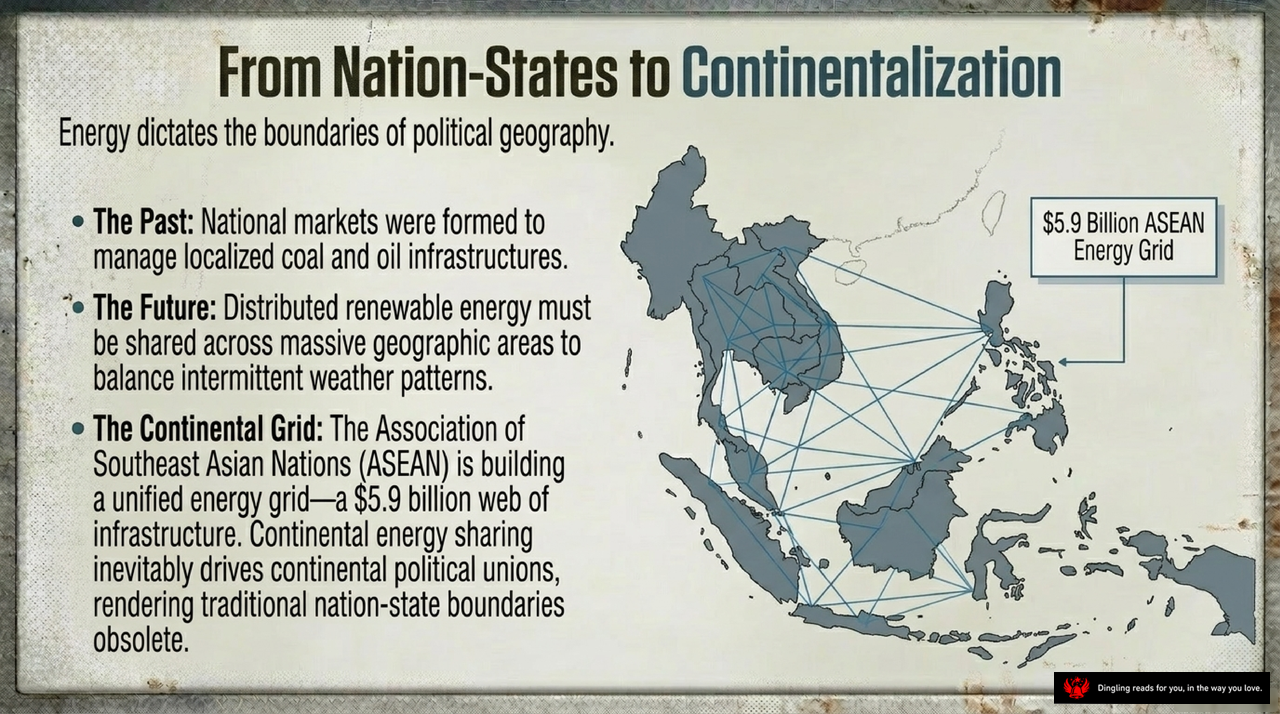
Let’s talk about a game-changing shift most people haven’t fully wrapped their heads around yet: we’re moving From Nation-States to Continentalization, and the core rule that powers this entire transition is super straightforward—energy dictates the boundaries of political geography.
Rewind a few generations, the entire modern nation-state structure was built around fossil fuels. Back in that era, national markets were intentionally formed to manage all those localized coal and oil infrastructures. Every country guarded its own limited, geographically locked fossil fuel reserves, drew hard, defended borders to control their energy supply chains, that’s the system we all grew up with.
But that old model completely breaks down for the renewable energy future we’re stepping into right now. Distributed renewables like solar, wind and run-of-river hydro aren’t trapped in a single small oil field or coal mine. They’re also inherently intermittent: the sun doesn’t shine 24/7, the wind doesn’t blow every single day, so you have to share that power across massive geographic areas to balance out those inconsistent, spotty weather patterns. No single small country can pull that off efficiently on its own.
That’s exactly the real-world example we’re seeing play out across Southeast Asia right now. The Association of Southeast Asian Nations, or ASEAN, is building a unified $5.9 Billion ASEAN Energy Grid, a sprawling interconnected web of infrastructure that links every country in the region into one shared power network. This kind of cross-border, continental energy sharing doesn’t just cut energy costs and boost reliability, it inevitably pushes nations to build deeper coordinated continental political unions too. Slowly but surely, those rigid 20th century nation-state boundaries that used to define how we manage power, resources and trade are on track to become totally obsolete.

Let’s walk through this Ultimate Paradigm Matrix, it’s such a straightforward, no-BS breakdown of how the 2nd and 3rd Industrial Revolutions differ across every single core dimension that shapes how we live, work and govern.
First up, power structure: the old 2nd Industrial Revolution ran on rigid, vertical, centralized, hierarchical systems, the kind of top-down control that let giant fossil fuel conglomerates and federal bureaucracies call all the shots for the last 100 years. The 3rd Industrial Revolution completely upends that, shifting to lateral, distributed, peer-to-peer networks that spread power out to regular people instead of hoarding it at the top.
Next, energy sources: the 2nd era was built on scarce, elite-controlled fossil fuels and uranium, resources concentrated in a handful of geographic spots that let a tiny group of insiders jack up prices and hold entire nations hostage. The 3rd revolution runs on ubiquitous, democratic sun, wind and geothermal power, energy anyone can harvest right at their home or business, no monopolies required.
For economic theory, the old 2nd Industrial Revolution clung to outdated Newtonian frameworks that chased impossible perpetual growth no matter the cost. The new 3rd era uses thermodynamic models that center the biosphere and entropy, working within the planet’s natural limits instead of treating it like an infinite resource dump. On geopolitics, the old order centered nation-states competing for global market share through globalization, while the new model builds cross-border continental networks to drive continentalization. And finally, education: the old system relied on rote, standardized, top-down memorization designed to churn out obedient factory workers, while the new model prioritizes collaborative, interdisciplinary, empathic learning that prepares people to thrive in our shared, connected future.
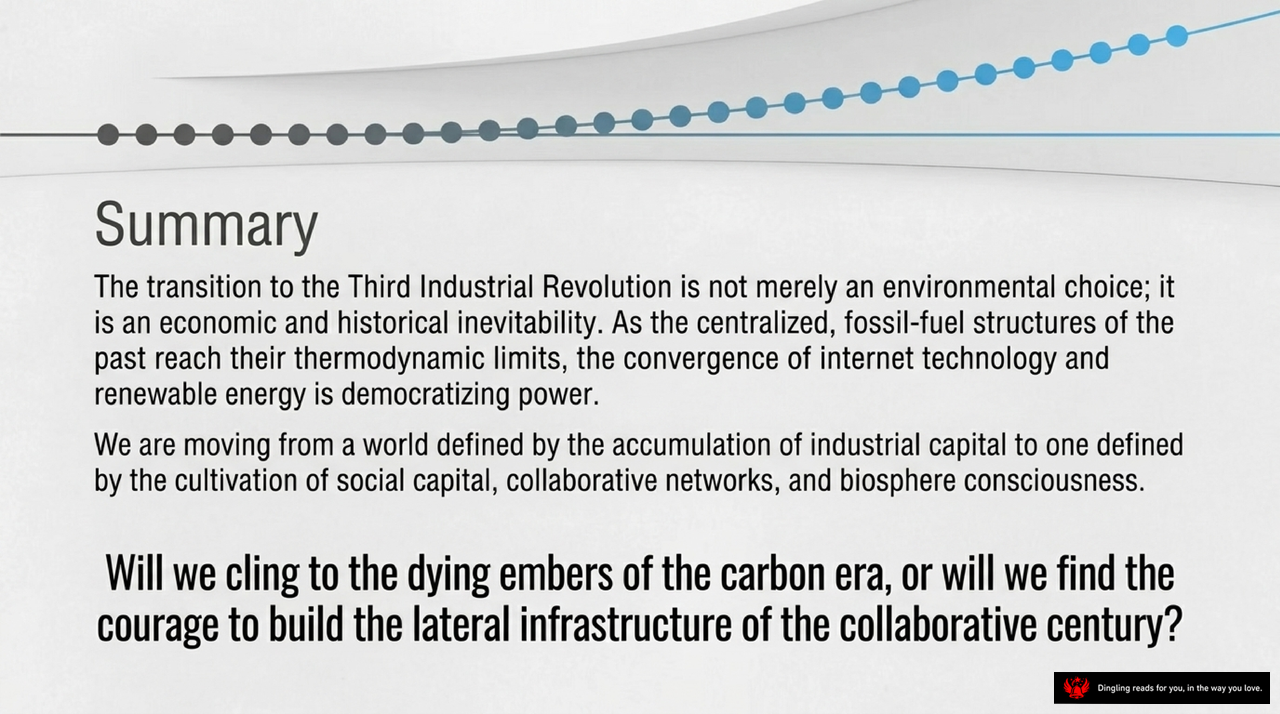
Alright, let’s lock in our core takeaways here to make sure we’re all on the same page about the massive shift unfolding right in front of us. A lot of people still frame the transition to the Third Industrial Revolution as just a nice, optional environmental choice you can pick or pass on, but that’s completely missing the point. This isn’t some niche progressive climate pet project — it’s an economic and historical inevitability.
Think about it: the old centralized, fossil-fuel powered systems that carried us through the last century have hit their hard thermodynamic limits. You can’t keep squeezing cheap, easy oil out of the ground forever, you can’t keep patching up a 100-year-old grid built exclusively for giant, distant power plants, and you can’t keep ignoring the skyrocketing costs of climate chaos forever. The convergence of internet technology and renewable energy right now is democratizing power, plain and simple. No more letting a handful of giant utility and oil conglomerates control every part of the energy supply, jack up prices whenever they want, and call all the shots for the rest of us.
We’re not just swapping out old coal plants for solar panels, either. We’re moving from a world that ran entirely on hoarding industrial capital and concentrating wealth at the very top, to one built around nurturing social capital, building collaborative cross-community networks, and centering biosphere consciousness that recognizes every single one of us is connected to the rest of the living planet.
At the end of the day, it all boils down to one defining question: Will we cling to the dying embers of the carbon era, or will we find the courage to build the lateral infrastructure of the collaborative century? That choice isn’t 50 years off — it’s staring us in the face right now.