
The Tipping Point: Complete Chapter-by-Chapter Summary

Welcome to today's session on Malcolm Gladwell's masterpiece, *The Tipping Point*. As you see in the image, a single red domino is positioned to knock over a long line of blue ones. This visual perfectly captures the book's central thesis: how small, seemingly insignificant things can make a massive difference.
Gladwell argues that the arrival of a trend isn't about widespread coverage, but rather the convergence of a few critical factors. He breaks this down into three laws: the Law of the Few, the Stickiness Factor, and the Power of Context. When these elements align, a tiny trend can instantly explode into a massive social wave. Whether it's a new fashion style, a public health initiative, or a viral idea, understanding these mechanics allows us to not just observe trends, but actively shape them. Today, we will dive deep into how these laws work and why they matter so much in our interconnected world.

Look at this curve. It's not a straight line; it's an explosion waiting to happen. This slide breaks down exactly how an epidemic—whether it's a disease, a fashion trend, or a crime wave—progresses.
It starts with **The Anatomy of an Epidemic**, or what we call **The Incubation**. Here, contagiousness builds quietly in the background. Small causes compound invisibly. Think of it as the quiet buildup before the storm. Nothing looks like a crisis yet, but the seeds are being sown.
Then comes **The Ignition**. This is the critical mass. The moment a minor adjustment forcefully shatters the equilibrium. It's the tipping point where the invisible pressure finally breaks the surface.
And finally, **The Outbreak**. Change happens in one dramatic leap, not gradually. Look at the examples here: Hush Puppies sales jumping from 30,000 to 430,000 in a single year. The NYC murder rate dropping 64% in just five years after fixing small details like graffiti and fare evasion. Or Baltimore syphilis cases spiking 500% in one year.
The lesson is clear: massive shifts don't happen slowly. They happen fast once the invisible buildup hits that red target. Understanding where you are on this curve is the only way to control the outcome.
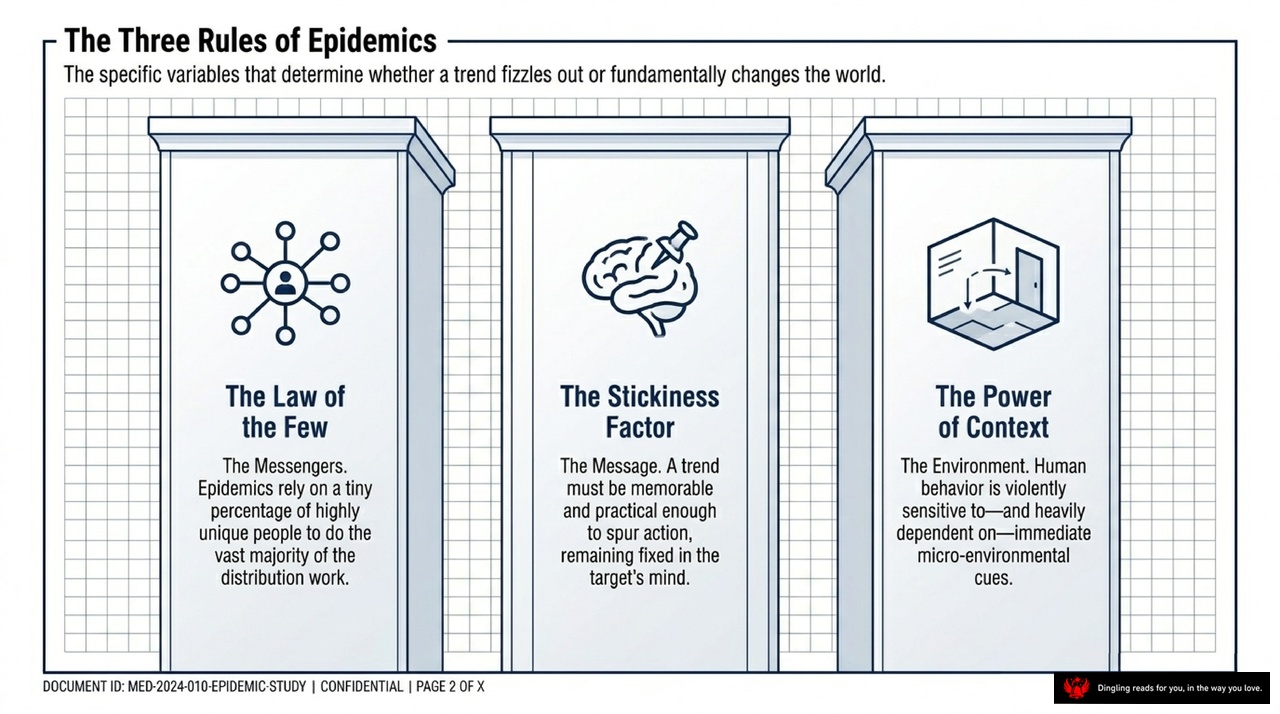
So, we've cracked the code on why trends explode. It all comes down to three specific variables that decide whether a trend fizzles out or fundamentally changes the world. Think of these as the three pillars holding up an epidemic of ideas.
First, look at the left pillar: The Law of the Few. This is about the messengers. It turns out, you don't need the masses to spread a trend; you only need a tiny percentage of highly unique people. These are the connectors, the experts, and the persuaders who do the heavy lifting of distribution. Without them, even the best idea stays stuck in one corner.
Next, in the middle, we have The Stickiness Factor. This is about the message itself. A trend must be memorable and practical enough to spur action. It's not about volume; it's about making the information stick in the target's mind. If the message isn't sticky, the messengers won't be able to carry it far.
Finally, on the right, sits The Power of Context. This reminds us that human behavior is violently sensitive to the environment. Even if you have the perfect messengers and a sticky message, if the immediate micro-environmental cues aren't right, the trend won't take off. Context is the catalyst that turns potential into reality.
When these three rules align—the right people, the right message, and the right environment—that's when a trend ignites.

Welcome back. Today we're diving into the mechanics of how ideas actually spread, moving beyond the assumption that popularity comes from reaching everyone. Instead, we need to look at the "Law of the Few," which suggests that a tiny minority of people drives the vast majority of social epidemics.
Look at the network diagram on the right. Notice how almost all the connections radiate from just three red nodes in the center? That's the 80/20 Social Rule in action. In any situation, roughly 80% of the work is done by just 20% of the participants. In social epidemics, this ratio is even more extreme. A handful of exceptional individuals dictate the spread of information, while the rest of the network remains largely passive.
This brings us to the Revere vs. Dawes Effect. Paul Revere's midnight ride ignited a revolution, while William Dawes carried the exact same message that same night but was ignored. The difference wasn't the message; it was the social architecture of the messenger. Revere was connected to the right people at the right time, whereas Dawes wasn't.
So, what makes these few individuals so powerful? They fall into three categories: Connectors, who bridge different social circles; Mavens, who hoard and share expert information; and Salesmen, who possess the unique ability to persuade. Without these specific types of people, even the best idea will remain trapped in a small circle, never becoming a true epidemic.

Today's slide, "The Messengers Matrix," maps out the three distinct profiles required to collaborate and ignite a trend. Let's break down how these archetypes work together to turn a whisper into a roar.
First, we have the Connectors, or "The Social Glue." Their social asset is network size. They master the weak tie, inhabiting entirely different worlds and subcultures. Think of Lois Weisberg; she didn't just know people, she connected the dots between the theater world, sci-fi authors, and legal experts, turning isolated circles into a unified conversation.
Next are the Mavens, or "The Data Bank." Their asset is information. They are pathological helpers driven to solve other people's problems by sharing knowledge. Take Mark Alpert, a librarian who knew every book in the city and was ready to share that wisdom with anyone who asked. They provide the reliable content that makes the trend credible.
Finally, there are the Salesmen, or "The Persuader." Their asset is charisma. They use non-verbal cues and emotional contagion to seamlessly align others to their rhythm. Consider Tom Gau, a psychologist who could make you laugh, cry, or agree with him in minutes just by syncing his body language and voice to yours. He doesn't argue; he infects you with enthusiasm.
In short, Connectors spread the message, Mavens define it, and Salesmen sell it. Without this trio, a trend stays stuck in one room.

So, here's the twist that makes this whole theory click: it's not just about scaring people into action. It's about making that action actually *possible*.
Look at the data on this slide. We're talking about the Yale Tetanus Experiment. Panel A shows the "Academic Approach." They handed students a scary medical booklet with a big red warning symbol about the dangers of tetanus. The message was clear, right? The fear was high. But look at the result: only 3% of the students actually got vaccinated. Why? Because the message was abstract. It was just a warning floating in the air, disconnected from their real lives. They understood the danger, but they had no idea how to fix it.
Then, look at Panel B, the "Sticky Approach." They kept that same scary booklet, but they added one tiny thing: a simple campus map showing where the clinic was and when it was open. That's it. Just a map and some hours. And the result? The vaccination rate jumped to 28%. That's a massive difference.
The lesson here is profound. Fear alone fails because it's overwhelming and vague. But when you add practical, personal details—like exactly where to go and when to do it—you transform a scary warning into a simple to-do list. You give people the tools to act immediately. That's the power of the Stickiness Factor: turning abstract information into concrete action.
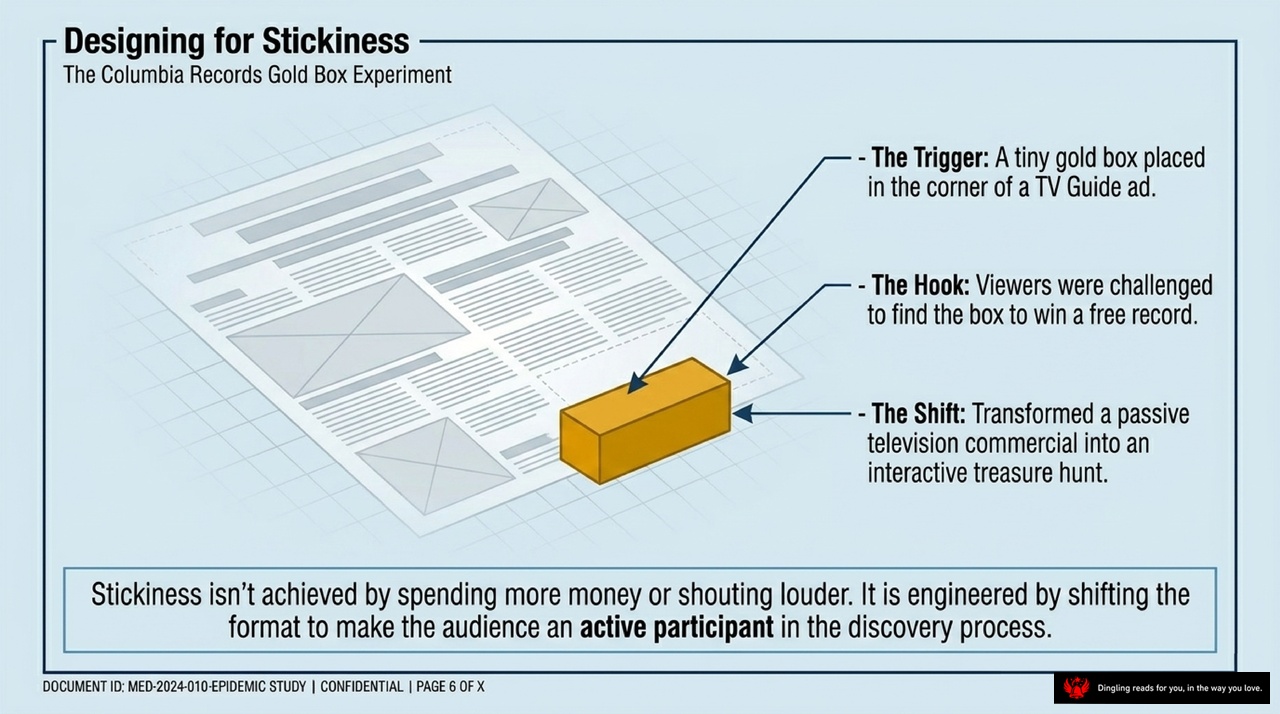
Stickiness isn't about spending more money or shouting louder. It's about engineering the experience so the audience becomes an active participant. Look at this slide: the Columbia Records "Gold Box" experiment. In the 1970s, Lester Wunderman took a simple TV ad and added a tiny, golden box hidden in the TV Guide magazine. The trigger was that small, mysterious box. The hook was a challenge: find it to win a free record. This tiny shift transformed a passive commercial into an interactive treasure hunt. The result? Response rates jumped by 80 percent. This proves that stickiness is engineered by shifting the format to make the audience part of the discovery process. When you turn a consumer into a hunter, you don't just sell a product; you create a moment they can't forget.

Rule 3: The Power of Context. Here's the hard truth: human behavior isn't just about who you are; it's about where you are. We are fiercely dependent on the immediate micro-environmental cues around us.
Think about the "Broken Windows Theory." If you see a broken window and no one fixes it, your brain sends a signal: "No one cares. No one is in charge." Suddenly, societal rules feel suspended. It's a powerful psychological trigger.
Look at this subway car. On the left, it's covered in graffiti and broken glass. On the right, it's clean and orderly. Why the difference? In the 1990s, NYC was drowning in violent crime. Police Chief William Bratton realized that focusing on major crimes wasn't working. Instead, he hyper-focused on the environment. He scrubbed every bit of graffiti every night and arrested every single fare-beater.
It sounds simple, but the result was massive. By fixing the smallest environmental details—removing those visual cues of disorder—he reversed the city's macro-crime epidemic. The environment wasn't just a backdrop; it was the catalyst. When the subway looked cared for, people behaved with care. When it looked neglected, chaos took over.
This is the core of the Power of Context. We often think we control our own actions, but often, we are just reacting to the signals the world sends us. Fix the environment, and you change the behavior.

The magic number 150 isn't just a statistic; it's the absolute ceiling of human social cohesion. As our slide shows, once a group exceeds this threshold, the tightly woven web of relationships on the left simply unravels into scattered dots. Human anthropology tells us that 150 is the maximum number of individuals with whom we can maintain genuine social relationships. Beyond this point, social bonds fracture. Orders can no longer be executed through personal loyalty or peer pressure; instead, organizations are forced to rely on rigid hierarchies, complex rules, and bureaucracy just to survive.
This is the corporate tipping point. To scale effectively, organizations must aggressively split and multiply whenever a facility hits 150 people. If you ignore this cognitive limit, you lose the very trust and intimacy that drive performance. The Hutterite and Gore Associates models prove that staying small isn't about being limited; it's about preserving the social glue that makes a group actually work.
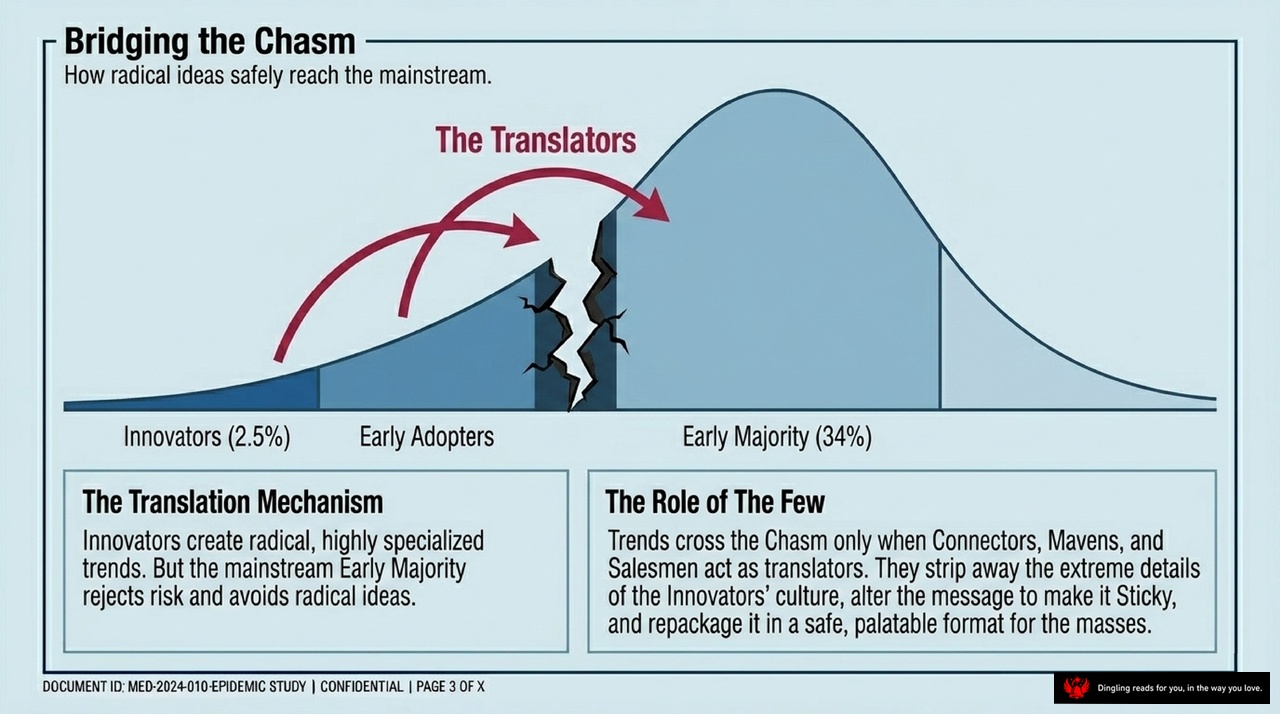
So, how do we actually get these radical ideas from the early adopters all the way to the mainstream? The diagram on your screen shows the "Chasm"—that massive gap between the Early Adopters and the Early Majority. It looks like a canyon, and without a bridge, trends just get stuck on the left side.
But the answer lies right in the middle of that gap: "The Translators."
Here is the critical insight: trends only cross the Chasm when a specific group of people—Connectors, Mavens, and Salesmen—act as translators. They don't just pass the message along; they fundamentally change it.
Think about what the Innovators create: it's often radical, highly specialized, and filled with extreme details that the mainstream simply doesn't understand or wants to avoid. The Early Majority rejects risk. So, these translators step in to do the heavy lifting. They strip away those confusing, extreme details of the Innovators' culture. They alter the message to make it "sticky" and memorable. And finally, they repackage it into a safe, palatable format that the masses can actually digest.
In short, the translators are the essential bridge. They take the raw, risky idea and translate it into something the world is ready to accept, turning a niche trend into a global phenomenon.

So, we've walked through the mechanics of how things go viral—the connectors, the mavens, the stickiness of ideas, and even the power of the environment. But there's one final, crucial piece to the puzzle that ties it all together: the Law of Plentitude.
Look at this diagram. On the left, you have a massive storm of "Mass Marketing Noise." It's an age of infinite communication where everyone is shouting at everyone else. The problem? Audiences are developing a kind of physiological and psychological immunity to it. They just tune it out. The value of a network no longer scales just by getting bigger; if you just blast out more messages, they hit a wall.
That's why the cure isn't to shout louder. As the slide suggests, the antidote to information immunity is a complete reliance on "Curated Trusted Networks."
Think of it like a cell membrane protecting a living organism. Instead of trying to penetrate the noise with brute force, successful ideas find a narrow channel. They rely on the trusted, insulated social networks curated by those specific connectors, mavens, and salesmen we discussed earlier. It's not about volume anymore; it's about precision. By filtering the chaos and delivering the right message through the right trusted channels, you bypass the audience's defenses entirely.
So, the lesson is clear: in a world drowning in information, the winners aren't the ones broadcasting the most. They are the ones who can curate the right message and deliver it through the right trusted network. That is the only way to survive the death of mass marketing and truly ignite a trend.

To create a true epidemic, you have to stop trying to shout at everyone and instead focus your limited resources on the exact right places. As we've seen, it all comes down to three things: the right people, the right packaging, and the right micro-environment.
Think about the people first. It's not about mass appeal; it's about finding the "Few"—the Connectors who bridge different social circles, the Mavens who hold the secrets, and the Salesmen who can make anyone believe. Then, look at your packaging. Just like the "Golden Box" in a mail-order ad or the mix of puppets and humans on *Sesame Street*, tiny tweaks can turn a boring message into something people can't ignore. Finally, consider the context. A broken window signals chaos, while a clean subway car signals safety; the environment itself acts as a silent force that either triggers or stops the spread.
When these three elements align, you find your exact point of leverage. The world is incredibly sensitive and malleable, waiting for just a gentle push in the right direction. So, the real question isn't whether change is possible—it's inevitable. The only question left is: where will you place your push to become the tipping point?