
The Toyota Way: Complete Chapter-by-Chapter Summary

Welcome to our deep dive into "The Toyota Way." This presentation is based on the groundbreaking research of Jeffrey K. Liker, who spent years uncovering the secrets behind the world's most successful manufacturer.
Today, we are decoding the fourteen principles that drive Toyota's legendary performance. But here's the crucial insight we want to share: Toyota's success isn't about copying surface-level tools like lean manufacturing or just using checklists. That's a common trap. Instead, Liker reveals that Toyota's true DNA is a powerful double helix, intertwining a deeply held set of guiding philosophies with practical, daily processes.
We've broken these fourteen principles into four core categories to make them actionable for you. First, we have the "Long-Term Philosophy," which is the foundation of everything Toyota does. Second, the "Right Processes" that ensure quality and efficiency. Third, the development of "People and Partners," recognizing that humans are their most valuable asset. And finally, the commitment to "Continuous Improvement" and solving problems at the source.
By understanding this complete framework, you move beyond the illusion of simple tools and start building a culture that can truly compete and innovate for the long term.

The "Lean" Illusion is a powerful metaphor for why so many companies fail to replicate Toyota's success. As the slide illustrates, there's a massive iceberg beneath the waterline. Above the surface, you see the visible tools: Kanban, 5S, Just-in-Time, and Andon. These are the flashy, easy-to-copy tactics that companies rush to implement. But below the red line lies the invisible foundation—Continuous Learning, Leadership, Philosophy, Genchi Genbutsu, and Hansei. This is where the real work happens.
Most organizations make the mistake of only building the tip of the iceberg. They buy the tools and paste the processes onto their walls, but they ignore the massive cultural bedrock required to sustain them. Without that deep foundation of trust, continuous improvement, and a willingness to stop production when problems arise, those tools quickly become useless decorations. As the slide notes, 99% of companies fail because they try to copy the outcome without understanding the DNA that made it possible. True lean isn't about the tools you use; it's about the culture that drives them.

Look at this slide comparing "Mass Production" against "The Toyota Way." The visual clearly splits the battlefield into four critical areas: Flow, Quality, Decisions, and Philosophy.
On the left, we see the traditional approach. It relies on large batches and pushing inventory forward, often hiding defects just to keep machines running at 100% uptime. Decisions are made quickly by management, but execution is slow and resistant. The entire philosophy is optimized for short-term quarterly profits.
Now, look at the Toyota side. The red checkmarks highlight a complete reversal. Instead of pushing inventory, Toyota uses a continuous one-piece flow pulled directly by customer demand. When a defect appears, they don't hide it; they stop the entire line immediately to expose and fix the root cause. This might seem risky, but it builds a culture of quality. Decisions take longer to reach consensus, but once agreed upon, execution is rapid and flawless.
Most importantly, the philosophy shifts from optimizing for quarterly financial profit to optimizing for long-term survival and societal value. This isn't just about making cars faster; it's about building a resilient organization that creates value for everyone, not just shareholders. This fundamental shift is what separates the Toyota Way from standard mass production.
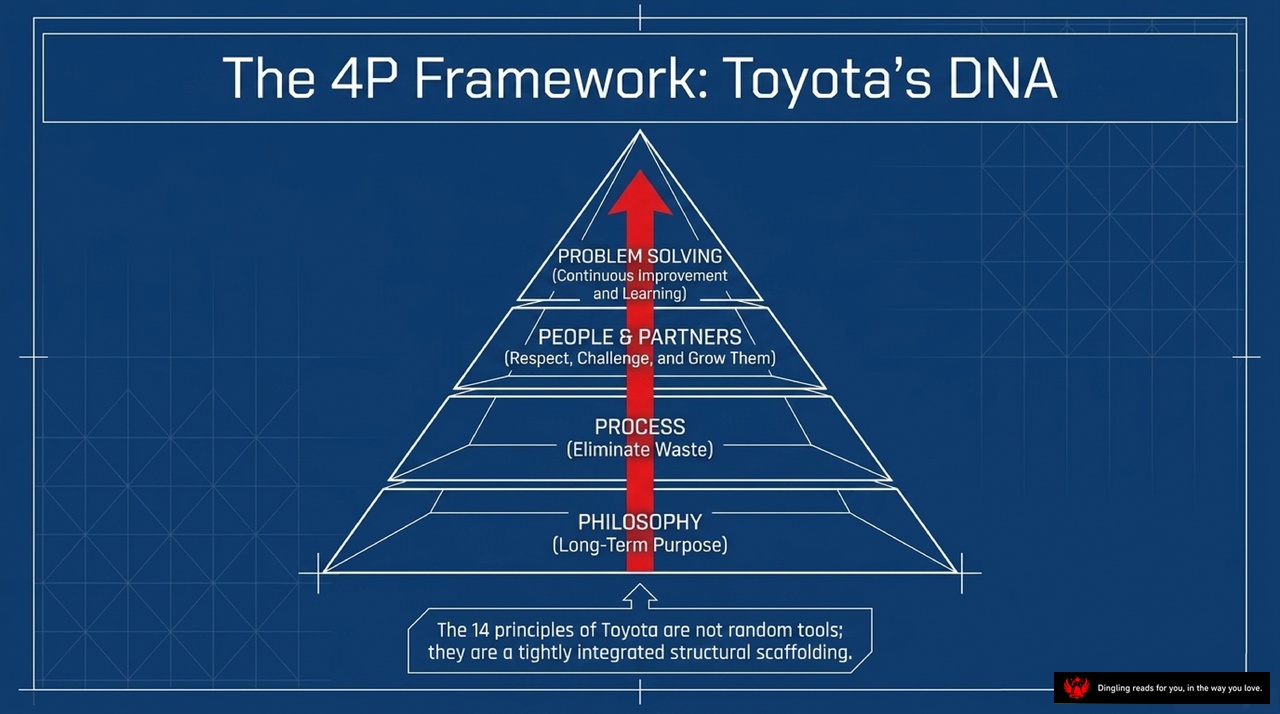
The 4P Framework: Toyota's DNA isn't just a chart; it's the genetic code that powers one of the world's most successful companies. Think of this pyramid as a structural scaffold where every layer supports the one above it.
At the very base, you have **Philosophy**. This is the foundation, built on a **Long-Term Purpose**. Toyota doesn't chase quick wins or quarterly profits; they build decisions on what's right for the future. Without this stable base, the entire structure collapses.
Resting on that foundation is **Process**. Here, the goal is to **Eliminate Waste**. This is where the magic happens—streamlining operations, standardizing work, and ensuring that every action adds real value. You can't have a great product without a flawless process to build it.
Above process stands **People & Partners**. Toyota believes in **Respecting, Challenging, and Growing Them**. Tools and processes are useless without talented, empowered people who are willing to take ownership and drive continuous improvement. They are the engine of the organization.
Finally, at the peak, you have **Problem Solving**, driven by **Continuous Improvement and Learning**. This is where the company evolves. It's the constant push to learn from mistakes and innovate, ensuring Toyota stays ahead of the curve.
The red arrow running through the center of this pyramid is crucial. It reminds us that these 14 principles aren't random tools. They are a tightly integrated system. You can't just pick and choose; you must build the culture first, then the process, and finally, the solutions. This is how Toyota turns principles into a living, breathing DNA that drives long-term success.

Philosophy: The Long-Term Purpose. Look at this compass. It's not pointing at the nearest dollar sign—quarterly profit—but at a distant star: Long-Term Survival and Value. This visual perfectly captures Principle 1 of the Toyota Way: base management decisions on a long-term philosophy, even at the expense of short-term financial goals.
Think about it. Most companies are obsessed with the immediate bottom line, reacting to every market fluctuation. Toyota is different. Their corporate mission explicitly prioritizes contributing to the economy, employees, and society over raw shareholder value. Why? Because the goal is not merely to manufacture cars, but to build a learning organization capable of surviving any economic environment.
Consider the trade-offs. In the 1960s, while competitors imported parts to dodge tariffs, Toyota invested millions to build a factory in California, creating jobs and building trust, even though it hurt their short-term margins. Later, during Japan's bubble economy, they launched the Prius—a massive, risky bet on hybrid technology when no one believed in it. They sacrificed immediate profits for a future that others couldn't see.
This isn't about being naive; it's about strategic patience. By focusing on long-term survival, Toyota builds resilience. They invest in people, they refine their processes, and they create a culture where quality and innovation are never compromised for a quick win. In a volatile world, that long-term vision is the only true competitive advantage.
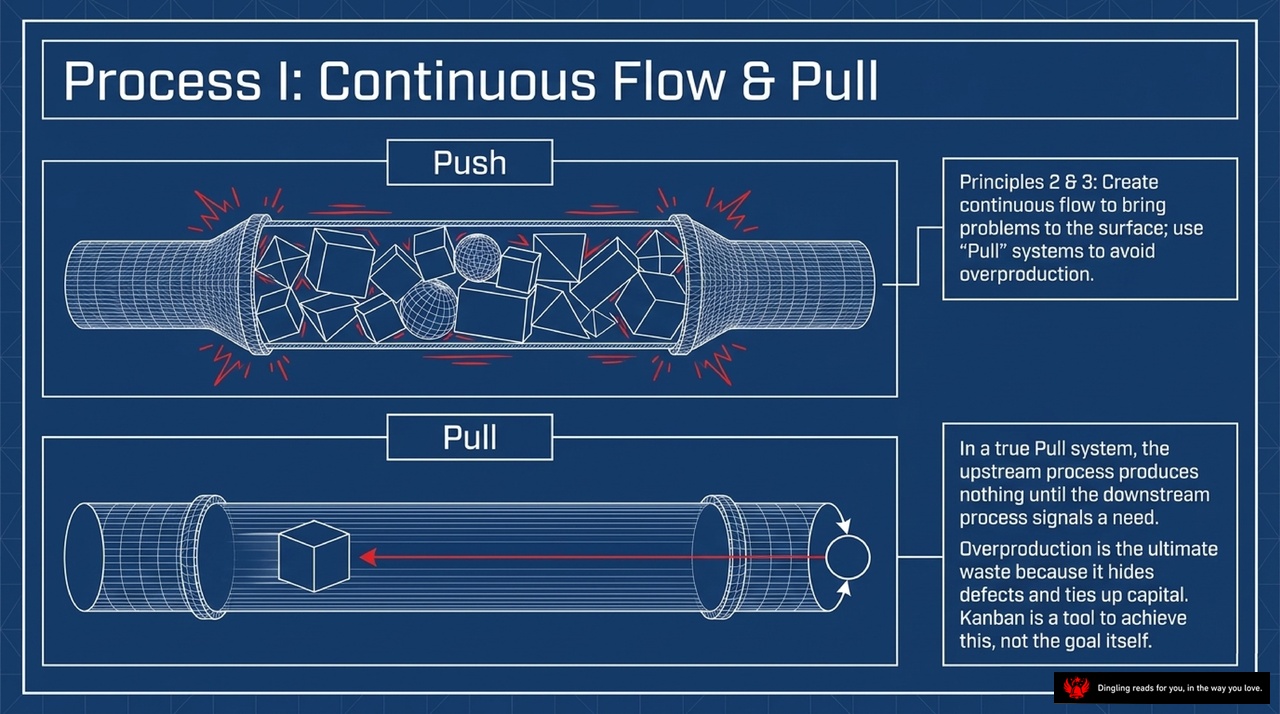
Process I: Continuous Flow & Pull. Look at this diagram. On the top, we see the "Push" system. It's like a pipe clogged with random shapes—cubes, spheres, pyramids. Everything is shoved in blindly. The text on the right explains this clearly: Principles 2 and 3 tell us to create continuous flow so problems surface immediately, and to use "Pull" systems specifically to avoid overproduction. In a Push environment, you just keep feeding work forward regardless of what the customer actually needs. This creates a bottleneck, hides defects, and wastes massive amounts of capital.
Now, look at the bottom section labeled "Pull." Here, the pipe is clean and smooth. A single cube moves steadily from left to right, only when the downstream process signals a need. The text highlights that in a true Pull system, upstream production stops until the customer demands the next item. Overproduction is identified as the ultimate waste because it covers up defects and ties up money. Kanban is the tool we use to achieve this, but remember, it's a tool, not the goal itself. The goal is to respect the customer and eliminate waste. By switching from Push to Pull, we expose problems instantly and ensure we only produce what is truly necessary.

Process II: Heijunka, or Leveling the Load. Think of it as the difference between a frantic hare and a steady tortoise.
Look at this chart. The jagged white line represents traditional customer orders—spiky, unpredictable, and chaotic. This erratic rhythm creates three major problems. First, you have Mura, unevenness. Your production schedule jumps up and down, making it impossible to keep a consistent pace. Second, you get Muri, overburden. Those sudden spikes stress your machines and your people beyond their capacity, leading to burnout. And third, this chaos often hides Muda, waste. When things are running at full tilt just to catch up, you stop seeing the real inefficiencies.
Toyota's solution? They counterintuitively hold some inventory not to cover delays, but to smooth the wave. By decoupling production from the exact moment of the order, they level out the workload. Instead of reacting to every spike, they work like the tortoise: a steady, sustainable pace. This strict build-to-order approach actually creates chaos if followed blindly. That's why Toyota uses this leveling principle to eliminate Mura and Muri, ensuring a smooth, high-quality flow that no other system can match.

Stop the line. That's the only way to succeed.
Today's slide introduces Process III: Jidoka, often translated as "Automation with a Human Touch," but let's call it what it really is: "Stopping to Succeed."
Look at this visual flow. It starts with a defect appearing on the line. Instead of letting that bad part move down the assembly line, a worker immediately pulls the Andon Cord. That red cord triggers the alarm, and the line stops. This isn't a breakdown; it's a feature.
Toyota Principle #5 is all about building a culture where stopping is the default response to a problem. Western managers often chase 100% machine uptime, hiding defects to hit their quotas. But Toyota views 100% uptime as a failure because it means problems are being hidden. By halting the line immediately, Toyota prevents a single defect from multiplying downstream and ruining an entire batch of cars.
Once the line stops, the team gathers right there. They don't wait for a manager from another department to come fix it. They use that moment to solve the root cause, adjust the machine, and only then do they restart production. This ensures quality is built right the first time, rather than inspected at the end.
So, remember this: In Toyota's world, the line stops not because things went wrong, but because they are about to get better.

Process IV: Standardization & Visibility. Think of your workflow not as a static list of tasks, but as a staircase where every step is a deliberate act of improvement.
The image highlights three critical principles. First, Standardized tasks are the foundation for continuous improvement. You cannot improve a chaotic process. Standards are not rigid bureaucratic rules; they are simply the "current best way" to do a job, serving as the stable baseline from which the next creative improvement is measured. Without this baseline, you have no reference point for progress.
Second, use visual control so no problems are hidden. When you standardize, you create a predictable rhythm. But if you don't make that rhythm visible, issues get buried. Visual control acts as an early warning system, ensuring that deviations from the standard are immediately apparent to everyone, not just managers.
Finally, look at the red arrows labeled Kaizen or Innovation. These represent the upward climb. Standardization gives you the stability to stand firm, while innovation pushes you higher. It's a cycle: you standardize the current best practice, use that stability to spot problems quickly, and then innovate to raise the standard to the next level. This is how you move from good to great, step by step.
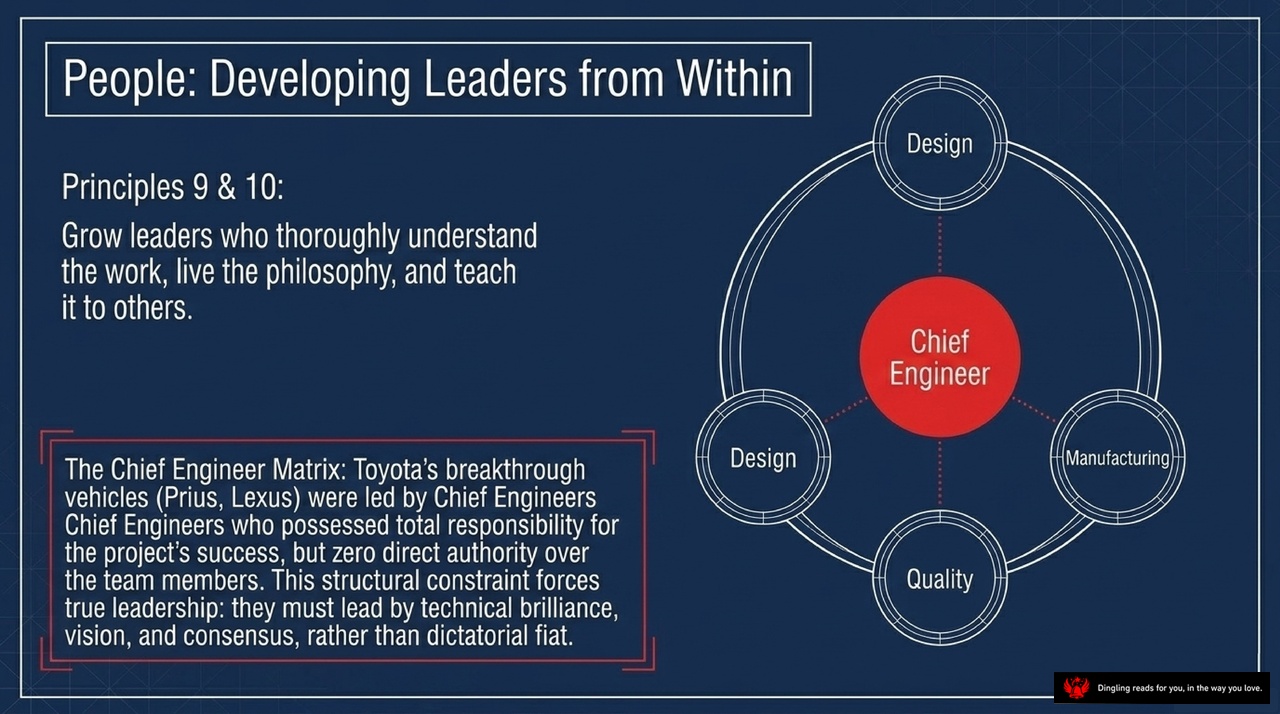
Today's slide focuses on the heart of Toyota's leadership philosophy: developing leaders from within. Look at that central red circle labeled "Chief Engineer." This isn't just a job title; it's a unique structural constraint designed to force true leadership. As the text explains, Toyota's breakthrough vehicles like the Prius and Lexus were led by Chief Engineers who held total responsibility for success but possessed zero direct authority over their team members.
This setup is brilliant because it forces leaders to lead through technical brilliance, vision, and consensus rather than dictatorial fiat. Without the power to simply order people around, these engineers must deeply understand the work, live the company's philosophy, and teach it to others to get results. This aligns perfectly with Principles 9 and 10, which emphasize growing leaders who are embedded in the work itself. By removing the crutch of direct authority, Toyota ensures that only those who can truly inspire and align their teams—through expertise and shared values—rise to the top. It's a system where leadership is earned through influence, not granted through hierarchy.
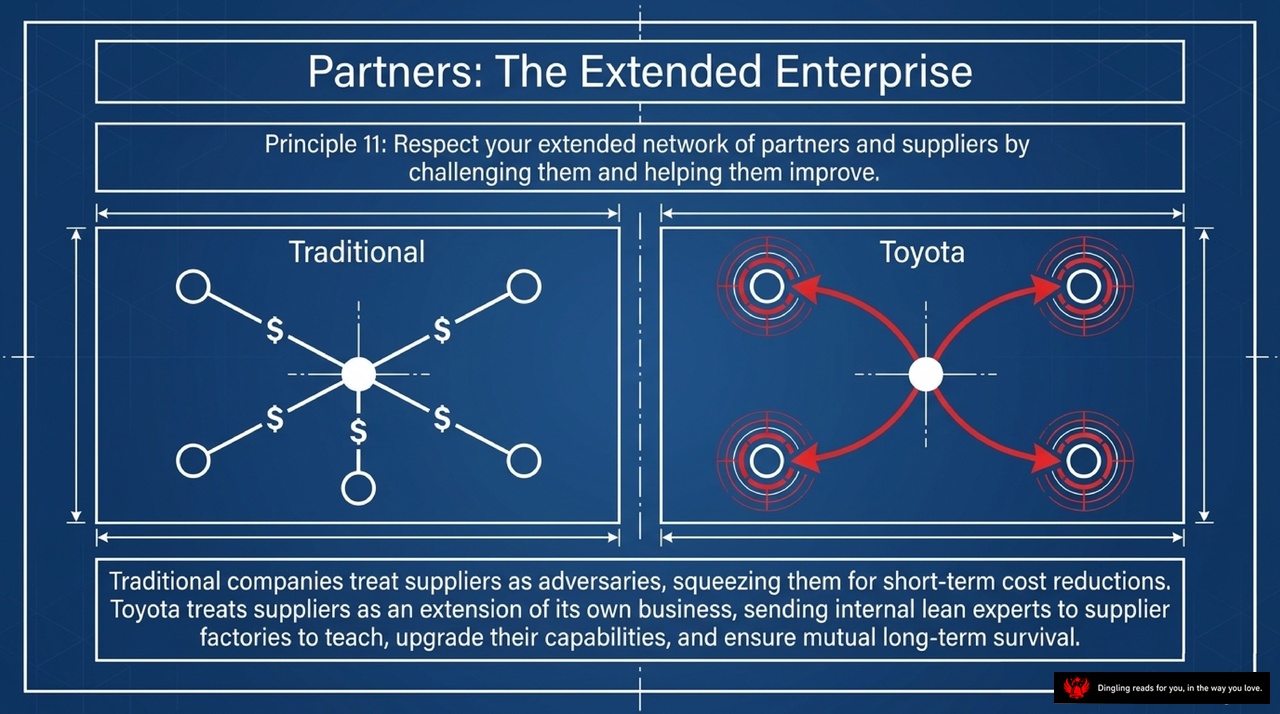
Imagine a world where your suppliers aren't your enemies to be squeezed for pennies, but your most valuable partners. That is the core difference between the "Traditional" approach and the Toyota way, as shown on this slide.
On the left, you see the traditional model. It's a zero-sum game where companies treat suppliers as adversaries, constantly pushing them to lower costs just to protect their own short-term profits. It's a transactional relationship built on fear and pressure, which often leads to fragile supply chains that crumble when the market shifts.
Now, look at the Toyota side. Here, the relationship is a continuous, two-way flow of value. Toyota doesn't just demand lower prices; they actively invest in their suppliers' success. They send their own internal lean experts to supplier factories to teach, upgrade capabilities, and solve problems together. This is what Principle 11 is all about: respecting your extended network by challenging them and helping them improve.
By treating suppliers as an extension of their own business, Toyota ensures mutual long-term survival. Instead of squeezing partners dry, they build a resilient ecosystem where everyone grows stronger together. This shift from adversarial competition to collaborative partnership is what transforms a simple supply chain into a true "Extended Enterprise," creating stability and innovation that no competitor can easily replicate.
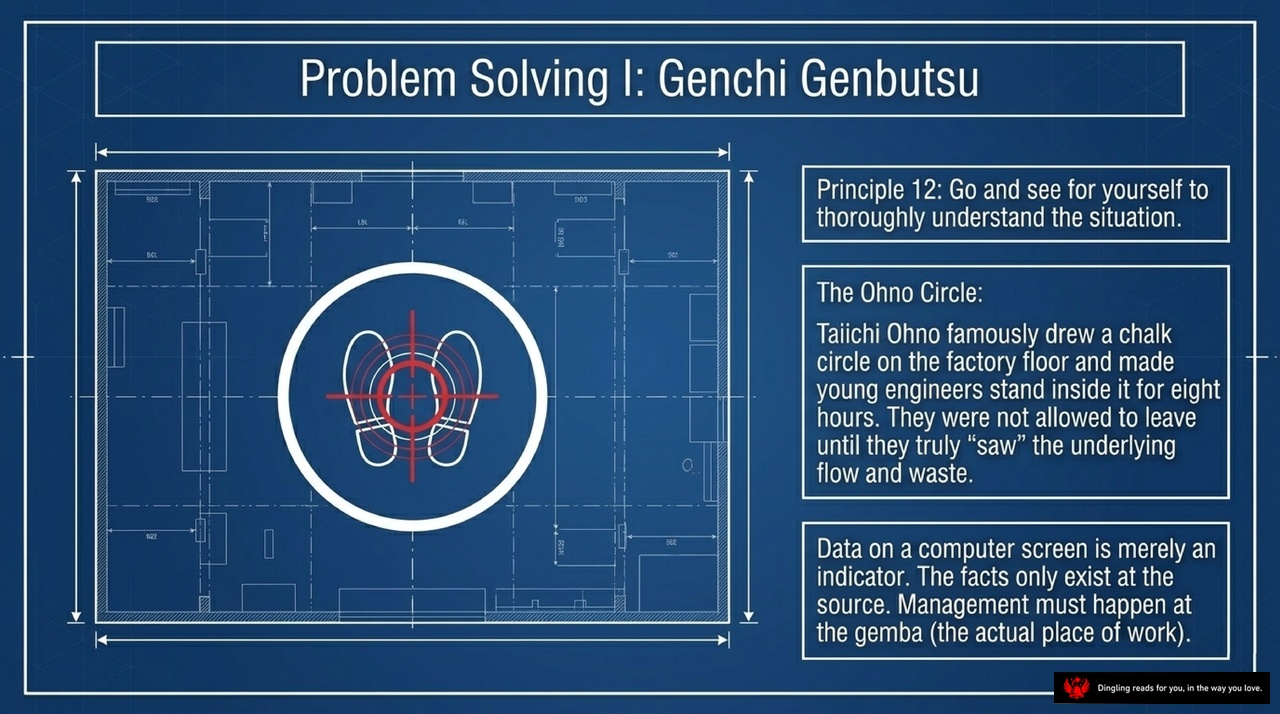
Problem Solving I: Genchi Genbutsu. Let's talk about Principle 12: Go and see for yourself to thoroughly understand the situation.
Imagine this: Taiichi Ohno, the father of TPS, drew a simple chalk circle on the factory floor and made young engineers stand inside it for eight hours straight. They weren't allowed to leave until they truly "saw" the underlying flow and waste. Why such a harsh test? Because data on a computer screen is merely an indicator. The facts only exist at the source. Management must happen at the gemba, the actual place of work.
In the real world, relying on reports is like trying to diagnose a patient without ever looking at them. You need to be there. Just like Ohno's circle forces you to confront reality, stepping onto the shop floor forces you to see the truth. Whether it's a manufacturing line or a service process, the gap between what your data says and what is actually happening is where the real problems hide. Don't just trust the dashboard; go to the source, look with your own eyes, and let the reality on the ground guide your decisions. That is the heart of true problem-solving.
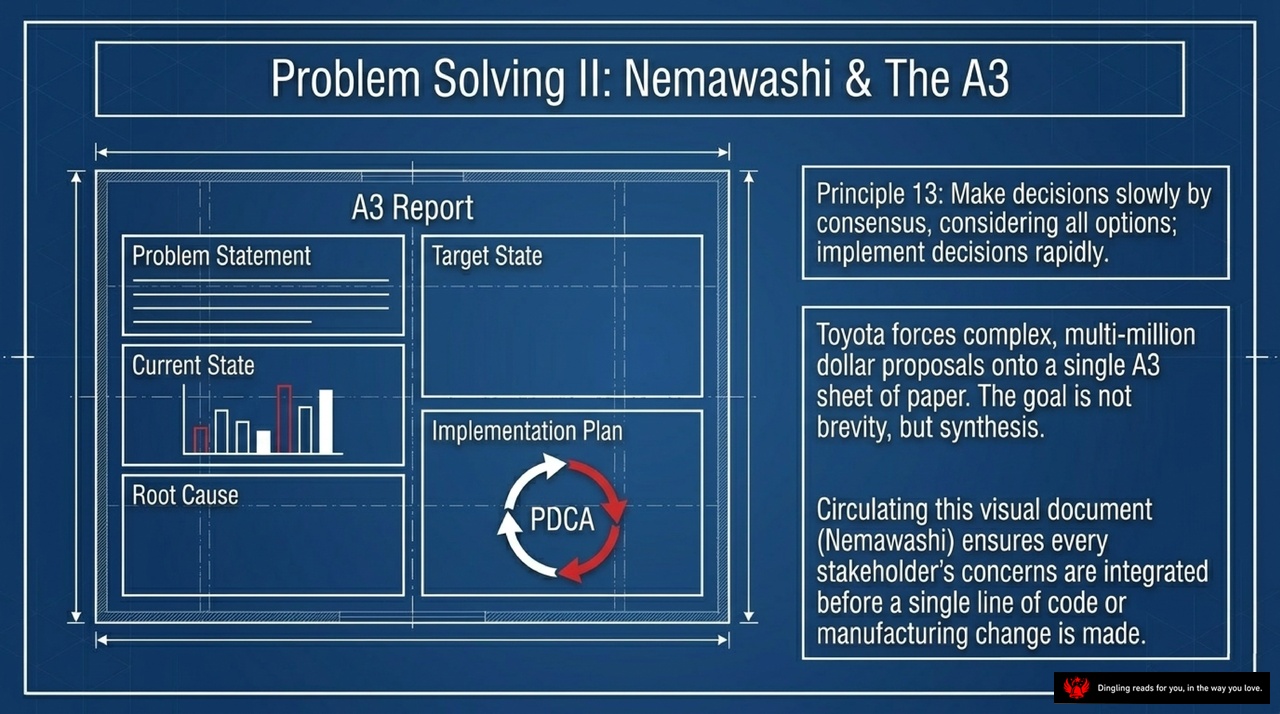
Today's slide breaks down Toyota's powerful problem-solving engine: Nemawashi and the A3 Report. You're looking at a single sheet of paper—the A3 Report—that forces complexity into clarity. On the left, we see the core diagnostic flow: starting with the Problem Statement, moving through the Current State and Root Cause, to define the Target State and the Implementation Plan, all driven by the PDCA cycle. On the right, Principle 13 sets the golden rule: make decisions slowly by consensus, but implement them rapidly. Toyota forces even multi-million dollar proposals onto this single A3 sheet. The goal isn't brevity; it's synthesis. By circulating this visual document, they practice Nemawashi, ensuring every stakeholder's concerns are integrated before a single line of code or manufacturing change is made. This visual discipline guarantees that when we finally move, we are truly ready.
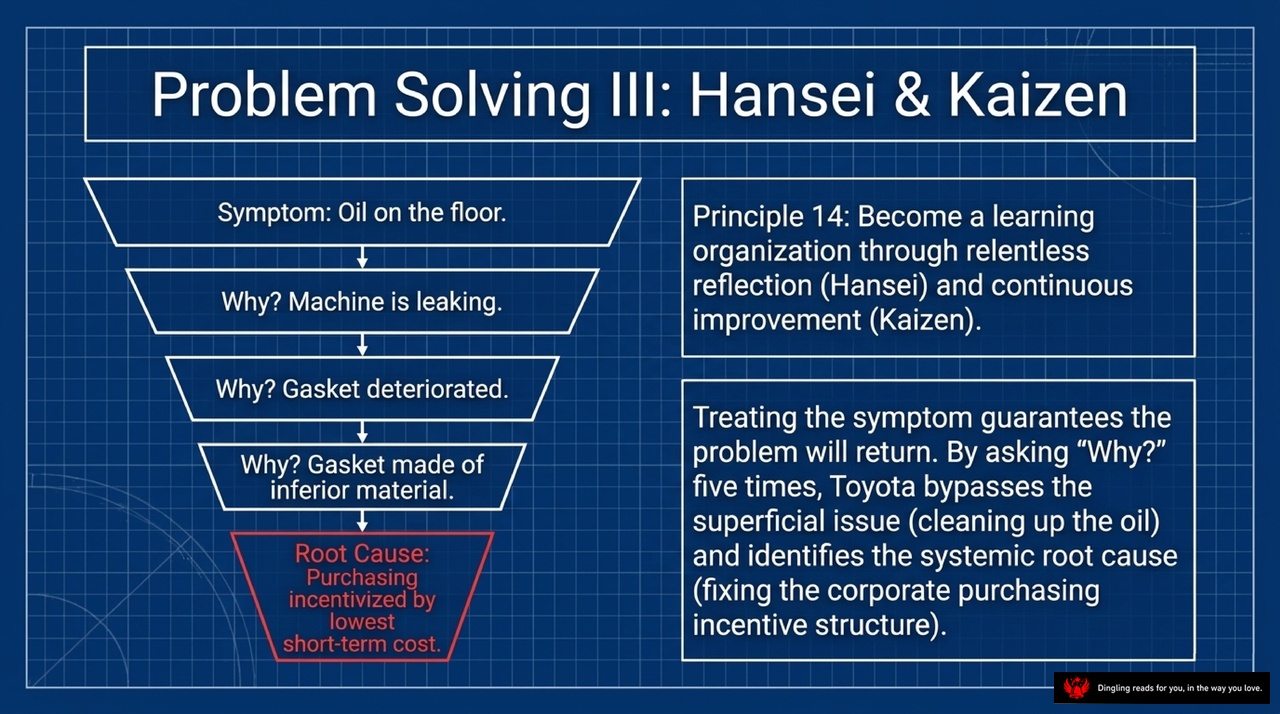
Look at this flowchart. It starts with a simple symptom: oil on the floor. At first glance, you might just clean it up. But Toyota asks "Why?" five times. Why is there oil? The machine is leaking. Why? The gasket deteriorated. Why? It was made of inferior material. And finally, why was inferior material used? Because the purchasing department is incentivized to choose the lowest short-term cost.
This slide illustrates the power of Hansei and Kaizen. Instead of treating the symptom, Toyota digs deep to find the systemic root cause. By fixing the corporate incentive structure rather than just cleaning the floor, they prevent the problem from returning. This aligns with Principle 14: becoming a learning organization through relentless reflection and continuous improvement. It's all about bypassing superficial issues to identify the real drivers of failure.
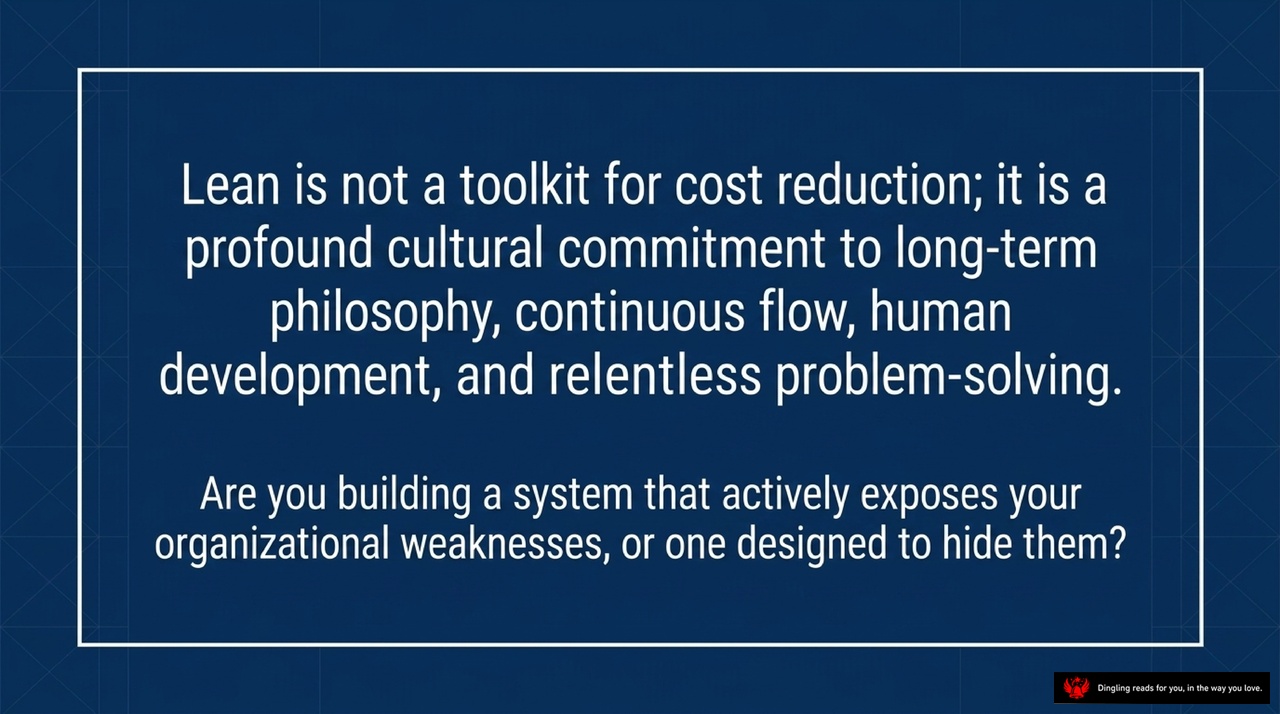
Lean isn't just a toolkit for cutting costs; it's a profound cultural commitment to long-term philosophy, continuous flow, human development, and relentless problem-solving. Are you building a system that actively exposes your organizational weaknesses, or one designed to hide them?
Too many companies fall into the trap of treating Lean as a checklist of tools—Kanban cards, 5S cleanups, or automated lines—without understanding the culture that makes them work. When you focus only on the tools, you often end up hiding problems behind buffers and inventory instead of solving them at the source.
Think about it: if your employees are afraid to pull the Andon cord and stop the line when they see a defect, your automation is just a expensive piece of theater. Real Lean requires a mindset where stopping production to fix a root cause is seen as a victory, not a failure. It demands that you respect your people, trust their judgment, and empower them to improve the process every single day.
The question isn't "Do you have these tools?" It's "Are you creating an environment where the truth is always visible?" When you build a system that hides weaknesses, you're just delaying the inevitable crash. But when you build a system that exposes them, you turn every problem into an opportunity for growth. That is the only way to achieve true, sustainable success.