



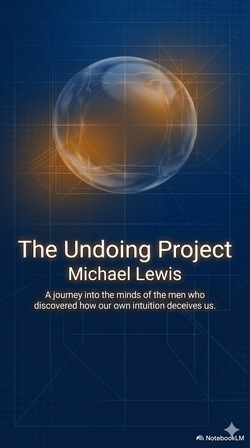
Lewis exposes how our brain's hidden biases make experts fail when data should help us decide.
Your Review
Lewis exposes how our brain's hidden biases make experts fail when data should help us decide.

Lewis reveals how Kahneman and Tversky exposed our mental shortcuts that make experts fail, proving that intuition often misleads us when we ignore base rates and get trapped by framing effects or counterfactual regrets, showing why traditional rationality myths collapse in real life.

This book finally made sense of why I keep making bad decisions despite having all the facts.

Lewis proves data fails when our biased brains ignore it.
This book completely changed how I view expert decisions and human intuition.

Interesting take on why smart people still make predictable mistakes in life.

Smart data fails because our brains are flawed.

Lewis brilliantly explains how Kahneman and Tversky proved our brains rely on mental shortcuts that make even experts consistently wrong.

Lewis brilliantly shows how Kahneman and Tversky exposed our hidden biases through clever experiments and real stories that make sense of why experts fail, proving that our brains rely on mental shortcuts like the law of small numbers and representativeness heuristics which distort our judgment when facing risks, framing effects, or counterfactual thinking, ultimately replacing the myth of the rational man with a realistic view of human behavior where loss aversion and the focus principle explain why we regret near misses more than failures, giving us tools to anchor decisions to base rates and use premortems to mitigate these predictable errors in our daily lives and work.

Smart book about why experts fail so often.

The detailed story of Kahneman and Tversky makes their complex psychological theories feel very real.

A fascinating look at how mental shortcuts trick us into making predictable errors.

A must read for anyone who thinks data alone can fix every problem in life.

Lewis effectively illustrates how Kahneman and Tversky's work transformed economics by proving that human decision-making is governed by psychological biases like loss aversion and the availability heuristic rather than pure rationality.

Lewis explains how Kahneman and Tversky proved our brains rely on mental shortcuts that lead to predictable, irrational errors in judgment.

Lewis traces the fascinating journey of Kahneman and Tversky from their early skepticism of rationality to developing prospect theory, showing how their insights into loss aversion and framing effects explain why we make irrational financial and policy choices despite having all the data.

This book made me realize how often my own quick guesses lead me to make bad decisions.

Lewis brilliantly explains how Kahneman and Tversky's experiments on heuristics and prospect theory completely shattered the myth of the rational man, showing us that our intuitive shortcuts, like the law of small numbers and loss aversion, systematically distort our judgment in ways that even experts cannot escape when facing real-world risks or framing effects.

Truly mind-shifting read.

Lewis shows how our brains trick us into errors. He explains that even experts ignore basic statistics when they trust their gut feelings too much. The Law of Small Numbers experiment proved that we overvalue tiny samples. For instance, experts thought a group of 50 students with one genius would have an average IQ of 100, ignoring the outlier. This reveals why we judge restaurants by one meal or stocks by a week. Lewis also details how framing changes risk choices. When options are shown as lives saved, people choose safe. When shown as lives lost, they pick risky. This proves our choices depend on presentation, not facts. Understanding these biases helps us make better decisions in life and work by slowing down our intuitive shortcuts.