
The Universe in a Nutshell: Complete Chapter-by-Chapter Summary

Welcome to a visual journey through the cosmos, where we explore the ultimate theories shaping our reality. Today, we're diving into Stephen Hawking's "The Universe in a Nutshell."
Imagine the universe not as an endless void, but as a finite space with no edges—much like the surface of the Earth. You can walk forever without ever hitting a boundary. This is the core idea Hawking presents: a universe that is finite yet unbounded.
But how did it begin? Traditional physics pointed to a singular point, a singularity where laws broke down. Hawking challenged this with his "No Boundary Proposal." He suggested the universe has no beginning in time, similar to how the Earth has no beginning in space. Instead, it smoothly emerges from a quantum state, like a bubble forming in a calm sea.
As this universe expands, tiny quantum fluctuations are stretched into the vast structures we see today—galaxies, stars, and everything in between. This process, driven by the interplay of gravity and quantum mechanics, creates a cosmos that evolves from a simple quantum state into the complex reality we inhabit.
So, we are not just observers in a random explosion; we are part of a self-contained system that exists within its own geometry. From a single quantum possibility to the grand tapestry of spacetime, the universe is a story written in the language of physics, waiting for us to read it.

Imagine you're standing in front of a cosmic chalkboard, split right down the middle. On the left, you see a smooth, glowing grid curving around a massive star—that's General Relativity, the rulebook for the macro universe. It describes how gravity shapes the motion of stars and galaxies, painting a picture of a predictable, smooth spacetime. But look to the right. That's Quantum Mechanics, the chaotic, sparkling world of the micro. Here, everything is uncertain, probabilistic, and constantly fluctuating. It defines the behavior of atoms and subatomic particles, a realm where nothing is ever truly still.
The real drama happens right in the center, where these two giants violently clash. At the moment of the Big Bang and deep inside black holes, gravity shrinks to the microscopic scale. Suddenly, the smooth curves of General Relativity break down into infinite mathematical errors. The two foundational theories refuse to coexist, creating a crisis that demands a new Theory of Everything to finally unite the vast cosmos with the tiny building blocks of reality.

Imagine our universe not as an infinite void with hard edges, but as a finite space without a boundary—much like the surface of the Earth. You can walk forever in one direction and eventually return to your starting point, yet you never encounter a "rim." This is the core of Hawking's model: a universe that is finite in size but has no edge, containing no center and no "outside."
To explain how such a universe could begin, Hawkin introduced the concept of "imaginary time." Think of it as a fourth spatial dimension, running at a right angle to the time we experience. In this mathematical framework, the universe's origin isn't a sharp, catastrophic singularity where physics breaks down. Instead, time behaves smoothly, curving back on itself like the bottom of a funnel. Just as there is nothing south of the South Pole, there is nothing "before" the Big Bang in imaginary time. The universe is entirely self-contained, requiring no external trigger to start.
This idea also helps us visualize the shape of the cosmos. If we map our four-dimensional spacetime into a higher-dimensional space, it resembles a sphere—often called the "no-boundary proposal." This model suggests that the universe emerged from a quantum state, evolving smoothly from this imaginary beginning into the real time we inhabit today. It resolves the mystery of the "first moment" by showing that the universe simply exists as a complete, self-sufficient whole, with no need for a creator or a prior cause.
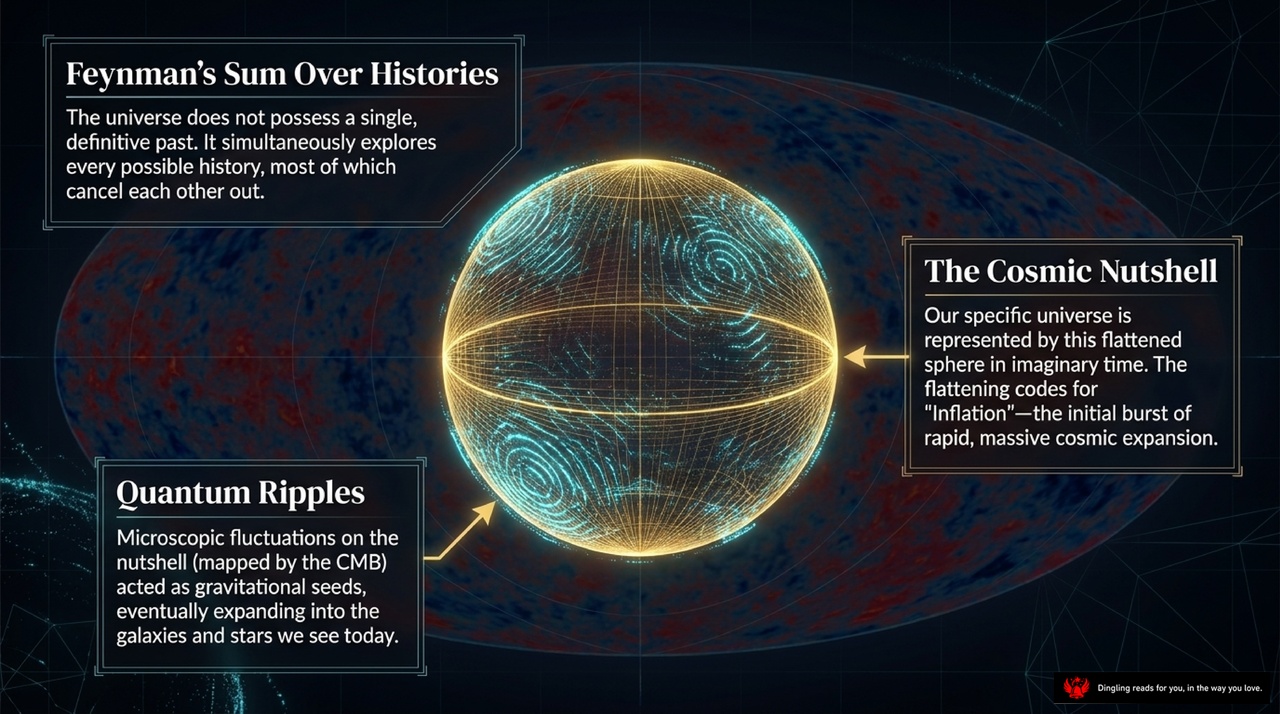
Imagine our universe not as a single, fixed story, but as a vast ocean of possibilities where every history plays out simultaneously, only for most of them to cancel each other out. This is the essence of Feynman's "Sum Over Histories," a concept that reshapes how we see the past. But what does our specific reality look like within this quantum foam?
Visualize our universe as a flattened sphere in imaginary time, often called the "Cosmic Nutshell." This flattening isn't just a geometric trick; it codes for "Inflation"—that initial, explosive burst of rapid expansion that set the stage for everything we see today. Now, look closely at the ripples on this surface. These are "Quantum Ripples," microscopic fluctuations that acted as the gravitational seeds for our cosmos. Just like tiny disturbances on a pond eventually grow into massive waves, these tiny quantum jitters expanded into the galaxies and stars that fill our sky.
So, we are essentially living on a tiny, specific patch of a quantum sphere, born from the cancellation of infinite possibilities and seeded by the tiniest fluctuations in the fabric of space itself.

We all have that nagging feeling that if we just knew enough about the universe right now, we could predict everything that happens next. For centuries, this was the scientific dream, known as Laplace's Determinism. Imagine a giant, perfectly oiled clockwork mechanism, like the golden gears you see here. If you could know the precise location and velocity of every single particle in the universe at this exact moment, the laws of physics would allow you to calculate the entire past and future with absolute certainty. It was a beautiful, logical idea that dominated the 19th century.
But then, the universe threw us a curveball in the 1920s. Werner Heisenberg stepped in and proved that we can't have our cake and eat it too. He showed that we cannot know both the position and velocity of a particle with perfect precision. The more accurately you know one, the fuzzier the other becomes. This Quantum Uncertainty shattered the clockwork dream. We can no longer predict specific outcomes; we can only predict probabilities, represented by a wave function. Determinism was cut in half, replaced by a world of inherent uncertainty.
Then, the plot thickened again in the 1970s with the Black Hole Paradox. Here, we face a scenario where information falls into a black hole, and when the black hole eventually evaporates, that information seems to vanish completely. If the wave function itself is lost, our ability to predict the future drops to zero. This suggests that even with all the laws of physics, the future might not be calculable at all. From the predictable gears of the 19th century to the probabilistic clouds of the 20th and the information loss of the 70s, our understanding of what the future holds has shifted dramatically, challenging the very idea that the universe is a simple, predictable machine.

Time travel has always been one of humanity's most captivating dreams, but physics reveals it's far more dangerous than a sci-fi movie. The biggest hurdle is the Grandfather Paradox: if you go back and stop your grandfather from meeting your grandmother, you never get born, so who went back to kill him? It's a logical loop that breaks reality itself. To solve this, some theories suggest parallel universes—changing the past just creates a new branch, leaving your original timeline untouched. Others propose closed timelike curves, where the cause and effect form a self-consistent loop, like a story that writes itself without a clear beginning.
However, nature has built a powerful firewall against this. The laws of thermodynamics, specifically entropy, dictate that time only moves forward from order to chaos. Reversing this to fix a mistake would violate a fundamental rule of the universe. Even if we could build a wormhole or warp drive, quantum effects would likely destabilize them instantly, creating infinite energy that tears the structure apart. Stephen Hawking proposed the "Chronology Protection Conjecture," suggesting that the laws of physics themselves conspire to prevent macroscopic time travel, protecting the past from being rewritten. In short, while the idea is thrilling, the universe seems determined to keep us firmly anchored in the present, ensuring that cause always precedes effect.

Imagine our familiar three-dimensional universe isn't the whole story, but rather a thin sheet floating in a vast, higher-dimensional space. This is the core idea of the Brane World scenario, where everything we see and touch is trapped on this "brane," while gravity is the one force capable of escaping into the bulk—the extra dimensions beyond our perception.
This framework offers a radical new explanation for the Big Bang. Instead of a mysterious singularity tearing spacetime apart, the universe's birth could simply be the result of two parallel branes colliding. When these sheets slam together, the energy released ignites the explosion we observe as the Big Bang, creating matter and radiation in the process. As they bounce apart, our universe expands, only to potentially collide again in a cosmic cycle, offering a dynamic, loop-like history for our cosmos.
Perhaps most intriguingly, this theory redefines the nature of dark matter and dark energy. What we perceive as invisible dark matter might actually be normal matter living on a parallel brane, whose gravity leaks through the bulk to influence us without emitting any light. Similarly, the mysterious force driving our universe's accelerated expansion, dark energy, could be a gravitational pull from that hidden extra dimension or the influence of neighboring branes.
We are currently on the verge of testing these wild ideas. Experiments like those at the Large Hadron Collider are hunting for microscopic black holes that would evaporate instantly, signaling extra dimensions. Meanwhile, ultra-precise measurements of gravity at tiny scales might reveal deviations from standard physics, proving that gravity is indeed "leaking" into hidden realms. If confirmed, this brane perspective doesn't just solve the puzzle of the universe's origin; it unifies the strongest and weakest forces, revealing that our reality is just a small part of a much grander, multidimensional tapestry.

Imagine a tunnel connecting two distant points in space and time—a true shortcut through the fabric of reality. This is the wormhole, a concept that turns science fiction into a serious theoretical possibility. According to General Relativity, spacetime can warp so severely that it creates a Closed Timelike Curve, a path that loops back into its own past. If a spaceship enters one mouth of this tunnel, it could theoretically exit the other mouth before it ever launched, effectively traveling backward in time.
However, nature isn't so cooperative. Gravity naturally crushes these wormholes shut, trying to collapse the tunnel instantly. To sustain an open time portal, we would need vast amounts of Negative Energy to push the throat outward and prevent collapse. While we haven't mastered negative energy yet, the math suggests it's the only key to unlocking a time machine. This delicate balance between gravitational collapse and exotic matter defines the extreme requirement for time travel, making the wormhole one of the most fascinating, yet fragile, bridges to the past.

Imagine a wormhole that has evolved into a time machine. As soon as it opens a path to the past, something terrifying happens: vacuum fluctuations, or virtual particles, begin to loop back through the tunnel again and again. This creates a relentless feedback loop. Because these particles return instantly to the start, they multiply into an infinite spike of radiation energy inside the wormhole. The result? A localized radiation bomb that violently destroys the wormhole the very microsecond it becomes capable of time travel. This is the Chronology Protection Conjecture. It suggests that the laws of quantum physics conspire to keep history safe for historians, ensuring that the past remains unchangeable and stable.
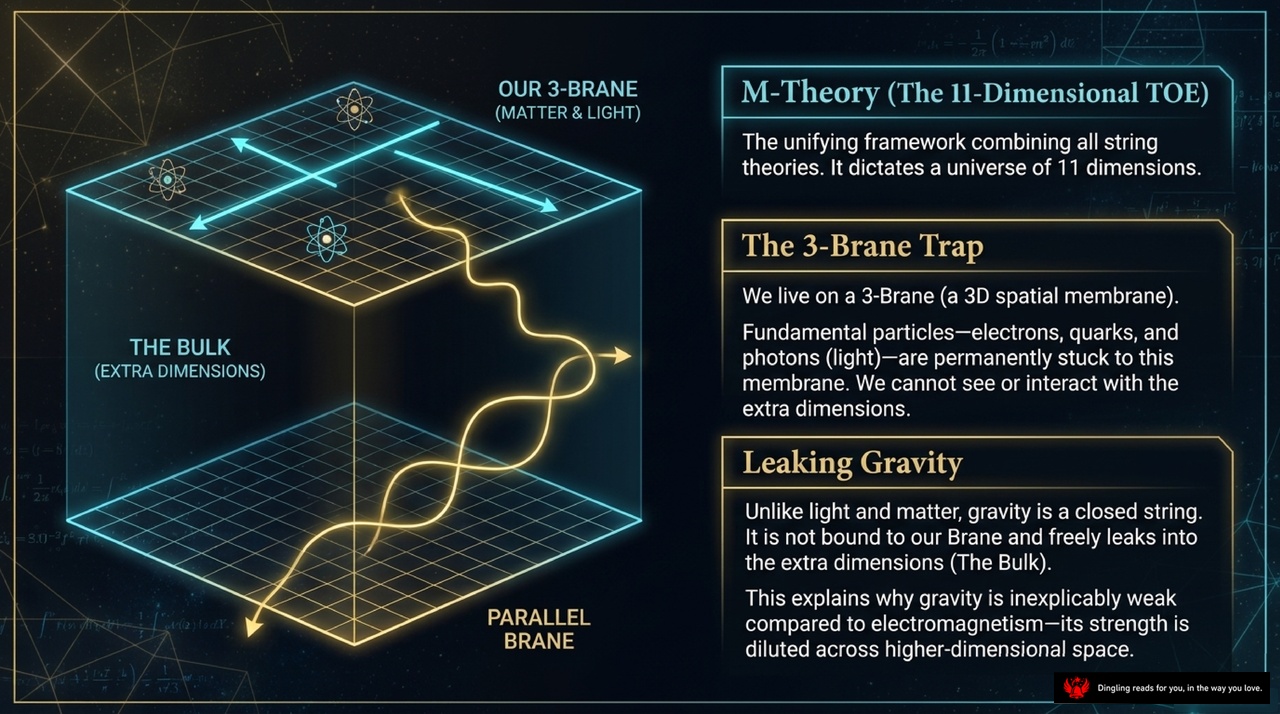
Imagine you're standing on a thin sheet of rubber floating in a vast, dark ocean. That sheet is our "3-Brane," the 3D membrane where all matter and light are permanently stuck. Electrons, quarks, and photons are like ants trapped on that surface; they can move around freely, but they can never step off into the water below. This is the "3-Brane Trap."
But here's where it gets mind-bending. While matter and light are stuck to our brane, gravity behaves differently. In M-Theory, gravity is a closed string that isn't bound to our membrane. It can leak out into the extra dimensions—the "Bulk"—where our 3D world doesn't exist.
Think of it like this: if you pour a bucket of water onto a table, the water spreads out only on the table's surface. But if you pour oil, it might seep through the table and spread underneath. Gravity is that oil. It spreads into the higher-dimensional space, diluting its strength across a much larger volume. That is why gravity feels so incredibly weak compared to electromagnetism. Our senses can't detect the extra dimensions because we are trapped on the brane, but gravity "feels" the bulk.
This idea unifies all string theories into one framework: M-Theory. It suggests our universe is just one of many parallel branes floating in an 11-dimensional spacetime. We are unaware of the other dimensions, except for the faint, diluted tug of gravity pulling us toward a parallel brane just out of reach.

Imagine a universe that exists right next to ours, separated only by a microscopic gap across extra dimensions. This is the "Shadow Brane," a parallel membrane predicted by M-Theory. While our visible universe is filled with light and matter, the Shadow Universe remains completely invisible to us because light cannot cross the vast "Bulk" between these two branes. Yet, it isn't entirely absent. We can still feel its presence through gravity. The mysterious pull we attribute to Dark Matter—the invisible force holding our galaxies together—might simply be the gravitational tug of massive galaxies residing on that hidden, parallel brane. In this cosmic setup, we live in a transparent bubble, unaware of the bustling, shadowy life happening just a fraction of a millimeter away, influencing our very existence without ever being seen.
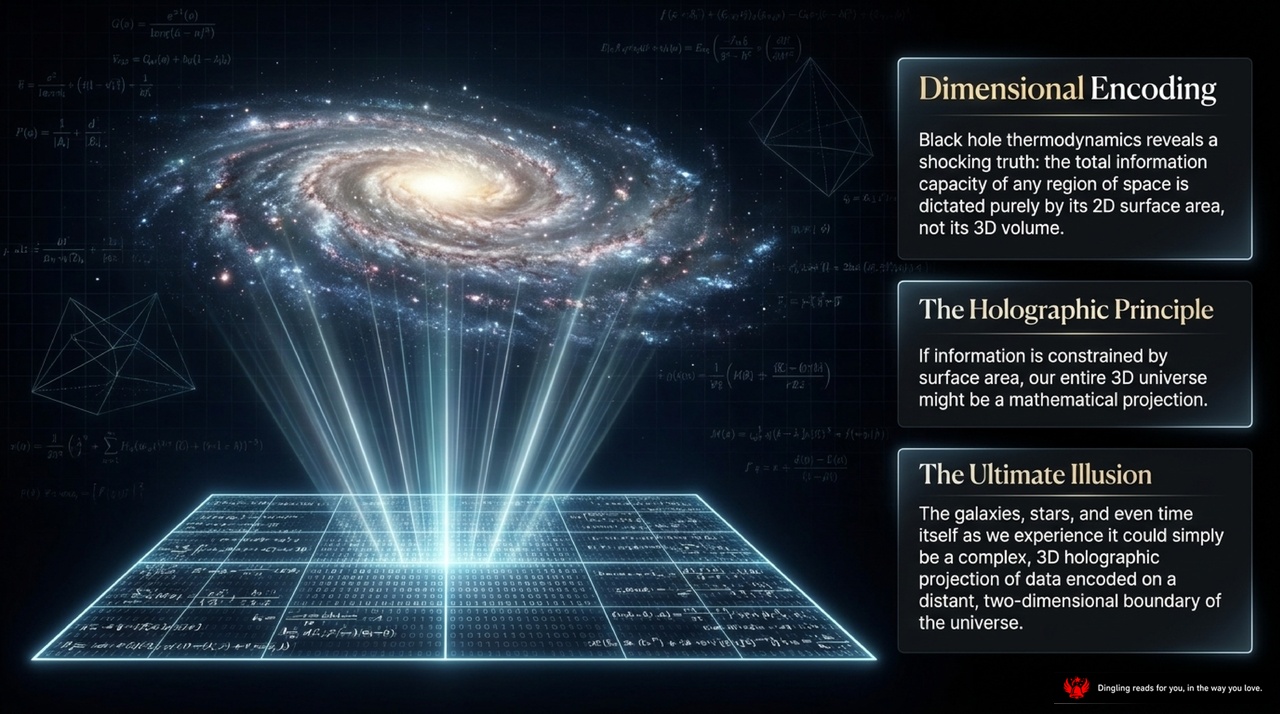
Imagine you are standing on the edge of a vast, glowing grid, looking up at a swirling galaxy that seems to be projecting its entire existence onto the flat surface beneath your feet. This isn't just art; it's a visualization of one of the most mind-bending ideas in modern physics: the Holographic Principle.
Look at the text on the right. It starts with "Dimensional Encoding." This is the core revelation: black hole thermodynamics suggests that the total information capacity of any region of space isn't determined by its 3D volume, but purely by its 2D surface area. It's like saying the entire depth of a movie is encoded on the flat screen.
This leads us to "The Holographic Principle." If information is truly constrained by surface area, then our entire 3D universe might be nothing more than a mathematical projection. Think of it like a hologram. We live in a three-dimensional world filled with galaxies, stars, and time itself, but the text calls this "The Ultimate Illusion." It suggests that these complex 3D realities could simply be a holographic projection of data encoded on a distant, two-dimensional boundary of the universe.
So, when you look at those beams of light shooting from the grid up into the galaxy, visualize them not as rays of light, but as data streams. Every star, every planet, every moment in time you experience is just information being reconstructed in real-time from that 2D surface. It challenges everything we think we know about reality, suggesting that the universe we perceive might be a sophisticated illusion, a 3D movie playing out on a cosmic screen we can't see.
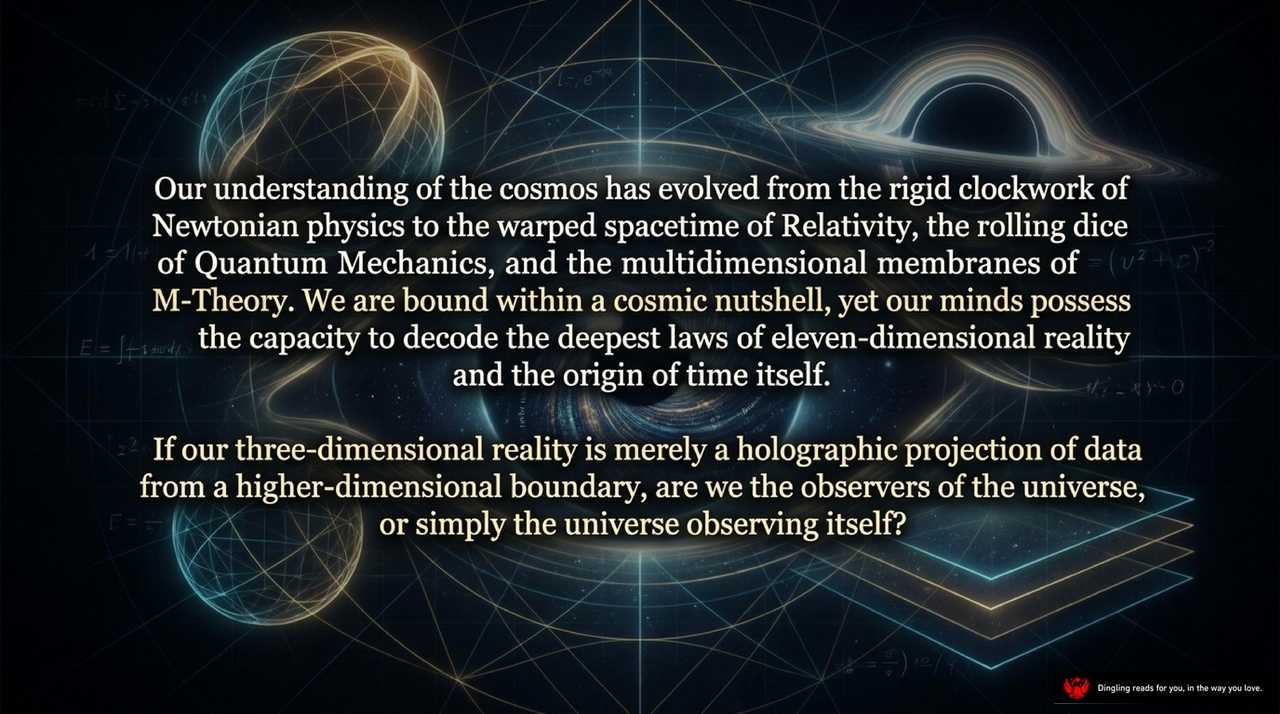
Our understanding of the cosmos has evolved from the rigid clockwork of Newtonian physics to the warped spacetime of Relativity, the rolling dice of Quantum Mechanics, and the multidimensional membranes of M-Theory. We are bound within a cosmic nutshell, yet our minds possess the capacity to decode the deepest laws of eleven-dimensional reality and the origin of time itself.
If our three-dimensional reality is merely a holographic projection of data from a higher-dimensional boundary, are we the observers of the universe, or simply the universe observing itself?