
The Unwinding: Complete Chapter-by-Chapter Summary
Welcome to *The Unwinding* by George Packer. This book explores the quiet, invisible collapse of the institutions that once held America together. It's not about a single dramatic event, but rather a slow unraveling that happened in the cracks of everyday life.
The story begins with a sense of disorientation. For those coming of age in the 1960s, the familiar world of farms, factories, and tight-knit neighborhoods began to dissolve. The unwritten rules of Washington and Wall Street shifted beneath their feet. As the old structures crumbled, a new kind of freedom emerged—one where individuals could move, change careers, or start over, but also one where they were left to face the consequences entirely on their own.
This era brought unprecedented opportunity for the winners, but for many others, it meant a fall from which there was no recovery. Families isolated themselves, communities vanished, and cities lost their industrial backbone in silence. Yet, amidst this chaos, Americans found their own voices. They were open, emotional, and often angry, reflecting a reality that was rapidly changing around them.
From the inflation of the late 1970s to the cultural shifts of the 1980s, the nation navigated a landscape where traditional anchors were gone. Whether it was the rise of new technologies, the transformation of retail giants like Walmart, or the personal struggles of individuals trying to escape their fathers' failures, the narrative is one of adaptation. People were forced to write their own stories in a world where the old scripts no longer applied. As we move forward, we see how these fractures deepened, leading to the crises and transformations that defined the decades to come.
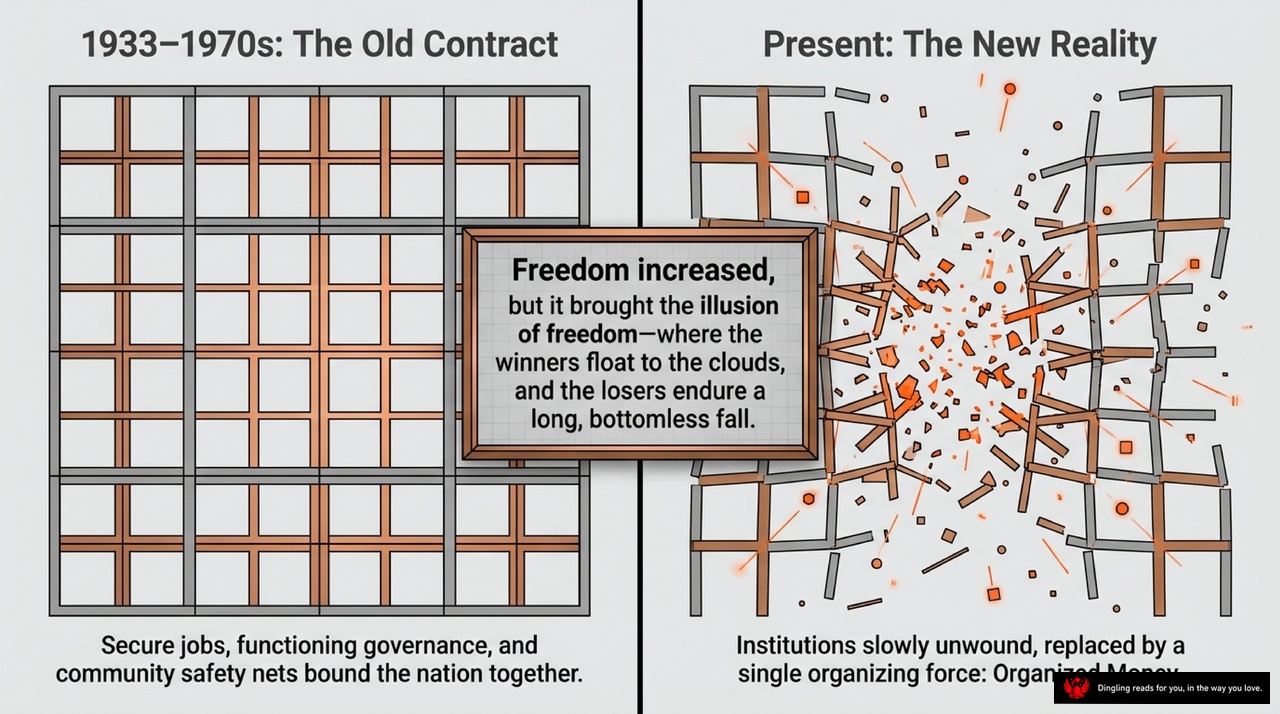
Look at this split screen. On the left, we see "1933–1970s: The Old Contract." It's a rigid, sturdy grid. This was the era of the "Roosevelt Republic"—a time defined by what the book calls the "Old Contract." It wasn't just about economics; it was about a social promise. Secure jobs, functioning governance, and community safety nets bound the nation together. Life felt predictable. You worked, you earned, and society held you steady.
But look at the right side. "Present: The New Reality." The grid has shattered. The structure is gone, replaced by a chaotic explosion of debris. The book describes this as institutions slowly unwinding, replaced by a single organizing force: Organized Money. The safety nets are gone.
The central message here is stark and brutal. The slide tells us that while "freedom increased," it brought the "illusion of freedom." Think about that. In this new reality, the winners float to the clouds, accumulating endless resources and opportunities. But the losers? They endure a long, bottomless fall. There is no net to catch them.
This isn't just a historical comparison; it's the story of how America fundamentally changed. The old system of shared stability collapsed, leaving individuals to navigate a world where the rules are set by capital, not community. The grid didn't just break; it was dismantled, leaving us in a landscape where the gap between the haves and the have-nots isn't just wide—it's a chasm.
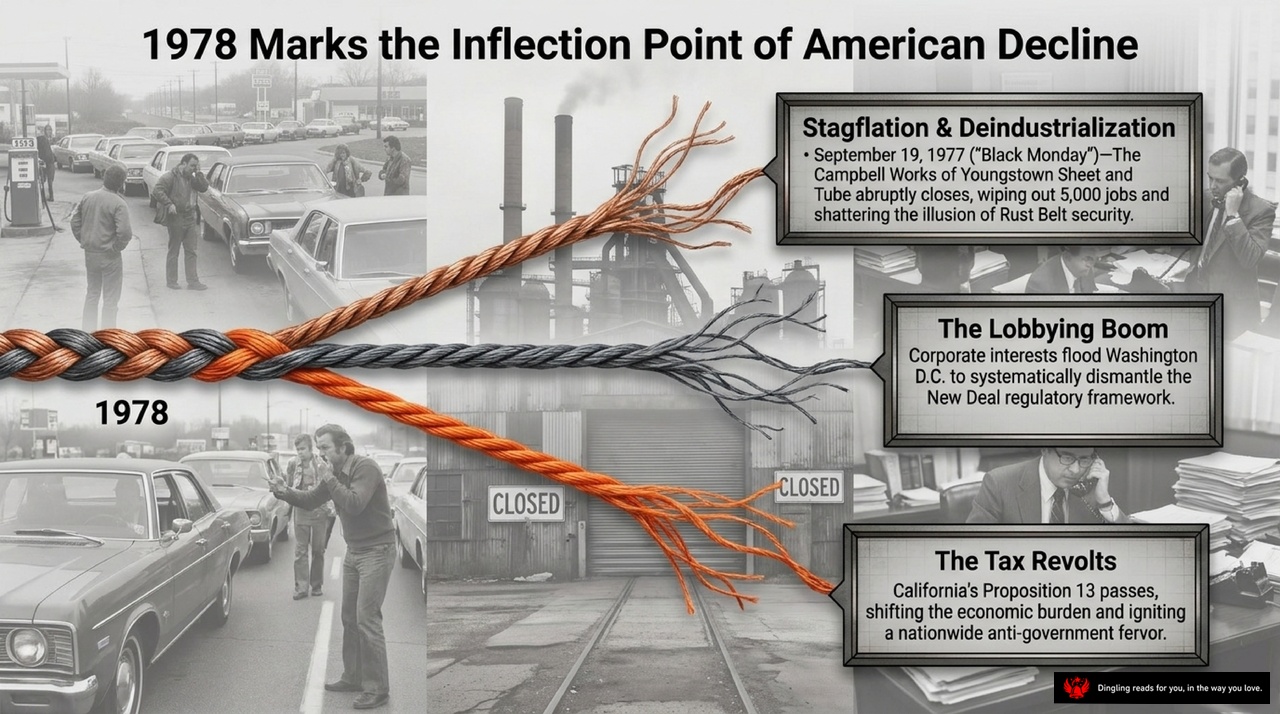
The year 1978 wasn't just another date on the calendar; it was the moment the American dream started to fray at the edges. Think of the nation's stability as a thick, braided cable—strong, unified, and holding everything together. But that year, the strands began to snap.
On the left, you see the oil crisis and long lines at gas stations. This wasn't just about high prices; it was the beginning of "Stagflation"—a terrifying mix of stagnant growth and high inflation that left families desperate. Remember "Black Monday" in 1977? When the Campbell Works factory in Youngstown shut down overnight, wiping out 5,000 jobs in the Rust Belt. It shattered the illusion of security that had defined generations of American workers.
But the unraveling wasn't just economic; it was political and cultural. Look at the middle section labeled "The Lobbying Boom." This is where the real shift happened. Corporate interests flooded Washington, systematically dismantling the New Deal's protective regulations. The government stopped acting as a shield for the vulnerable and started serving the powerful.
Then, look at the bottom right: "The Tax Revolts." This isn't just about numbers; it's about anger. California's Proposition 13 was a scream into the void. It shifted the economic burden onto the state and ignited a nationwide anti-government fervor. People were done paying for a system they felt was broken.
By 1978, the cable was fraying. The old social contract was gone. The winners of this new era grabbed more resources, while the losers were left behind with no safety net. It was the inflection point where the United States moved from a cohesive society into a fractured landscape, setting the stage for the decades of struggle and transformation that followed.
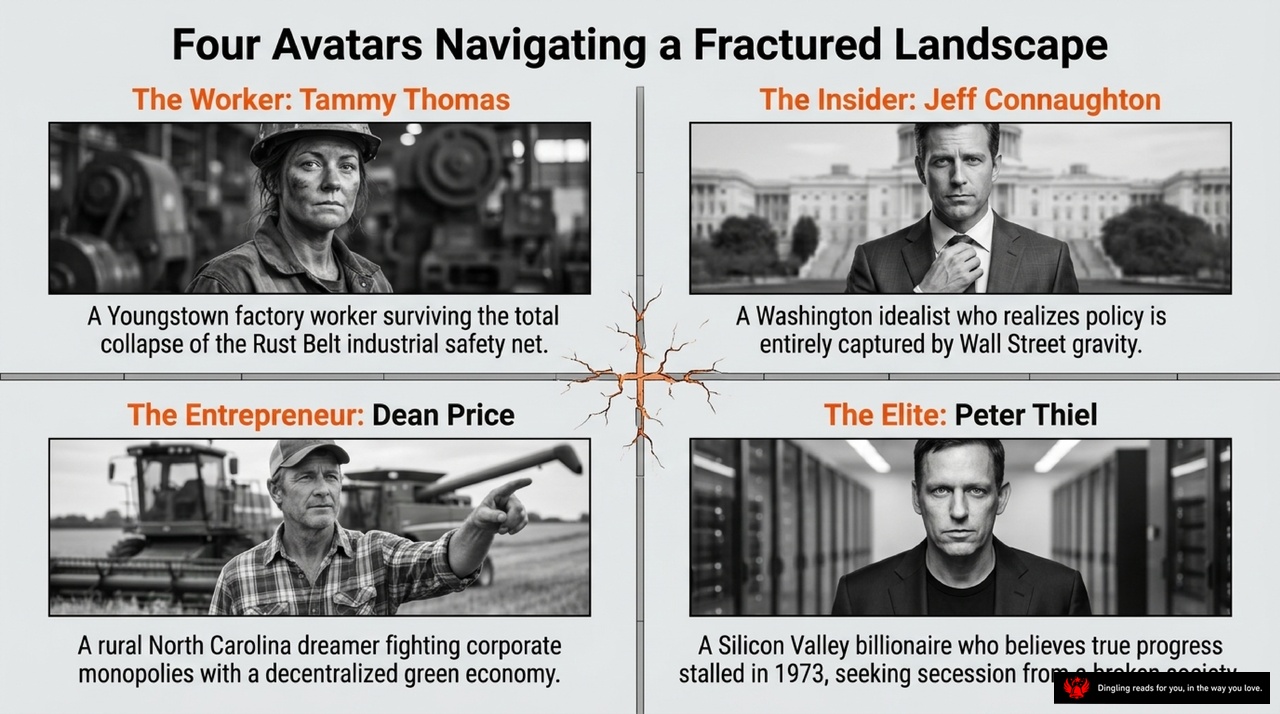
Four Avatars Navigating a Fractured Landscape.
Meet the four faces of our time, each wrestling with a system that no longer holds them together.
First, Tammy Thomas, The Worker. She survived the total collapse of the Rust Belt industrial safety net, watching her factory turn into a ghost town while her community burned down around her.
Then, Jeff Connaughton, The Insider. A Washington idealist who realized too late that policy was entirely captured by Wall Street gravity, forced to watch his dreams dissolve into political maneuvering.
Next, Dean Price, The Entrepreneur. A rural North Carolina dreamer fighting corporate monopolies with a decentralized green economy, trying to build a future on land that was slowly being abandoned.
Finally, Peter Thiel, The Elite. A Silicon Valley billionaire who believes true progress stalled in 1973, seeking secession from a broken society because the old rules no longer serve the new world.
These four avatars aren't just characters; they are us. They show us that when the old structures fail, we don't just wait for rescue. We adapt, we fight, or we leave. The landscape is fractured, but so is our potential to rebuild it.

The collapse of labor and the concrete desert isn't just a headline; it's the silent story of millions of lives upended. Look at this map of Youngstown, Ohio. On the left, in 1970, you see a thriving, unionized middle-class community. Factories hummed, neighborhoods were safe, and people had a stake in their city. But the diagonal line represents the brutal reality of deindustrialization. By the present day, that vibrant landscape has been transformed into an abandoned concrete desert.
This systemic failure wasn't just about jobs disappearing; it was about the entire safety net tearing apart. When companies moved production overseas or simply shut down, like the Lex Company in 1977, thousands of workers were left behind overnight. In Youngstown, the unemployment rate soared to nearly 22%, becoming the highest in the nation. As the factories cooled, the community bonds that once held people together dissolved. The loss of this safety net forced individuals into bare survival, turning a city of homeowners into a landscape of despair.
But amidst this macro-scale collapse, we see the micro reality through the eyes of people like Tammy Thomas. Growing up on the East Side, she watched her neighborhood physically dismantle itself. When her long-time employer, Packard Electric, went bankrupt in 2005, her dreams of retirement vanished. She wasn't just unemployed; she was trapped in a cycle of poverty where crime, arson, and addiction became the new normal. Her family home was eventually demolished, leaving her with nothing but anger and a need for agency.
Tammy's story is the human cost of the "Rust Belt." She realized that waiting for the government to save her was futile. Instead, she turned to grassroots organizing, becoming a community organizer who mapped out abandoned homes and fought for her neighbors. Her journey from a factory worker to a leader shows that even in the darkest times, there is a way to rebuild. The collapse of labor didn't just destroy buildings; it destroyed hope, but for people like Tammy, it also sparked a fight to reclaim their future.

The Privatization of Power in Washington isn't just a slogan; it's a self-reinforcing cycle that has turned public service into an extractive industry. Look at this "Influence Loop." It starts with an Idealistic Campaigner who enters politics with good intentions, only to become a Congressional Staffer whose primary job is fundraising, not legislation. This staff member then feeds into the K Street Lobbyist, who spends billions shaping policy to favor corporate interests over constituents. Finally, that lobbyist becomes a Corporate Defender, protecting the very system that enriched them, which then funds the next campaign for a new Idealistic Campaigner. The cycle never breaks because policy is no longer driven by what people need, but by the gravitational pull of Wall Street funding.
Consider the real-world impact of this loop. In 2008, when the financial crisis hit, the Department of Justice refused to prosecute the architects of the crash, leaving the middle class to absorb the losses while the bankers kept their bonuses. This isn't an accident; it's the result of a system where power has been privatized. The same logic played out in the tech sector, where investors like Peter Thiel funded companies not just to innovate, but to consolidate market power, further entrenching the dominance of a few over the many. From the collapse of steel mills in Youngstown to the foreclosure crisis in Tampa, the result is the same: a society where opportunity is concentrated at the top, and the rest are left to navigate the wreckage alone.
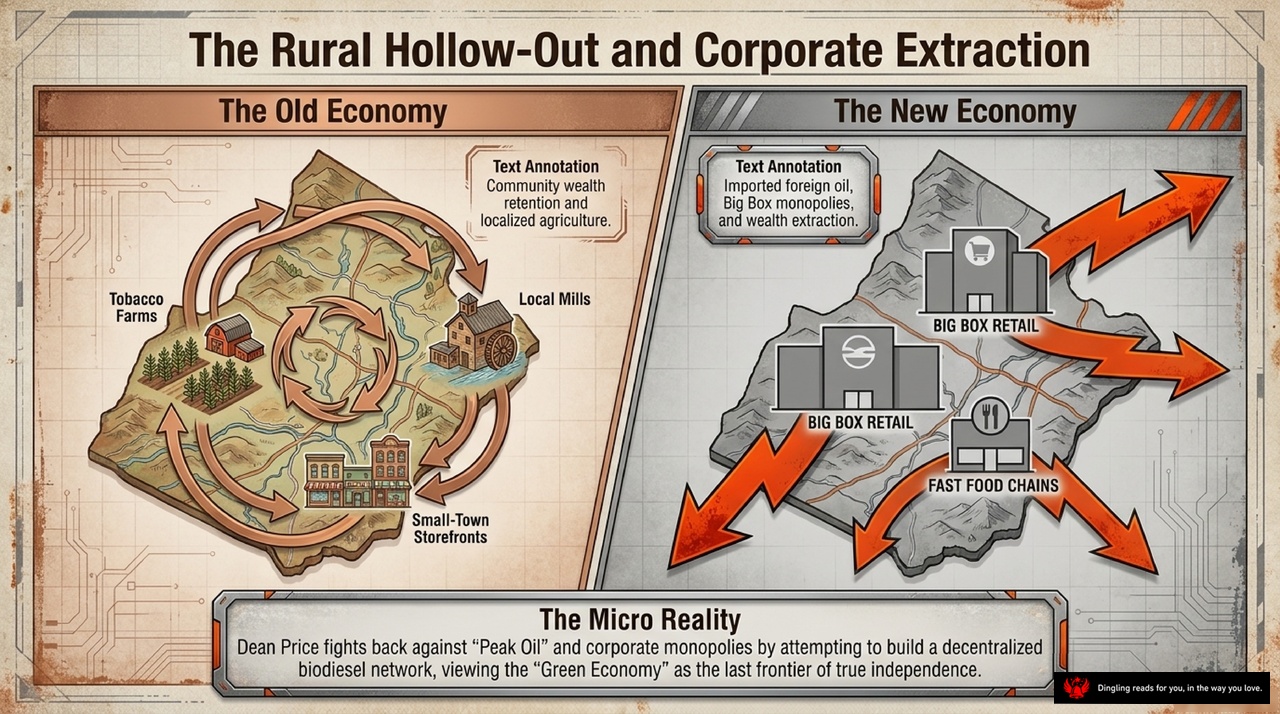
The slide we see here perfectly captures the central tension of our story: the shift from a self-sustaining local economy to one designed for extraction. On the left, under "The Old Economy," we see a closed loop. Tobacco farms, local mills, and small-town storefronts were all connected. Wealth generated on the farm stayed in the town, and the town supported the farm. It was a community where money circulated locally, creating resilience.
But look at the stark contrast on the right: "The New Economy." The arrows point outward, away from the community. We see big-box retailers and fast-food chains replacing local businesses. These aren't just stores; they are engines of wealth extraction. As the text notes, this era brought imported foreign oil and corporate monopolies. Money earned in these rural towns doesn't stay there; it flows out to distant headquarters, foreign oil companies, and corporate shareholders.
This structural shift created what we call the "rural hollow-out." The community lost its ability to retain wealth. Instead of building up, these areas began to drain. This is the reality Dean Price fought against. He saw that in a system designed for extraction, independence was impossible. That's why he looked to the "Green Economy" and the "Peak Oil" theory not just as environmental choices, but as a desperate strategy for survival. By building a decentralized biodiesel network, Dean Price was trying to reverse those outward arrows, creating a new loop where energy and wealth could finally stay home again.

Technological Stagnation and Elite Secession. This slide captures the defining paradox of the last fifty years: a massive divergence between our digital dreams and our physical reality.
Look at the orange line labeled "Bits." Since 1973, software, the internet, and financialization have exploded upward. We live in a world of infinite connection and virtual wealth. But look at the gray line labeled "Atoms." Manufacturing, energy, wages, and our physical infrastructure have been in a slow, relentless decline. This is the "Innovation Divergence." While our screens get smarter, our streets, our factories, and our paychecks get poorer.
This isn't just an economic chart; it's a story of systemic failure. The text on the right explains that true physical progress stalled in the 1970s, replaced by what the author calls "virtual escapism." Meanwhile, the Silicon Valley elite, convinced that the American system is broken, have chosen to secede. Instead of repairing the national fabric, they redirected their vast wealth toward libertarian enclaves, leaving the rest of us to deal with the crumbling infrastructure.
We are living in a world where the elite have built a new, perfect reality in the cloud, while the rest of us are stuck in a dying physical world. That gap is the source of our current crisis.

Welcome back to the dossier. We are now looking at the three false idols that defined the American landscape from the late 70s through the 2010s. On the screen, you see three files: The Partisan, The Financier, and The Consumers. These aren't just names; they represent the forces that hijacked our national narrative.
First, let's look at Newt Gingrich, labeled here as "The Partisan." The text describes him as the architect of "weaponized politics." He didn't just change the rules of Washington; he turned governance into a perpetual, bloodless war. By attacking the Democratic establishment as a "corrupt left-wing machine," he successfully mobilized a base that thrived on outrage rather than compromise. He taught a generation of politicians that the goal wasn't to govern, but to win a culture war, effectively paralyzing the institution of Congress with gridlock and polarization.
Next is Robert Rubin, "The Financier." His file notes that he erased the boundary between Washington policy and Wall Street greed. Rubin was the ultimate insider who believed that deregulation was the key to prosperity. From advising Clinton to lead the Treasury, to later heading Citigroup, he championed the abolition of the Glass-Steagall Act and the expansion of complex financial derivatives. His philosophy was that if you remove the rules, the market will self-correct. Tragically, his vision unleashed unchecked speculative banking, directly paving the way for the 2008 crash. He showed us that when finance is untethered from reality, the entire system becomes a house of cards.
Finally, we have Oprah Winfrey and Sam Walton, grouped together as "The Consumers." This file argues that they replaced civic engagement with hyper-individualism and relentless consumerism. Oprah became the ultimate symbol of the idea that anyone can succeed if they just believe hard enough, turning personal branding into a cure for societal decay. Meanwhile, Sam Walton built an empire on the "Everyday Low Price" model. While he lowered costs for shoppers, his strategy systematically destroyed local small businesses, union jobs, and community stability. He taught us that value is defined by price, not by the quality of our neighbors or the health of our towns.
Together, these three figures created a feedback loop. The Partisan sold us anger, The Financier sold us the illusion of infinite growth, and The Consumers sold us the promise that if we just buy the right things and believe the right slogans, we could escape our reality. They are the false idols of the new era, and understanding their legacy is the first step to breaking free from it.

Imagine a nation where the American Dream isn't a shared ladder, but four diverging paths leading nowhere. This slide maps the tragic reality of modern America: regardless of your class, the defining trait is institutional abandonment. Every citizen is forced into a private war for survival.
Look at Tammy, the worker. Her old promise was a union factory job, but she faced capital flight and decay. Her new survival strategy? Grassroots community organizing. Then there's Jeff, the insider. He once believed in noble public service, only to face lobbyist capture. His only escape? Whistleblowing and institutional exit.
For Dean, the entrepreneur, the dream of traditional farming was crushed by big-box monopolies. His answer? Decentralized green energy. And finally, Peter, the elite. He hoped for national innovation but hit technological stagnation. His strategy? Radical libertarian secession.
Notice the pattern? From the factory floor to the boardroom, the system has failed everyone. The old structures have dissolved, leaving no safety net. Whether you're a worker, an insider, an entrepreneur, or an elite, the message is the same: the government has left you behind, and now, you must fight alone to survive.

Look at this aerial view of Tampa in 2008. What you're seeing here is the "ultimate rupture"—the moment the American dream in the Sun Belt finally collapsed. The image tells a brutal story: half-built frames, overgrown lawns, empty driveways, and bank-owned foreclosures scattered across a neighborhood that was supposed to be thriving.
This wasn't just a local failure; it was the end of an era. For decades, the Sun Belt's growth machine relied entirely on the illusion of endless expansion, fueled by subprime mortgages. Developers and banks convinced everyone that wealth was guaranteed simply by buying a home in a new subdivision. But when the credit bubble burst, the music stopped instantly.
The consequences were devastatingly unequal. Decades of middle-class wealth were wiped out in a single year for those at the bottom—families like the one in the photo, left with nothing but debt and empty houses. Meanwhile, the financial institutions at the top were bailed out with taxpayer money, while ordinary Americans faced foreclosure and ruin. This was the moment the growth myth shattered, leaving behind a landscape of broken promises and stark inequality.

Look at this split screen. On the left, we see Occupy Wall Street, a movement targeting a rigged financial elite, with crowds holding signs like "We are the 99%" and "End Corporate Greed." On the right, we see the Tea Party, focusing its anger on a corrupt government elite, rallying behind flags and signs demanding "Stop Spending" and "Taxed Enough Already."
At first glance, these movements seem like opposites. One wants more regulation; the other wants less. But as we see in the center, the shared insight is profound: despite these deep ideological differences, both movements stem from the exact same root cause—a profound anger at a system that no longer serves or protects the people.
Think about the context of that time. In 2008, the financial crisis hit, and then came the stimulus package. But for many ordinary Americans, the result was a crushing sense of unfairness. They watched Wall Street bankers receive massive bailouts while they faced unemployment and foreclosures. The Occupy movement gave voice to this resentment, shouting that the system was rigged for the top 1%. Meanwhile, the Tea Party channeled the same frustration into a demand for fiscal discipline, arguing that the government had become too big, too corrupt, and too out of touch with the real economy.
Both sides were essentially saying the same thing: the old rules are broken. Whether it's the financial sector or the political establishment, the people felt abandoned by the very system that was supposed to protect them. This fracture wasn't just about policy; it was a fundamental loss of trust. It was the moment when the American narrative of upward mobility and shared prosperity shattered, leaving behind a nation deeply divided, yet united by a common, burning rage against the status quo.

Imagine a society where the very ground beneath us has crumbled, leaving only three massive, cracked pillars holding up a world that no longer feels like home. This is the "Unwound Society," and we are standing at the edge of its collapse. Look at these three pillars: Hyper-Individualism, the Financialization of Everything, and the Cult of Celebrity.
First, consider Hyper-Individualism. The safety net is gone. The era of pensions, unions, and community support is permanently over. As the text reminds us, you are entirely on your own. Think about Tammy in Youngstown, Ohio, or Dean Price in North Carolina. They aren't just facing personal failures; they are witnessing the total erosion of the structures that once held their communities together. When the steel mills close and tobacco farms go bankrupt, there is no collective hand to catch them. The free market doesn't care about your struggle; it only cares about the next transaction.
Next, we see the Financialization of Everything. The economy has stopped rewarding the creation of real things—like the cars, houses, or food we actually need—and instead, it rewards the movement of money itself. Look at Dean's dream to create energy independence with biodiesel, only to be crushed by a financial crisis he couldn't control. Or consider the people in Tampa whose homes were swallowed by a housing bubble fueled not by needs, but by speculation. When the economy rewards debt over manufacturing, and when wealth concentrates in the hands of a few while the rest of us chase assets that keep rising, the system becomes a game rigged against everyone except the winners.
Finally, there is the Cult of Celebrity. In this fractured, deeply unequal world, what holds us together? It's not shared values or a common future. It's media spectacle and fame. Oprah Winfrey became a symbol of individual triumph, proving that anyone can rise if they just hustle hard enough. Jay-Z turned his street trauma into a billion-dollar brand, redefining success as a personal journey away from the system. But this creates a dangerous illusion. It tells us that if you aren't famous or wealthy, you've failed. It distracts us from the systemic rot while we worship icons who seem to have escaped it all.
These three forces—radical isolation, an economy obsessed with capital over goods, and a culture fixated on fame—have dismantled the American promise. We are left with a society that is technically free, yet profoundly alone, watching our shared reality dissolve into a series of individual tragedies.

Look at this tangled web of wires. It's a powerful visual for what's happening to America today: we are left navigating an increasingly fragmented, unequal, and lonely landscape. The institutions that once held us together are gone, forcing us to write our own stories of salvation from scratch in the void they left behind.
But this isn't just about economics. As the slide suggests, "The Unwinding" is not merely a macroeconomic shift; it is a profound psychological transformation. For decades, Americans relied on shared structures—factories, unions, a safety net—that gave us a collective identity and a guaranteed floor. Now, that floor has vanished.
Think about Dean Price, who watched his family's tobacco empire crumble as global markets shifted. Or Tammy Thomas in Youngstown, who saw her factory close and her community fracture into isolation. Or even Peter Thiel, who felt the old systems were too slow, pushing him to build his own world from the ground up.
We have lost the safety net, and now we are alone. The question is: in this void, will we find a way to rebuild something better, or will we just drift apart?

The image captures a hauntingly lonely figure walking down a cracked, desolate road under a stormy sky—a perfect visual metaphor for the American condition today. The text on the slide asks a profound question: "If the institutions that once bound us together are gone forever, what will we choose to build in the void?"
This isn't just a rhetorical question; it's the reality millions of Americans are facing right now. We are living in a fractured landscape where the "Roosevelt Republic" has been dismantled, leaving organized money to dictate power while individuals are forced to navigate the ruins of the American dream entirely alone.
Think about the last few decades. The safety nets that once held us—strong unions, stable middle-class wages, reliable public institutions—have eroded. Instead of a society where everyone plays by the same rules, we now see a world where wealth concentrates at the top, and the rest of us are left to fend for ourselves.
Look at the stories we've explored. Take Dean Price, for instance. He grew up in a tobacco farm, believing in hard work and family stability. But when the market crashed, the subsidies ended, and his father's addiction took over, Dean was thrown into a void. He had to reinvent himself from scratch, moving from the North back to his Southern roots, fighting to find a new economic model that actually worked for his community.
Then there's Tammy Thomas in Youngstown, Ohio. Once a proud union worker in a thriving steel town, she watched her factory close, her community decay, and her husband die. She didn't just accept it; she became an organizer, turning her personal tragedy into a movement to rebuild her city. She realized that when the system fails, you don't wait for a savior—you build the solution yourself.
And consider the tech giants like Peter Thiel. He represents a different kind of "void-filling." Instead of rebuilding for the many, he's building for the few, using technology and capital to create a world where the ultra-wealthy thrive while the rest of us are left behind in a digital, disconnected reality.
So, what does the future look like? Will we choose to rebuild a society based on shared prosperity, community, and fair rules? Or will we let the powerful continue to carve out their own paradise while the rest of us struggle in the ashes?
The road ahead is cracked and uncertain, just like the one in the image. But the path we take depends entirely on the choices we make today. Will we remain passive victims of the status quo, or will we rise up and build something better, something that truly belongs to all of us?