
The Vital Question: Complete Chapter-by-Chapter Summary

Welcome to *The Vital Questions* by Nick Lane. Today, we dive into the deepest mystery of biology: why life on Earth looks the way it does. For billions of years, life remained simple, trapped in a bacterial form. Then, in a single, sudden leap, complex life—plants, animals, fungi—exploded from one unique ancestor. This event has never happened again. We still don't know why.
This book explores the energy, evolution, and origins of complex life. We will uncover how a simple proton gradient at a deep-sea vent might have built the first cell, how a rare merger with a bacterium created the mitochondria, and why this energy breakthrough allowed us to become who we are. It is a story of how energy constraints shaped the very blueprint of life, and how that same logic might apply to life elsewhere in the universe. Let's begin our journey into the vital questions.
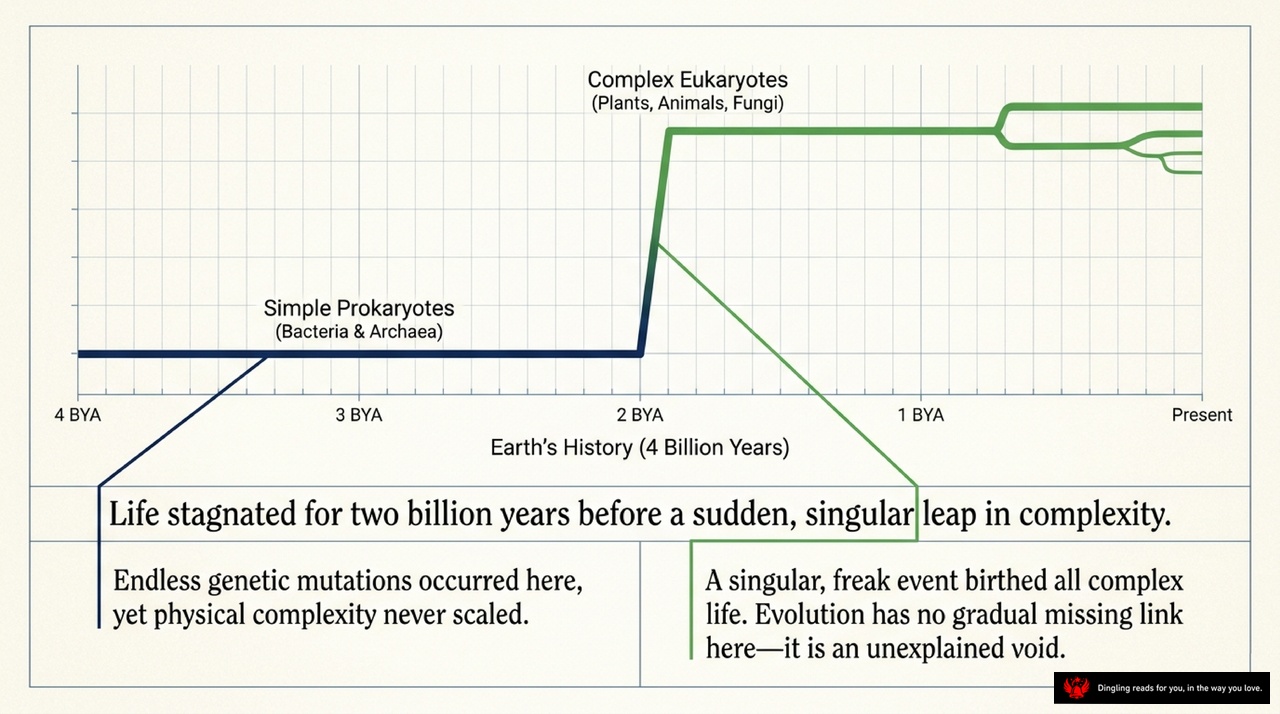
Life didn't just start; it got stuck. For the first two billion years of Earth's history, life remained frozen in a simple state. As this chart shows, Simple Prokaryotes—bacteria and archaea—dominated the planet from 4 billion years ago right up until about 2 billion years ago. Despite endless genetic mutations and a changing environment, physical complexity never scaled. They were trapped.
Then, suddenly, everything changed. Around 2 billion years ago, life took a singular, freak leap. In an instant, the evolutionary trajectory shot upward from simple prokaryotes to Complex Eukaryotes—plants, animals, and fungi. This wasn't a gradual climb with missing links; it was an unexplained void. A single, rare event birthed all complex life. Before this moment, evolution had no path forward. After this moment, the explosion of complexity began. This sudden jump remains one of biology's biggest mysteries, marking the moment life finally broke free from its ancient constraints.

Imagine the classic view of life as a computer: DNA is the code, and biology is just about reading that software. But what if the code is useless without electricity? The slide you see right now captures this exact paradox. On the left, we have a broken DNA helix labeled "Information," and on the right, disconnected power plugs labeled "Power." The text above them makes a bold claim: genetic information without an adequate power supply cannot build complex life.
This is the crux of the evolutionary void that has puzzled scientists for decades. We know bacteria mutate endlessly, sharing massive genetic diversity across populations. They have infinite coding potential. Yet, despite this, they never evolved complex, multi-cellular structures. The traditional "DNA-first" view fails here because it ignores the energy engine. It's like having the most advanced blueprint for a skyscraper but no power to run the construction equipment.
To truly understand life, we must look beyond the code. We must look at the power supply. The slide concludes with this vital insight: "To understand life, we must look beyond the code. We must look at the power supply." This shift in perspective suggests that the barrier to complex life isn't a lack of genetic instructions, but a fundamental limit in how efficiently early cells could capture and use energy. Without solving this energy puzzle, the gap between simple bacteria and complex organisms remains unbridgeable.

All life on Earth runs on a counter-intuitive electrical mechanism: the proton gradient. As this diagram illustrates, Peter Mitchell's Chemiosmotic Theory reveals that cells operate exactly like hydroelectric dams. On the left, you see the classic analogy: water flows from a high-pressure reservoir through a channel, spinning a turbine to generate electricity. On the right, biology mirrors this perfectly. Protons (H+) are pumped across the cellular membrane, creating a high concentration on one side. Just like water falling through a dam, these protons rush back through a specific proton channel. This flow spins the ATP synthase, which acts as the biological turbine. As the rotor turns, it converts ADP and inorganic phosphate into ATP, the universal energy currency of life. This elegant coupling of a proton gradient to ATP generation is the fundamental engine driving every living thing, from the simplest bacteria to the most complex organisms.

Look at this cross-section of a hydrothermal vent micropore. On the left, you see the warm, alkaline hydrothermal fluid with a high pH, while on the right lies the acidic, iron-rich ocean water, packed with hydrogen ions. The key here is what happens right at the interface: porous rocks naturally mix these two opposing environments. This continuous mixing creates a natural, geological proton gradient across thin iron-sulfur walls, establishing a massive difference in hydrogen ion concentration. Notice how life did not invent this proton gradient; biology emerged from an energetic system already established by geology. This primordial battery, forged in these deep-sea micropores, provided the very first spark of energy that allowed early life to harness the flow of protons, driving the synthesis of ATP and setting the stage for the complex evolutionary journey we see today.

Prokaryotes are trapped in a microscopic straightjacket by their surface area-to-volume ratio. As we dive deeper into the energy constraints that have shaped life for billions of years, imagine a bacterium trying to grow larger. When it expands, its volume—and thus its energy demand—grows exponentially, but its surface area, where it generates power, only increases linearly. This mismatch creates a fatal bottleneck. If a bacterium scaled up to the size of a complex cell, it would instantly suffocate from an energy deficit. The math simply doesn't allow it.
This is why prokaryotes have remained small and simple for over four billion years. Their strategy isn't a lack of potential; it's a perfect adaptation to this physical limit. By staying small, they maintain a high surface-area-to-volume ratio, ensuring every gene has enough energy to function. They can replicate rapidly and adapt through horizontal gene transfer, but they hit a hard ceiling when it comes to complexity.
In contrast, eukaryotes broke this straitjacket through a rare, singular event: endosymbiosis. By engulfing a bacterium that became the mitochondrion, our ancestors gained a massive internal energy supply. This liberated them from the size constraint, allowing for a genome explosion and the birth of complex life. While bacteria are masters of efficiency in their tiny form, eukaryotes leveraged that extra energy to build intricate structures, multicellular bodies, and diverse ecosystems. So, the next time you see a microscopic organism, remember: its size isn't just biology; it's a hard-wired limit imposed by the physics of energy.
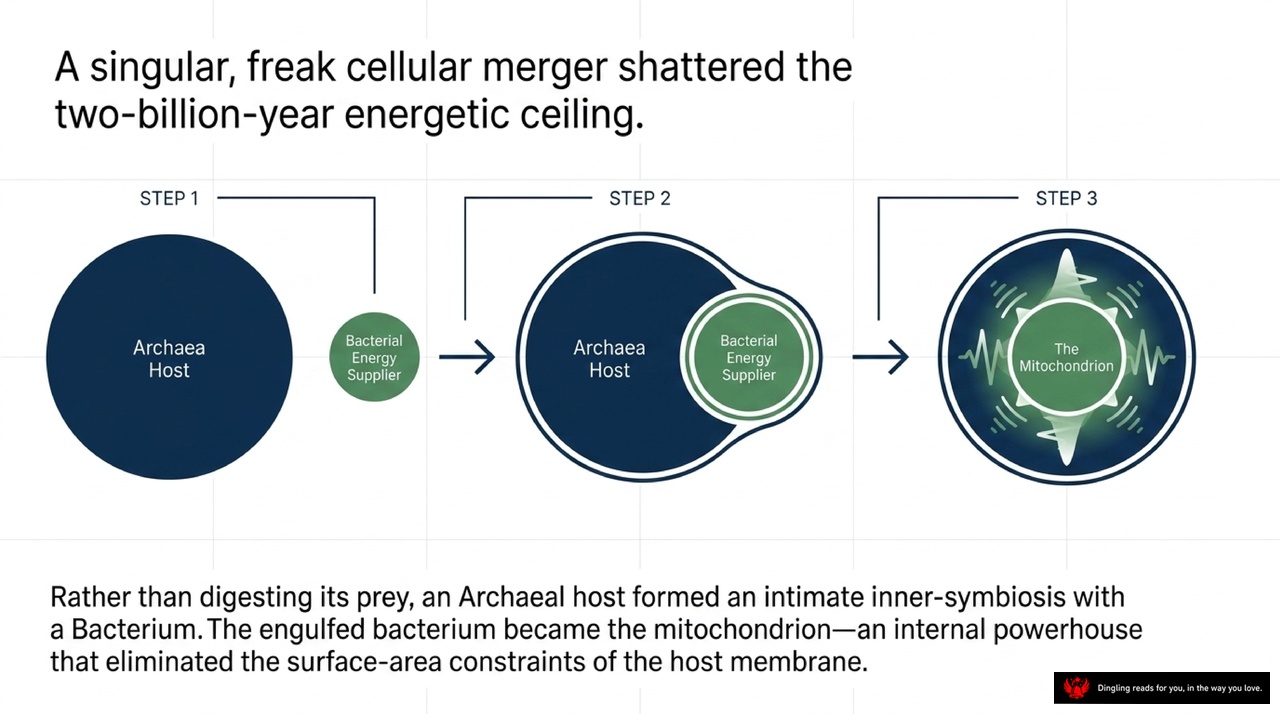
Imagine a singular, freak cellular merger that shattered the two-billion-year energetic ceiling. As we've seen, for billions of years, life was stuck in a simple state. Bacteria and Archaea could adapt and thrive, but they hit a hard wall: they couldn't build complex genomes because their energy budget just wasn't big enough. The surface-area-to-volume ratio simply limited how much power a single cell could generate.
But then, something extraordinary happened. Instead of digesting its prey, an Archaeal host formed an intimate inner-symbiosis with a Bacterium. This engulfed bacterium didn't die; it transformed into the mitochondrion—an internal powerhouse that eliminated the surface-area constraints of the host membrane.
This is the moment life broke free. By acquiring this "battery," the host cell could generate vastly more energy, allowing it to support a massive genome and complex structures. This single event gave rise to all complex life—plants, animals, fungi, and us. It wasn't just a lucky accident; it was the inevitable result of energy constraints pushing evolution toward a specific solution. The mitochondrion didn't just provide power; it unlocked the entire future of complexity.
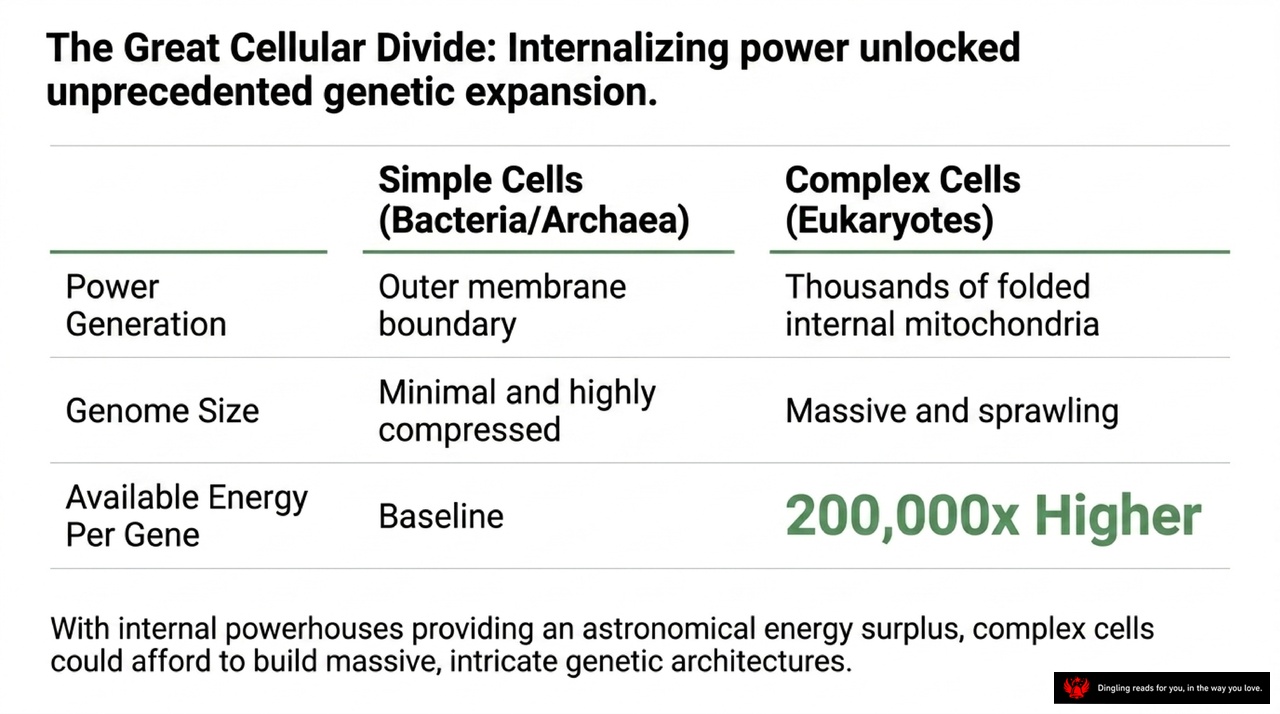
Imagine a world where the simplest cell, a bacterium, is trapped by a strict energy budget. It has a small genome, but every single gene demands a massive share of its limited power just to stay alive. Now, picture a completely different cell: a eukaryote. Thanks to an ancient merger with a bacteria that became our mitochondria, this cell possesses an internal powerhouse generating 200,000 times more energy per gene than its simple cousin. This isn't just a slight upgrade; it's a revolution.
As the slide illustrates, this "Great Cellular Divide" changed everything. While simple cells rely on a basic outer membrane for power, complex cells utilize thousands of folded internal mitochondria. This astronomical surplus of energy solved a fundamental bottleneck. Suddenly, the cell could afford to carry a massive, sprawling genome. It could build intricate genetic architectures, develop complex internal structures, and evolve features like sexual reproduction and programmed cell death—traits that were simply too expensive for simple cells to support.
This energy breakthrough unlocked unprecedented genetic expansion. It explains why complex life appeared only once in history: it required that specific, singular event of endosymbiosis to cross the energy threshold. Without this internal powerhouse, life would have remained stuck in the simple, compressed state of bacteria for billions more years. By internalizing power, life finally gained the freedom to become as diverse and complex as we see today.
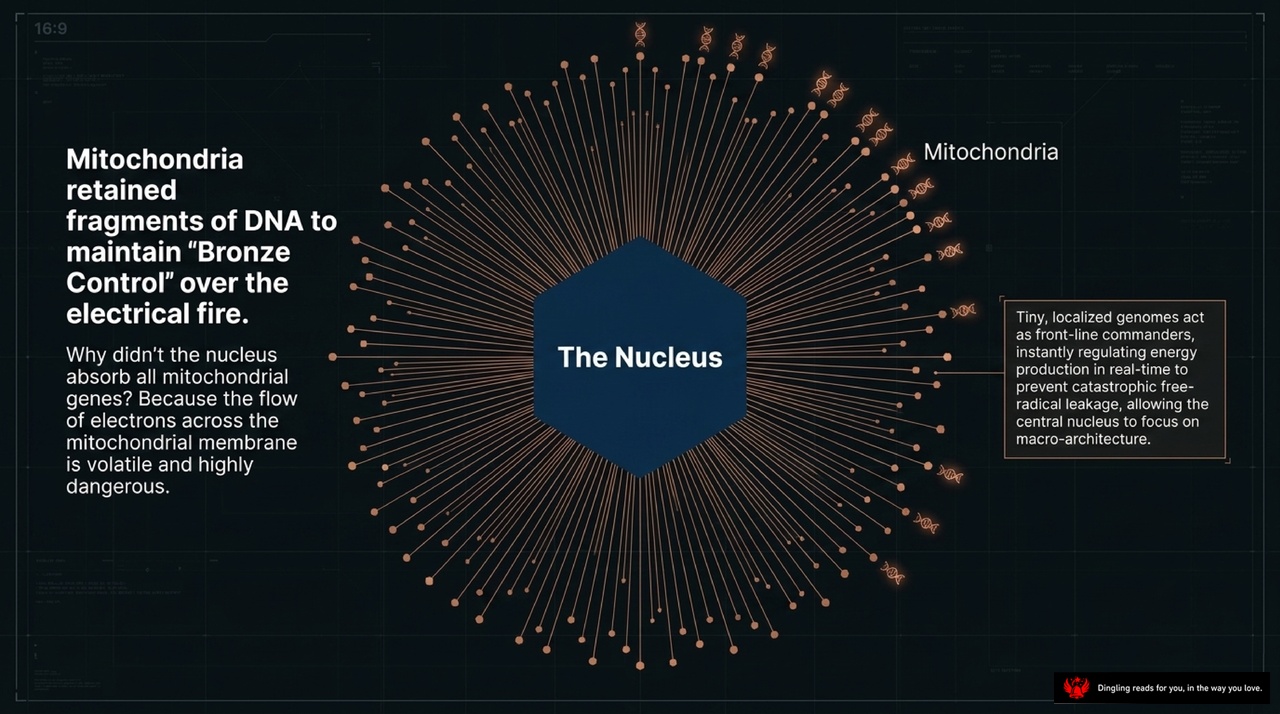
Look at this diagram. It illustrates a fascinating biological standoff: The Nucleus sits at the center, while the Mitochondria act as a ring of specialized generals surrounding it. The text explains why the Nucleus never absorbed all the mitochondrial genes. It's because the flow of electrons across the mitochondrial membrane is volatile and highly dangerous.
Think of the Mitochondria as retaining fragments of their own DNA to maintain what the slide calls "Bronze Control" over this electrical fire. If the central command took over everything, it would lose the ability to react instantly to these dangerous fluctuations. Instead, these tiny, localized genomes act as front-line commanders. They instantly regulate energy production in real-time, preventing catastrophic free-radical leakage. This allows the central nucleus to focus on macro-architecture rather than micromanaging every spark. It's a brilliant division of labor that keeps the entire cell stable.
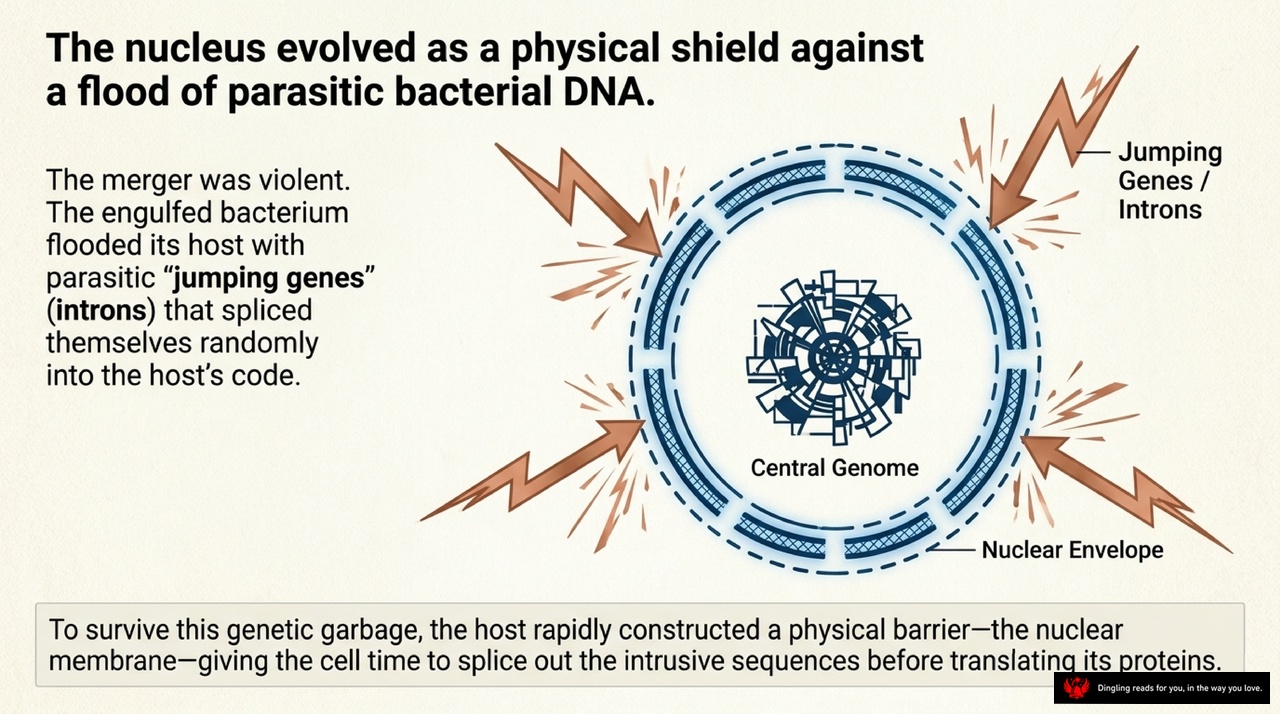
Imagine the nucleus not as a command center, but as a desperate shield. About two billion years ago, life underwent a violent merger. A host cell engulfed a bacterium, but instead of digesting it, they formed a partnership. This was the birth of the eukaryotic cell. But this union came with a terrifying cost: the engulfed bacterium flooded the host's genetic code with parasitic "jumping genes," known as introns. These rogue sequences scrambled randomly into the host's DNA, threatening to corrupt its vital instructions.
To survive this genetic garbage, the host rapidly constructed a physical barrier—the nuclear envelope. This membrane acts as a filter, giving the cell crucial time to splice out these intrusive sequences before translating proteins. Without this shield, the chaotic influx of jumping genes would have destroyed the cell's ability to function. Today, that ancient defense still protects us, allowing our complex genomes to remain stable while harnessing the power of the mitochondria inside.
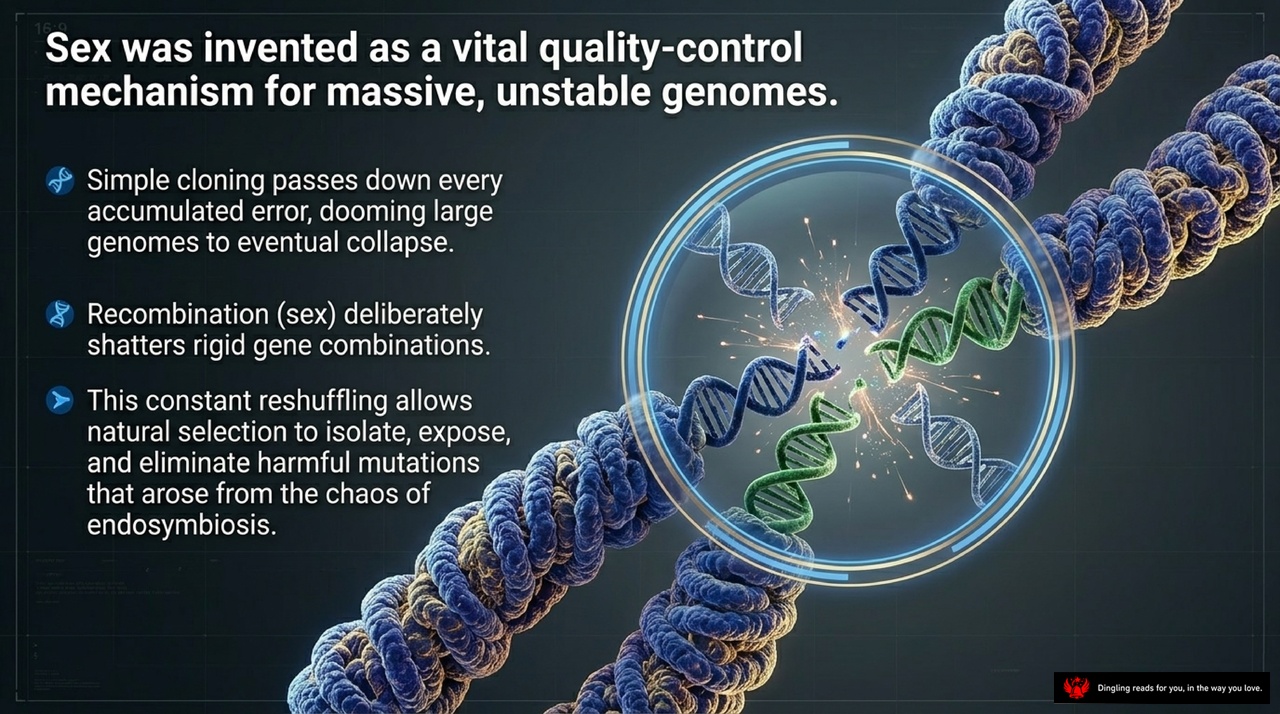
So, why did sex even evolve? It wasn't just about making babies; it was a desperate survival strategy for massive, unstable genomes. As the slide illustrates, simple cloning is a death sentence for large genomes because it blindly passes down every single accumulated error, eventually leading to total collapse. That's where recombination—sex—comes in. It deliberately shatters rigid gene combinations, constantly reshuffling the deck. This chaos allows natural selection to isolate, expose, and eliminate harmful mutations that arise from the complexity of endosymbiosis. Without this constant reshuffling, life as we know it would have suffocated under its own genetic baggage. Sex is essentially a vital quality-control mechanism, ensuring that our massive genetic libraries don't just accumulate errors, but actually get cleaned up and optimized for survival.

Imagine your body as a high-powered engine running at full capacity. Just like any powerful machine, this cellular engine generates immense energy, but that power comes with a price. As the infographic shows, aging and death are the inescapable costs of running such a complex system.
Let's look at how life splits into two distinct paths. On one side, we have the germline—your sperm and eggs. These are shielded and immortal, designed to pass on the blueprints for life forever. On the other side lies the somatic body, the disposable vessel you live in. This body is built to run that high-powered engine, but it inevitably degrades over time.
Why does this happen? It all comes down to the mitochondria, the tiny power plants inside your cells. As they work tirelessly to produce energy, they inevitably leak highly reactive electrons, known as free radicals. These rogue particles degrade the cell from the inside out, slowly wearing down the very machinery that keeps you alive.
This leads to a profound synthesis: complex life makes a radical trade-off. We sacrifice an eternal, simple existence for a high-powered, highly structured reality. By permanently separating our immortal reproductive instructions from our disposable, mortal bodies, we gain the ability to build complex structures and think deeply, but we accept that our physical form must eventually fail. This is the fundamental cost of being alive.
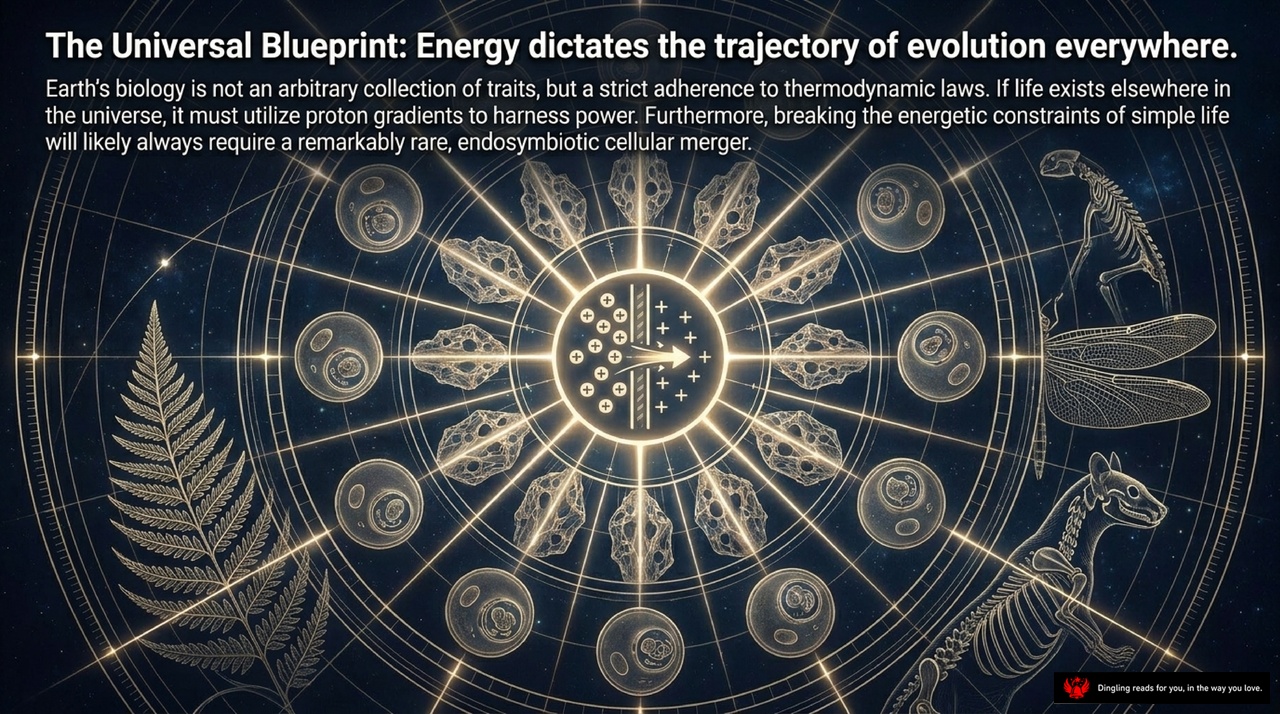
The Universal Blueprint: Energy dictates the trajectory of evolution everywhere. Look at this diagram; it illustrates a profound truth: Earth's biology isn't just a random collection of traits, but a strict adherence to thermodynamic laws. If life exists elsewhere in the universe, it must utilize proton gradients to harness power. Furthermore, breaking the energetic constraints of simple life will likely always require a remarkably rare, endosymbiotic cellular merger.
Consider the center of this image: the proton gradient. For billions of years, bacteria and archaea were trapped by an invisible energy ceiling. Their small size limited their surface area, making it impossible to generate enough energy to support a complex genome. They were stuck in a simple, stable loop. But then, about two billion years ago, a rare event changed everything. An ancient archaeal host engulfed a bacterium, which became the mitochondrion. This merger didn't just add a new organelle; it unlocked a massive surge in energy production. Suddenly, the cell had enough power to build a complex genome, develop a nucleus, and evolve sexual reproduction. This single event broke the barrier, allowing life to explode in complexity. Without this endosymbiotic merger, we would never have had plants, animals, or fungi. The blueprint is clear: energy constraints shaped our history, and that same logic will likely guide the evolution of life across the cosmos.

Complex life isn't a given; it is the extraordinary consequence of a singular energetic merger that shattered a two-billion-year evolutionary ceiling, trading immortality for the power to evolve.
Look at the image behind us. We see the intricate, glowing network of neurons and mitochondria—the very machinery that made us possible. But ask yourself: if the blueprint of our existence is dictated by the rigid laws of energy, are we truly a cosmic accident, or an inevitable spark waiting in the dark?
For two billion years, life on Earth was stuck. Bacteria and archaea dominated, trapped in a simple form they couldn't escape. They had all the time in the world, yet they couldn't break through the energy barrier that limited their size and complexity. Why? Because without a breakthrough, the energy available to each gene simply wasn't enough to support a larger, more complex body.
Then, about two billion years ago, something miraculous happened. A single event changed everything. An ancient archaeal host engulfed a bacterium, and instead of digesting it, they formed a partnership. That bacterium became the mitochondrion. This was the "energetic merger" the slide refers to.
Suddenly, the cell gained a massive, portable power plant. For the first time, a single cell could generate enough energy to support a genome thousands of times larger than a bacterium's. This energy surplus unlocked the door to complexity. It allowed for the evolution of a nucleus, intricate internal structures, and eventually, multicellular life.
This event was so unique that it happened only once. All plants, animals, fungi, and humans trace back to this single ancestor. That is why we share such unique traits—like sexual reproduction and programmed cell death—that bacteria never developed. We are not just a random collection of atoms; we are the direct result of this one pivotal moment where life traded the safety of immortality for the explosive potential of evolution.
So, when we look at the stars, we aren't just searching for another Earth. We are searching for the conditions that allow this specific energetic breakthrough to happen. Are we a fluke, or is this the inevitable next step for any life that finds a way to harness energy efficiently? The answer lies in understanding that we are the spark that lit up the universe, waiting to be seen.