
The Wager: Complete Chapter-by-Chapter Summary

Welcome to "The Wager," a gripping true tale by David Grann that explores the fragile line between civilization and savagery. Imagine a massive wooden ship battling against a colossal, terrifying wave, drowning in a dark, stormy night. This isn't just a story about shipwreck and mutiny; it's a profound look at how quickly order can collapse into chaos when pushed to the edge. As the subtitle suggests, we are witnessing a battle for survival where the very definition of humanity is tested. Join us as we dive into this unforgettable journey of desperation, courage, and the relentless power of the sea.
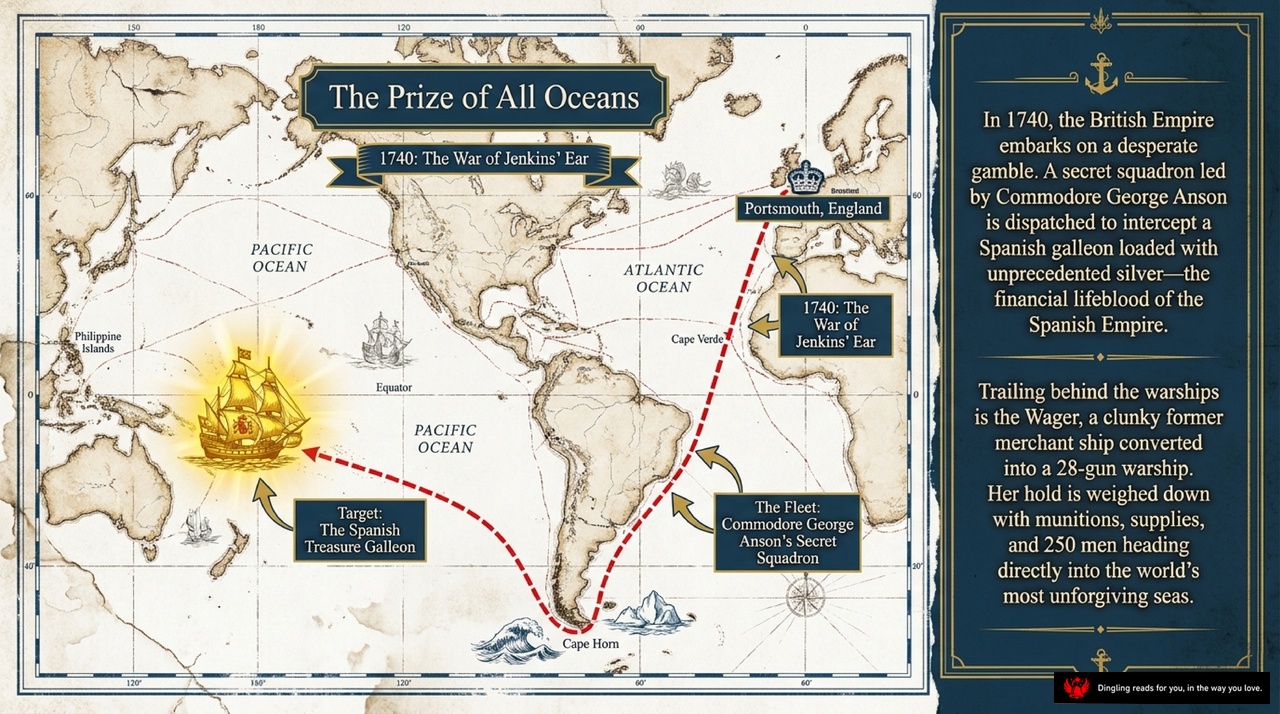
In 1740, the British Empire made a desperate gamble, sending a secret squadron led by Commodore George Anson to intercept a Spanish galleon loaded with unprecedented silver—the very financial lifeblood of the Spanish Empire. Trailing behind these warships was the *Wager*, a clunky former merchant ship converted into a 28-gun warship. Her hold was weighed down with munitions, supplies, and 250 men heading directly into the world's most unforgiving seas. The target was clear: the Spanish Treasure Galleon, waiting to be seized in the vast Pacific. But the journey ahead would test every soul on board, turning a mission for glory into a harrowing fight for survival against nature and each other.

Welcome back. Today, we're diving into the grim reality of life aboard an 18th-century warship. Look at this cross-section of a British frigate. It looks like a floating castle, impressive and powerful, but as the text warns, it's also a wooden prison.
On the left, we see the sheer scale of this wooden world. These ships were giants, stretching up to 144 feet long and built from thousands of massive oak trees. They were lethal machines, packed with 28 to 60 heavy cannons layered across multiple decks, ready to dominate the seas. But they operated under absolute law, governed by a rigid, unquestionable hierarchy where disobedience could mean death.
However, the right side of our image reveals the terrifying truth hidden beneath that imposing surface. This wasn't just a machine of war; it was a biological nightmare. From the inside out, the ship's hull was secretly being devoured by shipworms, causing structural decay that no one could see until it was too late. Below deck, over 250 men were crammed together in squalor, enduring typhus, scurvy, and rampant rat infestations.
Ultimately, the ship was a microcosm of society held together not by physical strength, but entirely by the threat of the lash and the illusion of invincibility. It was a place where men fought for their lives against the ocean, the rot, and each other.

Three men. Three very different souls, all running from their pasts, yet destined to collide on the same ship. Look at Captain David Cheap. He's a dogmatist, a Scottish nobleman desperate to escape crushing debt. He doesn't just want to survive; he craves glory, wealth, and a permanent command. His leadership style is rigid, believing in absolute, unwavering authority. To him, naval law is infallible, a shield against his failures on land.
Then there is Gunner John Bulkeley. He is the pragmatist. A highly skilled, experienced seaman who is fiercely protective of his crew, but his loyalty is to physical survival over rigid imperial protocol. He is pragmatic and ruthless, willing to do whatever it takes to keep men alive, even if it means breaking the rules.
And finally, Midshipman John Byron. The dreamer. At just 17, he is an aristocratic youth seeking adventure, hoping the sea will be a romantic escape from his structured life. But his leadership style is observant yet untested. His romantic views of the sea are about to be violently shattered.
These three—the man who needs to control everything, the man who will do anything to live, and the boy who just wants to see what's out there—form the fragile triangle that will define their fate.

Nature didn't just challenge the *Wager*; it systematically dismantled it. As the slide illustrates, the ship's journey became a relentless downward spiral of destruction. First came the Scurvy Outbreak, a silent killer where old wounds inexplicably reopened and bodies literally fell apart. Then, the Wrath of Cape Horn hit with hurricane-force winds and monstrous 100-foot waves that battered the squadron until it broke. Finally, the Separation occurred: the *Wager* lost her mizzenmast, became broken and rudderless, and was severed from Commodore Anson's fleet. Pushed relentlessly by rogue currents, the crippled ship drifted helplessly toward the unforgiving, uncharted rocks of Patagonia. By that point, the men were no longer fighting the Spanish; they were fighting for their final breaths against an ocean that had decided to erase them entirely.

The reality of the Wager's crew didn't just end; it shattered into pieces. Welcome to Wager Island, where the ship is dead and the law is drowning.
On May 14, 1741, at 4:30 AM, the Wager crashed into submerged rocks off the coast of Patagonia. The physical boundary of naval law was instantly destroyed. As the chaos erupted, the crew split into two factions. While some prayed, others broke into the rum stores and armed themselves with cutlasses, refusing all orders. Mutineers took over the sinking wreck, while 145 starving, freezing men managed to escape to a desolate, barren rock.
This was the "Split." The order of the British Empire collapsed into a primal struggle for survival. Captain David Chipper tried to maintain authority, but hunger and desperation soon drove his men to mutiny. They abandoned him, leaving him alone on the island while the rest sailed away to find a new life. For Chipper and the few who stayed behind, the world they knew ceased to exist. They were no longer sailors of the Royal Navy; they were castaways in a nightmare where civilization had drowned.

Imagine a world where civilization's rules simply vanish. In the image you see, we trace the terrifying descent of the *Wedge* crew from a structured society into a nightmare of survival. It begins with the "Loss of the Ship." As Captain Cheap notes, the wooden world is gone. Without the physical structure of the warship, the hierarchy instantly evaporates. This vacuum creates the perfect conditions for "Starvation." Foraging yields only bitter celery and seaweed, and a severe caloric deficit drives the men toward madness.
This hunger fuels "Factionalism." Men divide into armed camps, stealing the few remaining rations. Sea lawyers openly debate the validity of their contracts, while others form rebellious groups. The tension eventually snaps, leading to the final, brutal stage: "Murder." Captain Cheap, losing control, shoots a mutinous crewman point-blank in the face. The final thread of civilized order is severed. As Thomas Hobbes famously warned, this is a "war of every man against every man." The story of the *Wedge* proves that without the constraints of society, human nature can quickly turn against itself.

Imagine two distinct paths to survival, forged in the fires of desperation on a remote island. On the left, we see Captain Cheap, representing rigid dogmatism. His worldview is anchored in an eternal belief: naval law is absolute, and he is still a British sailor on a mission, regardless of reality. His plan? A heroic but suicidal northward journey to intercept Spanish ships and complete his original orders. Driven by honor, ego, and a paralyzing fear of a court-martial, he refuses to adapt, leading directly to mutiny.
On the right stands John Bulkeley, the embodiment of pragatism. His belief is starkly different: without pay, their contract is void, and they are free men fighting to live. His plan involves modifying their longboat and sailing south through the deadly Strait of Magellan to reach Portuguese Brazil. His drive isn't about glory, but raw, mathematical survival. This clash of ideologies—honor versus survival, dogma versus pragmatism—culminated in a tragic result. On October 9, Bulkeley and his followers bound Captain Cheap and left him marooned, choosing life over the ghost of a mission that no longer existed.

Defying the Odds. Look at this map of South America; it tells the story of two harrowing journeys born from the same desperate situation. On the left, Route 2: The Captain's Ordeal. Here, we see the fate of Byron, Cheap, and a handful of loyalists left behind on Wager Island. After being captured by the indigenous Kawésqar people, they endured years of slavery, disease, and starvation across the Andes. The toll was devastating, but three emaciated survivors finally reached a Spanish settlement in Chile. Now, look at Route 1: The Mutineers' Voyage. This path was led by Bulkeley, with 80 men crammed into a modified longboat. It was a 3,000-mile, 3.5-month nightmare navigating freezing waters, starvation, and storms. The toll here was even steeper: only about 30 skeletal survivors eventually washed ashore in Brazil. These two routes represent the ultimate human struggle against the odds, where survival depended on every ounce of courage and resilience.

Imagine a scene where the ultimate betrayal happens not with a sword, but with a whisper. After surviving the impossible—waking up on a desolate island, fighting starvation, and enduring the madness of mutiny—David Cheap, our hero, stands alone. He has been abandoned by his own crew, left to die on the rocks of Juan Fernández, while his former comrades sail away to Brazil, carrying the only hope of rescue.
But the story doesn't end there. The true horror lies in what happens next. Five and a half years later, in March 1746, Captain Cheap returns from the dead. He walks back into London, not as a hero who survived the impossible, but as a ghost haunting his own victory. He immediately accuses the men he once trusted—his former heroes—of being treacherous mutineers and murderers.
The image captures this chilling twist perfectly. On one side, we see the initial celebration of survival, where Cheap was hailed as a miracle. On the other, the dark reality of his return, where he transforms into a vengeful specter. The central message is stark: physical survival was only the first test. Now, he faces the Admiralty, where the penalty for mutiny is hanging. The real battle for his life, and the truth of what happened on that island, has just begun.

The battle for the truth has shifted from the high seas to the printed page, entering what we call the Grub Street War. As the slide illustrates, this was a fierce struggle where the survivors realized their lives now depended entirely on shaping a narrative the public would believe.
First, we see Bulkeley's Defense. After being accused of mutiny, he publishes a wildly popular, highly detailed journal framing Captain Cheap as a tyrant and a murderer. This book justifies the mutiny in the eyes of the public, turning the officers into victims and the captain into a villain.
Next is Cheap's Retaliation. Undeterred, he relies on elite naval connections and military affidavits to paint Bulkeley as a treasonous rogue, attempting to reclaim the moral high ground through official channels.
Finally, there is Byron's Romance. The young poet writes his own heavily romanticized account, focusing on the heroism of the captain and the tragedy of the crew, specifically aiming to clear his family's aristocratic name from the stain of rebellion.
Ultimately, the slide captures the core lesson of this era: the survivors realized their lives now depended entirely on shaping a narrative the public would believe. In this new arena, truth became malleable. It was no longer about what happened on the rocks of Desolation Island, but about whose story was told first and loudest. By controlling the narrative, they became the authors of their own salvation.

On April 15, 1746, the British Admiralty convened a court-martial to judge the survivors of the Wager. The scene depicted here captures that tense moment: a formal judicial setting where the fate of men who had endured unimaginable suffering was about to be decided. But this wasn't just a legal proceeding; it was a crisis of conscience for the entire Empire. The court faced a terrifying paradox. On one hand, they could hang the mutineers, but doing so would force the official record to include horrifying details of British officers descending into savagery, cannibalism, and murder. On the other hand, exposing this truth would permanently shatter the myth of British imperial moral superiority. The system simply could not afford to admit that its own men had become the monsters it claimed to fight. So, the verdict was a calculated cover-up. The court sidestepped the mutiny charges entirely. No one was hanged. The darkness was legally swept under the rug to protect the institution. In the end, the law chose to preserve the image of the Empire rather than deliver justice to the men who had survived hell.

While the officers wrote best-selling books to save their necks and cement their legacies, others were permanently silenced. Take John Duck, for instance. He was a free Black sailor who survived the shipwreck and that brutal 3,000-mile voyage with the mutineers. But upon reaching South America, he was kidnapped and sold into slavery. He never returned to England. He never stood trial. He never had the chance to write his story.
This slide drives home a chilling truth: History is curated by those who hold the pen. The rest are erased. While Anson and his officers crafted narratives of heroism and glory, the brutal reality of the mutiny, the suffering of the abandoned, and the specific fates of individuals like John Duck were deliberately scrubbed from the official record. We see the face of the man who survived only to be erased, a stark reminder that the stories we celebrate are often just the ones the powerful chose to tell.
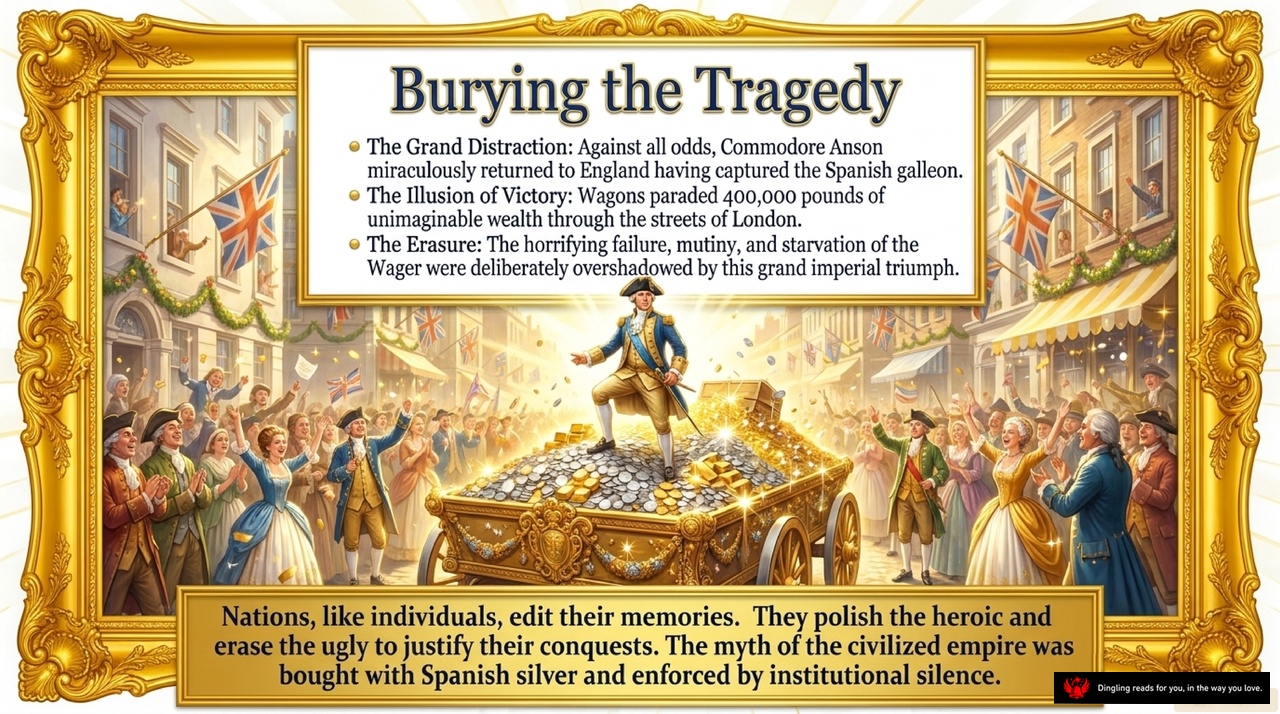
Imagine a parade so grand, it feels like a fairy tale. In 1740, London was drowning in gold. Comodore Anson had miraculously returned from the edge of the world, dragging back a Spanish galleon loaded with unimaginable wealth. As the story goes, 400,000 pounds of silver were paraded through the streets on wagons, while the city cheered. The British flag flew high, and the myth of the civilized empire was born. But here is the dark truth the empire didn't want to see: this triumph was built on a foundation of horror.
While London celebrated, the reality on the ground was a nightmare of mutiny, starvation, and death. The story of the HMS Wager—the horrific failure of a ship that ran aground and was eventually abandoned by its own crew—was deliberately erased. The suffering of the men who starved on that remote island, and the brutal betrayal of their captain, David Chipp, was swallowed by the noise of victory. Nations, much like individuals, edit their memories. They polish the heroic and erase the ugly to justify their conquests. The glory of the empire was bought with Spanish silver, but it was enforced by a silence that refused to let the tragedy speak.
The tragedy of the Wager stripped men of their civilization, revealing the primal chaos beneath the uniforms. Yet, their ultimate survival proved that human beings are fundamentally creatures of narrative, capable of reshaping the truth to escape the gallows and protect the myths of empire. If history is merely the surviving story of those who outlived or outwrote their rivals, how much of the civilization we trust today is built on a foundation of well-told lies?