
The Warren Buffett Portfolio: Complete Chapter-by-Chapter Summary
Welcome to the world of The Warren Buffett Portfolio by Robert G. Hagstrom. Imagine a complex, golden lattice of gears turning in perfect harmony against a deep blue backdrop—this isn't just art; it's a visual representation of how enduring wealth is built. Today, we're diving into the core philosophy that separates the average investor from the legends: the power of the focus investment strategy.
While most of the industry gets lost in a frantic game of diversification, constantly chasing market trends and holding hundreds of stocks to feel safe, Buffett offers a different path. He believes that true wealth comes from mastering a few mental models and concentrating your capital on a small number of outstanding companies. Instead of spreading your bets thin, you aim to find five to ten businesses with long-term competitive advantages and price them right, then go all in.
This approach relies on probability and deep understanding. As the book suggests, if you truly know your business, traditional diversification becomes unnecessary. It's about having the courage to bet big on high-probability events, much like Buffett did with American Express or Coca-Cola. The key isn't just picking winners, but holding them for the long term, ignoring short-term noise, and letting compound interest do its work. By focusing on the economic reality of the companies you own rather than the daily fluctuations of the stock price, you align yourself with the true engine of wealth creation.

Look at this slide comparing three distinct investment philosophies. On the left, we see **Active Management**. This is the traditional image of finance: high turnover, often exceeding 80%, with funds holding over 100 stocks. The goal is to constantly beat the market, but the result, as the slide clearly states, is that they fail to beat the market after costs. The relentless buying and selling just eats away at your returns.
On the far right, we have **Passive Indexing**. This approach relies on extreme diversification and zero active decision-making. While it guarantees you the market average, it effectively eliminates the possibility of outperformance. It's safe, but it leaves money on the table.
Now, look at the golden center. This is **Focus Investing**, or what the slide calls "The Third Way." This isn't about guessing the market; it's about concentrated portfolios, deep knowledge, and low turnover. The result here is the highest statistical probability of outperforming the index.
This middle path rejects the extremes. It argues that traditional diversification is useless if you don't truly understand the companies you own. Instead of holding a basket of unknowns, you should find just a few—perhaps 5 to 10 companies—that have a proven track record and a strong moat. By concentrating your capital on these high-probability winners, you align yourself with the business's growth rather than fighting the market's noise. It's a shift from trying to time the market to simply owning great businesses for the long haul.

So, how do we actually put this philosophy into action? It's not about watching the news or guessing the next quarter's earnings. It's about a disciplined, three-step process that separates the serious investors from the gamblers.
Think of it as a funnel.
Phase one is **Filter**. You need to do the hard work of identifying just a few highly probable, outstanding companies. These are businesses with high returns on equity and management that truly acts in the shareholders' best interest. You aren't looking for a hundred options; you're looking for the golden few.
Once you've found them, Phase two is **Concentrate**. Instead of spreading your money thin across dozens of mediocre stocks, you allocate the vast majority of your capital to these top ten to fifteen selections. This is where the power lies. By focusing your resources on the best opportunities, you allow the compound effect to do its heavy lifting.
Finally, Phase three is **Hold**. This is where most people fail. You must maintain extreme patience. Your portfolio turnover should be kept low, ideally between 10% and 20% a year. This means you are willing to ignore short-term price volatility completely. If a stock drops because of a market scare or a temporary rumor, you don't sell. You hold, because you know the long-term economic trend of the business is what drives the price, not the daily headlines.
This approach isn't about diversifying away risk by owning everything. It's about managing risk by understanding a few things deeply and having the courage to stand by them when everyone else is panicking.
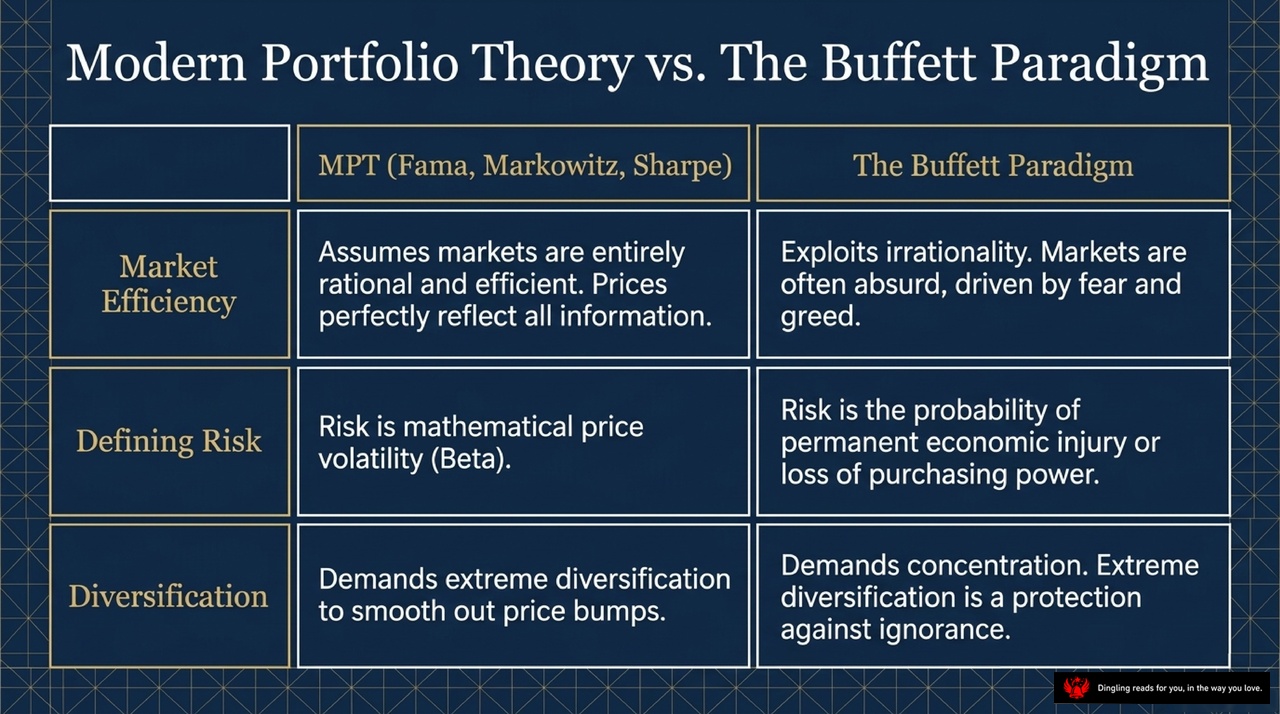
So, why do the greatest investors in history—John Maynard Keynes, Philip Fisher, and Warren Buffett—all swear by the same thing: concentration? Think of it like baseball legend Ted Williams. In the early 20th century, hitters with a batting average over .400 were common. But today? It's nearly impossible. Why? Because the whole game has leveled up. The gap between the best and the average has vanished. Bernstein argues that investing is exactly the same. As everyone becomes smarter and more educated, beating the market becomes harder. But that doesn't mean you should give up. Instead, you need to become the .400 hitter of your own life.
How do you do it? First, stop treating stocks like ticker symbols and start treating them like businesses. Buffett says you need to understand the company's economics, its management, and the price you're paying. Second, have the courage to go big. Buffett famously said if you aren't willing to put 10% of your net worth into a single idea, you probably shouldn't do it at all. If you can truly analyze a company, why split your money across 100 mediocre picks when you could double down on the one great one?
Third, stop trading so much. High turnover kills returns through fees and taxes. You want to hold your winners for years, letting compound interest do the heavy lifting. And finally, change how you measure success. Don't look at short-term price swings. Instead, use "perspective earnings"—the actual economic profit your companies are generating over the next decade.
But here's the hard part: you need a specific mindset. You must think in probabilities, like a poker player, not just guess. You need to understand human psychology and avoid emotional traps. You have to ignore the noise of market predictions because the future is too complex to forecast. And you need the discipline of Ted Williams: only swing at the pitches you can hit. Assume you only get 20 "at-bats" in your entire life. If you miss, you don't get another chance.
This approach goes against the grain. It requires a personality that can handle volatility and stick to a plan. That's why so many professionals ignore it. As philosopher Thomas Kuhn noted, when a new idea challenges the old way of thinking, the establishment often resists it. Academia still struggles to accept that concentrating on a few known winners is better than blindly diversifying into ignorance. But history proves that for those with the right skills and temperament, concentration is the ultimate path to wealth.
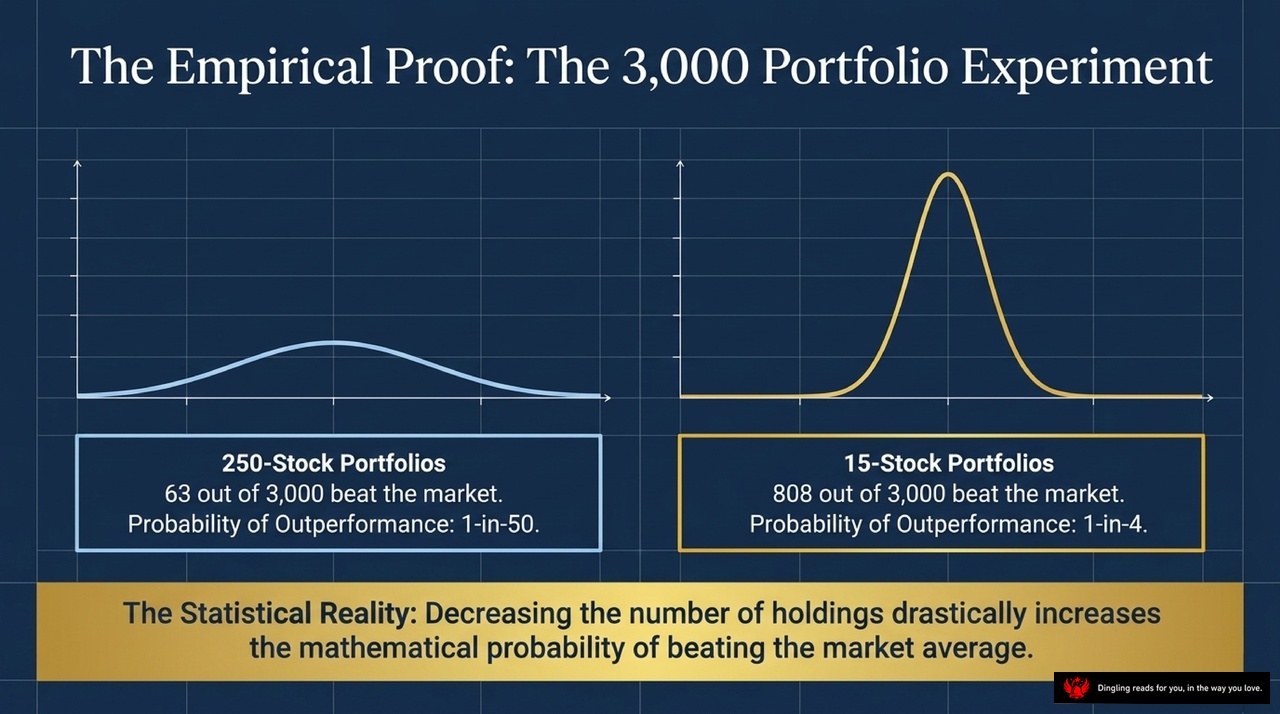
Imagine you are a professional investor sitting across from a skeptic, ready to prove that "diversification" might actually be holding you back. Look at the data on this slide. We ran a massive experiment, analyzing 3,000 different portfolios to find the truth about beating the market.
On the left, you see the result of spreading your money thin. When we created 250-stock portfolios, the results were flat. Only 63 out of those 3,000 combinations managed to outperform the market. That's a probability of just 1 in 50. It's statistically almost impossible to win by simply owning more stocks.
Now, look at the right side. This is where the magic happens. When we reduced the holdings to just 15 stocks, the curve shifts dramatically. Suddenly, 808 out of 3,000 portfolios beat the market. That probability jumps to 1 in 4.
The lesson is clear: decreasing the number of holdings drastically increases your mathematical chance of success. This isn't about luck; it's about probability. As Warren Buffett and Philip Fisher taught us, if you truly understand a few great companies, you don't need a hundred mediocre ones to feel safe. In fact, holding fewer, better stocks gives you a statistical advantage over the crowd. So, stop trying to own everything, and start owning the right things.
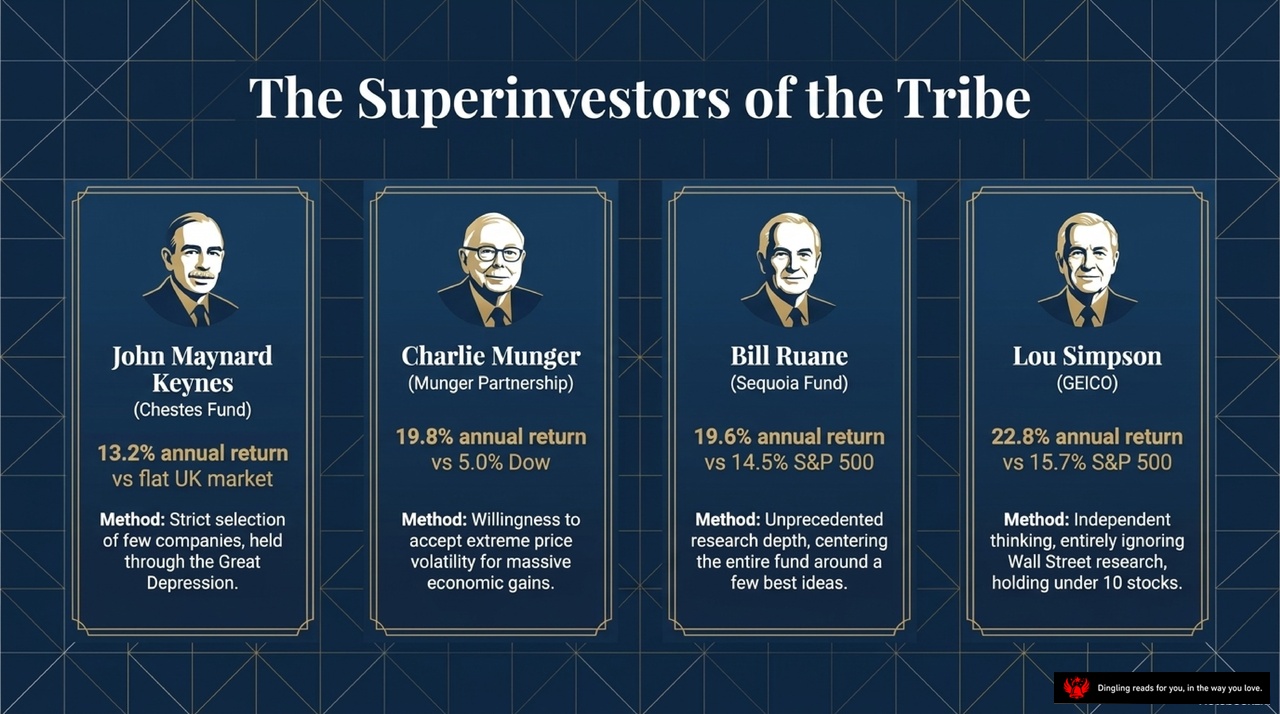
So, what exactly separates the "superinvestors of the tribe" from the rest of the pack? It all comes down to one radical, counter-intuitive principle: concentration. While the modern financial world obsesses over diversification—holding hundreds of stocks to smooth out volatility—true giants like John Maynard Keynes, Charlie Munger, Bill Ruane, and Lou Simpson mastered the art of holding just a handful of exceptional companies.
Look at the numbers on this slide. These aren't just successful investors; they are statistical outliers. Keynes achieved a 13.2% annual return while the entire UK market was flat. Munger, alongside Buffett, delivered nearly 20% annually against a sluggish Dow. Ruane outperformed the S&P 500 by a wide margin, and Simpson, managing GEICO's portfolio, hit an incredible 22.8% return.
But how did they do it? Their methods were the opposite of the herd. Keynes relied on strict selection of a few companies, weathering the Great Depression by staying the course. Munger embraced extreme price volatility, knowing that massive gains come from buying deeply when fear takes over. Ruane went deep into research, building his entire fund around just a few best ideas. And Simpson? He completely ignored Wall Street's noise, holding under ten stocks and trusting his own independent thinking.
The lesson here is clear: true alpha doesn't come from spreading your bets thin. It comes from finding the few companies with a massive economic moat, understanding them deeply, and then concentrating your capital where the odds are overwhelmingly in your favor. These superinvestors didn't just pick winners; they had the courage to bet big on them.

To succeed in focus investing, you have to break down the academic silos that trap most investors. Picking stocks isn't enough; you need a multidisciplinary framework to truly understand market reality. Think of it as building a latticework of mental models, where three critical nodes connect to form a complete picture.
The first node is the mathematics of probability, specifically risk and reward. This is the engine of focus investing. It's not about guessing the future, but about calculating the odds. You look for situations where the probability of success is high enough to justify a large bet, much like a professional poker player or a bridge champion.
The second node is the psychology of misjudgment. This covers human behavior and why we make mistakes. It reminds us that markets are driven by irrational emotions like fear and greed. Understanding these psychological traps allows you to stay calm when others panic and act decisively when others hesitate.
The third node is complex adaptive systems, which treats biological markets as dynamic, evolving ecosystems rather than predictable machines. Since the economy is too complex to forecast, you stop trying to predict the weather and instead focus on planting seeds in fertile soil.
When you combine these three—probability, psychology, and systems thinking—you stop chasing short-term noise and start investing in the fundamental economic value of great companies. This multidisciplinary approach is the only way to build a robust strategy that can withstand the chaos of the real world.
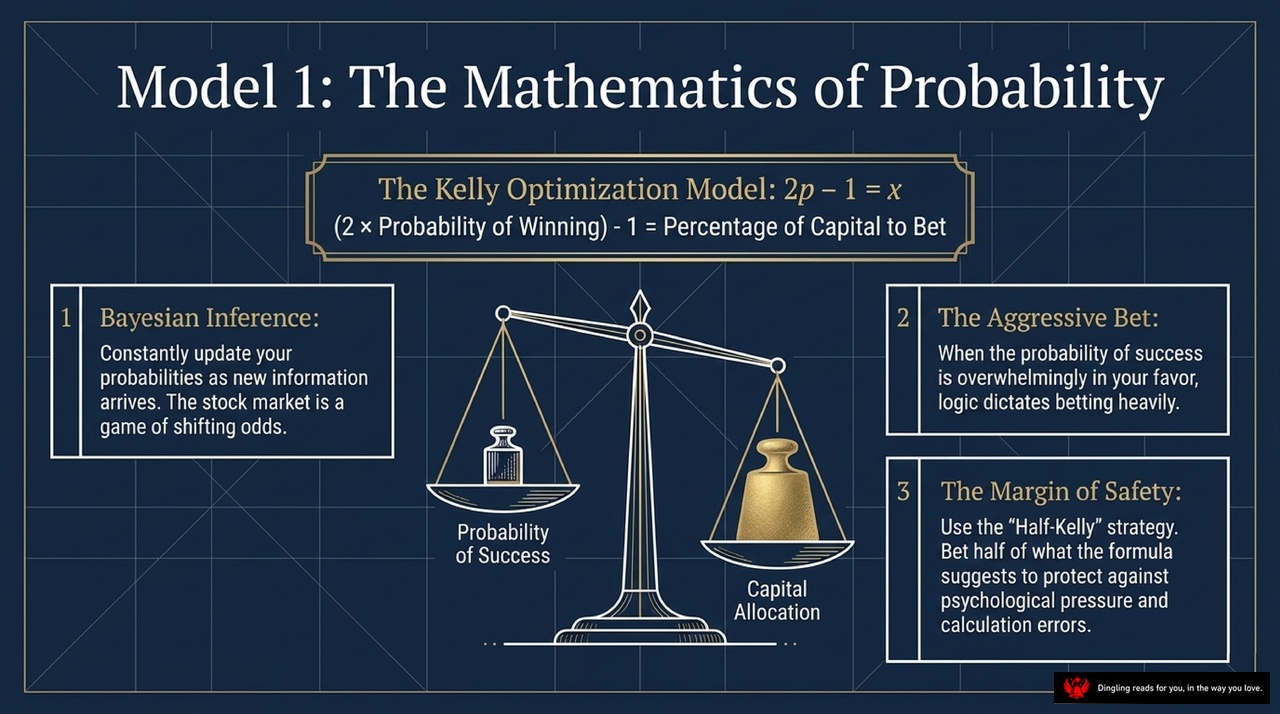
Look at this scale in the center of the slide. It perfectly captures the delicate balance between the probability of success and how much capital you allocate. This is the heart of Model 1: The Mathematics of Probability.
At the top, we see the Kelly Optimization Model, a formula that tells us exactly how much to bet based on our edge. The logic is simple but powerful: if your probability of winning is high, you should bet heavily. This is what we call the Aggressive Bet. When the odds are overwhelmingly in your favor, logic dictates that you go big.
However, being aggressive doesn't mean being reckless. That's where the Margin of Safety comes in. The slide suggests using the "Half-Kelly" strategy. Why? Because even with great math, human psychology can get in the way, or our calculations might be slightly off. By betting only half of what the formula suggests, you protect yourself from emotional pressure and potential errors, creating a buffer against disaster.
But it all starts with one crucial step on the left: Bayesian Inference. This means you must constantly update your probabilities as new information arrives. The stock market isn't static; it's a game of shifting odds. You need to weigh every new piece of data, adjusting your view of success and your capital allocation accordingly. It's about respecting the math while staying flexible enough to adapt when the world changes around you.

Welcome back. Today we're diving into Model 2: The Psychology of Misjudgment. This slide brilliantly contrasts two worlds: the Irrational Market, or "Mr. Market," versus the Rational Investor.
On the left, you see Mr. Market. He suffers from extreme loss aversion and overreacts to every short-term news headline. He is driven by cyclical fear and greed, viewing a 50% price drop as a catastrophic disaster. This is the market we all know: noisy, emotional, and prone to panic.
But look at the right side. The Rational Investor is the antidote. They suffer from zero "myopic loss aversion." They ignore the daily urge to check their portfolio and instead focus on fundamental business value. Crucially, they view that same 50% price drop not as a tragedy, but as a buying opportunity. This shift in perspective is everything.
The bottom of the slide highlights Richard Thaler's 25-Year Experiment, which proves this point scientifically. Investors bombarded with daily price fluctuations only allocated 40% to equities, while those given only five-year performance data allocated 70%. Ignoring short-term noise is a financial superpower. The lesson is clear: to win, you must stop looking like Mr. Market and start acting like the rational investor who sees value where others see fear.

Model 3 introduces the concept of Complex Adaptive Systems, challenging the old idea that the economy is a predictable machine. As the slide illustrates, forecasting fails because the economy isn't a Newtonian system seeking equilibrium; it's a biological, complex adaptive system. The diagram shows a feedback loop: investors try to forecast the market (Step 1), act on those forecasts (Step 2), and their collective action permanently alters the market environment (Step 3). This changes the future, rendering the original forecast obsolete (Step 4). Because the "ecology" of predictions constantly reshapes the landscape, macroeconomic forecasting becomes a mathematical impossibility. Just as a baseball player like Ted Williams couldn't hit .400 every year because the game itself evolved, our ability to predict the market diminishes as everyone adapts. This means you can't outsmart the system by guessing where it's going; instead, you must accept uncertainty and focus on what you can control: the quality of the companies you own.

Imagine a world where the stock market isn't a reliable scoreboard, but a chaotic, emotional rollercoaster. Look at the graph on your screen: that jagged white line represents "Market Price," which swings wildly up and down, often completely disconnected from reality. It's what we call the "Voting Machine"—a device that votes based on the fleeting moods of investors rather than the actual worth of a business.
But here is the breakthrough: if we stop obsessing over this noisy short-term price action, we can see the true picture. Enter "Look-Through Earnings," represented by those steady, rising gold bars. This metric measures the real economic operating performance of the companies you own, independent of the market's daily tantrums. As the text explains, if you measure your portfolio by the actual earnings of the underlying businesses and calculate your share of their retained earnings, something magical happens over a 10-to-18-year horizon. The correlation between those real earnings and the stock price approaches 1.0.
This is the essence of abandoning the "Voting Machine." By discarding short-term stock prices as our measuring stick, we replace them with a metric tied to reality. While the market price might panic-sell or greed-buy in Year 4 or Year 9, your Look-Through Earnings keep climbing steadily. This approach allows you to ignore the market's noise and focus entirely on the compounding value of great businesses, proving that in the long run, the market is not a voting machine, but a weighing machine.
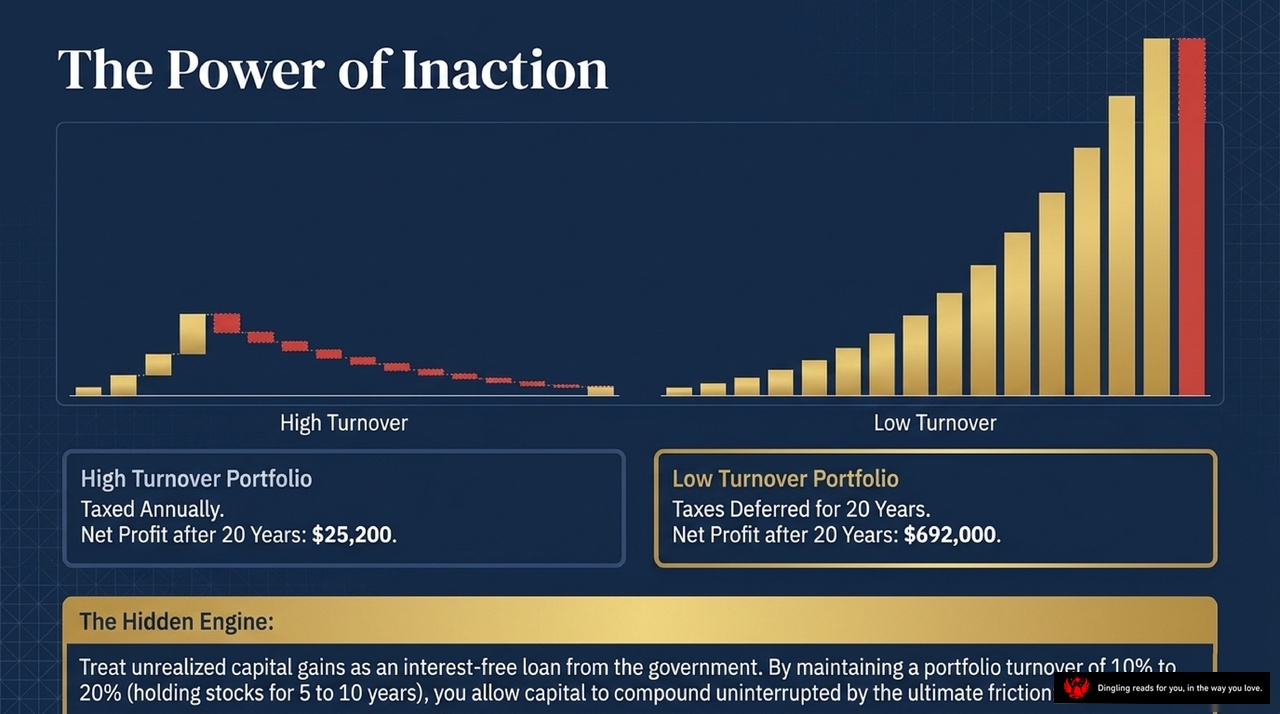
Look at this chart, titled "The Power of Inaction." It perfectly illustrates why doing nothing is often the most powerful thing you can do in investing. On the left, we see the "High Turnover" portfolio. This investor trades constantly, paying taxes every single year on their gains. After just 20 years, despite the activity, their net profit is a mere $25,200. The money is eaten away by the ultimate friction: taxes and transaction costs.
Now, look at the right side. This is the "Low Turnover" portfolio. Here, taxes are deferred for 20 years. By simply holding the stocks and letting them compound without interruption, the net profit explodes to $692,000. That's nearly 27 times the return of the high-turnover strategy.
The hidden engine behind this massive difference is simple: treat your unrealized capital gains as an interest-free loan from the government. By maintaining a low turnover rate—holding stocks for 5 to 10 years—you allow your capital to grow exponentially. You aren't fighting the market; you are harnessing the power of compound interest, letting your money work for you while the government effectively lends you the money you haven't sold yet. This is the secret to building true wealth.

Think about the difference between watching thousands of mediocre companies fly by and waiting for that one perfect moment. In investing, there are no "called strikes." You can sit back and watch average businesses pass you without penalty, but true discipline requires you to swing only when the pitch crosses the dead-center of the sweet spot. This is the mindset of the ultimate focus investor. They don't chase every opportunity; instead, they wait patiently for a business that is priced perfectly, managed by flawless leadership, and positioned to dominate its industry. Only when the "fat pitch" arrives do they swing—and they swing heavily. This isn't about missing out on the mediocre; it's about having the courage to commit everything to the few extraordinary opportunities that actually matter.

Imagine the architecture of enduring wealth as a grand temple, built not on sand, but on the bedrock of multidisciplinary science. This is the core of Focus Investing, a philosophy that rejects the chaotic noise of market predictions in favor of timeless principles.
Look at the foundation of this temple: the Business Tenets. Just like a building needs a solid base, your investments must rest on companies with understandable business models, a consistent history, and favorable long-term prospects. Without this, you are building on air.
Supporting this foundation are three essential pillars. The first is Probabilities. In an unpredictable world, you don't try to guess the future; instead, you wait for high-odds bets and allocate heavily when the odds are truly in your favor. The second pillar is Psychology. You must ignore "Mr. Market"—that emotional, fluctuating voice—and master your own emotional discipline. The third pillar is Complexity. You discard macro-forecasting, which is often useless, and instead focus deeply on the specific realities of the businesses you own.
All three of these pillars converge at the roof, where the true goal lies: Enduring Wealth. This isn't about getting rich quick; it is achieved through low-turnover compounding and intense concentration. As the slide reminds us, Focus Investing is not merely about buying fewer stocks; it is the inevitable conclusion of applying rigorous science to a chaotic world. It is about patience, probability, and the courage to do what is right, even when the market disagrees.

In a market obsessed with the frantic illusion of action, do you have the psychological fortitude to stand still and wait for your fat pitch? This slide captures the essence of focus investing: it is the ultimate intersection of patience, probability, and multidisciplinary discipline. By isolating a few exceptional businesses and allocating capital ruthlessly to high-probability bets, you transform risk into long-term economic triumph.
Think of it like a baseball legend. In the early days of baseball, hitting averages above .400 was common, but today, it's nearly impossible because the overall level of play has skyrocketed. The same is true in investing. As competition rises, beating the market becomes harder, which is why you can't rely on diversification or constant trading. Instead, you need the discipline of Ted Williams, who waited for the perfect pitch. Focus investors don't swing at every ball; they wait for the one high-probability opportunity where the odds are overwhelmingly in their favor.
This approach requires tuning out the manic noise of complex markets. When everyone else is panic-selling or chasing trends, the focus investor stays calm, knowing that short-term price volatility is irrelevant. What matters is the underlying economic value of the companies you own. As Warren Buffett famously noted, the stock market is a device for transferring money from the impatient to the patient. So, the real question isn't whether you can predict the market, but whether you have the courage to ignore the crowd and hold your position until the business truly delivers its value. That is how you turn a simple bet on a great company into a lifetime of wealth.