
The Warren Buffett Way: Complete Chapter-by-Chapter Summary

Welcome to "The Warren Buffett Way" by Robert G. Hagstrom. This isn't just another finance book; it's a comprehensive masterclass designed to decode the financial principles, mathematical frameworks, and psychological disciplines of the world's greatest investor. Whether you are looking to understand the math behind the magic or the mindset that separates the legends from the rest, this guide covers it all. It breaks down the secrets of how Buffett thinks, calculates, and decides, offering you a clear path to apply these timeless lessons to your own investment journey.

Look at this timeline. It's not just a history of dates; it's the story of how Warren Buffett built an empire that has outperformed the market for six decades straight.
Notice the title: "The Five-Sigma Event." In statistics, this is an anomaly so rare it happens less than once in a million times. Yet, look at the track record below it. From 1965 to 2012, Berkshire Hathaway's book value grew at a compound annual rate of 19.7%. That's not just beating the S&P 500; it's beating it by over 10 percentage points every single year for half a century.
Let's trace the journey on this slide. It starts in 1942, when an 11-year-old Buffett buys his first stock. He learns the brutal cost of impatience early on. By 1956, he's running his own partnership with just $100 of his own money. The pivotal moment comes in 1965 when he takes control of Berkshire Hathaway, shifting from buying cheap "cigar-butts" to investing in high-quality businesses.
Then, in 1967, he acquires National Indemnity, unlocking the power of insurance float—free capital that fuels his growth. Finally, in 2006, he makes the ultimate dividend move, committing over $30 billion to the Gates Foundation. He applies the same rational capital allocation he uses for stocks to global philanthropy.
This chart proves one thing: consistency. While the market swings wildly, Buffett's edge remains steady. That's the power of a 60-year track record of market outperformance.
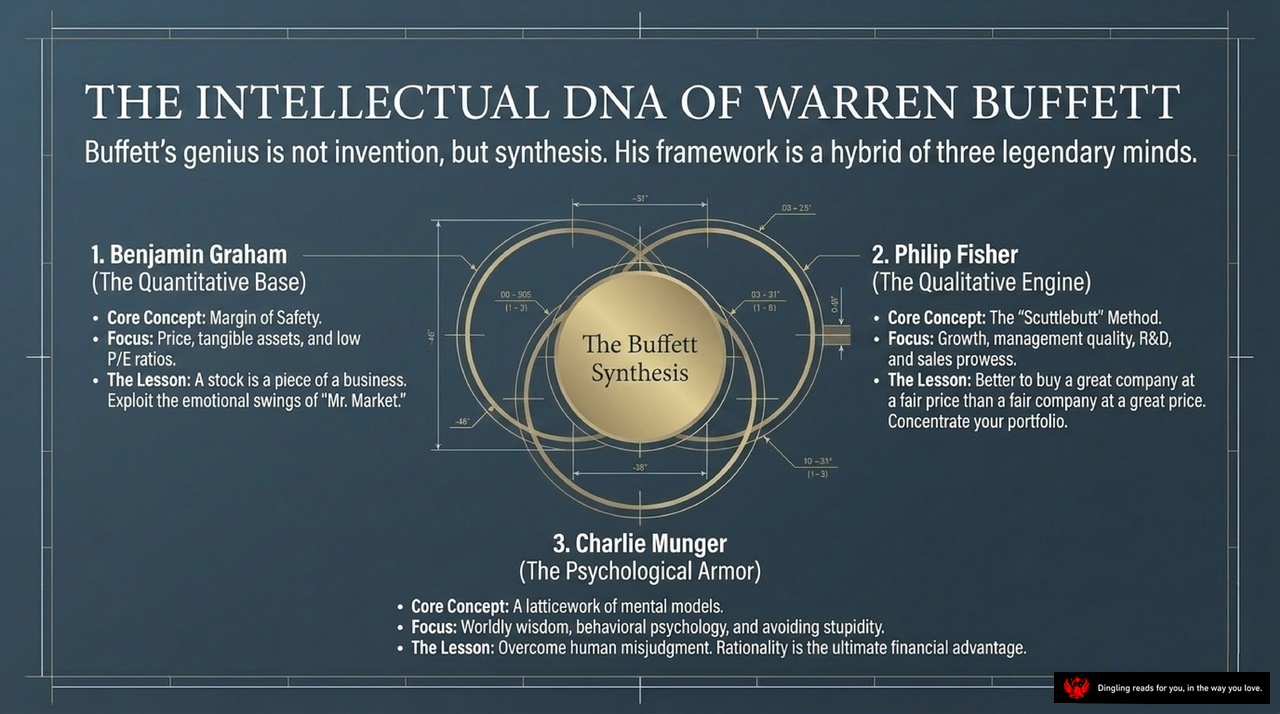
Let's dive into the blueprint of Warren Buffett's genius. It's not about inventing something entirely new; it's about the masterful synthesis of three legendary minds. Think of this as the intellectual DNA that built Berkshire Hathaway.
First, we have Benjamin Graham, the quantitative base. He gave Buffett the mathematical foundation, teaching him the concept of the "margin of safety." Graham's core lesson is simple but powerful: a stock is just a piece of a business. You must buy it at a price significantly lower than its intrinsic value to protect yourself from errors and market volatility.
Next is Philip Fisher, the qualitative engine. While Graham focused on numbers, Fisher taught Buffett to look at the story behind the numbers. He introduced the "scuttlebutt" method—digging deep into management quality, R&D, and sales prowess. Fisher's golden rule is that it's better to buy a great company at a fair price than a fair company at a great price. This shifted the focus from cheap stocks to high-quality businesses.
Finally, we have Charlie Munger, the psychological armor. Munger took Buffett's framework and added a layer of mental discipline. He introduced the idea of a "latticework of mental models" to avoid stupidity and overcome human misjudgment. Munger's lesson is that rationality is the ultimate financial advantage; you must resist the emotional swings of Mr. Market.
When you combine Graham's safety, Fisher's quality, and Munger's psychology, you get "The Buffett Synthesis." This hybrid framework allowed Buffett to evolve from a deep-value picker to a long-term holder of world-class franchises, creating an investment system that has outperformed the market for decades.

Welcome to the blueprint of Warren Buffett's investment empire. Look at this structure; it represents the four distinct analytical filters every potential investment must pass before it can become part of your portfolio. Think of it as a building where "The Investment Decision" is the roof, supported by four massive pillars: Business, Management, Financial, and Market tenets.
First, we have the Business Tenets, labeled here as "The Nature of the Machine." This is your first filter. Buffett only invests in companies he understands, with simple, stable operations and a long history of success. He avoids complex businesses or those undergoing major transformations, preferring the reliability of a machine that has been running smoothly for decades.
Next is the Management Tenets, or "The Operators of the Machine." Once you've found a great business, you must vet the people running it. Buffett looks for rational, honest leaders who resist the urge to follow the herd. He values managers who are transparent about their mistakes and who make capital allocation decisions based on logic, not ego or inertia.
The third pillar is the Financial Tenets, representing "The Output of the Machine." Here, we move beyond simple numbers to understand the quality of earnings. Buffett focuses on metrics like Return on Equity and "Owner Earnings," ensuring that the company is actually creating value for shareholders, not just reporting inflated profits. He looks for high profit margins and a track record of turning every dollar of retained earnings into even more market value.
Finally, the fourth filter is the Market Tenets, "The Price of the Machine." This is where the magic happens. No matter how great a business or manager is, the price must be right. Buffett insists on buying with a significant margin of safety, ensuring the price is well below the intrinsic value. This buffer protects you from errors and provides the opportunity for extraordinary returns when the market eventually corrects itself.
As Warren Buffett himself reminds us at the bottom: "Our behavior is not beyond the capabilities of anyone. We do not do extraordinary things to get extraordinary results." By systematically applying these four filters, anyone can make the investment decisions that separate the winners from the losers.

Imagine a castle built on a foundation of predictability. That is the core of Warren Buffett's business philosophy. As you see on this slide, the entire structure rests on one simple truth: Predictability is the foundation of valuation. If you can't see what's coming, you can't assign a real value to the asset.
So, how do we build this castle? Buffett gives us three essential rules to check before we even lay the first brick.
First, ask yourself: Is the business simple and understandable? You must stay within your "Circle of Competence." If you don't truly understand the inputs and outputs of a company, you cannot predict its future cash flows. It's just too risky.
Second, does the business have a consistent operating history? Buffett warns us to avoid turnarounds. Severe change destroys predictability. Look for businesses that have been producing the same core product for decades. Stability is your friend.
Finally, does the business have favorable long-term prospects? You need to seek an "Economic Moat." Look for franchises, not commodities. A franchise possesses a product that is needed, desired, has no close substitute, and is not heavily regulated. This is what creates lasting value.
On the left, you see a cross-section of this ideal business. The top part is "The Franchise"—the visible, profitable operations. The bottom part is "The Competitive Advantage"—the deep, structural moat that protects those profits from competitors. Only when you have both a simple, stable franchise and a strong competitive advantage do you have a truly predictable business worth investing in.

So, let's talk about the two distinct personalities that drive the corporate world: The Rational CEO and The Irrational CEO.
On the left, you see the Rational CEO. Think of this leader as a disciplined architect of capital. When reinvesting profits doesn't yield above-average returns, their instinct isn to chase growth blindly but to return cash to shareholders through dividends or buybacks. They value candor above all else; they admit mistakes openly in annual reports rather than hiding behind complex accounting tricks. Most importantly, they possess true independence, resisting the "institutional imperative" to blindly follow industry trends and instead focusing strictly on intrinsic value.
Now, look at the right side: The Irrational CEO. This is the empire-builder who reinvests capital into low-yield projects simply to inflate the size of the company, regardless of returns. This leader thrives on deception, covering up missteps and misleading the public while deceiving themselves in private. Perhaps most dangerously, they are driven by imitation. They blindly copy their peers, letting an invisible force of inertia drive them to make bad acquisitions just because "everyone else is doing it."
Ultimately, the difference between these two archetypes comes down to one thing: the ability to think independently and allocate capital wisely, rather than being swept away by the crowd.
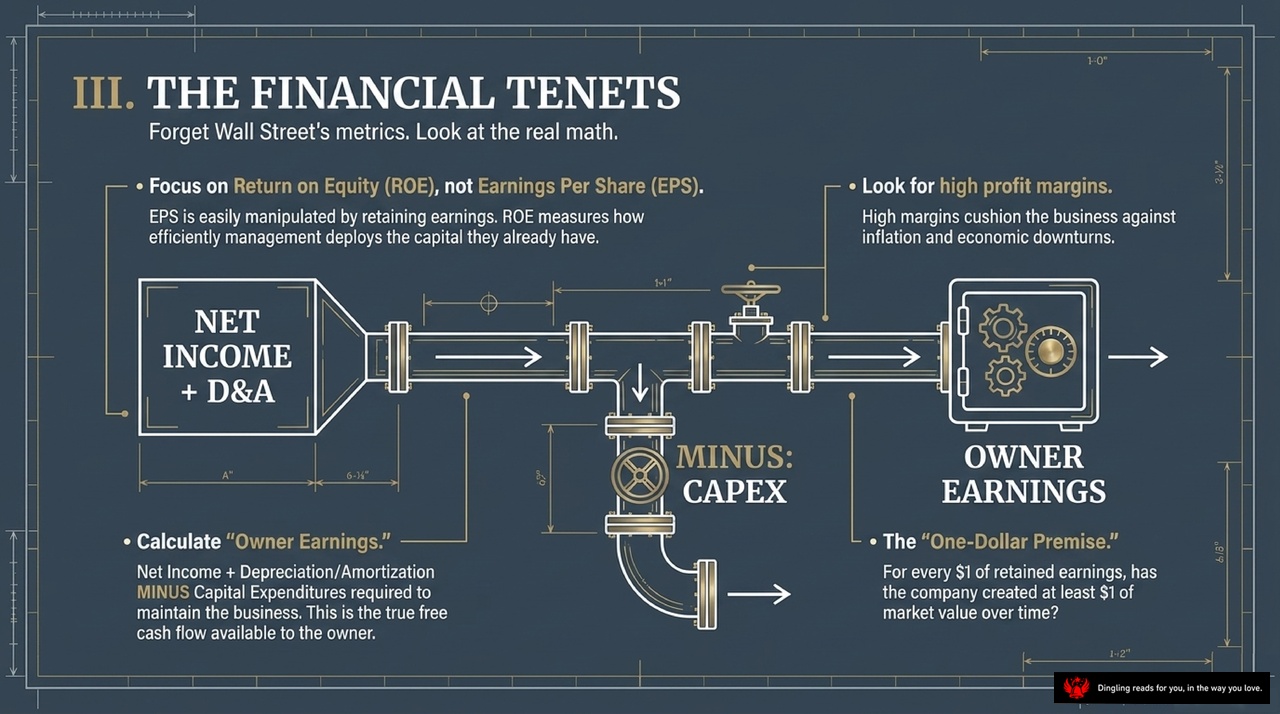
Welcome to the final chapter of our journey into Warren Buffett's investment philosophy. This slide, titled "The Financial Tenets," distills everything we've learned into one powerful visual: a pipeline of real math, stripping away the noise of Wall Street to show you exactly how wealth is created.
Notice the starting point on the left: Net Income plus Depreciation and Amortization. This is where many investors stop, but Buffett goes further. He asks a critical question: what does it actually cost to keep this business running? That's why we subtract Capital Expenditures, or CAPEX, flowing down the pipe. The result on the right is what Buffett calls "Owner Earnings"—the true free cash flow available to you as the owner. This is the number that matters, not just the accounting profit.
This leads us to the first golden rule displayed here: Focus on Return on Equity, or ROE, not Earnings Per Share. EPS can be manipulated by simply retaining earnings, but ROE tells you how efficiently management deploys the capital they already have. It measures the engine's efficiency, not just the fuel tank size.
Look at the top right. We must look for high profit margins. Why? Because high margins act as a cushion against inflation and economic downturns. They protect the business when the world gets tough. Finally, consider the "One-Dollar Premise." Ask yourself: for every dollar of retained earnings, has the company created at least one dollar of market value over time? If the answer is yes, you have found a true compounder.
In short, forget the flashy metrics. Look at the real math. Calculate owner earnings, demand high margins, and verify that every dollar kept is worth a dollar in value. This is the foundation of building a fortune that lasts.
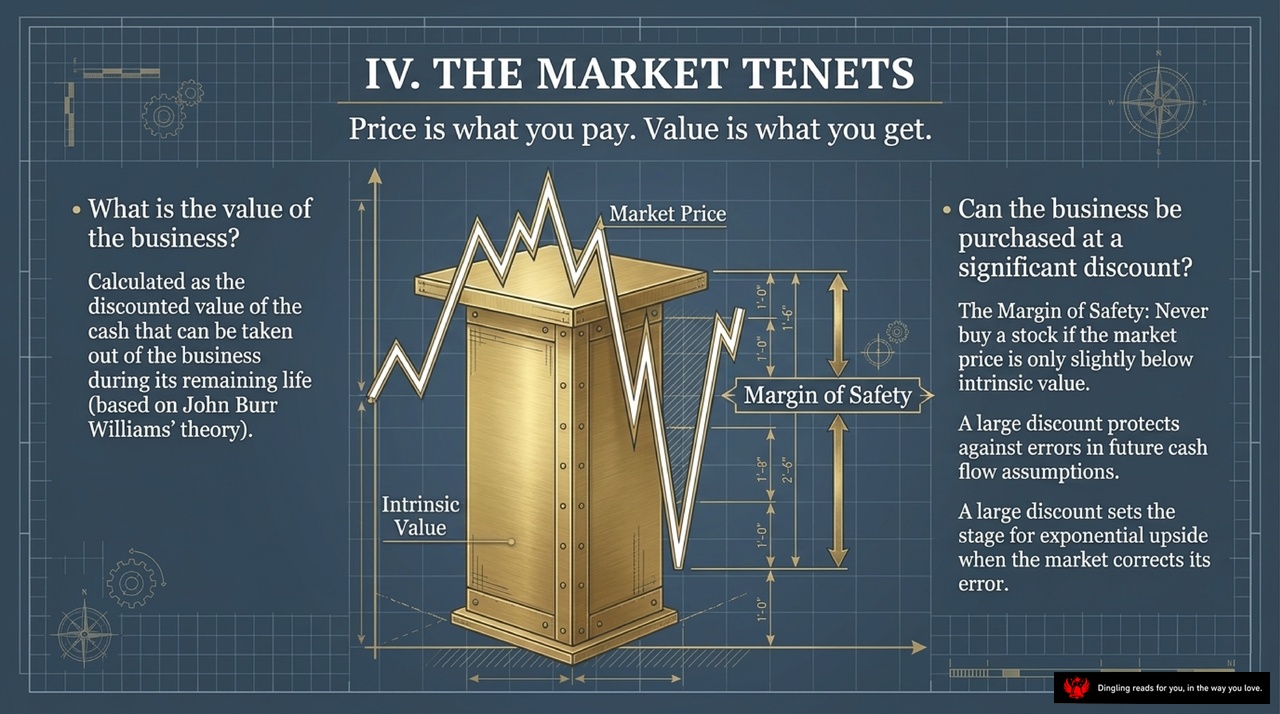
Price is what you pay, but value is what you get. This simple distinction lies at the heart of Warren Buffett's entire investment philosophy, separating the smart investor from the rest of the crowd.
As the slide illustrates, the gap between the market price and the intrinsic value of a business is called the "Margin of Safety." Think of it as an insurance policy for your capital. If you buy a business for $80 when its true value is $100, you have a $20 safety cushion. This margin protects you against errors in your cash flow assumptions or unexpected market downturns. A large discount doesn't just lower your entry cost; it sets the stage for exponential upside when the market eventually corrects its mistake.
But how do you find that intrinsic value? It's not a crystal ball. As the text explains, you calculate it as the discounted value of the cash the business can generate over its remaining life. This requires patience and a deep understanding of the company's future, not just its past numbers.
So, the critical question becomes: Can the business be purchased at a significant discount? The answer is always yes, but only if you wait. Buffett teaches us that we should never buy a stock if the market price is only slightly below its intrinsic value. We need that wide margin of safety. By focusing on the business's fundamental value rather than the day-to-day noise of the market, you align yourself with the long-term trend and avoid the traps of speculation.

Look at this blueprint-style chart. It's not just a list of companies; it's a masterclass in how Warren Buffett applied his four core tenets to build the Berkshire empire. Let's walk through the logic of these four pillars: The Investment, The Catalyst, The Moat, and The Management.
Take the Washington Post in 1973. The catalyst was clear: the stock crashed due to market fears, trading at an $80 million market cap when its intrinsic value was actually $400 million. That massive gap was the opportunity. The moat? It was a dominant daily newspaper in a one-paper town—a true monopoly franchise. And the management? Katharine Graham. She was a rational capital allocator who, instead of panicking, bought back shares at a massive discount.
Fast forward to GEICO in 1976. The catalyst here was almost the opposite: the company was edging toward bankruptcy due to pricing errors, with the stock plummeting from $61 to just $2. But the moat remained intact: a direct-to-consumer auto insurance model with a permanent structural low-cost advantage. The management, Jack Byrne, was brutally candid. He cut 3,000 jobs and exited unprofitable markets to save the core business.
Then there's Coca-Cola in 1988. The catalyst was the market crash of 1987, which masked the company's global expansion potential. The moat? An ultimate global brand identity and an incredible high-margin cash generator. The management, Roberto Goizueta, had a relentless focus on maximizing shareholder value and rising ROE.
Finally, General Dynamics in 1992. The catalyst was the end of the Cold War, which decimated defense stocks, leaving them trading at only 60% of book value. While this wasn't a traditional moat, it was a classic "Margin of Safety" pricing play. The management, Bill Anders, resisted institutional imperatives. He sold off bloated divisions and returned cash to owners.
Notice the pattern? In every single case, the stock price was depressed by temporary fears or errors. The moat was solid, the management was rational and shareholder-focused, and Buffett stepped in to buy the business, not just the stock. This is the diagnostic framework in action.
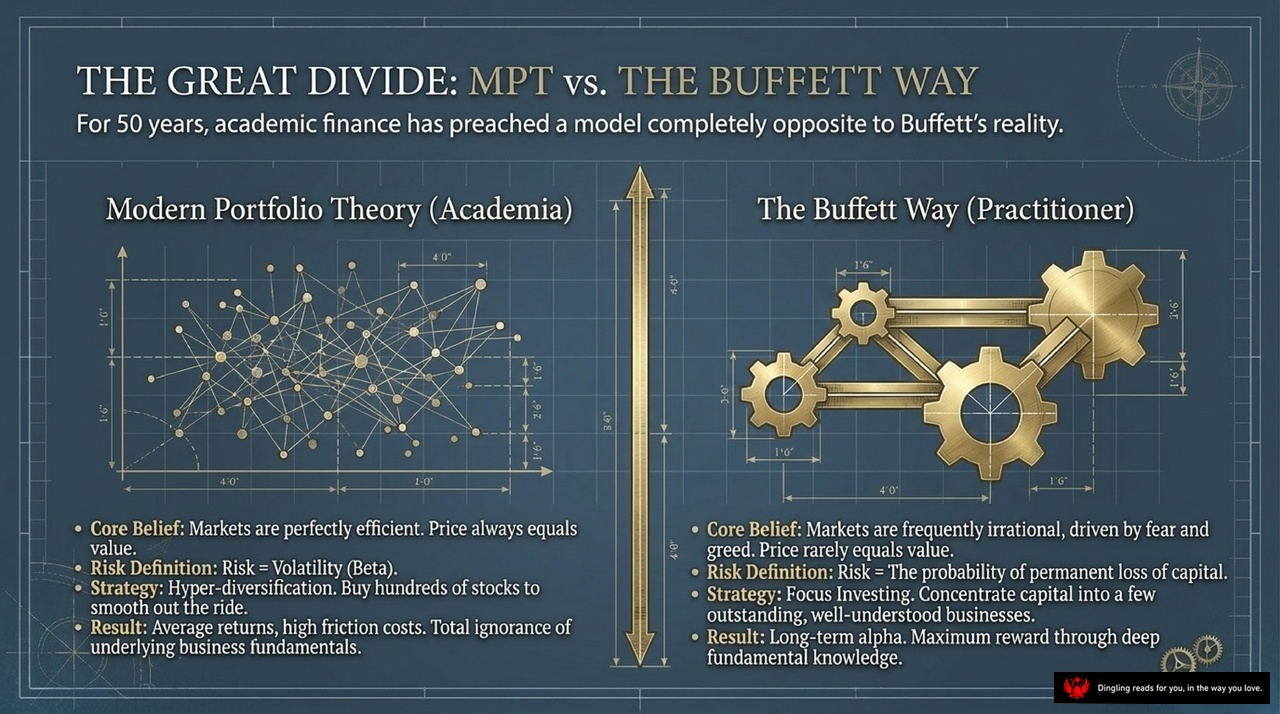
Today's slide highlights the fundamental clash between two worlds: the academic theory of Modern Portfolio Theory versus the practical reality of the Buffett Way. On the left, you see a chaotic web of dots, representing MPT's core belief that markets are perfectly efficient and that risk is simply volatility. The strategy here is hyper-diversification—buying hundreds of stocks to smooth out the ride, hoping to capture average returns while ignoring the actual businesses underneath.
On the right, we see the gears of the Buffett Way. This is the practitioner's approach, built on the belief that markets are often irrational, driven by fear and greed. Here, risk isn't about price swings; it's defined as the probability of permanent loss of capital. Instead of spreading capital thin, Buffett focuses on concentration, pouring resources into a few outstanding, well-understood businesses. The result? Long-term alpha generated through deep fundamental knowledge, not statistical averaging.
For the last 50 years, academia has preached a model completely opposite to Buffett's reality. While MPT tells us to diversify to eliminate risk, Buffett teaches us that true safety comes from understanding what you own and buying it at a price that offers a margin of safety. One approach hides behind a spreadsheet; the other builds wealth by understanding the engine driving the business.

Imagine you're a golfer waiting for the perfect shot. You don't swing wildly at every ball; instead, you wait patiently, analyzing the wind, the grass, and your own stance until the opportunity is undeniable. That is exactly Warren Buffett's approach to investing.
Look at the charts on your screen. We are diving deep into the math behind his success: Bayesian Logic and the Kelly Criterion. Think of it this way: investing isn't about gambling on what might happen; it's about calculating probabilities based on new information. As the slide illustrates, you start with a base probability—your initial view of a company. But as new facts arrive, like a competitor failing or management changing, you mathematically update your view. You never hold rigid views. If the odds shift in your favor, you adjust your bet.
This leads us to the Kelly Optimization Model, shown on the right. It dictates your "optimal bet size" based on your mathematical edge. The formula is simple yet powerful: your bet size depends on the probability of winning versus the payout ratio. Buffett's translation is clear: when the odds are overwhelmingly in your favor, bet heavily. When you find a rare, mispriced franchise, he allocates 20%, 30%, or even 40% of his portfolio to it.
He famously said, "When it rains gold, put out the bucket, not the thimble." This means if you have a massive edge, you should deploy significant capital, not just a tiny drop. However, this strategy requires a partner with immense patience. You must be willing to sit still, accumulating cash, until those perfect, high-probability moments appear. It's about using mathematics to remove emotion, ensuring you bet big only when the math says you have the advantage.

So, here is the reality check: having a high IQ doesn't guarantee investing success if your brain gets hijacked by emotions. This slide perfectly illustrates the battle between System 1 and System 2 thinking.
On the top, we see the path of the "Average Investor," driven by System 1. It's fast, intuitive, and effortless. When a stimulus hits—like a breaking news headline or a dropping ticker price—this system reacts instantly with fear. It triggers "Myopic Loss Aversion," making you panic sell every time you check your portfolio, just to avoid the psychological pain of seeing your losses.
Conversely, look at the bottom path for the "Buffett Investor," powered by System 2. This is the slow, analytical, and deliberate way. Instead of reacting to the daily noise, you analyze the information, value the business itself, assess the margin of safety, and finally make a rational decision to invest, hold, or buy. You view market drops not as existential threats, but as opportunities.
The core lesson here is simple: investing isn't a game where the guy with a 160 IQ beats the guy with a 130 IQ. Rationality is the only thing that matters. You need to build that golden pipeline of deep thinking to avoid the red lightning of emotional panic.
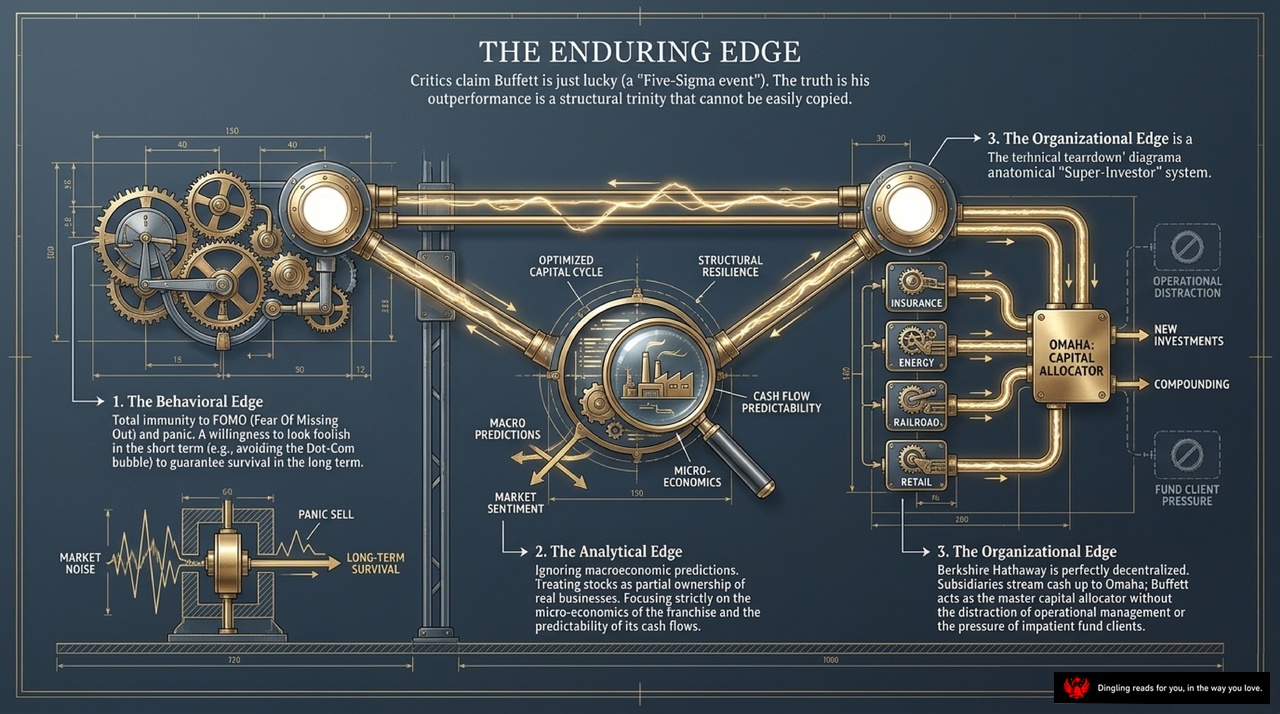
The enduring edge isn't luck; it's a structural trinity that critics can't easily copy. Let's break down this machine.
First, we have the Behavioral Edge. This is about total immunity to FOMO and panic. It's the willingness to look foolish in the short term—like avoiding the Dot-Com bubble—to guarantee survival in the long term. Think of it as building a shield against market noise.
Next is the Analytical Edge. Here, you ignore macroeconomic predictions and market sentiment. Instead, you treat stocks as partial ownership of real businesses. You focus strictly on the micro-economics of the franchise and the predictability of its cash flows. It's about seeing the business, not just the ticker symbol.
Finally, the Organizational Edge. This is the anatomy of a "Super-Investor" system. Look at the diagram: subsidiaries like Insurance, Energy, Railroad, and Retail stream cash up to Omaha. Buffett acts as the master capital allocator, making decisions without the distraction of operational management or impatient fund clients. This structure allows for true compounding and new investments, completely free from operational distractions or fund pressure.
Together, these three edges create a resilient engine that keeps generating value, regardless of what the market is doing right now.
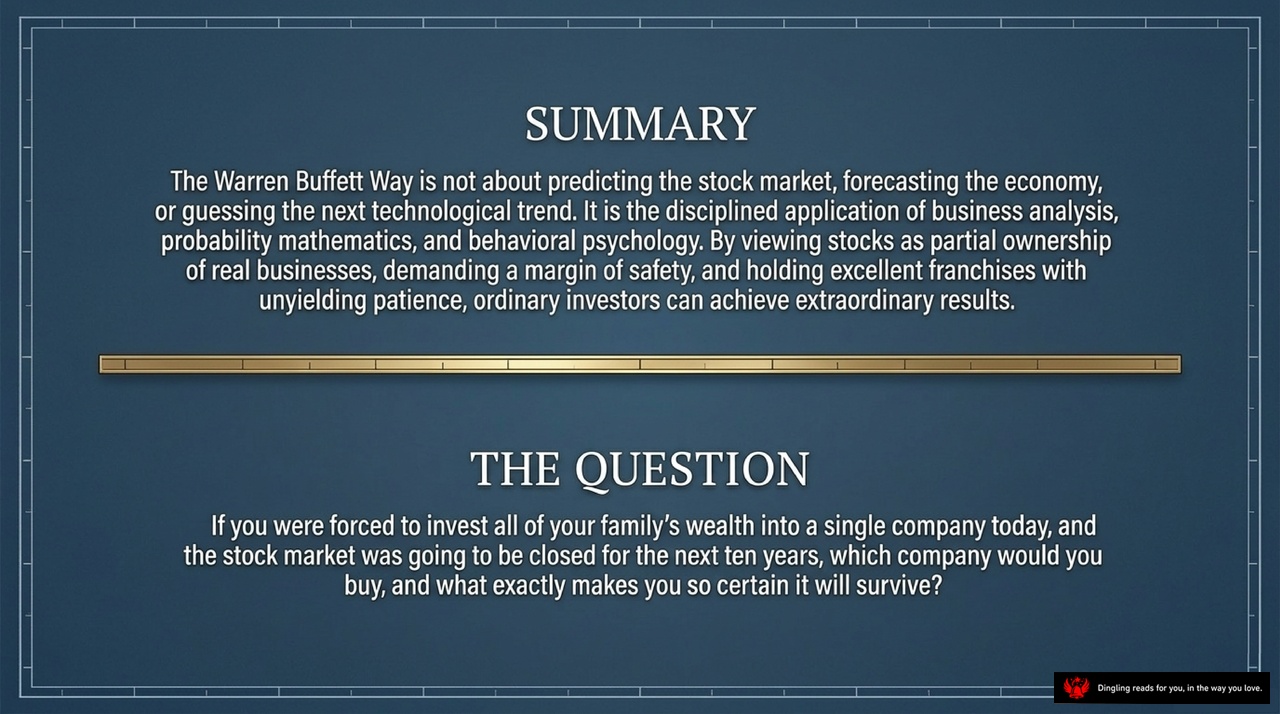
So, here is the big takeaway from everything we've discussed: The Warren Buffett Way isn't about predicting the stock market, guessing the next tech trend, or forecasting the economy. It's actually the disciplined application of business analysis, probability mathematics, and behavioral psychology.
Think of stocks not as ticker symbols, but as partial ownership in real businesses. By viewing them this way, demanding a margin of safety, and holding onto excellent franchises with unyielding patience, even ordinary investors can achieve extraordinary results.
Now, I want to leave you with a question to really test your thinking. If you were forced to invest all of your family's wealth into a single company today, and the stock market was going to be closed for the next ten years, which company would you buy? And more importantly, what exactly makes you so certain it will survive?