
The Water of Canglang: Complete Chapter-by-Chapter Summary
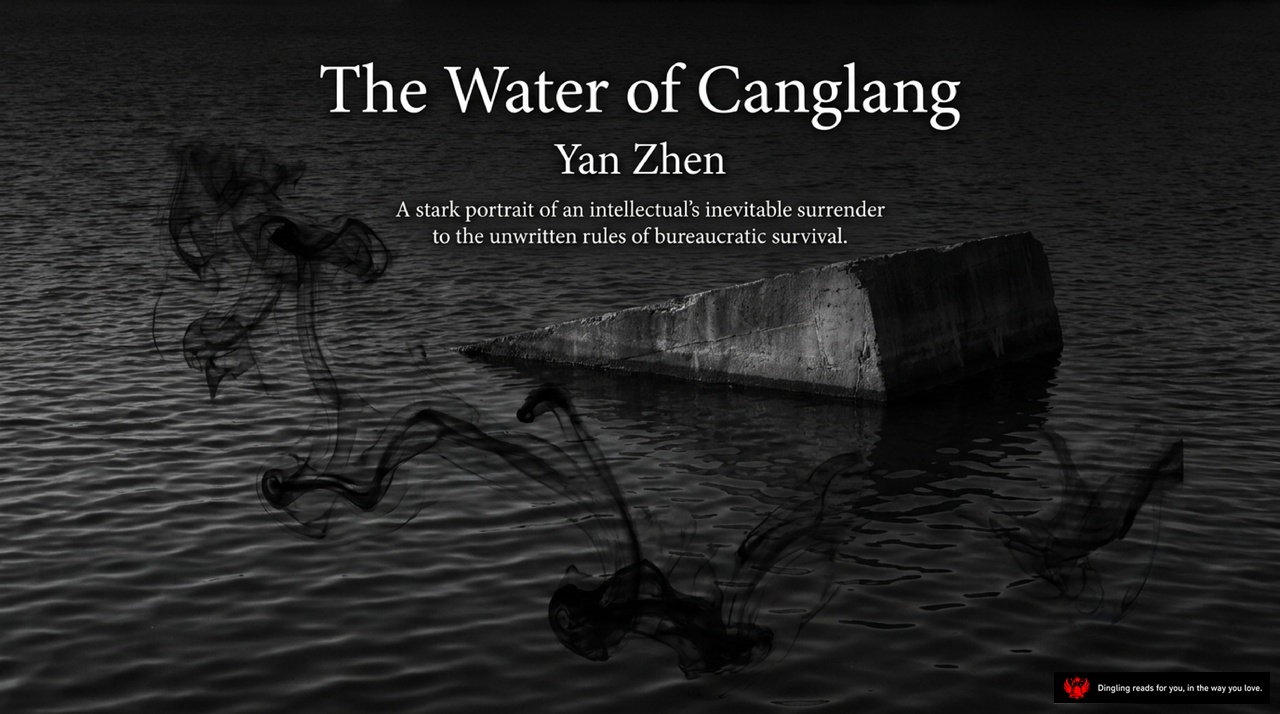
Welcome to the story of *The Water of Canglang*. This isn't just a tale about an intellectual's journey; it's a stark portrait of the inevitable surrender to the unspoken rules of bureaucratic survival.
Imagine a lone, jagged piece of concrete floating in a dark, endless sea. That is the book's title, and it perfectly captures the feeling of being lost in a system you can't control. The story begins with a father's tragic death, a moment that shatters a young man's world. His father was a brilliant doctor, a man of principle who believed in saving lives above all else. Yet, because he refused to play the political game, he was stripped of his title, forced to live in the mountains, and eventually died in poverty.
The protagonist, Chi Dawei, carries this legacy like a heavy stone in his stomach. He is raised on the belief that being a "good person" is enough—that integrity and talent should be rewarded. But as he steps into the adult world, he quickly learns a harsh truth: in the real world, being good often means being powerless.
The cover tells us this is about an intellectual's surrender. And indeed, that is the core conflict. Chi Dawei starts with high ideals, dreaming of changing the world and helping the common people. But soon, he finds himself trapped in a hierarchy where every move is calculated, where relationships are transactions, and where the only way to survive is to stop being who you are and become what the system demands.
This book asks a question that cuts deep: Can you keep your soul when the world demands you trade it for safety and success? It's a story about the gap between what we believe is right and what we are forced to do to live. As the concrete block sits silently in the water, so does the protagonist, waiting to see if he will drown his principles or find a way to float above the chaos.

Look at this split screen. On the left, we see "The Weight of the World," representing the traditional scholar's mindset—focused on historical moral grandiosity, absolute truth, and a legacy that spans generations. On the right, "Only One Life," capturing the modern bureaucratic reality where immediate pragmatic needs, material survival, and self-interest take the stage.
This contrast perfectly mirrors my journey. For years, I lived by the scholar's code, believing in "inner integrity" and "external duty," thinking that being a good person was enough. But the reality of my life kept hitting me with a different logic. When I tried to save a barefoot doctor with a few hundred yuan, the system's rigid rules made it impossible. When I tried to speak up about waste in the government, I was silenced. I realized that in this world, my moral principles were fragile as paper.
The truth was stark: survival isn't about grand ideals; it's about navigating the immediate hierarchy. My wife, Dong Liu, eventually made it clear that I couldn't just be a dreamer if my son was going to suffer in a cramped apartment. She pushed me to lower my head, to play the game, to become part of the system I once despised. I had to kill the idealist inside me to save the family outside. That was the weight of the world for me—not the burden of history, but the crushing pressure of staying alive in a world that only rewards those who know how to bend.

Look at this pyramid. It's not just a graphic; it's the brutal reality of the system we're navigating. At the very top sits "The Systemic Core," or Director Ma. He isn't just a boss; he is the engine that drives everything. Everything below him is designed to serve his will.
On the left, we see "Rule 1: Loyalty Metrics over Merit." Notice the text: "Medical expertise is secondary; absolute alignment with the leader's will is the primary currency." This is a hard truth. In this world, being the smartest doctor doesn't matter. What matters is being the most loyal servant. If you disagree with the leader, your talent becomes irrelevant.
On the right is "Rule 2: The Monopoly on Resources." The system controls everything—housing, kindergarten admissions, promotions. It forces you to rely entirely on the system. You can't survive on your own merit because the system holds all the cards.
And at the base, anchoring the whole structure, is "Rule 3: The Silence Mandate." The text warns us: "Speaking the truth is penalized. Survival requires mastering the art of being blind, deaf, and mute to corruption." This is the cost of entry. To stay in the game, you must learn to ignore the obvious injustices around you.
This pyramid illustrates the trap we face. It's a structure where loyalty replaces skill, control replaces opportunity, and silence replaces integrity. Understanding this isn't just about analyzing the system; it's about recognizing the invisible rules that dictate our survival and our choices.

Let's talk about the three distinct archetypes that define the human condition in this story: The Martyr, The Hound, and The Convert.
On the left, we have The Martyr, represented by the father, Chi Yongchang. His strategy is absolute adherence to moral truth; he refuses to bend to power. The result? He gets marginalized, lives in extreme poverty, and dies of untreated illness. He preserves his soul, but he loses his life. It's a tragic path of noble integrity.
In the center sits The Hound, Ding Xiaohuai. His strategy is the opposite: absolute sycophancy. He believes in pure pragmatism, anticipating and serving the leader's every unspoken whim. The result is a steady, safe bureaucratic ascent with material comfort, but at the cost of abandoning all personal dignity. He survives by becoming the very thing he once despised.
And on the right, we have The Convert, the protagonist, Chi Dawei. He begins as a Martyr, experiencing the systemic squeeze, but eventually transforms into a high-level manipulator of the rules. His strategy mirrors the Hound's, and while he achieves ultimate power and wealth, he suffers total spiritual death.
This slide captures the brutal reality of the system: you can either die with your soul intact, or live with your soul dead. There is no middle ground.
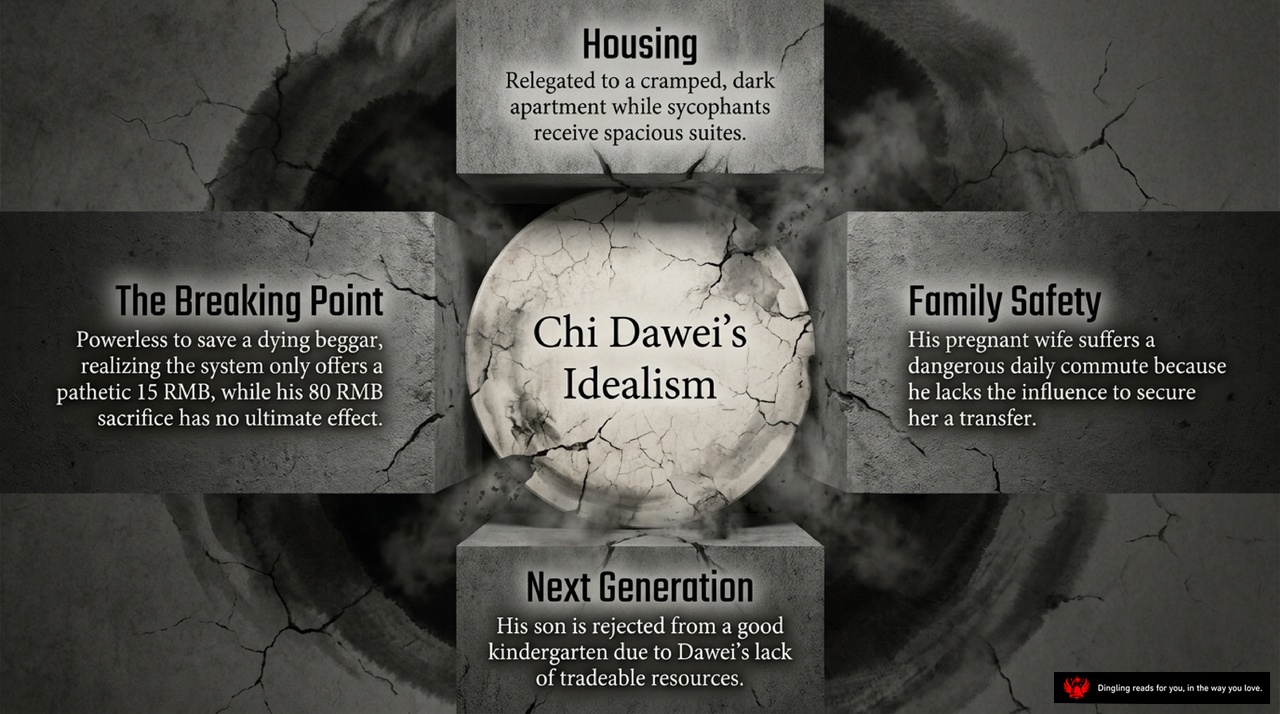
Imagine a world where your child's future is decided not by talent or effort, but by who you know. This is the harsh reality Chi Dawei faces as his son, Bo, is rejected from the prestigious provincial kindergarten simply because his father lacks "tradeable resources." In a system where influence is the currency, Bo is left behind while other children secure spots through connections.
But the story doesn't end there. Enter Ren Zhiqiang, a man who represents the new, ruthless logic of survival. While Chi Dawei hesitates, Ren steps in with a bold promise. He doesn't just talk; he acts, leveraging his network to bypass every barrier and get Bo into that elite school. The result is a heartbreaking victory for the boy, but a devastating defeat for the father.
Watching his son succeed while he fails, Chi Dawei realizes a painful truth: in this world, being a good person isn't enough. You need power, or you need someone who does. His years of integrity in the TCM Association feel like a hollow shell. The gap between his moral ideals and the demands of reality has become unbridgeable. To save his son, he must abandon the very principles he held dear, proving that sometimes, to win, you have to become the system you once despised.
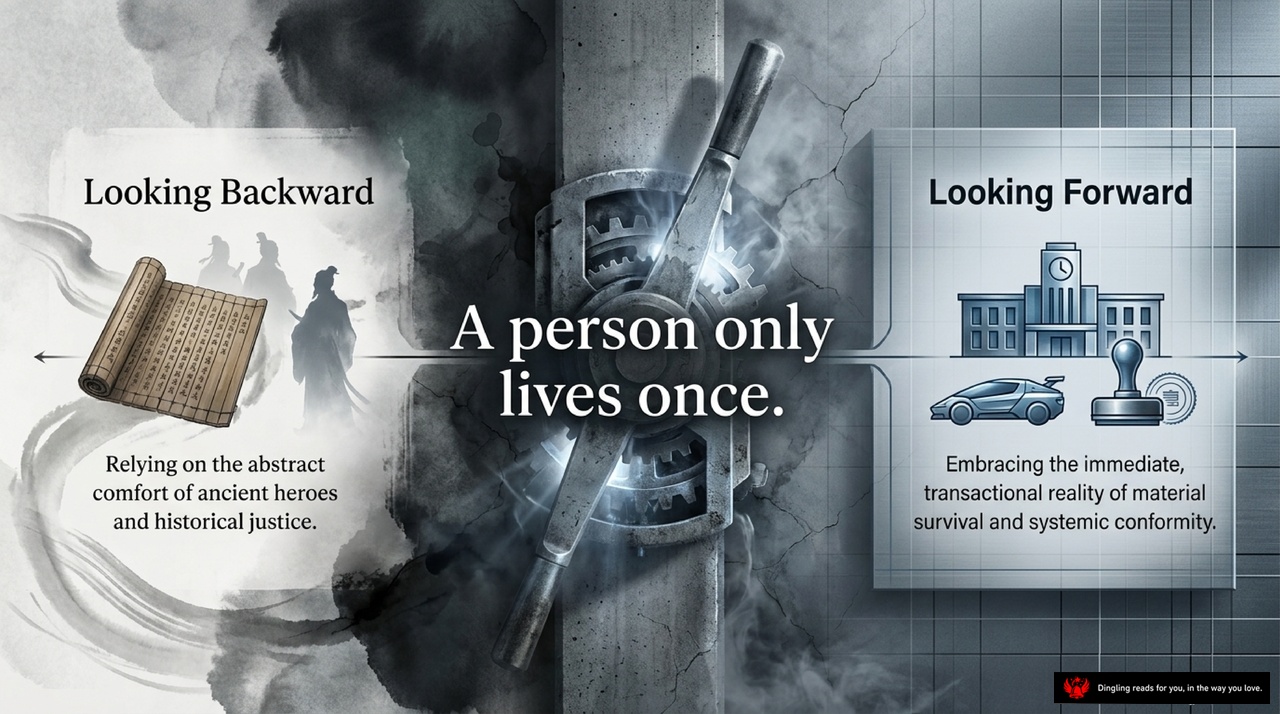
Look back at the left side of this slide. It represents our past—the "Looking Backward" mindset. Here, we see ancient scrolls and silhouettes of historical figures. This symbolizes relying on the abstract comfort of ancient heroes and the belief in historical justice. It's a safe, nostalgic place where we find solace in the distant past.
Now, look at the right side: "Looking Forward." This is the stark reality of the modern world. We see a clock tower, a sleek sports car, and an official stamp. This represents embracing the immediate, transactional reality of material survival and systemic conformity. It's about efficiency, status, and the tangible rewards of the present.
Right in the center, splitting these two worlds, is the core truth: "A person only lives once." This isn't just a quote; it's the engine driving the shift from the left to the right.
The story of Chi Dawei illustrates this perfectly. In the beginning, he was like the "Looking Backward" side. He idolized his father's noble principles, believing in "inner integrity" and moral purity. He refused to compromise, even when it meant his family suffered in a cramped apartment while others thrived. He thought he was living a high-minded life.
But life threw him a curveball. His son got injured, and without money or connections, they couldn't get the best care. His wife, Dong Liu, faced a brutal reality: she couldn't afford the best kindergarten for their child, while others' children were whisked away by powerful connections. The gap between their "moral high ground" and the actual needs of their family became unbearable.
This pain forced him to turn toward the "Looking Forward" side. He realized that without power and resources, his principles were just paper tigers. To save his son and secure a future, he had to stop looking at the ancient heroes and start looking at the clock. He had to enter the game, learn the rules of the system, and even play by them.
The slide captures this painful but necessary transition. It's the moment a person realizes that waiting for justice or living in the past won't feed their children. The only way forward is to engage with the present, to understand the mechanics of power, and to make choices that ensure survival. It's a move from the abstract comfort of the past to the gritty, transactional reality of now.
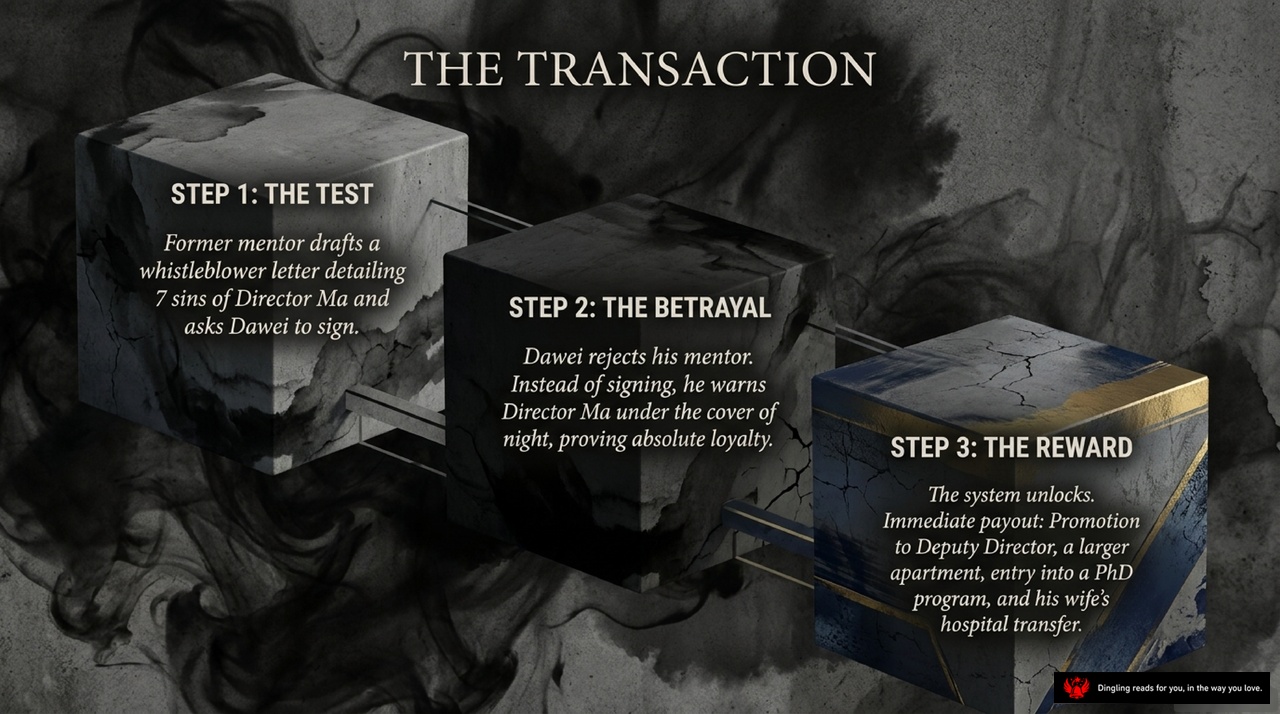
Today, we reach the final chapter of our journey: the moment the system unlocks. Look at this slide, "The Transaction." It maps out the three-step bargain that defines our protagonist's life.
Step one is the test. A former mentor drafts a whistleblower letter detailing seven sins of Director Ma and asks Dawei to sign. It's a trap designed to force a choice. Step two is the betrayal. Dawei rejects his mentor. Instead of signing, he warns Director Ma under the cover of night, proving absolute loyalty. This is the pivot point where he chooses power over principle. And step three is the reward. The system unlocks. Immediate payout: promotion to Deputy Director, a larger apartment, entry into a PhD program, and his wife's hospital transfer.
This isn't just about career advancement; it's about the ultimate price of survival. In the original text, this shift is crystallized when the protagonist realizes that "survival is the hard truth." He admits that his previous ideals—those noble figures like Qu Yuan and Li Bai—were too fragile for this world. He thought he could stay pure, but reality taught him that without power, you can't even protect your own family. He decides to kill the idealistic version of himself, to become like the people he once despised, just to secure a future for his son.
This slide captures that tragic transformation. The "betrayal" isn't just against the mentor; it's against his own soul. The "reward" isn't just a job title; it's the validation of a system that demands compromise. As the text poignantly asks, "What is the meaning of such persistence?" when it can't even keep a child out of a substandard kindergarten? The transaction is complete. The idealist is gone, replaced by someone who knows exactly how the game is played. We are left with a heavy question: In a world where rules are bent by power, is it better to be a "successful failure" or a "failed success"?

Look at this graph. It tells a brutal story about the cost of success. On the left, we see "Moral Integrity & Dignity" declining as time passes. On the right, "Socio-Economic Power & Wealth" climbs steeply. This is the trajectory of Dawei's rise from a junior clerk to a Deputy Director.
The chart highlights a critical moment: "The Software Update." It states that Dawei's success is directly, mathematically correlated to the deliberate erosion of his conscience. This isn't just a metaphor; it's a trade-off. To gain power and wealth, he had to sacrifice his inner compass.
This graph reflects the harsh reality Dawei faces. In the beginning, he was an idealist, believing in fairness and principle. But as he ascends the bureaucratic ladder, he encounters a world where rules are flexible and survival depends on compromise. Every step up requires him to lower his standards, to ignore the suffering of others, and to silence his own doubts. The graph shows that his moral decline wasn't an accident; it was a necessary calculation. He realized that in this system, being too upright is a liability.
Ultimately, the graph reveals a tragic truth: in the pursuit of the top position, he traded his soul for the seat. The golden line of his career is built on the fading white line of his integrity. It's a stark reminder that sometimes, the highest price for success is the loss of who you used to be.
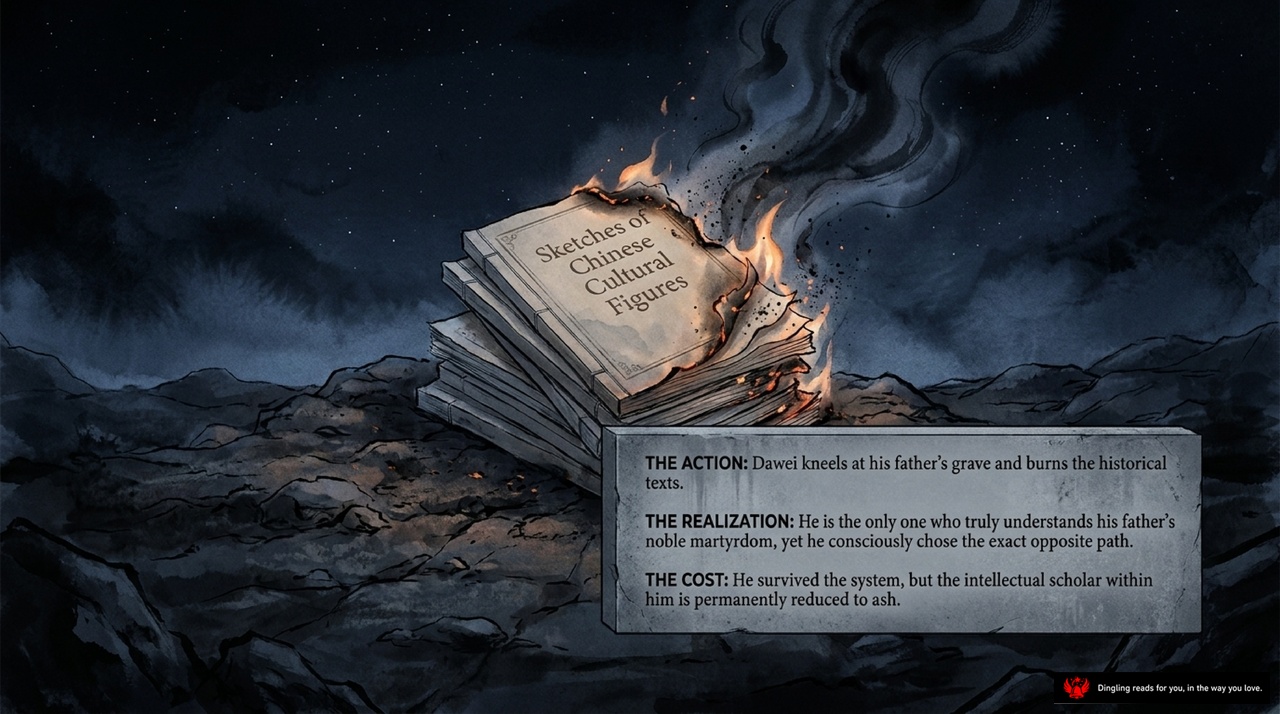
Look at this burning book. The title reads "Sketches of Chinese Cultural Figures," and it's being consumed by flames on a dark, desolate landscape. This image captures the tragic arc of Dawei's life and the ultimate cost of his choices.
In the story, Dawei kneels at his father's grave and burns these very texts. It is a moment of profound realization. He understands that his father, a man of noble martyrdom, chose a path of integrity and suffering. Yet, Dawei consciously chose the exact opposite. He survived the system, but in doing so, he permanently reduced the intellectual scholar within himself to ash.
The fire isn't just destroying paper; it's the destruction of his own soul. He realized that by trying to play the game of power and survival, he had to burn away the very things that made him who he was. The cost of his survival was his humanity. He became part of the system he once despised, and in that transformation, the light of his father's legacy was extinguished forever. This is the heavy price of choosing the easy path over the difficult one.
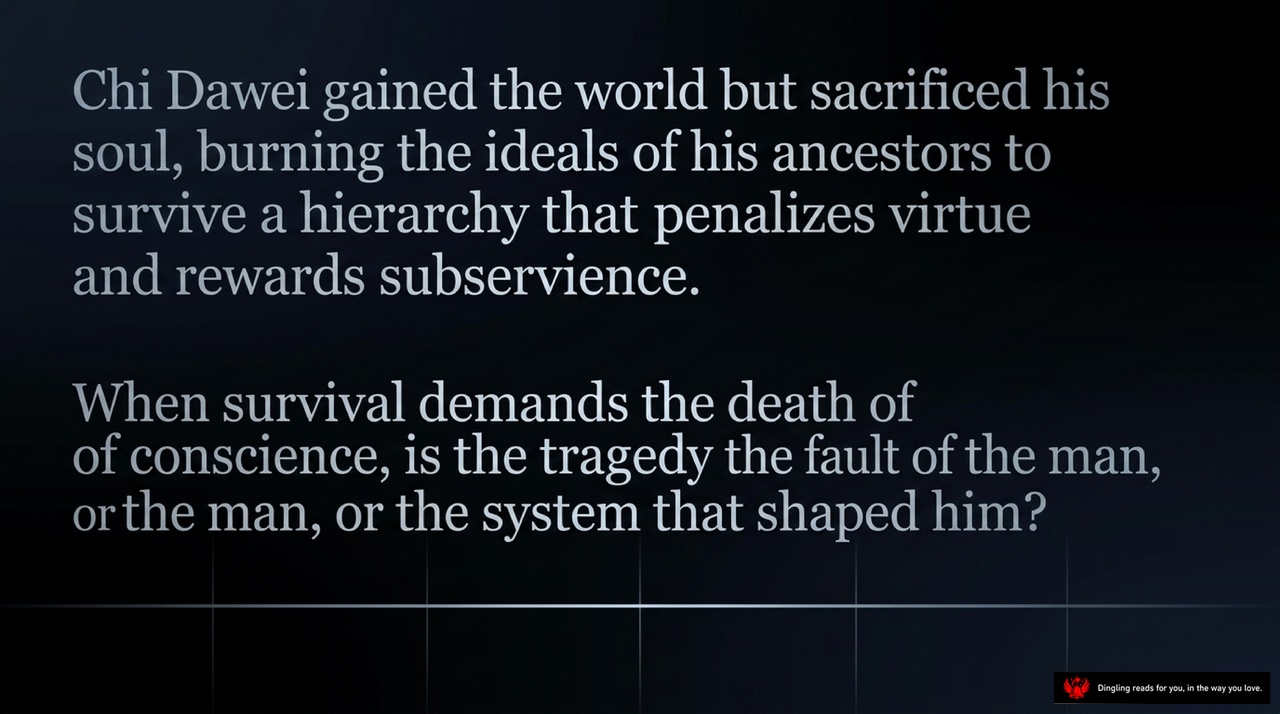
Chi Dawei's story is a haunting mirror for anyone who has ever felt the weight of compromise. He gained the world, yes, but at what cost? He sacrificed his soul, burning the ideals of his ancestors just to survive a hierarchy that penalizes virtue and rewards subservience.
When survival demands the death of conscience, we are left with a terrible question: is the tragedy the fault of the man, or the system that shaped him?
Look at the contrast in his life. On one hand, he had the power to change things, to be a "hero" in the eyes of the system. On the other, he was forced to become a sycophant, to watch others take credit for his work, to stay silent when justice was needed. The system taught him that being good isn't enough; you have to be useful to the powerful.
This isn't just about Chi Dawei. It's about us. We all face moments where doing the right thing feels too expensive. We all face systems that reward those who play by the unwritten rules, not the ones written in our hearts.
So, when we look at Chi Dawei, do we see a traitor? Or do we see a victim of a broken game? The tragedy isn't just his; it's ours too, if we let the system win.