
The Well-Fed Poor: Complete Chapter-by-Chapter Summary
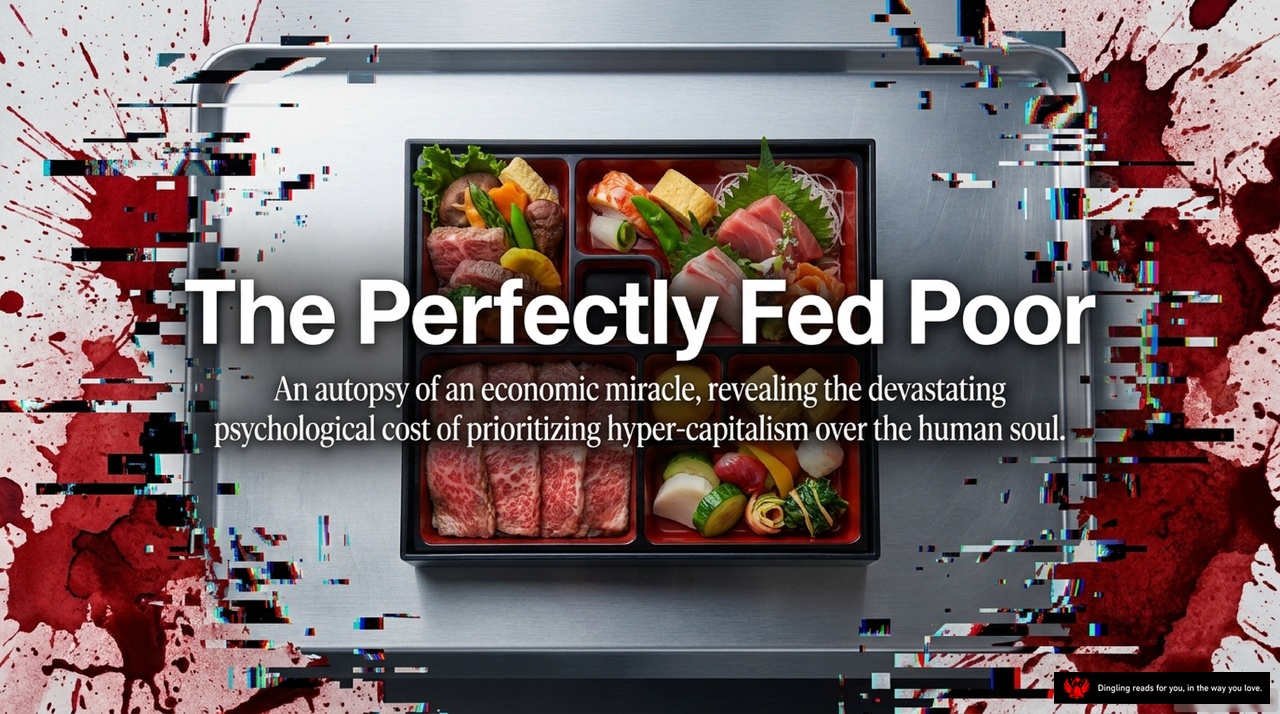
Welcome to today's session. We are diving into a book that peels back the layers of a seemingly perfect society to reveal a terrifying truth. Look at the image on your screen: a pristine, high-end bento box, filled with premium wagyu and fresh sashimi. It represents the pinnacle of abundance and order. Yet, the title overlaying it reads, "The Perfectly Fed Poor." This is not a contradiction; it is the central thesis of our story.
This book serves as an autopsy of an economic miracle. It explores how a nation could achieve such material wealth while systematically starving its citizens of dignity, connection, and mental peace. The subtitle warns us of the devastating psychological cost of prioritizing hyper-capitalism over the human soul. In this narrative, being "fed" physically does not mean being nourished. We will see how relentless performance metrics, crushing debt, and a culture of perfectionism trap individuals in cycles of despair, turning them into hollow shells. From corporate salespeople drowning in hidden loans to engineers losing their empathy to code, and women battling eating disorders to fill a void no amount of food can touch, this is a story about the hunger that money cannot satisfy. We are about to uncover how a society can be so full, yet so profoundly empty.
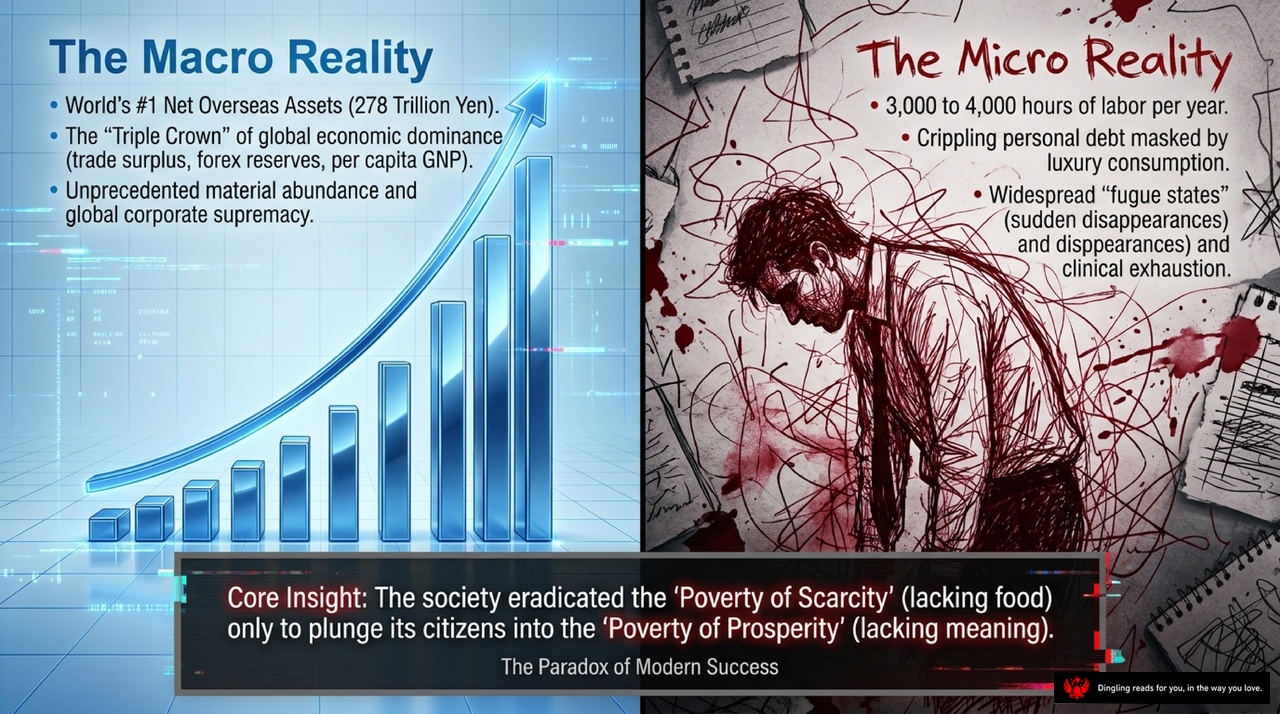
Look at this stark contrast between the macro and micro realities of modern Japan. On the left, we see a soaring graph representing the nation's wealth: the world's #1 net overseas assets, a "Triple Crown" of economic dominance, and unprecedented corporate supremacy. It's the story of a society that conquered the "Poverty of Scarcity."
But look at the right side. That's the "Micro Reality." While the economy soars, the individual is drowning. We see 3,000 to 4,000 hours of labor per year, crippling personal debt masked by luxury consumption, and widespread "fugue states"—sudden disappearances and clinical exhaustion.
This is the core insight of the book: we eradicated the poverty of lacking food, only to plunge our citizens into the "Poverty of Prosperity"—a state of lacking meaning. We built a machine for massive wealth, but it left us as hollow, exhausted shells, trapped in a paradox where modern success feels like a slow suicide.
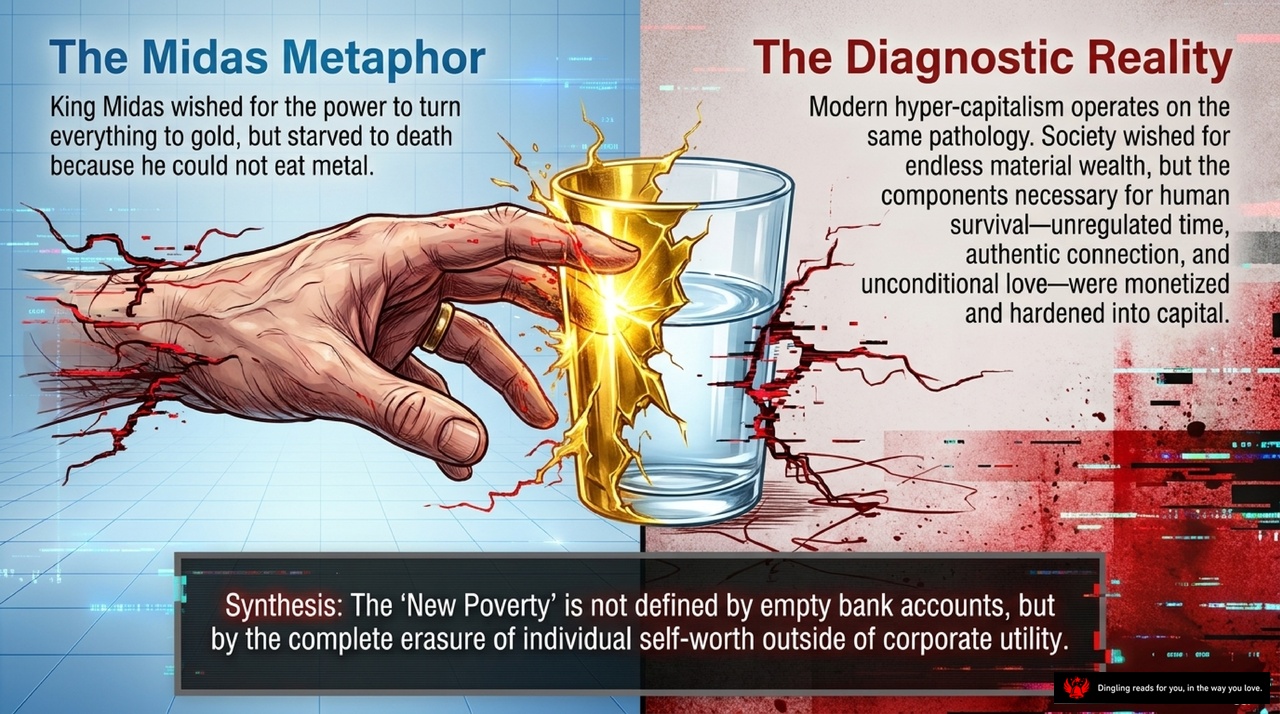
King Midas wished to turn everything into gold, only to starve because he could no longer eat. This ancient myth isn't just a fairy tale; it's the terrifying blueprint of our modern reality. Today, hyper-capitalism operates on the exact same fatal pathology. We have collectively wished for endless material wealth, but in doing so, we have accidentally monetized the very components necessary for human survival. Things like unregulated time, authentic connection, and unconditional love have been hardened into cold capital.
Look at the synthesis at the bottom: this "New Poverty" isn't about empty bank accounts. It is defined by the complete erasure of your individual self-worth outside of your corporate utility. We are the new King Midas, turning our lives into gold, only to find we have nothing left to live.

The Cycle of Modern Poverty isn't just a catchy title; it's a brutal, unbreakable loop that traps millions of people in a state of constant crisis. Look at this diagram: it starts with **The Setup**. Just like the salesmen in our book who were forced to hit impossible quotas, workers are pushed into a corner where they feel they must buy their own company's products just to save face. It's a trap from the very beginning.
Then, the wheel spins into **The Trap**. Imagine living in a city that never sleeps, masking your chronic exhaustion with hyper-consuming luxury goods. These workers take out high-interest loans, buying things they can't afford just to "buy proof of their own existence." They are borrowing against their future, drowning in debt to feel like they are somehow succeeding.
Finally, we hit **The Break**. This is where the cycle snaps. After working grueling 14-hour days just to service mounting debt—often exceeding millions in loans—the system inevitably collapses. The tragic output is clinical depression, sudden disappearances, or total bankruptcy. The heart monitor line in the middle of this wheel shows the truth: under this pressure, the human spirit flatlines. We aren't just struggling financially; we are being systematically broken by a cycle designed to keep us running until we crash.
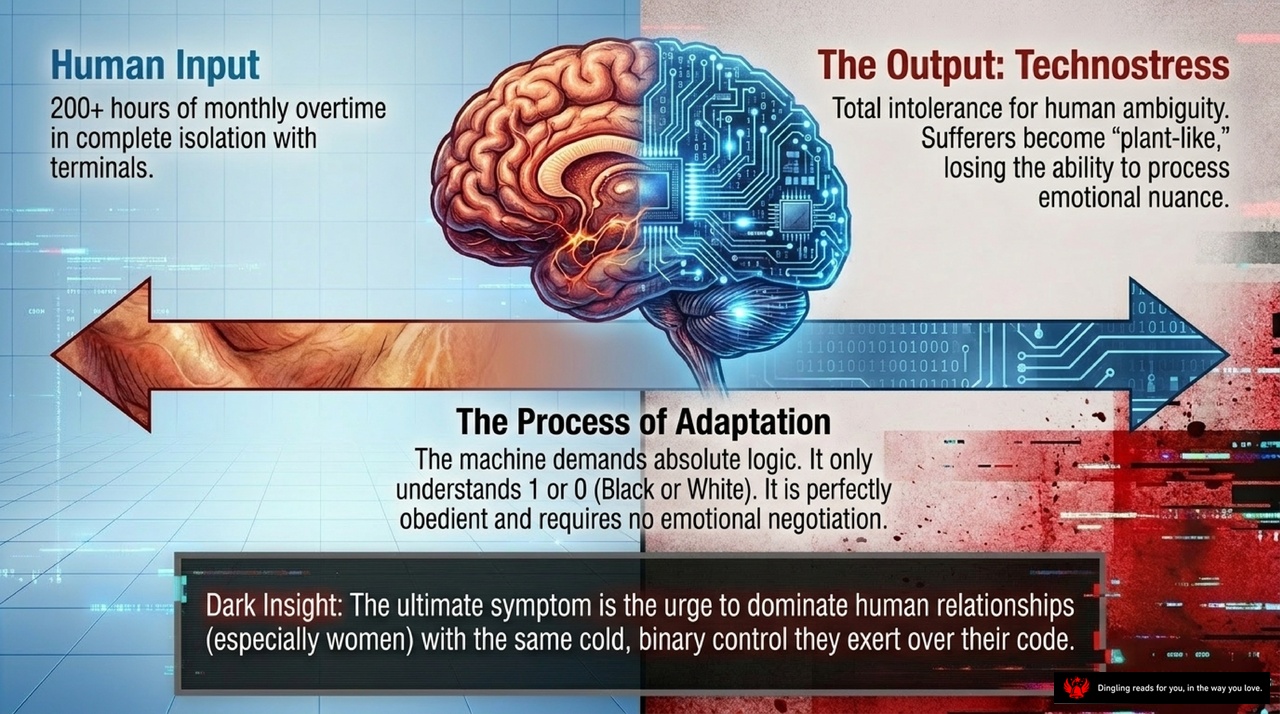
Look at this split brain. On the left, we have the human input: 200-plus hours of monthly overtime, isolated behind a terminal. On the right, the output is technostress—a total intolerance for human ambiguity, leaving sufferers "plant-like" and unable to process emotional nuance.
This isn't just about coding; it's a process of adaptation where the machine demands absolute logic. It only understands 1 or 0, black or white. It's perfectly obedient and requires no emotional negotiation. When you spend your life in that binary world, your brain starts to mimic it. You lose the ability to handle the messy gray areas of real life.
Here is the dark insight: the ultimate symptom is the urge to dominate human relationships, especially with women, using the same cold, binary control they exert over their code. Instead of connecting, they try to "debug" people, treating complex emotions like errors to be fixed. This is how high-tech isolation turns into a crisis of humanity.
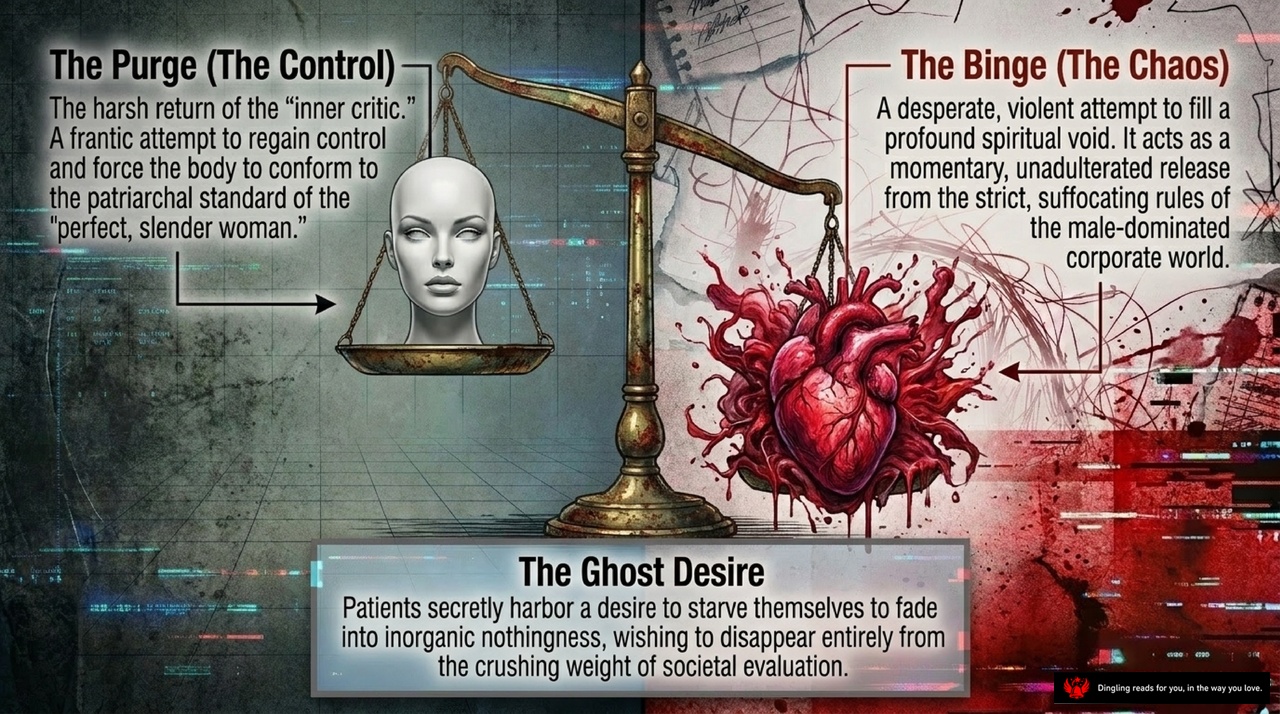
Have you ever felt like your life is a performance, and the only way to survive is to shrink yourself until you disappear? This slide captures that terrifying duality perfectly. On the left, we see "The Purge," or The Control. It's that harsh, frantic return of the inner critic—a desperate attempt to force your body into the mold of the "perfect, slender woman." It's about regaining control by conforming to patriarchal standards, starving away the parts of yourself that don't fit the script.
But on the right, we see the inevitable backlash: "The Binge," or The Chaos. This is a violent, desperate attempt to fill that profound spiritual void. It's an unadulterated release from the suffocating rules of a world that demands you be small and perfect. It's about eating until the pain goes away, until the silence is drowned out by noise.
And beneath it all lies "The Ghost Desire." This is the secret, haunting truth many of us carry: a deep, secret wish to starve ourselves not just to lose weight, but to fade into inorganic nothingness. We wish to disappear entirely from the crushing weight of societal evaluation. We want to be so small, so invisible, that no one can hurt us anymore.
This isn't just about food; it's about a society that has turned us into products to be judged, leaving us with nothing but a hollow core, screaming for a connection we can't find.
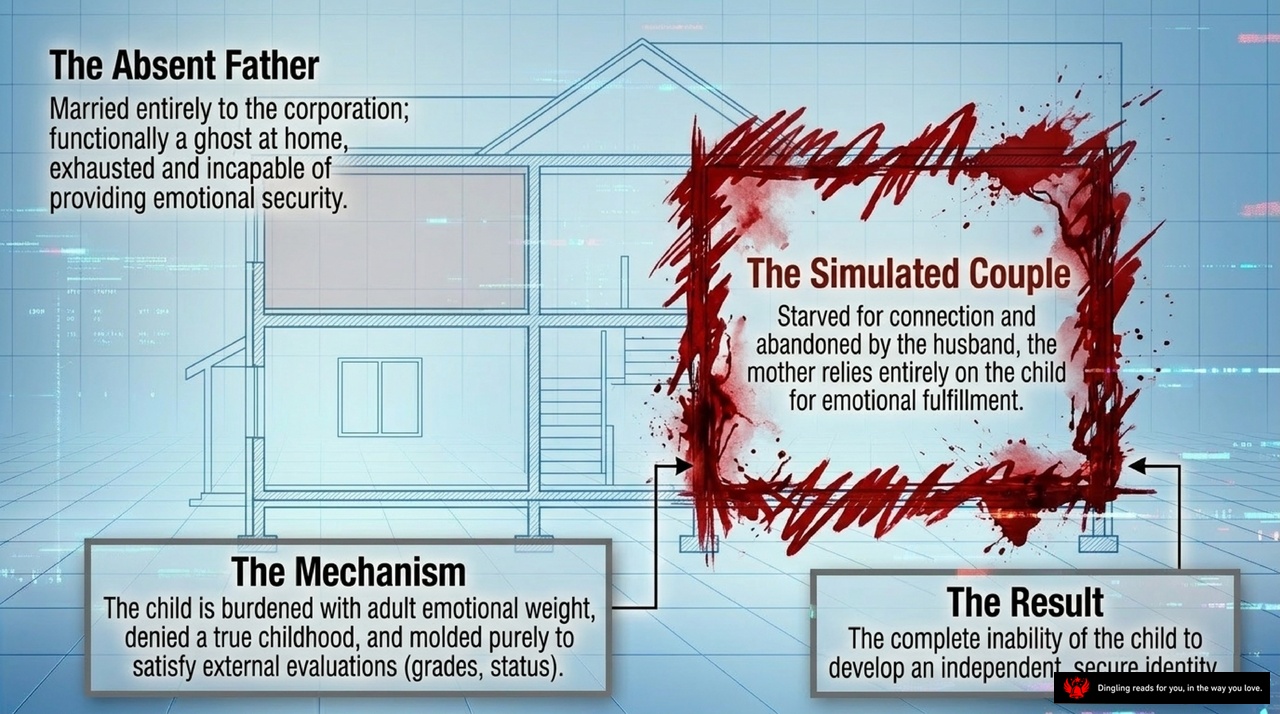
Picture this: a house that looks perfect on the outside, but inside, it's a cold, blue blueprint where no one actually lives. This slide captures the tragic cycle of "The Absent Father." The dad is so obsessed with his corporation that he becomes a ghost at home, exhausted and unable to offer real emotional security. Left behind, the mother starves for connection and ends up relying entirely on the child to fill that void, creating what the book calls "The Simulated Couple." In this twisted dynamic, the child isn't a kid anymore; they are burdened with adult emotional weight, forced to grow up too fast, and molded purely to satisfy external expectations like grades and status. The result? A complete inability for the child to ever develop an independent or secure identity. It's a haunting reminder that when parents prioritize performance over presence, the most innocent victim is often the one standing right in the middle of the room.

Look at this image. We see a human silhouette trapped inside a transparent capsule, surrounded by red arrows striking the glass. This visual perfectly captures the concept of "Capsule Humans"—a term describing how modern individuals seal themselves off to survive.
On the left, we see "The Defense Mechanism." Just like the capsule in the image, individuals build a protective shell to survive the constant barrage of being graded, judged, and optimized by society. We are afraid of being hurt or evaluated, so we retreat into this invisible bubble.
On the right, the image highlights "The Illusion of Connection." Inside the capsule, we might excel at superficial exchanges—trading data, talking about consumer goods, or making jokes. But as the arrows show, we fiercely block any attempt at genuine emotional intimacy. We trade information for safety, mistaking it for connection.
Finally, at the bottom, lies "The Tragic Trade-off." By refusing to let anyone step into our heart to avoid pain, we guarantee our own absolute, inescapable loneliness. We protect ourselves from the risk of rejection, only to end up in a state of total isolation. We are safe, yet utterly alone.

Look at this chilling grid: The Triad of Alienation. It maps the invisible chains binding modern society. On the left, we see the engine of destruction: Societal Pressure. Whether it's impossible sales quotas for the Salaryman, the demand for binary speed for the IT Engineer, or patriarchal beauty standards for the Daughter, the pressure is identical. It's a system that violently commodifies self-worth.
But how do they survive? The middle row reveals their desperate Coping Mechanisms. The Salaryman escapes into hyper-consumption and loans. The Engineer retreats into emotional detachment and binary logic. And the Daughter? She gets trapped in the Binge & Purge cycle. These aren't just personal failures; they are survival strategies against a crushing environment.
And the result? The bottom row shows the Tragic Outcome. Financial ruin and fugue states for the worker. Alienation from humanity for the coder. And the erasure of the physical body for the young woman. Despite these different surface symptoms, the underlying pathology is identical. As the text warns, this is a society forcing individuals to destroy themselves just to prove their right to exist. We are all trapped in this triad, fighting a war against ourselves.
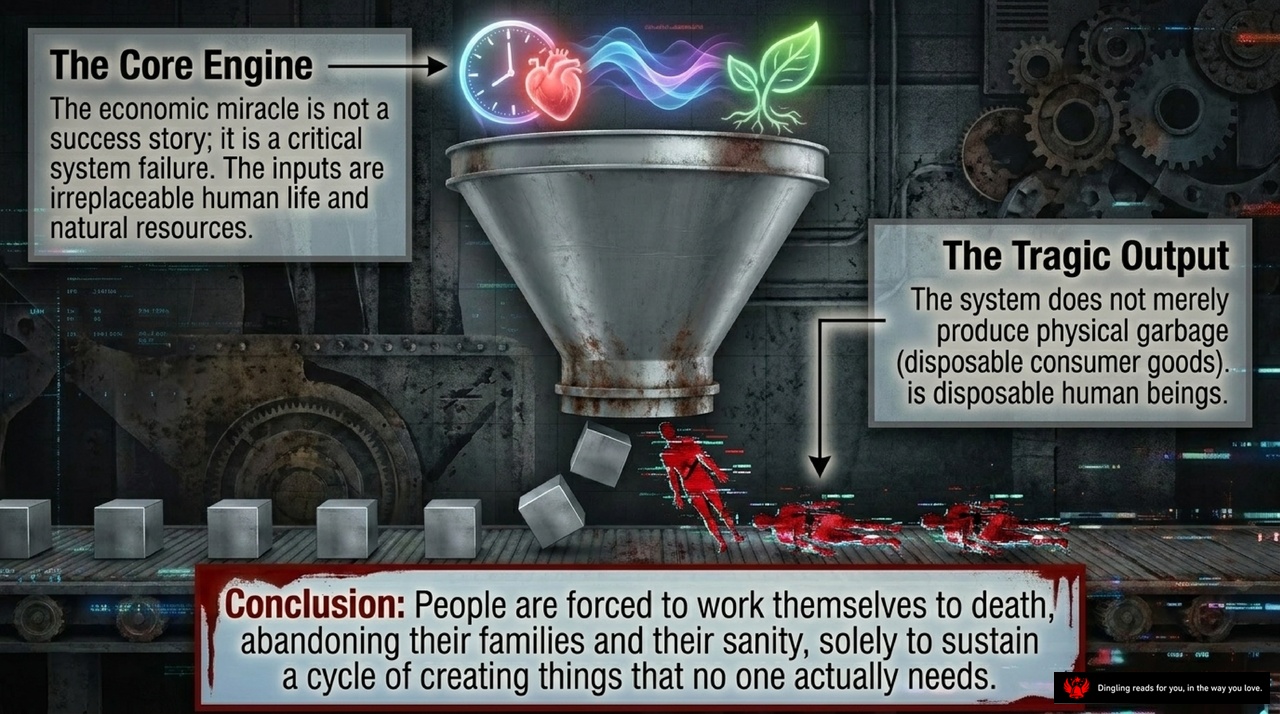
Look at this stark diagram. It shows "The Core Engine" feeding into a funnel, producing "The Tragic Output." The text argues that our economic miracle isn't a success story, but a critical system failure. It takes our most irreplaceable assets—human life and natural resources—and churns them into disposable human beings and physical garbage.
The conclusion is brutal: people are forced to work themselves to death, abandoning their families and sanity, just to sustain a cycle of creating things that no one actually needs.
This isn't just about Japan; it's a warning for us all. We've built a machine where the goal isn't human fulfillment, but endless production. We are told to keep consuming, to keep working, to keep filling a void that the system itself created. But as we see in the stories of these exhausted workers and broken families, the cost of this "miracle" is our very humanity. When we become disposable, when our worth is tied only to our output, we lose everything that makes us human. It's time to ask: are we running the economy, or is the economy running us?

In our relentless pursuit of efficiency, optimization, and material success, what parts of our own humanity are we quietly allowing to starve? Shigeo Saito's "The Perfectly Fed Poor" proves that an economic miracle built on the suppression of human nature inevitably leads to a society of robotic compliance and extreme psychological distress. We see this in the engineers who lose their empathy, the executives who collapse under debt, and the women who turn to eating disorders to fill a void no amount of money can touch. True poverty is not the absence of wealth, but the absence of authentic connection, unregulated time, and unconditional love. When we treat ourselves like machines and our lives like metrics, we don't just fail to thrive; we slowly starve the very soul that makes us human.