
The Whole-Brain Child: Complete Chapter-by-Chapter Summary

Welcome to our book club session on "The Whole-Brain Child." This isn't just another parenting guide; it's a roadmap to understanding the invisible engine driving your child's behavior. Written by Daniel J. Siegel and Tina Payne Bryson, this book offers twelve revolutionary strategies to nurture your child's developing mind through the power of integration.
Look at this cover image: a mother and child sharing a quiet, loving moment. That connection is the foundation of everything we'll discuss. We often know how to care for a child's body—checking temperatures or treating scrapes—but we frequently lack the knowledge about how their brain actually develops. It's fascinating to realize that a child's brain is shaped by the experiences and feelings we provide. Whether it's how we handle a scary moment or how we talk about daily events, our parenting style directly influences their brain structure.
The core promise of this book is simple yet profound: by understanding the brain, we can help children build a healthy emotional and psychological foundation. Instead of reacting to tantrums or confusion, we can use these insights to guide them toward a more integrated, peaceful life. Whether you're dealing with a toddler's meltdown or a teenager's anxiety, the strategies inside will help you turn those challenging moments into opportunities for growth. Let's dive in and discover how to support your child's whole-brain development.

Parenting transforms chaotic survival moments into prime opportunities to build a child's brain. On the left, we see the Survival Trap: during a tantrum or meltdown, the highest expectation for most parents is simply to survive the moment without losing their temper. But on the right lies the Thriving Opportunity. These exact high-stress moments are the best times to teach emotional regulation, resilience, and connection.
Think of it this way: when your child spirals into chaos, your instinct might be to just get through it. But that's where the growth happens. By staying calm and helping your child process their feelings, you aren't just surviving; you are actively wiring their brain for success. You are turning a crisis into a classroom. So, instead of fearing the storm, embrace it. It's the perfect chance to show your child that even in the toughest moments, they can find their way back to calm and connection.

Imagine your child's mind not as a static machine, but as a river. True mental health is the ability to stay integrated right in the middle of this River of Well-Being.
Look at the left side of our image: this is the Bank of Chaos. When a child lacks integration, they get pulled into emotional flooding—overwhelmed by fear, anger, or confusion. It's like being swept away by a raging current, completely out of control.
Now look at the opposite extreme on the right: The Bank of Rigidity. Here, the child clings to inflexible control and rigid logic. They refuse to compromise, getting stuck and unable to move forward.
The healthy path is right in the center: The Flow of Integration. When a child's brain is integrated, they navigate life flexibly and adaptively, staying in that central current. They can handle change without falling apart or shutting down.
Think of it like a boat. If you drift too close to the chaotic bank, you're overwhelmed. If you drift too close to the rigid bank, you get stuck. But when you stay centered, your brain's different parts—logic, emotion, and intuition—work together smoothly. This integration is the foundation for emotional resilience, better decision-making, and strong relationships. It's not about avoiding the riverbanks; it's about learning to sail confidently right in the middle.

Imagine the brain not as a single, uniform organ, but as a complex structure divided into five distinct architectural zones, each playing a unique role in how we think and feel. As shown on this slide, these zones map out the specific divides we need to bridge: Zone 1 handles the horizontal connection between logic and emotion; Zone 2 connects our conscious reasoning with our primal instincts; Zone 3 links our explicit memories with our deep, implicit feelings; Zone 4 centers around our sense of self; and Zone 5 bridges the gap between our individual identity and our social connections.
The core message here is that a fully integrated "whole brain" avoids the chaos of uncontrolled impulses and the rigidity of stubborn thinking. By linking these distinct parts of the mind, we allow them to function as a unified system. When these zones work in harmony, we move away from the extremes of emotional flooding or logical detachment, achieving a state of balance where we can respond thoughtfully rather than react impulsively. This integration is the foundation for emotional health, allowing us to navigate life's challenges with clarity and resilience.
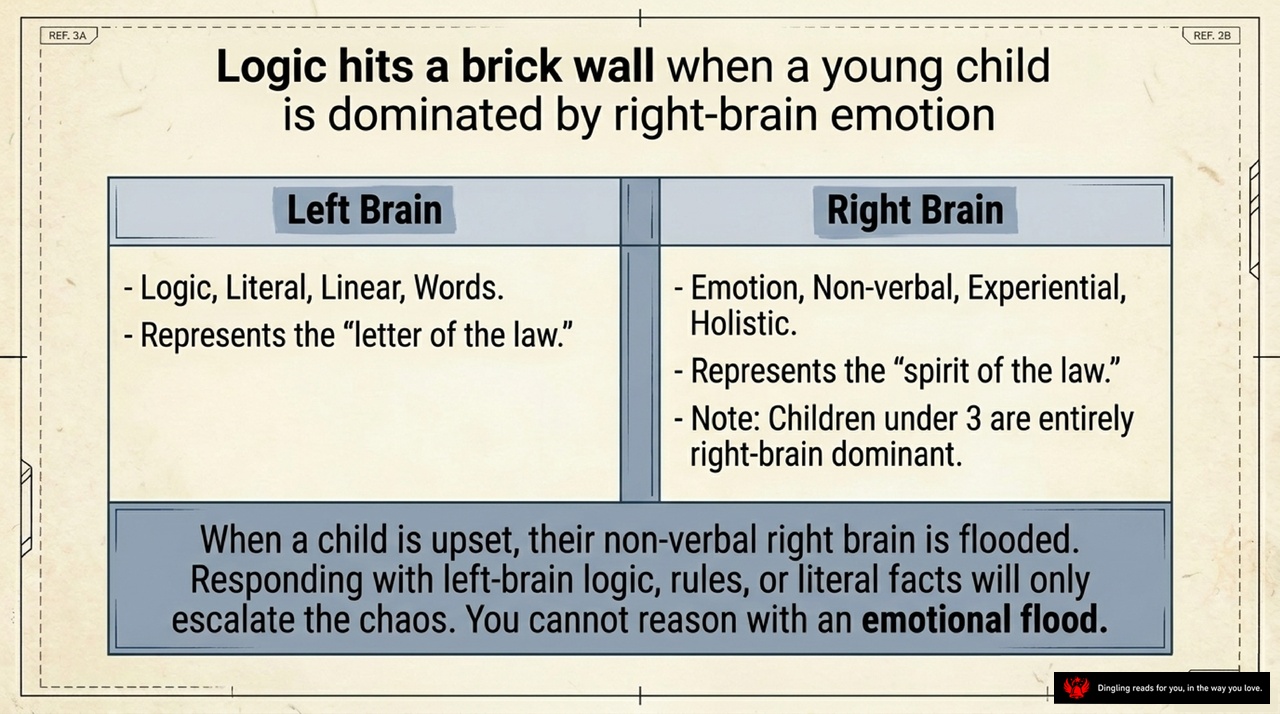
When a child is upset, their non-verbal right brain gets completely flooded with emotion. In that moment, logic hits a brick wall. If you try to reason with them using rules, facts, or literal explanations, you aren't just failing to solve the problem; you are actually escalating the chaos. You cannot reason with an emotional flood.
This is because, especially in children under three, the right brain is entirely dominant. It handles emotion, non-verbal cues, and holistic experiences—it represents the "spirit of the law." Meanwhile, the left brain, which handles logic, linear thinking, and words, represents the "letter of the law." When a child is overwhelmed, that left-brain capacity goes offline. Responding with left-brain logic at this exact moment is like trying to talk a person out of a panic attack by reciting statistics.
To truly connect, you have to match the brain that is currently active. You need to respond with empathy, using your own right brain to meet theirs. Only once the emotional flood subsides and the child feels understood, can you gently bring the left brain back online to discuss rules and solutions. This simple shift from logic to connection is the key to calming an upset child and helping their brains eventually integrate.
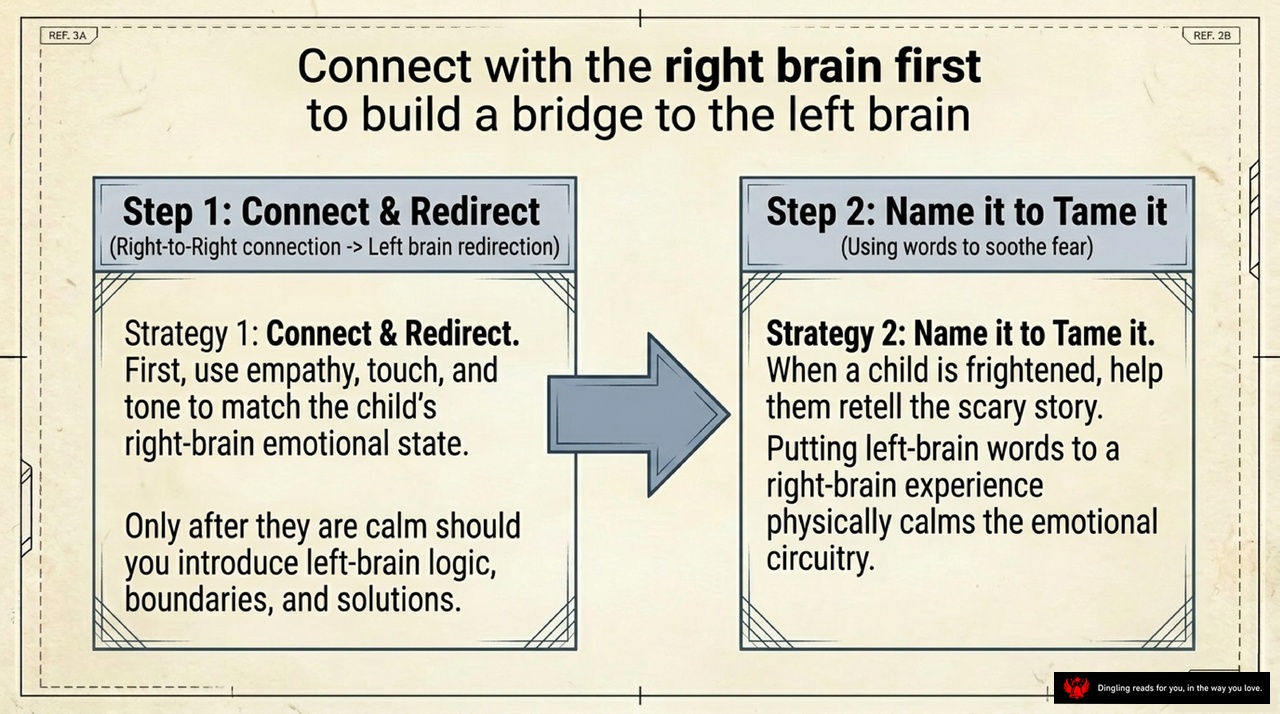
To connect with the right brain first and build a bridge to the left brain, we start by matching the child's emotional state with empathy, touch, and tone. This right-to-right connection calms the nervous system before we can introduce logic or boundaries. Only after they are calm should we bring in left-brain strategies like reasoning and problem-solving. Next, we use the power of words to soothe fear by helping the child retell the scary story. Putting left-brain language to a right-brain experience physically calms the emotional circuitry. By naming feelings and recounting events, we help the child integrate their emotions and logic, transforming overwhelming chaos into a manageable narrative. This two-step process—connecting first, then redirecting—creates a safe path for children to process trauma, regulate their emotions, and develop the resilience needed to navigate life's challenges with clarity and confidence.

Imagine your child's brain as a two-story house. Down in the basement lives the "downstairs brain"—the amygdala. It's the ancient, instinctive part that handles breathing, anger, and fear. Upstairs sits the "upstairs brain," the modern command center responsible for logic, empathy, and decision-making. But here's the critical catch: that upstairs brain isn't fully built until a child reaches their mid-twenties.
So, what happens when stress hits? The downstairs amygdala acts like a frantic security guard. It detects a threat and instantly slams the "baby gate" shut, locking the child out of the upstairs thinking brain. In that moment, the child is physically incapable of higher-order reasoning or empathy. They aren't being stubborn or manipulative; they are literally hijacked by their primitive instincts. To help them, we first need to open that gate and bring the upstairs brain back online before we can expect them to listen or learn.

To truly parent effectively, we have to look beneath the surface of a tantrum and identify its neurological source. This slide breaks down the critical difference between two types of outbursts: the "Upstairs Tantrum" and the "Downstairs Tantrum."
Think of the Upstairs Tantrum as a deliberate, manipulative decision made by the child's logical, thinking brain. In these moments, the child is fully capable of stopping instantly if they get what they want. Because they are in control, the parent's required response is to hold firm boundaries. You must not negotiate with a child who is essentially using a tantrum as a weapon to get their way.
On the other side, we have the Downstairs Tantrum. Here, the child has experienced a complete emotional hijacking where the amygdala—the brain's alarm system—has overloaded. In this state, they are physically incapable of self-regulation or logic. They aren't choosing to be difficult; they are overwhelmed. Consequently, logic will not work here. The parent's response must shift entirely to empathy, physical soothing, and connection. You need to help calm their nervous system before any teaching can happen.
Understanding this distinction changes everything. It stops us from punishing a child who is already overwhelmed and prevents us from negotiating with a child who is trying to manipulate us. By identifying which "tantrum" we are facing, we can deploy the correct parenting response to help the child's brain return to balance.
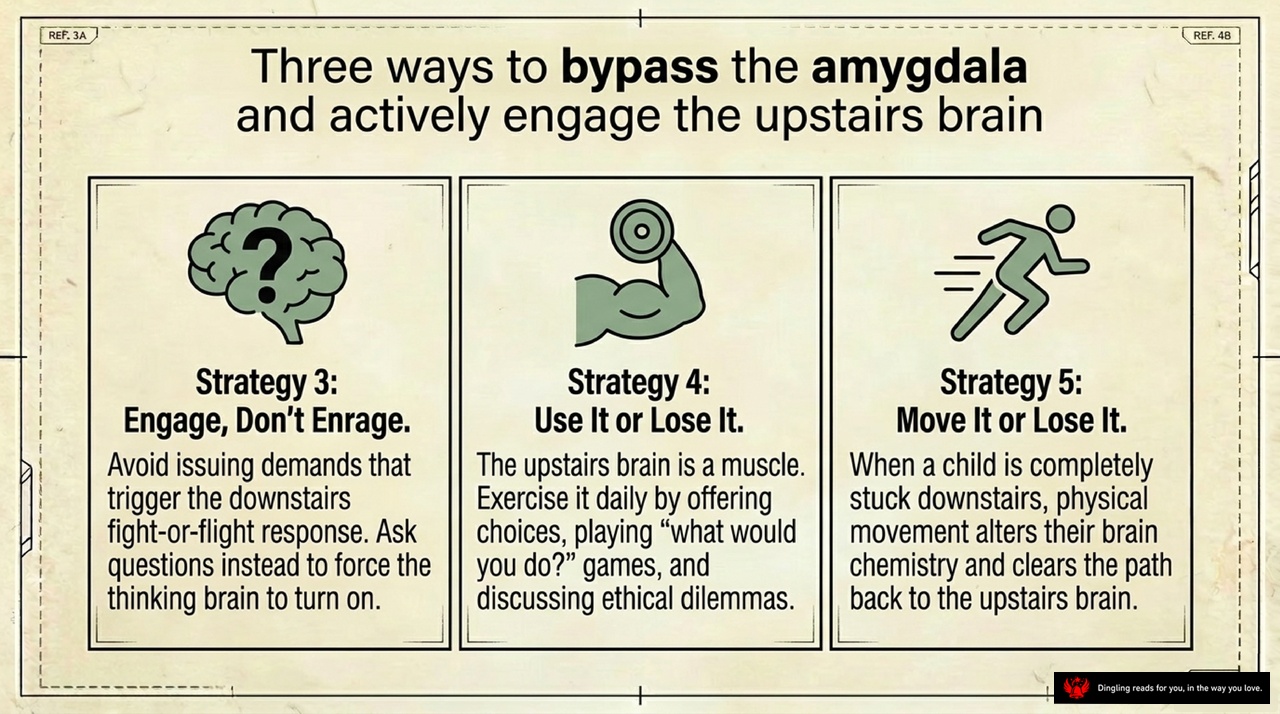
Imagine your child's brain as a two-story house. The downstairs brain, including that tiny almond-shaped structure called the amygdala, is the primitive guard dog. It's fast, reactive, and obsessed with danger, instantly hijacking the upstairs brain—the seat of logic, planning, and moral judgment—whenever it senses a threat. When the amygdala is in charge, your child isn't thinking; they're just reacting. So, how do we help them get back to the top floor? The book outlines three powerful strategies to bypass the amygdala and engage the upstairs brain.
First, try to engage, not enrage. Instead of issuing demands that trigger a fight-or-flight response, ask questions. This gently forces the thinking brain to turn on without triggering the alarm bells. Second, remember that the upstairs brain is a muscle. You can't just wish it stronger; you have to use it or lose it. Exercise it daily by offering choices, playing "what would you do?" games, and discussing ethical dilemmas. These moments build the neural pathways needed for better decision-making. Finally, when a child is completely stuck downstairs, overwhelmed by emotion, help them move. Physical movement alters their brain chemistry and clears the path back to the upstairs brain. Whether it's running outside or jumping in place, getting the body moving helps the brain find its balance again.

Imagine your child's brain not as a neat filing cabinet, but as a complex web of hidden associations. Today's slide reveals a critical concept: unintegrated implicit memories act as hidden emotional landmines.
Look at the diagram. On the left, we see "Implicit Memory"—scattered puzzle pieces representing unexplained fears and bodily sensations without context. These are the fragments our child feels but cannot name. When these pieces remain disconnected, they trigger irrational fear in present situations. The child reacts with panic, not because of what's happening now, but because of a buried, fragmented past.
The solution lies in the middle: The Hippocampus. This is the brain's master assembler. Its job is to take those scattered, emotional fragments and fit them into a conscious, completed narrative. On the right, we see "Explicit Memory"—the puzzle fully solved, where the child understands the story behind their feelings.
When we help a child retell a scary or confusing event, we are essentially using their hippocampus to disarm those emotional landmines. By turning vague fear into a clear story, we integrate the memory, allowing the child to move from chaos to calm.
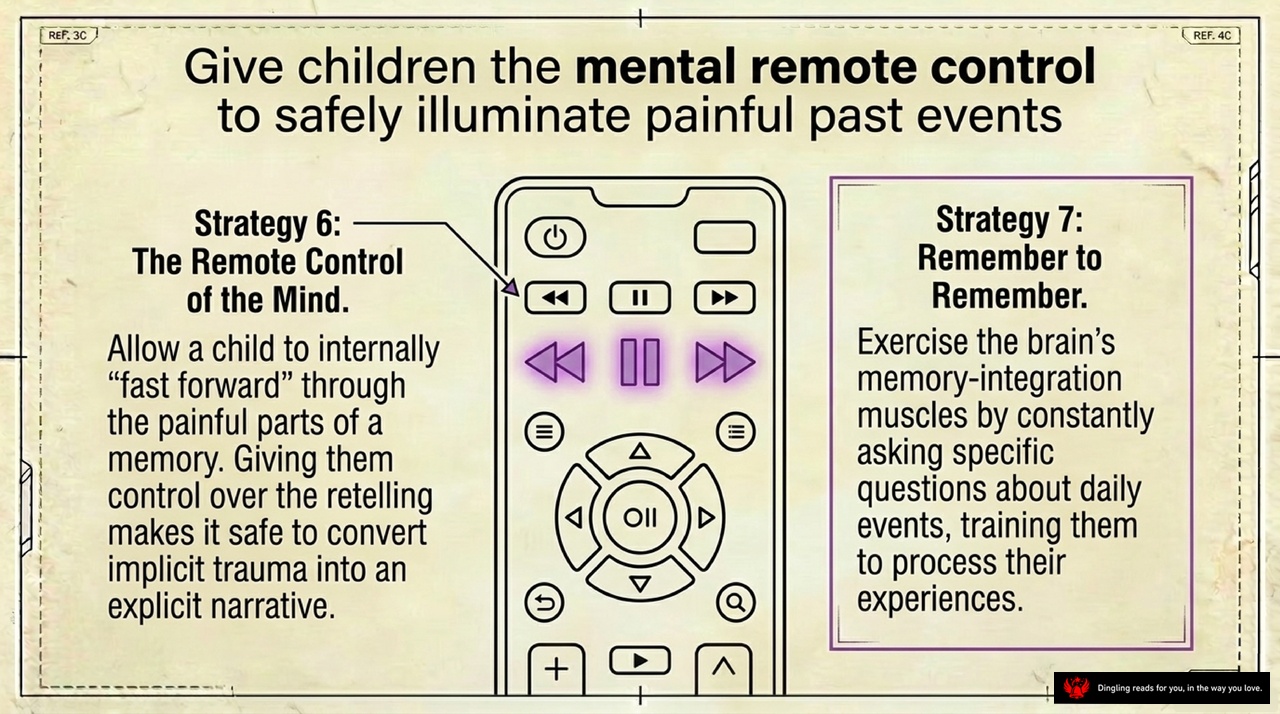
Imagine giving your child a mental remote control. This isn't about controlling their behavior, but empowering them to safely navigate their own past. Today's slide highlights two powerful strategies for doing just that.
First, look at Strategy 6: The Remote Control of the Mind. Think of a painful memory like a movie stuck on a loop in your child's head. Instead of forcing them to rewatch the scary parts, we teach them to "fast forward." By allowing a child to internally skip over the most painful moments of a memory, we give them a sense of control. When a child feels they are steering the retelling, it becomes safe to convert those hidden, implicit traumas into a clear, explicit story they can understand.
Next, we have Strategy 7: Remember to Remember. This is about strengthening the brain's memory muscles. By constantly asking specific questions about daily events—like "What was the best part of your day?" or "What was tricky?"—we help children process their experiences. This practice trains their brains to integrate new information, turning fleeting moments into solid memories.
Together, these tools help children move from being overwhelmed by the past to becoming the authors of their own stories. It's about turning confusion into clarity and fear into understanding.
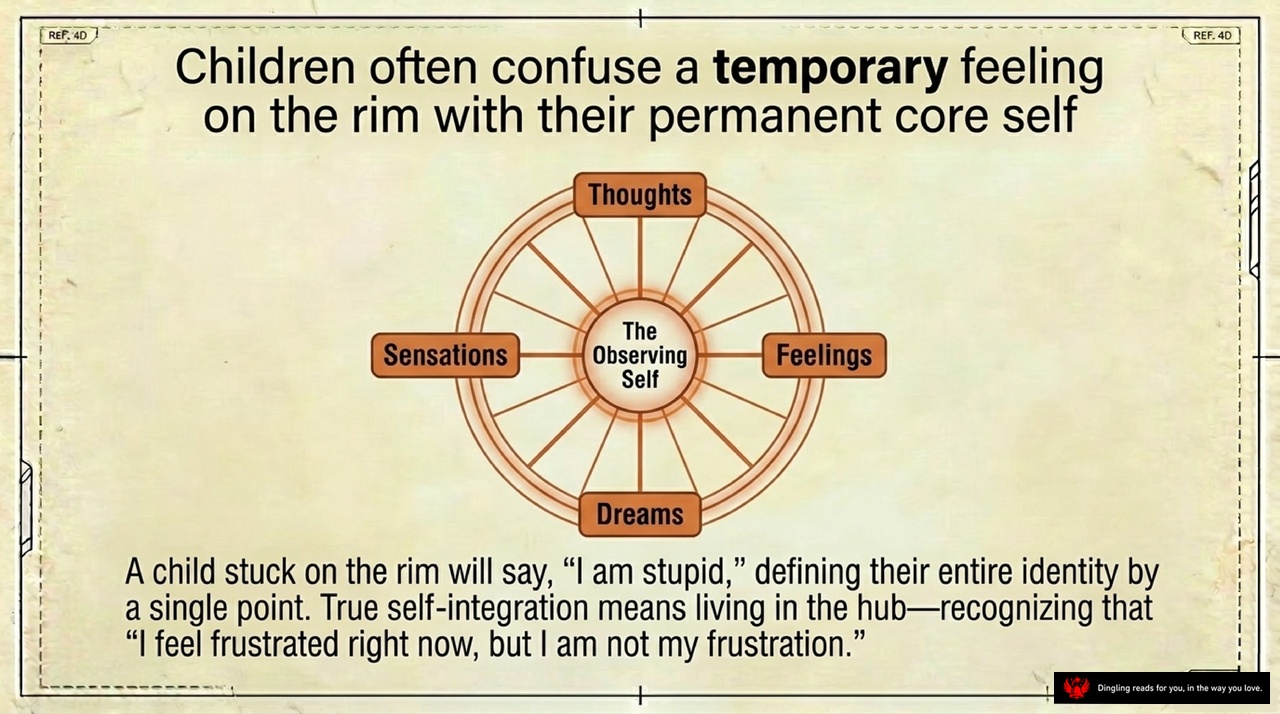
Imagine your child's mind as a bicycle wheel. Right in the center sits "The Observing Self"—the calm, permanent core that never changes. Spinning around it are the outer rim: Thoughts, Feelings, Sensations, and Dreams. These are temporary experiences, like passing clouds. But many children get stuck on the rim, mistaking a fleeting feeling for who they truly are. When a child identifies solely with a moment of frustration, they might say, "I am stupid," defining their entire identity by a single, passing point. This is the danger of losing the hub. True self-integration means living in that center. It means recognizing that while you might feel frustrated right now, you are not your frustration. You are the observer watching the feeling pass by. By helping children distinguish between the temporary storm on the rim and the steady ground of the hub, we give them the power to navigate life's challenges without letting them define their worth.
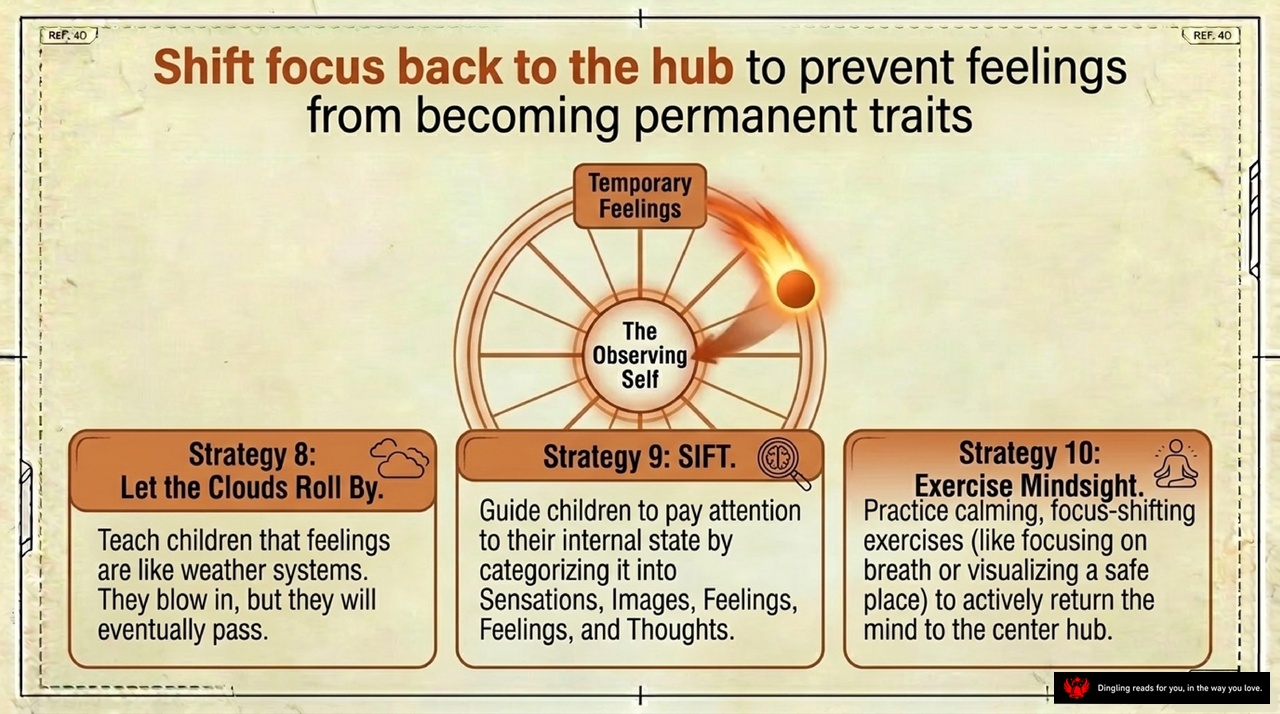
Imagine your child's mind as a spinning wheel with a calm center and a chaotic rim. The center represents the "Observing Self," a place of stability and choice, while the rim holds all those fleeting feelings, thoughts, and images that can easily pull us off balance. Today, we are exploring how to help children master this wheel so they don't get swept away by their emotions.
The first strategy is to "Let the Clouds Roll By." Just like weather systems that blow in and eventually pass, feelings are temporary states, not permanent traits of who a child is. By teaching kids that sadness or anger is just passing weather, we help them detach from the emotion and stay grounded.
Next, we introduce the SIFT method. This is a powerful tool to help children pay attention to their internal state. Instead of getting lost in a storm of feelings, they can categorize their experience into four parts: Sensations, Images, Feelings, and Thoughts. By naming these components, children gain a sense of control and begin to see their inner world clearly.
Finally, we encourage them to "Exercise Mindsight." This involves practicing calming exercises, like focusing on the rhythm of their breath or visualizing a safe, peaceful place. These techniques act as a gentle brake, actively pulling the mind back to the center hub of the wheel. When children learn to shift their focus back to this calm center, they prevent temporary feelings from becoming overwhelming, permanent traits. It is a simple yet profound way to build emotional resilience and a balanced mind.
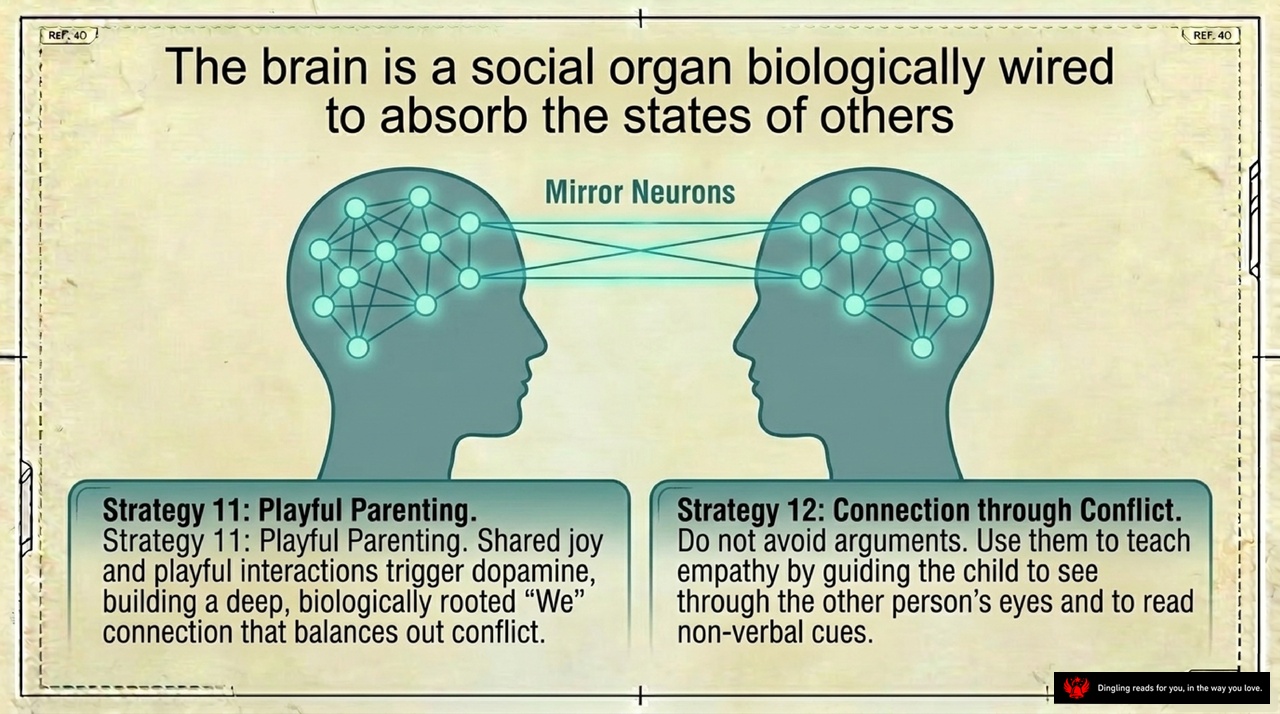
The brain isn't just a thinking machine; it's fundamentally a social organ, biologically wired to absorb the states of others. This is all thanks to mirror neurons, the invisible bridges connecting us. When we see someone else feel joy or pain, our own brain lights up as if we were experiencing it directly.
This biological wiring is the foundation for our two key strategies. First, let's look at Strategy 11: Playful Parenting. When parents and kids share joy through games and laughter, they trigger dopamine. This doesn't just make them happy in the moment; it builds a deep, biologically rooted "We" connection. It teaches the child that they belong, creating a secure base that naturally balances out future conflicts.
But what happens when things don't go smoothly? That's where Strategy 12 comes in: Connection through Conflict. Instead of avoiding arguments or trying to force peace, we should use them as teaching moments. By guiding a child to see through the other person's eyes and read their non-verbal cues, we turn friction into empathy. We help them understand that even in disagreement, they are still connected. Ultimately, by leveraging these mirror neurons, we move children from a self-centered "Me" to an inclusive "We," fostering the empathy and social intelligence they need for life.

Imagine holding your child's hand, walking together into the golden light of the future. This simple image captures the core message on our screen: a child's mind is a mirror of the environment we create. But true integration with our children doesn't start with them; it begins with the integration of our own minds.
Here is the crucial question we must ask ourselves: Are you reacting to your child from the ghosts of your own unintegrated past, or are you truly responding to the unique child standing right in front of you?
We often find ourselves projecting our own unresolved histories onto our children, mistaking our past triggers for their current needs. If our own minds are fragmented, our children's minds will reflect that chaos. The path to a healthy, integrated family starts with a parent who is whole. Only when we can see our child clearly—free from the distortions of our own history—can we help them build a stable, connected, and happy life.