
The Windup Girl: Complete Chapter-by-Chapter Summary
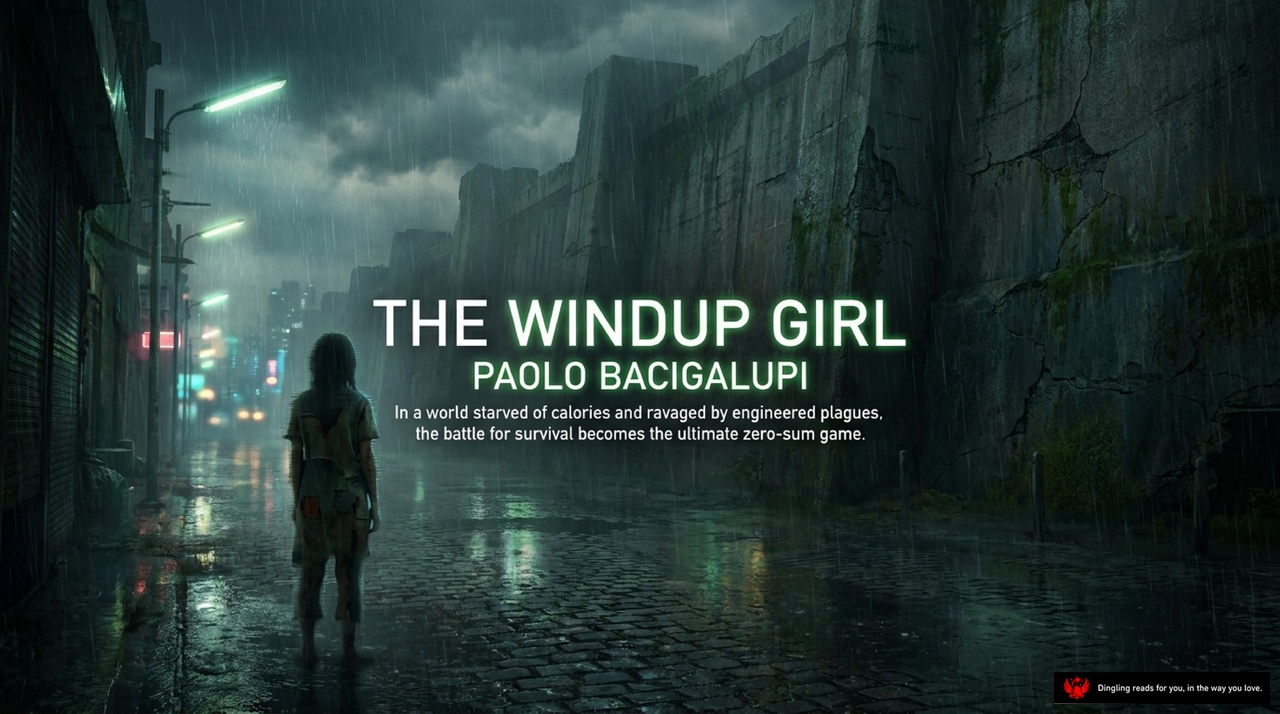
Welcome to the world of *The Windup Girl*, by Paolo Bacigalupi.
Picture a future Bangkok, drenched in relentless rain and choked by the smell of decay. The city is a crumbling mix of ancient temples and towering, decaying skyscrapers, where the air itself feels heavy with danger. In this dystopian landscape, survival is the ultimate zero-sum game. Calories are scarce, engineered plagues are rampant, and the battle for life has become a desperate struggle where one person's gain is another's loss.
At the center of this chaos is Anderson Lake, a man driven by a singular mission: to save humanity from the looming threat of global starvation. He believes that the key to our survival lies hidden within the seeds of the past, buried deep in the forgotten history of the Expansion Era. But as he navigates this treacherous world, he encounters a cast of unforgettable characters. There is Kanya, a fierce environmental officer fighting to protect her nation from corporate greed; there is Anderson's former secretary, Than Hosen, a man haunted by his past and desperate to rebuild his life; and there is Ema, a windup girl—a genetically modified being with the movements of a clockwork toy, whose very existence challenges everything we think we know about humanity.
This isn't just a story about technology or politics. It's a gripping exploration of what it means to be alive in a world on the brink of collapse. As Anderson digs deeper into the secrets of the Thai seed bank, he uncovers a conspiracy that threatens to tear the world apart. But with the help of his unlikely allies, he may just have the chance to turn the tide.
So, grab your seat, and let's dive into this thrilling journey through a future where the line between man and machine, life and death, is thinner than ever.

The global macro-environment is collapsing, and a terrifying new economic order is rising in its place. Look at the timeline: the expansion era is dead. Fossil fuels are depleted, global supply chains have failed, and trade volume is crashing into the abyss. We are entering a contraction where billions starve as unpatented crops are wiped out globally.
But in this dystopia, a new economy has emerged. The currency isn't money anymore; it's calories. One kilocalorie equals one unit of value. Power sources have shifted to kinetic energy—megadonts, kink-springs, and human labor generate the energy required to run machinery and survive. Food is literal power.
This isn't just about economics; it's about survival through engineered plagues. Calorie companies are releasing engineered diseases like Blister Rust and Genehack Weevil to enforce seed monopolies, ensuring only patented crops survive. The infection rate is a global pandemic, and patent enforcement is 90% effective. The result? A catastrophic calorie deficit and a rapid decline in the global population. This is the biopunk future we are facing: a world where life itself is a transaction, and the only way to survive is to control the very biology that keeps us alive.

The city of Bangkok is under siege, not by an enemy army, but by a creeping disease and a rising tide that threatens to swallow everything. Look at this diagram: as global sea levels climb, the only barrier protecting the sacred city is the massive Dike & Lock System, an engineering marvel built under King Rama XII to hold back the ocean. But even this fortress is cracking under the pressure.
Inside this enclosed zone lies the Sacred City, a place of strict isolationism and border quarantines. It's the only reason the city survived the plagues. Yet, survival comes at a terrible cost. In the factories, workers are exposed to contaminated seaweed and toxic sprays, leading to mysterious illnesses that spread faster than anyone can contain. The very mechanisms designed to keep the world out are now failing from the inside.
And outside these walls, the chaos is escalating. The White Shirts, the elite police force, are sweeping through the streets with brutal efficiency, shutting down ports and burning illegal methane stations. They don't care about the people trapped in the slums; they only care about enforcing the new rules of the regime. As the city burns and the water rises, everyone is fighting for their life, caught between a rising ocean and a collapsing government.
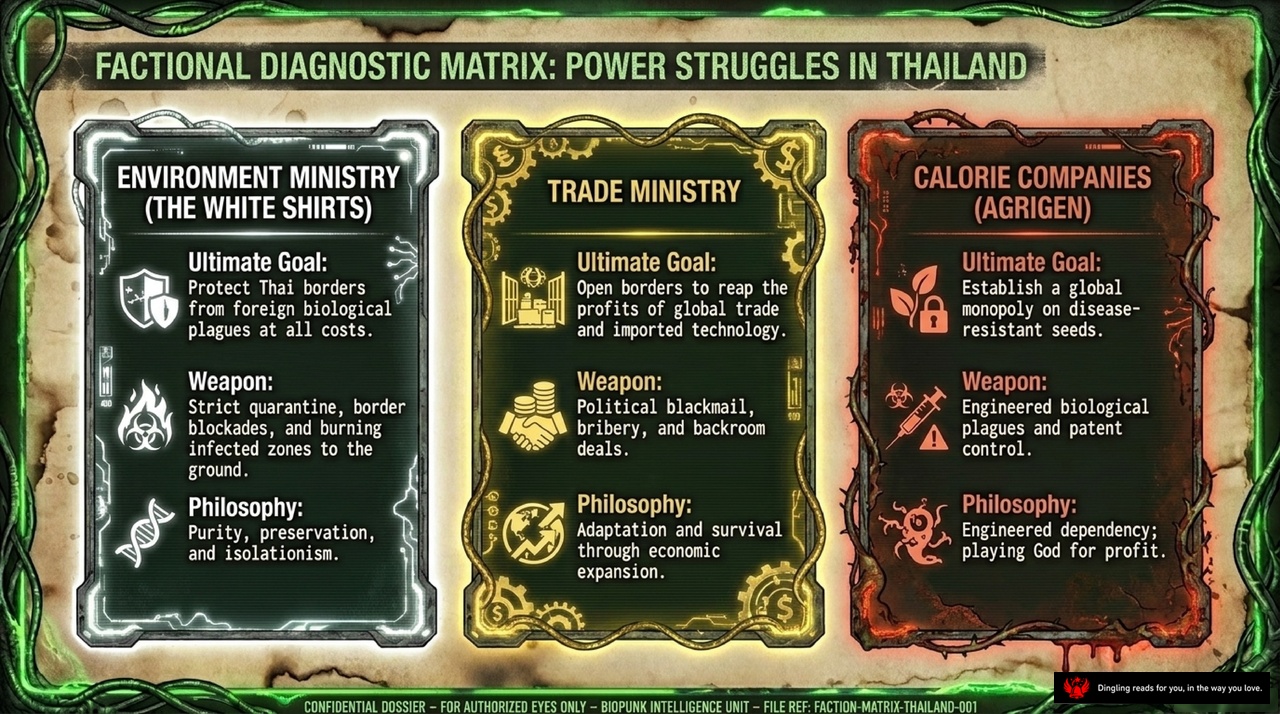
Look at this "Factional Diagnostic Matrix." It lays out the brutal power struggle tearing Thailand apart, revealing three distinct factions with completely opposing worldviews. On the left, we have the Environment Ministry, the "White Shirts." Their philosophy is pure isolationism; they believe in purity and preservation at all costs. Their weapon? Extreme quarantine and burning infected zones to the ground, treating the border like a fortress to keep foreign biological plagues out.
In the center sits the Trade Ministry. They represent the opposite extreme: adaptation and survival through economic expansion. Their goal is to open borders to reap profits from global trade and imported technology. But their methods are ruthless, relying on political blackmail, bribery, and backroom deals to push their agenda.
Then, on the right, we have the Calorie Companies, or AGRIGEN. They are the most dangerous of all, driven by a philosophy of engineered dependency and playing God for profit. Their ultimate goal is a global monopoly on disease-resistant seeds. To achieve this, they weaponize engineered biological plagues and patent control, ensuring that humanity remains dependent on their technology to survive.
This isn't just a conflict over territory; it's a fight over the very definition of life and the future of the nation.

The city of Bangkok has officially turned into a war zone. Tanks are rumbling over the streets, and armored elephants with mounted machine guns are mowing down anyone in their path. Students with machetes are charging at the machines, only to be cut down instantly. It's a slaughter.
But amidst this chaos, there is a new player rising from the ashes. Kan Ya, once the lieutenant under the fallen "Tiger of Bangkok," finds herself leading the remnants of the Environmental Department. She's no longer just a subordinate; she's the new commander. The city is burning, and she knows she can't just run away. She has to fight.
As she retreats into the woods, she realizes her team is being hunted like prey. They are surrounded, and the odds are against them. But Kan Ya isn't giving up. She orders her soldiers to use the trees as cover and keep moving. It's a desperate battle, and every second counts.
But the fight isn't just against the machines. There's a deeper conspiracy at play. Someone is trying to control the city, and they're not afraid to use anyone, including the clockwork people, to achieve their goals. Kan Ya knows she has to find out who is pulling the strings before it's too late.
The revolution has begun, and the future of Thailand hangs in the balance. Only time will tell who will emerge victorious in this brutal struggle for power.

Look at this dossier. It paints a terrifying picture of the Thai Seedbank, the ultimate prize in a world running out of time. This isn't just a vault of seeds; it's the kingdom's last line of defense against starvation, guarded with religious zeal by the Environment Ministry. But for the Calorie Companies, it's the ultimate biological prize. They desperately need this uncorrupted base DNA to engineer their next generation of patented, plague-resistant crops.
Inside, you have centuries of extinct, uncorrupted genetic material—think lost nightshade family, tomatoes, potatoes, eggplants. This is the clean, pure genetic code that the world has forgotten. Yet, the defense is absolute. The contents are surrounded by mechanical sentinels, a high-tech fortress where ancient biology meets brutal industrial control.
This is the core conflict driving the entire story. The desperate need for survival versus the corporate greed to weaponize nature. The Seedbank holds the key to the future, but getting to it will cost everything.
The city of Bangkok is burning, and the sky is turning a terrifying shade of red. Tanks are crushing through the streets, their treads grinding over everything in their path, while armored elephants with scythe-like tusks charge into the crowds, mowing down anyone who stands in their way. This isn't just a riot; it's a full-scale revolution, and the lines between friend and foe have completely vanished.
Amidst this chaos, a desperate race is underway. Tan Hao-son, now known as "Dog-Faced," is trying to survive. He's been forced to flee his factory, leaving behind the blueprints he desperately needs. He's hiding in the shadows, clutching stolen cash that feels like hot coals in his hand. His yellow card status makes him a target everywhere he goes, and the fear of being sent back to Malaysia, where the "Green Headbands" are waiting, keeps him trembling. He's lost his home, his wealth, and his dignity, yet he refuses to give up.
Meanwhile, the situation for the city's inhabitants is even more dire. The White Shirts, the environmental police, are no longer in control. They are being overrun. As the revolution erupts, the White Shirts are forced to retreat, but not without a fight. The streets are filled with the sounds of gunfire and the screams of the dying. The once-proud city is now a battlefield, and everyone is caught in the crossfire.
For Kanya, the head of the Environmental Department, the fight is personal. She's seen her commander, General Pracha, fall, and now she's the sole leader of a crumbling force. She's fighting not just for her own survival, but for the future of the kingdom and the thousands of civilians trapped in the ruins. She knows that if she loses, there's no going back.
And then there's Anderson, who has been captured by the new regime. He's in a dark, damp basement, surrounded by enemies. He's injured, his finger broken, and his ribs are aching. But he's not giving up. He's still thinking, still planning, still looking for a way out. He knows that the situation is changing, and he's ready to adapt to whatever comes next.
This is the moment where everything falls apart and everything starts anew. The old order is dead, and a new, uncertain future is being born from the ashes of the old one.

The city of Bangkok is burning. It's not just a metaphor anymore; the streets are literally being torn apart by the chaos of revolution. Tanks are rolling over the ruins, their treads crushing everything in their path, while armored elephants with scythe-tipped tusks mow down anyone who dares to stand in their way. It is a scene straight out of a nightmare, a true post-natural purgatory where nothing is natural, and humanity is forced to choose between adapting to the monsters they created or facing extinction.
In the heart of this destruction, the conflict between opposing philosophies is reaching its breaking point. On one side, you have the forces of engineered evolution, viewing nature merely as a raw resource to be mutated, patented, and controlled for profit. They believe the environment should adapt to human greed, no matter the cost. On the other side, there is the lingering belief in karma and the impermanence of all things, a desire to protect the remaining natural world rather than perverting it. But now, neither side has a choice left. The ecosystem is broken, and the pressure is forcing a collision.
As the revolution rages on, the lines between hero and villain blur. The "white shirts," the environmentalists who once tried to save the city, are now being overrun by the very trade forces they sought to contain. The once-proud "Bangkok Tiger," Jady, is dead, leaving a power vacuum that has been filled by ruthless opportunists like Akarat. The city is descending into anarchy, with students charging tanks with machetes and the poor paying the ultimate price for the greed of the powerful.
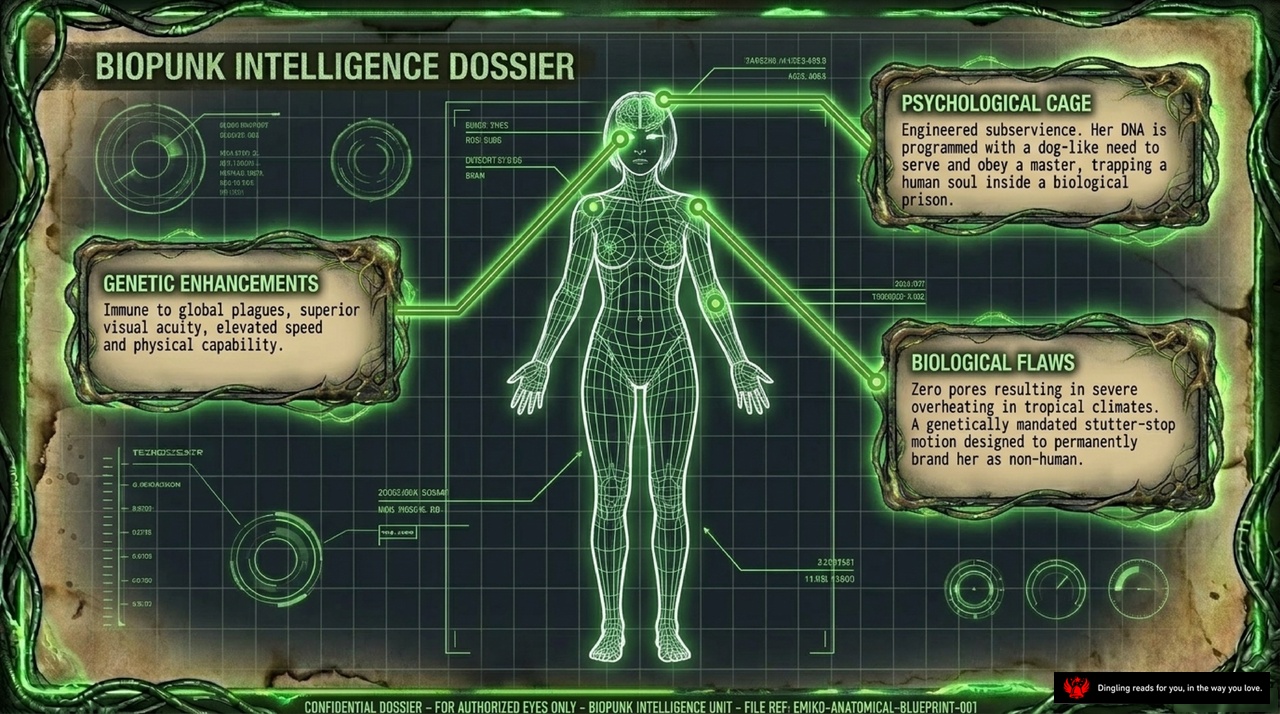
In this crucible of fire and blood, the characters we've followed are pushed to their limits. Anderson, once a confident scientist, is now a prisoner of circumstance, his health failing as the virus he helped unleash seems to be turning on him. Tan Haoson, the man who once believed he could control his fate, is now a fugitive, running through the ashes of his own life, holding onto a stolen blueprint that might be the only key to survival. And then there is the mechanical girl, Emiko, who has found a momentary respite only to be dragged back into the fray, her body a testament to the cruelty of a world that treats living beings as tools.
This is the moment where the philosophical collision becomes physical. The belief that nature is a resource clashes with the desperate need to preserve life. The engineered evolution of the past is now consuming the present, creating a cycle of violence that seems impossible to break. As the smoke clears over the burning city, one thing becomes clear: the old world is gone. The question now is whether a new one can be built from the ruins, or if humanity will be left to wander in this broken ecosystem, forever forced to decide whether to adapt to the monsters they created or go extinct.

The world is burning, and the line between hero and villain has been erased. As the flames of revolution consume Bangkok, the city has become a chaotic battlefield where tanks roll over innocent civilians and carbon-armored elephants tear through the streets. For Tan Hawson, a man who has already lost everything, this is the final moment of despair. He returns to his factory, only to find it overrun by death and despair. But amidst the chaos, a glimmer of hope appears—a newspaper clipping about the murder of the powerful Prince Songdet. This revelation sparks a new idea, a desperate plan to turn the tide against his oppressors.
Meanwhile, the political landscape shifts dramatically. Arakarat, the new power behind the throne, declares victory and promises a new era. But for Anderson, the cost of this revolution is personal. He is now a prisoner of the very system he tried to navigate, his body failing under the weight of a mysterious illness linked to the contaminated algae. As the city falls into darkness, the question remains: can anyone rebuild what was lost, or are we all just architects of our own extinction?