
Way of the Wolf: Complete Chapter-by-Chapter Summary

Welcome to the world of *Way of the Wolf* by Jordan Belfort. This isn't just another sales book; it's your blueprint to mastering the art of ethical persuasion and unlocking the science behind the Straight Line Sales System. Think of it as the ultimate upgrade for anyone who wants to stop chasing leads and start closing deals with confidence.
At its core, this system teaches you that all sales are actually the same, regardless of what you're selling or who you're talking to. The secret lies in building what we call the "Three 10s." First, your product must be a 10—undeniably the best in its class. Second, you, the salesperson, must be a 10, building deep trust and resonance with your client. And third, the company you represent must also be a 10, ensuring the client feels safe and confident in the organization behind the deal.
When you hit that perfect alignment where the product, you, and your company all score near 10 on a scale of certainty, the sale becomes almost inevitable. It's about removing every ounce of doubt from the client's mind. But here's the catch: if even one of these three elements drops to a 1, the entire deal collapses. That's why the Straight Line Sales System exists—to give you a clear, step-by-step path to guide a prospect from the very first moment of contact all the way to a signed contract, without ever losing their trust or interest along the way.

Influence isn't just about getting a "yes"; it's about the difference between ethical persuasion and manipulation. Look at the compass on the left—that's "The Spider-Man Rule": with great power comes great responsibility. We must strictly separate ethical persuasion from manipulation based on intent, the prospect, and the outcome.
Ethical persuasion starts with the intent to create real value and solve genuine pain. You aren't targeting anyone just because they have a pulse and a wallet; you are looking for qualified individuals who genuinely need your product. The result? Long-term client relationships built on trust.
Contrast that with manipulation. The intent here is extracting maximum commission, often at the expense of the buyer. You cast your net wide, targeting anyone with a wallet, regardless of need. The outcome is buyer's remorse and canceled contracts.
The Straight Line System provides the tools to stay on the ethical side of the line. It must solely be used to guide qualified prospects toward decisions that genuinely improve their lives. When you influence with integrity, you don't just make a sale; you build a legacy.

Here is the spoken-word script for Slide 2, tailored for an American audience with natural, engaging delivery.
**Script:**
"Let's be real for a second: humans are wired for survival, not shopping. Our brains are still running on that ancient reptile mode, scanning for threats the moment we meet someone. Science shows it takes less than a quarter of a second to visually scan you, and only about four seconds to form that snap judgment. If you miss those first four seconds, you've already lost the sale. There is no amount of great product or logic that can fix a broken first impression later.
So, what do you have to do in that tiny window? You need to hit three specific targets instantly. First, be sharp as a tack. You have to signal that you are quick-witted and decisive, showing the client you won't waste their time. Second, you need to be enthusiastic as hell. This isn't about faking it; it's about radiating a contagious, positive energy that signals genuine value. And third, you must position yourself as an expert in your field. Clients want to rely on authority, just like they do with doctors or top coaches.
If you fail to establish these three pillars—Sharp, Enthusiastic, and Expert—within those first four seconds, you lose control of the conversation before it even begins. The client's brain will have already categorized you as a risk, and they will walk away. This is why mastering your tone, body language, and presence from the very first greeting is the single most important thing you can do. It's not about what you say; it's about who you become in those critical first few seconds."

Unconscious communication drives ninety percent of human influence. Did you know that the words you actually speak only account for 10% of your persuasion power? The real magic happens in the other 90%, which is split evenly between how you sound and how you move. That's 45% tonality and 45% body language. Think about it: when your mom calls your name, do you rush over because she sounds angry, or do you ignore her because she sounds cheerful? It's the hidden internal monologue triggered by your tone that truly dictates your relationship with others.
In sales, most people fail because they focus entirely on their logical script while ignoring these powerful non-verbal signals. A perfect script is useless if delivered with the wrong tone or physical presence. True influence requires mastering this 90% that bypasses the logical brain and speaks directly to the gut. This is why you need to learn to regulate your voice and align your body language with your message. When you master tonality and body language, you stop fighting for attention and start guiding the customer's decision effortlessly.

Every successful sale follows the exact same architectural path. Think of your sales call as a straight line stretching from "The Open" to "The Close." Your only job is to move the prospect forward along this line, gathering intelligence while strictly maintaining the boundaries of control.
But here's the trap: if you drift too far off this line, you lose the deal. The diagram shows two dangerous zones. If you get too excited or aggressive, you fly up to "Pluto," which the system calls "Wasting Time." You're chasing a fantasy instead of closing. Conversely, if you become too passive or lose your edge, you drop down to "Uranus," labeled as "Losing Control." In this zone, the prospect takes over, and you're just a spectator.
The secret to mastering sales isn't about being perfect every second; it's about managing these deviations. When you hit Pluto or Uranus, the system gives you a simple tool: the "loop." Notice the white curved arrows on the chart? That's your reset button. Instead of panicking or giving up, you gently pull the conversation back to the center line. You regain control, collect more data, and continue pushing forward toward the close. Every single successful sale, whether it's selling a stock or a software subscription, looks exactly like this. It's all about staying on the straight line between the open and the close.

Imagine your prospect's mind as a high-security combination lock. To open it and close the deal, you need three absolute certainties, all dialed up to a 10. If even one gauge falls short, the vault stays locked.
First, the product. The prospect must absolutely love your idea, viewing it as the best in the class. Second, you. They must trust you personally and feel a deep connection with you as the salesperson. And third, the company. They must trust the institution you represent.
Here's the hard truth: a prospect enters your conversation with an unknown level of certainty. Your words, tone, and pacing are designed to push all three gauges to the top. If one gauge is low, the sale cannot close.
Think of this as a "three 10s" framework. You aren't just selling a product; you are building three pillars of trust simultaneously. If the product is perfect but they don't trust you, the deal dies. If you are likable but the company has a bad reputation, the deal dies. If the company is great but the product is mediocre, the deal dies.
Your entire sales strategy must focus on lifting these three dials. You need to provide a logical case so they understand the facts, and an emotional case so they feel the future. Only when the prospect is convinced on all three levels—Product, You, and Company—do you have the green light to ask for the business.
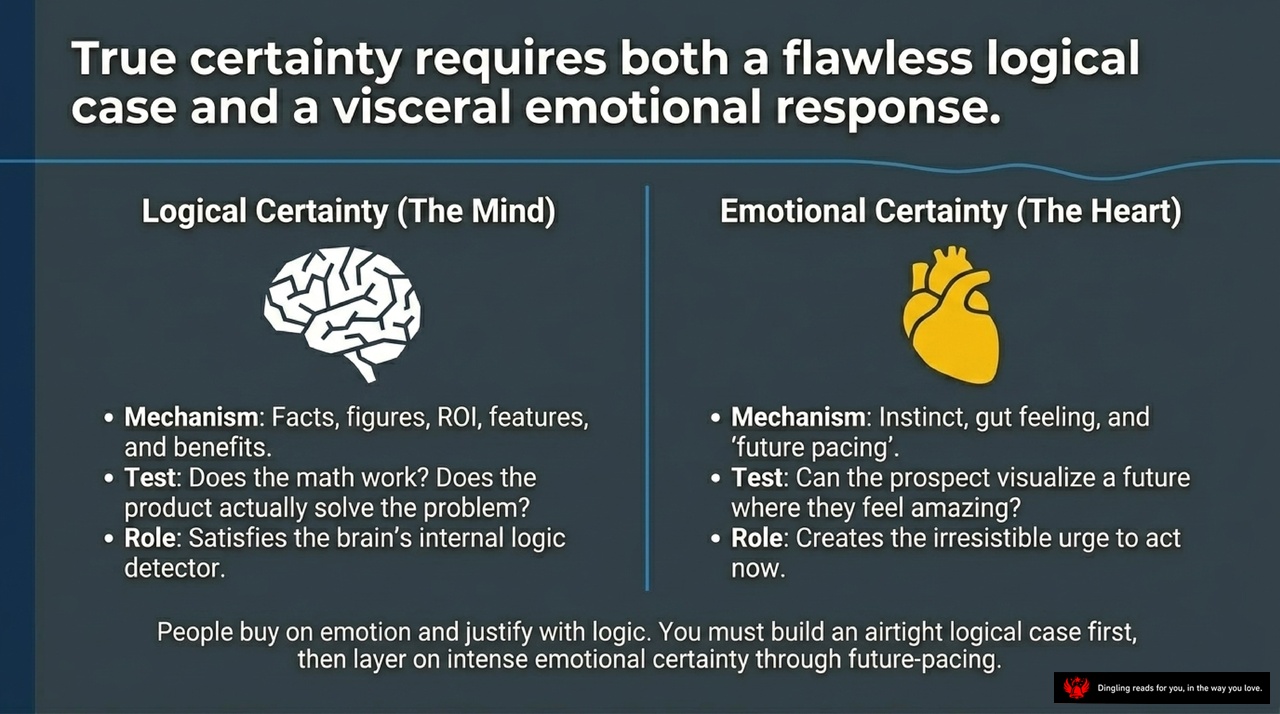
True certainty isn't just about having the facts right; it's about how your brain and your heart both say "yes." As we see here, you need a flawless logical case to satisfy the mind, but you also need a visceral emotional response to engage the heart.
Think of it this way: Logical certainty comes from facts, figures, and ROI. It answers the question, "Does the math work?" It satisfies the brain's internal logic detector. But without that, people will hesitate. On the other hand, emotional certainty relies on instinct and what we call "future pacing." Can the prospect actually visualize a future where they feel amazing? That creates the irresistible urge to act right now.
Here is the golden rule: People buy on emotion and justify with logic. If you only give them the logic, they'll stay on the fence. If you only give them the emotion, their rational mind will shut it down. You must build an airtight logical case first, and then layer on that intense emotional certainty. Only when both the mind and the heart are convinced can you truly close the deal.

Mastering tonality allows you to control the prospect's internal monologue. Think about it: when someone listens to you, their brain isn't just processing your words. It's actually hearing two voices at once. There's your voice, the one speaking the logical facts, and then there's their own internal monologue, which is driven entirely by your tone.
This slide breaks down exactly how three specific tonalities dictate what that hidden internal voice says. First, there's the "Reasonable Man" tone. Visually, it's smooth and steady. When you use this, the hidden message your prospect hears is, "I am reasonable, you are reasonable, and this is a highly reasonable request." It disarms their defenses by appealing to their logic.
Next, look at the "Absolute Certainty" tone. Notice how jagged and intense that waveform is. This isn't about being aggressive; it's about conviction. When you project this, the prospect's internal voice shifts to, "This is a profound truth. You can completely rely on this fact." It removes doubt before it even has a chance to take root.
Finally, we have the "I Care / Sincerity" tone. This waveform is softer, warmer, and more fluid. This is the secret weapon for building trust. When you use this, the hidden message becomes, "I genuinely understand your pain and have your absolute best interests at heart." It moves the conversation from a transaction to a relationship.
Remember, the prospect's brain hears both voices simultaneously. Deliberate shifts in tonality dictate exactly what that internal voice says. If you want to be a top performer, you can't just rely on what you say; you must master how you say it to align their internal monologue with your offer.

To achieve peak influence, you have to master your own internal state before you even speak a word to a prospect. Think of your mindset as a valve controlling access to your skills. If you approach a sale in a resourceful state, your abilities flow freely. But if you're operating from uncertainty or fear, even the greatest script in the world will fail. You simply can't deliver what you don't believe in.
That's why you must consciously trigger the "4 Cs" before engaging. First, **Certainty**: an unshakable belief in the value you provide. Second, **Clarity**: sharp, distraction-free focus on the prospect's specific needs. Third, **Confidence**: absolute faith in your ability to close the deal gracefully. And finally, **Courage**: the willingness to push past your comfort zone and simply ask for the order.
These four elements aren't just buzzwords; they are the foundation of everything we've discussed. Without them, you might have all the right techniques, but you'll lack the presence to execute them. So, before you pick up the phone or walk into a room, take a moment to check your state. Make sure you are certain, clear, confident, and courageous. Because when you align your internal state with the Straight Line System, you stop chasing success and start commanding it.

Olfactory Anchoring triggers a peak state of absolute certainty on demand. This isn't magic; it's a biological hack for your brain. Think of it as programming your own neurochemistry to enter the zone instantly before a call.
The process follows five simple steps. First, choose your target state. For sales, this is "Absolute Certainty." Second, visualize a vivid memory of closing a massive deal. Make that internal image bigger, brighter, and closer until the feeling is real. Third, intensify that emotion until it hits its peak.
Now comes the critical fourth step: Fire the Anchor. At that exact moment of emotional intensity, use a unique olfactory trigger—like a specific scent—and internally shout "Yes!" This links the physical sensation of the smell directly to that peak feeling of success. Finally, stack and repeat this process after every real-world win. Every time you hit a new high, reinforce the anchor again.
The human brain can be programmed. By linking an intense, naturally occurring peak state to a unique physical and olfactory trigger, you biohack your chemistry. Next time you face a client, you don't just hope for confidence; you trigger it on demand with a single breath.

Surface objections are merely smokescreens for underlying uncertainty. Think of it like an iceberg: the polite excuses you hear—"Let me think about it," "Send me some materials," or "It's a bad time of year"—are just the tiny tip above the water. The massive, hidden reality beneath is simple and often uncomfortable: the prospect simply isn't at a 10 on the product, you, or the company.
In the world of high-level selling, an objection is rarely a definitive "No." It's actually a polite fiction used to avoid confrontation when certainty is lacking. If you attack the excuse, you miss the point entirely. The real game is to ignore the surface noise and address the root cause of that uncertainty. Your only job is to systematically raise the prospect's confidence on all three fronts—product, person, and company—until the hidden iceberg breaks the surface and they feel safe enough to say yes.

The Looping Cycle is your secret weapon for turning objections into opportunities. Instead of arguing, you simply deflect with phrases like, "I hear you, but let me ask..." This acknowledges the prospect without starting a fight. Next, you reassess by asking if the idea still makes sense to gauge their baseline logic. Then, you resell the "3 10s"—the product, you, and the company—by presenting a tighter case. Finally, you re-ask using a soft "Reasonable Man" close to test the new level of certainty. Every time you loop, you systematically elevate the prospect's certainty closer to a 10, all while maintaining rapport. This elegant process ensures you never break the connection, even when things get tough.

Imagine a simple seesaw balancing your prospect's decision to buy. On one side sits the "Action Threshold"—the invisible barrier holding them back. This side is heavy with fears: the fear of looking foolish, the fear of losing money, and a deep resistance to change. On the other side, you have the power to place weights like "Money-back guarantees," "Cooling-off periods," and promises like "I will hold your hand." The core truth here is that a prospect will only buy when the certainty you provide outweighs their action threshold. For highly skeptical buyers, logic isn't enough; you must actively lower that threshold by systematically removing the psychological risk of saying yes. Think of it as cracking a code: just like a thief needs the right numbers to open a safe, you need to dismantle every fear in their mind to unlock their wallet.
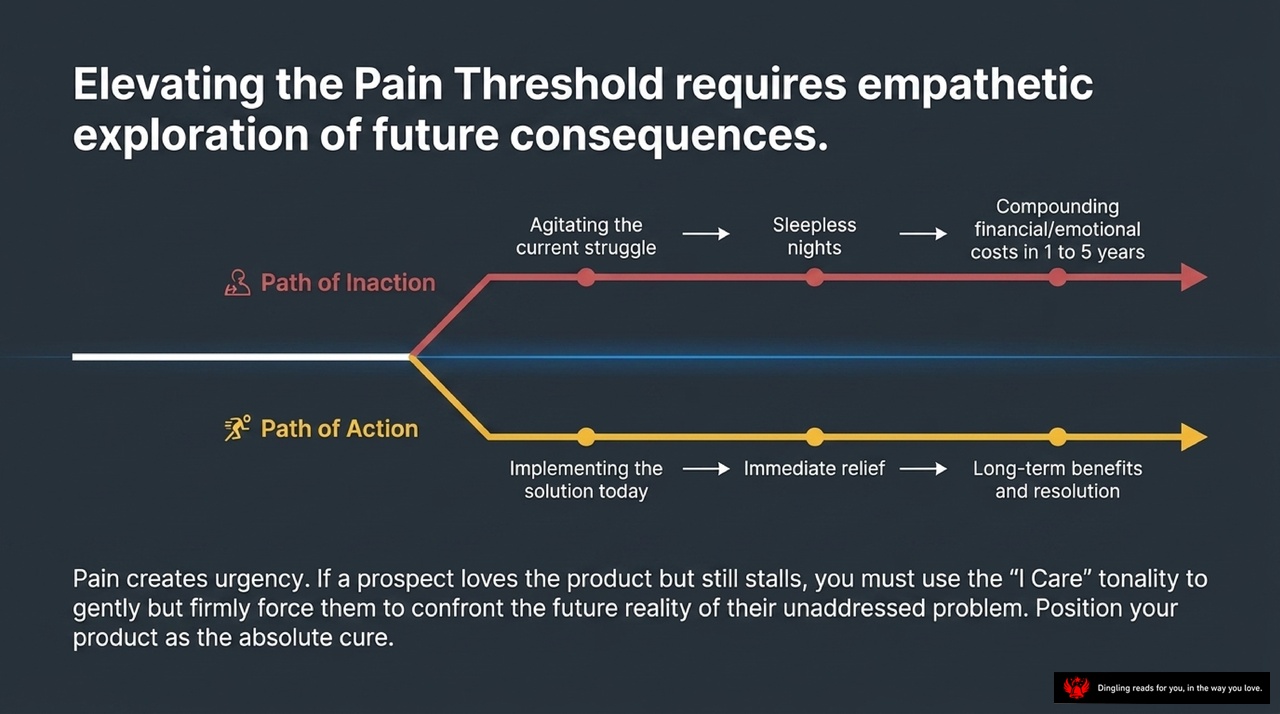
Elevating the pain threshold isn't just about being tough; it's about showing genuine empathy for the future they are walking into. Look at this path of inaction. Right now, they might just be agitating their current struggle, but if they don't act, that pain compounds into sleepless nights and eventually, massive financial and emotional costs over the next five years. That future is terrifying, and that fear creates the urgency they need to move.
Conversely, look at the path of action. By implementing the solution today, they don't just get immediate relief; they unlock long-term benefits and true resolution. Pain is the catalyst, but you have to guide them to see that the cost of staying stuck is far higher than the cost of change. If a prospect loves your product but still stalls, you must use an "I Care" tonality. Don't just push the sale; gently but firmly force them to confront the harsh reality of their unaddressed problem. Position your product not just as a tool, but as the absolute cure for that future pain. When they finally feel the weight of that future, the decision becomes obvious.

Look at this blueprint. It's the core of unlocking a closed sale, and it's not magic; it's a measurable, repeatable science.
At the very center, we have the "Three 10s." This is the foundation. You must maximize the certainty your client has regarding the product, you, the salesperson, and the company. If the client sees the product as the best on the market, trusts you as a genuine expert, and believes in the company's reputation, you are building a solid base for the deal.
Moving outward, we lower the Action Threshold. This means removing all perceived risk. You want the client to feel safe, knowing that the product, you, and the company are all aligned and reliable. When risk is removed, hesitation disappears.
Finally, at the outermost ring, we elevate the Pain Threshold. This is where urgency is established. You must make the problem they are facing feel so acute that the solution you offer becomes the only logical choice. By systematically aligning these psychological triggers—logic and emotion—you can ethically influence anyone who is genuinely qualified.
Remember, this Straight Line System works because it manages the conversation boundaries and keeps the client moving forward along a clear path to a "yes."