
The Woman in the Dunes: Complete Chapter-by-Chapter Summary

Welcome to our deep dive into *The Woman in the Dunes* by Kobo Abe. This isn't just a story about a man who runs away to find rare insects; it's a gripping psychological thriller that explores the terrifying architecture of freedom. When August descends into the shifting sands to escape the mundane, he discovers that true freedom might be far more dangerous than the cage he thought he was breaking. Join us as we uncover the secrets hidden beneath the dunes.
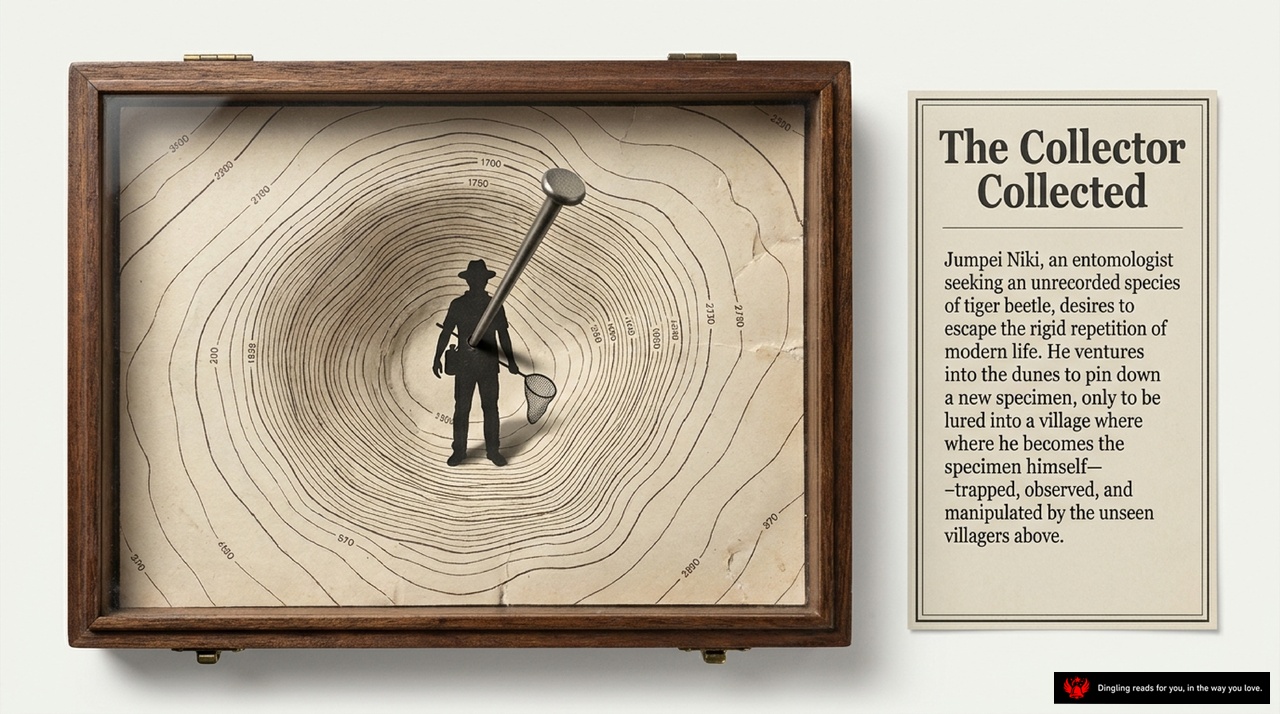
Imagine a wooden box, a collector's case, holding a map of the world that looks more like a target than a terrain. In the center, a silhouette stands, pinned down by a massive nail, surrounded by concentric rings that pull everything inward. This isn't just a map; it's a trap. To the right, the text reveals the story: "The Collector Collected." It introduces Jumpei Niki, an entomologist tired of the rigid repetition of modern life. He escapes the city, seeking an unrecorded species of tiger beetle in the dunes, hoping to find something new to pin in his collection. But the irony is cruel and inevitable. He ventures into the shifting sands, only to be lured into a village where he becomes the specimen himself—trapped, observed, and manipulated by unseen villagers above. The image captures this perfect inversion: the hunter becomes the hunted. The man who wanted to escape the rigid world finds himself trapped in a loop, pinned down by the very nature of the place he sought to explore. He thought he was collecting insects, but he didn't realize that in this village, he was the only thing left to be collected. The sand, ever-flowing and consuming, mirrors his fate, pulling him deeper into a life where he is no longer the observer, but the observed.

Sand isn't just a pretty landscape; it's an active, hostile force defined by the physics of fluid dynamics. Look at the 1/8mm particle shown here—it's the perfect size for wind to transport, turning sand into an unstoppable fluid that erases everything in its path. This relentless flow rejects all rooted, static life, rotting wood and destroying structures that try to stay put. It represents the ultimate formlessness, threatening humanity's desperate need to leave a permanent mark on the world. As August discovers, the village is trapped in a battle against this invisible enemy, where every house and every day is slowly erased by the sand's relentless advance.

Look at this diagram. It's not just a house buried in sand; it's a living trap. This is the anatomy of the Antlion's Pit. Notice how the village itself is parasitic architecture. The houses aren't built on the surface; they are dug deep, 20 meters down into the earth. There are no stairs, no paths. The only way in or out is a single rope ladder, and here is the terrifying part: it is controlled entirely by the villagers above. When they pull the ladder away, the physical geometry of the trap becomes absolute.
Now, look at the three critical threats labeled here. First, we have the Overhanging Cornice. That's 20 meters of unstable sand threatening to bury the house at any moment. Second, the Crumbling House itself. The rotting wood is sustained only by constant digging; the sand is actively eating the structure from the inside out. And third, the Missing Lifeline. That ghostly outline marks where the rope ladder used to hang. It's a visual reminder of how quickly freedom can vanish.
This isn't just a story about a man getting lost; it's a lesson on how easily we can be trapped by systems we don't understand. The sand flows like a liquid, and without a ladder, there is no escape. It's a brutal, absolute trap where the ground itself is the enemy.

In this pivotal moment, August shifts from a prisoner fighting against the sand to a survivor learning from it. Look at the table: his identity is no longer defined by documents and social contracts, but by immediate survival. He realizes that true freedom isn't about the ability to move freely, but about accepting the bounds of his reality.
Where he once saw the sand as an enemy to be conquered, he now understands it as an inescapable, harsh, yet necessary companion. His response to captivity has transformed from furious resistance and demands for legal rights into a passive acceptance, finding meaning in the daily maintenance of their rotting house. He stops trying to escape the sand and instead learns to find water within it, realizing that survival in this world requires adapting to the flow rather than fighting against it.

Imagine a world where survival isn't about building a future, but simply fighting to stay in the present. This is the Sisyphean Economy, a brutal cycle of endless labor with no reward. It starts with a constant threat: sand falling endlessly from the dunes, an unstoppable force that threatens to swallow everything. To survive, the villagers must engage in relentless labor, shoveling sand furiously through the night, just to keep their homes from collapsing.
But the cycle doesn't stop there. This desperate work creates a dark commerce. The sand they clear isn't just waste; it's illegally sold for cheap construction projects, fueling the very demand that keeps them trapped. This extraction feeds back into the threat, ensuring the sand keeps falling. And finally, the result is a harsh ration. The villagers are left with meager supplies, lowering a single bucket of water to survive another day.
At the center of this loop lies a haunting question: "To live for the sake of clearing sand, or to clear sand for the sake of living?" In this economy, the act of living has been completely reversed. They are no longer clearing sand to live; they are clearing sand just to continue the cycle of clearing. It is a trap where the effort to survive only guarantees that survival will always be just out of reach.

Imagine a man named August, once a respected teacher and insect collector, who vanished into the sand dunes of a remote coastal village, only to be swallowed by its relentless, shifting landscape. His journey wasn't just a physical escape; it was a terrifying descent into despair, marked by four distinct stages of collapse.
It all began with **Denial**. August initially believed that his disappearance would trigger a massive police search. He relied on his identity as a tax-paying citizen, convinced that modern society and the law would inevitably find him. He didn't expect to be forgotten or lost.
But the reality of the dunes was far more cruel, forcing him into **Bargaining**. Desperate for help, he faked a debilitating illness—claiming he had suffered a sunstroke or a dislocated spine. He used this lie as a desperate transaction, trying to force the villagers to send a doctor. He thought he could trade his health for his freedom, bargaining with a world that didn't care for his suffering.
When that failed, his situation escalated into **Violent Resistance**. He tried to fight back by binding and gagging a woman, taking her hostage to demand the rope ladder that would lead him out. He believed force could break the village's control. But he was betrayed; he was dropped back into the pit, realizing that violence only deepened his trap.
Finally, August reached **Existential Surrender**. This was the most painful realization of all: the understanding that legal rights, logic, and the rules of modern civilization have absolutely no jurisdiction in the sand. In that desolate place, no one was in charge but the wind. He realized he was not a prisoner of people, but a victim of a force that could not be reasoned with or fought against.

Picture shows a man struggling on a steep, shifting slope, surrounded by physics labels like "Gravitational Force," "Normal Force," and "Kinetic Energy Trigger." The diagram illustrates how his own energy becomes the mechanism of his burial, making escape mathematically impossible.
In the book, August learns that physical strength cannot defeat a fluid enemy. Every attempt to scale the walls triggers an avalanche. The more he struggles, the faster he sinks. The sand's perfect balance of weight and resistance turns his own energy into the mechanism of his burial. Escape is mathematically impossible.
This slide perfectly captures August's tragic realization. He thought he was fighting the sand, but the sand was fighting back using his own momentum against him. The diagram labels show how gravity pulls him down, while his movement creates kinetic energy that only accelerates the avalanche. He isn't just sinking; he's being actively buried by the very physics he tried to overcome.
This is the "Physics of Failure." It's not about weakness; it's about the environment turning your resistance into your downfall. August's story teaches us that sometimes, the harder you push against an unstoppable force, the quicker you get consumed by it. The sand doesn't hate him; it just follows the rules of nature, and in doing so, it wins.

Imagine a moment where total failure becomes your greatest victory. That's exactly what happened here. Jumppei, desperate to catch a crow to attach a message to its leg, built a trap. It failed miserably. The bird never bit. But in that buried bucket meant for the trap, something unexpected happened. The sand around it didn't just sit there; it worked. Through capillary action, moisture from the deep, cold sand was drawn upward, pooling inside the bucket. The failed trap inadvertently became a pump, creating a reservoir of pure, potable water. This accidental triumph is what we call the 'Hope' Mechanism. Sometimes, when our plans collapse, the very elements we thought were obstacles become the solution we needed all along.
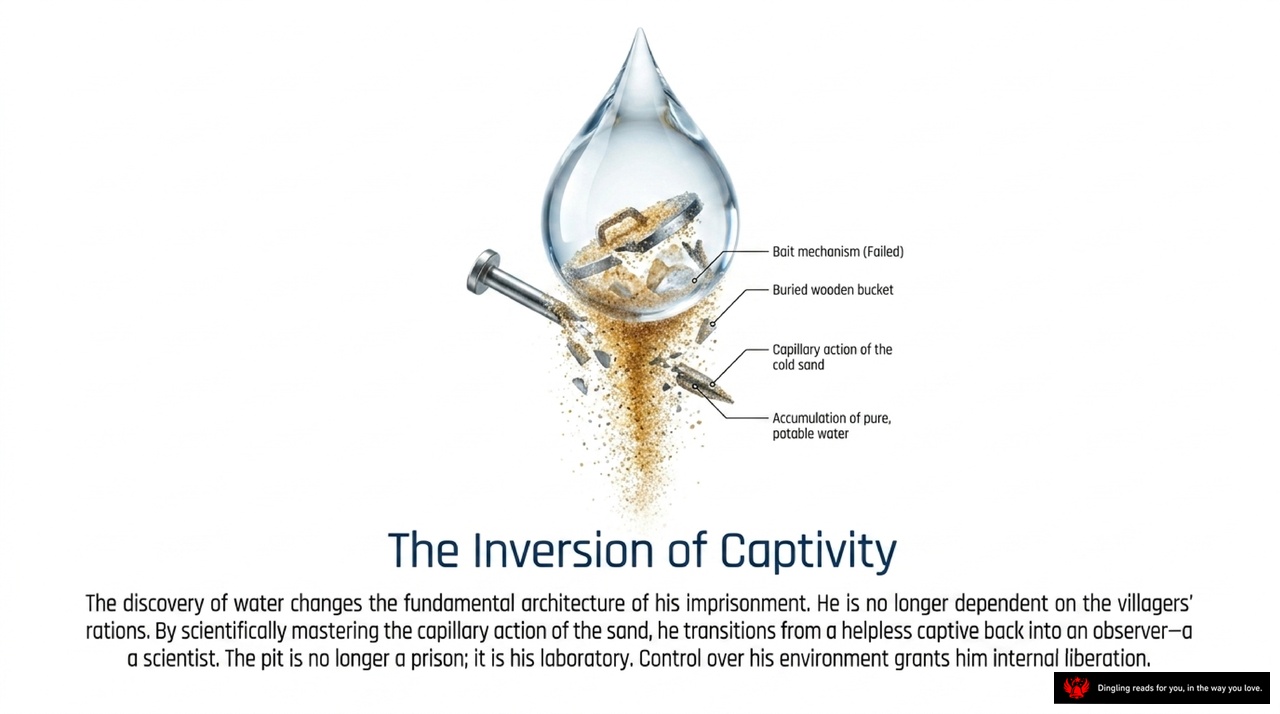
The image illustrates a profound transformation: from a trapped prisoner to a master of his environment. Look closely at the diagram. It shows a "buried wooden bucket" utilizing the "capillary action of cold sand" to accumulate pure, potable water. The text labels the "bait mechanism" as failed, but the result is a breakthrough. This is the essence of "The Inversion of Captivity."
August's journey wasn't about escaping the physical prison of the sand dunes; it was about escaping the mental prison of helplessness. When he first arrived, he was a victim, dependent on the villagers for food and water, watching his life slowly erode. But the sand, which he once feared as a destructive force, became his greatest ally. By scientifically understanding how sand particles interact with moisture, he discovered that the very ground beneath him could lift water up through capillary action.
This discovery changed everything. He was no longer a helpless captive waiting for a rescue that might never come. He became an observer, a scientist, and eventually, a creator. The pit was no longer a prison; it was his laboratory. By mastering his environment, he gained internal liberation. He realized that true freedom isn't about breaking the walls around you, but about finding the water within them. Control over your environment grants you the power to rewrite your reality.

Imagine standing at the edge of a cliff, staring out at a vast, empty ocean, holding the very thing that could save your life. In the story, this is Jumpei's moment. After months of being trapped in that shifting, deadly sand pit, his wife is finally hoisted out by the villagers thanks to an ectopic pregnancy. But in their frantic rush to save her, they leave the rope ladder dangling—just out of reach.
Jumpei climbs up to the top. For the first time, he sees the world beyond the pit: the endless sea and the road leading back to civilization. He holds the means to escape, a literal return ticket to his old life. He could climb down the ladder right now and walk away. But instead, he chooses to climb back down into the pit. Why? Because his desire to watch his water pump—his secret weapon for survival—outweighs his desire to return to the surface. It's a haunting realization that sometimes, the thing you need to survive isn't freedom, but the very place that tries to bury you.
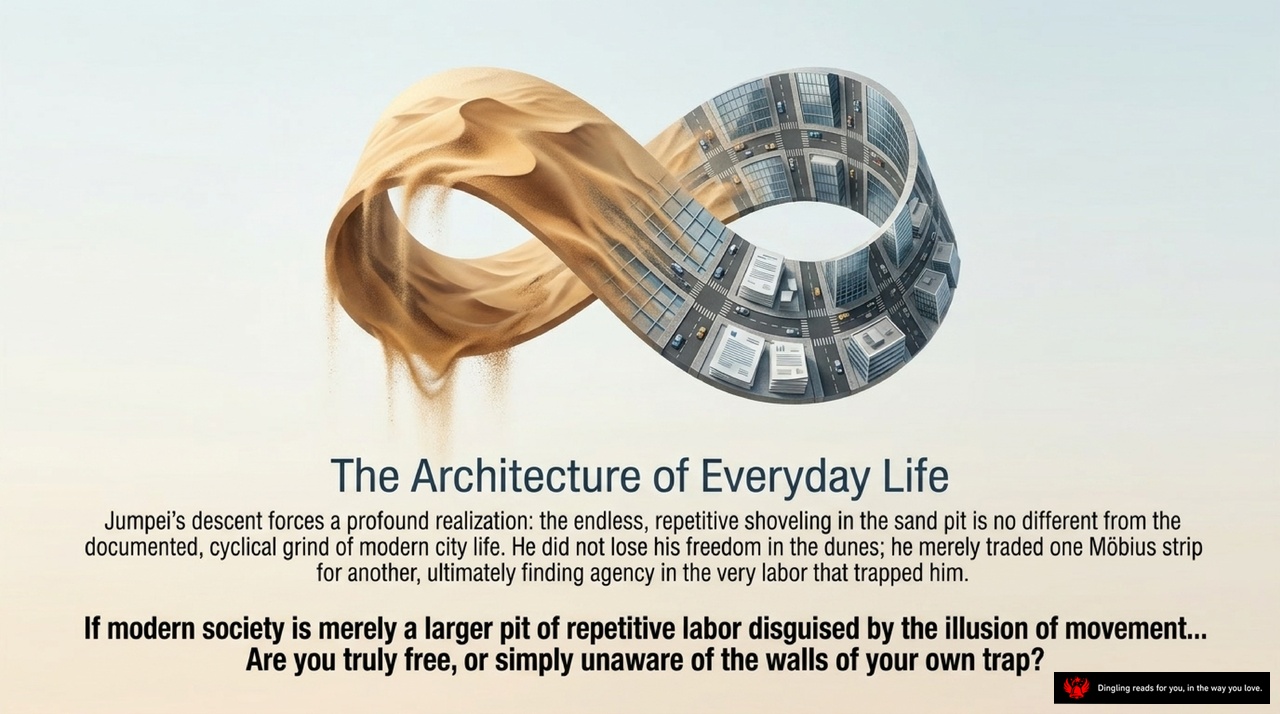
Look at this Möbius strip. On one side, it's the endless, flowing sand; on the other, the rigid, cyclical grind of our modern city life. This image captures a profound realization from the book: we often think we've traded one trap for another, but the mechanism remains the same.
The protagonist, Jumpei, discovers that the endless shoveling in the sand pit isn't so different from the documented, repetitive routine of modern urban existence. He didn't lose his freedom in the dunes; he merely traded one Möbius strip for another. The illusion of movement in the city is just as deceptive as the shifting sand.
So, the critical question remains: If modern society is merely a larger pit of repetitive labor disguised by the illusion of progress, are you truly free, or simply unaware of the walls of your own trap?