
The Zulu Principle: Complete Chapter-by-Chapter Summary

Welcome to the world of *The Zulu Principle* by Jim Slater. Imagine having a superpower that allows you to outsmart the massive institutional investors who usually dominate the market. The secret isn't about having more money or being smarter; it's about mastering a specialized niche to uncover extraordinary growth stocks.
The book's core idea is simple yet powerful: instead of spreading your efforts thin like a shotgun blast, focus your attention like a laser beam. This is the essence of the Zulu Principle. By narrowing your focus to a specific area—whether it's a particular industry or a specific type of stock—you can become a relative expert. It's just like needing to be only six inches taller than someone else to see over their head; that small, focused advantage is what allows you to outmaneuver the giants.
In this guide, we'll explore how to leverage your unique advantages as an individual investor, such as flexibility and deep knowledge of specific sectors, to find hidden gems in the market. We'll dive into the power of growth stocks, how to evaluate their true value using metrics like the Price-to-Earnings-to-Growth ratio, and how to build a portfolio that can withstand market volatility. Whether you're looking for long-term wealth or simply want to invest with confidence, mastering this principle will give you the edge you need to succeed.

On this slide, we see a powerful visual metaphor comparing two distinct investment philosophies: "The Shotgun" versus "The Laser Beam." On the left, the shotgun approach represents the traditional institutional disadvantage. It shows capital scattered wildly across hundreds of targets, forcing massive fund managers to dilute their holdings across 500 or more large-cap stocks just to manage risk. This sheer scale makes it nearly impossible for them to meaningfully invest in high-growth micro-caps without moving the entire market.
In stark contrast, the right side illustrates the retail advantage: the laser beam. Instead of spreading power thin, individual investors can deploy capital with nimble, frictionless precision. Rather than chasing a broad scatter, you concentrate your resources into just 10 to 15 high-conviction picks. This allows you to achieve deep mastery within a specific, narrow capability circle—specifically targeting small-cap growth stocks. While institutions are trapped by their size, you have the freedom to focus like a laser, turning a scattered shot into a concentrated beam of power that punches through the market with far greater efficiency.

Welcome back to our deep dive into the Zulu Rules. Today, we're looking at the heart of the strategy: **The Zulu Screening Engine**. Think of this funnel not just as a checklist, but as a sophisticated filter designed to separate the noise from the signal, isolating the few high-quality growth companies that can truly outperform the market.
Let's start at the top with the **Mandatory Rules**. These are your non-negotiables. First, we look at the PEG Ratio. We want it below 0.75. This is our golden metric for value, ensuring the stock price is reasonable relative to its growth rate. Next, we cap the Forward P/E at 20 to avoid overpaying for hype. Cash flow is king, so we demand that cash flow per share exceeds earnings per share, proving the company generates real, usable money rather than just accounting profits. We also keep leverage under 50% and ensure the stock shows positive relative strength over the last 12 months, meaning it's outperforming the broader market. Finally, a critical red line: no director selling. If the people running the company are dumping their shares, walk away immediately.
Moving down to the **Middle Tier**, these are the highly recommended traits that refine our selection. We look for accelerating earnings growth to confirm the upward trajectory. It's a strong signal when multiple directors are buying the stock, indicating internal confidence. We also target a market capitalization between £30 million and £250 million. This sweet spot offers enough liquidity for us to enter and exit positions without moving the market, while still providing ample room for growth. And don't forget the dividend yield; while growth stocks often reinvest, a dividend signals financial stability and management confidence.
Finally, at the bottom of the funnel, we have the **Bonus Traits**. These are the extra points that can tip the scales. A low Price-to-Sales ratio under 0.75 suggests the company is undervalued relative to its revenue. We also look for a low Price-to-R&D ratio, ideally between 5 and 10, which is crucial for tech-heavy firms to ensure their market cap is justified by their innovation spending. Favorable asset backing adds a layer of safety, and most importantly, we look for a catalyst—a new event like a product launch or acquisition—that could spark the next phase of growth.
By applying these three tiers, we transform a chaotic market into a curated list of perfection. It's about discipline, filtering out the weak, and focusing our energy on the few opportunities that truly matter.

So, let's talk about the real engine of value. Forget chasing the market's every move; instead, focus on finding companies where the price is surprisingly low compared to how fast they're actually growing. That's exactly what the PEG ratio does. As you can see on the screen, it's a simple but powerful formula: take the Forward P/E Ratio and divide it by the Expected Annual EPS Growth.
Think of this ratio as your compass for spotting the best opportunities. The slide breaks it down clearly: if a PEG is higher than 1.50, the stock is overvalued, and you should probably avoid it. Anything between 1.00 and 1.50 is fair value, but honestly, it's not very attractive. A PEG between 0.75 and 1.00 is good, especially for large companies. But here is where the real magic happens: a PEG below 0.60 is extraordinary. This is what the author calls "The Zulu Target."
Why do we obsess over this specific number? Because of what they call the "Double-Kick Effect." When you buy a low-PEG stock, your profits come from two powerful forces working at the same time. First, the company's actual earnings are growing as planned. Second, and often more importantly, as the market realizes the company is a winner, they re-rate the stock upward, expanding the P/E multiple itself. You get the growth of the business plus the expansion of the valuation.
This strategy gives you both aggressive upside potential and a defensive safety margin. It allows you to buy quality growth stocks at a discount, protecting you if earnings miss expectations while setting you up for massive gains if the market finally catches up. In a volatile market, this is how you turn a simple investment into a wealth-building machine.

The Reality Check: Cash Flow & Gearing
Look at this slide. It's a stark reminder that growth without cash is just an accounting illusion. A true "Zulu" stock doesn't just look good on paper; it generates immense liquidity. Think of these two pillars as the bedrock of your portfolio.
On the left, we have Cash Flow Immunity. The golden rule here is simple but powerful: your Operating Cash Flow per share must always exceed your Earnings Per Share. Why does this matter? Because it protects you against "paper profits." It ensures the company can actually self-fund its expansion and survive shocks without needing to beg for money. A major red flag to watch out for is a "cash sink"—where capital expenditures consistently eat up more cash than the company generates. If you see that, run.
On the right, we have Balance Sheet Fortitude. The rule here is strict: Net Gearing, or Debt-to-Equity, must stay below 50%. High debt amplifies risk, especially when interest rates rise or liquidity crises hit. However, there is an exception. Higher gearing is permissible only if the company is a cash machine, generating massive free cash flow rapidly to pay down that debt.
In short, ignore the hype. Build a portfolio with cash flow immunity and a fortress-like balance sheet. That's how you separate real winners from the rest.
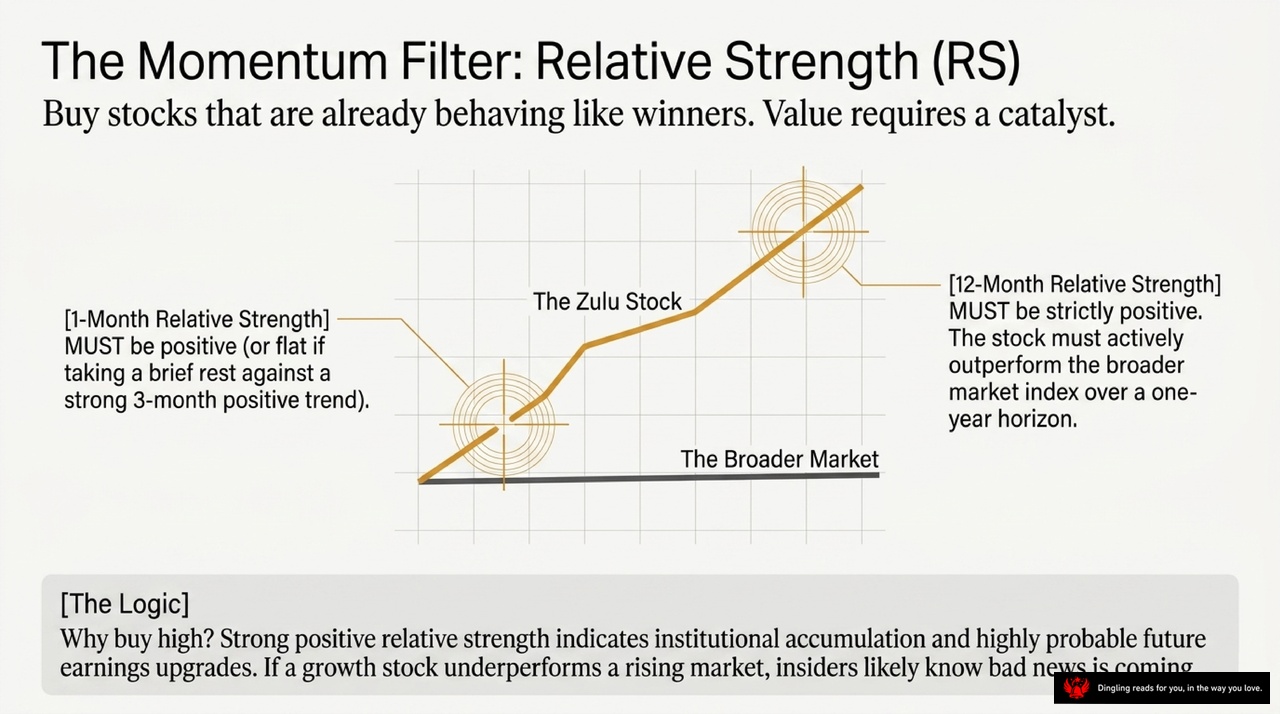
The Momentum Filter: Relative Strength (RS) is all about buying stocks that are already behaving like winners. As the slide reminds us, value alone isn't enough; it requires a catalyst, and that catalyst is often strong momentum.
Look at the chart comparing "The Zulu Stock" against "The Broader Market." The Zulu Stock is clearly outperforming, climbing steadily while the market stays flat. This visual tells us the core rule: you need to find companies that actively beat the broader market index over a one-year horizon. That's our 12-Month Relative Strength, and it must be strictly positive.
But we also care about the short term. The 1-Month Relative Strength needs to be positive, or at least flat if the stock is just taking a brief rest against a strong three-month positive trend. Why do we care about this? Because strong positive relative strength signals institutional accumulation. It suggests that smart money is buying in, and it points to a highly probable future earnings upgrade. If a growth stock underperforms a rising market, insiders likely know bad news is coming. So, by combining these filters, we aren't just guessing; we are following the money and the momentum to find the next big winner.
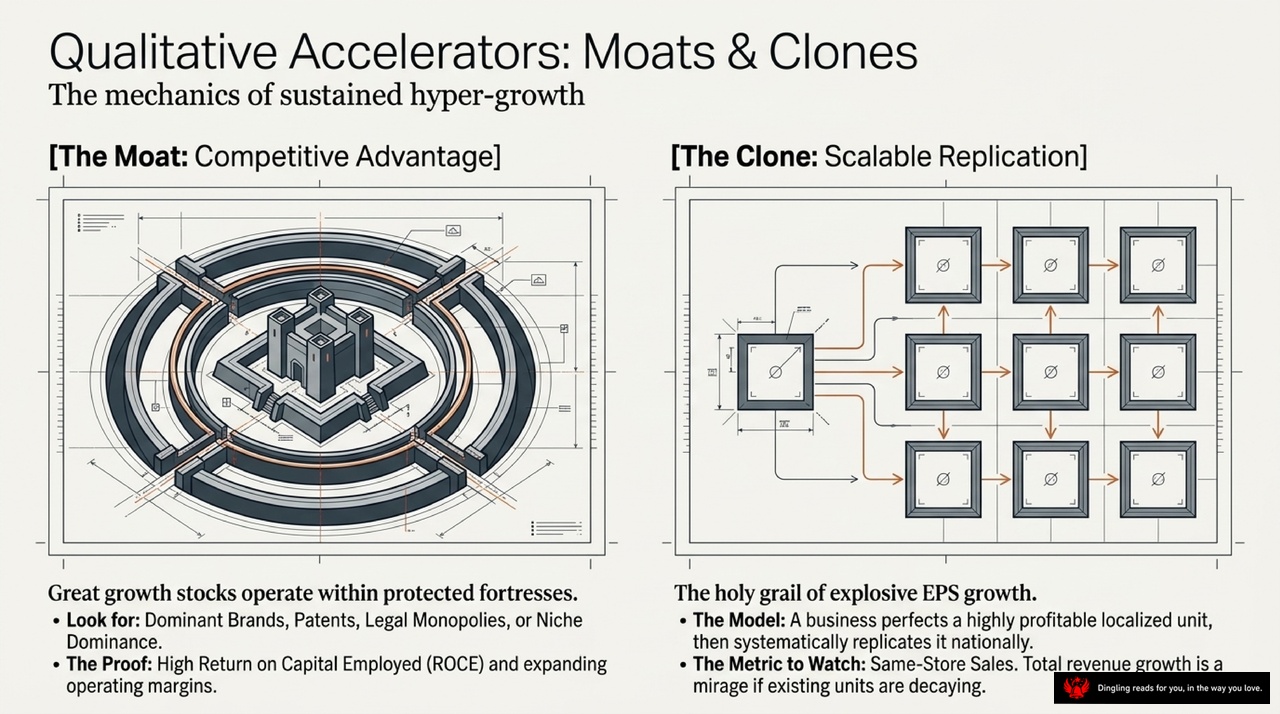
Qualitative Accelerators: Moats & Clones. Today, we're breaking down the exact mechanics behind sustained hyper-growth. Look at the screen: on the left, we have "The Moat," representing your competitive advantage, and on the right, "The Clone," which is about scalable replication.
Think of the Moat as a fortress. Great growth stocks don't just exist in the open market; they operate within protected fortresses. You need to look for dominant brands, powerful patents, legal monopolies, or niche dominance. This is your proof of durability. The financial metric that confirms this fortress is strong? High Return on Capital Employed, or ROCE, paired with expanding operating margins. When a company can keep raising prices or cut costs without losing customers, that's the moat in action.
Now, shift your focus to the right side: The Clone. This is the holy grail for explosive earnings per share growth. The model is simple but powerful: a business perfects a highly profitable, localized unit and then systematically replicates it nationally. Think of it as a factory of success. The key metric to watch here isn't just total revenue, which can be misleading if old stores are closing. Instead, focus on Same-Store Sales. If your existing units are decaying, total growth is just a mirage. Real hyper-growth happens when you have a winning unit and the discipline to copy it everywhere.
In summary, you want companies that have built an unassailable defensive wall and possess the operational playbook to scale that advantage across the entire market. That is how you achieve the kind of consistent, high-quality growth that separates the top performers from the rest.
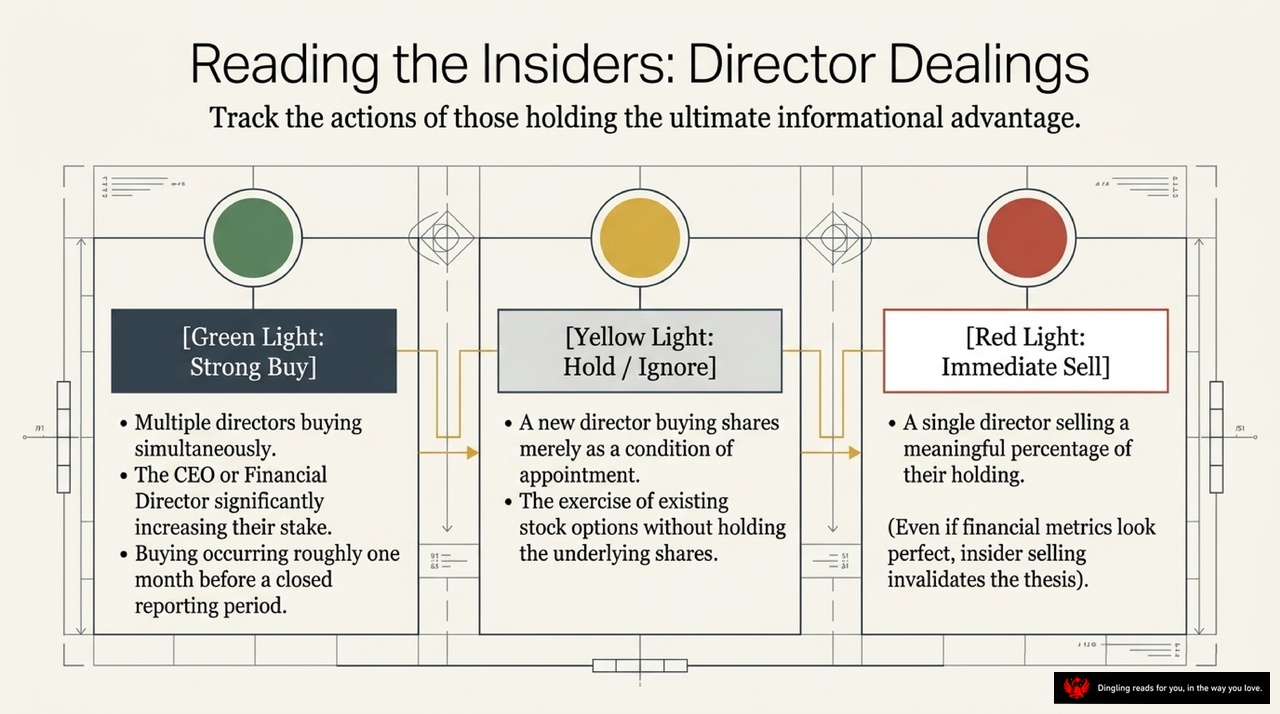
Reading the Insiders: Director Dealings. If you want to track the actions of those holding the ultimate informational advantage, you have to look at the board. This slide breaks down exactly how to interpret director trades into a simple traffic light system.
On the left, we have the Green Light: a strong buy signal. This triggers when multiple directors buy simultaneously, or when the CEO and Financial Director significantly increase their stake. It's also a major warning sign if they start buying roughly one month before a closed reporting period. Essentially, insiders are putting their own money on the line, signaling they believe the stock is undervalued.
In the middle, the Yellow Light means hold or ignore. A new director buying shares merely as a condition of appointment isn't a confidence signal; it's just a requirement. Similarly, exercising existing stock options without actually holding the underlying shares doesn't count as a real buy. These are noise, not signals.
Finally, on the right, the Red Light demands an immediate sell. Even if the financial metrics look perfect, insider selling invalidates the entire thesis. If a single director sells a meaningful percentage of their holding, it's a red flag that you should run. Don't get distracted by the numbers; when the people who know the most start cashing out, the market usually follows.

Market Archetypes: The Comparison Matrix. Today, we're adjusting our investment filter based on the specific environment we're in. Think of this as choosing the right vehicle for the road: a truck for heavy loads, a sports car for speed, and a drone for innovation.
First, let's look at **Growth Stocks**, which are the core focus of the Zulu strategy. These aren't just companies that grow; they are businesses with consistent, scalable increases in earnings per share. The ideal entry point is when the PEG ratio drops below 0.75. Your key metrics here are the PEG ratio and cash flow per share. But be warned: the core risk is P/E multiples getting violently compressed if that growth rate slows down.
Next, we have **Cyclical Stocks**. These thrive on economic rebounds and interest rate cuts. Your ideal entry is maximum pessimism, specifically during the second year of falling interest rates. Focus on the Price-to-Book ratio and discounts to net assets. The danger here is buying when the P/E looks artificially cheap right at the top of the cycle.
Finally, there are **Technology Stocks**, driven by disruptive innovation and paradigm shifts. The best time to enter is after a glitch—what we call the "Fallen Angel"—or right at the early proof of concept stage. Key metrics for tech include Price-to-Sales, ideally under 0.75, and Price-to-R&D, which should stay between 5 and 10. The core risk here is cash burn outlasting your capital reserves before the company ever becomes profitable.
By understanding these three archetypes, you stop using a sledgehammer to crack a nut and start using the perfect tool for the job.

The Zulu Portfolio isn't just about picking winners; it's about the precise art of sizing and execution. As the slide clearly states, diversification protects your wealth, but concentration is what actually builds it.
Think of your portfolio like this pie chart. You aren't trying to own a slice of every company in the market. Instead, the "Allocation Rules" tell us to focus on a curated group of just 10 to 15 carefully selected stocks, especially if your portfolio is under £500k. The golden rule here is strict concentration: never let a single stock take up more than 15% of your total cost basis. This forces you to do deep due diligence on a manageable number of companies rather than skimming the surface of hundreds.
But what happens when the market turns against you? That's where the "Golden Axiom" comes into play: cut losses quickly, but let profits run. This is the engine of the Zulu strategy. Under the "When to Sell" section, the book outlines three critical triggers. First, if the fundamental narrative changes—like a new competitor destroying your margins. Second, if the PEG ratio expands beyond 1.20, signaling that your safety margin has vanished. And third, if you see unexplained, prolonged deterioration in relative strength, which often means the market knows something you don't.
By adhering to these allocation rules and selling triggers, you transform a simple list of stocks into a disciplined, high-performing machine that maximizes upside while strictly limiting downside.

Imagine you've been throwing your money around like a shotgun blast in the dark, hoping to hit something. Or are you ready to switch to a laser? That's the core question on this slide. The Zulu Principle proves that you don't need to predict the entire market or analyze the macroeconomy to get outsized returns. True wealth isn't built by scattering your capital; it's built through asymmetric effort. You master a narrow, high-growth niche of small-cap companies, demand flawless cash flow, and relentlessly buy growth at a discount using the PEG ratio. By ignoring the noise and focusing like a laser on strict quantitative filters, the retail investor holds an undeniable structural advantage over the institutional giants. So, stop scattering your bullets and start focusing your investments like a laser.