
Throwing Rocks at the Google Bus: Complete Chapter-by-Chapter Summary
Ever wondered why tech’s rapid growth often leaves communities and workers behind? Douglas Rushkoff’s Throwing Rocks at the Google Bus digs into that disconnect. The book challenges the unspoken mandate for infinite growth—one that’s pricing people out of their neighborhoods, squeezing creators, and prioritizing short-term profits over long-term well-being. Rushkoff argues we can reimagine the digital economy: instead of letting tech serve Wall Street’s greed, we can build a system where prosperity is distributed, not hoarded. It’s a call to turn the digital revolution into something that works for everyone, not just the few at the top.
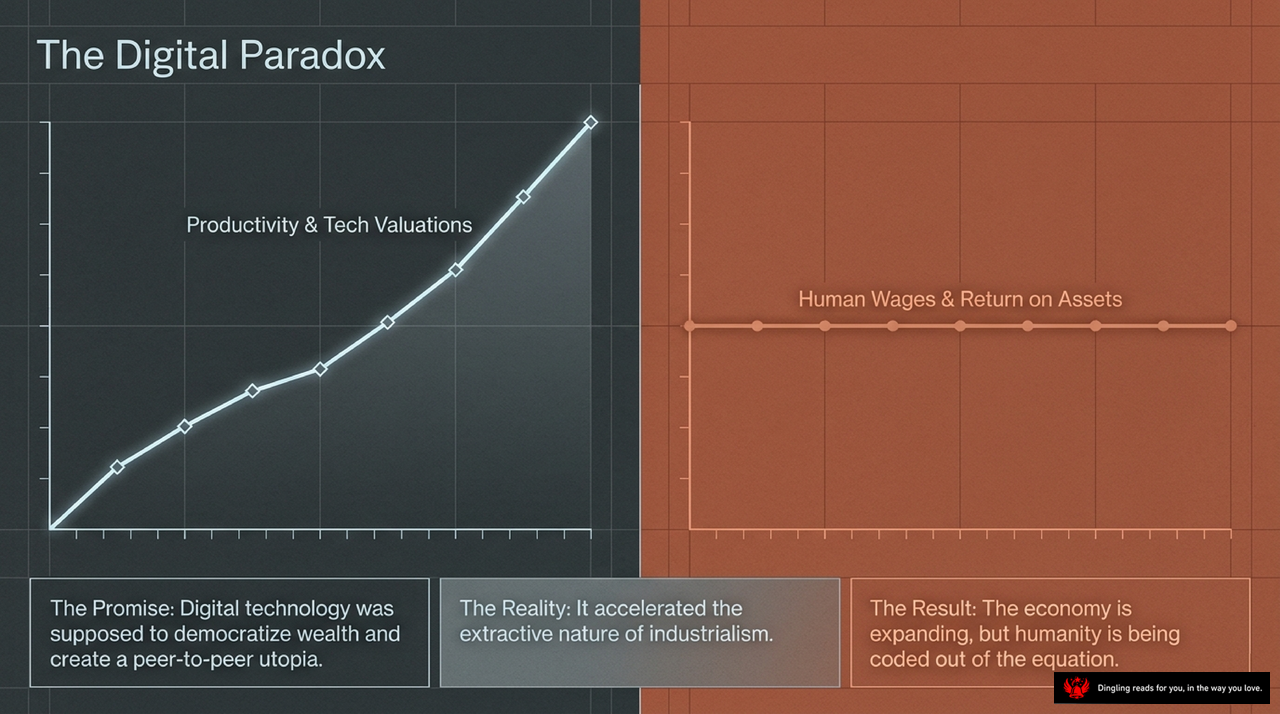
Let’s dive into this slide—The Digital Paradox. On the left, productivity and tech valuations are skyrocketing, but on the right? Human wages and return on assets are stuck flat. That’s the contradiction we’re unpacking today.
We were sold a dream: digital tech would democratize wealth, build a peer-to-peer utopia where everyone gets a piece of the pie. But the reality hit hard—it just supercharged the extractive side of industrialism. Think back to 2013: San Francisco residents lying in front of Google buses, Oakland protesters throwing stones at them. Why? Tech workers moving in sent rents soaring, displacing families who’d lived there for decades. Even the tech folks weren’t winning—they’re so overworked, most quit within a year.
Take Twitter. Evan Williams created it to revolutionize news: it helped organize the Tunisian uprising, gave Occupy Wall Street a voice, let regular people be journalists. But once it went public, Wall Street took over. Suddenly, growth was everything. They crammed in ads, mined user data, and fired the CEO because investors wanted “100x growth”—even though Twitter didn’t need billions to operate. It lost the heart of what made it special.
So the result? The economy’s growing, but humanity’s being coded out of the equation. We’re treating people like costs to cut, not as the reason we build things. This growth-first model is broken, and digital tech’s just making it more extreme. We need to flip the script—tech should work for us, not the other way around.
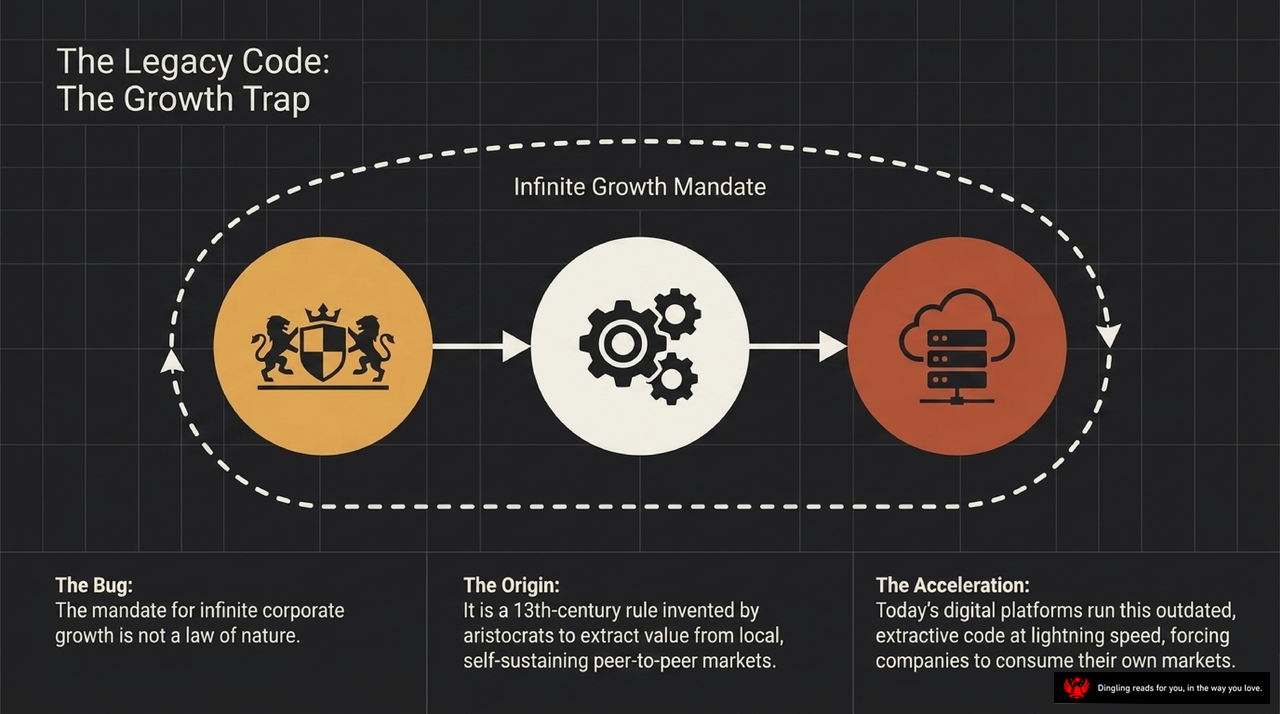
Let’s dive into a trap that’s been shaping our economy for centuries: the growth trap. Take a look at this slide—The Legacy Code: The Growth Trap. That idea we’re all told, that companies must grow infinitely to survive? It’s not a law of nature. It’s a bug in our system.
Where did this bug originate? Way back in the 13th century, aristocrats saw local peer-to-peer markets—like village fairs where farmers traded crops and artisans sold crafts—and wanted to take control. They made rules to extract value: taxes, abolishing guilds that kept competition fair, and giving monopolies to their allies. Suddenly, those community-focused P2P systems were turned into top-down machines that benefited the few at the expense of the many.
Today, digital platforms have supercharged this old code. They run that extractive logic at lightning speed, forcing companies to do whatever it takes to grow—even if it means eating their own markets. Think about your favorite app: it might have started as a simple, user-friendly tool, but now it’s crammed with ads, or it uses your data in ways you never agreed to. Why? Because the pressure to hit infinite growth targets pushes companies to prioritize short-term gains over what users actually need. They end up alienating their own customers or cannibalizing their products just to keep the growth numbers up.
This isn’t just about big corporations—it touches every part of our lives, from the apps we use to the jobs we hold. The growth trap isn’t inevitable, but first we have to recognize it: it’s a legacy code from a time of aristocratic control, now amplified by digital technology. And once we see it, we can start to rewrite the rules for a system that works for everyone, not just the few.
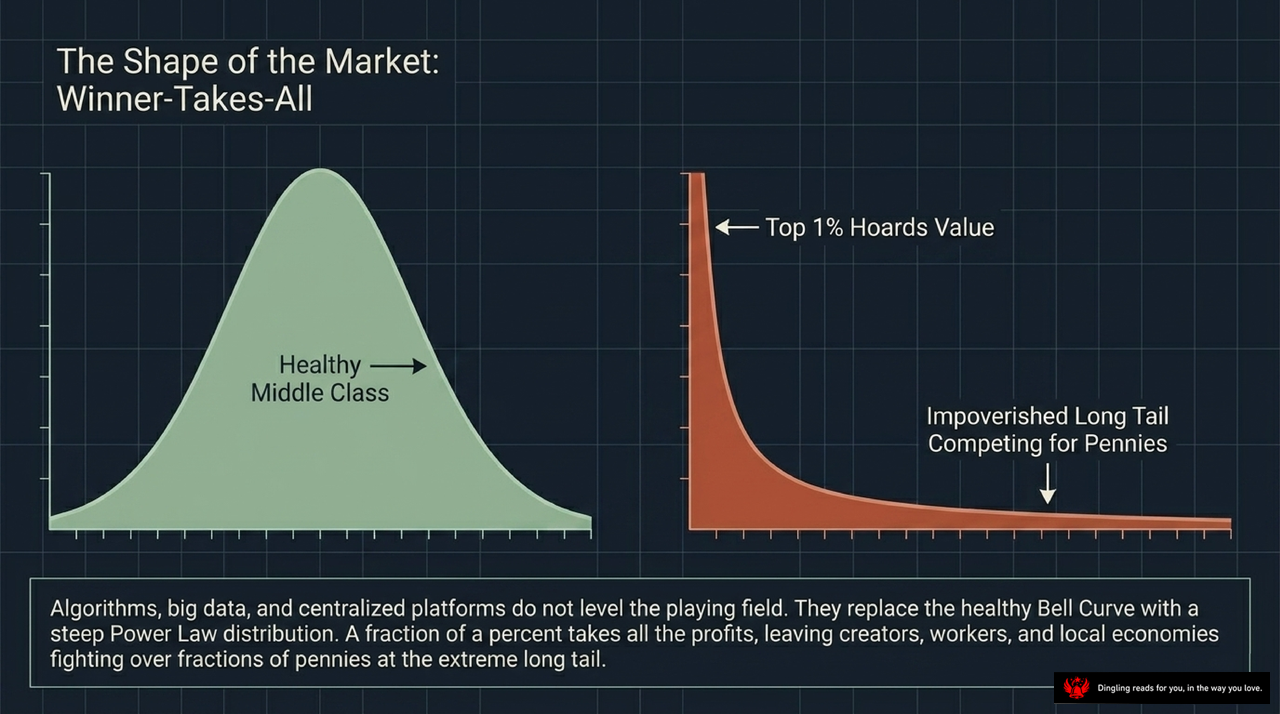
Take a look at these two graphs on the screen. On the left, we’ve got the classic Bell Curve—remember that? It’s the shape of a healthy middle class, where most people sit in the center, thriving. But on the right? That’s the Power Law distribution we see today: a tiny top 1% hoarding almost all the value, and a long, impoverished tail where everyone else is competing for pennies.
You might’ve heard of the Long Tail theory—Chris Anderson thought digital platforms would let more creators succeed, right? But the data tells a different story. Let’s take music: on iTunes, 94% of albums sell fewer than 100 copies. And get this—0.00001% of albums take up 1/6 of all sales! That’s not a long tail that lifts everyone up; it’s a winner-takes-all market.
Why does this happen? Well, centralized platforms use algorithms and big data that don’t level the playing field—they tilt it. Network effects mean the more users a platform has, the more valuable it becomes, so it squeezes out competitors. And those algorithms? They push popular content even more, creating a feedback loop where the top gets bigger and the rest get left behind.
So instead of the healthy middle class we used to have, we’re stuck with this: a fraction of a percent takes all the profits, and creators, workers, and local economies are left fighting over crumbs at the end of that long tail. It’s not just a graph—it’s the reality of our digital market today. The shape of the market has shifted, and it’s time we talk about what that means for all of us.
Let’s talk about money—because the way we use it right now isn’t working for most of us. Small businesses can’t get loans to grow, our investments feel disconnected from our communities, and the system keeps funneling wealth to the top. But there are better ways.
Take the L3C—Low-Profit Limited Liability Company. It’s a hybrid: businesses can make a little profit to stay operational, but their main mission is solving a social or environmental problem. Think Homeport New Orleans cleaning up abandoned docks, or Battle-Bro helping veterans find jobs. They get some nonprofit tax breaks and can raise small investments—perfect for projects that matter but don’t fit Silicon Valley’s growth obsession.
Then there are alternative currencies. Time-based ones like Japan’s “kinmoku tickets” let you trade care work: help an elderly neighbor, earn credits to use when you need help later. Or LETS systems—Curitiba, Brazil, used them to fix trash and unemployment: kids picked up garbage for bus tickets, parents used those to get to work, businesses accepted the tickets. Now 70% of families join in, and the city’s a sustainability model. These currencies keep value local, not flowing out to big banks.
Local banks are changing too. Instead of just loaning at high rates, they’re partners. Sam’s Pizzeria needed $20k to expand. The bank said: “Raise $10k from neighbors first, we’ll match it.” Sam sold pre-paid coupons (100 bucks for $120 pizza), got the cash, neighbors got a deal. Now everyone’s invested in Sam’s success—they spread the word, bring friends, and the whole area thrives.
And for our own money? Ditch the 401(k) stress or online trading games. Try crowdfunding local projects, or direct public offerings where small businesses let neighbors invest. Put your money where your community is, not into distant stocks that don’t help anyone near you.
Money should connect us, not divide us. These small changes add up to a financial system that works for everyone.
Ever get the feeling the economy’s stacked against regular folks? Big corporations hoard power, Wall Street chases endless growth, and small businesses or workers get left behind. But what if there’s another way—an economy where power and value are spread out, not concentrated? That’s the idea behind distributed economy, and it’s not just a pipe dream.
Distributed economy is all about decentralization: instead of a few big players calling the shots, it’s small businesses, worker co-ops, and local communities driving things. Think of it like this: centralized economy takes value (from workers, from local shops) and sends it up to the top. Distributed economy keeps value circulating where it’s created—like a local café that’s worker-owned, so profits go to the people who run it, not distant shareholders.
Digital tech is making this easier than ever. Blockchain lets people trade goods or services without a middleman taking a cut. Crowdfunding platforms let you support a neighborhood bookstore instead of a chain. Even local digital currencies—where you can buy coffee from the corner shop and the money stays in the community—are popping up.
This idea has deep roots, too. Distributism, as it’s called, goes back to thinkers who believed everyone should have access to the tools they need to make a living—like a farmer owning their land or a craftsman owning their tools. Digital distributism updates that: now it’s a freelance writer owning their online platform, or a group of teachers starting a co-op school.
You can see signs of it everywhere: Burning Man’s DIY community, worker-owned grocery stores, or even a local time bank where you exchange babysitting for lawn care. These aren’t just niche projects—they’re building blocks of a more fair economy.
The best part? You don’t have to wait for big changes. Small choices matter: buy from local businesses, support worker co-ops, or join a community exchange. Every time you choose to keep value in your neighborhood, you’re helping build an economy that works for everyone, not just the few.
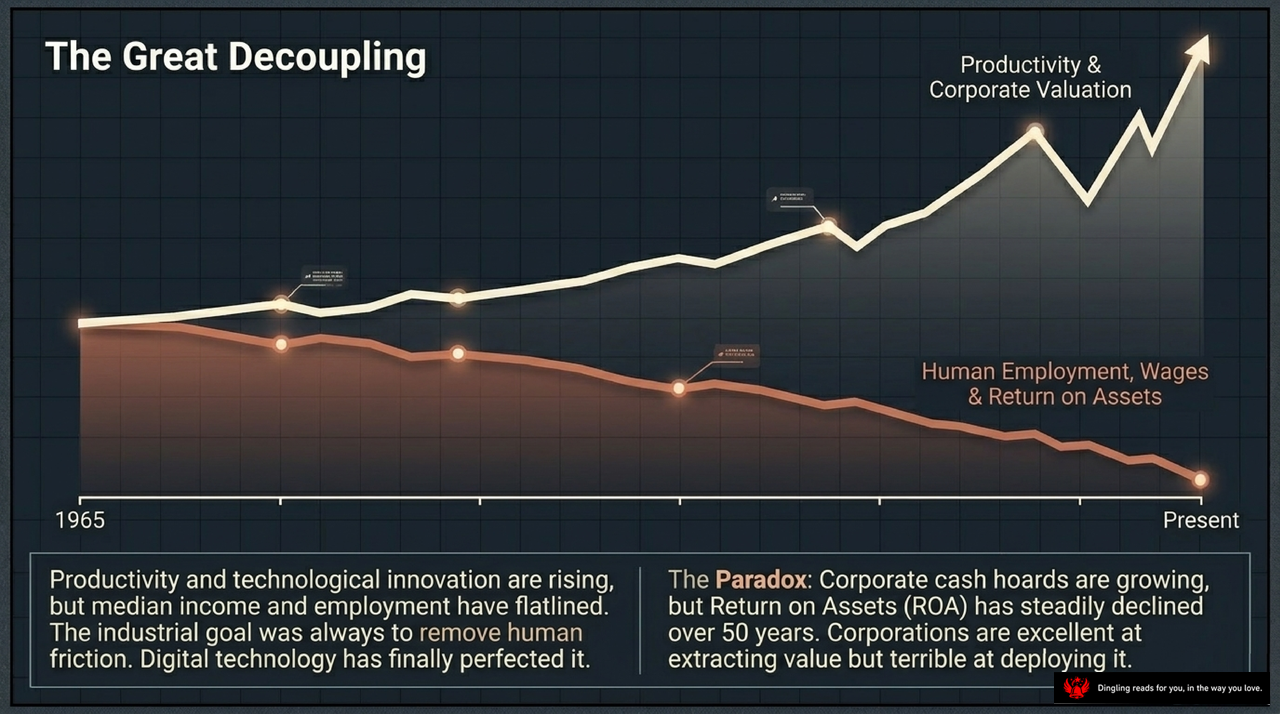
Let’s take a look at this graph—does any of this feel familiar? For decades, companies have gotten more productive, their valuations have soared… but for most people, wages have stayed stuck, and job security? It’s become a thing of the past. This is The Great Decoupling, and it’s reshaping our economy in ways we can’t ignore.
The top line here shows productivity and corporate valuation climbing—thanks to digital tech, automation, all those tools that make businesses run faster and cheaper. But the bottom line? Human employment, wages, even return on assets—they’ve flatlined or dropped. The industrial age always aimed to cut human friction, and digital tech has finally perfected that. But when you eliminate friction, you often eliminate the humans involved too. So companies get more efficient, but the people who power them don’t see the benefits.
And here’s another twist: corporations are hoarding cash like never before—trillions of dollars sitting idle. But their return on assets has been declining for 50 years. Why? Because they’re experts at extracting value—cutting jobs, squeezing suppliers, slashing costs—but they’re terrible at deploying that value back into the economy. They don’t raise wages, they don’t invest in new projects that create jobs, they just let the cash pile up.
This isn’t just a numbers game. It’s why so many people feel like the economy is working for someone else, not them. The question now is: how do we fix this? How do we make sure that when companies thrive, workers and communities thrive too? That’s the conversation we need to have next.

Let’s dive into how our economic operating system has evolved—this slide maps out four key stages of that journey.
First, the Craft Economy: Back in the day, it was all local peer-to-peer. Think neighborhood blacksmiths or bakers selling directly to folks down the street. The goal was simple subsistence—making enough to keep the lights on— and everyone was an artisan, owning their tools and skills.
Then came the Industrial Economy: Topology shifted to centralized factories. Big corporations took over, with growth as their only North Star. Workers? We became machine cogs—replaceable parts in a giant production line, our value reduced to how fast we could repeat a task.
Next up: Digital Industrialism, the era we’re still navigating. This is the age of cloud monopolies—think Google, Amazon, those platforms that control so much of our online lives. The rule here is winner-takes-all; if you’re not the biggest, you’re invisible. And as users? We’re often just data points—our clicks, likes, and habits harvested to drive profits for the few.
But there’s a better vision: Digital Distributism. Here, the topology is a distributed web—no single company holds all the power. The goal changes to sustainable prosperity, not endless growth. And our role? We’re value creators—each of us contributes meaningfully, and the benefits are shared more fairly.
The book talks about how digital industrialism has led to problems like skyrocketing rents (remember those Google bus protests in San Francisco?) and workers being treated as disposable. But digital distributism offers a way out—one where technology serves people, not the other way around. It’s about putting power back in the hands of individuals and communities, building an economy that works for everyone long-term.

Let’s dive into The Patch: Digital Distributism—because let’s be real, the digital world we live in right now often feels like it’s built to take from us, not give back. The slide says it clearly: Digital Distributism is the antidote to that digital industrialism we’re all sick of—the kind where platforms hoard data, squeeze profits for a tiny few, and treat growth like it’s the only thing that matters.
Here’s the thing: the economy isn’t some unchangeable force of nature. The slide reminds us—if humans coded it, we can recode it. So instead of building platforms that prioritize value extraction and infinite capital accumulation (you know, the ones that make billionaires richer while your data gets sold to the highest bidder), we need to shift gears. We need platforms that put value creation first, and lateral peer-to-peer exchange—direct, person-to-person connections—at the center.
Think about it: it’s like the old local farmers’ market, but with digital superpowers. No middlemen siphoning off profits, no distant corporations calling the shots. Just people trading goods, services, and ideas directly, keeping the value right where it belongs—in the community.
This isn’t just a pipe dream. Digital Distributism draws from old distributist principles—getting tools and power into as many hands as possible—but updates them for today. We’re talking platform co-ops where workers own the tech they use, local digital currencies that keep money circulating in your town, and peer-to-peer networks that cut out the middleman.
The network graphic on the slide says it all: this is a system of connections, not hierarchy. Every node—you, me, small businesses—has a voice, not just a handful of big players. So next time you feel like a platform is using you, remember: we don’t have to settle. We can build something better. Because if we made the old system, we can make a new one—one that works for everyone, not just the top 1%.
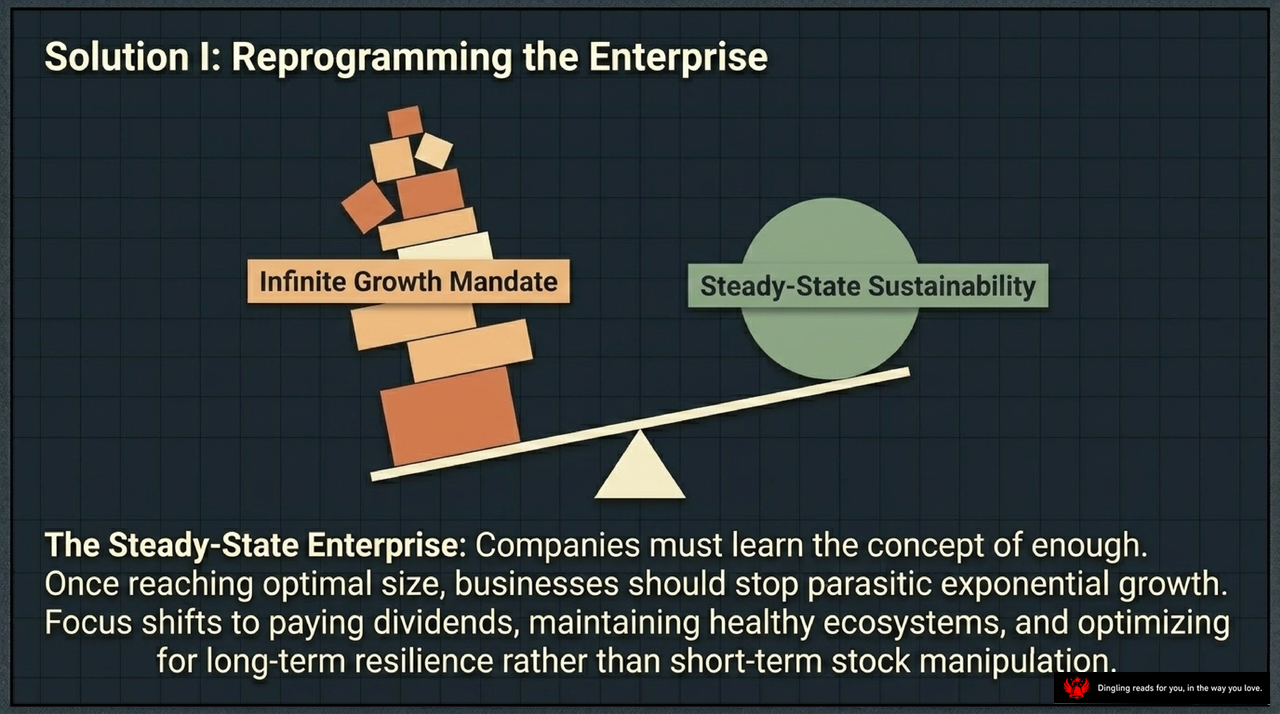
Let’s dive into Solution I: Reprogramming the Enterprise. Look at this seesaw—on one side, we’ve got the infinite growth mandate that’s been drilled into businesses for decades. On the other, steady-state sustainability. Right now, that endless growth obsession is weighing us down, but it’s time to tip the scales.
The steady-state enterprise is all about learning the concept of “enough.” Once a company hits its optimal size, why keep chasing that parasitic exponential growth? It’s like a tree—once mature, it doesn’t keep stretching taller; it focuses on staying healthy and nurturing the ecosystem around it.
So what does this shift actually look like? Instead of obsessing over short-term stock tricks to please Wall Street, businesses should pivot to priorities that last: paying fair dividends to shareholders, maintaining healthy environmental and community ecosystems, and building long-term resilience.
Take Toyota, for example. Back in 2014, when other carmakers were racing to hit 10 million annual sales, Toyota said no. Their CEO called rapid growth “fragile”—they chose stability over a quick win, and that call kept them steady through market swings.
Family businesses get this too. They treat their companies like legacies, not just profit machines. They invest in their employees, their local communities, and long-term sustainability because they want the business to thrive for generations, not just the next quarter’s earnings report.
Reprogramming the enterprise isn’t about hitting the brakes on progress—it’s about redirecting it. It’s about building businesses that don’t drain resources or burn out their teams, but instead thrive for the long haul. And that’s a solution we can all get behind.
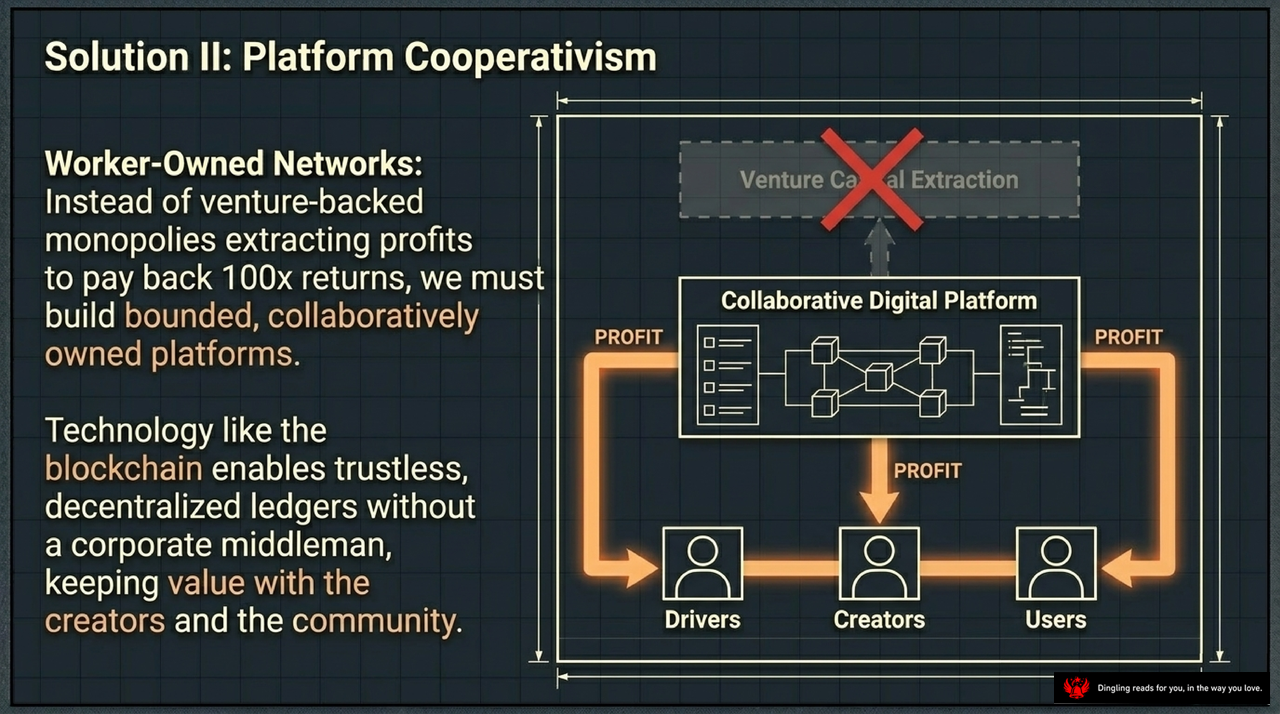
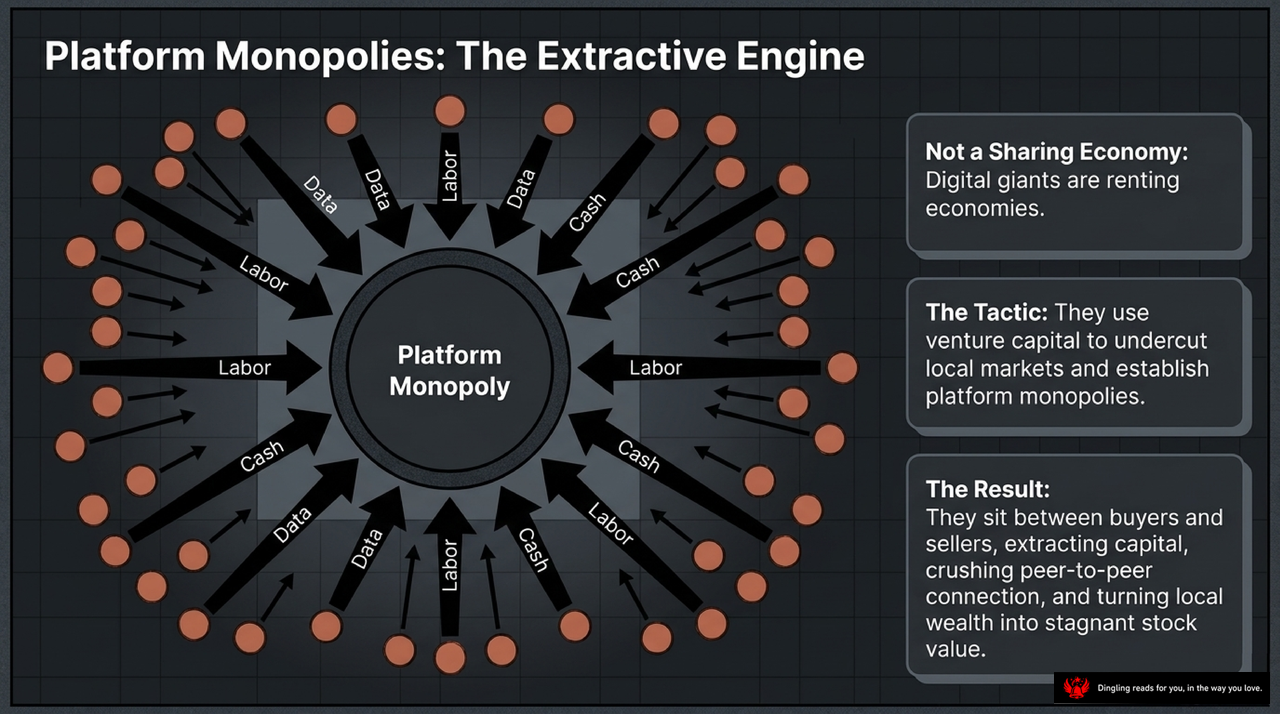
Ever notice how the apps we use daily—ride-sharing, content platforms, even shopping apps—rake in billions, but the people doing the real work (drivers, creators, users) barely see any of that profit? Most platforms are run by venture-backed monopolies, obsessed with squeezing 100x returns for investors instead of valuing the community that makes them successful.
But there’s a better way: platform cooperativism. This means building worker-owned networks—bounded, collaboratively owned platforms—instead of those extractive VC giants. The core idea? The people who use and contribute to the platform are the ones who own it. So profits don’t flow up to distant investors; they stay with the drivers, creators, and users—the folks who keep the platform running day in and day out.
Technology like blockchain is making this possible. It lets us create trustless, decentralized ledgers without a corporate middleman. No need for a big company to verify transactions, hoard data, or control operations. The value stays right where it belongs: with the creators and the community.
Think about it: a ride-sharing co-op where drivers set fair rates and keep more earnings, no surprise fees or algorithm changes that hurt their income. Or a content platform where creators own their work and get a fair cut of ad revenue, not just a tiny fraction. Platform cooperativism turns extractive systems into collaborative ones—where everyone benefits, not just a handful of wealthy investors. It’s about putting power back into the hands of the people who build the value.
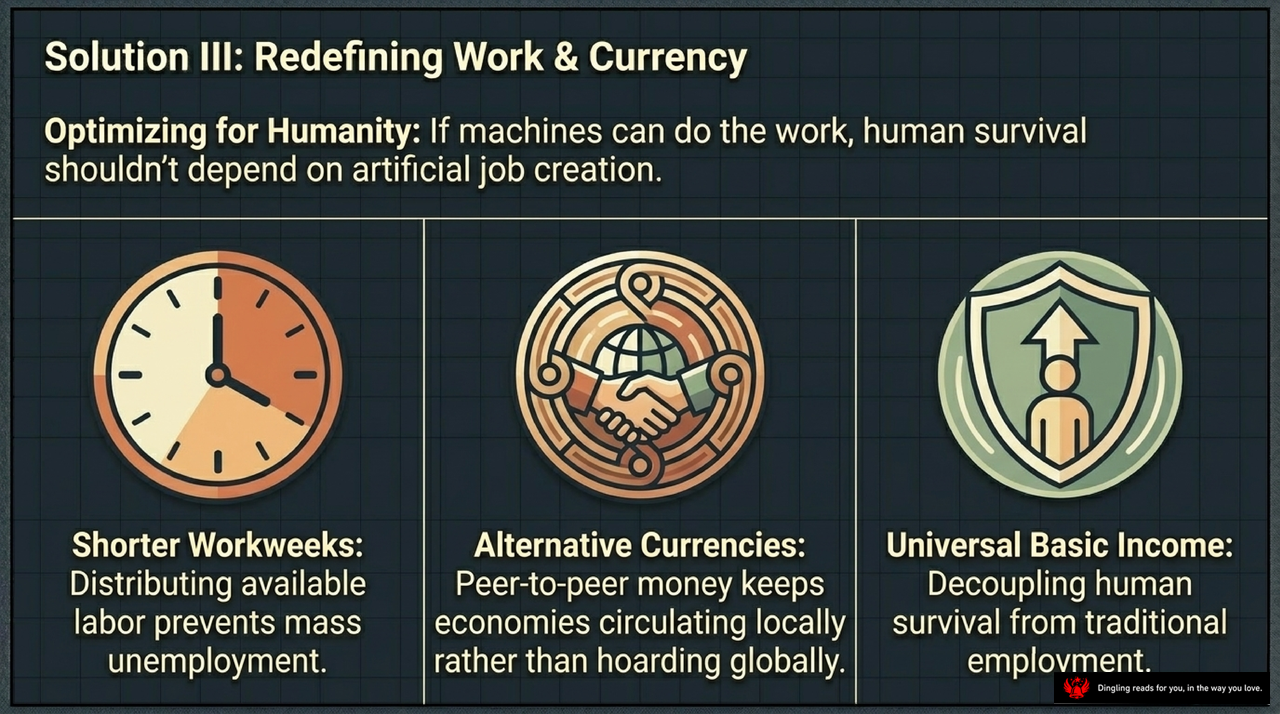
Let’s dive into Solution III: Redefining Work & Currency. The core principle here is optimizing for humanity—if machines can handle the work, we shouldn’t force artificial job creation just to keep people employed.
First up: Shorter Workweeks. Distributing available labor prevents mass unemployment, but it’s more than just cutting hours. Take Utah’s 4-day workweek for state employees: 50% reported higher productivity, the state saved $400 million, and CO2 emissions dropped by 40,000 tons. Online education company Treehouse adopted the same model and grew 120% annually—because less time means you cut the fluff: no useless meetings, no idle chatter, just focus on core tasks.
Next, Alternative Currencies: Peer-to-peer money keeps economies circulating locally instead of letting capital hoard globally. Think Curitiba, Brazil: kids picked up trash to earn bus tickets, parents used those to commute to jobs, and local merchants accepted them as payment. Twenty-five years later, Curitiba has one of the world’s highest quality of life indexes, with 60-70% trash recycling rates. Or Japan’s time-based currency: care for an elder, earn credits to use when you need care later—no money, just community trust.
Then there’s Universal Basic Income: Decoupling human survival from traditional employment. 1970s experiments showed UBI didn’t make people stop working—most who cut hours did so to finish school or care for family. And it’s affordable: the U.S. could fund a negative income tax (a UBI variant) for just 1% of GDP. Imagine not having to take a dead-end job just to pay rent—volunteer, start a community garden, or work on climate solutions.
These aren’t just theories; they’re proven solutions. It’s time to stop tying our worth to hours worked and build an economy that works for people, not the other way around.

Let’s talk renaissances—because we’re long overdue for a new one, and it’s not just about art and science this time. The original Renaissance gave us Michelangelo and the printing press, sure, but let’s not ignore its darker side: it centralized power and birthed those extractive colonial corporations that took far more than they gave to the communities they exploited.
Now, we’re on the cusp of a New Renaissance. But this isn’t about turning back the clock—it’s about using digital tools to reclaim what industrialism stripped away. Industrialism pushed us into big, impersonal systems: small towns lost their local grocery stores to chains, real human connections got replaced by transactional interactions, and genuine craftsmanship was traded for mass-produced, disposable goods.
The New Renaissance needs to flip that script. We can use digital tools—not to extract value or centralize power, but to scale those human-centered things we crave. Picture local farmers using apps to sell directly to neighbors, cutting out middlemen and keeping money in the community. Or artisans sharing their craft online, building communities around quality instead of quick profits. And most importantly, we have to do this with our finite planet in mind—no more chasing endless growth that drains resources and harms the environment.
This isn’t a fantasy. It’s about redefining progress: not how much we can take, but how well we can connect, create, and sustain. The original Renaissance changed the world, but this New Renaissance? It has the chance to make it a better, more equitable place—for everyone, and for the planet we all call home.
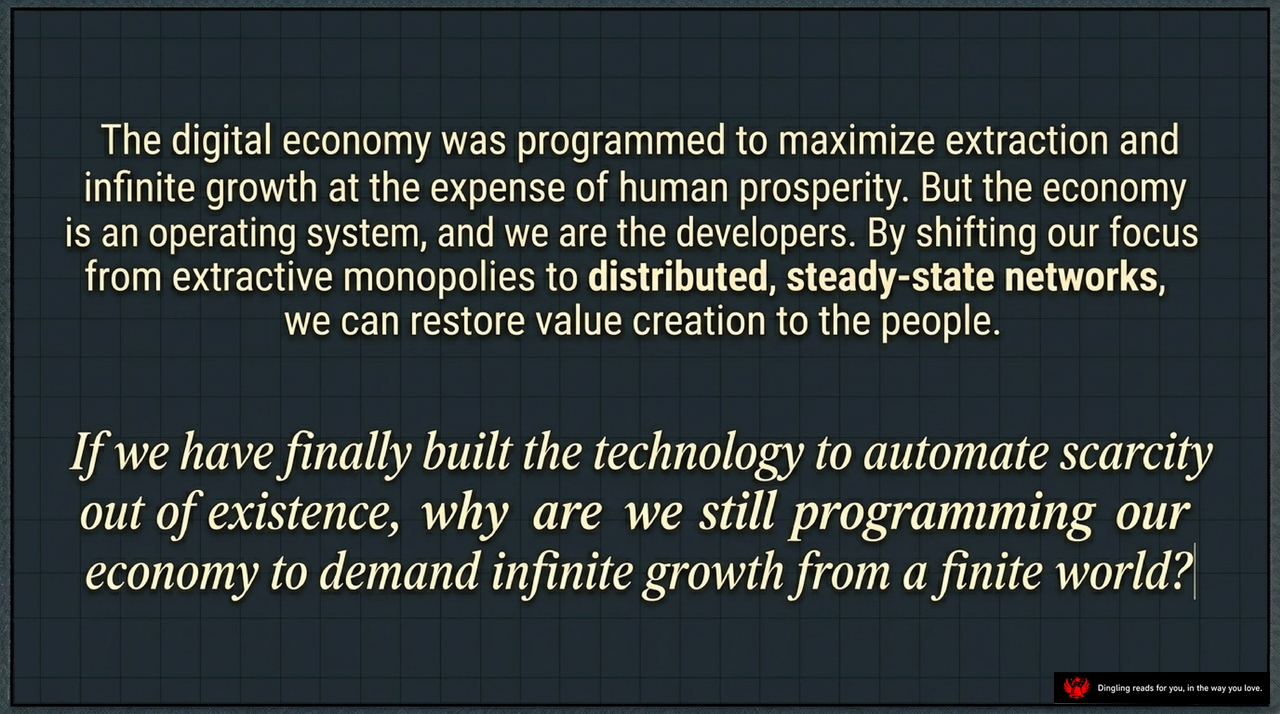
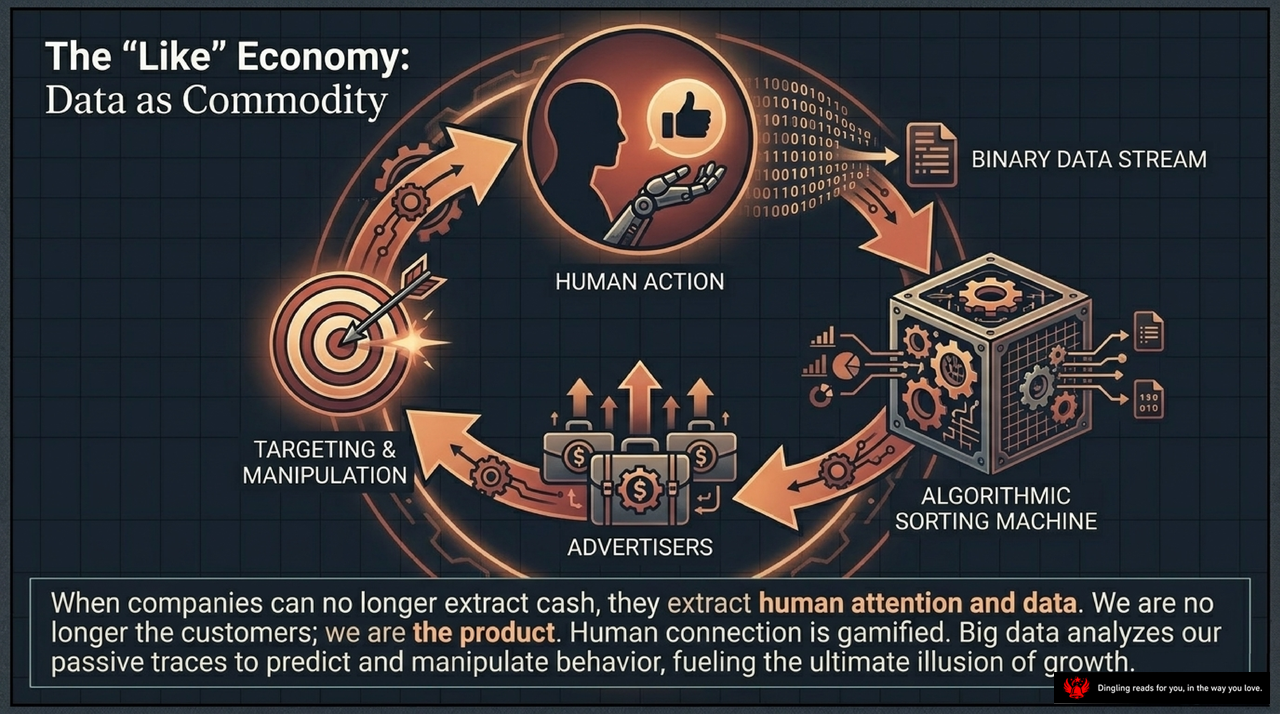
Let’s take a step back for a second. Think about the apps you scroll, the platforms you use daily—have you ever felt like they’re always hungry for more? More clicks, more data, more growth, no matter who gets left behind?
That’s not a bug; it’s the feature we built into the digital economy. As the slide points out, it was programmed to maximize extraction and infinite growth at the expense of human prosperity. But here’s the game-changer: the economy isn’t some fixed, unbreakable machine. It’s an operating system, and we’re the developers. We get to rewrite the rules.
Instead of letting extractive monopolies hoard value—those big platforms that take a cut of every transaction without giving back to the creators or users who make them work—we can shift to distributed, steady-state networks. These are systems where value flows directly to the people who create it: local food co-ops cutting out middlemen, peer-to-peer marketplaces where artisans sell straight to customers, or social platforms owned and run by their users.
And here’s the question that should make us all pause: if we’ve finally built technology that could automate scarcity out of existence—think 3D printing, AI that optimizes resources, or tools connecting people directly—why are we still forcing our economy to demand infinite growth from a finite planet? It’s like using a supercomputer to do math homework with a pencil.
We’re stuck in an old mindset where growth is the only measure of success, even when it hurts our communities and our planet. But the power to change this is in our hands. By reorienting our digital systems to prioritize people over profit, stability over endless expansion, we can restore value creation to the people who deserve it most.
This isn’t a pipe dream. It’s about taking the tools we already have and using them to build something fairer. Because at the end of the day, technology should serve us—not the other way around. We just need to hit “rewrite.”