
Too Big to Fail: Complete Chapter-by-Chapter Summary

Welcome to our book club session on *Too Big to Fail* by Andrew Ross Sorkin. Set against the backdrop of a shadowy, towering financial district, this image captures the very essence of the 2008 crisis: the immense power of Wall Street and Washington, and the terrifying fragility beneath it.
This book is the inside story of how the world's most powerful institutions fought to save the financial system—and themselves. It begins in March 2008, when the first dominoes started falling with the collapse of Bear Stearns. Just weeks later, the pressure shifted to Lehman Brothers. We see the frantic energy of CEO Richard Fuld, who believed his firm was too strong to fail, only to watch his world crumble around him. Meanwhile, Treasury Secretary Hank Paulson grappled with impossible political choices, torn between conservative principles and the urgent need to prevent a total economic meltdown.
As the crisis deepened, giants like Merrill Lynch and AIG teetered on the brink, forcing leaders to make decisions that would reshape the global economy forever. From secret backroom deals to the controversial TARP bailout, Sorkin pulls back the curtain on the high-stakes drama that defined a generation. This isn't just a history of finance; it's a gripping tale of human ambition, fear, and the relentless struggle to keep the lights on when everything seems destined to go dark.
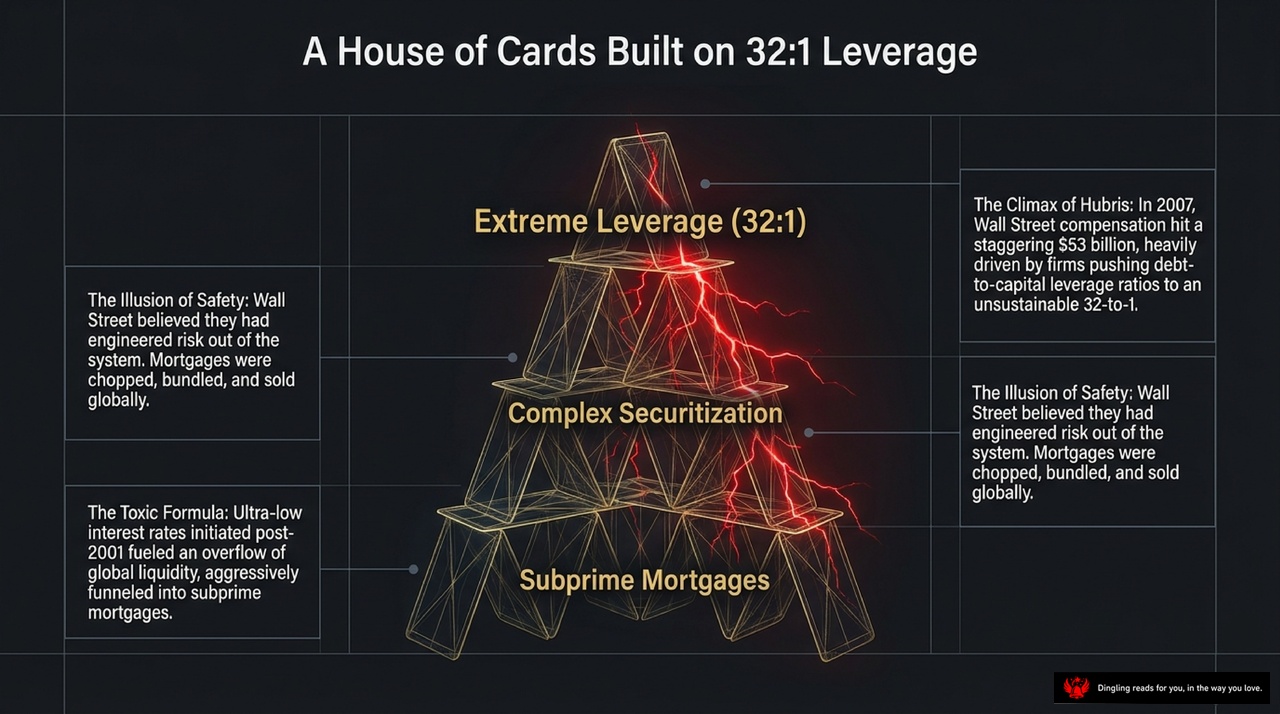
This slide visualizes the catastrophic structure that brought down the global economy: a house of cards built on unsustainable 32-to-1 leverage. At the very base, we see subprime mortgages fueled by ultra-low interest rates, which created an artificial boom and an overflow of global liquidity. But the real danger wasn't just the loans themselves; it was the complex securitization that followed. Wall Street chopped, bundled, and sold these risky assets globally, creating the illusion that they had engineered risk out of the system entirely.
As we move up the tower, that leverage skyrockets to an extreme 32-to-1 ratio. This was the climax of hubris. In 2007, Wall Street compensation hit a staggering $53 billion, driven by firms pushing debt-to-capital ratios to these unsustainable levels. They believed the system was unbreakable, but as the slide shows, lightning struck right through the middle of this fragile structure. When the foundation of subprime assets began to rot, the entire edifice collapsed. This wasn't a simple failure; it was a systemic implosion caused by the toxic formula of cheap money, hidden risk, and excessive leverage that no amount of confidence could ever support.

Picture content: The War Room Roster: Wall Street vs. Washington. The Regulators (Washington/NY): Henry Paulson (Treasury Secretary – the ex-Goldman pragmatist), Ben Bernanke (Federal Reserve Chairman – the Great Depression scholar), Timothy Geithner (NY Fed President – the crisis manager). The Titans (Wall Street): Dick Fuld (Lehman Brothers): Clinging to brand value. Jamie Dimon (JPMorgan): The cautious survivor. John Thain (Merrill Lynch): The desperate negotiator. Lloyd Blankfein (Goldman Sachs) & John Mack (Morgan Stanley): The last independent titans.
Here is the spoken script for Slide 2:
On this slide, we see the ultimate chessboard of the 2008 crisis, a stark battle between Washington's regulators and the titans of Wall Street. On the left, we have the architects of the rescue effort. First is Henry Paulson, the Treasury Secretary, a former Goldman partner who brought a pragmatic, no-nonsense approach to the chaos. Beside him stands Ben Bernanke, the Federal Reserve Chairman, the scholar who had studied the Great Depression and now faced its modern reincarnation. Completing the regulatory trio is Timothy Geithner, the NY Fed President, the man tasked with managing the daily crisis as it unfolded in real-time.
On the right side, we see the players who held the market hostage. Leading the charge is Dick Fuld of Lehman Brothers, desperately clinging to the brand value of a legacy firm that was rapidly crumbling. Next is Jamie Dimon of JPMorgan, the cautious survivor who had already pulled off the acquisition of Bear Stearnes and was watching the storm closely. Then there is John Thain of Merrill Lynch, the desperate negotiator scrambling for a buyer as his house of cards began to tilt. Finally, we have the last independent titans: Lloyd Blankfein at Goldman Sachs and John Mack at Morgan Stanley. Unlike their rivals, they had already transformed into bank holding companies, giving them a unique shield against the coming collapse. This visual perfectly captures the tension: the regulators trying to contain the explosion, while the titans fought for survival, with only two managing to pivot in time.

Look at this slide. We're talking about a dark turning point in history: the precedent of saving Bear Stearns. On the left, you see the action. It happened in March 2008. Bear Stearns was on the verge of total collapse. The Federal Reserve brokered a desperate, fire-sale deal. JPMorgan bought it for just two dollars a share. But here's the kicker: that humiliating price tag was backed by a massive thirty-billion-dollar government guarantee for their toxic assets. As Jamie Dimon, the CEO of JPMorgan, later said, "Buying a house is one thing, buying a house on fire is another."
But look at the right side. This is the consequence. That rescue didn't just save one bank; it ignited a dangerous concept called Moral Hazard. As the diagram shows, this created an implicit safety net. Suddenly, Wall Street learned a new lesson: if you are "Too Big to Fail," the government will bail you out. This expectation encouraged even more reckless risk-taking. It increased systemic vulnerability, making the entire financial system more fragile. By saving Bear Stearns, the government essentially established a rule that any institution deemed too big to fail would be protected, setting a terrifying precedent for the chaos that was coming.

The Lehman Delusion: Denying the Inevitable Collapse. This slide breaks down the fatal three-step failure that took down the firm. First, look at the market reality: liquidity had completely dried up. Short-sellers like David Einhorn publicly exposed Lehman's refusal to mark down toxic commercial real estate assets, forcing the truth into the open. While the market screamed for action, the executives were in total denial. Dick Fuld refused to accept the plunging valuation, rejected capital injections, and clung desperately to Lehman's historic brand equity, ignoring the bleeding on the balance sheet. Underpinning it all was a fatal assumption held by leadership: they operated on the flawed belief that Washington would ultimately catch them if they fell, just as they had caught Bear Stearns. But that safety net was gone. The graph shows the inevitable result: as denial set in, the collapse accelerated into a freefall.
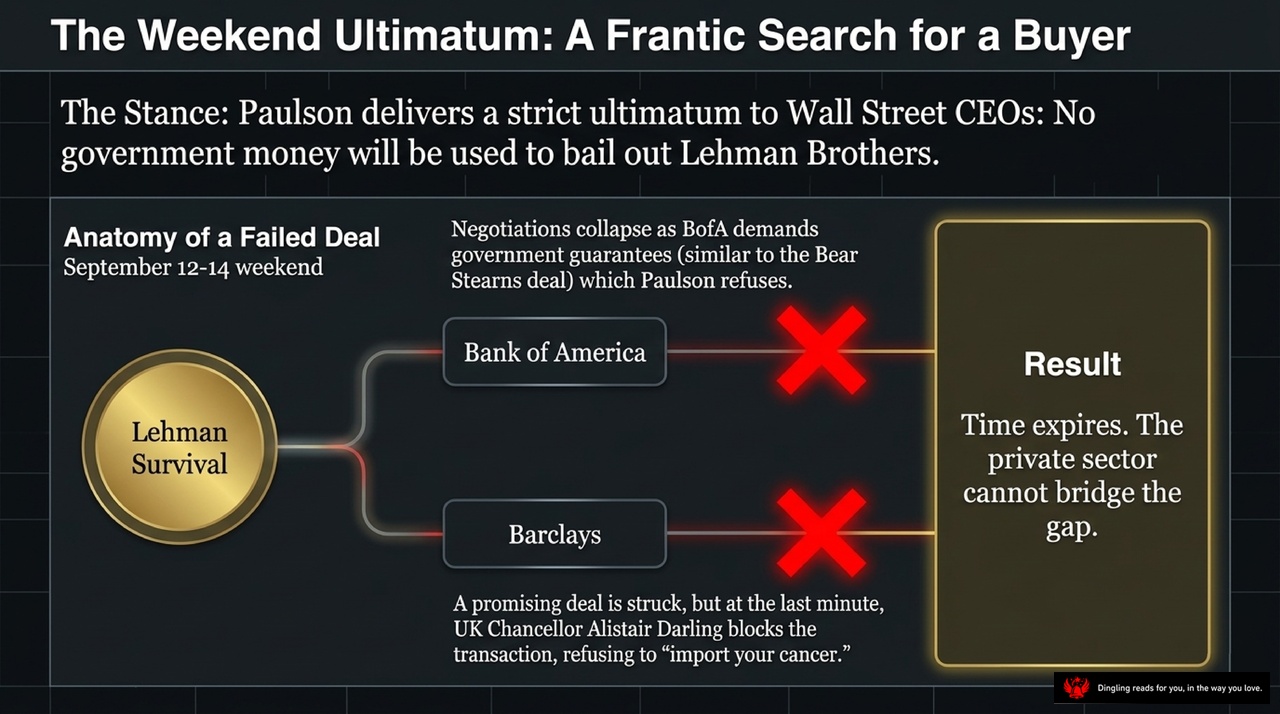
The weekend turned into a frantic race against time for Lehman Brothers. As the clock ticked down from September 14th to the 15th, the search for a buyer collapsed in spectacular fashion. The ultimate hope rested on two potential rescuers: Bank of America and Barclays. But both deals failed, sealing Lehman's fate.
First, Bank of America tried to step in, but the negotiations hit a wall. They demanded government guarantees for the toxic assets, essentially asking the U.S. to cover the losses. Paulson, the Treasury Secretary, flatly refused. He drew a hard line: no taxpayer money would be used to bail out Lehman. Without that safety net, the deal simply fell apart.
Then, there was Barclays. It looked like a promising lifeline. A deal was struck at the last minute, but it was blocked by the UK Chancellor, Alistair Darling. He refused to let his country "import cancer" by taking on Lehman's massive toxic assets. With both private-sector options dead in the water, the private sector could not bridge the gap.
The result was inevitable. Time expired. Lehman Brothers had no buyer. The frantic search ended in total failure, leaving the world on the brink of a financial collapse that no one could stop.
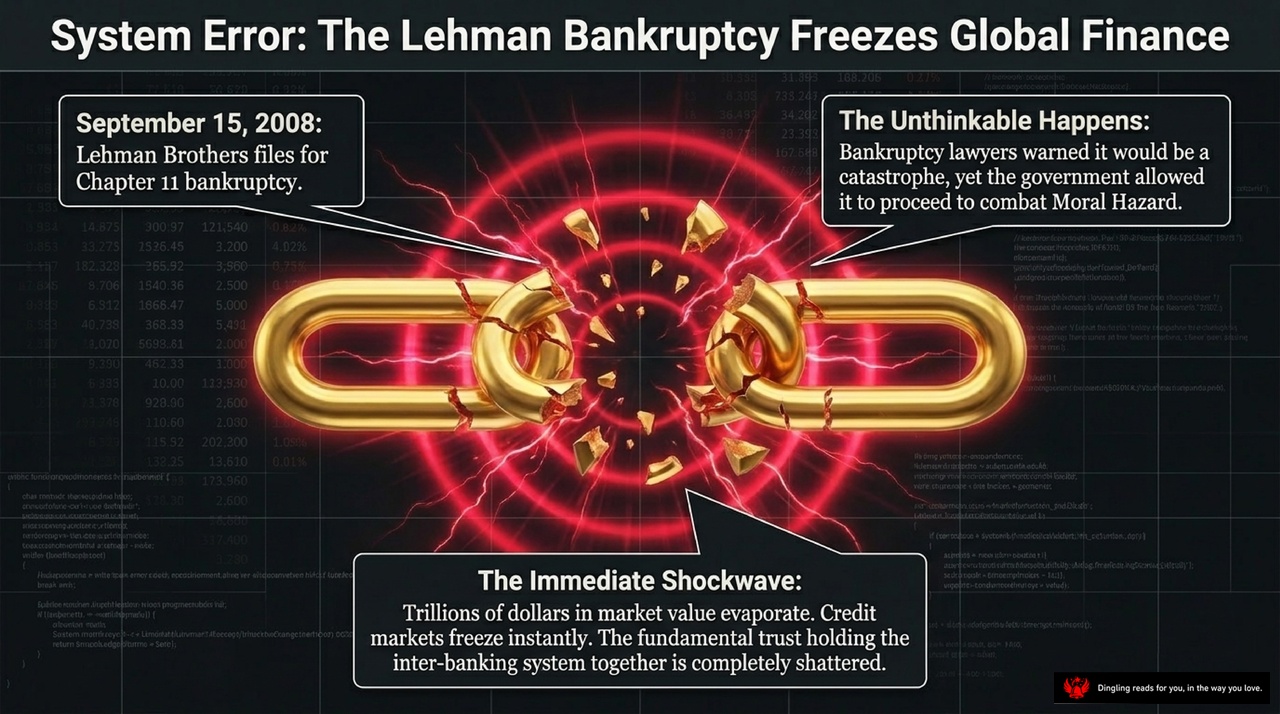
Imagine a golden chain, the very backbone of global finance, snapping in half with a deafening crack. This graphic captures the terrifying reality of September 15, 2008, the day Lehman Brothers filed for Chapter 11 bankruptcy. It wasn't just one company falling; it was a system error that froze the entire world's financial engine.
Look at that broken link in the center. Before this moment, banks relied on a fragile trust, believing their debts were guaranteed by others. But when Lehman collapsed, that fundamental trust shattered instantly. Trillions of dollars in market value evaporated in a heartbeat. Credit markets froze. The inter-banking system, which had held the global economy together for decades, came undone.
Why did this happen? As the slide notes, bankruptcy lawyers had warned the government that allowing Lehman to fail would be a catastrophe. Yet, in a shocking decision to combat moral hazard, the government let it proceed. They feared that saving Lehman would encourage reckless behavior elsewhere, but they underestimated the immediate shockwave. The result was a global panic that would ripple for years, proving that in an interconnected world, you cannot simply let one giant fall without dragging everyone else down with it.

Look at this explosive visual of "The Contagion Matrix." This diagram perfectly captures the terrifying speed of the 2008 financial collapse. At the center sits Lehman Brothers, the 158-year-old titan whose failure didn't just end a company—it shattered the entire global financial system. The image illustrates the domino effect in real-time. When Lehman collapsed, overnight lending simply stopped. Wall Street's survival relied on banks lending to each other, but in an instant, that trust vanished.
The red lightning bolts show how the shockwave rippled outward. To the top right, AIG faces immediate credit downgrades, triggering massive collateral calls that strangled its liquidity. To the left, Merrill Lynch's shares plummet as the market targets the next weakest link. At the bottom, the last two independent investment banks, Morgan Stanley and Goldman Sachs, face catastrophic runs on their capital. The graphic makes it clear: no institution was safe. If a giant like Lehman could fail, anyone could. This wasn't just a recession; it was a systemic collapse where trust evaporated overnight, leaving the entire world holding the bag.

The image you're looking at captures one of the most dramatic moments in modern financial history: the "Shotgun Wedding" between Merrill Lynch and Bank of America. It's a story of high-stakes negotiation, last-minute drama, and a race against time that determined the fate of one of the world's largest financial institutions.
As the slide illustrates, it all comes down to a critical 48-hour window. By mid-September 2008, with Lehman Brothers collapsing just days earlier, the entire financial system was on the brink of total meltdown. Merrill Lynch, once a powerhouse, found itself drowning in toxic assets and facing an existential crisis. The government, having already bailed out AIG, was under immense pressure to act again—but this time, the political and public sentiment was turning sharply against another rescue.
Seeing the writing on the wall, Merrill Lynch CEO John Thain realized that waiting for government help was a losing strategy. Instead of betting on a bailout, he made a bold, behind-the-scenes move: he initiated secret talks with Ken Lewis, the CEO of Bank of America. The goal? To merge Merrill into Bank of America before the weekend market closed, effectively escaping bankruptcy by the time the Monday morning bell rang.
This was no ordinary merger. It was a desperate, 48-hour sprint. Thain and his team worked around the clock, negotiating a $50 billion deal that would transfer Merrill's entire investment banking arm to Bank of America. But there was a catch: the deal had to be approved by both boards and announced publicly before the market opened on Monday. That meant getting everything done over a single weekend—something no major corporate merger had ever attempted.
The tension was palpable. Every hour counted. If the deal fell through, Merrill would likely go bankrupt, triggering another wave of panic across global markets. If it succeeded, it would stabilize the system and prevent further contagion. In the end, against all odds, the deal was struck. Merrill Lynch was absorbed into Bank of America in a matter of hours, just before the market opened on Monday, September 15th.
This "shotgun wedding" wasn't just about saving one company—it was about preventing the collapse of the entire financial system. It stands as a stark reminder of how quickly things can change in finance, and how decisive leadership can be when the clock is ticking.
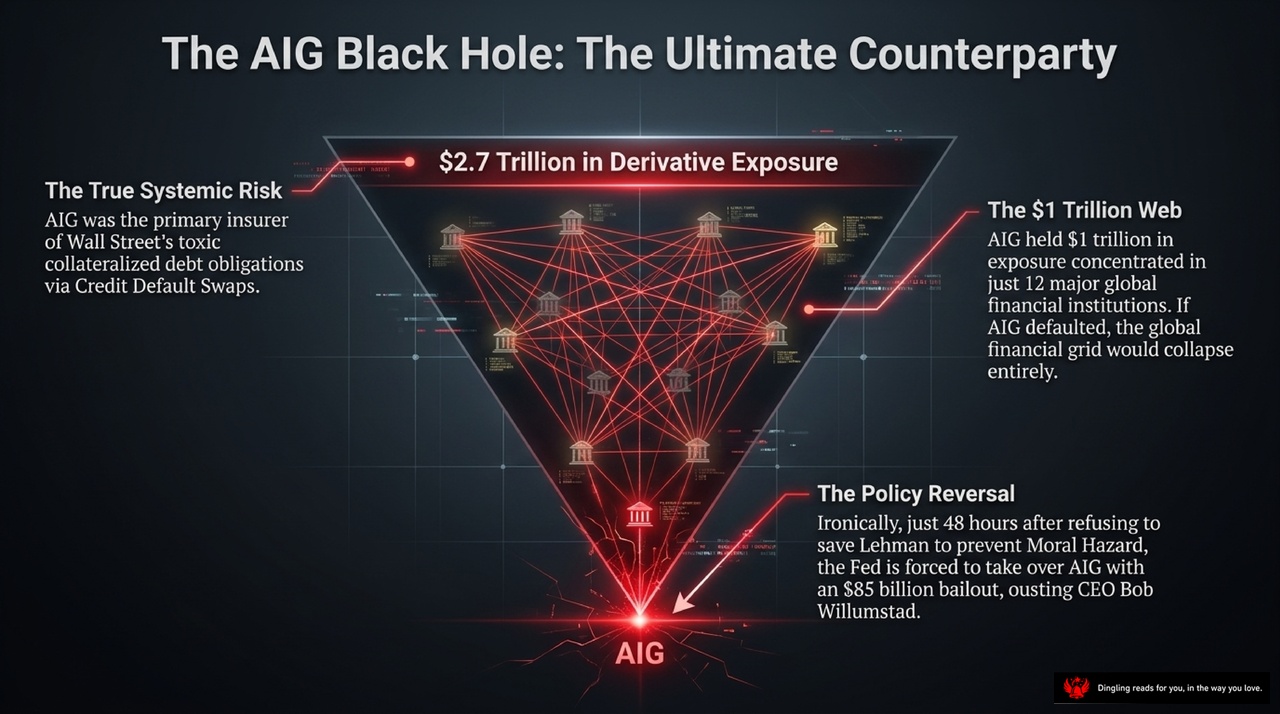
Imagine a financial system not as a collection of separate companies, but as a single, fragile web where one thread holding the entire structure together is about to snap. This slide captures the terrifying reality of AIG's collapse. At the center sits AIG itself, but look at the massive red triangle expanding outward: this represents $2.7 trillion in derivative exposure. AIG wasn't just an insurance company; it was the primary underwriter for Wall Street's most toxic collateralized debt obligations, effectively insuring the entire market's worst bets through Credit Default Swaps.
The visual on the right highlights the concentration of this risk. A staggering $1 trillion of that exposure was held by just 12 major global financial institutions. The logic is stark: if AIG defaulted, the global financial grid would not just wobble; it would collapse entirely. The interconnected lines you see represent the lethal contagion effect, where the failure of one entity threatens to drag down the entire system.
Yet, the irony captured at the bottom of the slide is perhaps the most chilling part of the story. Just 48 hours after refusing to save Lehman Brothers to prevent a "moral hazard," the Federal Reserve was forced into a complete policy reversal. With no other choice, the Fed took over AIG, providing an $85 billion bailout and ousting CEO Bob Willumstad. The market had learned the hard way that while they wouldn't save the reckless, they absolutely would not let the system burn. AIG's fall proved that in a world this interconnected, there is no such thing as too big to fail.

The image captures a dramatic before-and-after moment in financial history, illustrating how the era of the pure investment bank ended and gave way to the survival of the Bank Holding Company model. On the left, we see the "Before" state: a row of pristine, silver columns representing giants like Bear Stearns, Lehman Brothers, Merrill Lynch, Morgan Stanley, and Goldman Sachs. These were the high-leverage, high-risk investment banks that defined the 2008 crisis. As the graphic shows, this structure collapsed under pressure, leaving behind nothing but crumbling red ruins—crum-dust.
But look at the "After" state on the right. From the ashes rose two new, golden structures: Morgan Stanley and Goldman Sachs, now rebranded as Bank Holding Companies. This transformation wasn't a choice made lightly; it was a desperate lifeline to survive. To stay afloat, these titans had to abandon their historic, risky business models. They officially converted into traditional banking entities, submitting to much tighter federal regulations in exchange for safety and permanent access to Federal Reserve capital.
This pivot was crucial. Without it, they would have joined the pile of ruins alongside Lehman. As the text highlights, Morgan Stanley specifically secured its survival with a $9 billion lifeline investment from Japan's Mitsubishi UFJ. Interestingly, that deal was finalized using a physical paper check simply because the electronic banking system was down due to the crisis. This shift from silver skyscrapers to golden, regulated fortresses marks the true end of an era and the birth of a more cautious, but ultimately safer, financial landscape.

The image before us captures the exact moment history shifted gears: the transition from desperate, piecemeal fixes to a bold, systemic solution. On the left, we see the "Case-by-Case Rescues"—the frantic, red-hot attempts to save individual institutions like Bear Stearns, which ultimately proved insufficient as the contagion spread faster than the government could negotiate. This was the breaking point where Bernanke and Paulson realized that saving one bank at a time was no longer enough; the fire had become too large to contain with small buckets.
To stop the collapse, Treasury aides drafted "The Break the Glass Plan," a radical emergency strategy to buy toxic assets and recapitalize banks, aiming to prevent a second Great Depression. This vision materialized into the golden pipe labeled "Systemic Bailout (TARP)," representing the shift from isolated rescues to a unified national effort. The goal was clear: inject capital into the entire financial system to restore confidence and stop the bleeding.
But no plan comes without a price. In the bottom right, we see "The Ask." Paulson and Bernanke went to Congress demanding unprecedented authority and a staggering $700 billion. The urgency was palpable; Bernanke warned Congress with a chilling quote: "If we don't do this, we may not have an economy on Monday." This wasn't just about saving banks; it was about saving the economy itself. The $700 billion "bazooka" was the only tool left to stabilize the system, directing that massive capital flow into the heart of Washington, symbolized by the Capitol dome, to ensure the financial engine could restart.
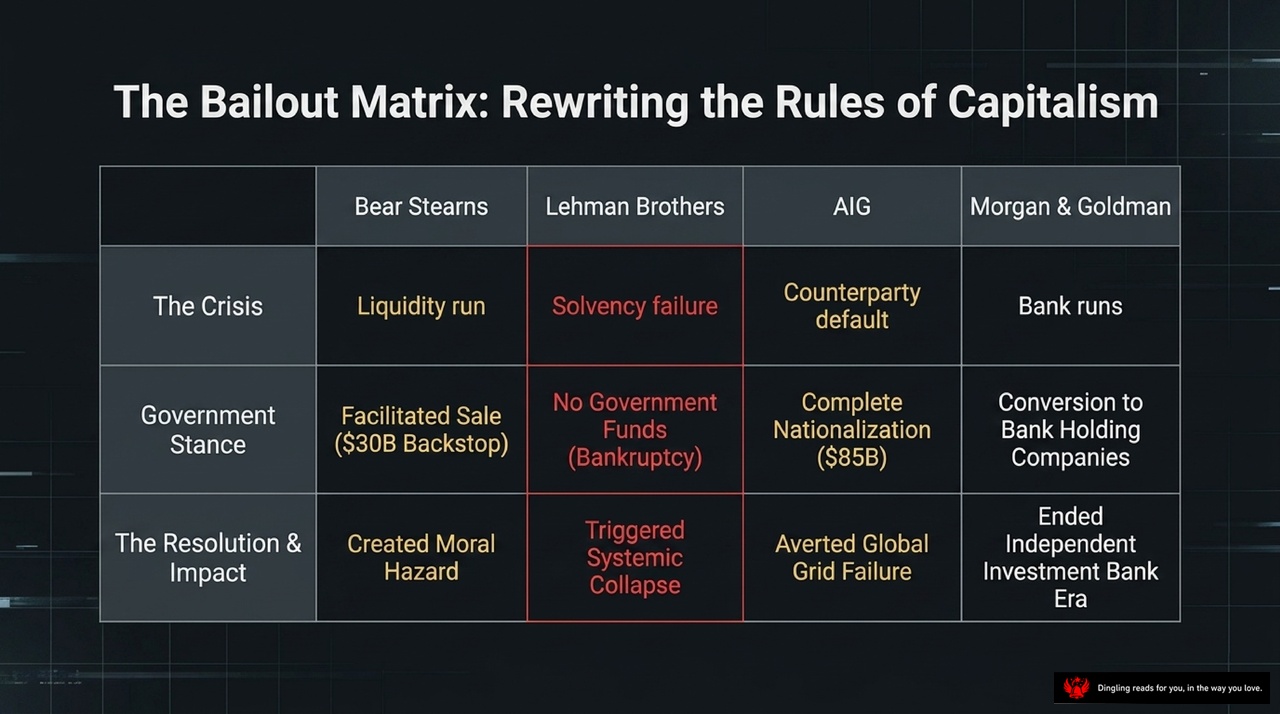
This slide breaks down the chaotic 2008 crisis into a clear "Bailout Matrix," contrasting how the government handled four major players: Bear Stearns, Lehman Brothers, AIG, and the investment banks Morgan & Goldman.
Look at the first column, Bear Stearns. They faced a liquidity run, meaning they had no cash to meet immediate demands. The government stepped in with a $30 billion backstop to facilitate a sale, which unfortunately created a moral hazard—the idea that the government would always save you if you get into trouble.
Then, we hit the red zone with Lehman Brothers. Unlike Bear Stearns, Lehman suffered a solvency failure; they were fundamentally insolvent. The government's stance here was stark: "No Government Funds." They were allowed to go bankrupt. While this triggered a systemic collapse and froze the global market, it was a deliberate choice to avoid the moral hazard seen with Bear Stearns.
Contrast that with AIG. They faced a counterparty default, primarily due to massive credit default swaps. The government chose complete nationalization, pouring in $85 billion to avert a global grid failure. Why the difference? Because AIG's collapse would have been catastrophic for the entire insurance and financial system, whereas Lehman's was viewed as a necessary shock to reset the market.
Finally, look at Morgan & Goldman. They faced bank runs, but instead of a bailout or bankruptcy, the government forced a conversion to Bank Holding Companies. This effectively ended the era of independent investment banks, merging them with commercial banks to ensure stability.
This matrix reveals a brutal truth: the rules of capitalism were rewritten on the fly. The government didn't follow a consistent playbook; they reacted based on perceived systemic risk, saving AIG while letting Lehman fail, fundamentally changing the landscape of global finance forever.

October 13, 2008, became the day the rules of Wall Street were rewritten. In a tense meeting at the Treasury Department, Henry Paulson summoned the nine top banking CEOs for a final showdown. He handed them a one-page ultimatum: accept billions in government capital and partial nationalization, or face the consequences. The offer was stark—no more hiding behind the "too big to fail" myth without paying the price. To remove the stigma and prevent a domino effect, Paulson forced healthy banks like Goldman and Morgan Stanley to take the same hit as the struggling ones. There was no room for negotiation. Every single CEO signed the agreement, marking the end of an era where private capital alone was supposed to save the system. This was the forced intervention that even the most skeptical of Wall Street couldn't refuse.

To save the free market, the United States government had to temporarily suspend it, utilizing unprecedented federal power and taxpayer capital to rescue the very architects of the crisis. This paradoxical move marked a historic turning point, where the state stepped in not to clean up the mess, but to bail out the bankers who created it. But did we truly fix the structural flaws of the financial system, or have we merely guaranteed that the next failure will be even larger? The question lingers, challenging us to look beyond the immediate stabilization and consider the long-term consequences of such massive intervention.