
Tools of Titans: Complete Chapter-by-Chapter Summary

Welcome to Tools of Titans by Tim Ferriss. This isn't just another self-help book; it's a masterclass in how the world's most successful people—billionaires, icons, and elite performers—actually operate. Think of it as a cheat code for life, revealing the hidden tactics, routines, and habits that separate the titans from the rest of us.
The core idea is simple but powerful: you don't need to be born a genius or have unlimited resources. You just need to adopt the right systems. Whether it's the recovery methods used by extreme athletes, the nutritional strategies of top investors, or the mental frameworks of legendary entrepreneurs, these tools are accessible to anyone willing to try them.
In this session, we'll dive deep into the specific techniques that drive extraordinary results. From optimizing your sleep and diet to mastering your mindset and building unshakeable resilience, you'll discover practical steps you can start using today. It's about stopping guessing and starting executing with precision.
So, let's get straight into the playbook. What does it take to think and act like a titan?
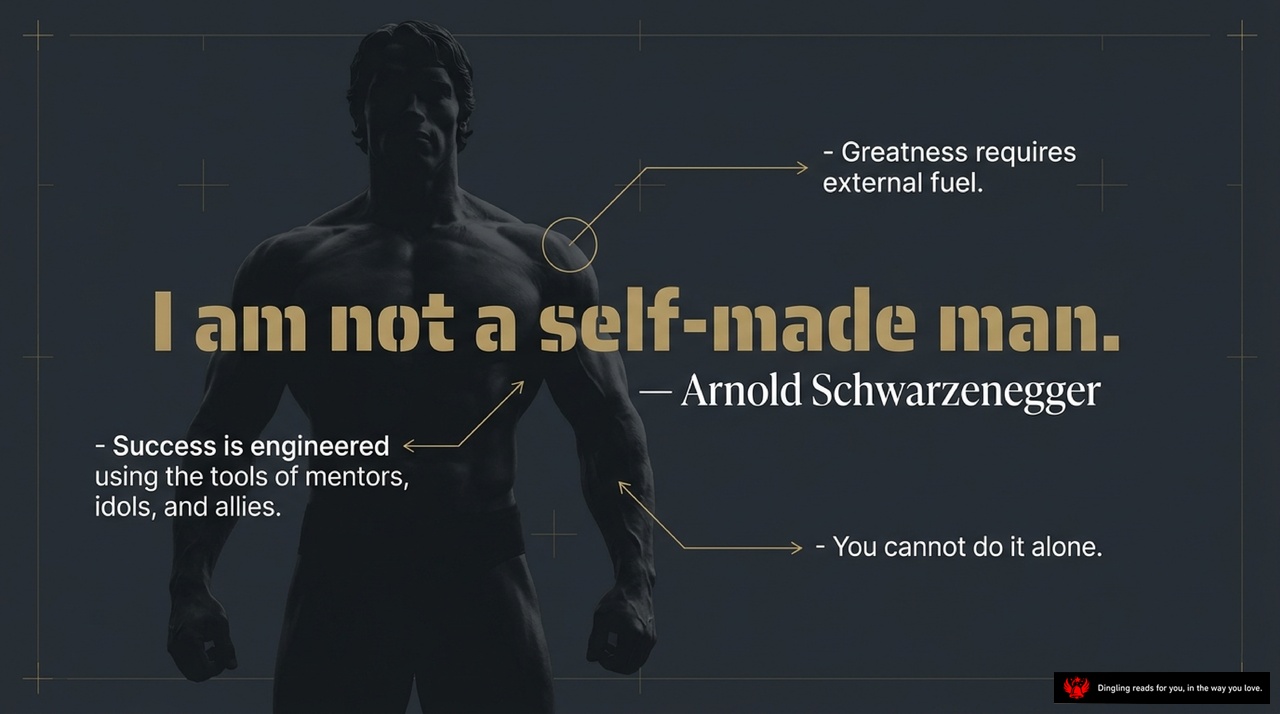
Let's be honest: the idea of the "self-made man" is a myth that holds us back more than it helps us. Look at the figure on this slide—Arnold Schwarzenegger didn't just appear out of thin air. He explicitly stated, "I am not a self-made man." His success wasn't a solo sprint; it was an engineered victory built on the tools of mentors, idols, and allies.
Think about it: greatness requires external fuel. You cannot do it alone. Whether you are climbing a mountain, building a business, or just trying to get through your morning, you need a support system. Success is engineered using the people who came before you and the network around you. So, stop trying to carry the entire weight of your life on your own shoulders. Lean on your tribe, learn from your heroes, and realize that your greatest strength lies in the connections you build, not the isolation you maintain.
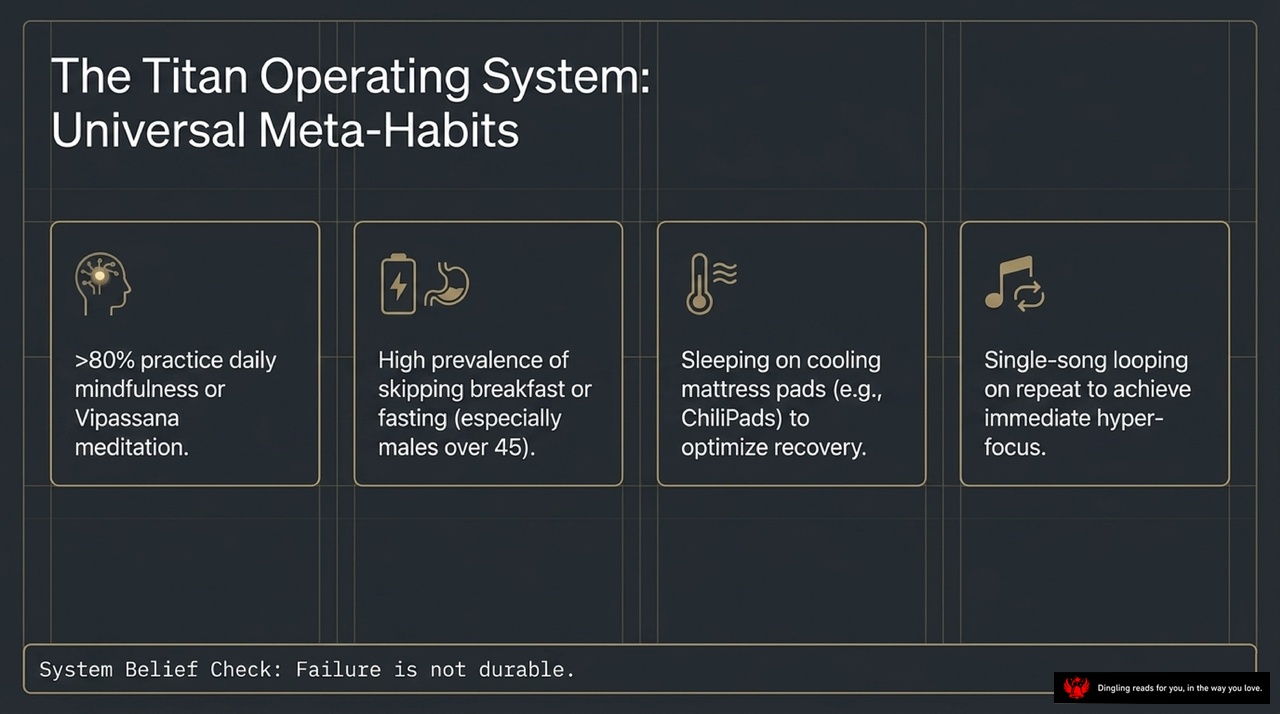
Look at this slide, "The Titan Operating System: Universal Meta-Habits." We aren't just talking about random tips here; we're looking at the daily rituals of the world's most elite performers, from Olympic champions to top-tier investors. These are the non-negotiable habits that build a "Titan" mindset.
First, notice the mental game. Over 80% of these high-performers practice daily mindfulness or Vipassana meditation. It's not about emptying your mind, but about training it to stay calm under pressure. Then, look at their physical fuel. There's a high prevalence of skipping breakfast or fasting, especially among men over 45. This isn't starvation; it's a strategic way to control insulin and boost fat-burning.
Next, check out their recovery protocols. Many sleep on cooling mattress pads, like ChiliPads, to optimize their body temperature and repair tissues faster. And for instant focus, they use a simple trick: single-song looping. Playing one track on repeat helps them achieve immediate hyper-focus without the distraction of changing music.
Finally, keep an eye on the footer: "System Belief Check: Failure is not durable." This is the core logic of a Titan. You don't avoid failure; you design systems where failure is temporary and recoverable. By stacking these habits—mindfulness, strategic fasting, optimized sleep, and laser focus—you aren't just working harder; you're engineering a lifestyle where success becomes the default outcome.
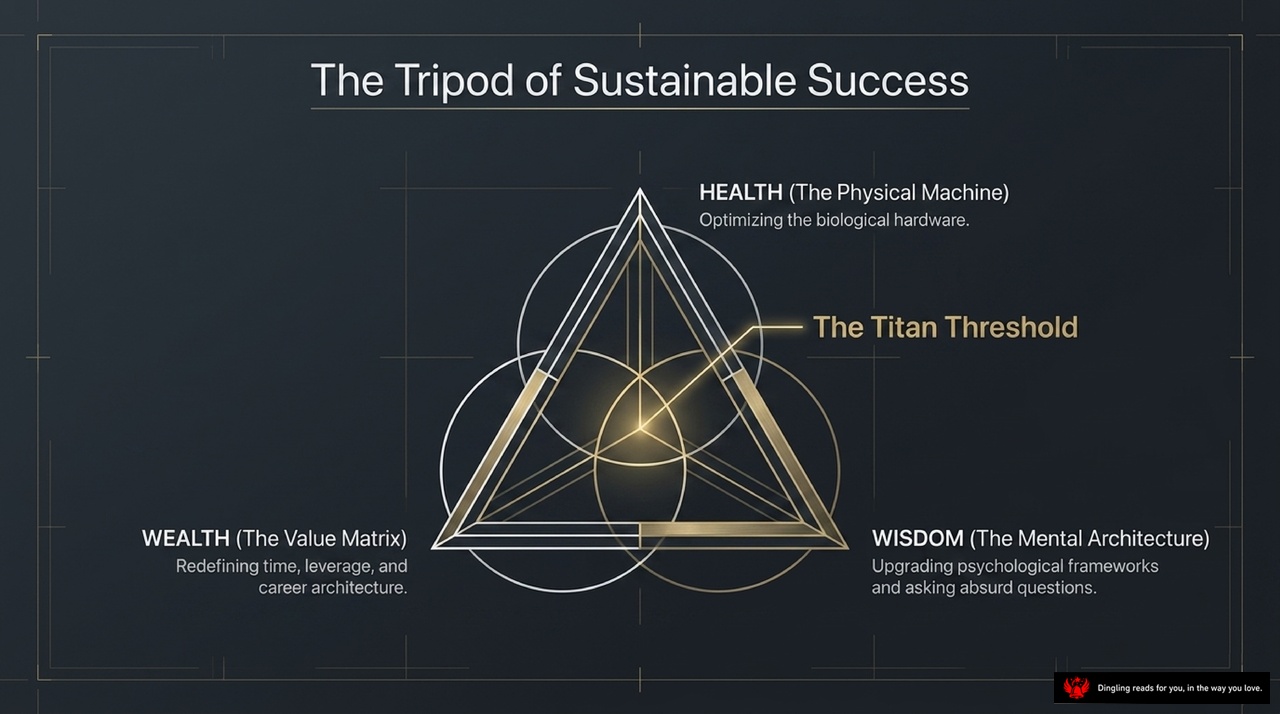
Let's talk about the foundation of sustainable success. Look at this diagram: it's not just about being rich or smart; it's about the "Tripod of Sustainable Success." To build a life that lasts, you need to balance three critical pillars.
First, you have Health. Think of your body as the physical machine. Without optimizing this biological hardware, nothing else matters. You can have the best ideas and the most wealth, but if the engine fails, the journey stops.
Second, there is Wealth, which we call the Value Matrix. This isn't just about having money; it's about redefining how you use time, leverage, and your career architecture. It's about building systems that generate value, not just trading hours for dollars.
And finally, Wisdom. This is the mental architecture. It involves upgrading your psychological frameworks and asking the kind of absurd, disruptive questions that most people are too afraid to ask. It's the difference between following the crowd and creating your own path.
But here's the most important part: all three of these legs must meet at a specific point in the center. The slide calls this "The Titan Threshold." This is the intersection where your physical vitality, your financial leverage, and your mental clarity converge. If you focus on only one leg—say, making money while ignoring your health or your mindset—the entire structure becomes unstable. You might succeed briefly, but you won't be able to sustain it. True success isn't about maximizing one area at the expense of the others; it's about finding that precise balance point where health fuels wealth, wisdom guides both, and the threshold is crossed, allowing you to operate at your highest potential for the long haul.

Today, we're looking at the blueprint for building a high-performance human. Think of your body not just as a biological organism, but as a finely tuned machine that needs specific engineering upgrades to handle extreme demands. This slide breaks down the first pillar: Health. It's about taking control of your biology through three distinct systems.
First, let's look at the engine itself: your metabolism and cognition. Dr. Dominic D'Agostino teaches us that shifting your primary fuel source can revolutionize your mental endurance. By utilizing nutritional ketosis and fasting, you stop relying on glucose and start burning fat. This isn't just about weight loss; it's about creating a state where your brain runs on pure, efficient energy, allowing for extreme cognitive endurance that a sugar-fueled diet simply can't match.
Next, we have the command center: your nervous system. Enter Wim Hof, the legendary "Ice Man." His approach is all about hacking your autonomic nervous system through extreme cold exposure and rhythmic breathing. By voluntarily triggering a stress response and then mastering your way back to calm, you essentially supercharge your immune system and resilience. It's a powerful tool for anyone looking to thrive under pressure.
Finally, let's talk about the foundation: your connective tissue. This is where Amelia Boone, the ultimate obstacle course champion, shares her secret. After suffering a devastating knee injury, she didn't just rest; she engineered her recovery. Her protocol combines hydrolyzed collagen with beet root powder to repair tissue and boost stamina, while using simple tools like rolling a golf ball under her feet to maintain flexibility. This proactive approach to tissue health is what allowed her to return from surgery in just eight weeks and dominate the world stage again.
So, whether it's fueling your brain with fat, hardening your nerves with cold, or rebuilding your joints with precision, the message is clear: treat your body like a machine you are actively designing for success.

Look at this graph. It illustrates a concept called "The Minimum Effective Dose," and it completely changes how we should think about training. On the left, you see the "Minimum Effective Dose Zone." This is where strength is actually built. As Pavel Tsatsouline famously said, "Strength is a skill, not just an exertion." To get there, we need low reps with high load—limiting sets to five reps or fewer. This builds real, functional strength rather than just cosmetic muscle.
But look at what happens as we push past that zone. The curve drops off sharply. Why? Because "burn is the enemy," according to Charles Poliquin. When you chase that intense burn, you are maximizing fatigue instead of maximizing tension. The graph shows that once you go too far, results plummet. The key is to stop before the muscle fails. Don't push into exhaustion; push until the tension is maximized. By staying in that sweet spot, you get the best results with the least amount of effort.
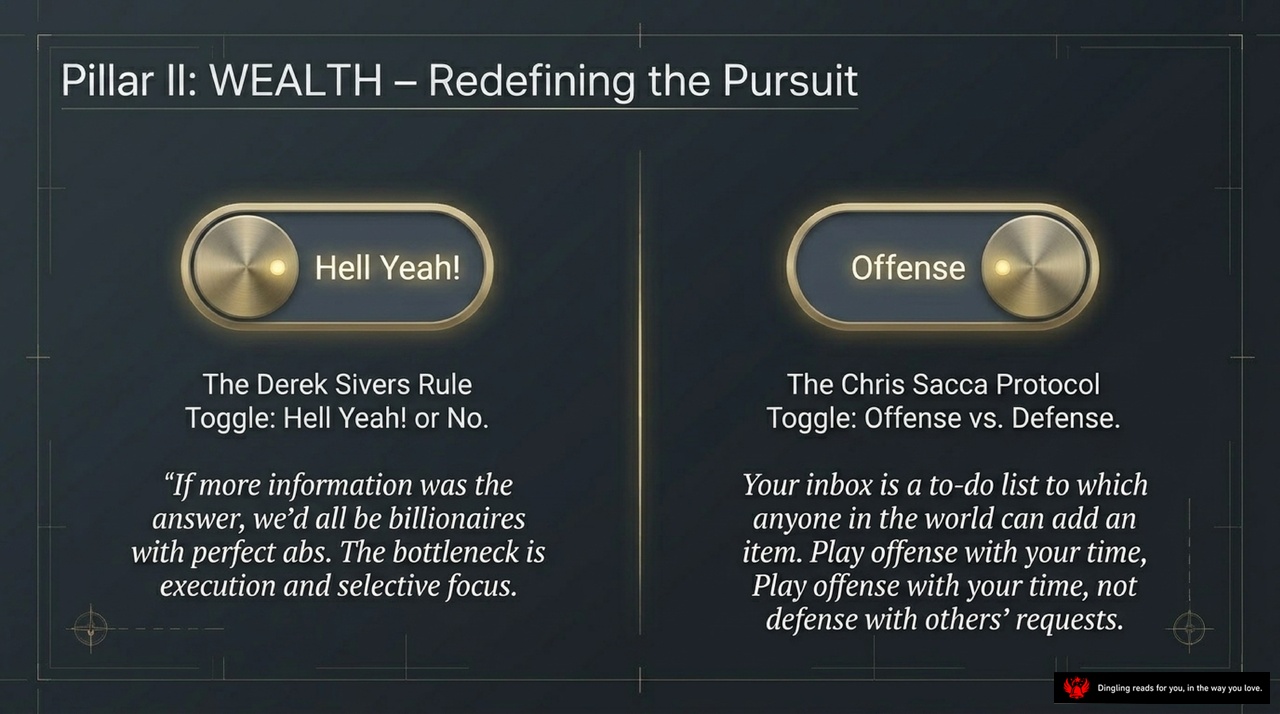
Welcome back to our Wealth pillar. Today, we're redefining the pursuit of success by turning two powerful mental toggles on. On the left, we have the "Hell Yeah!" rule, popularized by Derek Sivers. Think of it as a filter for your life: if an opportunity doesn't make you say an enthusiastic "Hell Yeah!", the default answer is a firm "No." Sivers reminds us that information isn't the bottleneck; execution and selective focus are. If everyone had perfect data, we'd all be billionaires with perfect abs. So, stop saying "maybe" or "I'll think about it." If it's not a total yes, it's a no.
Now, look at the right side: the "Offense" toggle, inspired by Chris Sacca. This is about how you manage your time and attention. Sacca argues that your inbox is essentially a to-do list where anyone in the world can add items to it. If you spend your day reacting to emails and requests, you are playing defense. You are letting other people dictate your schedule. Instead, you must play offense. Take control of your time. Proactively reach out, set boundaries, and design your day around your goals, not other people's demands. By switching from a defensive posture to an offensive one, you stop being busy and start being productive. These two toggles—one for saying yes only to the extraordinary, and the other for taking charge of your time—are the foundation of true wealth creation.
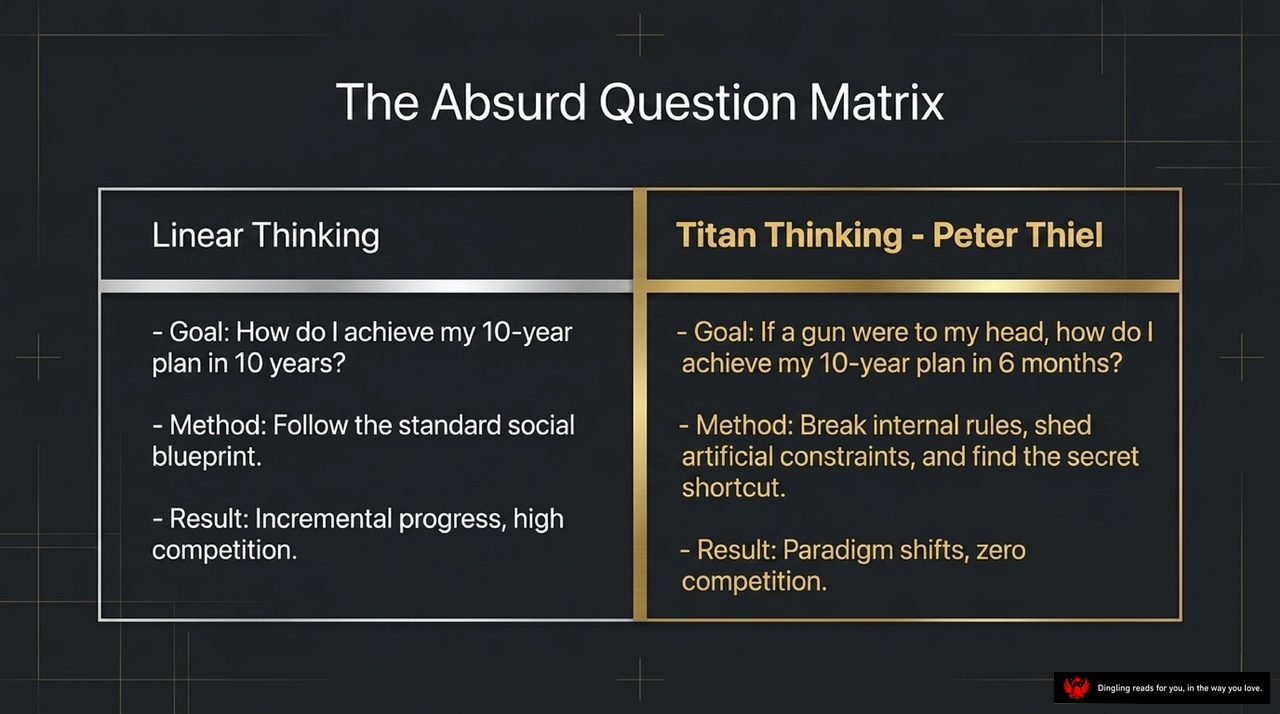
So, let's talk about the Absurd Question Matrix, a powerful mental framework popularized by Peter Thiel that completely flips how we approach success. On the left, you see Linear Thinking: the standard path where everyone asks, "How do I achieve my 10-year plan in 10 years?" The method is simply following the standard social blueprint, which inevitably leads to incremental progress but leaves you trapped in high competition.
Now, look at the right side: Titan Thinking. This is the game-changer. Instead of asking how to reach your goal in a decade, Thiel asks, "If a gun were to my head, how do I achieve my 10-year plan in 6 months?" This creates an absurd amount of urgency. The method shifts from following rules to breaking internal ones, shedding artificial constraints, and finding the secret shortcut. The result? Instead of just moving forward slowly, you force a paradigm shift that results in zero competition.
The core lesson here is simple: stop trying to be the best in a crowded market by following the herd. Instead, use extreme pressure to innovate so hard that you become the only player in a new game. That is the true secret to achieving something truly unique.

Look at this upward trajectory. It's not just a graph; it's the blueprint for how you actually build a legacy. We call this "The Canvas Strategy," and it starts with something counterintuitive: subverting your ego.
Step one is to find the absolute brightest people in your field and then, crucially, to subordinate your own ego. You have to be willing to let them shine brighter than you do. Why? Because greatness begins with humility. You need to anticipate their problems before they even realize them.
That leads us to Step two: clear the path. This is where the magic happens. You do the tedious, unglamorous work that no one else wants to touch. You remove their obstacles, you fix their logistics, you handle the boring stuff. You make their life easier so they can focus on their brilliance. It sounds simple, but it's the hardest work of all.
And finally, Step three: accumulate leverage. By making them indispensable, you become indispensable to them. You aren't competing for the spotlight anymore; you are the foundation that holds the spotlight up.
The insight here is profound. Real success isn't about being the loudest voice in the room. It's about making other people look good. It's about the monotonous, repetitive work of clearing the path for the geniuses around you. When you do that, you don't just climb the chart; you become the engine that drives it upward.
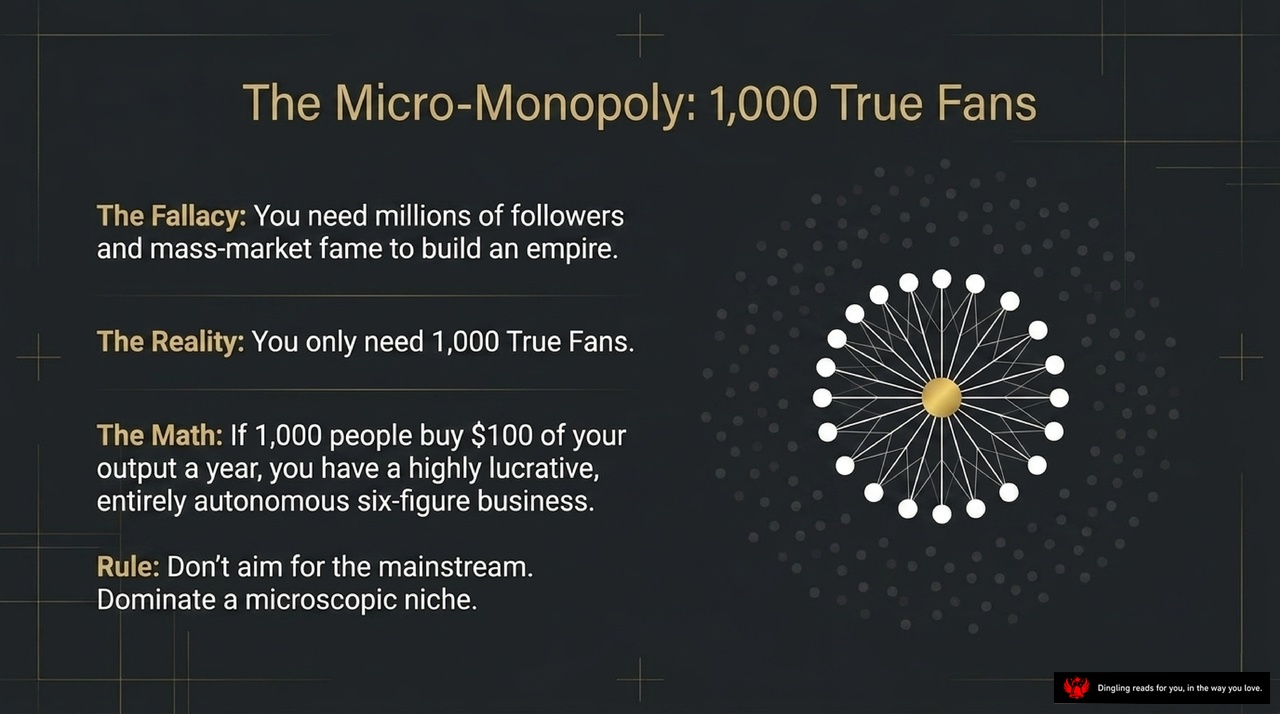
Let's talk about how you actually build a business. We've all been sold this idea that you need millions of followers, a massive audience, and mainstream fame to ever make it. That's the fallacy. The reality, however, is much more accessible and powerful: you only need 1,000 true fans.
Look at that diagram on the right. It visualizes a network where a single core connects to many others. In business terms, this isn't about a crowd; it's about a community. A true fan is someone who will buy anything you make, follow you anywhere, and defend your work. If you have 1,000 of them, the math is incredibly simple and lucrative. If just 1,000 people buy $100 of your output a year, you've just built a highly autonomous, six-figure business.
So, the rule is clear: don't aim for the mainstream. Stop chasing the noise and instead dominate a microscopic niche. By focusing your energy on a small group of people who truly care about what you do, you create a stable foundation that you can grow from, rather than trying to please everyone who might scroll past you.
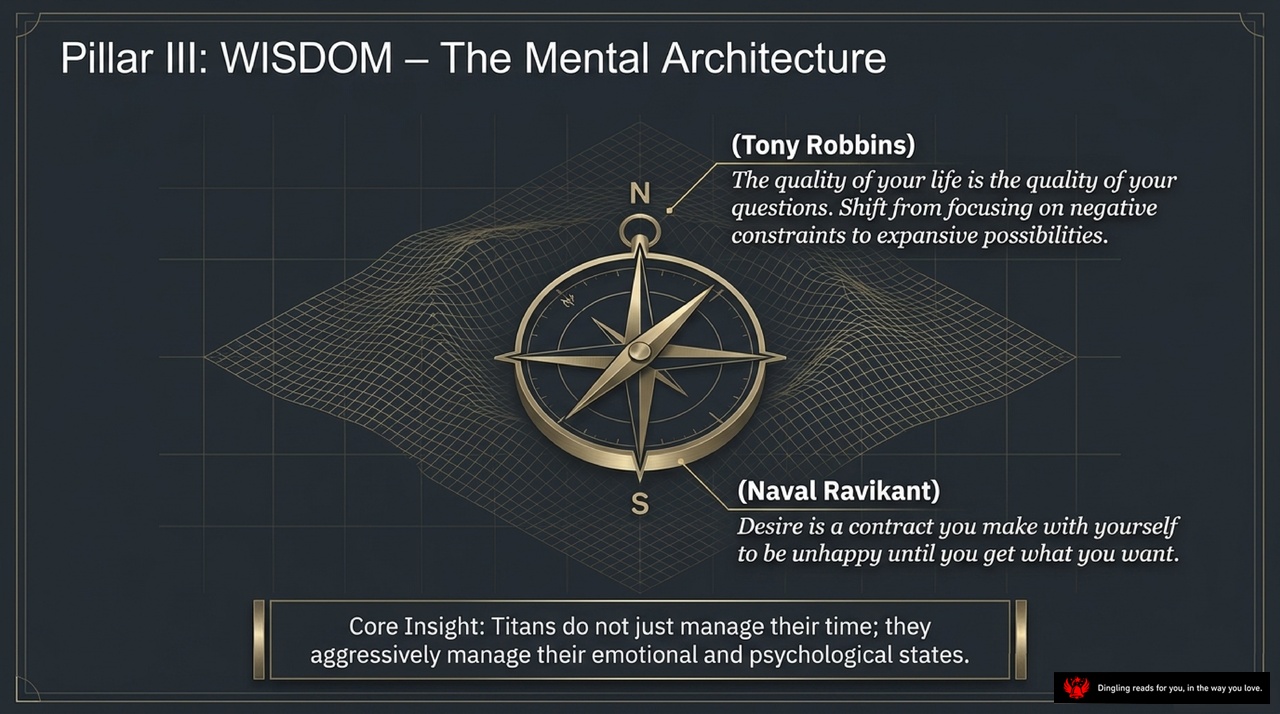
Welcome to Pillar III: Wisdom, the Mental Architecture. Think of your mind not just as a processor, but as the very blueprint of your reality. Today, we're looking at how top performers don't just manage their time; they aggressively manage their internal state.
First, let's talk about the compass of your life. As Tony Robbins famously says, "The quality of your life is the quality of your questions." If you keep asking, "What's stopping me?" you'll get stuck in negative constraints. But if you shift your focus to expansive possibilities, you unlock a completely different path. It's all about the narrative you choose to live by.
Then there's the concept of desire itself. Naval Ravikant offers a brutal but liberating truth: "Desire is a contract you make with yourself to be unhappy until you get what you want." Most of us are unknowingly signing that contract every day. The wisdom here is realizing that desire isn't a right; it's a choice. You have the power to rewrite that contract and find contentment in the pursuit, not just the result.
So, what's the core insight for titans? It's this: they don't just react to the world; they curate their psychological environment. They understand that how they think, what questions they ask, and whether they're at war with their own desires determines everything. Master your mind, and you master the architecture of your life.
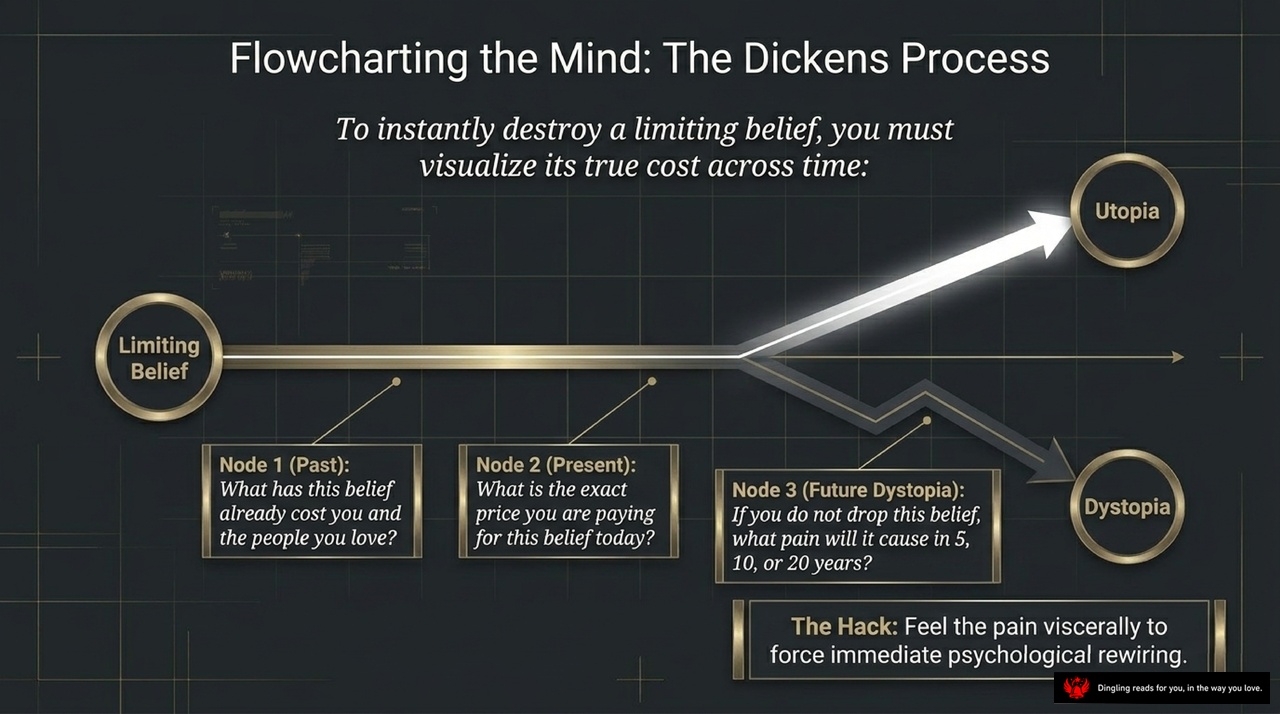
Imagine you're standing at a crossroads in your mind. On one side lies a limiting belief you've been carrying for years; on the other, the potential for a completely transformed life. The image you just saw outlines a powerful mental framework called the "Dickens Process," a method to instantly dismantle those self-sabotaging thoughts. It works by forcing you to visualize the true cost of your beliefs across three critical dimensions: the past, the present, and the future.
First, look at Node 1, the Past. Ask yourself: What has this belief already cost you and the people you love? It's not just about money; it's about the opportunities missed and the relationships strained. Then, move to Node 2, the Present. What is the exact price you are paying right now? This is where the daily friction happens—the hesitation, the anxiety, the ceiling on your performance. Finally, and most importantly, gaze into Node 3, the Future Dystopia. If you do not drop this belief, what pain will it cause in 5, 10, or 20 years? Picture the version of yourself trapped by this mindset, watching others soar while you stay grounded.
This visualization isn't just intellectual; it's visceral. The hack here is to feel that future pain in your gut. When you truly taste the bitterness of that dystopian future, your brain is forced to rewire itself immediately. You stop rationalizing and start acting. By contrasting the current suffering with the terrifying cost of inaction, you create a powerful motivation to leap toward Utopia. Don't just think about changing; feel the necessity of it.
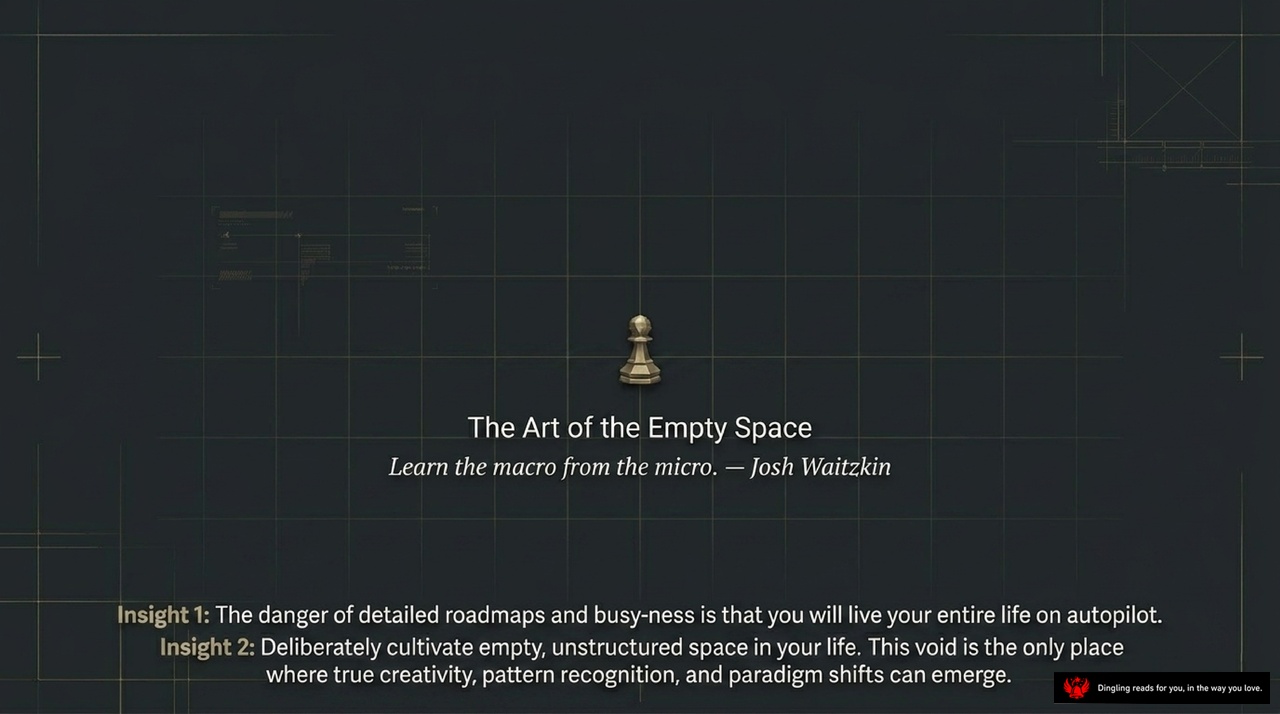
Today's slide is titled "The Art of the Empty Space," featuring a quote from Josh Waitzkin: "Learn the macro from the micro." This isn't just about chess; it's a life lesson. The first insight warns us of a hidden trap: detailed roadmaps and constant busyness can put us on autopilot, stealing our agency. But the second insight offers the antidote. We must deliberately cultivate empty, unstructured space in our lives. This void isn't a gap to be filled; it's the only place where true creativity, pattern recognition, and paradigm shifts can actually emerge. Think of it this way: if your mind is always packed with noise and schedules, there's no room for new ideas to breathe. By stepping back and embracing that silence, you create the conditions for breakthroughs. It's about learning the big picture—the macro—by understanding the value of the small, quiet moments—the micro. Don't fear the empty space; invite it in, because that's exactly where your next great idea is waiting to be born.
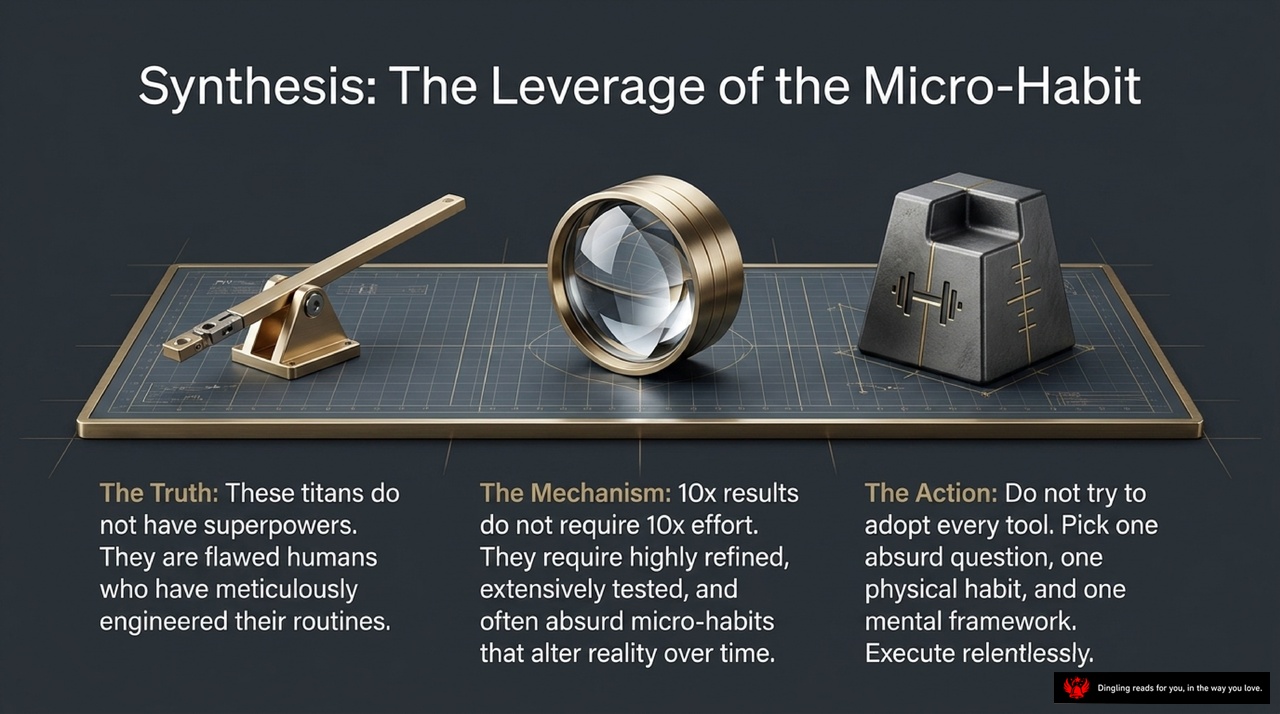
So, let's synthesize everything we've discussed into one powerful concept: the leverage of the micro-habit. Look at these three icons on the screen. They represent the truth, the mechanism, and the action.
First, the truth: These high-achieving titans you admire don't have superpowers. They are just flawed humans who have meticulously engineered their routines. Second, the mechanism: You don't need 10x effort to get 10x results. Instead, you need highly refined, extensively tested, and often absurd micro-habits that alter reality over time. Finally, the action: Stop trying to adopt every tool. Pick one absurd question, one physical habit, and one mental framework. Then, execute relentlessly. That is how you build leverage.
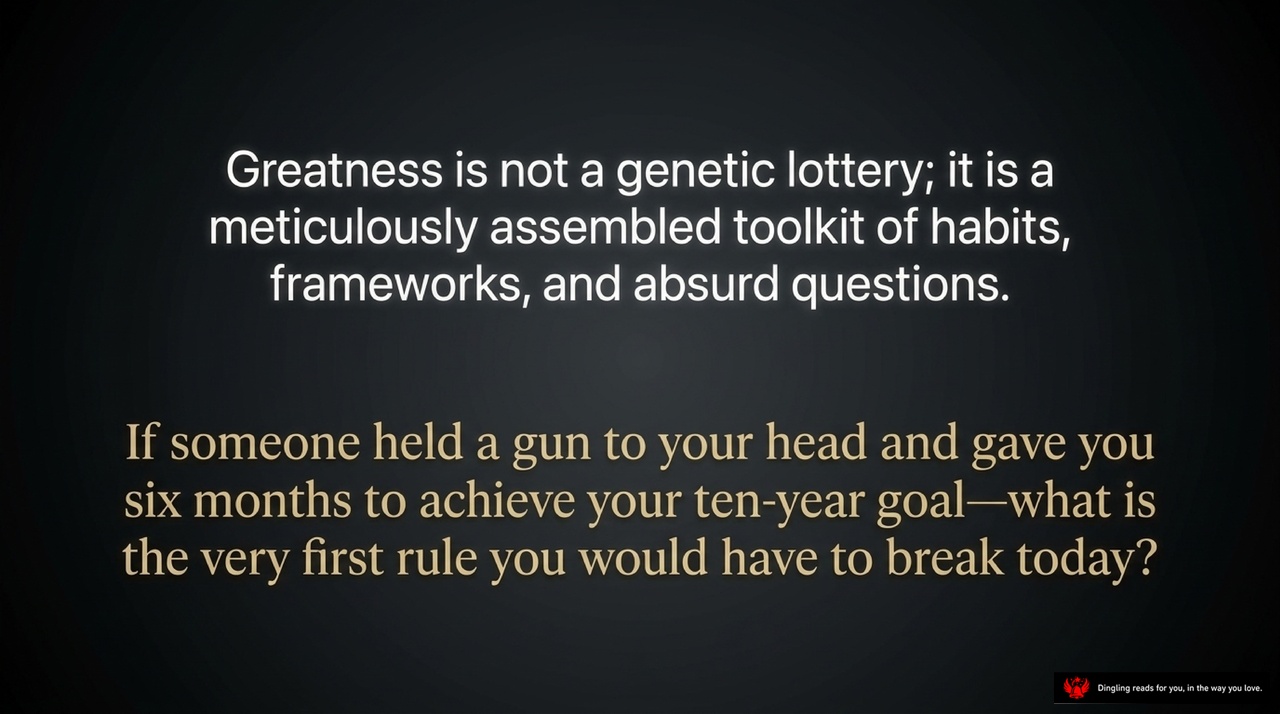
Greatness isn't a genetic lottery; it's a meticulously assembled toolkit of habits, frameworks, and absurd questions. Think about it: if someone held a gun to your head and gave you six months to achieve your ten-year goal, what is the very first rule you would have to break today?
That's the mindset shift we're talking about. Instead of waiting for perfect conditions or fearing failure, you start by identifying the one constraint holding you back and shattering it immediately. It's about aggressive prioritization and ruthless focus.
In our previous discussions, we looked at how experts like Amelia Boone and Dominic D'Agostino use specific tools—whether it's bone broth, ketosis, or cold exposure—to build their incredible capabilities. But tools alone aren't enough without the right mental framework. As Scott Adams famously said, "Losers have goals; winners have systems." A goal is a single point of failure, but a system is a resilient process that keeps moving forward even when things go wrong.
So, what's your first broken rule? Are you breaking the rule of "waiting for motivation"? Are you breaking the rule of "needing permission"? Or perhaps, you're breaking the rule of "trying to please everyone," remembering that trying to make everyone happy is the mark of a mediocre person.
The path to greatness isn't about following a script written by others. It's about courageously designing your own toolkit, testing your frameworks against reality, and asking the most absurd, uncomfortable questions to find the truth. Start breaking rules today.