
Toyota Production System: Complete Chapter-by-Chapter Summary

Welcome to today's session on the Toyota Production System. This isn't just a set of manufacturing rules; it is a profound management philosophy rooted in one absolute truth: the elimination of waste. As we see on this screen, imagine these gears not as static metal parts, but as a living system where every movement must be intentional. In a world obsessed with speed and scale, Toyota dared to ask a radical question: what if we stopped producing just because we could, and only produced what was needed, exactly when it was needed?
This philosophy, developed by Taiichi Ohno, was born out of necessity. While other companies chased the high-growth era with massive inventories and endless production, Toyota prepared for a different reality. They realized that true efficiency doesn't come from running machines at full speed regardless of demand, but from aligning every action with actual customer needs. By focusing on the absolute elimination of waste, Toyota built a system capable of surviving and thriving in any environment, even when the economy slows down. This is the core of their legacy: a resilient, flexible, and waste-free way of working that remains relevant today.

Look at this split screen. On the left, we see "The Paradigm of Abundance," represented by that classic factory icon. This was the American way: massive resources, mass market demand, and a relentless push for large-batch, high-speed production. It was the Ford System, built on the belief that more volume always equals lower costs.
But on the right, we see "The Catalyst of Constraint." This is where the story gets interesting. When extreme resource scarcity hit Japan in 1945, they faced a brutal reality: their efficiency was only one-ninth of America's. The American model simply didn't fit their国情. So, instead of trying to copy the abundance model, Japan's engineers, led by Toyota, decided to engineer a fundamentally new system: Lean Production. Their philosophy was bold and clear: "Catch up with America in three years."
They realized that in a world of scarcity, you couldn't just push more product out. You had to be smart. They needed a system that thrived on multi-variety and small-lot markets, turning the very constraint of limited resources into the engine for their innovation. While the West was obsessed with speed and volume, Japan was forced to invent a way to produce efficiently with far fewer people and materials. That shift from abundance to constraint didn't just save them; it gave the world a new way to manufacture.
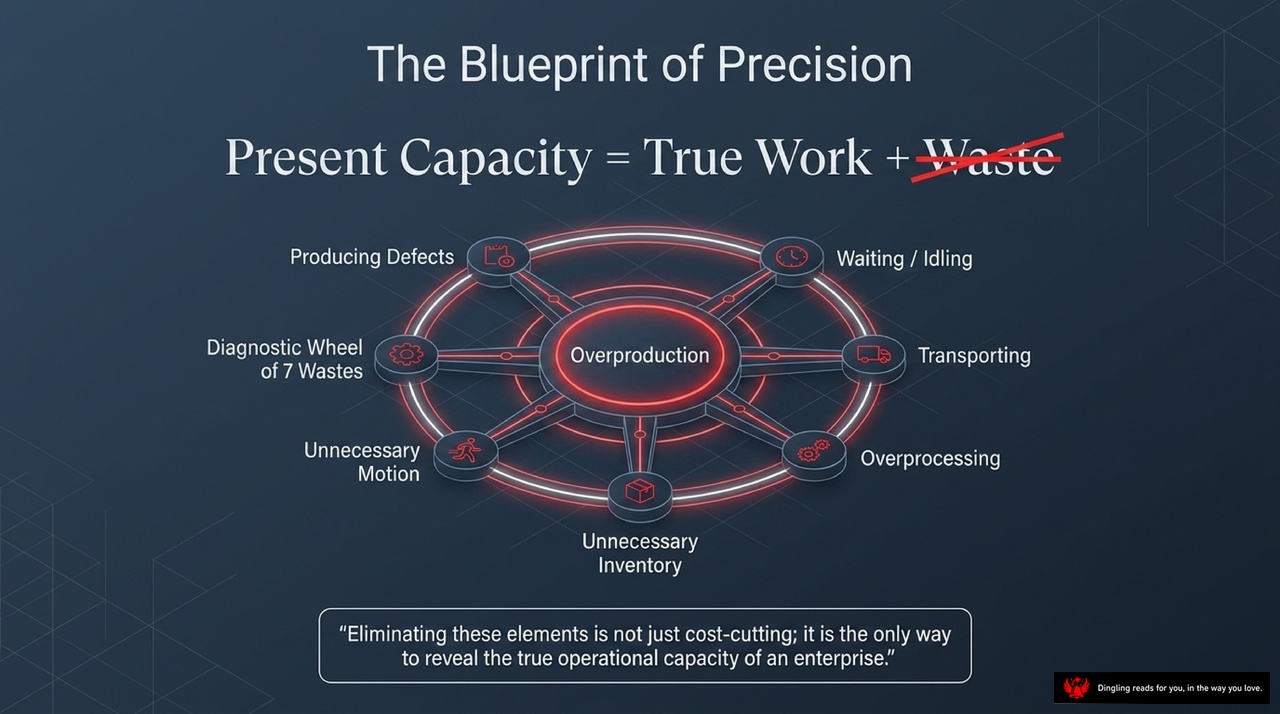
Look at this blueprint of precision. It starts with a simple but powerful equation: Present Capacity equals True Work plus Waste. Notice how "Waste" gets crossed out? That's the core message. We aren't just looking at what we produce; we are ruthlessly separating what adds real value from everything else that doesn't.
This slide introduces the "Diagnostic Wheel of 7 Wastes," a critical tool for identifying where efficiency leaks out of your system. At the center sits "Overproduction." In my view, this is the root of all evil. It's the most dangerous waste because it creates a false sense of security, hiding the other six problems beneath a mountain of excess inventory.
Surrounding Overproduction are the six symptoms: Producing Defects, Waiting or Idling, Unnecessary Motion, Unnecessary Inventory, Transporting, and Overprocessing. Think of it this way: if you start by eliminating Overproduction, you naturally reduce the need for massive inventory and unnecessary movement. You stop waiting for parts that don't exist yet, and you stop making things you don't need, which prevents defects from ever being created in the first place.
The text at the bottom makes it clear: eliminating these elements isn't just about cutting costs; it's the only way to reveal the true operational capacity of an enterprise. Many companies are running at full speed, yet they are actually moving very little value because they are drowning in waste. By fixing this wheel, you unlock the real potential of your business.
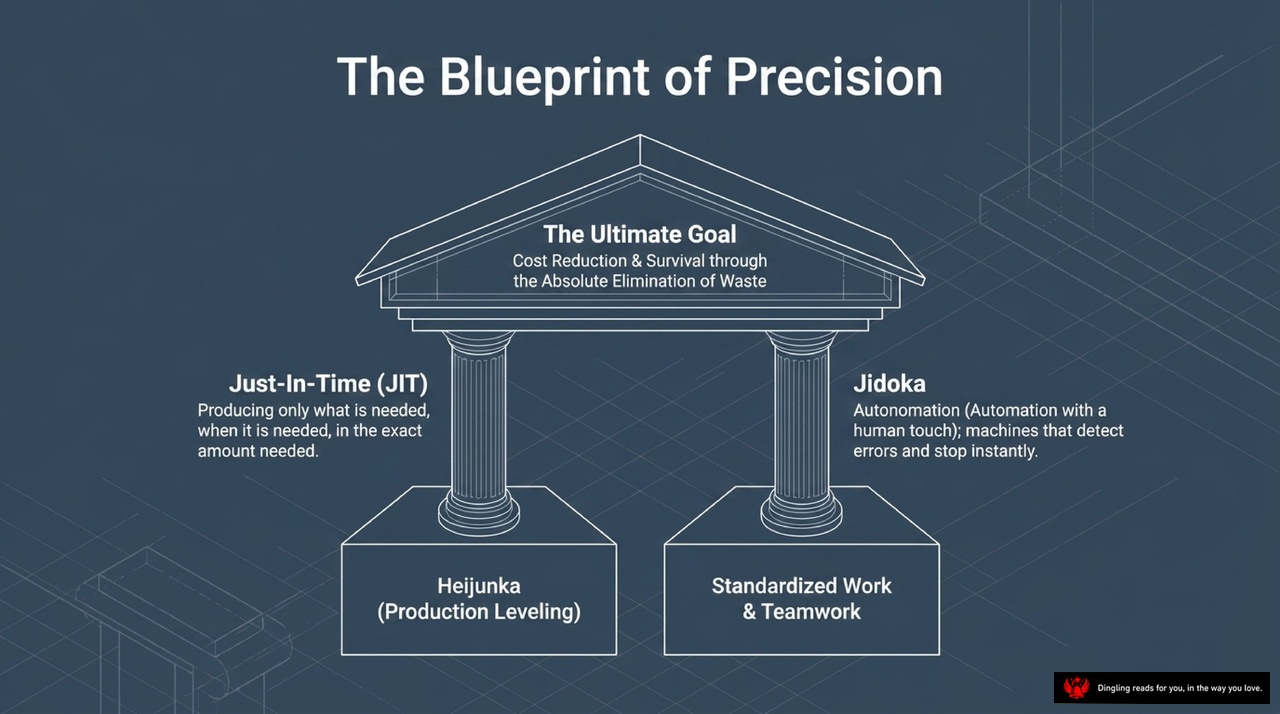
The Blueprint of Precision isn't just a fancy title; it's the architectural foundation of how Toyota survives and thrives in tough times. Think of this slide as a temple, where every pillar supports the ultimate goal: cutting costs and ensuring survival by absolutely eliminating waste.
On the left, you see Just-In-Time. This isn't about magic; it's a disciplined promise to produce only what is needed, when it is needed, in the exact amount needed. It stops the chaos of overproduction and the burden of excess inventory.
On the right stands Jidoka. Don't mistake this for simple automation. Jidoka means "automation with a human touch." It gives machines the wisdom to stop instantly when an error occurs, preventing defects from moving down the line and forcing us to solve problems at the source.
But a temple needs a solid base. That's where Heijunka, or Production Leveling, comes in. It smooths out the peaks and valleys of demand, ensuring a steady, predictable flow. The other pillar is Standardized Work and Teamwork. This creates the rhythm and the trust necessary for everyone to move as one unit.
Together, these four elements create a system that is incredibly resilient. While other companies were burning cash trying to keep machines running at full speed regardless of demand, Toyota was quietly building a machine that could adapt, react, and survive. This blueprint transforms waste into a manageable variable, turning a fragile operation into an unstoppable force.
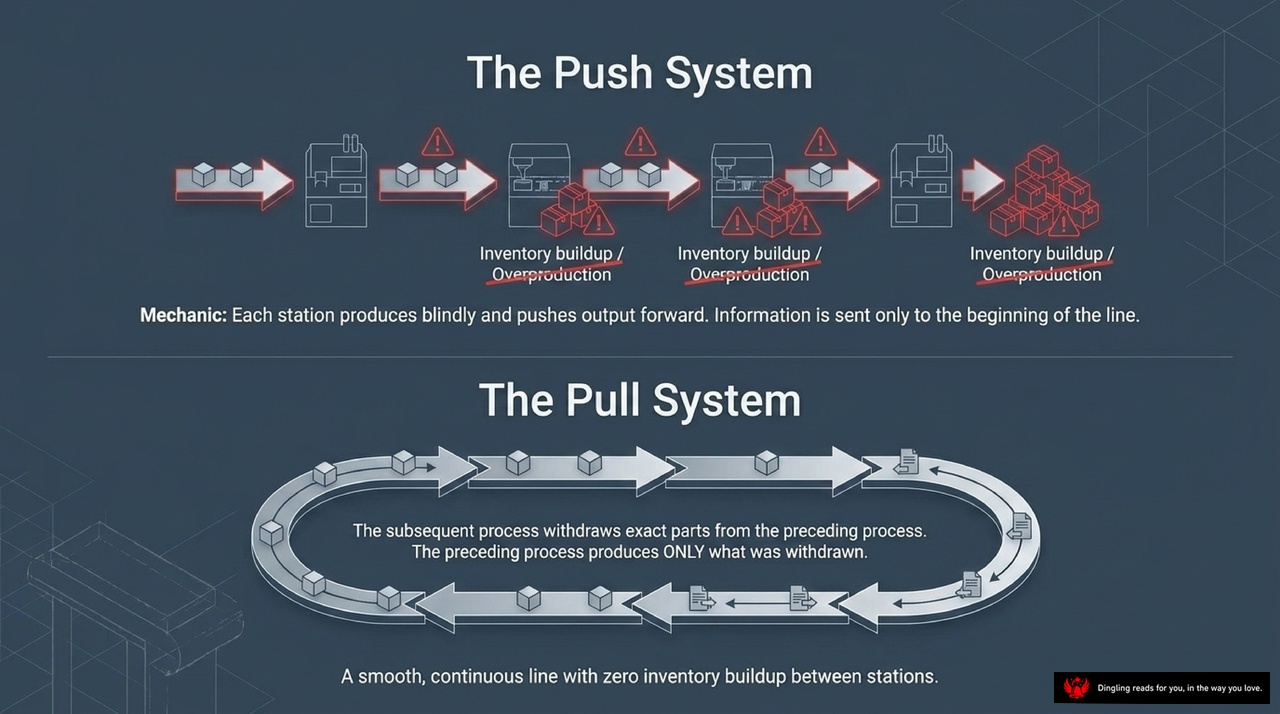
So, let's look at the two contrasting worlds presented here. On the top, we see "The Push System." Imagine a factory where every station just blindly produces and pushes its output forward to the next. Information only flows to the very beginning of the line. The result? As the diagram clearly shows, you end up with massive inventory buildup and overproduction at every single station. It's a recipe for chaos and waste.
Now, look at the bottom. This is "The Pull System." Here, the logic flips completely. The subsequent process withdraws exact parts from the preceding process. The preceding process produces ONLY what was withdrawn. Notice how smooth and continuous this line is? There is zero inventory buildup between stations.
The key takeaway here is simple but revolutionary. In a Push system, you produce based on a forecast, hoping you're right, which often leads to excess. In a Pull system, you produce based on actual demand. You only make what the next step needs, exactly when they need it. This eliminates the hidden costs of overproduction and creates a lean, efficient flow that can actually adapt to changes, whereas the Push system just piles up problems until they become unmanageable.
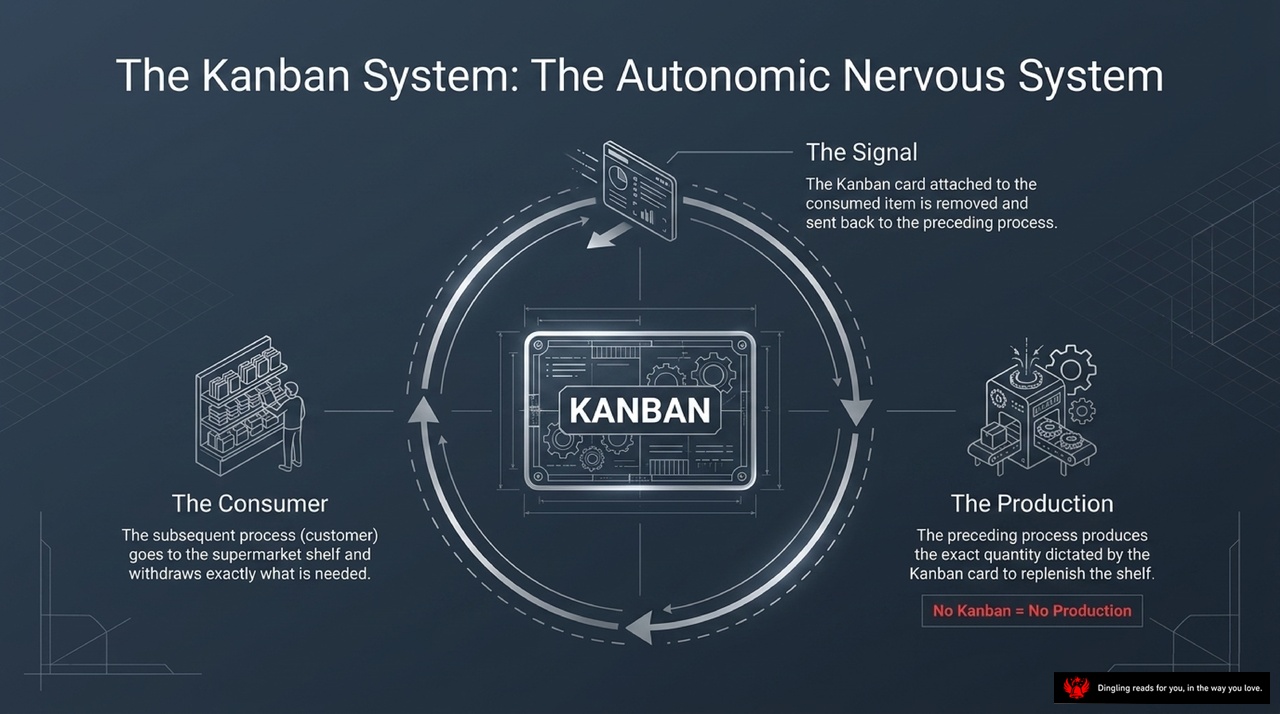
Imagine the entire production line as a single, living organism, much like the human autonomic nervous system. Just as your body automatically regulates its functions without constant conscious thought, the Kanban system allows a factory to self-regulate based on real-time demand.
At the heart of this system is the Kanban card, which acts as the signal. Think of it as a digital heartbeat. When a customer takes an item from the shelf—the subsequent process or consumer—they don't just grab it; they simultaneously remove the attached Kanban card and send it back to the preceding process. This simple action triggers the production. The signal travels back, instructing the upstream process to produce exactly what was just consumed, and nothing more.
This creates a perfect feedback loop. The production phase doesn't guess what to make or when; it strictly follows the quantity dictated by the Kanban card. If there is no signal, there is no production. This rule, "No Kanban = No Production," is the golden discipline that prevents overproduction. By tying production directly to consumption, the system eliminates the need for massive inventory buffers. It transforms the factory from a place that pushes products into the market into one that pulls exactly what the market needs, right when it needs it. This is the essence of just-in-time: a lean, responsive, and highly efficient rhythm driven by the simple, powerful flow of information.

Look at this diagram. It perfectly illustrates the core difference between "Traditional Automation" and Toyota's "Jidoka."
On the top path, you see what happens with standard automation: when an anomaly occurs—like a thread breaking or a tool getting dull—the line just keeps running. The result? A mass production of defects. The machine doesn't care; it only cares about speed, churning out mistakes that get buried in the pile.
But look at the bottom path. This is Jidoka, or "Autonomation." The moment that same anomaly is detected, the machine instantly and automatically stops. That red light flashes, the Andon cord is pulled, and production halts immediately. This isn't a failure; it's a feature. It forces human intervention right away to address the root cause. By stopping the line the instant a problem appears, we prevent zero defects from multiplying. We preserve 100% quality instead of wasting resources fixing bad parts later.
The key takeaway here is that true automation isn't about making machines run forever without humans. It's about giving machines human-like wisdom to stop when things go wrong, so we can fix the problem immediately and never let a defect move down the line.

Let's dive into the heart of problem-solving with a classic Toyota tool: The 5 Whys. Imagine your machine suddenly stops. Your first instinct might be to replace the fuse, right? That's a surface fix. But a Toyota fix digs deeper. Why did the fuse blow? Because of an overload. Why the overload? The bearing wasn't lubricated properly. Why no lubrication? The pump failed to deliver oil. Why did the pump fail? Its shaft was worn out. And finally, why was the shaft worn? Because there was no strainer, letting metal scrap destroy the pump.
See the difference? A quick fix just replaces the fuse, leaving the root cause untouched. A Toyota fix installs a strainer, preventing the entire chain of failure from ever starting. This diagram illustrates the power of asking "Why?" five times to move from a symptom to the true root cause. Never stop at the first answer. Only by reaching the source can we eliminate the problem forever and build a system that truly prevents recurrence.

Heijunka, or production leveling, is the antidote to the chaos of traditional manufacturing. Look at the top graph: that jagged red mountain range represents un-leveled production. In this traditional model, you see massive spikes in demand for product A and B. To survive these wild swings, companies are forced to build excess capacity, hire extra labor, and stockpile huge amounts of inventory just to be ready for the next spike. It's a reactive, expensive, and wasteful way to operate.
But look at the bottom graph. This is Heijunka in action. Instead of building those huge peaks and valleys, we flatten the curve. We mix our products—A, B, C, A, B—into a steady, rhythmic flow. This isn't just about making things look pretty; it's about eliminating the bullwhip effect. By shrinking batch sizes and mixing models, we stop the chaos from amplifying up the supply chain.
However, there's a catch. To run this smooth, flat line, you can't wait hours to switch molds. The text notes that shrinking batch sizes requires rapid die-change times—reduced from hours down to just three minutes. If you can't change molds quickly, you're forced back into large batches, and the whole system collapses. Heijunka eliminates waste, but it demands flexibility. It forces us to move from a mindset of "produce everything and hope for the best" to "produce exactly what is needed, right now." That shift from excess to precision is the key to surviving in a low-growth economy.
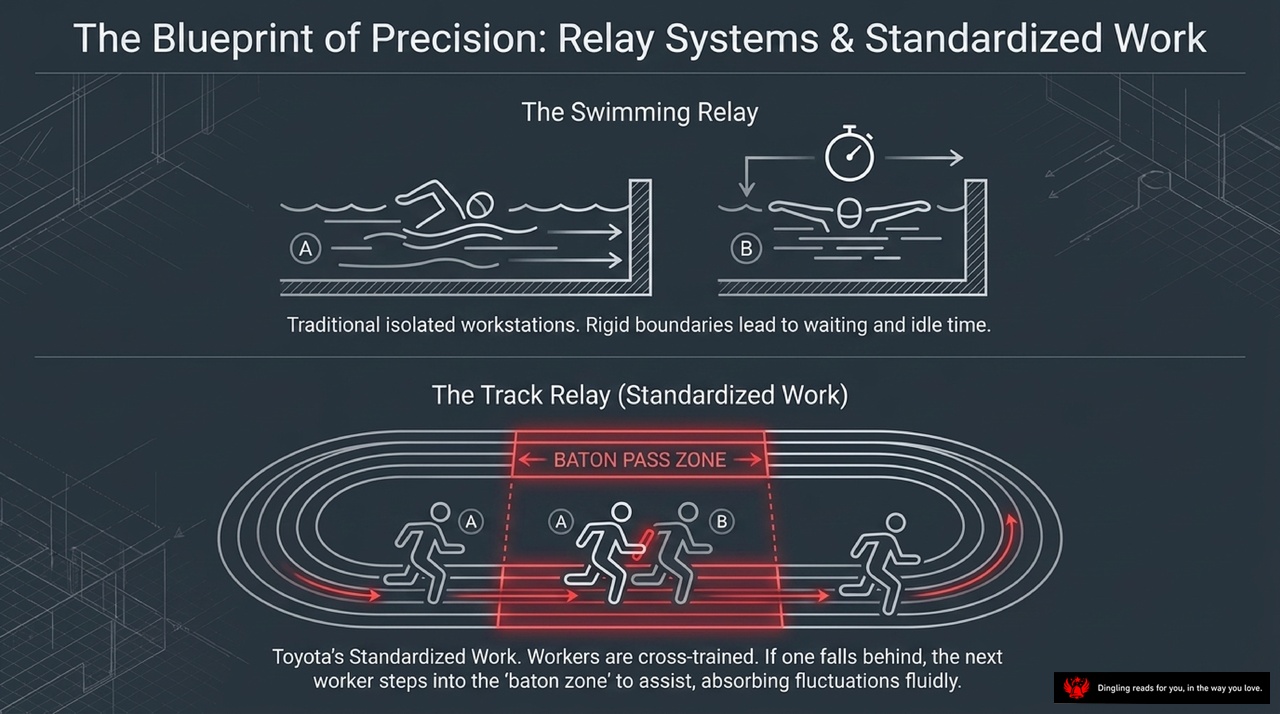
Imagine the difference between a swimming relay and a track relay. In the traditional swimming model, swimmers wait at the wall for the previous person to touch it before they can start. This rigid boundary creates inevitable gaps—dead time where no progress is being made. That's exactly what happens in isolated workstations: rigid boundaries lead to waiting and idle time, killing efficiency.
But look at the track relay. Here, the "baton pass zone" allows runners A and B to run side-by-side. If Runner A slows down, Runner B doesn't stop; they simply step into that zone to assist, absorb the fluctuation, and keep the overall pace steady. This is the essence of Toyota's Standardized Work.
We cross-train our workers so they aren't stuck in one spot. When one person falls behind, the next worker steps into the 'baton zone' to help, absorbing fluctuations fluidly. This breaks down the walls between stations, turning a line of individual workers into a single, resilient team capable of adapting instantly to any disruption.

Let's talk about the real meaning of efficiency. Most companies chase "Apparent Efficiency," thinking that producing more is always better. If you have ten workers and the market only needs 100 parts, making 120 might look like a win on paper, but it's actually a trap. You've created 20 unnecessary parts, generating waste in materials, storage, and transport. This is a false improvement that drains your resources.
The true path is "True Efficiency." Instead of forcing 10 workers to produce 120 parts, you should align your output perfectly with demand. By having just 8 workers produce the required 100 parts, you eliminate all that excess waste. Not only does this cut costs, but it also frees up those two extra workers to add value elsewhere in the business.
The blueprint for precision isn't about how fast you can run; it's about how accurately you can match the need. True efficiency means output perfectly matches demand, achieving real cost reduction rather than just busy work.

The Blueprint of Precision: Paradigm Comparison
Today, we're looking at the fundamental shift that defined modern manufacturing: the clash between the Ford Paradigm and the Toyota Paradigm. On the left, you see the old way. Ford's model was all about maximizing volume and speed. It was a "push" system driven by forecasts, relying on massive batches to achieve economies of scale. This approach created a safety net of inventory that, ironically, hid problems. It also depended on isolated, single-function operators who only knew one thing.
But look at the right side. This is the Toyota Paradigm, designed for a world where growth slows down. The core goal here is the absolute elimination of waste. Instead of pushing products, Toyota uses a "pull" system triggered by actual demand. They ditch massive batches for micro-batches, a concept known as Heijunka, to keep production smooth and balanced. Crucially, they view inventory not as a safety net, but as a primary waste that hides inefficiencies. Finally, instead of isolated workers, Toyota employs cross-trained, relay-race problem solvers who can step in anywhere on the line.
This comparison isn't just about history; it's a blueprint for survival. While Ford's model thrived when everything was growing fast, Toyota's approach is built to thrive in low-growth environments by exposing problems and empowering people to solve them instantly.
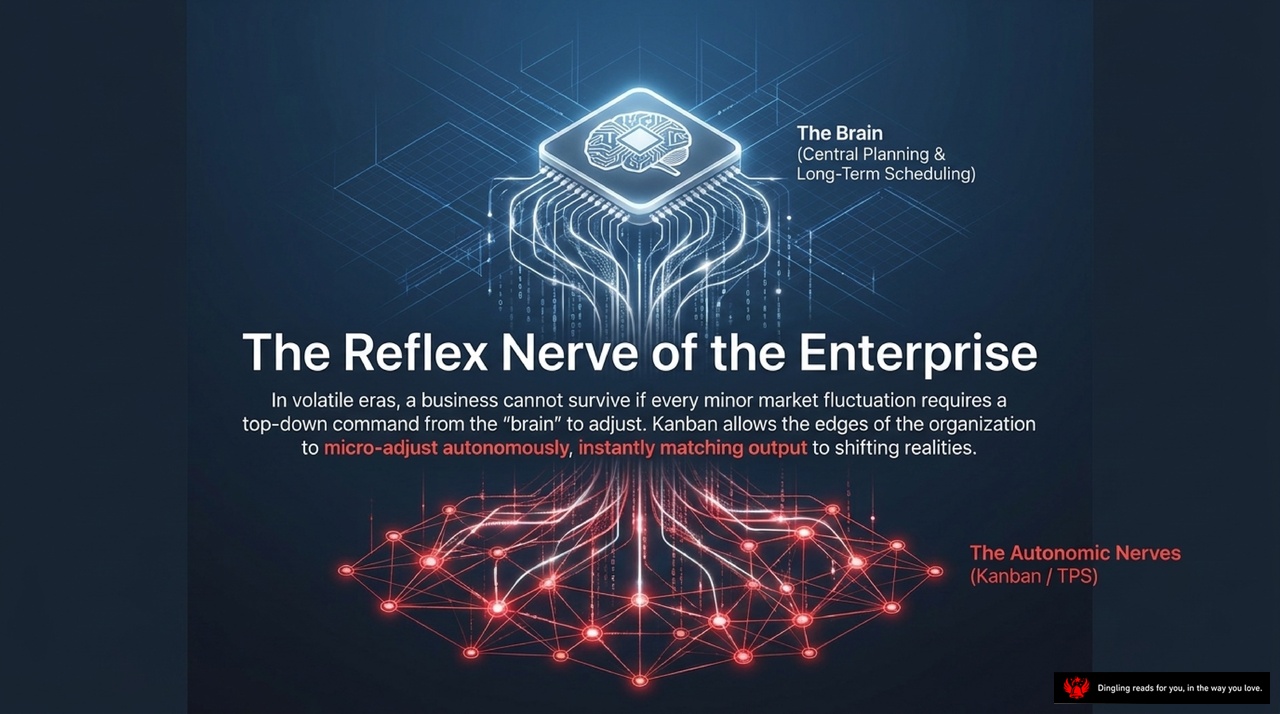
The Brain, Central Planning and Long-Term Scheduling, sits at the top of our enterprise nervous system, while The Autonomic Nerves, powered by Kanban and TPS, form the reflex network below. In volatile eras, a business cannot survive if every minor market fluctuation requires a top-down command from the Brain to adjust. Kanban allows the edges of the organization to micro-adjust autonomously, instantly matching output to shifting realities. Think of it this way: if you wait for the CEO to react to every small change in demand, you lose the market. But with this reflex nerve system, the front lines have the authority to pivot immediately. When a customer wants more of Product A and less of Product B, the Kanban cards signal the change instantly, and the production floor adjusts without waiting for a new schedule from above. This autonomy is what transforms a rigid factory into a living, breathing organism that thrives in uncertainty, ensuring that waste is eliminated and value is delivered exactly when it is needed.
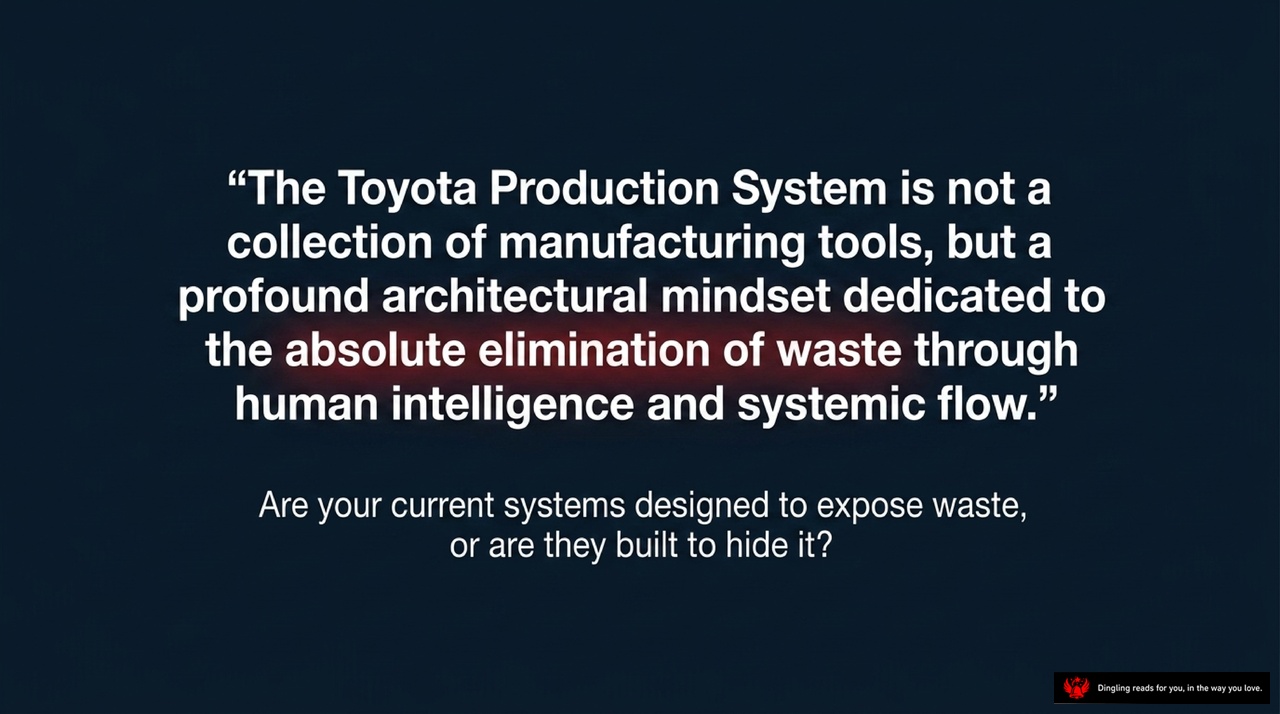
The Toyota Production System isn't just a toolbox of manufacturing tricks; it's a deep-seated architectural mindset obsessed with one thing: the absolute elimination of waste through human intelligence and systemic flow. Look at that highlighted phrase on the screen—waste isn't just a byproduct; it's the enemy we must eradicate.
But here's the critical question your systems face today: Are they designed to expose waste, or are they built to hide it? Most traditional systems, like the old Ford-style assembly lines, actually hide waste. They rely on massive inventory buffers and continuous machine running just to mask problems. When a machine breaks or a part is missing, the huge stockpile simply covers the gap, letting the issue linger unnoticed until it causes a massive disruption later.
In contrast, the TPS philosophy flips this script. It demands that problems be exposed immediately. If a machine stops, you don't just swap a fuse and keep going; you stop everything to find the root cause. If inventory runs out, the production line halts, forcing the team to solve the supply issue right then. This might seem counterintuitive to a business used to constant motion, but that very interruption is what drives true improvement. By refusing to hide waste, you transform every hiccup into a learning opportunity, building a resilient system that thrives even when growth slows down.