
Trading in the Zone: Complete Chapter-by-Chapter Summary

Welcome to the first chapter of our journey into mastering the market. Today, we are diving into the core philosophy of *Trading in the Zone* by Mark Douglas. As you see on this slide, the ultimate goal is simple yet profound: Master the market by reprogramming your mind to think in probabilities.
Most traders spend years chasing the perfect indicator or a secret formula, believing that if they just find the right tool, they can predict the future. But the truth is, the market isn't a machine waiting to be solved; it's a living system driven by human behavior. The real barrier to success isn't your knowledge of charts or economics; it's your relationship with uncertainty.
In this book, we strip away the noise of complex analysis to reveal the one thing that separates consistent winners from everyone else: a specific mindset. It's about accepting that you cannot control the outcome of any single trade, only your response to it. When you stop trying to predict the market and start embracing probability, you transform from a gambler into a professional. This isn't about being smarter; it's about being more comfortable with not knowing. Let's rewire your thinking to find that edge.

Look at this stark divide on the screen. On the left, we see "Endless Opportunities"—perfect market analysis, flawless charts, and a brain that seems to have cracked the code. On the right, we see the crushing reality: "Emotional Paralysis." The statistic is brutal—95% of traders wipe out their accounts in their first year.
This is the ultimate paradox of the financial markets, and it's exactly where most of us get stuck. We spend years mastering technical analysis, studying every candlestick and indicator, believing that if we just knew enough, we could predict the future. But as the text below reminds us, even highly successful professionals like doctors and CEOs often fail miserably at trading. Why? Because more market analysis simply cannot bridge the gap between knowing the market and building a rising equity curve.
The true chasm isn't in the charts; it's entirely psychological. The reason you might be struggling isn't because you lack data, but because you're fighting against your own fear, greed, and the need to be right. The market isn't a puzzle to be solved with perfect logic; it's a reflection of human behavior. When you try to force the market to match your expectations, you create the very resistance that stops you from profiting.
The solution isn't to study harder; it's to think differently. You need to shift from trying to predict every move to embracing uncertainty. True consistency comes from accepting that any single trade can go against you, while trusting that your edge will show up over time. Stop looking for a magical formula and start building the mental discipline to handle the chaos. That's where the real opportunity lies—not in the perfect analysis, but in the ability to stay calm when everything feels like it's falling apart.

Imagine your mind isn't a static thing, but an operating system constantly running in the background. Are you running as **The Novice**? This mindset is defined by being euphoric and reckless, leading to an inevitable financial wipeout. Or are you **The Boom-and-Bust** type? You might have excellent technical analysis skills, but your psychology is crippled, resulting in chronic frustration and a rollercoaster equity curve.
However, there is a third option: **The Consistent Winner**. This isn't about having a crystal ball; it's about a fully upgraded probabilistic mindset. Instead of fearing the market, you remain carefree, objective, and detached. While the first two groups get shocked by the market or sabotage themselves with fear, the Consistent Winner accepts uncertainty as the norm. This shift transforms the result from a chaotic ride into steady, effortless equity growth. The difference isn't in what you see on the chart, but entirely in the software running in your head.
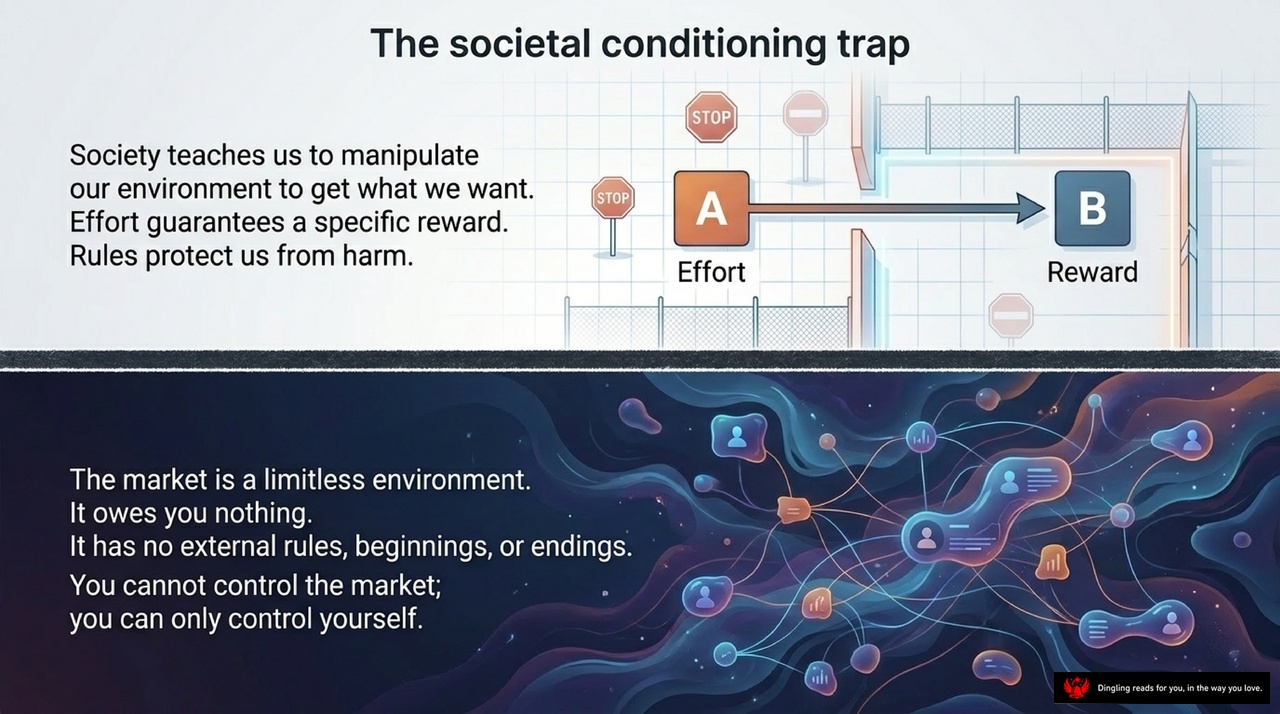
Welcome back. Today, we're diving deep into the core conflict that keeps most traders stuck: the tension between the freedom of the market and the limits we've been taught to accept in society.
Look at the top of this slide. It illustrates what I call "The Societal Conditioning Trap." Society teaches us a very specific lesson: that if we put in effort (Point A), we are guaranteed a specific reward (Point B). We are taught that rules protect us from harm and that we can manipulate our environment to get what we want. This is the comfort zone we all grew up in. It's a safe, predictable world where cause and effect are clear.
But then, look at the bottom half. This is where the real world of trading lives. The market is a limitless environment. It owes you nothing. Unlike society, it has no external rules, no clear beginnings, and no guaranteed endings. You cannot control the market; you can only control yourself.
Here is the critical shift you need to make: The danger isn't the market's volatility; the danger is trying to force the market to follow your societal rules. When you enter the market expecting a guaranteed reward for your effort, you set yourself up for failure. You are bringing a "society script" into a "wilderness environment."
The market doesn't care about your effort, your rules, or your protection. It only responds to your choices in the present moment. If you try to control the uncontrollable, you will lose. But if you accept that the market is limitless and that your only leverage is your own self-control, you finally stop fighting against reality and start working with it.
So, ask yourself: Are you trading based on the rules society gave you, or are you building a new set of rules that fit the limitless nature of the market? The path to consistent profitability starts the moment you stop expecting a guaranteed reward and start embracing total responsibility for your own actions.
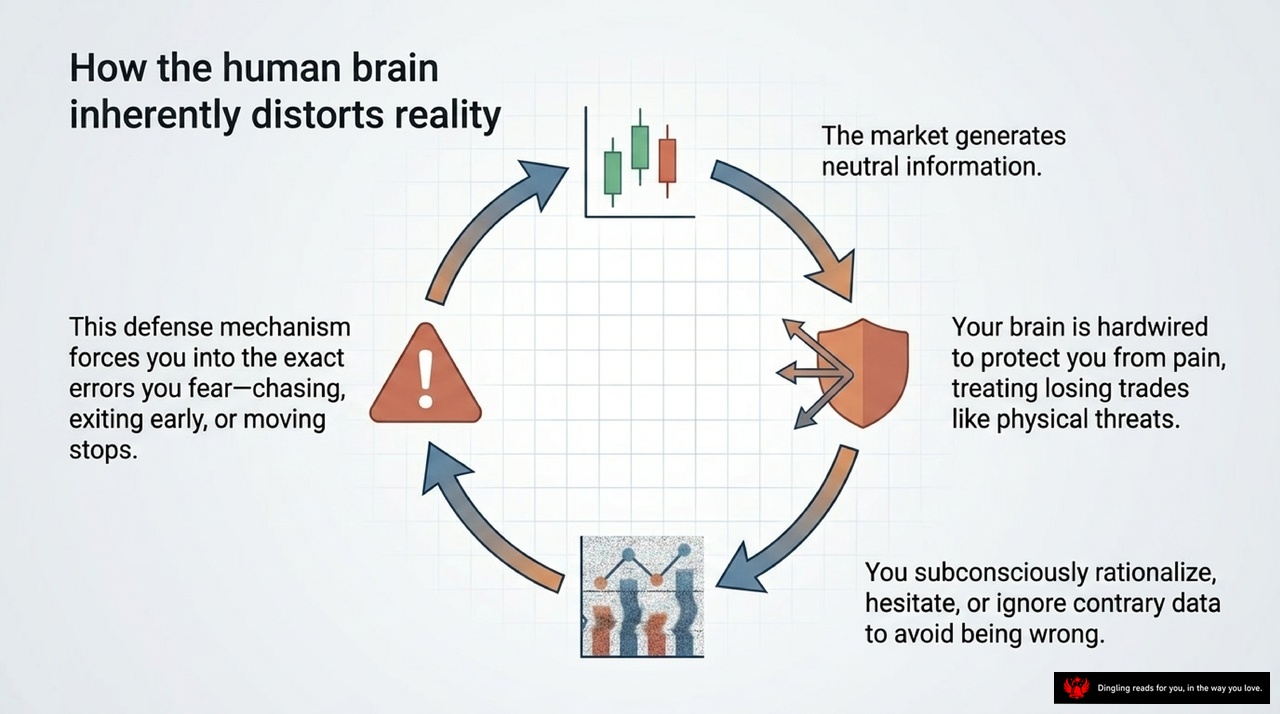
So, let's talk about why your brain is tricking you into making the exact mistakes you're most afraid of.
Look at this cycle. It starts with the market generating neutral information—just raw data, nothing more. But here's the catch: your brain is hardwired to protect you from pain. It treats losing trades like physical threats. Because of this, you subconsciously rationalize, hesitate, or ignore contrary data just to avoid being wrong.
This defense mechanism forces you into the exact errors you fear most: chasing trades, exiting too early, or moving your stops at the worst times. And then, you end up back at the start, staring at neutral information, completely unaware that the problem isn't the market, but your own distorted perception of it.
The truth is, the market isn't your enemy. The real battle is happening inside your own mind.

Imagine your mind as a sophisticated, yet sometimes tricked, data processor. The image you see here illustrates a powerful psychological phenomenon called the "associative mechanism." It explains why two identical market setups can trigger completely opposite reactions in your brain.
On the left, we see a young girl feeding a dog. In her memory, this action is linked to "Negative Energy Stored." She has learned that the dog bites. So, whenever she sees a dog, her brain immediately links that image to past pain and prepares for a threat.
Now, look at the right side. The girl is now facing a completely different situation. There is a small, harmless puppy wagging its tail. But because of that associative mechanism, her brain projects the shadow of the aggressive, biting wolf right onto the innocent puppy. Even though the puppy is safe, her mind perceives it as a deadly threat because the visual setup feels familiar.
In trading, this is exactly what happens to many of us. If your last two trades were losers, your brain perceives the next identical setup as a threat. You are projecting past pain onto a completely unique present moment. You aren't seeing the market as it is; you are seeing the market as you remember it being.
This is why technical analysis alone isn't enough. You can have the perfect chart pattern, but if your internal "associative mechanism" is still wired to fear, you will hesitate, exit too early, or never enter at all. True consistency requires you to break this automatic link. You need to train your brain to see the current market for what it actually is, not as a replay of your past failures.
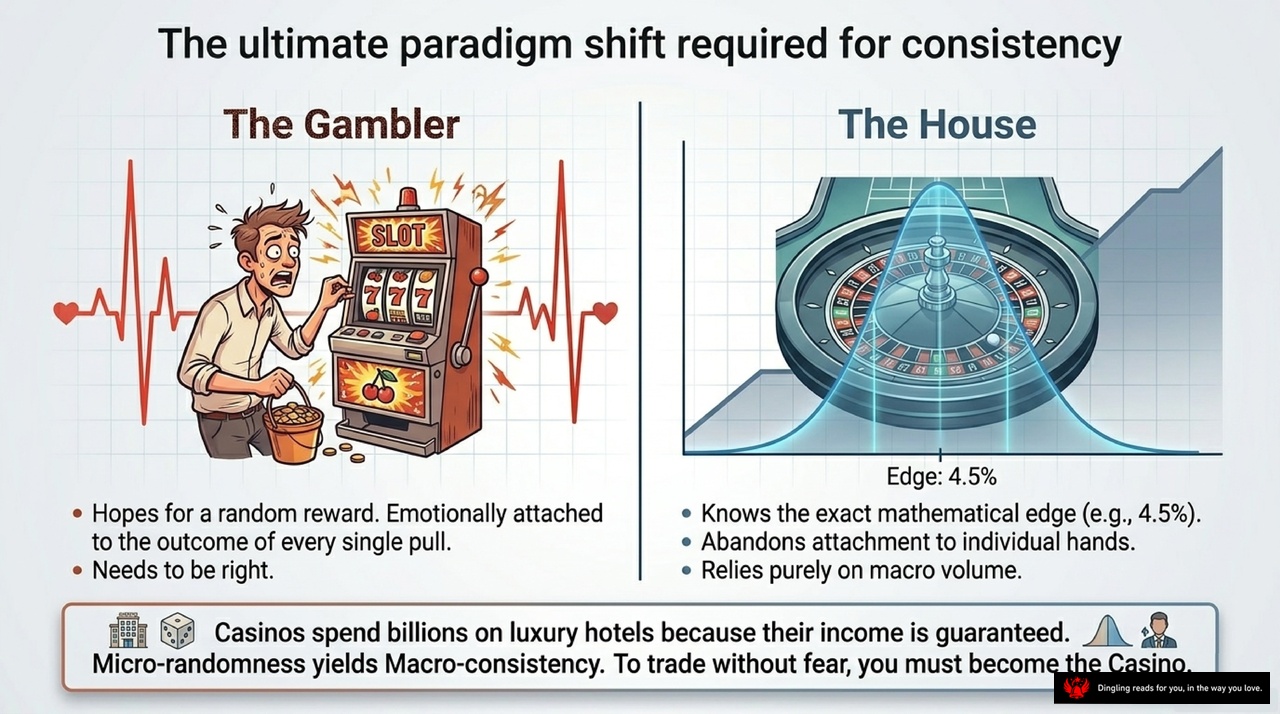
To trade like the House, you must completely rewire how you see risk. Look at the slide: on the left, we have The Gambler. He is emotionally attached to every single pull, hoping for a random reward and desperately needing to be right. His heart rate spikes with every outcome because he treats every trade as a life-or-death event.
Now look at the right side: The House. The House knows the exact mathematical edge, in this case, a 4.5% advantage. It doesn't care about individual hands. It abandons attachment to any single result and relies purely on macro volume. That is the ultimate paradigm shift required for consistency.
Casinos spend billions on luxury hotels because their income is guaranteed. Why? Because micro-randomness yields macro-consistency. When you trade without fear, you stop trying to predict the next spin and start managing the long-term game. To trade like the House, you must accept that any single trade can go against you, but as long as your system has a positive edge and you stick to it, the math will eventually work in your favor. Stop chasing the jackpot and start building the casino.

Installing the probabilistic operating system isn't just about memorizing rules; it's about rewiring how you see the market. Look at this slide—it outlines the five non-negotiable truths that separate the amateurs from the pros.
First, anything can happen. The market is a fluid environment where a single order from a whale can instantly shatter your most confident technical prediction. As we read, the text emphasizes that "any moment in the market is unique," meaning you cannot rely on past patterns to guarantee future results.
Second, you don't need to know what is going to happen next to make money. This is a game-changer. Instead of trying to predict the future, you focus on the present. You identify an edge—a situation where the probability favors you—and let the market do the rest. You don't need a crystal ball; you just need to be right more often than wrong over time.
Third, there is a random distribution between wins and losses. Even with a perfect system, you will face a string of losses. This is normal. The text explains that an edge is simply an indication of a higher probability of one thing happening over another. It doesn't mean you will win every single trade.
Finally, every moment is unique. The market is constantly evolving, and your strategy must be flexible enough to adapt to these unique conditions without being paralyzed by fear or greed. By internalizing these five points, you install a mental framework that allows you to trade with clarity, accept uncertainty, and build a consistent, long-term edge.
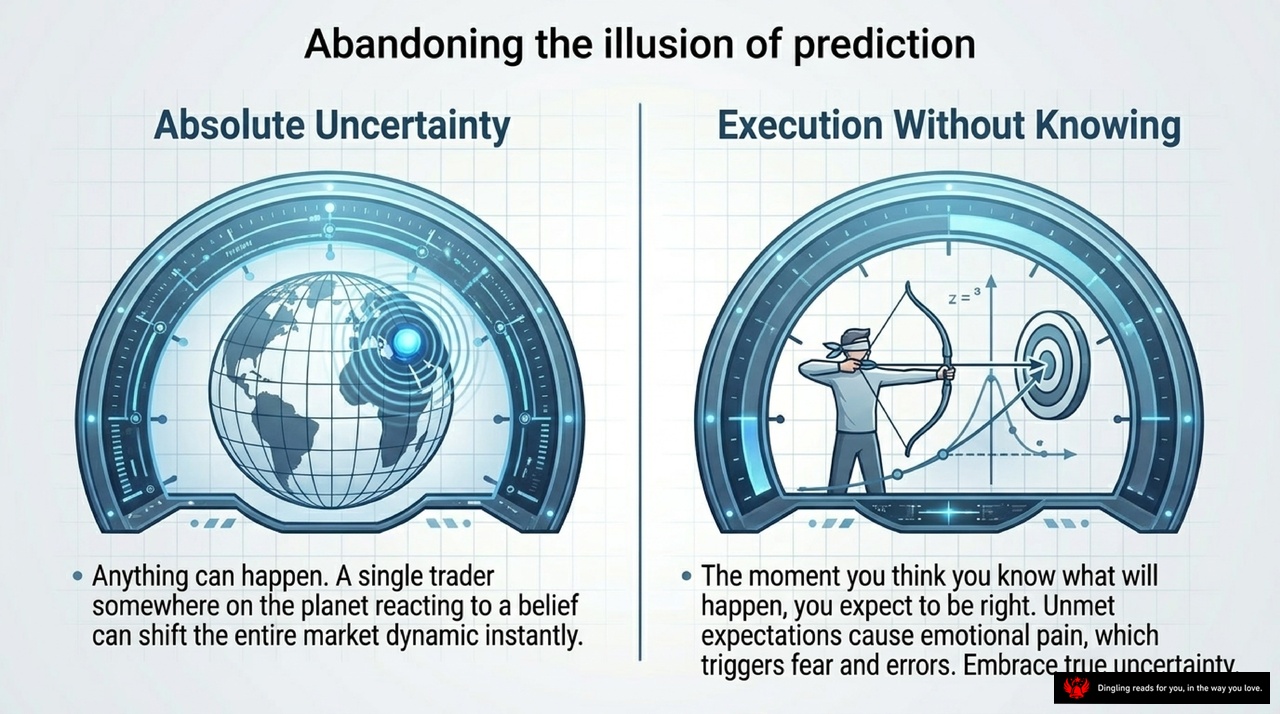
Welcome to the concept of "Execution Without Knowing." This slide challenges the most dangerous illusion in trading: the belief that we can predict the future. On the right, you see an archer aiming for a target, representing the moment you think you know what will happen. The text warns us that unmet expectations cause emotional pain, triggering fear and errors. We must embrace true uncertainty instead.
On the left, under "Absolute Uncertainty," the image shows a global network where a single point can shift the entire dynamic. The text explains that anything can happen; a single trader reacting to a belief can instantly shift the whole market. This is why trying to predict is a losing game.
The core lesson here is that the moment you think you know the outcome, you are setting yourself up for pain. When reality doesn't match your expectation, fear takes over, and your decisions go off the rails. Successful traders don't try to be right on every trade. Instead, they accept that the market is unpredictable. They execute their plan based on the current opportunity, without knowing the final result. By abandoning the illusion of prediction and embracing the chaos, you remove the emotional triggers that cause losses. True mastery isn't about knowing the future; it's about acting correctly in the present, regardless of what happens next.
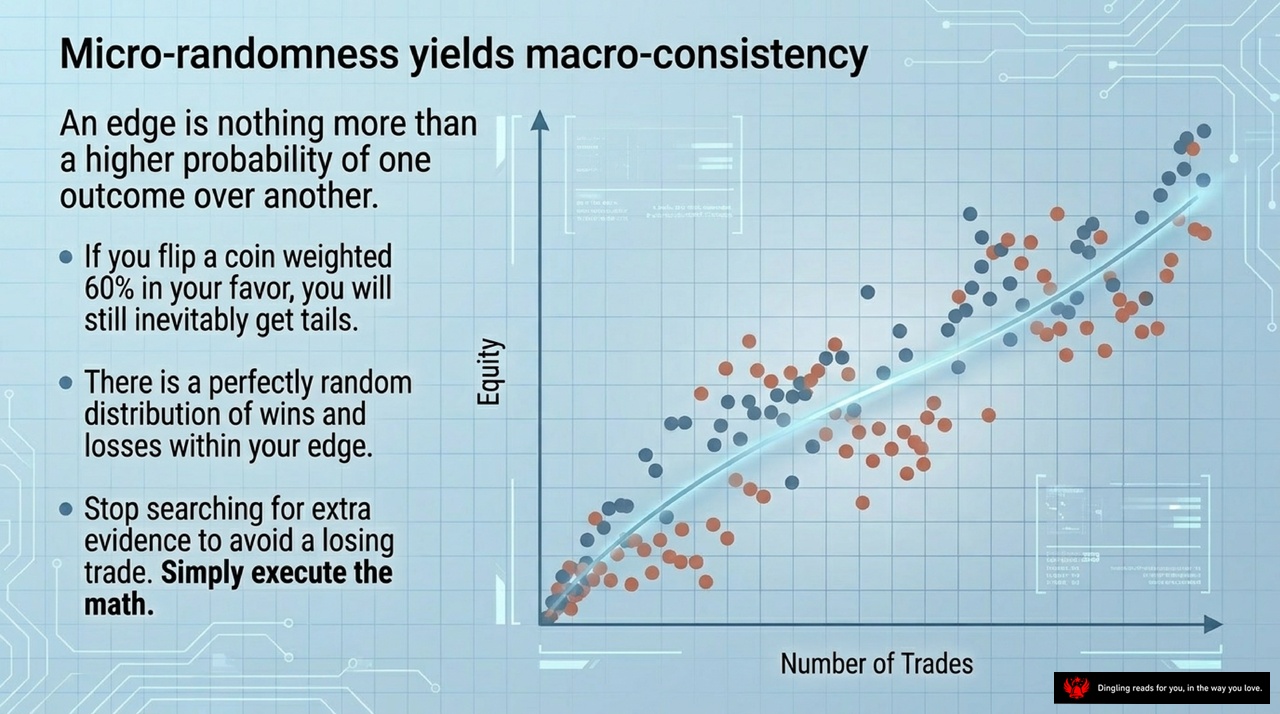
Here is the spoken script for the slide, tailored for an American audience with a natural, engaging tone.
**Slide 9 Script:**
"Let's talk about the one thing that separates the lucky from the consistent: the math behind the madness. Look at this chart. It shows a simple but profound truth: micro-randomness yields macro-consistency.
Think about it like flipping a weighted coin. If you have a 60% edge, you're the favorite, right? But here's the catch—you will still inevitably get tails. In trading, your edge is nothing more than a higher probability of one outcome over another. It doesn't guarantee a win on every single trade. There is a perfectly random distribution of wins and losses within your edge. You'll see streaks of losses, just like the red dots on this graph, even when you're right on paper.
So, what's the move? Stop searching for extra evidence to avoid a losing trade. That's where most people go wrong. They try to predict the next flip instead of trusting the odds. The answer is simple: simply execute the math. Don't let the noise of a single bad trade shake your confidence. Trust the process, trust the probability, and let the numbers work in your favor over the long run."
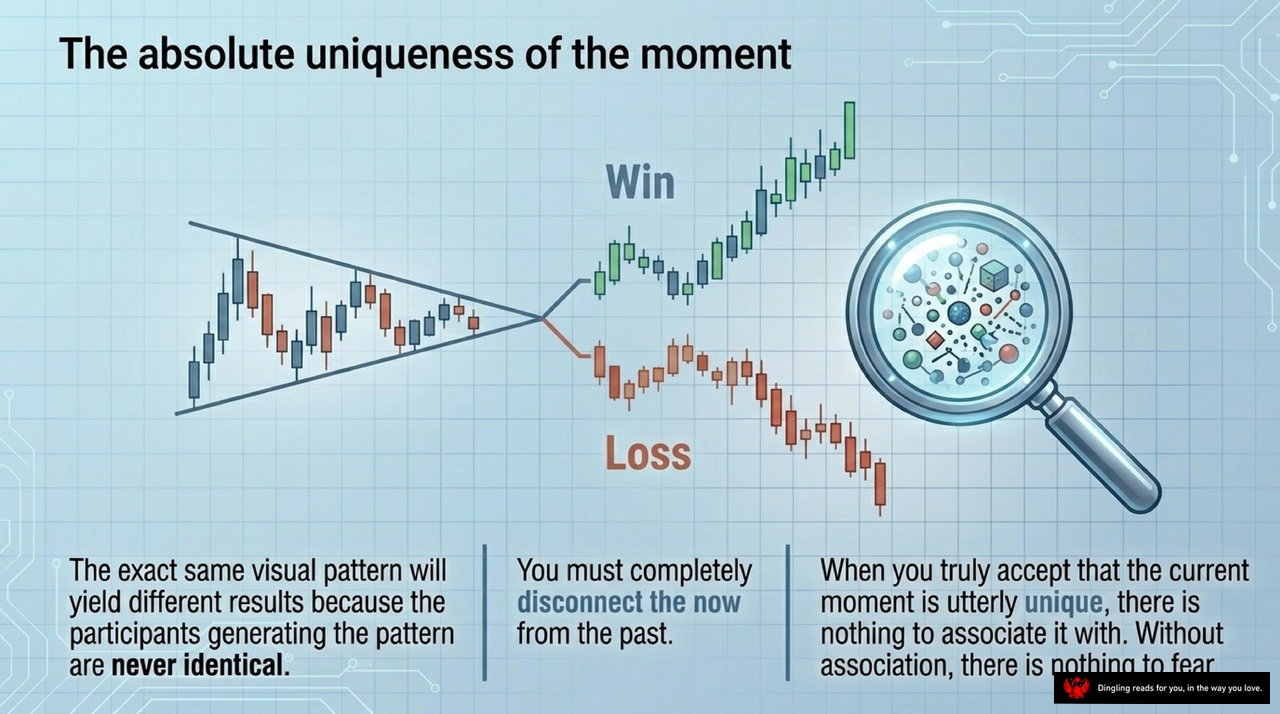
Imagine looking at this chart: the exact same visual pattern can lead to two completely different outcomes—a soaring "Win" or a crashing "Loss." Why? Because the participants generating that pattern are never identical.
This slide drives home a critical truth: you must completely disconnect the now from the past. In trading, the current moment is utterly unique. Every tick, every candle, is a fresh reality shaped by a new set of emotions and decisions. If you cling to past experiences—whether a string of losses or a lucky win—you distort your view of the present. You start seeing threats where there are only opportunities, or missing signals because you're still processing yesterday's pain.
When you truly accept that the current moment is unique, there is nothing to associate it with. Without that baggage of past associations, there is nothing to fear. You stop trying to predict what "should" happen based on history and start seeing what "is" happening right now. This shift from a historical mindset to a present-moment awareness is the key to unlocking consistent profitability. It allows you to see the market clearly, execute your plan without hesitation, and embrace the uncertainty that defines every single trade.

Deactivating flawed cognitive circuitry is the key to rewriting your psychological software. As the slide illustrates, beliefs are pure energy. You can't destroy a belief, but you can deactivate it by starving your predictive beliefs of attention.
Look at the left side: the "Depleting" tank. Here, old, limiting beliefs like "I must be right" and "Losses are failures" drain your mental energy. This is the trap that keeps most traders stuck. They treat every loss as a personal failure rather than a cost of doing business.
Now, watch the flow to the right: the "Charging" tank. By disciplined repetition, you transfer that energy into functional, probabilistic beliefs. Instead of fearing loss, you adopt the mindset that "Trading is a numbers game" and "I execute my edge flawlessly."
This isn't just about changing your words; it's about a disciplined transfer of mental energy. You stop feeding the old, fear-based narratives and start charging your mind with a new, resilient operating system. When you make this shift, the market stops being a threat and becomes an opportunity you can control.
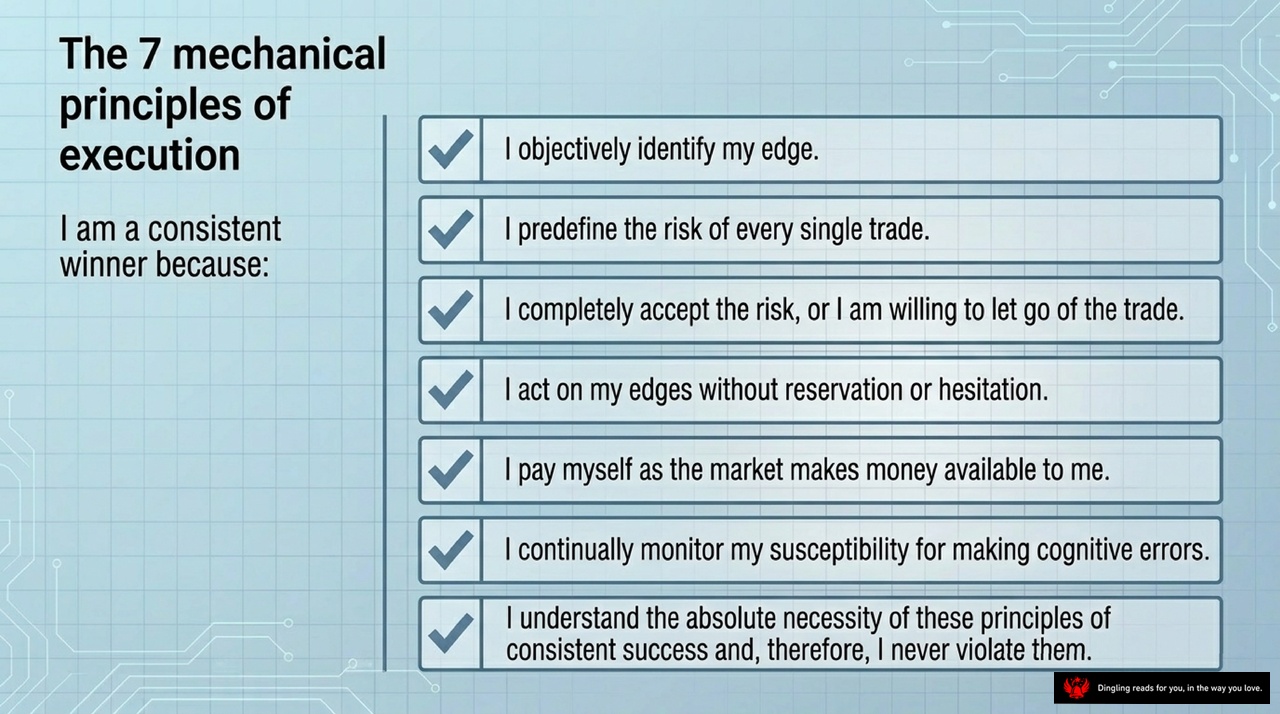
Today's slide outlines the "7 Mechanical Principles of Execution"—the exact mental framework that separates consistent winners from everyone else. Think of these not as rigid rules, but as a checklist for your mindset before you ever click the buy or sell button.
First, you must objectively identify your edge. This means knowing exactly why you are entering the trade based on probability, not hope. Once that edge is clear, you predefine the risk of every single trade. You decide upfront how much you can afford to lose, treating that loss as a business expense rather than a personal failure.
Crucially, you must completely accept that risk. If you aren't willing to let go of the trade if it goes against you, you shouldn't be in it. This acceptance allows you to act on your edges without hesitation or reservation. No more second-guessing. As soon as the market makes money available to you, you pay yourself. You don't wait for the trade to "prove" itself; you trust the process and take the profit.
Finally, and perhaps most importantly, you continually monitor your susceptibility for making cognitive errors. You stay humble and aware that you are human. You understand the absolute necessity of these principles. If you violate them, you lose your edge. By internalizing these seven steps, you stop fighting the market and start executing a system that works, turning consistency into your greatest asset.
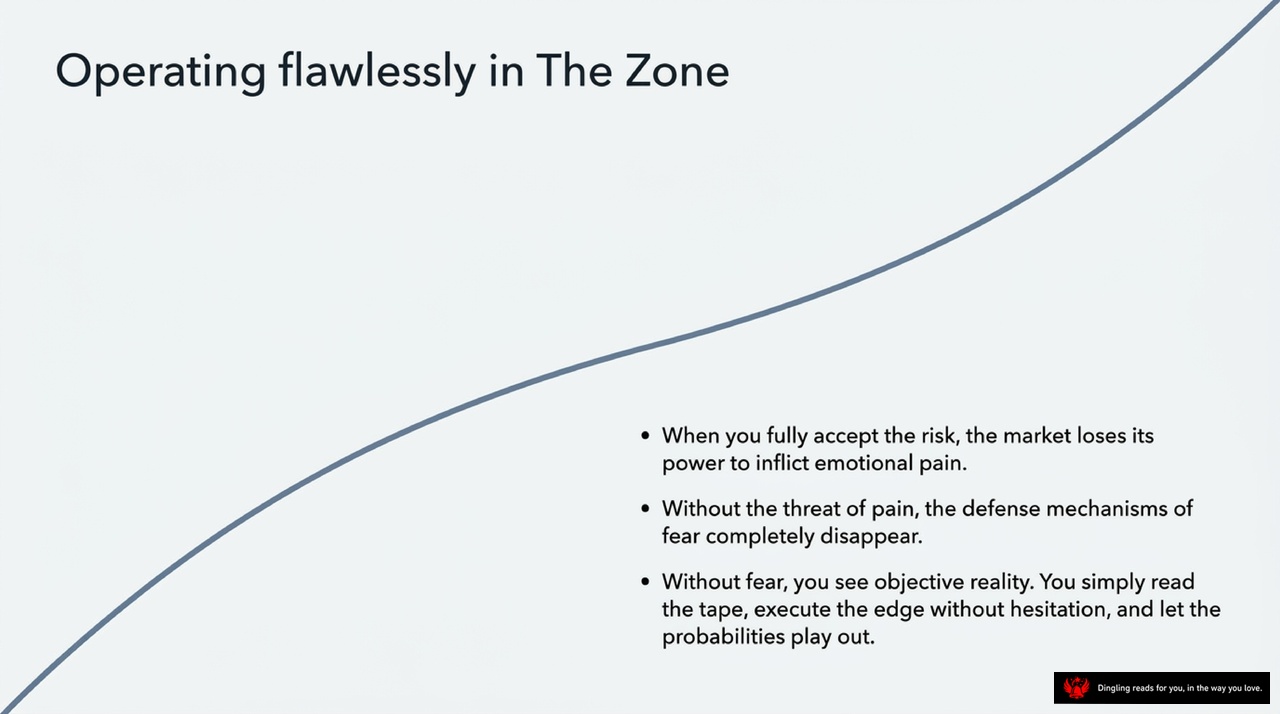
When you fully accept the risk, the market loses its power to inflict emotional pain. This is the turning point where everything changes. Without the threat of pain, the defense mechanisms of fear completely disappear, allowing you to see objective reality for the first time.
In this state of clarity, you simply read the tape and execute the edge without hesitation. You stop fighting the market and stop trying to predict the future. Instead, you let the probabilities play out. You trust your system because you've accepted that every single trade is a gamble, and your job isn't to win every time, but to ensure your odds are in your favor over the long run.
Operating flawlessly in The Zone isn't about being perfect; it's about being fearless. It's about stripping away the noise of fear and greed so you can act with pure precision. When you remove the fear, the chaos of the market becomes just another set of data points, and you become the calm observer who knows exactly what to do next.
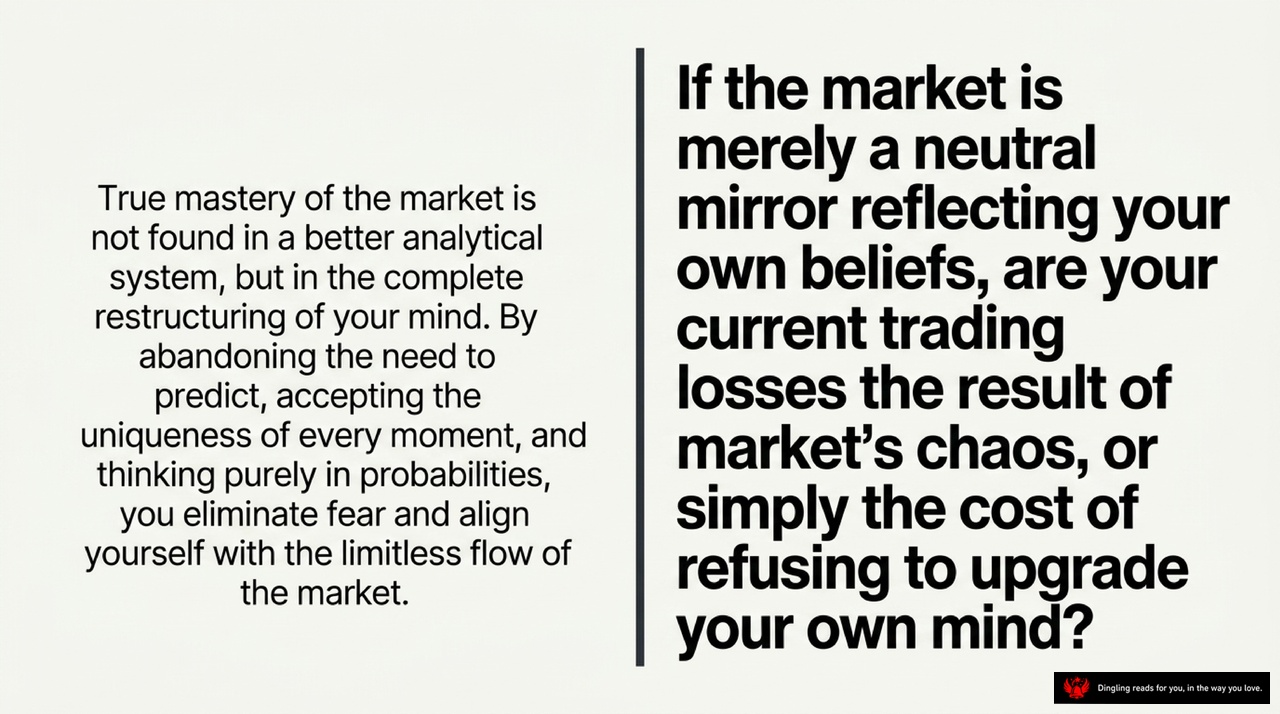
True mastery of the market isn't about finding a better analytical system or predicting the future. It's about completely restructuring your mind.
Look at this slide. It asks a tough question: If the market is just a neutral mirror reflecting your own beliefs, are your current trading losses actually the result of market chaos, or simply the cost of refusing to upgrade your own mind?
Think about it. Most traders believe they are fighting the market, but the truth is, the market is just showing you what you already believe. If you believe the market is a threat, it will feel like a threat. If you believe you must be right every time, you will constantly be wrong.
True mastery comes from abandoning the need to predict. Instead, you accept the uniqueness of every moment and think purely in probabilities. When you do this, you eliminate fear and align yourself with the limitless flow of the market.
Your losses aren't caused by bad data or a broken chart. They are caused by an outdated mindset. Are you ready to stop blaming the market and start upgrading your thinking? That is the only way to find true consistency.