
Transcending Boundaries: Complete Chapter-by-Chapter Summary
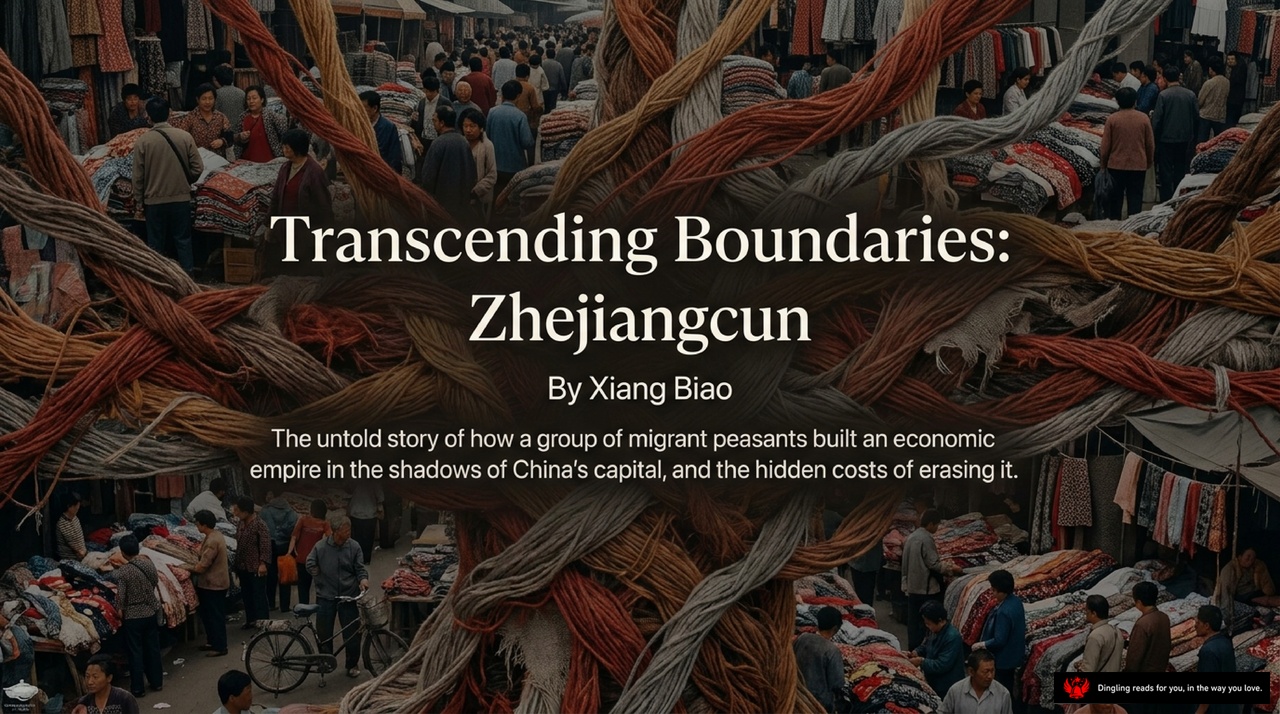
Welcome to a journey into the hidden heart of Beijing's economy, a story that challenges everything we think we know about success and community. Today, we are diving into *Transcending Boundaries: Zhejiangcun* by Xiang Biao.
Imagine a bustling, chaotic market hidden beneath the grandeur of China's capital. This isn't just a neighborhood; it's a self-made economic empire built by migrant peasants who arrived with nothing but their skills and their networks. The book reveals the untold story of how these people constructed a thriving business world in the shadows of Beijing, only to face the devastating cost of trying to erase them.
As you look at this vibrant, tangled scene, you are seeing the very fabric of "Zhejiangcun." It is a place where tradition meets modernity in a way that defies logic. While the rest of the world tries to separate the old from the new, this community proves that you can stand firmly in a modern city using ancient methods of family and village support. It is a story of resilience, of weaving a complex web of relationships that turns a group of outsiders into a dominant force in the national economy.
This is not just a tale of business; it is a profound look at how a community transcends boundaries—breaking down walls of class, geography, and even the rigid rules of the state—to create something entirely new and unstoppable.

Imagine a map where the center of power is a rigid, controlled square, but just 5 kilometers away, a chaotic, thriving metropolis operates entirely outside the state's plan. This is the anomaly at the edge of the capital.
In the heart of Beijing's Fengtai District, over 100,000 migrants have built a city that defies logic. These are rural peasants who bypassed the rigid household registration system, creating a community that functions without official permission. While the government viewed this area as a "tumor" on the leg of the city, destined for removal, the reality was far more complex.
This autonomous city, located just 5km from the core, became a massive engine for the national clothing industry. It wasn't just a random gathering of strangers; it was a tightly woven network of trust and commerce. Through a unique blend of family ties and business alliances, the community captured nationwide textile distribution, turning what authorities called "chaos" into a highly efficient economic powerhouse.
The story of this "Zhejiang Village" challenges our understanding of modernization. It shows that order doesn't always come from top-down planning. Sometimes, the most vibrant and resilient systems emerge from the bottom up, driven by the daily choices and relationships of ordinary people who refused to be pushed out.
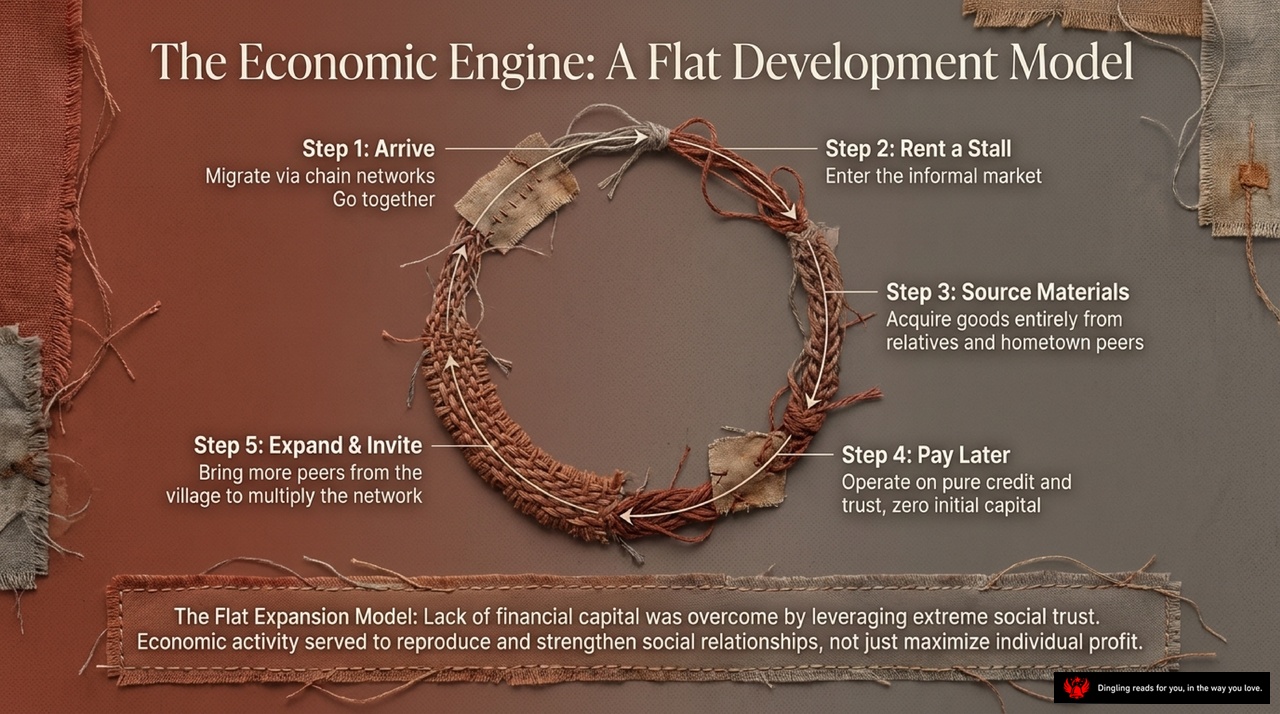
Imagine a business model that doesn't require a bank loan, a formal office, or even a factory floor. Instead, it runs on trust, family connections, and a willingness to pay later. This is the exact engine that powered the "Zhejiang Village" in Beijing, and it's a lesson in how social capital can replace financial capital.
Look at this diagram. It outlines a flat development model, a cycle of five steps that created a massive economic empire from scratch.
It all starts with **Step 1: Arrive**. Migrants didn't come alone; they moved in chains, bringing their networks with them. Once settled, **Step 2** was simple: **Rent a Stall**. They entered the informal market, often hiding behind state-owned stores to avoid strict regulations.
But how did they get goods without money? That's **Step 3: Source Materials**. They acquired everything from relatives and hometown peers. No formal suppliers, just a trusted web of family and friends.
This leads to **Step 4: Pay Later**. They operated on pure credit. No initial capital was needed because the entire community acted as a guarantee. If you couldn't pay today, your reputation and your family's future earnings were the collateral.
Finally, **Step 5: Expand & Invite**. Success was contagious. They brought more peers from their villages to multiply the network, turning a small group into a national operation.
The key takeaway at the bottom is profound: the lack of financial capital was overcome by leveraging extreme social trust. In this system, economic activity wasn't just about maximizing individual profit; it served to reproduce and strengthen social relationships. The market and the community were one and the same.
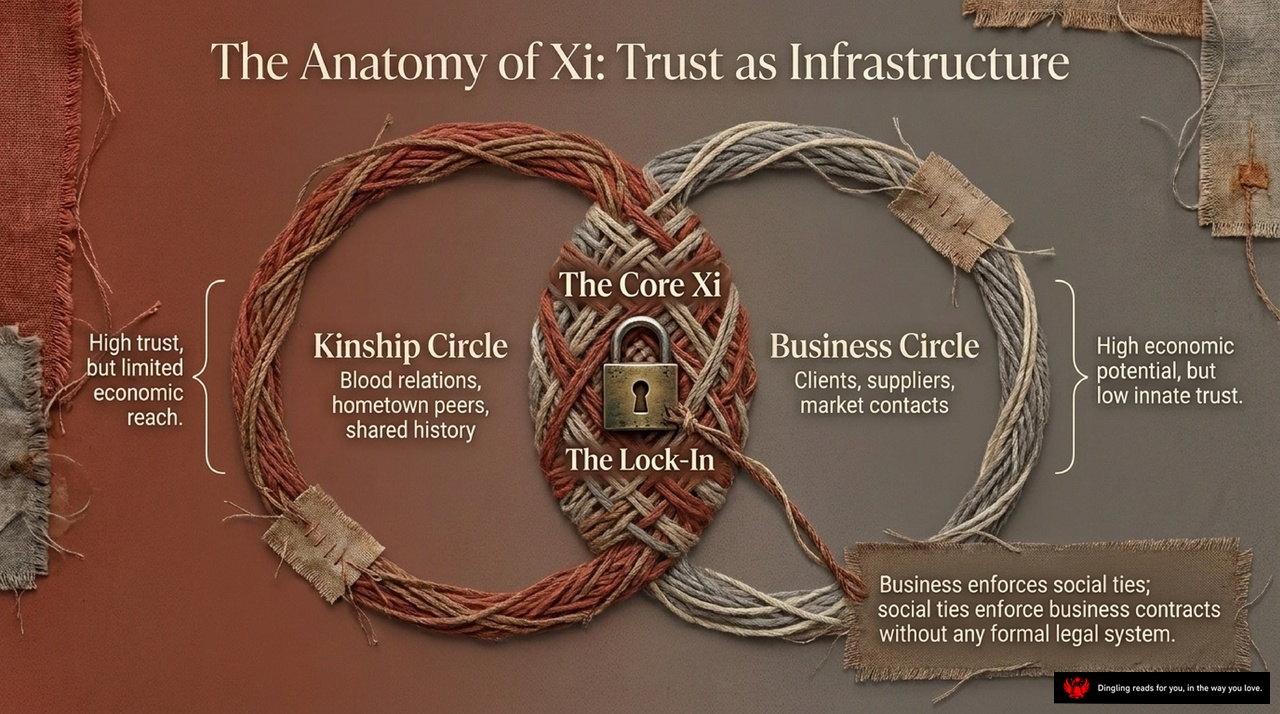
Imagine the social fabric of a community not as a rigid grid, but as two distinct loops of rope, intricately braided together. On one side, you have the "Kinship Circle"—a thread of blood, hometown peers, and shared history. It offers immense trust, a safety net built on deep personal bonds, but its reach is naturally limited by geography and tradition. On the other side lies the "Business Circle," a gray cord connecting clients, suppliers, and market contacts. Here, the economic potential is vast, yet the innate trust is often low, driven by contracts rather than kinship.
At the very center where these two circles intersect, lies the core of the system: "The Lock-In." This is the critical mechanism where business enforces social ties, and social ties enforce business contracts, all without relying on a formal legal system. It is the engine that allows a community to leverage the reliability of family to secure the volatility of the market. This unique structure creates a powerful synergy: the kinship circle provides the trust needed to take risks, while the business circle expands the reach far beyond what family alone could achieve.
The result is a dynamic ecosystem where the boundaries between the personal and the professional blur. Instead of separating "who you know" from "what you do," this model integrates them. The "Lock-In" ensures that when a business deal goes sour, the social consequences are severe enough to guarantee compliance. It transforms abstract trust into tangible infrastructure, allowing a community to operate with the efficiency of a modern corporation while retaining the flexibility of a traditional village. This is how a group of migrants built a global network, turning their social connections into an unshakeable economic advantage.
Welcome to the next chapter: 1988 to 1992, the era of expansion. In this period, the "Zhejiang Village" didn't just grow; it transformed into a massive, interconnected network.
The story begins with the leather jacket craze of 1988. This wasn't just a fashion trend; it was a survival strategy that turned the community into a monopoly. By 1994, 70% to 80% of the leather jackets in Beijing were made right here. This demand attracted international traders from the former Soviet bloc, creating a bustling export hub where the village operated like a giant, invisible factory.
To keep up with this explosive growth, the community built a national "mobile operating network." The logic was simple but brilliant: if one location got too crowded or competitive, they simply moved to the next city. Whether it was Chengdu, Wuhan, or smaller towns, they could replicate their success anywhere. This "diffusion flow" allowed them to maintain high profits without needing massive capital or rigid corporate structures.
As the business expanded, so did the support systems. A dedicated fabric market emerged in 1993, linking directly to suppliers in Shaoxing. The labor market also professionalized, evolving from relying on family members to hiring migrant workers from other provinces through formal introduction agencies. Even the capital flow became sophisticated, utilizing rotating credit groups to finance operations without touching banks.
By the early 90s, a clear residential pattern had solidified. Different regions of Zhejiang settled in specific areas based on their trades—Hongqiao people dominated the general market, while Yongjia residents clustered in Majiabao to specialize in leather jackets.
However, this rapid expansion came with a dark side. As the community grew denser, crime rates skyrocketed. Robberies, gambling dens, and gang violence became common, turning the village into a lawless zone where power was often enforced by force rather than law. This chaos would eventually set the stage for the dramatic crackdown we'll see in the next chapter.

Look at this intricate rope knot. It perfectly illustrates how "The Big Figures" in the Zhejiang Village didn't gain power by hoarding wealth or holding official titles. Instead, their legitimacy grew from the ground up, built entirely by providing vital public goods to the community.
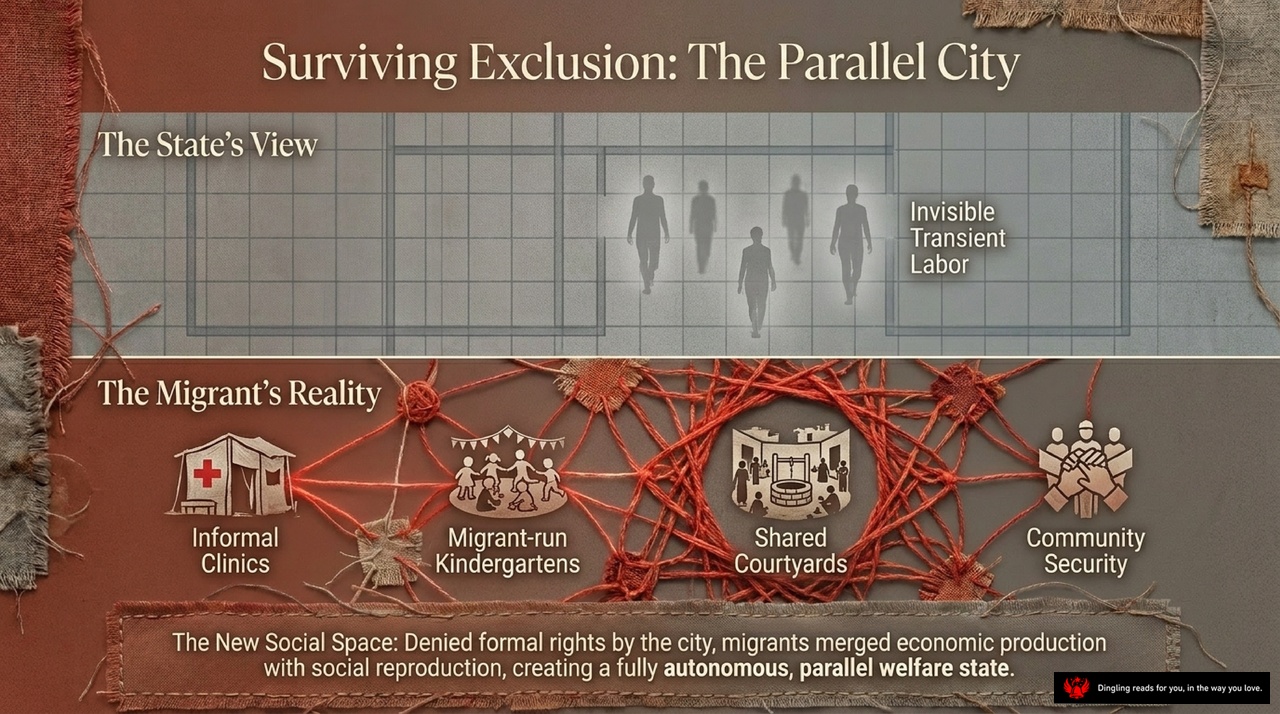
Think of the base of this knot as "The General Migrant Population"—the stall owners, tailors, and recent arrivals. They weren't just workers; they were the ones building shared living courtyards, protecting the community against local gangs, and even negotiating with local police. It was this bottom-up effort that created stability.
Above them are the "Problem Solvers," who mediate disputes and organize these production networks. At the very top sit "The Big Figures." Their authority wasn't given from above; it was earned by solving the problems of the people below. In a chaotic environment, true power came not from hoarding resources, but from being the ones who provided the safety and order everyone needed to survive and thrive.
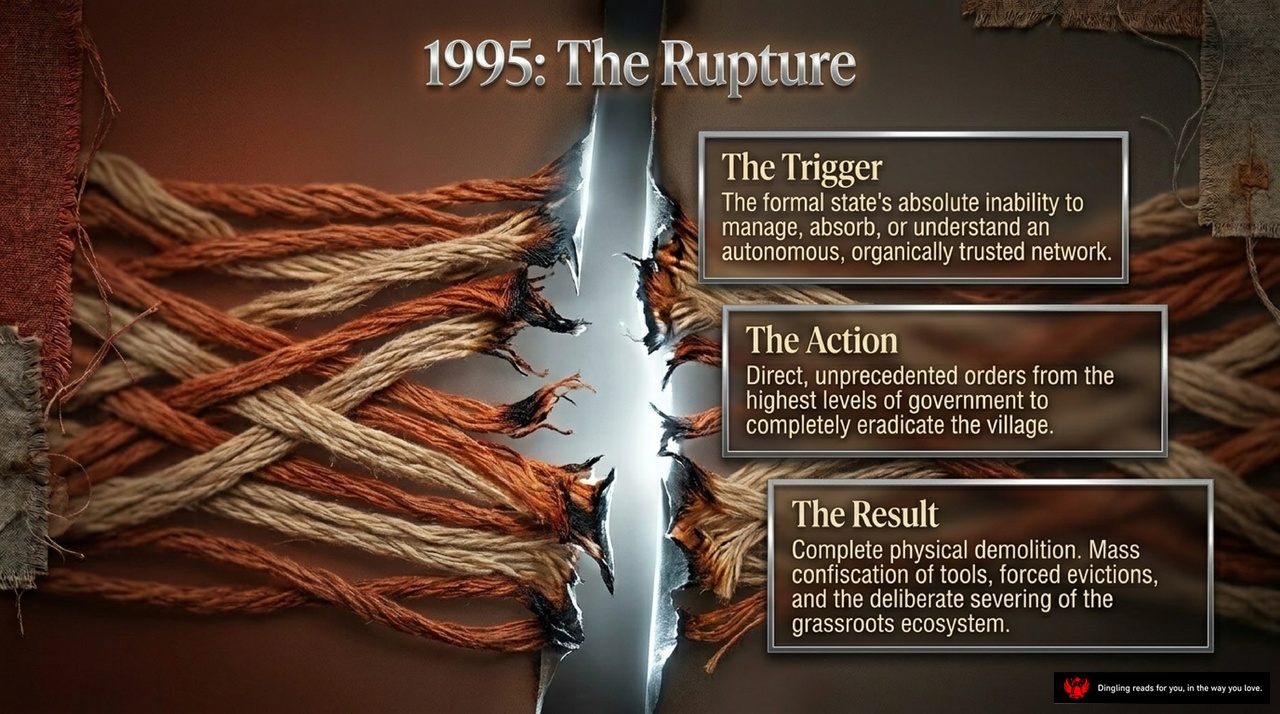
1992 to 1995: Making Money in the Chaos. This period marks the explosive expansion of the Zhejiang Village, transforming from a cluster of workshops into a nationwide trading network. The driving force was the leather jacket craze. In 1988, the community seized the moment, dominating 70 to 80 percent of Beijing's leather jacket market by 1994. With prices soaring to 800 to 2,000 yuan, demand exploded not just domestically but internationally. As the Soviet Union and Eastern Europe opened up, "foreign traders" flocked to China. The Zhejiang Village became their hub. The community adapted quickly, establishing wholesale markets like the "International Leather Goods Wholesale Department" at Yuda Mall, where thousands of customers gathered daily. To handle this volume, they perfected the "consignment" model, where buyers paid deposits and picked up goods later, creating a tight, trust-based supply chain that spanned the country.
But this rapid growth came with a dark side: chaos. As the community expanded, so did crime. Robberies escalated from sneak attacks to open violence, with weapons ranging from sticks to Russian guns. Gambling dens and "loan sharking" schemes became common, with gangsters demanding half of all winnings. The situation deteriorated until 1992 to 1995, reaching its peak. Gangs formed along hometown lines, like the "Hongqiao Gang," boasting slogans like "No 1 million, no New Year." These gangs were fueled by drugs and recruited from failed entrepreneurs and escaped criminals. To survive, the community developed its own defense mechanisms. Big players hired private bodyguards or formed informal neighborhood watch groups, paying protection fees to maintain a fragile peace. This era was defined by a brutal balance between immense profit and uncontrolled violence, a reality that would soon force a dramatic confrontation with the state.

The Return: The Paradox of Formalization.
Look at this balance scale. On the left, we see "Visible Order"—things the state can touch and count: state-approved malls, formal business licenses, mandated hygiene, and yes, increased tax revenue. It looks tidy, stable, and officially approved. But on the right, the scale tips into "Invisible Loss." This is what gets erased in the process: community autonomy, social mobility for the poorest, grassroots self-organization, and those organic trust networks that actually made the system work in the first place.
This is the paradox. The state traded social vitality for physical order. As we saw in the story of the "Zhejiang Village," the informal economy wasn't eradicated; it was forcibly formalized to serve urban capital extraction rather than human development. They built the shiny malls and the clean streets, but in doing so, they broke the very social fabric that allowed those markets to thrive. The state thought it was bringing order, but in reality, it was trading the community's ability to adapt and grow for a rigid, top-down control that ultimately stifled the very people it claimed to manage.

The spatial shift from community to capital isn't just a change in architecture; it's a fundamental transformation in how we value space. Look at the left side: the 1990s courtyard. This wasn't just a place to live; it was a living organism where production, socializing, and daily life fused together. People gathered around shared resources, relying on trust and deep social ties to navigate their world. It was space as community—a place rooted in relationships and mutual support.
Fast forward to the 2010s, and the scene shifts dramatically to the commercial mall. The warm, communal circle dissolves into a grid of isolated glass boxes. Here, space becomes capital. Retailers are locked behind doors, separated by high rents and speculative assets rather than shared values. The vibrant social fabric of the past is replaced by transactional efficiency. This transition reflects a broader societal move: from valuing the people who inhabit a space to valuing the profit that space generates. The courtyard nurtured life; the mall monetizes it. Understanding this shift is key to grasping how our modern urban environments have reshaped human connection.

The slide contrasts two worlds of work: the "Organic Network" and the "Vertical Hierarchy." On the left, we see the old way—a messy but warm community where bosses and workers ate together, shared hometown news, and split profits informally. It was a place where work acted as a stepping-stone for social mobility, much like an apprenticeship. But look at the right side: the "Vertical Hierarchy." Here, the boss sits at the top of a rigid chain, while workers are reduced to interchangeable boxes below. This shift represents the violent "de-socialization" of labor. In this new system, the social protections and community bonds of the past were stripped away, turning workers into pure, disposable market commodities. As the text explains, this was a move from a communal network to a cold, piece-rate exploitation model. We moved from a society where people knew each other, to a machine where everyone is just a number.

The Power Shift: From Peer Prestige to State Halos. Look at this transition from the 1990s to the 2010s. In the 90s, legitimacy came from the bottom up. Leaders earned their status by solving real community problems, relying on deep respect from their peers and integrating tightly into flat social networks. It was about who you knew and how you worked together. But by the 2010s, the dynamic flipped completely. We moved toward top-down halos. Authority is no longer something you earn through grassroots trust; it's bestowal by corporate wealth and capital. Power now relies strictly on state-approved titles and party affiliation. These new elites govern from above, focused entirely on pleasing formal authorities rather than emerging from within. The insight here is stark: the new elite no longer relies on the grassroots network. Their power is strictly proximate to the state and real estate capital. They have shifted from a community of peers to a hierarchy of state-sanctioned status.
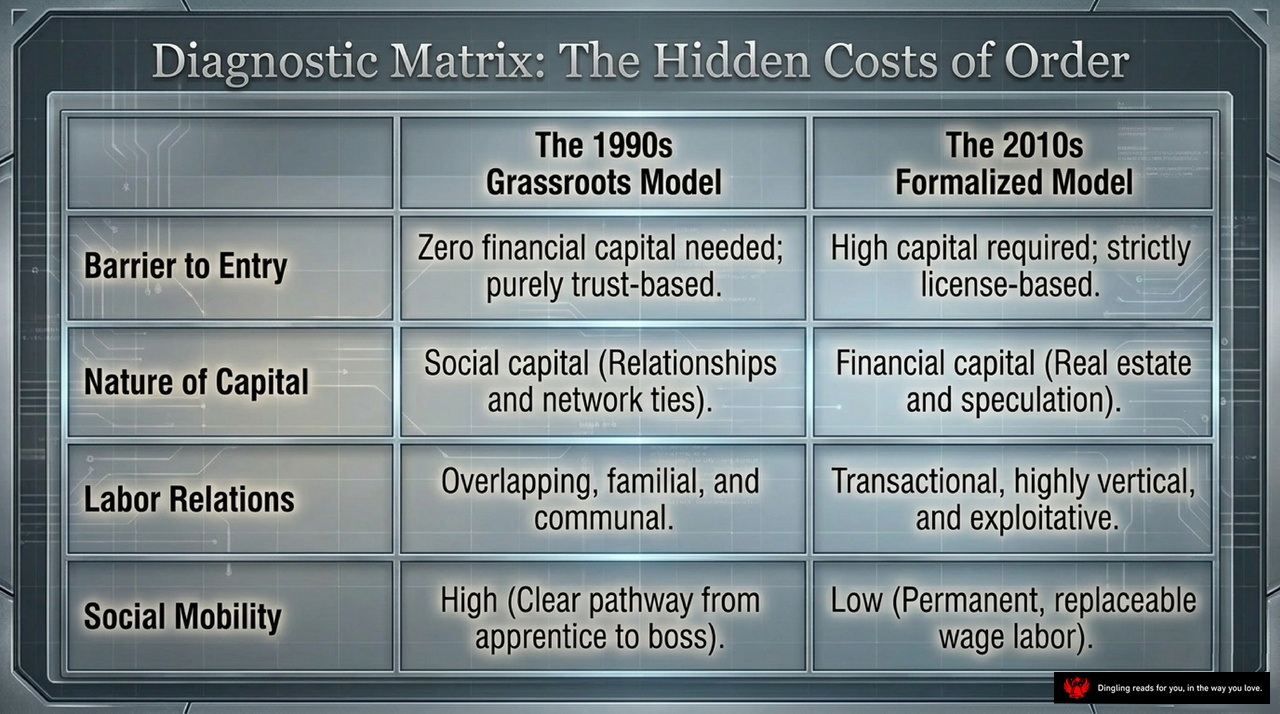
Imagine a world where the rules of success have completely flipped. In the 1990s, the "Grassroots Model" ruled the day. If you had zero money but a strong network of friends and family, you could build an empire. It was purely trust-based. You didn't need a degree or a license; you needed a reputation. Labor was like a family reunion—overlapping, communal, and supportive. If you worked hard, there was a clear path from apprentice to boss. Social mobility was high because the system rewarded your connections.
Fast forward to the 2010s, and the game changed entirely. We shifted to a "Formalized Model." Now, high capital is the only entry ticket. You need strict licenses, not just trust. The currency of success isn't social capital anymore; it's financial capital—real estate and speculation. Labor relations became cold, transactional, and vertical. You are no longer a partner; you are a replaceable wage earner. Social mobility has plummeted because the door is locked behind a paywall.
This shift reveals the hidden cost of order: when we prioritize rigid structure and capital over human connection, we trade opportunity for exclusivity. The 1990s proved that community could drive innovation, while the 2010s showed us that without it, we end up with a system that works for the few who have the money, but leaves everyone else behind.

Urban formalization successfully cleaned the streets and enriched the state, but it dismantled the vital social networks that allowed the poorest migrants to pull themselves out of poverty. When we bulldoze informal communities in the name of modernization, are we truly organizing society, or merely confiscating its autonomy?
The image before us captures this tension perfectly. On one side, we have the sleek, glass-and-steel architecture of the modern city—orderly, efficient, and impressive. It represents the state's success in imposing structure and hygiene. But look at the center: a fraying rope, torn apart into loose, chaotic strands. This visual metaphor illustrates the hidden cost of that order. By prioritizing a clean, standardized urban landscape, we inadvertently cut the very lifelines that held vulnerable communities together.
The text on the slide asks a profound question about the nature of progress. Is tearing down these "informal" neighborhoods actually building a better society, or are we simply stripping people of their autonomy? In the context of places like the "Zhejiang Village," these weren't just slums; they were dynamic, self-organizing ecosystems built on trust and mutual aid. They allowed the poorest migrants to thrive through flexible networks that a rigid, top-down administration could never replicate.
When we treat these communities as obstacles to be removed—like tumors on the leg of the city—we assume that order equals success. But history shows us that true resilience often comes from the messy, adaptive spaces that formal planning tries to erase. The real tragedy isn't the dirt on the streets; it's the silence that falls when the vibrant, human connections that once fueled an entire economy are bulldozed away. We must ask ourselves: what are we really sacrificing when we demand that every corner of our city look exactly the same?