
Transitional Labor: Complete Chapter-by-Chapter Summary
Hey everyone, today we’re kicking off our deep dive into *Transitional Labor: Delivery Riders under the Platform Economy* by Sun Ping. This is a rigorous, on-the-ground ethnographic deconstruction that lays bare exactly how gig economy algorithms and platform capitalism turn what most people see as temporary, short-term side gigs into a permanent, unending state of precarious, unstable labor. We’ll pull back the curtain on the hidden systems governing delivery workers’ daily lives, their unspoken struggles, and the far-reaching implications for the entire global gig economy.
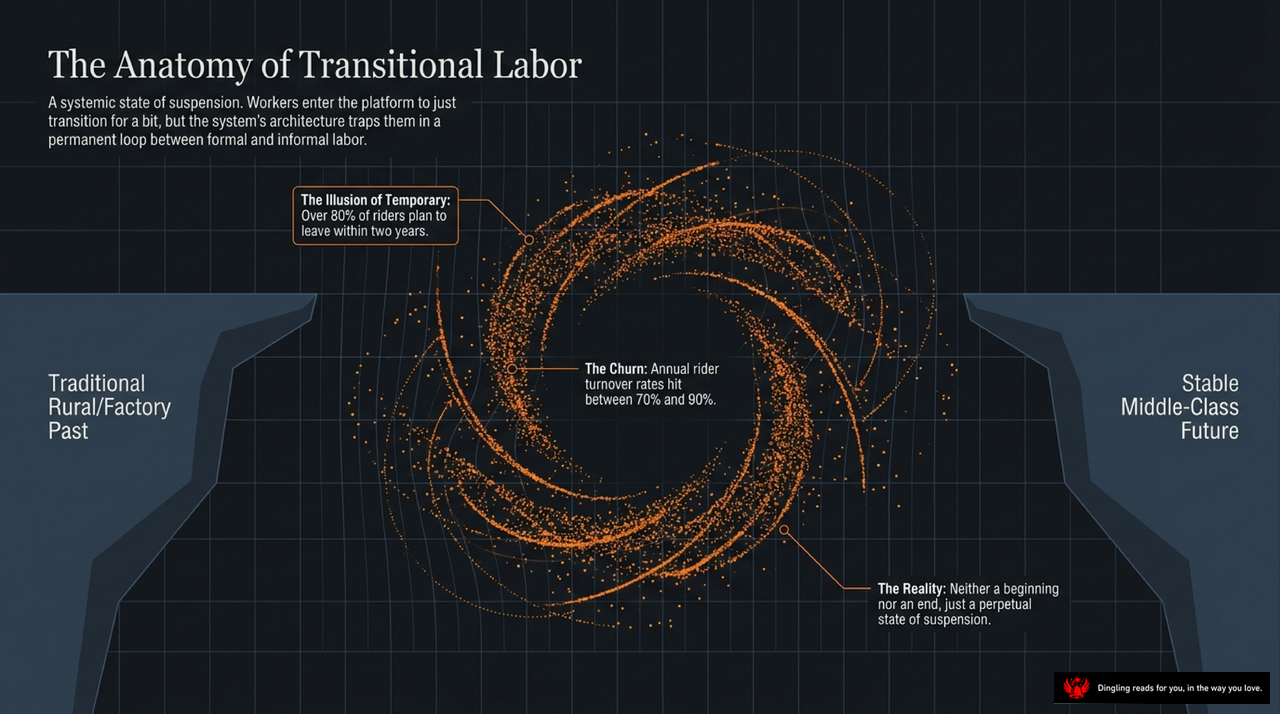
Let’s break down exactly what transitional labor looks like for gig delivery workers, a systemic state of suspension that way too many folks in the U.S. gig economy know all too well. Most people sign up to drive for these apps thinking it’s just a short-term stopgap, something to pick up quick cash while they line up a better, more stable role down the line. But the entire system’s architecture is built to trap them in a never-ending loop between formal, protected labor and unregulated informal gig work.
First, you run straight into The Illusion of Temporary: surveys show over 80% of riders plan to leave the job within two years. They’re all chasing that Stable Middle-Class Future, you know, the one with steady pay, health benefits, and the ability to put down roots, after leaving behind the Traditional Rural/Factory Past that no longer offers the reliable union wages and pensions it used to for most working people.
But that endless churn hits them first: The Churn, where annual rider turnover rates sit between 70% and 90%. That huge turnover isn’t people moving on to better careers, it’s them bouncing between different apps, switching from DoorDash to Uber Eats to other delivery or courier platforms, never gaining any job security or long-term footing. At the end of the day, The Reality hits hard: this gig work is neither a proper beginning to a new career, nor a clear end to their transition out of low-wage work, just a perpetual state of suspension where they stay stuck, running in place, with no clear path forward.
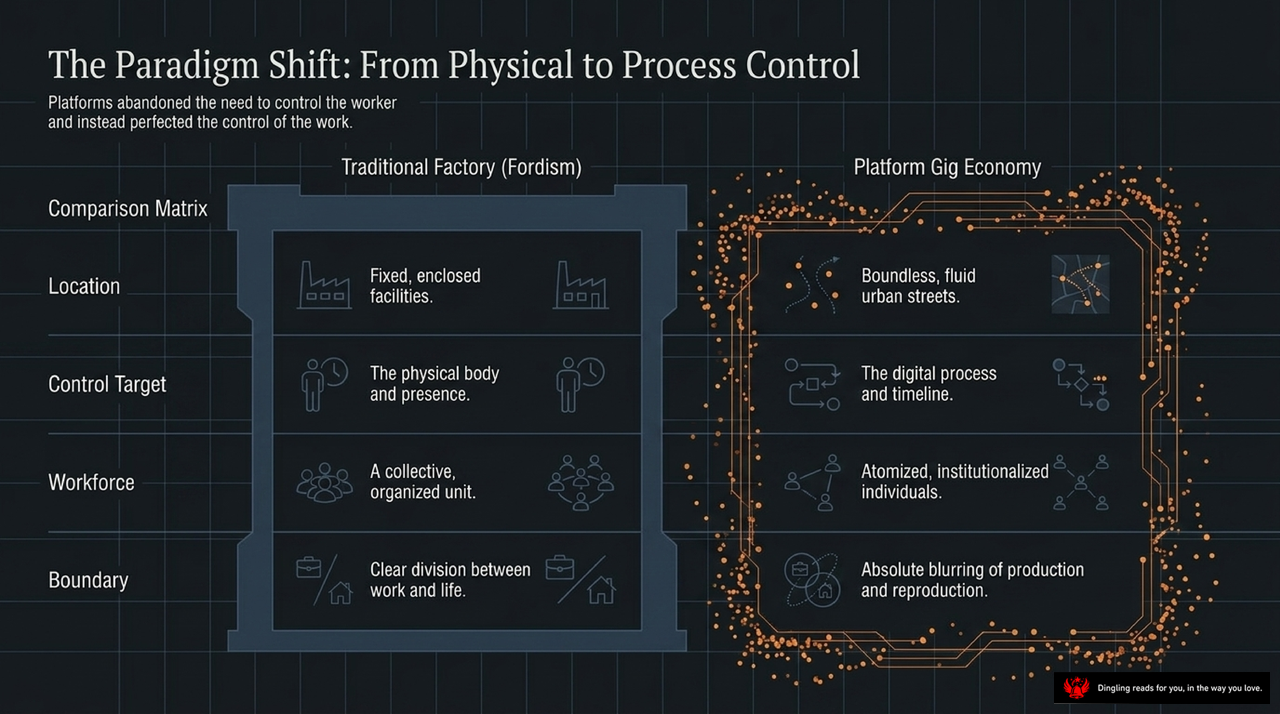
Let’s break down this massive paradigm shift we’re seeing right now, the one that moves us from old-school physical labor control to total process control. The big picture takeaway here? Modern gig platforms don’t waste time trying to track and micromanage individual workers the way old factories did — they perfected controlling the work itself, instead of controlling the person doing it.
If you line up the classic Fordist traditional factory next to today’s platform gig economy side by side, the difference is night and day. First, location: the old factory was a fixed, enclosed facility you had to show up to, punch a timecard at, and stay inside for your entire shift. Gig work? It’s completely boundless, fluid, playing out across the entire network of urban streets, no four walls holding you in.
The target of control totally flipped too. Back in the Ford era, managers spent all their energy monitoring your physical body and presence, making sure you didn’t step away from the assembly line, didn’t slack off at your station. Now platforms don’t care where your physical body is at all — they track the digital process and timeline of your tasks, down to the second. Your whole workforce used to be a collective, organized unit of factory labor that could unionize and bargain as a group. Now gig workers are atomized, institutionalized individuals, each logged into their own separate app account, rarely interacting as a cohesive group.
And that old clear division between work and life? It’s gone completely. There’s absolute blurring of production and reproduction now — you’re on call waiting for orders even when you think you’re “off the clock”, no hard line between your shift and your personal time. That’s the core of what makes modern gig labor feel so unmooring for so many people.
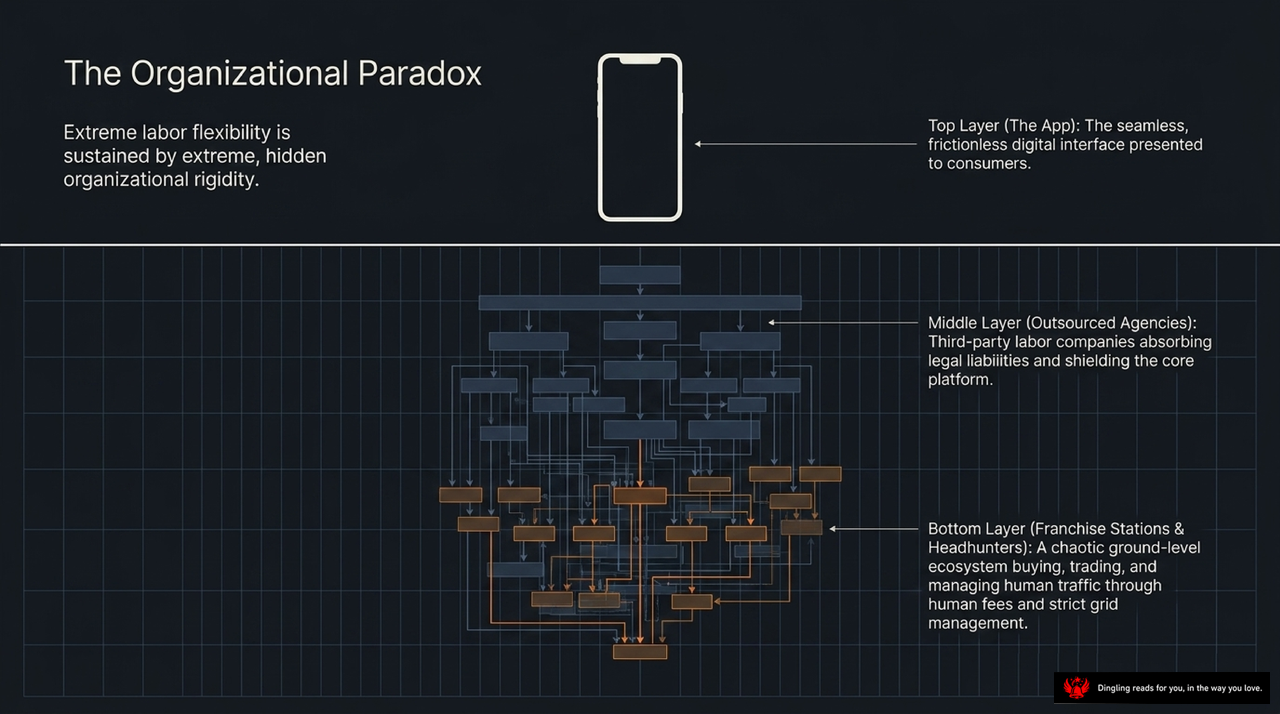
You’ve definitely experienced that seamless, frictionless feeling of ordering food on your phone, right? A couple quick taps, and your hot meal shows up at your door in 30 minutes flat, no hoops to jump through at all. What almost no regular consumer ever stops to notice is the massive, hyper-rigid hidden organizational system that makes that effortless convenience possible. That’s the core of The Organizational Paradox we’re breaking down today: extreme labor flexibility is sustained by extreme, hidden organizational rigidity.
Let’s walk through the three stacked layers that make this paradox work. The top layer is the app itself, the polished, consumer-facing digital interface that’s intentionally designed to keep you completely unaware of all the messy logistics going on out of sight. The middle layer is made up of all the outsourced agencies: those third-party labor companies that absorb all the legal liabilities, so the core platform never has to formally classify delivery workers as full employees, and never has to directly cover healthcare, overtime pay, or workers’ comp claims.
The bottom layer is the chaotic ground-level ecosystem of franchise stations and headhunters. These teams run constant, high-pressure recruitment to keep a steady stream of new riders flowing in, manage the constant churn of workers quitting, and enforce strict, granular grid management to make sure maximum numbers of drivers are on the road during peak hours. This exact same structure powers almost every gig economy platform from DoorDash to Uber Eats across the US, the whole setup is built to shield the core platform from accountability, while presenting the illusion of total frictionless convenience to end users.
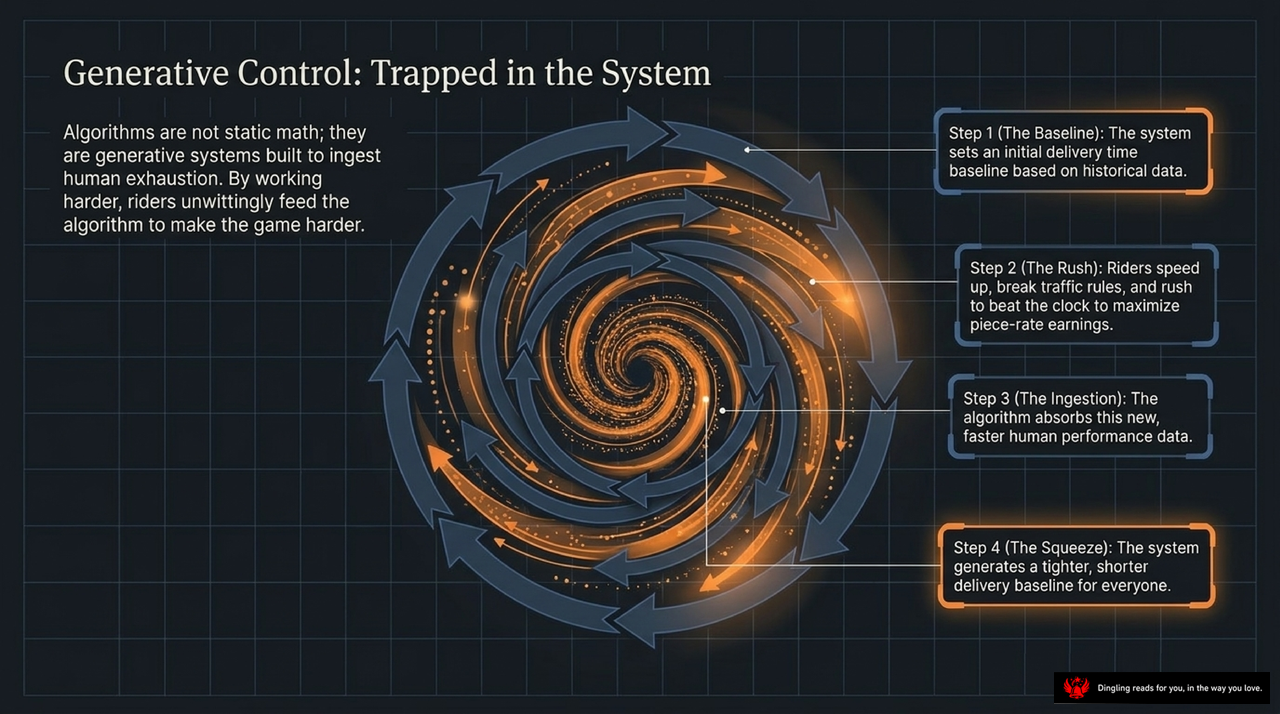
Ever wonder why DoorDash and Uber Eats delivery times keep getting shorter and shorter, even as traffic gets worse and restaurant lines get longer? That’s exactly the generative control trap we’re breaking down here, the vicious spiral that locks gig riders in without them even noticing at first.
A lot of people think algorithms are just neutral, static sets of math rules, but that couldn’t be further from the truth. These are generative systems literally built to ingest and feed off human exhaustion. The whole cycle plays out in four clear, repeating steps that keep spinning tighter over time.
First up is The Baseline: the system pulls years of historical delivery data to set that initial default expected delivery time for every route, no extra wiggle room factored in for random delays like backed-up restaurant lines or sudden traffic jams. Next comes The Rush: riders who want to maximize their piece-rate earnings speed up, cut corners on safe driving, even run small red lights to beat that initial clock and fit more orders into their shift to take home more cash at the end of the day.
Then we hit Step 3, The Ingestion: the algorithm absorbs all this new, faster human performance data, no context for how much risk or extra physical effort that speed required. It simply registers that the route can be completed faster, no human judgment added. Finally Step 4, The Squeeze: the system rolls out a tighter, shorter delivery baseline for every single rider on that route, no corresponding pay bump for the extra work everyone now has to put in.
This loop spins faster every week. You work harder to make more money, and you unwittingly train the algorithm to make the game harder for everyone, trapping the whole workforce in a never-ending race just to keep up.
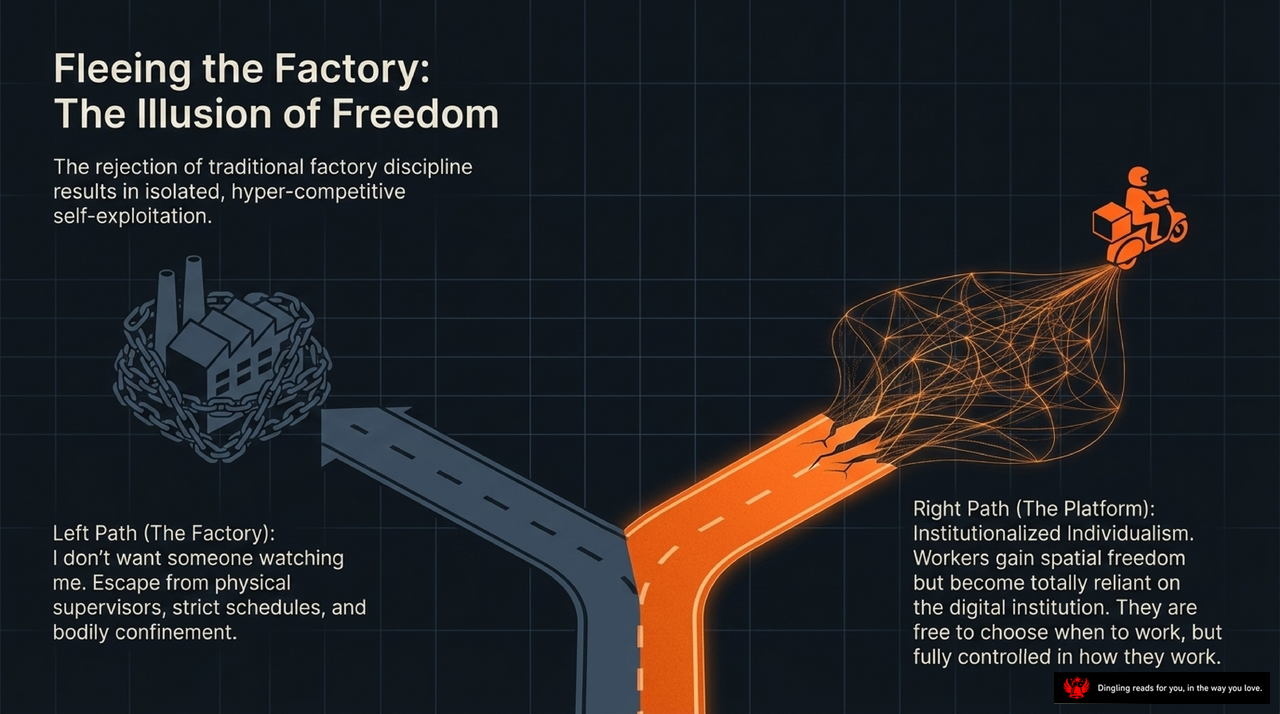
If you’ve ever spent a shift at a traditional manufacturing plant, you know exactly why so many workers bolt for gig work as delivery riders. No one wants a supervisor breathing down your neck every 10 minutes, clocking your bathroom breaks, forcing you to stick to a rigid shift that leaves zero flexibility for your personal life. That’s the exact mindset behind this idea of Fleeing the Factory: The Illusion of Freedom.
On the left path, the old factory system, everyone is chained to the building, stuck with all that top-down discipline most of us can’t stand. The second you hear you can be your own boss, set your own hours, ride around the city on your own schedule with no one hovering over you, it sounds like the perfect upgrade.
But that bright, open orange path on the right, the platform gig economy route? It doesn’t lead to real freedom, it leads to institutionalized individualism. You do gain spatial freedom, sure — you’re not locked inside a factory building for 8 hours a day. But you become totally reliant on that invisible digital institution running everything in the background. You get to pick when you log on to work, but the algorithm fully controls every single part of how you work: it calculates your delivery times down to the second, penalizes you for even a 30 second delay, pushes you to take more and more orders to keep your account ranking high, and pits you against every other rider in your zone to compete for the best paying jobs.
The end result of rejecting that old factory discipline isn’t liberation. It leaves you isolated, locked in hyper-competitive self-exploitation, where you push yourself way harder than any factory foreman ever could to hit your own personal earnings targets.
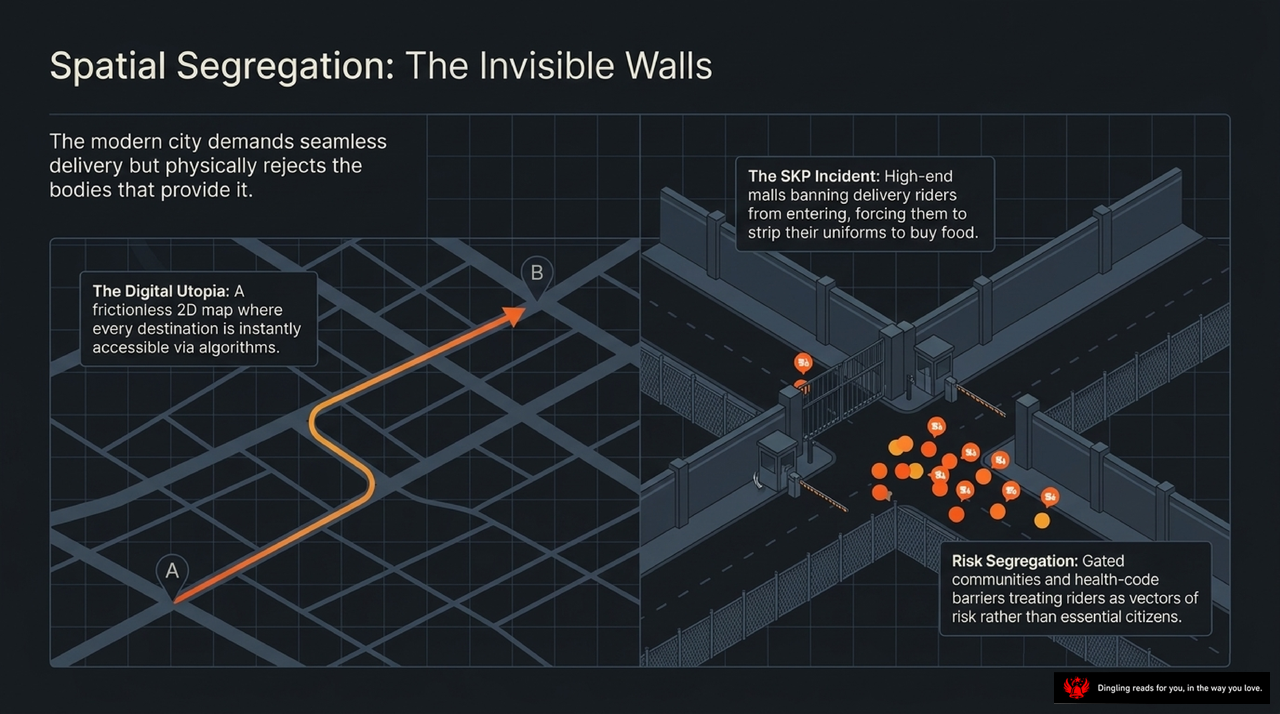
Let’s talk about a concept we call Spatial Segregation: The Invisible Walls, a dynamic you’ve definitely witnessed playing out in every major US city right now. The whole promise of modern urban life is that you can get any food, grocery or item delivered to your door in 15 minutes, totally seamless, zero friction — but the second the delivery worker who made that possible shows up at the property line, the city physically rejects their very presence.
On one hand, the Digital Utopia the delivery apps sell you looks flawless: that clean 2D map on your phone shows no barriers at all, every destination is supposed to be instantly accessible via the algorithm’s perfectly optimized route. But the real, physical city couldn’t be further from that fantasy.
You’ve seen local versions of the SKP Incident here for years, right? High-end luxury malls in Manhattan, Beverly Hills or downtown Chicago that ban uniformed delivery riders from even stepping through the front doors, forcing them to strip off their branded work gear just to go inside and buy a meal for themselves. Then there’s risk segregation, where gated residential communities, lingering health code barriers, and private security checkpoints treat these riders as vectors of risk, rather than the essential citizens who keep the entire city running. These aren’t arbitrary, random rules. They’re invisible walls, drawn right through the streets we all share, that wall off the people the city depends on, from the spaces they are never allowed to fully belong to.
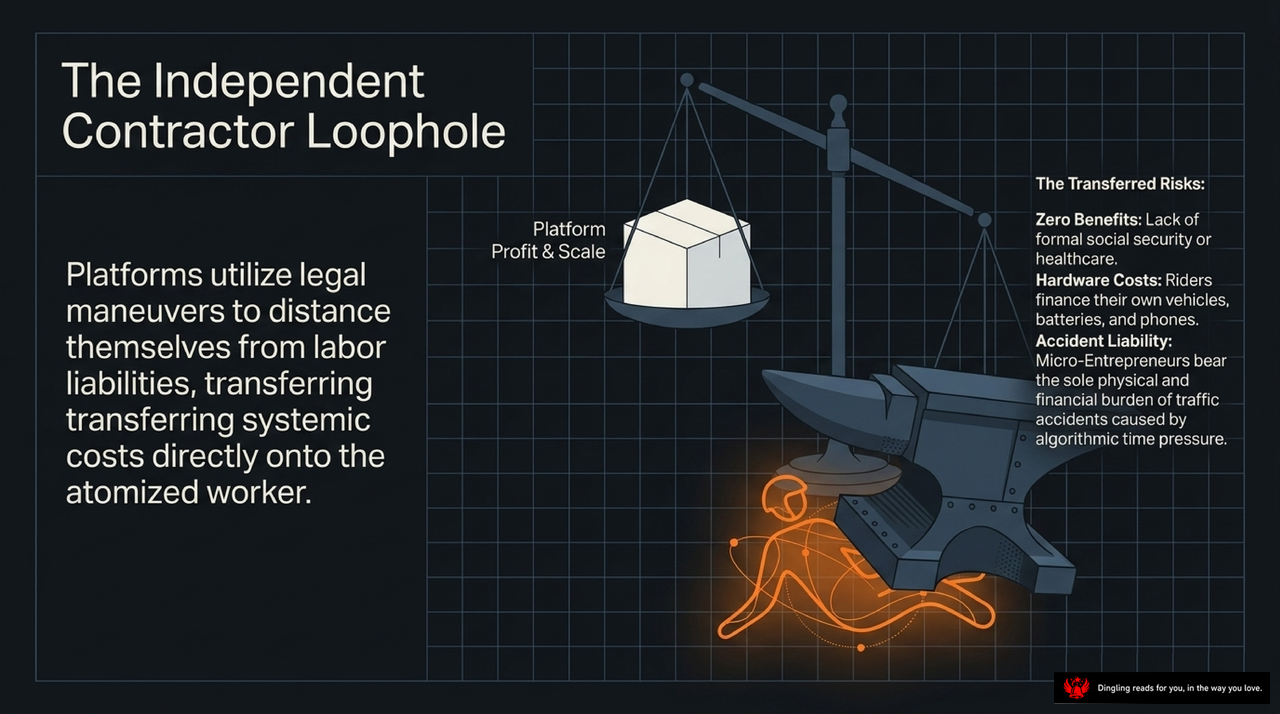
You’ve definitely heard the marketing talking points from gig platforms like DoorDash, Uber, and Instacart for years: “Be your own boss, set your own hours, run your own small business.” But what they never advertise is the legal trick that makes their entire hyper-profitable model possible: The Independent Contractor Loophole.
These companies use all kinds of carefully crafted legal maneuvers to distance themselves from every last labor liability, shifting every single systemic cost straight onto the individual, atomized worker they mislabel a “business partner.” If you picture the classic justice scale, one side is stacked heavy with Platform Profit & Scale — all the revenue they pull in from delivery fees, surge pricing, and ad revenue, no strings attached. The scale doesn’t even tilt evenly, though. All that unaccounted weight crashes straight down, slamming a heavy anvil right onto the worker pinned underneath, zero support to catch them.
These Transferred Risks add up to a raw deal no traditional full-time employee would ever be forced to accept. First up, Zero Benefits: no formal social security, no employer-sponsored healthcare, no paid sick leave, no easy-to-access workers compensation. Second, every last Hardware Cost falls on the worker themselves: they have to finance their own vehicle, cover gas, repairs, new e-bike batteries, and even their work phone out of their own pocket, no stipend from the platform at all. Third, you carry 100% of the Accident Liability. Those impossibly tight, algorithm-crunched delivery times that push you to run red lights or weave through traffic? If you get in a crash, you bear all the physical and financial burden alone, the platform washes their hands of the situation completely. This isn’t a glitch, it’s a deliberate system built to pad corporate margins at the expense of the people doing all the actual frontline work.
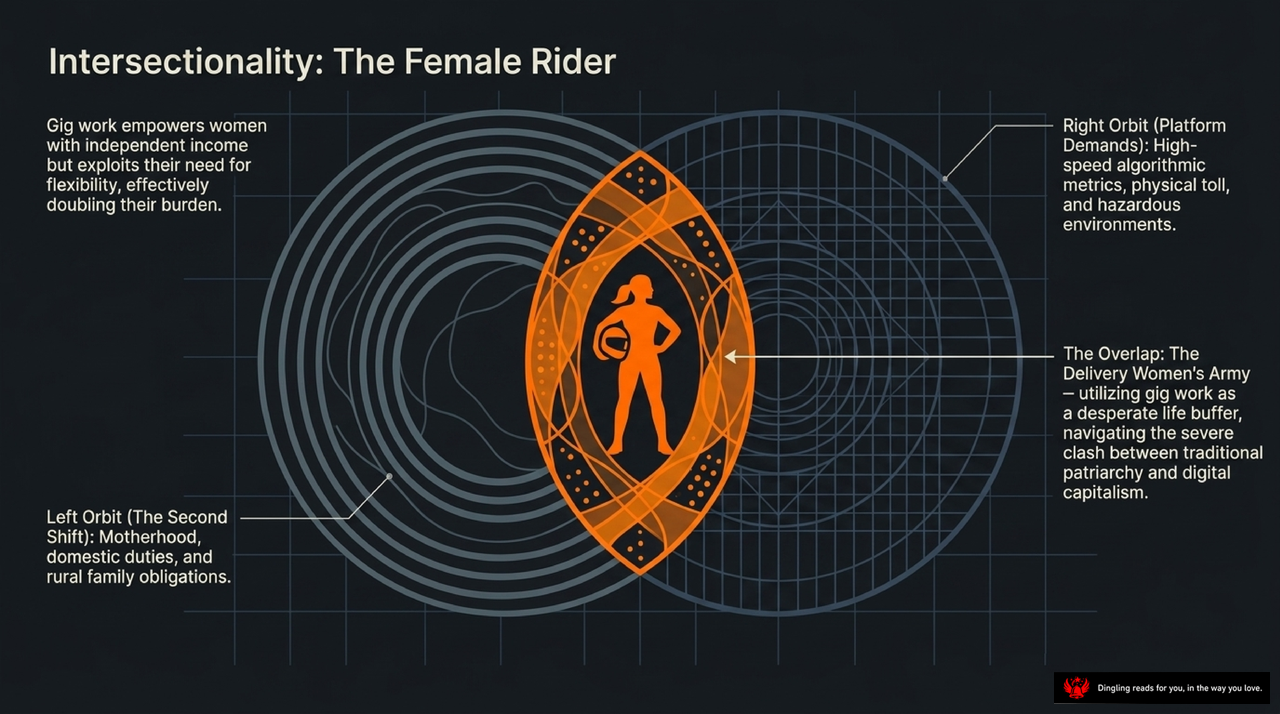
Let’s break down this super clear visual that lays out the unique, layered pressures female gig delivery riders face, under the heading *Intersectionality: The Female Rider*. This two-orbit diagram doesn’t just look polished, it perfectly maps the two separate, heavy sets of demands that stack on top of each other for these women, far beyond what most male riders ever have to navigate.
First, the left orbit, labeled The Second Shift, covers all the uncompensated, non-negotiable work they’re expected to handle off the clock: full-time motherhood, endless domestic chores, and unshirkable obligations to extended family, often back in their rural hometowns. That’s a full-time job all on its own, before they ever even turn on their delivery app.
Then you’ve got the right orbit, the Platform Demands side: the unforgiving, high-speed algorithm metrics that punish even a 10-second delay, the constant physical toll of riding 10+ hours a day in all weather, and the hazardous, unregulated street environments they navigate with zero employer-provided safety support.
Where these two orbits crash together in the center? That overlap is what researchers call The Delivery Women’s Army. These women aren’t just picking up shifts for side cash—they’re relying on gig work as a desperate, last-resort life buffer, stuck navigating the brutal, nonstop clash between rigid, traditional patriarchal expectations and the cold, unforgiving logic of digital capitalism. It’s such a brutal paradox: gig work gives them the independent income they can’t get from most other inflexible, low-wage jobs, but it exploits exactly the flexibility they need to juggle all their family duties, effectively doubling their total workload and burden, with no safety net, no overtime pay, no paid days off to catch their breath.
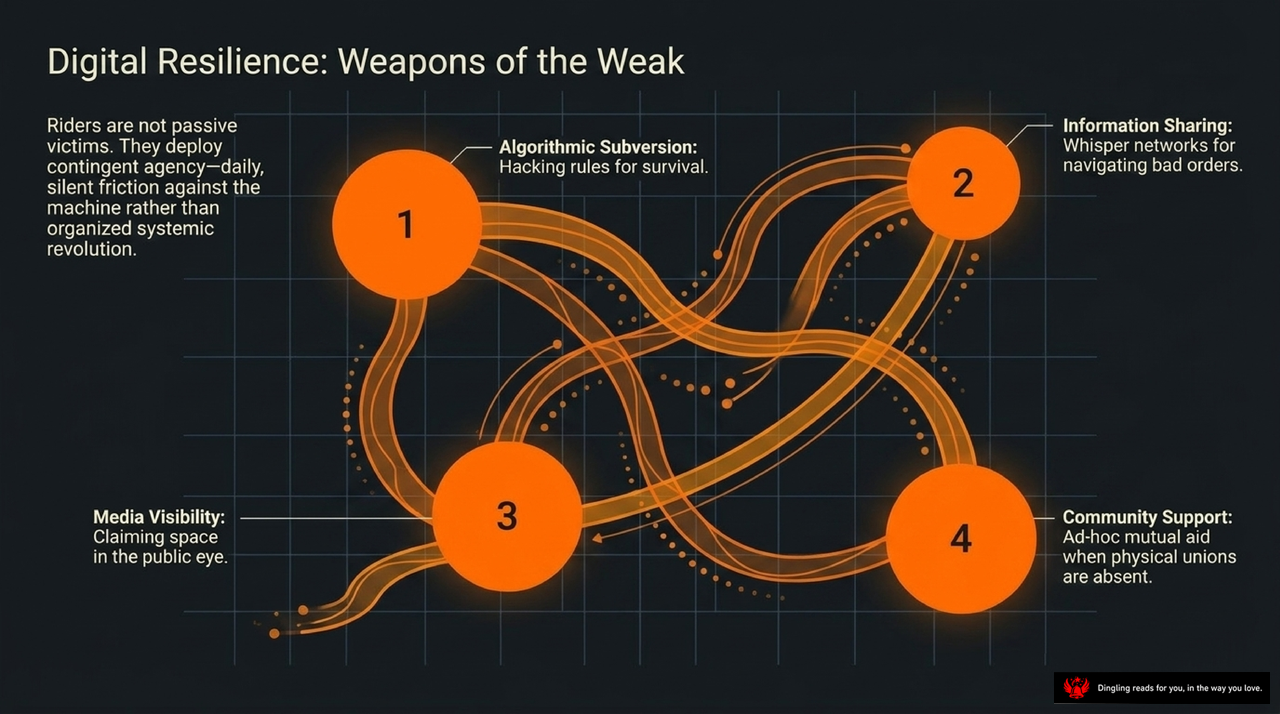
Let’s talk about what digital resilience actually looks like for gig delivery workers, the kind of quiet, everyday “Weapons of the Weak” that never make headline news. A lot of people assume these DoorDash or Uber Eats riders are just helpless, passive victims stuck at the total mercy of the dispatch algorithm, but that’s far from the truth. They don’t wait for a big, organized systemic revolution to push back against the system — they deploy small, daily, silent acts of friction against the machine, what researchers call contingent agency, to take back tiny pockets of control over their work.
There are four core, interconnected tactics they rely on to pull this off. The first one is Algorithmic Subversion, basically hacking the rules for survival: veteran riders pick up all kinds of little workarounds to outsmart the dispatch software, from triggering the system to send more high-value orders to ignoring the app’s suggested routes to take local shortcuts no algorithm knows about. Second, they lean on Information Sharing via tight, private whisper networks for navigating bad orders and unsafe conditions: group chats blow up with real time alerts for speed traps, backed-up restaurants, or apartment buildings that ban delivery workers, so no one gets blindsided by a hidden penalty. Third, they build Media Visibility to claiming space in the public eye, posting short clips of unfair pay cuts or dangerous working conditions on social media to push back against public erasure of their labor. And fourth, they build Community Support through ad-hoc mutual aid, when physical unions are completely absent for most gig workers. They swap spare batteries, cover each other’s orders when someone has an emergency, and pool cash to help a fellow rider hurt on the job. None of these acts are flashy, but they add up to real, tangible power for people the system was designed to leave behind.
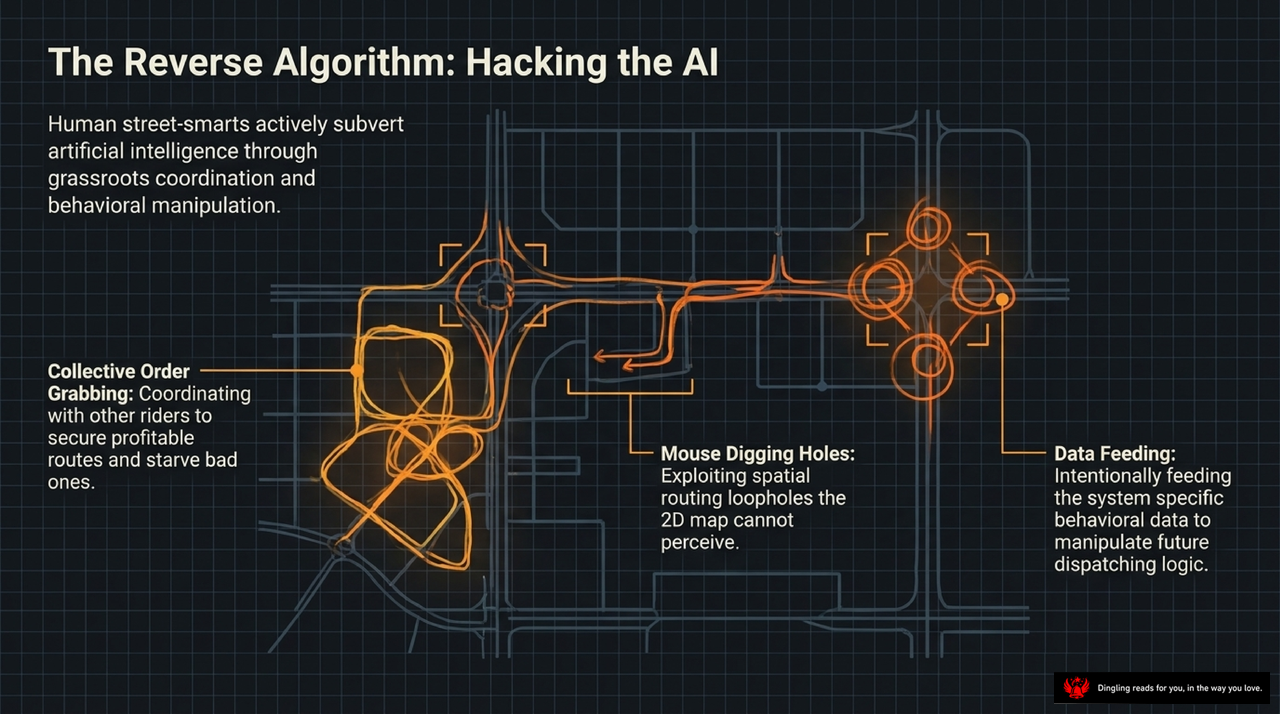
You’ve definitely heard all the viral stories about how delivery platform algorithms box gig riders into impossibly tight delivery windows, push them to rush through traffic, and call all the shots on their shifts. But what almost never gets covered is the super clever, grassroots counter-strategies these workers have built to flip the script on the AI, a system we call The Reverse Algorithm: Hacking the AI.
The whole idea is super straightforward: human street-smarts actively subvert artificial intelligence through grassroots coordination and behavioral manipulation, no fancy cybersecurity background required. These riders know their local cities far better than any generic map dataset, and they’ve turned that on-the-ground knowledge into real leverage over the system.
First, they use Collective Order Grabbing: riders sync up with other nearby drivers in their private group chats to coordinate and secure all the profitable, high-tip routes, while collectively choosing to ignore and starve out the low-paying, dead-end runs no one wants to waste their time on.
Next, they pull off a trick they call Mouse Digging Holes, exploiting all the spatial routing loopholes the 2D map the AI runs on can never perceive. That means hidden back alleys, unmarked apartment building elevator shortcuts, little-known parking lot cut-throughs, all the tiny local hacks the algorithm never bothered to document.
Last, they practice Data Feeding: riders intentionally feed the system specific behavioral data to manipulate its future dispatching logic. If they hang out in a high-demand, high-pay zone long enough to make the AI log that as their regular work area, the platform will automatically start pushing all the best, highest-value orders their way before they even pop up on other riders’ feeds. None of these tricks are malicious, they’re just regular workers clawing back a little control over their own time and pay.
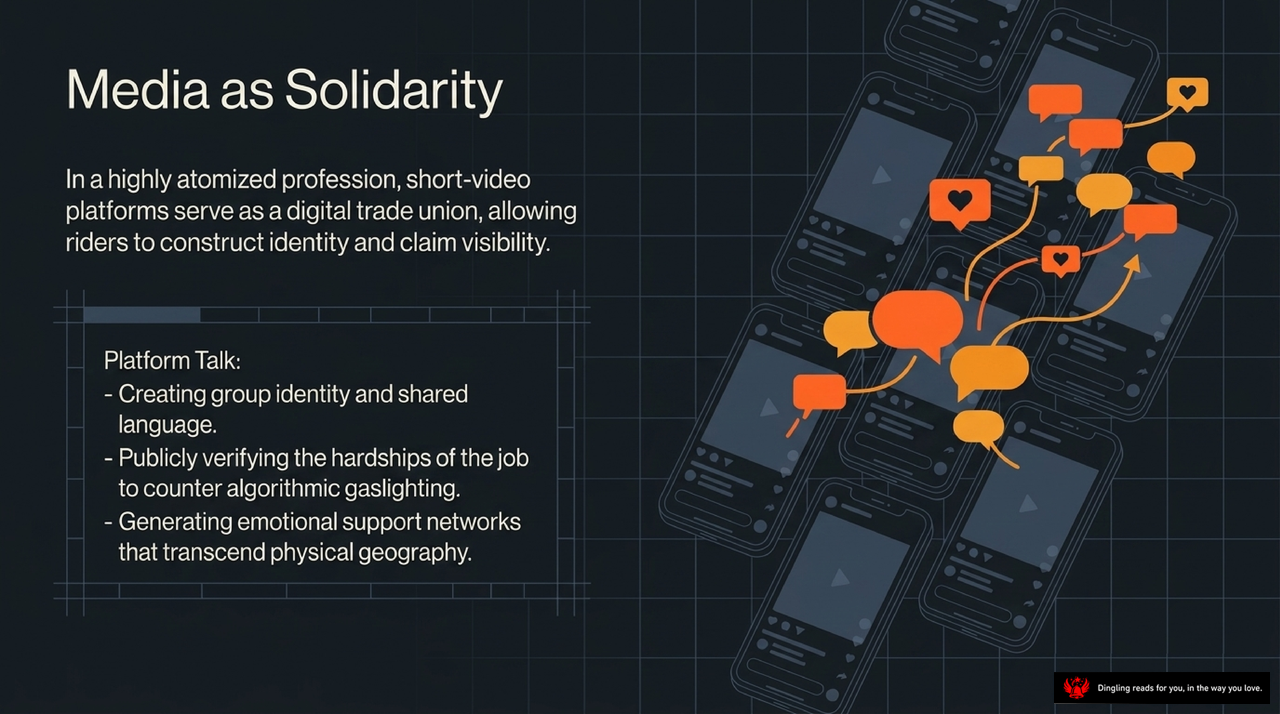
Hey, let’s break down a super underrated role short-video and social platforms play for gig delivery workers, a dynamic we call media as solidarity. Think about it: this line of work is extremely atomized, right? You’re zipping through city streets alone your entire shift, barely run into other riders, and it’s way too easy to buy into the lie that every unfair setback you face is your own personal failure. That’s exactly where these platforms step in, acting as a 24/7 digital trade union that lets scattered riders build real collective identity and claim public visibility they never had before.
First, they help riders build shared group identity and their own one-of-a-kind shared language. You’ve definitely seen those viral clips where riders joke about the algorithm slashing delivery times to absurdly tight windows, or pass around inside memes about nightmare luxury apartment drop-offs. All that casual, relatable content ties total strangers scattered across every neighborhood in the city together, so they never feel like they’re grinding through this alone.
Second, they publicly confirm all the unspoken hardships of the job to push back against that algorithmic gaslighting platforms pull nonstop. When hundreds of riders post their own clips of getting fined for a delay that was 100% the restaurant’s fault, no corporate rep can pretend those unfair penalties are just a “you’re bad at planning routes” individual problem anymore.
Best of all, these emotional support networks completely transcend physical geography. A rider stuck fighting an unfair account ban in Chicago can get proven, actionable advice from a fellow rider who dealt with the exact same policy in Houston months ago, no in-person meetup required. That no-barrier, cross-country mutual aid is what makes this digital solidarity so game changing for workers who never got to stand together before.
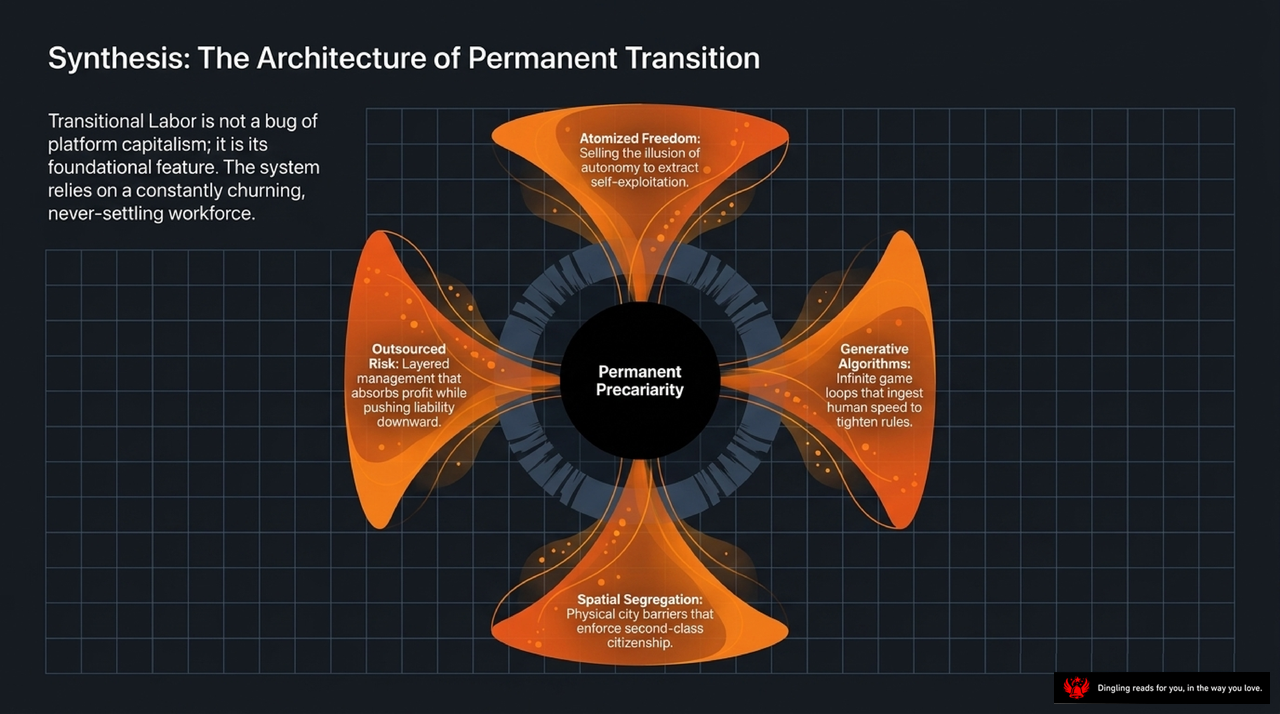
Let’s break down this big picture right here, what we call the Architecture of Permanent Transition. First off, let’s get one critical fact straight: Transitional Labor is not a bug of platform capitalism; it is its foundational feature. The entire system is built to run on a constantly churning, never-settling workforce that never gets to feel fully secure in their job.
This core state of Permanent Precarity is held up by four interlocking gears that work together seamlessly to lock gig workers in place. First, Atomized Freedom: platforms sell you the illusion of total autonomy, telling you you set your own hours, work whenever you want — but that “freedom” is just a trick to push you to self-exploit, work longer shifts, and chase every last penny of bonus pay entirely on your own.
Then you’ve got Generative Algorithms, those infinite game loops that ingest your speed as a worker to tighten the rules every single week. The faster you complete a delivery, the more the system cuts your allotted time, raising the performance bar on you nonstop. Third, Outsourced Risk: layered management structures let the top platform absorb all the profit, while pushing every last bit of liability down to the lowest level — if you get in a crash on shift, good luck finding anyone at corporate who will admit you were ever their employee.
Last, Spatial Segregation: all those locked luxury apartment lobbies, no-entry office building policies, that unspoken physical barrier across the city, they all enforce second-class citizenship for gig workers, making sure you can never truly belong in the community you spend every day servicing. All four of these pieces stack up, turning what you thought was a temporary side gig into permanent, unescapable instability.
Think about the last time you tapped to order takeout on DoorDash, or booked an Uber ride at 1 a.m. after a night out. Platform capitalism has pulled off a brilliant, almost seamless illusion here: it sells every gig worker the promise of total, unshackled freedom, no 9-to-5 grind, no micromanaging boss, full control over your own schedule. But behind that shiny marketing pitch, it’s using hyper-optimized algorithms and hidden spatial barriers to trap those same workers in a permanent state of high-speed, disposable transition. Most delivery drivers sign on thinking this is just a quick temporary side gig, something to pay the bills while they line up a more stable long-term job. But three or four years down the line, they’re still bouncing between apps, no health benefits, no job security, every second of their shift dictated by a system that keeps shaving minutes off their allowed delivery window to cram in more orders. They never get to move past that “temporary” phase, they never get to build the stable life they were chasing. And that leads directly to the tough question we all have to confront: if all these little modern conveniences we take for granted are built on the perpetual limbo of millions of workers stuck with no safety net, no upward path, are we actually consuming technology when we hit that order button? Or are we consuming the time, the labor, and the lives of the people on the other side of the screen?