
Treat Time as a Friend: Complete Chapter-by-Chapter Summary
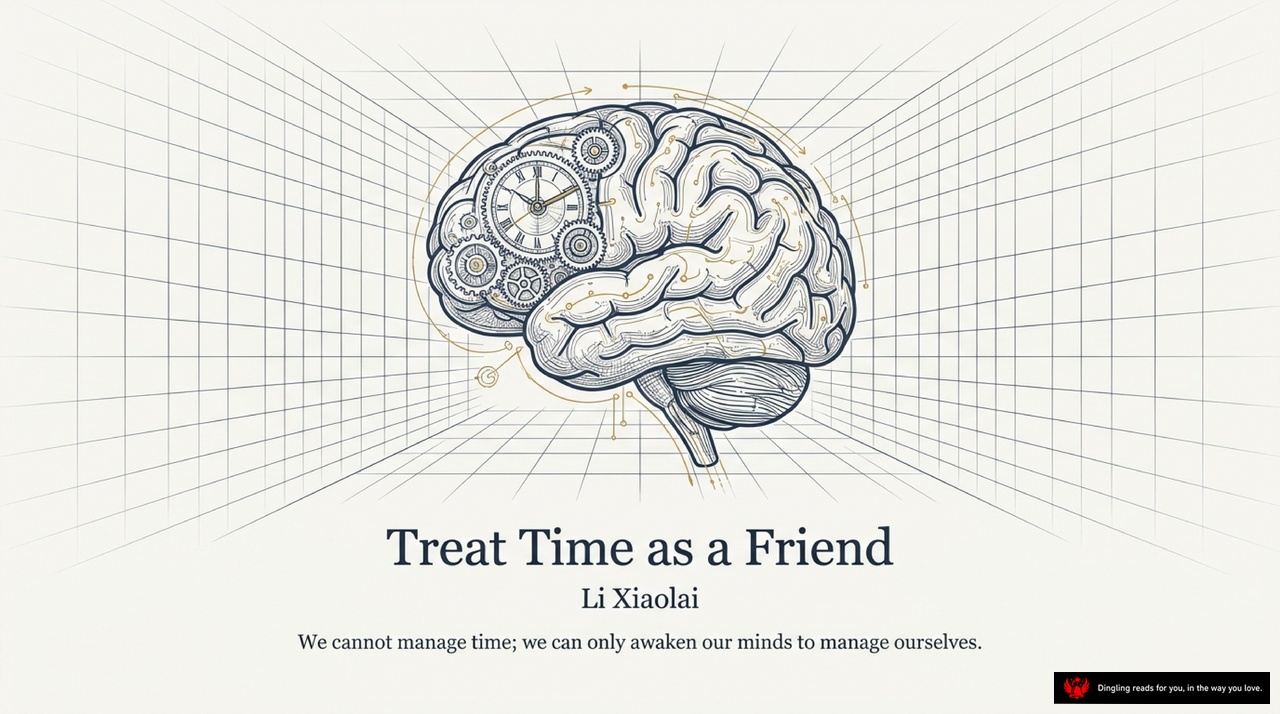
Hello everyone, welcome to today's session. Let's start by looking at the image on your screen. You see a brain intricately woven with gears and a clock, symbolizing the complex relationship between our minds and time. The title reads, "Treat Time as a Friend," and the quote below says, "We cannot manage time; we can only awaken our minds to manage ourselves." This is the core message we need to carry forward.
Think about this: do you ever feel like time is running away from you? You might see others working late, sacrificing weekends, yet still feel behind. But here's the truth—time itself is neutral and unstoppable. It flows at the same speed for everyone, regardless of your status or effort. The real problem isn't that time is against you; it's that we haven't awakened our minds to understand how to live within it.
Many of us suffer from what I call "time panic." We try to control every second, yet in our anxiety, we end up being both lazy and busy. We skip deep learning for quick fixes, or we procrastinate because we're scared we won't have enough time later. This fear creates a cycle where we feel overwhelmed, but the solution is simple: stop fighting time and start befriending it.
How do we do that? By shifting our focus from managing the clock to managing our own mindset. When you wake up your mind, you realize that you are the master of your actions, not a slave to deadlines. You learn to break big goals into small, manageable steps, to accept the value of repetition, and to delay instant gratification for long-term growth.
Remember, time is fair. It gives everyone 24 hours a day. The difference between those who succeed and those who struggle lies not in how much time they have, but in how they use it. Those who treat time as a friend invest patiently in their growth, knowing that today's effort builds tomorrow's freedom. So, let's stop panicking and start building that friendship with time, one mindful moment at a time.

Look at this split screen. On the left, we see "The Illusion": a tangled, chaotic figure frantically running along a timeline, surrounded by a mess of red lines. The caption warns that time doesn't listen; it flows on its own. Trying to force or "manage" time just creates a panic loop. On the right, we see "The Reality": a solid, golden bridge structure spanning the same timeline. The text explains that time is an immutable grid. We can't stop it, but we can calibrate our internal operating system to run perfectly parallel to it.
This visual perfectly captures the core conflict we face. We often feel like we're fighting a river, swimming against the current, convinced that if we just try harder or find a shortcut, we can control the flow. But that's the illusion. The reality, as shown by that sturdy bridge, is that time is neutral and unchangeable. It's not your enemy to fight; it's the ground you walk on.
The real power lies not in changing time, but in changing yourself. Instead of panicking because the clock is ticking, you need to build that golden structure inside your mind. When your internal system is aligned with time's steady rhythm, you stop fighting the current and start surfing it. You stop feeling like you're drowning in chaos and realize you are simply moving forward on a solid path. True freedom comes when you stop trying to grab the river and instead learn to build a bridge that connects where you are to where you want to be.
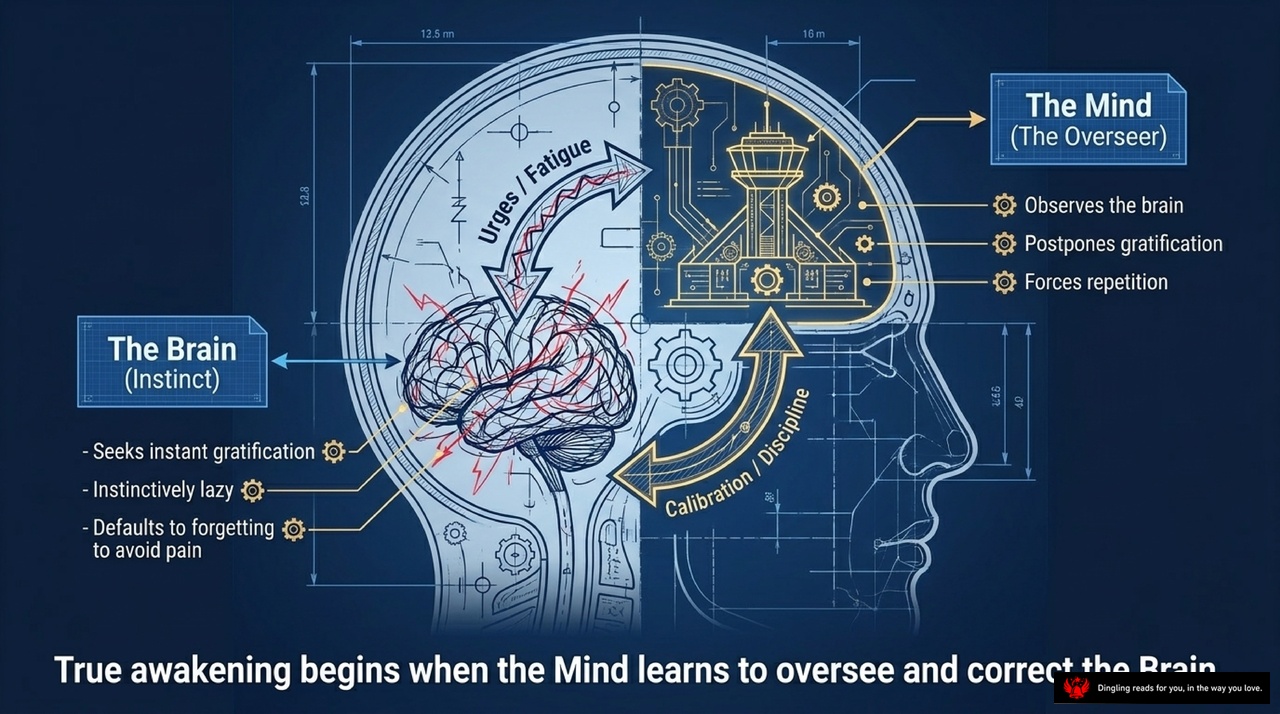
True awakening begins when the Mind learns to oversee and correct the Brain. Look at this blueprint of the human head. On the left, we see "The Brain," labeled as Instinct. It's the wild, chaotic part that seeks instant gratification, is instinctively lazy, and defaults to forgetting just to avoid pain. It's the part screaming with urges and fatigue, always looking for the easy way out.
But on the right, we have "The Mind," which acts as The Overseer. This is the control tower in your head. Its job is to observe the brain, postpone gratification, and force repetition. You see the arrows here? The Brain pushes for immediate pleasure, but the Mind pushes back with calibration and discipline.
Think about it: why do you feel so torn? Why do you study hard for an exam but then skip reviewing a single vocabulary word? That's your Instinct fighting your Overseer. True awakening doesn't happen when you try to suppress your brain. It happens the moment your Mind takes the wheel. It's the shift from being a slave to your impulses to becoming the master of your own life. When the Mind learns to correct the Brain, that's when you stop running on panic and start moving with purpose.
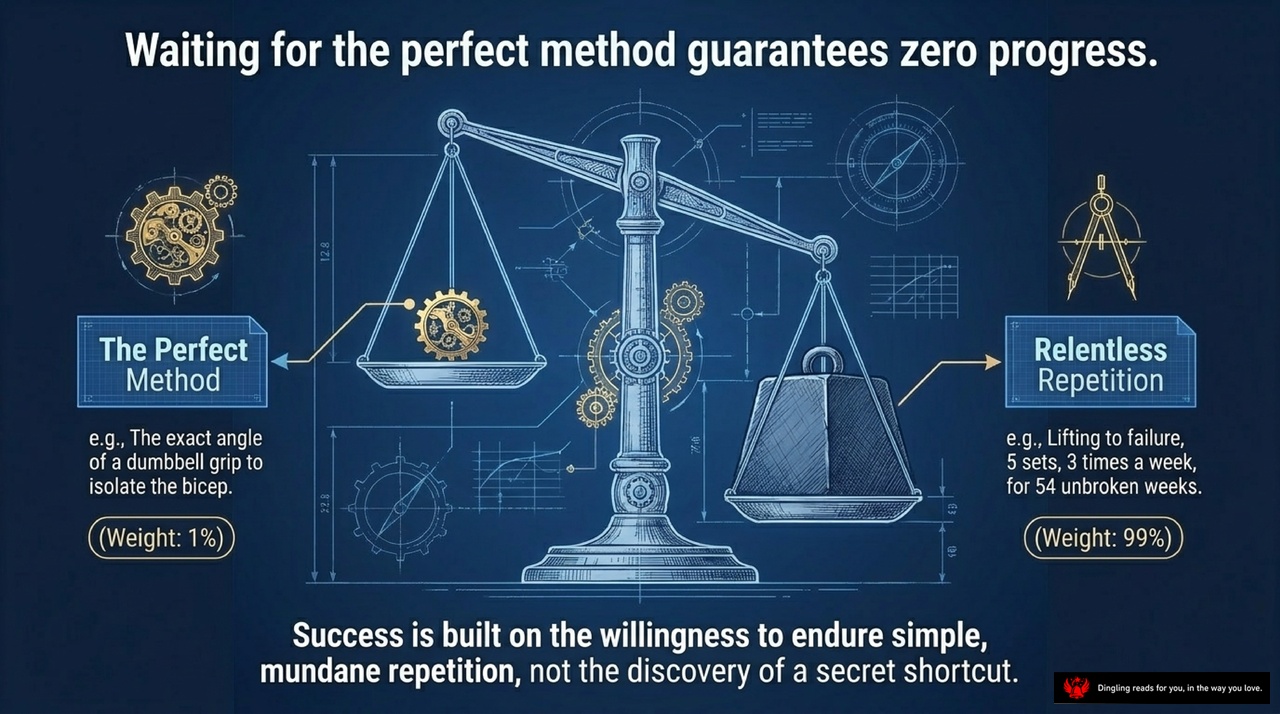
Wait for the perfect method, and you guarantee zero progress. Look at this scale: on one side, we have "The Perfect Method"—chasing the exact angle of a dumbbell grip to isolate a muscle. On the other, we have "Relentless Repetition"—lifting to failure, five sets, three times a week, for 54 unbroken weeks. The scale clearly tips to the right. Why? Because the weight of repetition is 99%, while the weight of finding the perfect method is only 1%.
Success isn't built on discovering a secret shortcut or finding the one right way to do everything. It is built on the willingness to endure simple, mundane repetition. Think about it: many students are willing to wake up early on weekends to attend crowded classes, yet they refuse to look up a single word in a dictionary when they get stuck. They want the result without the process. They fear the "time panic," believing that if they don't find the perfect method now, they'll fail later. But this fear is a trap.
As the text reminds us, there is no magic trick. The father who became an English department head without modern tools didn't find a secret formula; he just kept showing up day after day. The translator who started learning at 45 didn't rely on a clever technique; he relied on relentless practice. Just like building a thick arm, the key isn't the perfect grip on the dumbbell; it's the willingness to repeat the movement thousands of times.
Stop waiting for the perfect moment or the perfect plan. The truth is, waiting guarantees nothing but stagnation. Success belongs to those who are brave enough to do the boring work, to embrace the grind, and to trust that consistent, unglamorous repetition is the only real path to mastery. Don't let the illusion of the "perfect method" steal your time. Start repeating today.
Most people believe that success comes from finding the perfect shortcut or waiting for a sudden spark of inspiration. But the reality is far more grounded. True mastery isn't about skipping the hard work; it's about the willingness to do the boring, repetitive things that others avoid.
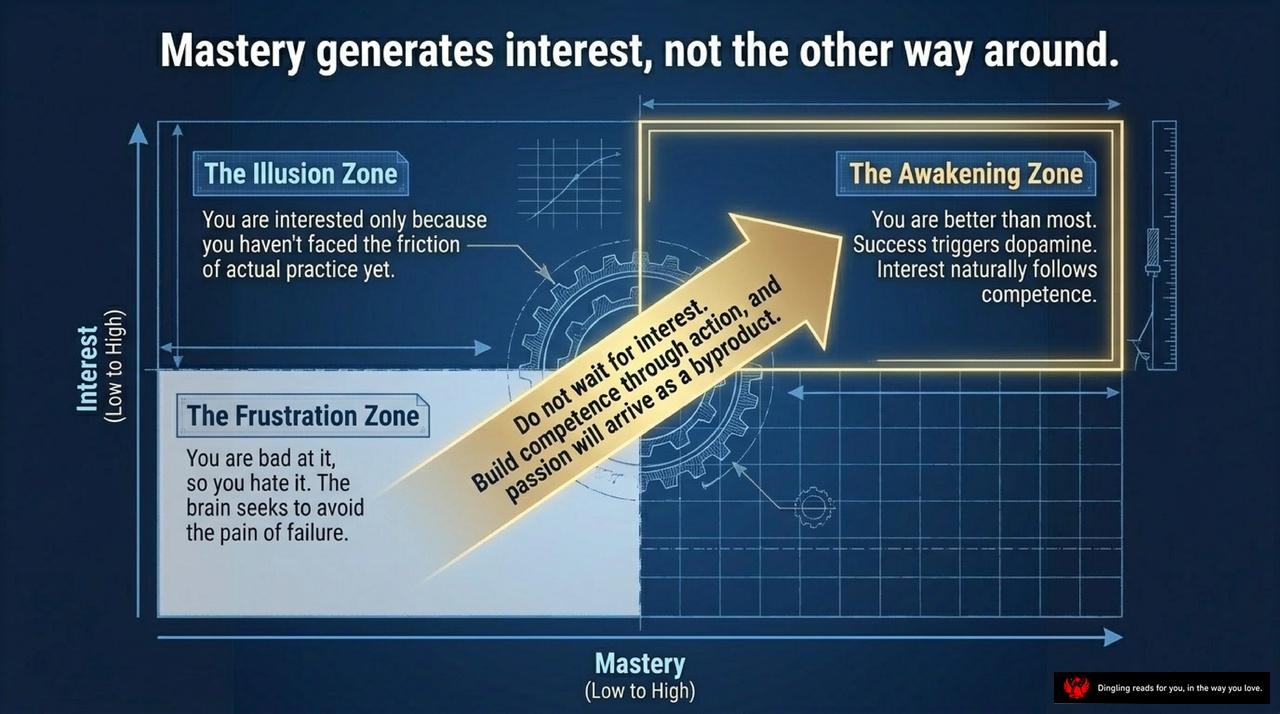
Look at this chart. It shows a powerful truth: **Mastery generates interest, not the other way around.**
Many of us start in **The Illusion Zone**. We feel interested only because we haven't faced the friction of actual practice yet. It's easy to be passionate when you haven't tried. But as soon as you hit **The Frustration Zone**, that interest vanishes. You're bad at it, so you hate it. Your brain seeks to avoid the pain of failure, and you quit. You think, "I just don't have the interest," but the real issue is that you haven't built the competence yet.
The key is to stop waiting for interest and start building competence. As the arrow in the diagram shows, you must build competence through action. Passion and interest will arrive as a byproduct.
Move into **The Awakening Zone**. This is where you are better than most. When you succeed, your brain triggers dopamine. That feeling of success naturally fuels your interest. You don't find the joy in learning; you find the joy in getting good at something.
So, do not wait for interest. Build competence through action, and passion will arrive as a byproduct.

The slide in front of us presents a powerful truth: the logic of avoiding learning is perfectly rational but entirely flawed. On the left, we see "The Ordinary Mindset." When we encounter new knowledge, our first instinct is to ask, "What is the immediate use?" If we can't guarantee an immediate return on investment, we refuse to invest time. We do this again and again, leading inevitably to stagnation. It feels smart because we are protecting ourselves from short-term risk, but it traps us in a cycle of zero growth.
Now, look at the right side: "The Awakened Mind." This is where the real shift happens. When we meet new knowledge, we accept a crucial reality: "I do not know the use yet." Instead of panicking, we choose to trust the accumulation of knowledge. We invest time and learn, even when the payoff isn't visible today. Why? Because years later, those dots will connect unexpectedly. Think about it: coding skills learned in 1984 might unlock the ability to write a statistical book in 2003. That is the power of compounding. The result isn't just progress; it's an exponential breakthrough.
The contrast is stark. The ordinary mind demands a receipt before spending; the awakened mind invests in the future without a guarantee. If you want to stop stagnating and start breaking through, you have to stop waiting for immediate utility and start trusting the invisible power of accumulation.

Most of us have that feeling where the clock seems to be running away from us, creating a panic that makes us do the exact opposite of what we need to do. We study harder than anyone, yet we skip the hard work, like memorizing words we should know or asking basic questions instead of figuring them out ourselves. Why does this happen? Because we are terrified that we don't have enough time.
But here is the hard truth: the problem isn't actually time. Time is the most fair thing in the world. Everyone gets exactly 24 hours, every single day, regardless of whether you are a billionaire or struggling to make ends meet. The gap between successful people and everyone else isn't that they have more hours; it's that they treat time like a friend, while we treat it like an enemy.
The real enemy is our own fear of the future. When we panic about "not having enough time," our brains get hijacked. We start looking for shortcuts, hoping to skip the boring parts and just grab the results. We want instant satisfaction, like getting a scholarship without doing the work. But this mental trap makes us inefficient. We end up busy but unproductive, spinning our wheels instead of moving forward.
The solution starts with a simple shift in perspective. Instead of fearing the deadline, you need to reframe your goals. Look at the picture on your screen: imagine that memorizing 20,000 GRE words isn't a painful chore. What if you calculated that those words are actually worth a $40,000 scholarship? Suddenly, every word you learn isn't just a task; it's a deposit of two dollars into your future bank account.
When you change your mindset this way, studying stops feeling like a burden and starts feeling like an investment. You stop rushing because you are afraid of running out of time, and you start working steadily because you are building something valuable. True mastery comes from patience and consistency, not from frantic last-minute sprints. So, stop fighting time. Start working with it, one word, one minute, one decision at a time.
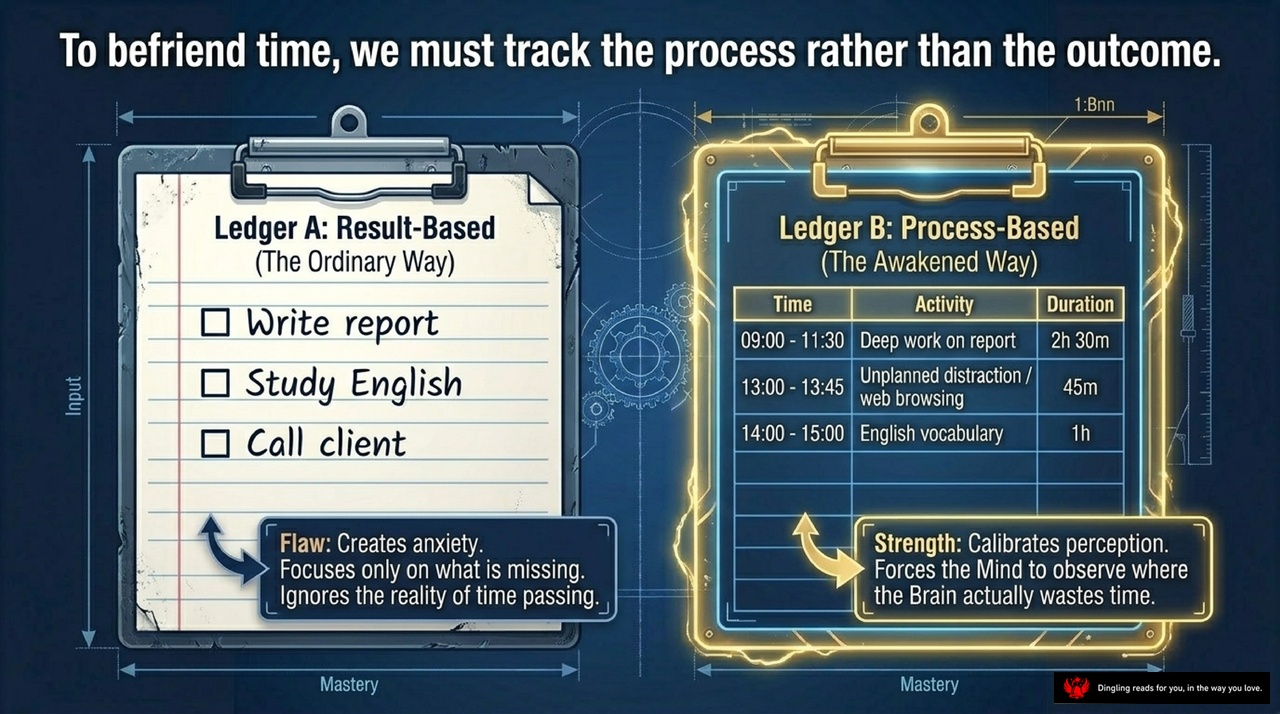
To truly befriend time, we must shift our focus from chasing outcomes to tracking the process itself. Look at these two ledgers: Ledger A represents the ordinary way, where we obsess over checklists like "write a report" or "study English." This result-based approach creates anxiety because it only highlights what is missing, ignoring the reality of how time actually passes. It keeps us trapped in a cycle of frantic activity without real progress.
In contrast, Ledger B shows the awakened way—a process-based mindset. Instead of just ticking boxes, we log the actual time spent on activities: two hours and thirty minutes of deep work, forty-five minutes of unplanned distraction, or one hour of vocabulary practice. This simple shift calibrates our perception. It forces our brains to observe exactly where we waste time, turning abstract anxiety into concrete data. By focusing on the process rather than the outcome, we stop fighting time and start working with it, transforming every minute into a deliberate step toward mastery.
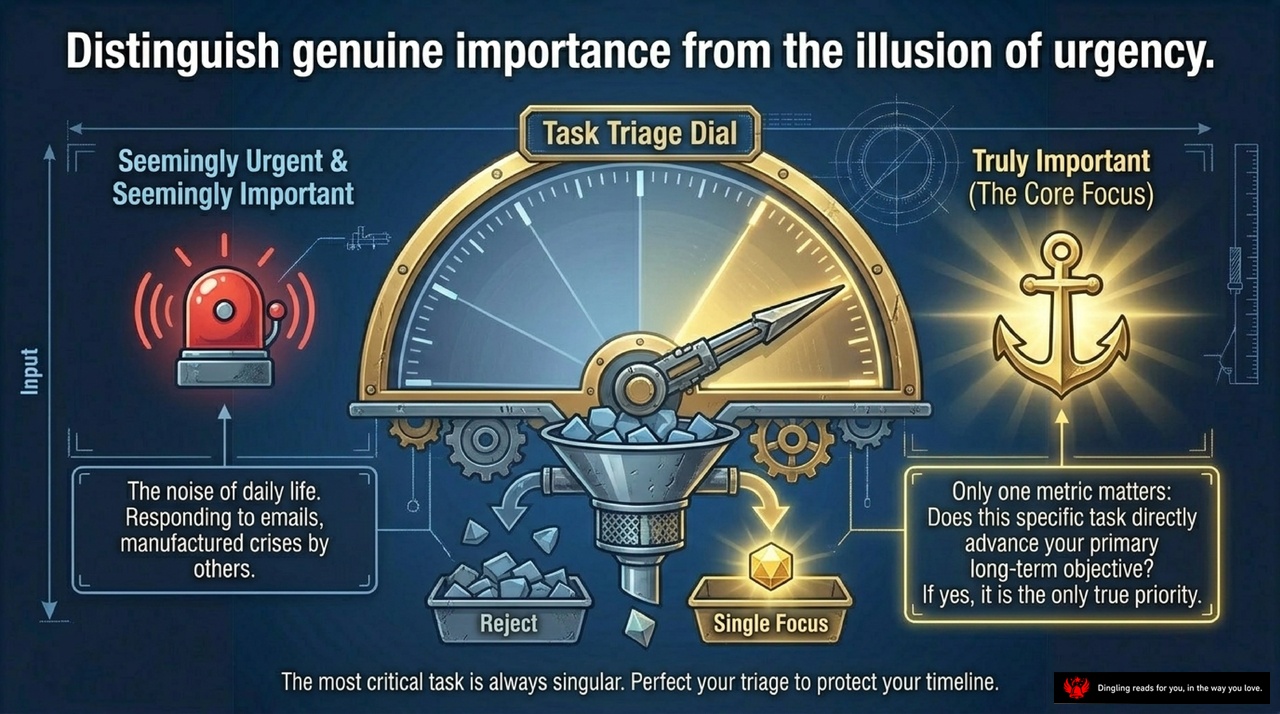
Distinguish genuine importance from the illusion of urgency. Look at this "Task Triage Dial." On the left, you see a red alarm blaring—that's the noise of daily life: responding to emails, reacting to manufactured crises. It feels urgent and important, but often, it's just distraction.
On the right, there is a glowing anchor labeled "Truly Important." This is your core focus. The question isn't whether a task is busy or exciting; the only metric that matters is this: Does this specific task directly advance your primary long-term objective? If the answer is yes, it is the only true priority.
Everything in between gets filtered through this dial. Most of those "urgent" demands get rejected, while the one critical task that moves the needle goes into your "Single Focus" box. Remember, the most critical task is always singular. Perfect your triage to protect your timeline. Don't let the illusion of urgency steal your time from what actually matters.
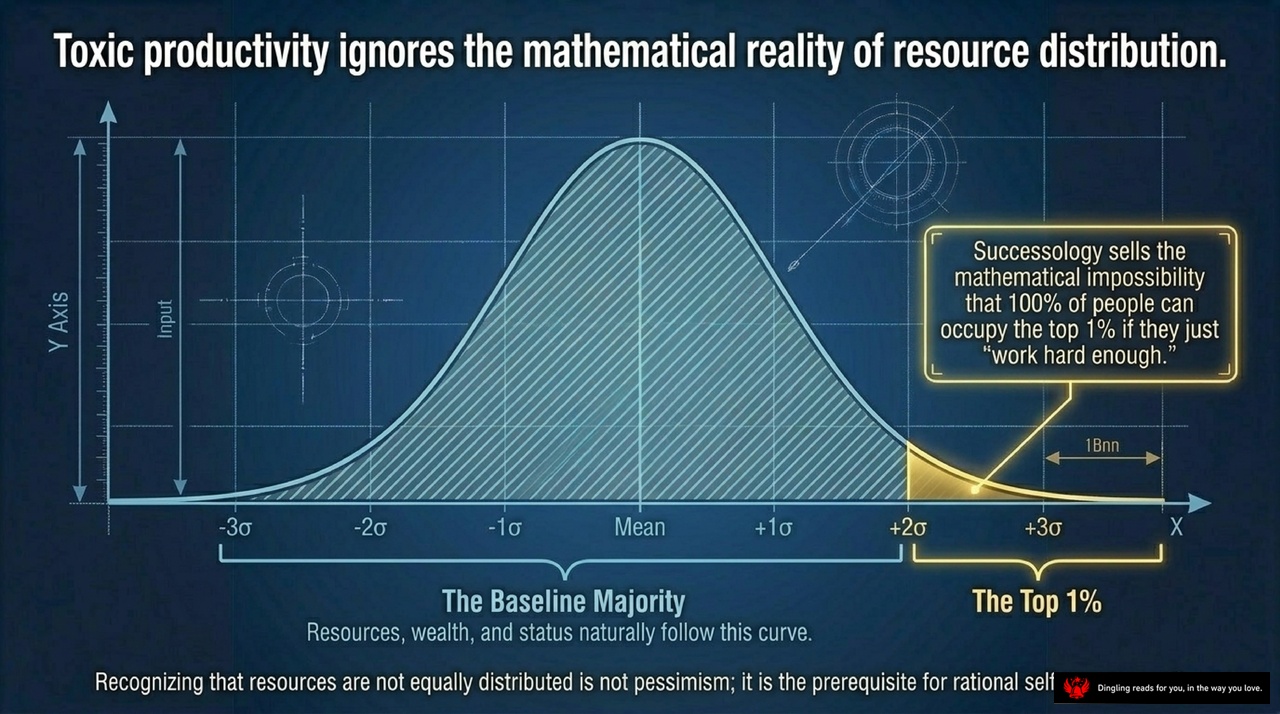
Toxic productivity often tricks us into believing that anyone can reach the top 1% simply by working harder. But this slide exposes the mathematical reality that successology ignores: resources, wealth, and status naturally follow a bell curve, not a straight line. As the chart shows, the vast majority of us—the baseline majority—will always occupy the middle ground between -3σ and +2σ. It is mathematically impossible for 100% of people to occupy that top 1% slice, no matter how much effort we pour in.
The text warns that successology sells this mathematical impossibility, claiming that if we just "work hard enough," we can all be outliers. This is a dangerous lie that fuels anxiety and burnout. Recognizing that resources are not equally distributed is not pessimism; it is the prerequisite for rational self-management. Accepting that you might not be in the top 1% frees you from the toxic pressure to force an unnatural outcome. Instead of fighting the curve, you can focus on optimizing your position within your own reality. True rationality begins when you stop chasing an impossible statistical anomaly and start building a meaningful life within the natural distribution of resources.
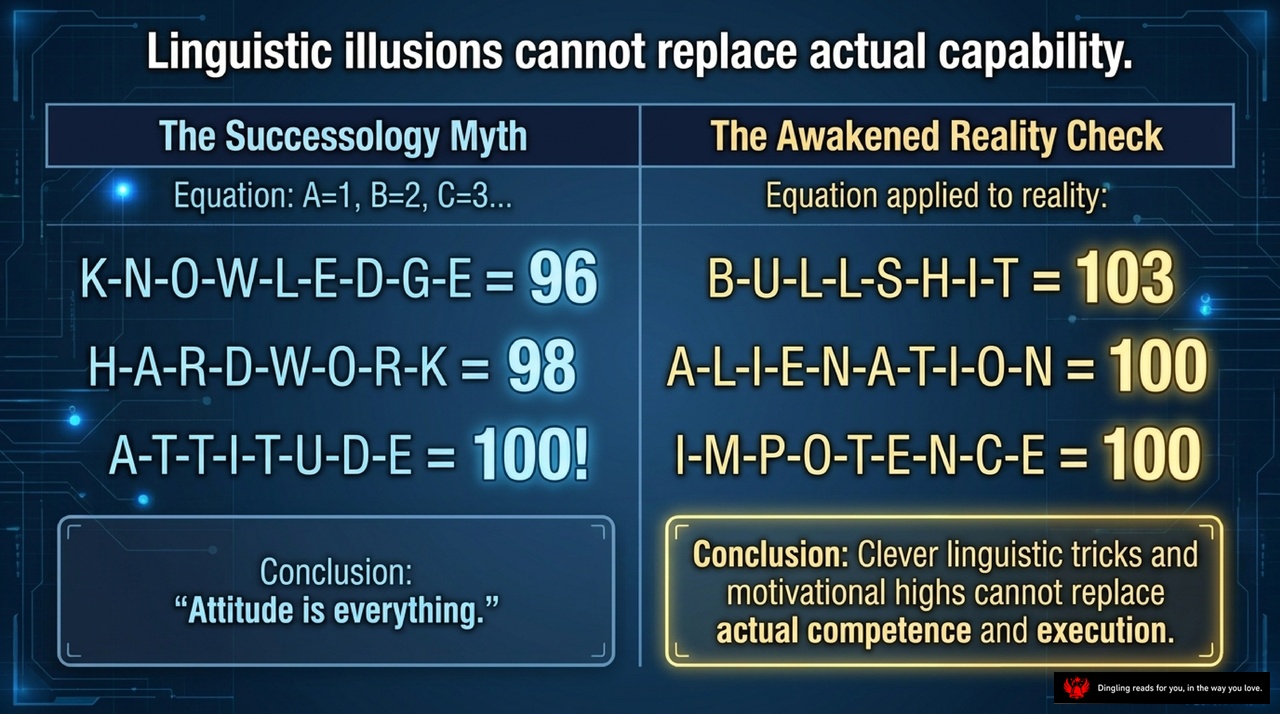
Linguistic illusions cannot replace actual capability. Look at the slide in front of us. On the left, we see "The Successology Myth," a classic trick where letters are assigned numerical values to prove that "Attitude" equals 100. It suggests that if you just have the right mindset, knowledge, hard work, or even alienation, you can magically achieve perfection. It's a seductive promise: that clever wordplay and motivational slogans are enough to build a successful life.
But let's look at the right side, where we apply this equation to reality. Suddenly, the numbers shift. "Bullshit" adds up to 103. "Alienation" totals exactly 100. Even "Impotence" scores a perfect 100. The math hasn't changed, but the results have revealed a harsh truth: these linguistic tricks are meaningless. You can construct a sentence that sounds like success, but it cannot create actual competence.
This is the core problem with "successology." It relies on cognitive illusions rather than tangible skills. It tells us that attitude is everything, but it ignores the brutal reality of execution. No amount of positive thinking can replace the need to actually do the work. No amount of motivational high can fix a lack of fundamental ability. The slide's conclusion is clear: clever linguistic tricks and motivational highs cannot replace actual competence and execution. In the real world, your value is determined by what you can actually do, not by how well you can spell out your potential.
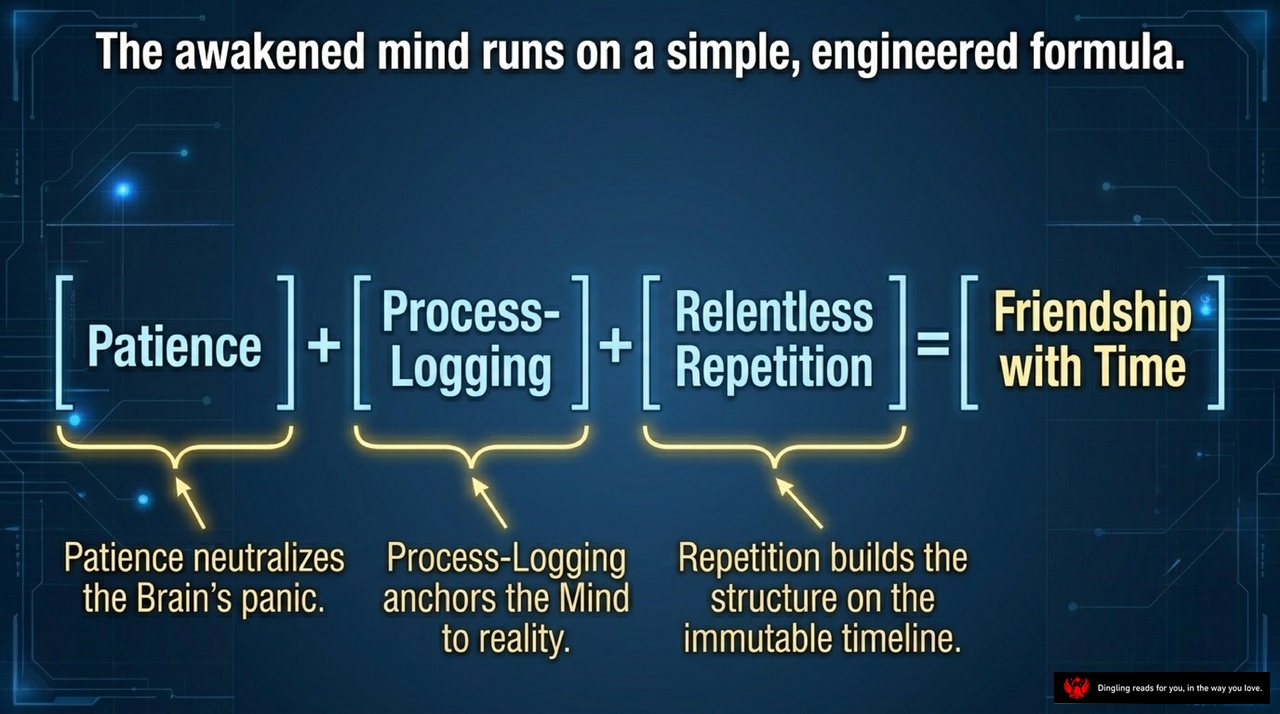
So, here is the secret formula that the awakened mind actually runs on. It's not magic; it's simple engineering. Look at the equation right in front of you: Patience plus Process-Logging plus Relentless Repetition equals Friendship with Time.
Let's break down these three ingredients. First, Patience. This isn't just about waiting; it's about neutralizing that panic in your brain. When you stop fighting the inevitable flow of time, you stop spiraling into anxiety. You become calm enough to actually work.
Next, Process-Logging. This is your anchor to reality. By recording exactly what you do and how long it takes, you stop guessing and start knowing. You move from being a slave to your vague feelings about time to a master who understands the data.
Finally, Relentless Repetition. This is the builder. It's the structure you lay down on the immutable timeline of your life. Repetition turns random actions into solid skills and habits.
When you combine these three—calmness, awareness, and consistent practice—you don't just manage time anymore. You build a genuine friendship with it. Time stops being your enemy, rushing you toward a deadline, and becomes your most loyal ally, working quietly in the background to build the life you actually want.

Time is an immutable force. It cannot be negotiated with, managed, or saved. We can only upgrade our own cognitive operating system, abandon the illusions of shortcuts, and patiently accumulate mastery through simple, relentless repetition.
Think about it: Time will pass exactly the same whether you spend it panicking over a shortcut or quietly building your competence. The clock doesn't care about your anxiety or your excuses. It ticks forward at a constant rate for everyone.
So, when the years finally run out, will time have been your warden, or your closest friend? The answer depends entirely on how you choose to live in the present. If you keep chasing quick fixes and fearing the unknown, time becomes your jailer, trapping you in a cycle of regret. But if you embrace the long game, invest in your mindset, and commit to the boring, repetitive work that actually builds skill, time transforms into your greatest ally. It rewards the patient, the consistent, and the brave enough to let go of the need for instant results. Your future isn't written by the days you waste; it's built by the ones you use wisely.